Posts tagged ‘Sothebys’

October 25, 2026

Behind the Scenes of the Year of the Dealer 16 – R.A. Lee at Temple Newsam

Our next in the series ‘Behind the Scenes of the Year of the Dealer’ returns to Temple Newsam and the film that focuses on the antique dealer R.A. Lee – you can see the final version of the film HERE.

For this ‘Behind the Scenes’ we can recount a fascinating story about Ronald A. Lee, as told to us by his daughter Georgina Gough. You can also hear Georgina in the YoD films telling us about her father and the R.A. Lee business, both in the Temple Newsam film of course, and in the other YoD film devoted to R.A. Lee at the V&A South Kensington. We also did an oral history interview with Georgina as part of the Voices of the Trade strand of the research project – you can read more about that HERE.

Georgina Gough. Photograph courtesy of Georgina Gough, 2015.

Georgina’s story is related to another object that Ronald Lee sold to a museum, this time a ’13th century Ciborium’ sold to The National Museum of Scotland in Edinburgh by R.A. Lee in 1966. As some of our readers will know, originally there were to be 7 YoD trails, before Covid 19 intervened, and The National Museum of Scotland was initially part of the larger group of museums we had planned for the YoD trails. In fact, as well as the five existing YoD partner museums (Temple Newsam, Lady Lever Art Gallery, The Bowes Museum, V&A Museum and Preston Park Museum), we had also included The Ashmolean Museum as part of the YoD, but for various reasons, all arising from the Covid pandemic, we could no longer include The Ashmolean Museum and National Museum of Scotland. The YoD was an awful lot of work, so maybe creating films of another 20 objects in another 2 museums would have been a bit of a stretch; but Ronald Lee’s Ciborium would certainly have been part of the YoD films at National Museum of Scotland had they gone ahead.

Anyway, Georgina’s story about her father does help us highlight yet another example of the relationship between antique dealers and public museums and recounts a lovely story about her father, Ronald Lee and his wife Betty. As Georgina recalls, Ronald bought his wife Betty a present, a small pierced 13th century copper-gilt circular foot, seemingly from the base of a cup or a bowl – Ronald gave Betty this small part-object sometime in the 1950s (see below). Ronald paid £30 for the 13th Century circular foot, and Georgina recalls that Betty placed the small object on the mantlepiece at home – which at that date would have been Ormeley Lodge on Ham Common to the south west of London.
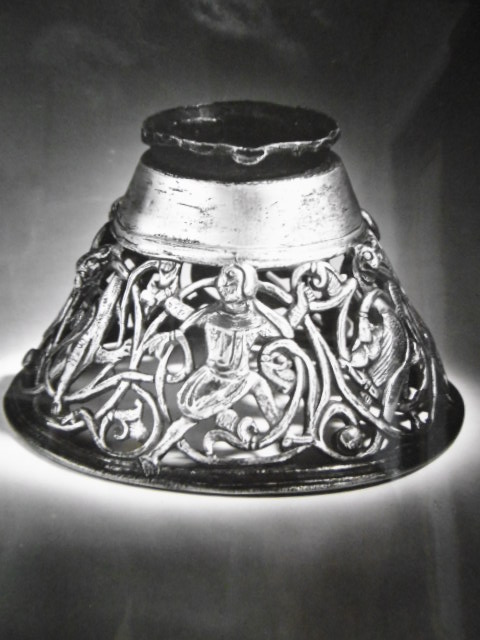
13th century Cooper-gilt circular foot that Ronald Lee gave to his wife Betty. Photograph, Antique Dealer Research Project, University of Leeds.

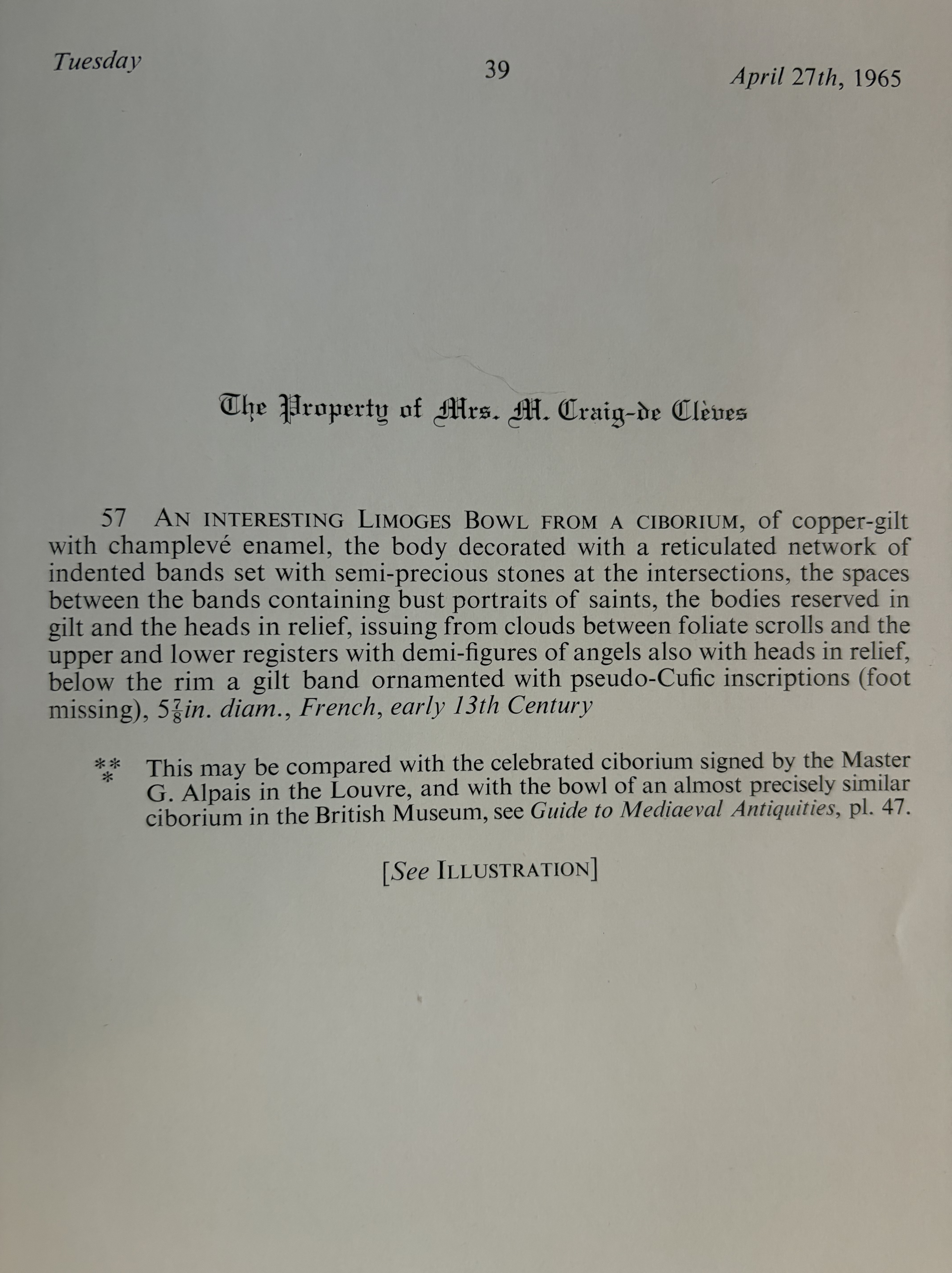
In late April 1965, Ronald went, as usual, to a view an auction sale at Sotheby’s in New Bond Street – ‘Highly Important Medieval Works of Art, Limoges Painted Enamels and a St. Porchaire Salt’ (Sale Tuesday 27th April 1965). Amongst the things he saw was Lot 57, ‘AN INTERESTING LIMOGES BOWL FROM A CIBORIUM, of copper-gilt with champleve enamel…..(foot missing)…French, early 13th Century’, The Property of Mrs. M. Craig-de Cleves’. (see below).
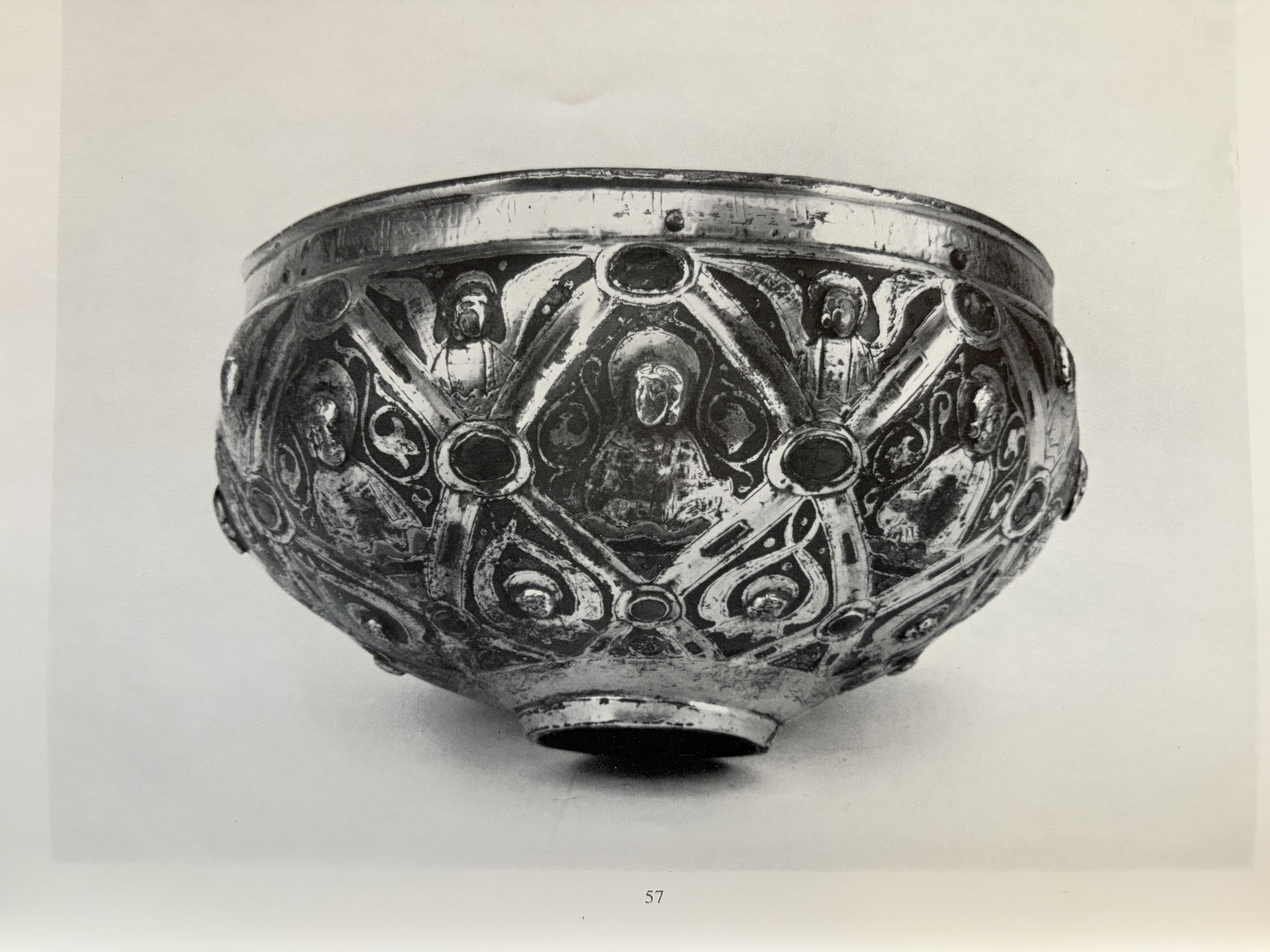
13th Century Ciborium Bowl. Sotheby’s auction sale April 27th 1965, Lot 57. Photograph Sotheby’s.
Auction catalogue entry for the 13th Century Ciborium Bowl, Sotheby’s Lot 57, auction sale 27th April 1965.

Like many antique dealers, Ronald seems to have had a form of photographic memory and he recalled the small copper-gilt foot on the mantlepiece at home. Georgina remembers the story, which was also reported in the Press at the time – her father rushed home, popped the circular foot in his pocket and returned to Sotheby’s where he surreptitiously offered the foot to the bowl – and like Cinderella’s slipper if fitted perfectly!

Ronald bought the bowl, paying £2,600 for it at the auction. The newspaper report quoted Ronald – ‘he supposed it would still have to belong to his wife, but if any museum was really anxious to have it, they might be willing to let it go’. Georgina does not recall how such a conversation went, but Ronald offered the bowl, now with its foot, in a selling Exhibition of Works of Art and Antiques held at his home/shop at Byfleet Manor in Surrey in June 1965, where it was fully described, and was one of only 3 full colour images in the catalogue (see below).
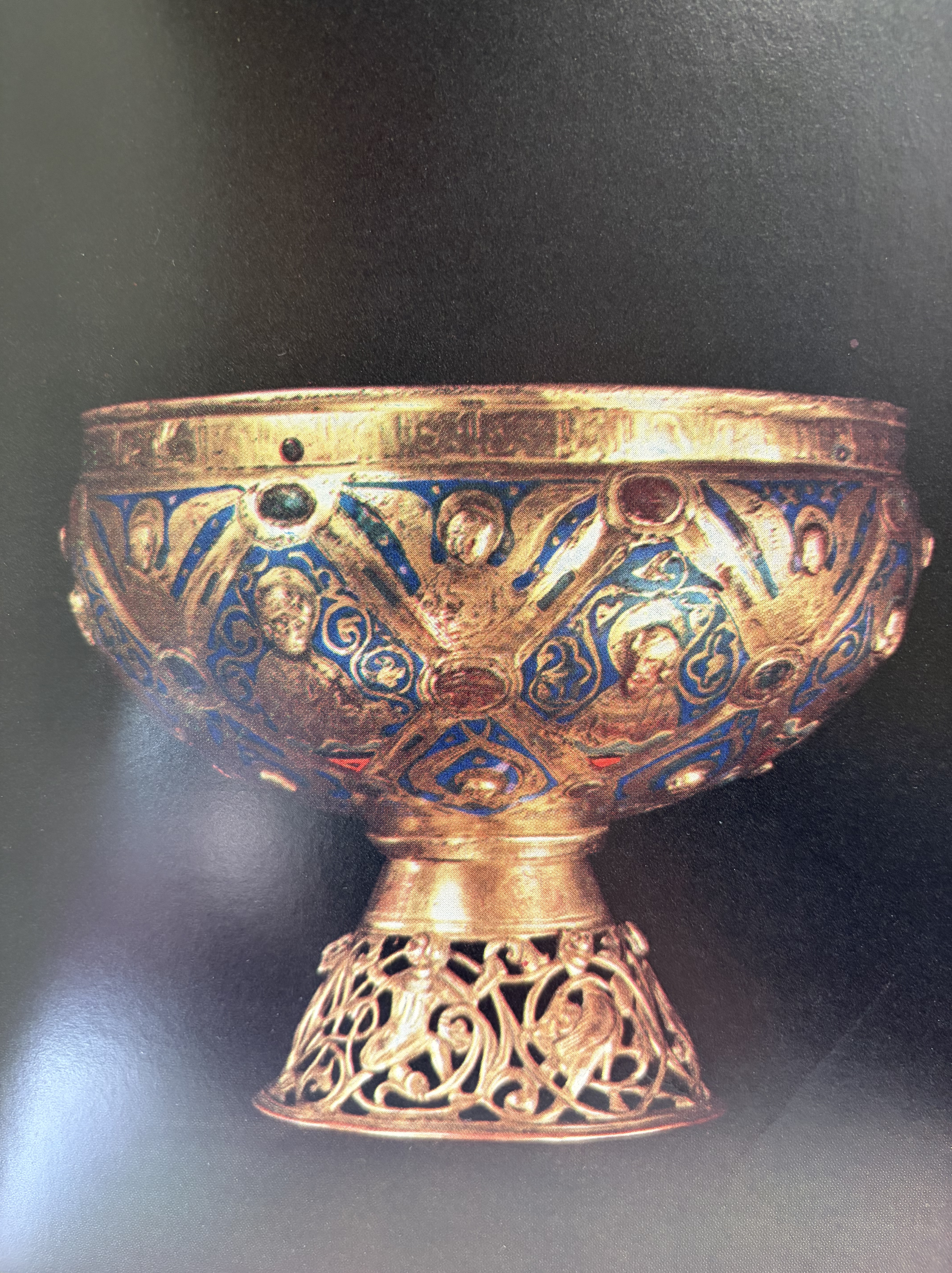
13th Century Limoges Ciborium illustrated in the R.A. Lee Exhibition of Works of Art and Antiques, June 1965. Photograph, Antique Dealer Research Project, University of Leeds.

Of course R. A. Lee did sell the Ciborium Bowl with its foot – it was sold in August 1966 to the National Museum of Scotland for £8,500. It remains in their collection – see HERE.
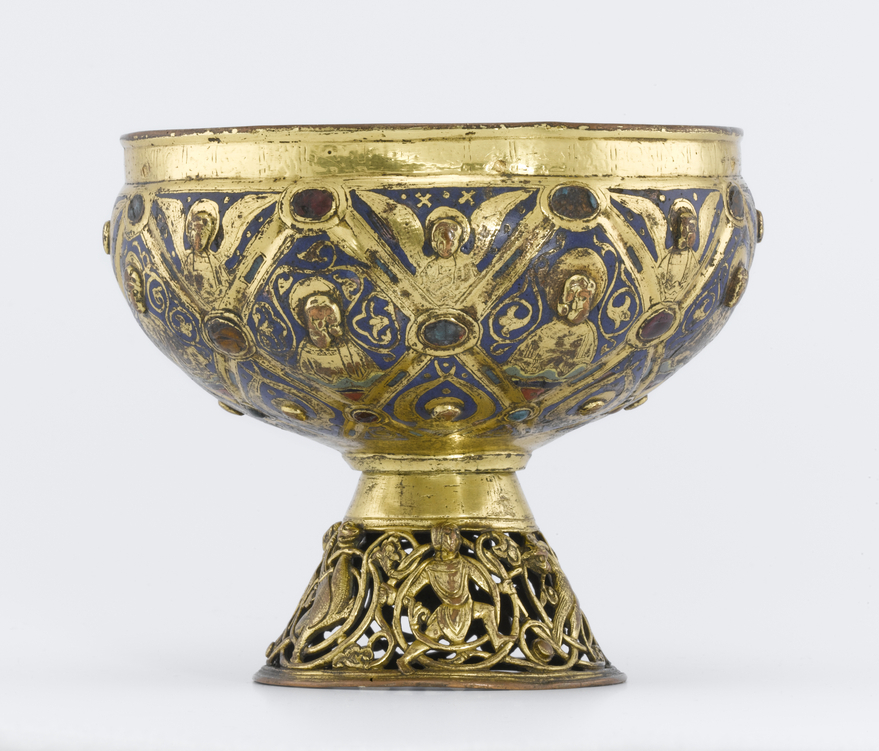
Ciborium, French, probably 19th century. National Museums Scotland. Acquired with contributions from Friends of the Royal Scottish Museum, The Railton Bequest and HM Treasury, 1966. Photograph, copyright NMS.

Perhaps the sad part of the story is not that Ronald sold his wife’s present (Betty must have agreed), but that the Ciborium has subsequently been reassessed and is now thought to be a 19th century copy. Notwithstanding this, Ronald Lee’s reuniting the foot to the bowl is such a brilliant story and one we would have told had we managed to include National Museum of Scotland in the YoD digital trails!

[I am reminded that we’ve highlighted the story about R A Lee and the ciborium before…in the blog in July 2017 but it’s such a lovely story!….and was nearly 10 years ago!….but do read the earlier version too!]

Do look out for the next in the series of ‘Behind the Scenes of the Year of the Dealer’.

Mark
May 16, 2026

A late 19th century Antique Dealer – W. D. Cutter

The history of antique dealing is littered with fascinating ephemera – dealer catalogues, invoices, letters, drawings and sketches, stock books, sales books and photograph albums. Some of the most interesting survivals are auction sale catalogues, often generated when a dealer makes changes to a business (sales of surplus stock when moving to different premises for example), or when a dealer retires, or dies. One such catalogue recently joined the collection of antique dealer ephemera that are such important resources for the antique dealer research project.

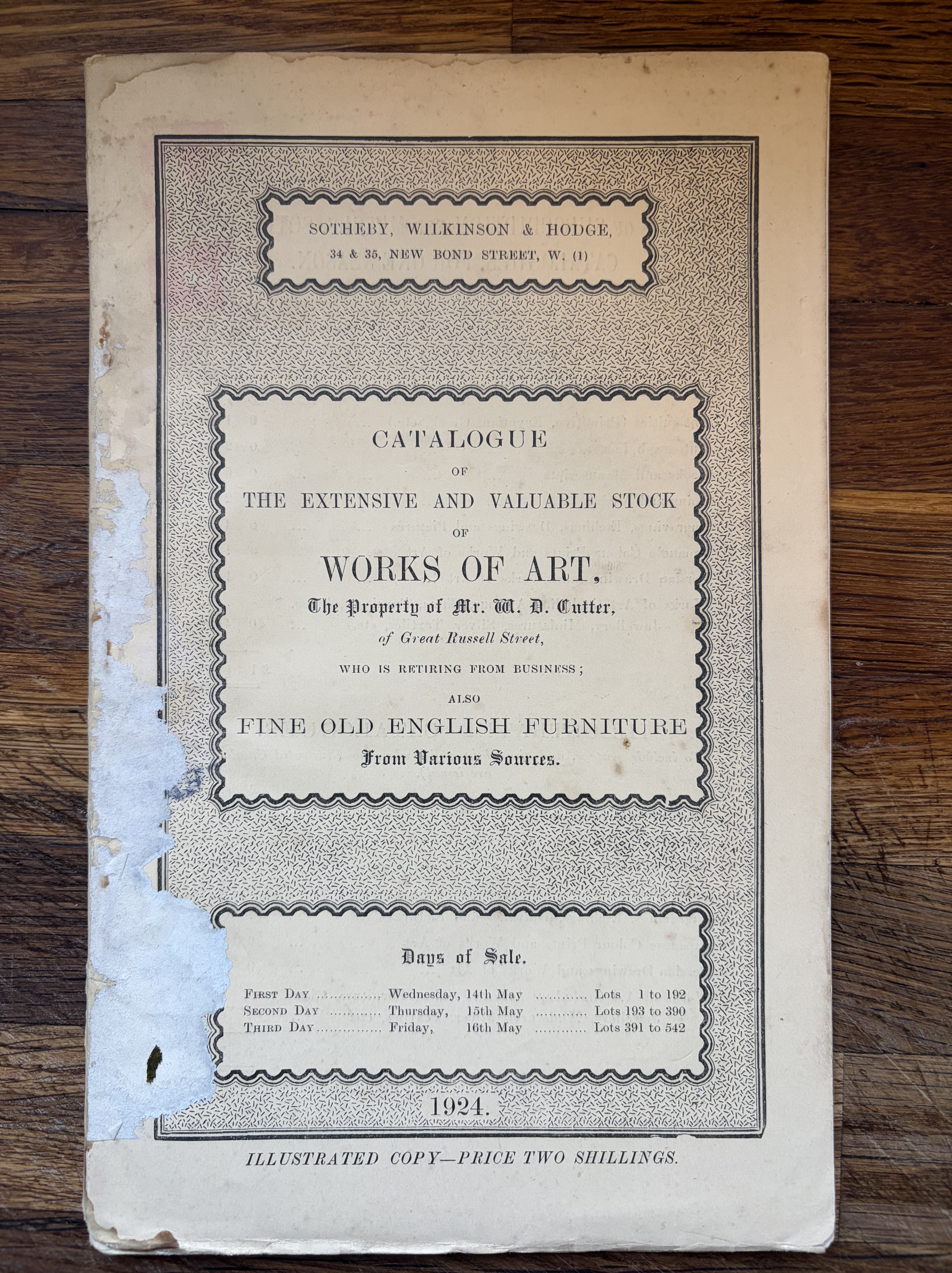
The catalogue presents ‘The Extensive and Valuable Stock of Works of Art, the property of Mr W.D. Cutter of Great Russell Street, who is retiring from business’ which was was sold over 3 days, 14th -16th May 1924. It gives us a unique insight into the remaining trading stock of an important and well-known (in the late 19th century at least) antique dealer.

Catalogue of the auction sale of the stock of W.D. Cutter; Sotheby, Wilkinson & Hodge, London 1924. Image, Antique Dealer Research Project, University of Leeds.

William Doherty Cutter (c.1848-1929) traded as ‘antique furniture dealer and curiosity dealer’ at 36 Great Russell Street, London in the 1870s, but the business can be traced back to as early as the 1860s, started by William’s father William George Cutter, a ‘picture dealer’ in St. James’s in London – William George Cutter was described as a ‘naturalist’ in the 1871 Census. Cutter’s were well known as suppliers of ‘curiosities’ of natural history and ethnography to the British Museum from the late 1860s to c.1900 – their shop was very close to the British Museum in Great Russell Street. Cutter is mentioned in Provenance: Twelve collectors of ethnographic art in England 1760-1990′ edited by H. Waterfield and J.C.H. King (2006), as well as having a short entry in my Biographical Dictionary of 19th century Antique and Curiosity Dealers (2009). Cutter’s appear to have been a very important antique dealers, now little known of course; they were active at the famous Hamilton Palace auction sale in 1882, buying a small number of Lots, including ‘a large cameo, with three heads in profile’ (Lot 2166) for £7.0.0. William George Cutter’s daughter, Eva A. Cutter (born c.1860) also traded as a dealer in natural history specimens and ethnographic artefacts, selling several objects to the British Museum in the late 1890s. Both of W.D. Cutter’s daughters, Marjorie Doherty (born c.1896) and Eva (born c.1890) also worked for their father in his antique dealing business.

What’s fascinating about the auction catalogue of Cutter’s stock is the sheer range and quality of the antiques he held in stock in 1924. This extends far beyond the natural history and ethnographic specimens that Cutter’s are said to have supplied to the British Museum in the second half of the 19th century. The auction sale had 499 Lots of Cutter’s stock, which ranged from bronzes, ivories, Chinese and European porcelain, silver, clocks, marble and terracotta sculptures, Chinese hardstone carvings and cloisonne, as well as some antique furniture, an array of objet d’art and a small number of paintings.

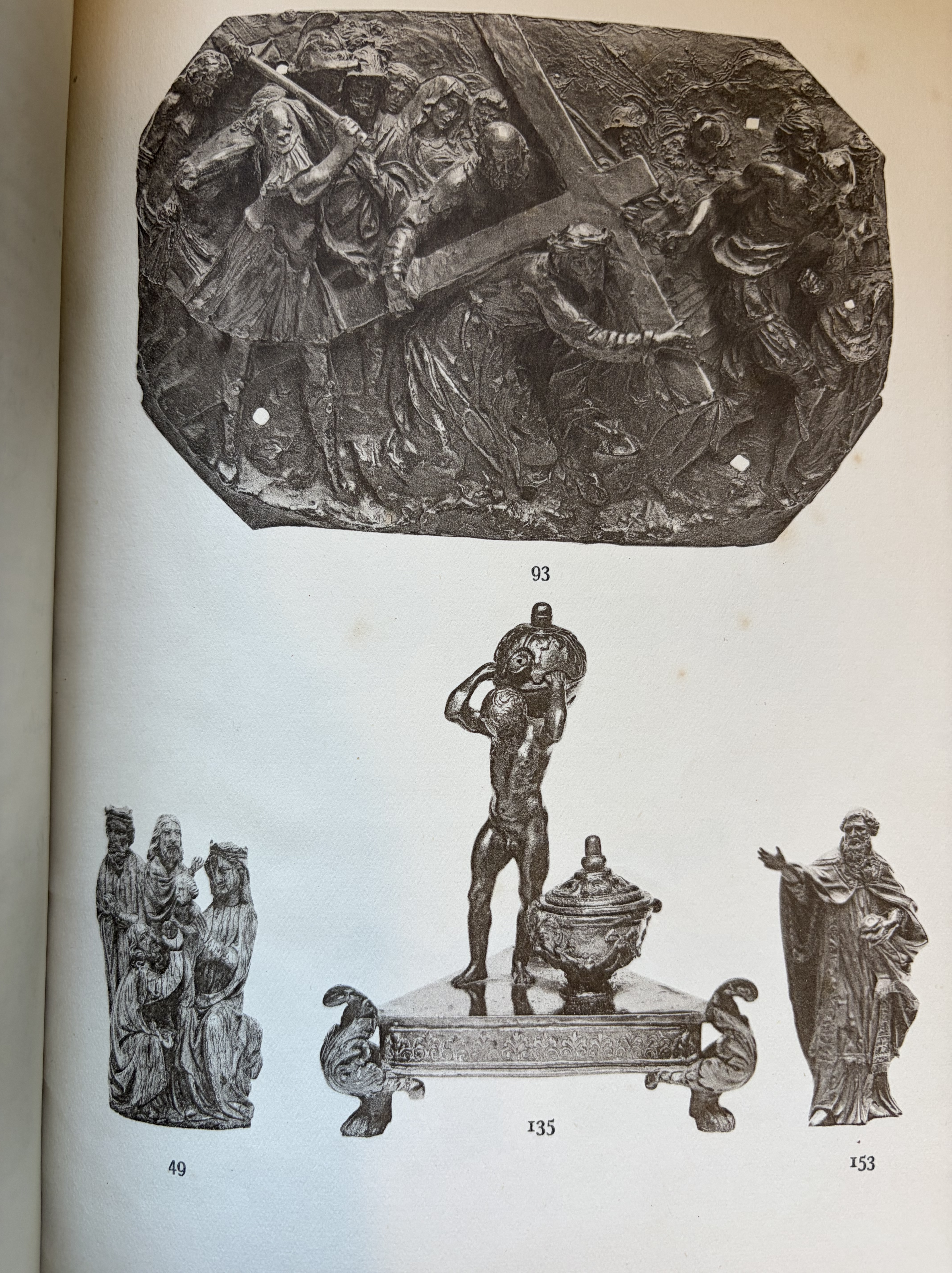
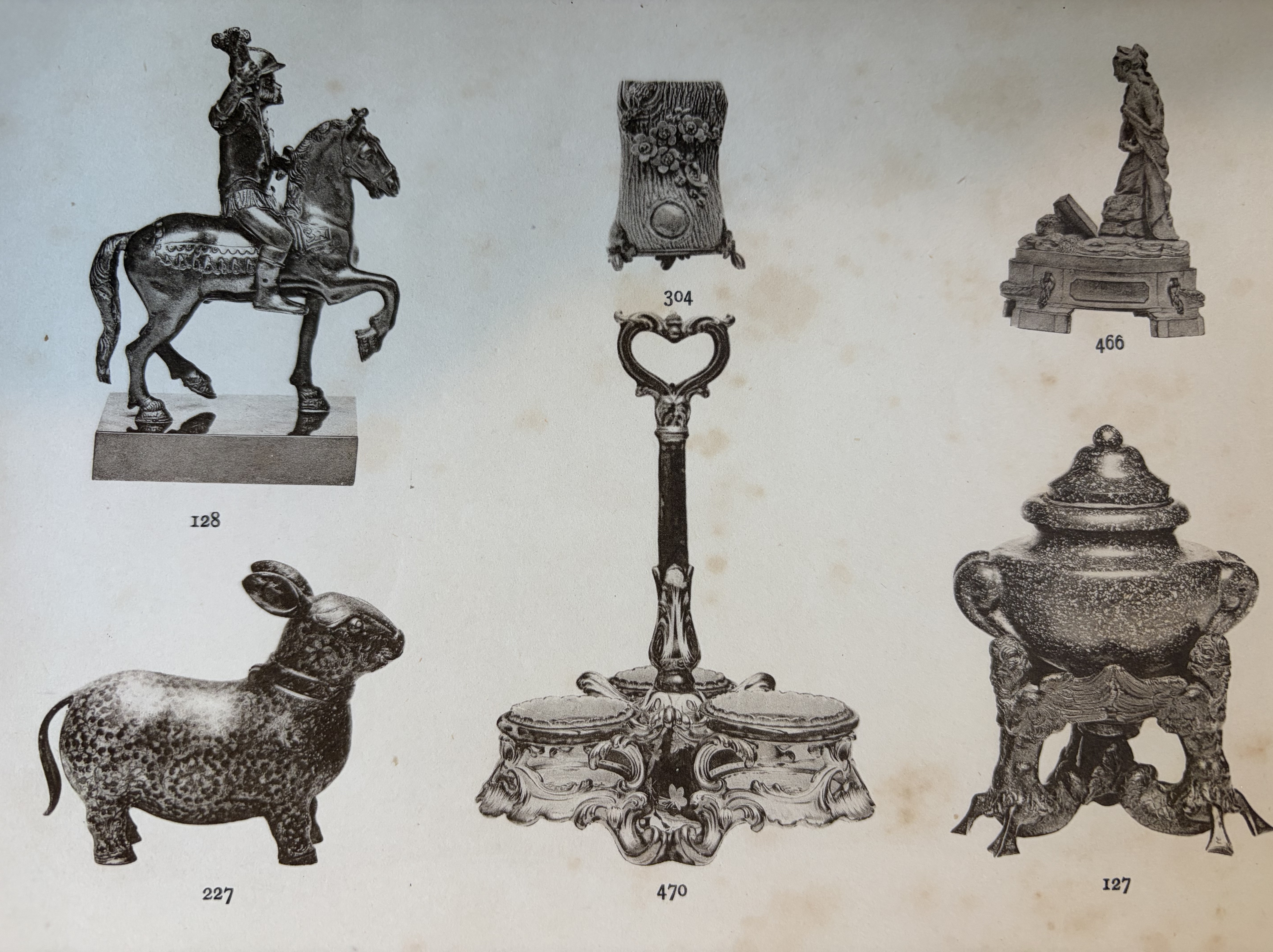
This range of ‘antiques’ is typical of late 19th and early 20th century collecting interests of course, but Cutter seems to have also been something of a specialist in Renaissance bronzes. Lot 135, for example, ‘A FINE INKSTAND, of the school of Riccio…’ (see below, centre – Andrea Briosco, called Riccio, (1470-1532)). The bronze inkstand was sold to ‘Kerin’ for £30 (equivalent to about £13,630, as ‘income value’, according to Measuringworth.com.) Gerald Kerin formed a partnership with the dealer Alfred Spero in 1928 – both Kerin and Spero were dealers based in London specialising in Renaissance bronzes and bought heavily at the Cutter auction sale.

Lot 49 (see below bottom left) ‘A VERY FINE 15th CENTURY IVORY GROUP of ‘The Adoration of the Magi 6 1/2 in.’ was bought by the dealer ‘Garabed’ for £7 & 10 shillings (equivalent to about £3,400). A. Garabed was well-known dealer trading at Pall Mall Safety Deposit, Carlton Street, London at the time. And Lot 153, ‘A VERY FINE FIGURE OF A POPE, in pear-wood, coloured to imitate bronze, full-length in vestments, standing with right arm raised, 6 7/8 in.’,(below bottom right) sold to the dealer ‘Lewis’ for £3 & 10 shillings (equivalent to about £1,590). Lewis could be any number of antique dealers of the Lewis family in the 1920s.

Auction catalogue of the W.D. Cutter sale, May 1924. Photograph, Antique Dealer Research Project, University of Leeds.

Lot 93,(see above, top middle) ‘A FINE 16th CENTURY PLAQUE of Christ bearing the Cross, a ”cire perdu” casting, with figures in very high relief (up to 1 1/2 in.), oblong, octagonal, 9 1/2 in. by 6 1/2 in.’, was sold to Alfred Spero for £40 (equivalent to £18,170) – the most expensive object sold at the Cutter auction. Alfred Spero was trading from a shop at 33 King Street, St. James’s in London in the 1920s, right next to Christie’s auction rooms.

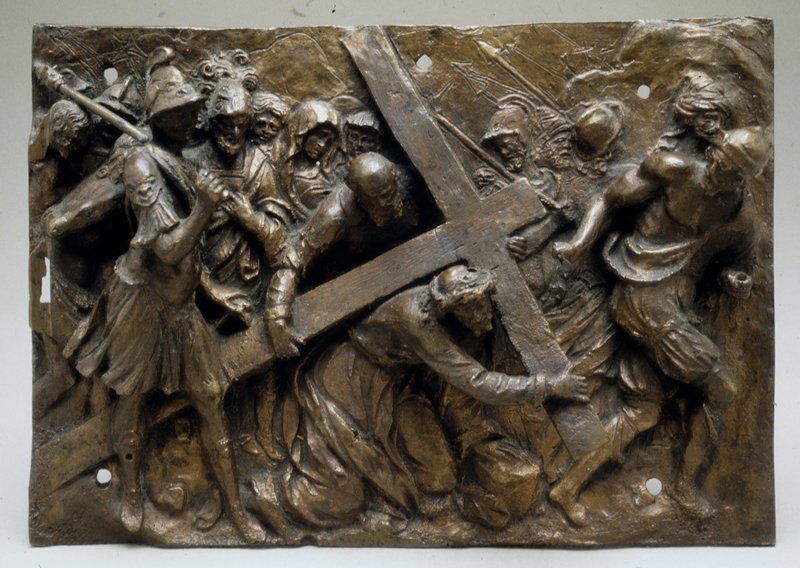
The bronze shown in Cutter’s stock is a well-known casting, previously attributed to Ferdinando Tacca (1619-1686), but is now said to be by Francesco Fanelli (1608-1661). There are three known versions of bronze, in different shapes and sizes, in museum collections in the USA. One version, rectangular in shape, in the collections of The Minneapolis Institute of Art (see below).

Francesco Fanelli (1608-1661), Christ bearing the cross, mid-17th century. Minneapolis Institute of Art, USA, (66.43.1) The Christina N and Swan J. Turnblad Memorial Fund. Image Minneapolis Institute of Art.

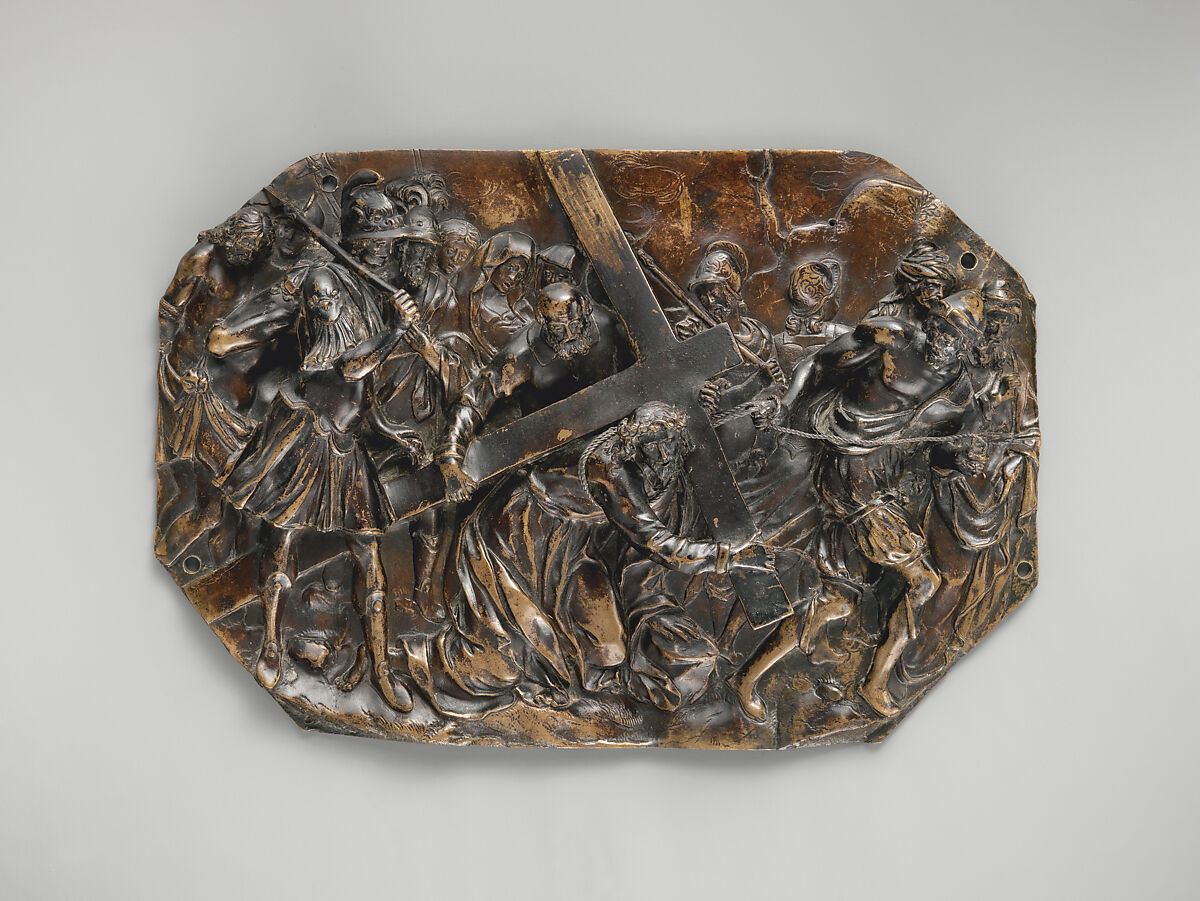
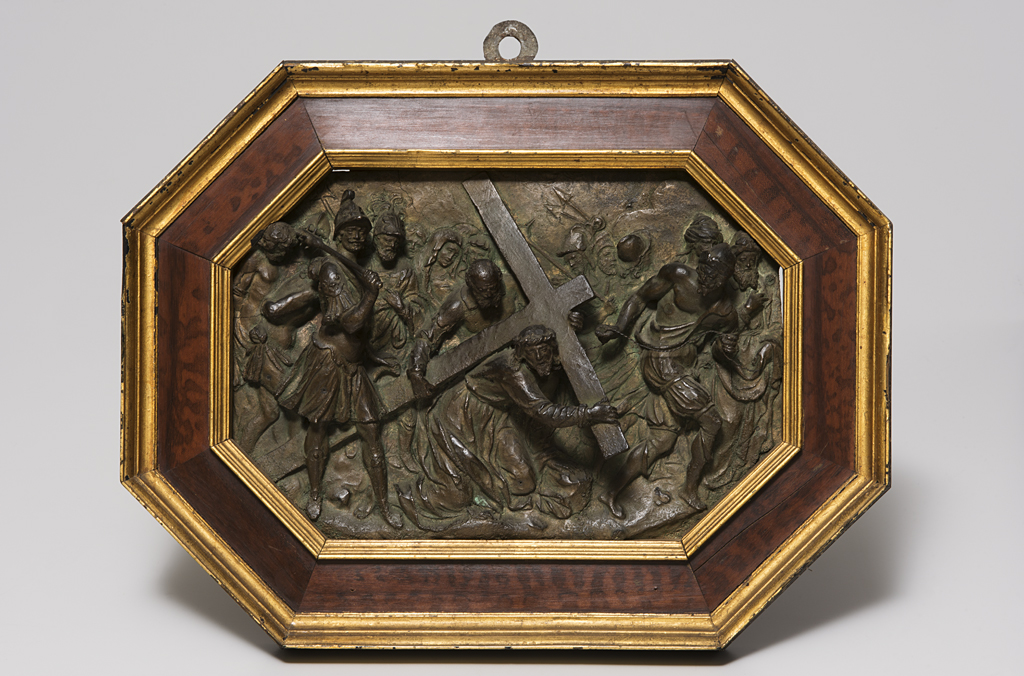
Two other versions are octagonal in shape, the same as the example in the Cutter auction. These are in the collections at The Metropolitan Museum of Art in New York and at the Spencer Museum of Art, Kansas, USA (see below).

Francesco Fanelli (1608-1661), Christ bearing the Cross, mid-17th century. Metropolitan Museum of Art, New York, USA. Image, Metropolitan Museum of Art, New York.
Francesco Fanelli (1608-1661), Christ bearing the Cross, mid 1600s. Spencer Museum of Art, Kansas. Image copyright Spencer Museum of Art, Kansas, USA.

The Metropolitan Museum of Art and the Spencer Museum of Art examples show different fixing holes and other variations, so cannot be the Cutter example, which raises the possibility that Cutter’s example is a previously unrecorded, and as yet unlocated, example of this famous bronze.

Other examples of Renaissance bronzes in the W.D. Cutter auction sale include Lot 128, ‘AN EARLY EQUESTRIAN FIGURE, in pseudo-classical costume, 8 in.’ (sold again to Kerin, at £3.0.0.) (see below top left).

Auction catalogue of the W.D. Cutter sale, May 1924. Photograph, Antique Dealer Research Project, University of Leeds.

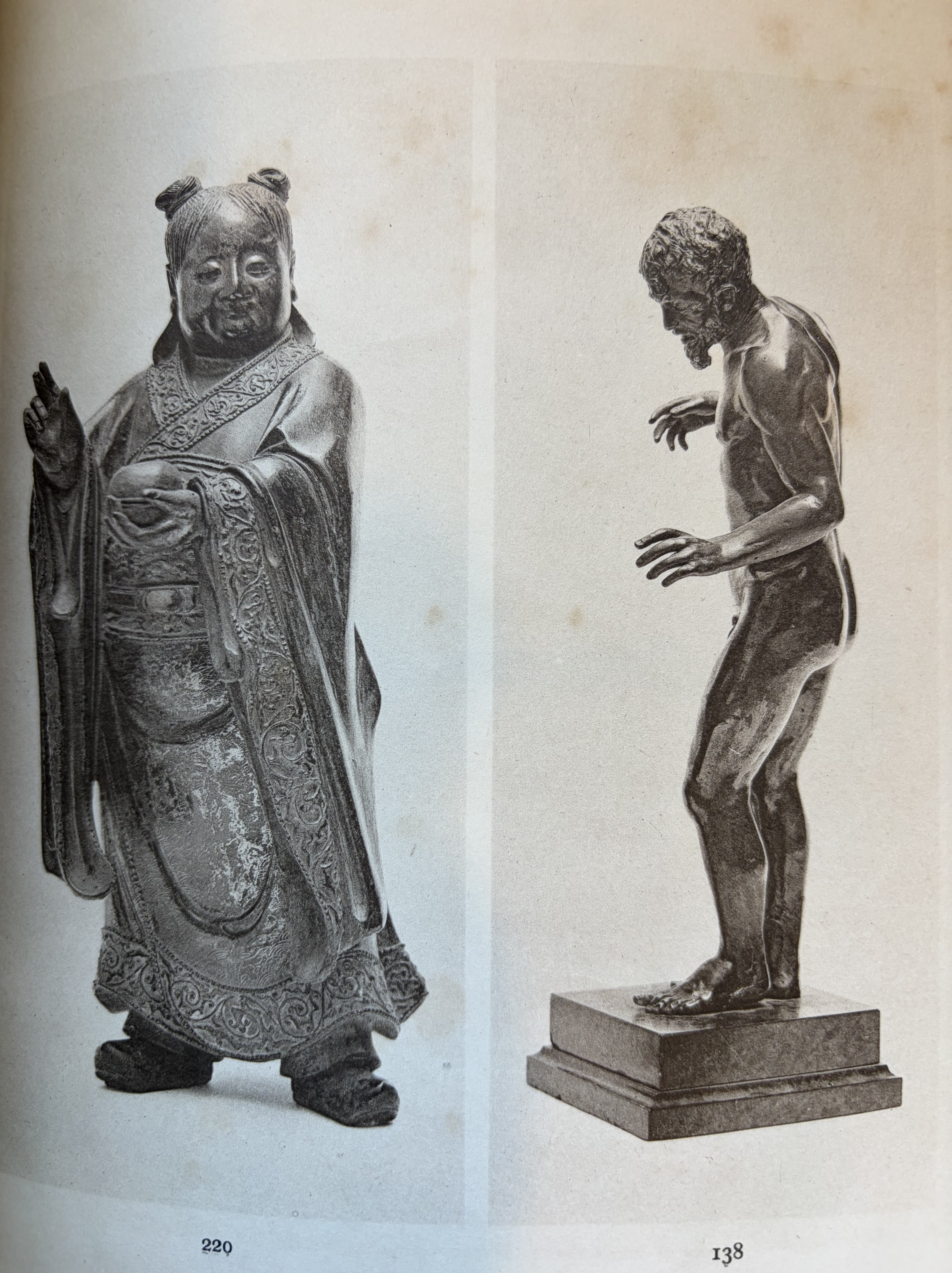
And a bronze sculpture of a man (below, right), Lot 138, ‘A FINE 16th CENTURY FIGURE of a man, with curling hair and beard, standing nude with head turned to right and looking downwards, both arms bent with fingers open 15 1/2 in.’ This was sold for £20.0.0. (to a buyer who’s name is too hard to decipher?).

Auction catalogue of the W.D. Cutter sale, May 1924. Photograph, Antique Dealer Research Project, University of Leeds.

The Cutter auction catalogue is a rare document of the stock of a formerly well-known, but now forgotten, antique dealer, and illustrates the high quality stock that W.D. Cutter held. The catalogue will be joining the range of antique dealer ephemera at the Brotherton Library at the University of Leeds in due course.

Mark

September 30, 2023

Antique Shops in Visual Culture II

Following on from the last Blog Post (which seemed to go down very well with readers), I thought I would continue the theme of Antique Shops in visual culture and focus on a few more images of antique shops, both exteriors and interiors, that are part of a growing archive of paintings we have as part of the research projects on the history of antique dealing. We can start with an example from quite a well-known series of images of antique shops by the artist John Cole (1903-1975). Cole was the son of the English landscape artist Rex Vicat Cole (1870-1940) and from a long line of well-known artists. Cole was particularly fascinated by the street scenery of London and produced a series of paintings of shops fronts especially in London, during the 1940s and 1950s. He seems to have a special fondness for antique shop fronts, and captured dozens of antique shops, most now long gone of course, in key locations such as Kensington Church Street, Avery Row and Christopher’s Place. We’re fortunate enough to have an example in our archive. A painting from the 1940s of 2 antique shops in New Bond Street, London.

John Cole (1903-1975) New Bond Street antique shops, c.1940. Oil on canvas. Private collection.

To the right is the shop of the antique silver dealers Arthur & Co., at 36 New Bond Street. Arthur & Co. were trading as antique dealers from at least 1900; by 1936 they had incorporated the business of the well-known antique silver dealer Reginald Davis. Arthur & Co. were right next door to Sotheby’s the auctioneers, when Cole captured their shop. To the left of Arthur & Co is the shop of Lewis & Lewis, one of the shops of the famous Lewis family of dealers, perhaps of James Lewis & Sons, the well-known antique dealer with shops in London and New York in the 1930s and 1950s. It’s interesting that Lewis & Lewis have a ‘sale’ ongoing in their shop in Cole’s painting – their shop window is full of a fascinating range of antiques.

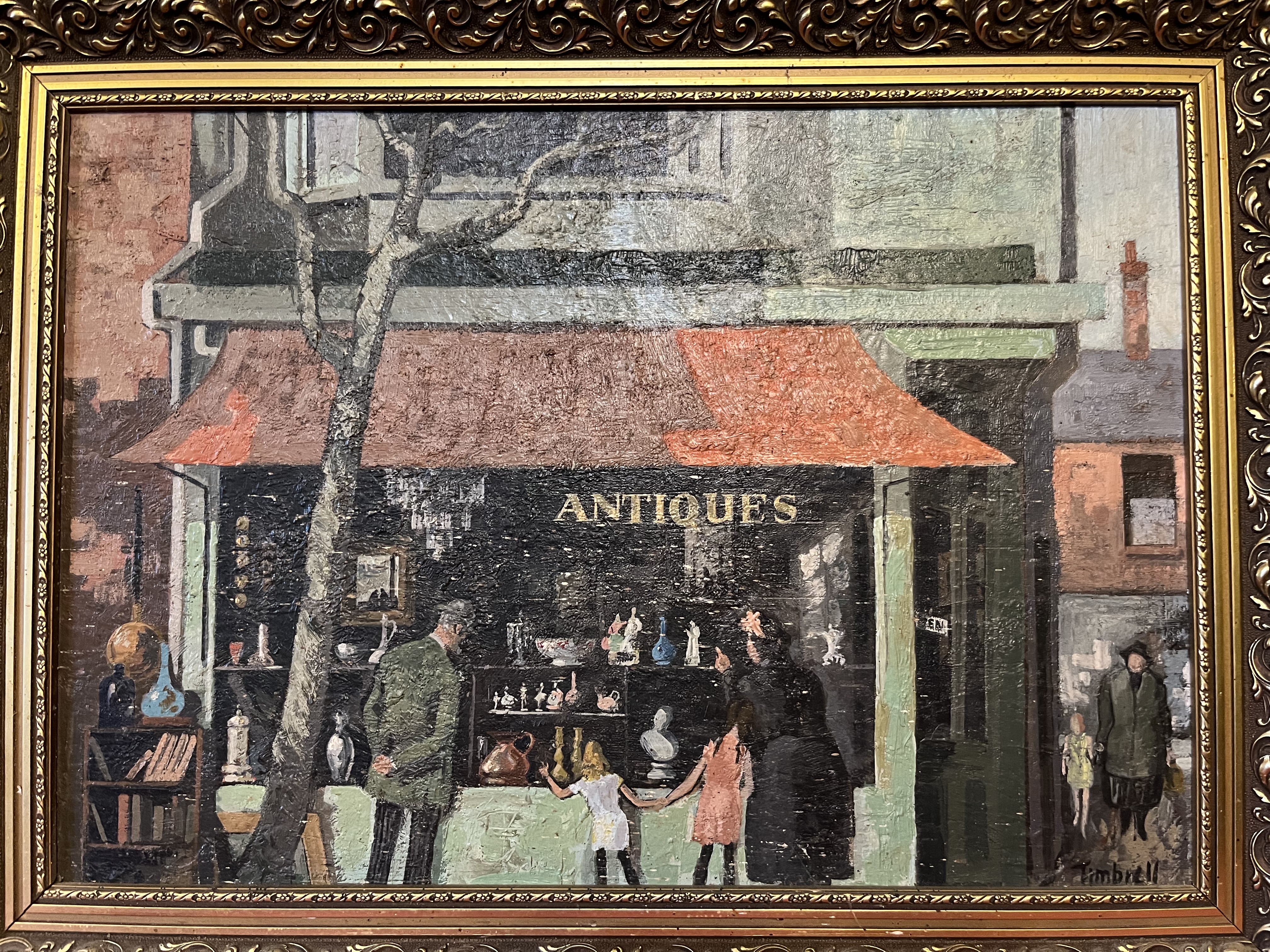
Another painting of an antique shop, from about the same period, 1960s, in the archive collection is by a less illustrious painter than John Cole; Frederick James Timbrell (1905-1992).

Frederick James Timbrell (1905-1992), ‘The Corner Shop’, c.1960. Oil on panel. Private collection

Timbrell was born in Lambeth, London and his painting of an (as yet unknown) antique shop is a charming rendition and, according to the label on the back, it was offered for sale at 30 guineas, a fair sum of money back in the 1960s. If anyone recognises the shop, do let me know!

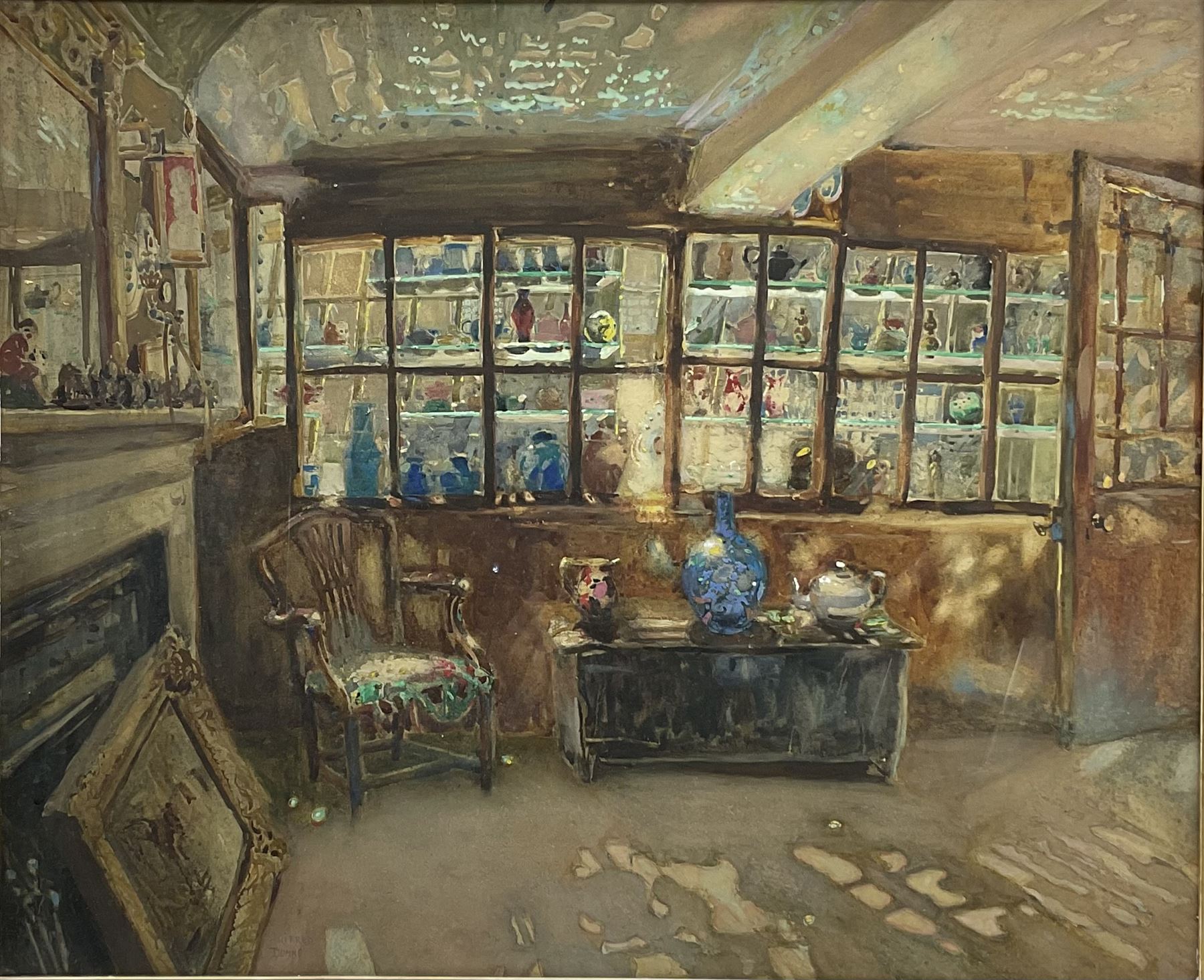
One final image of an antique shop (for this Blog post anyway) is, by contrast, a painting of an antique shop interior. This one, a beautifully atmospheric watercolour and gouache by the talented female artist Winifred Donne (1880-1922), titled ‘The Old Curiosity Shop’ was painted in about 1910.

Winifred Donne (1880-1922), ‘The Old Curiosity Shop’, c.1910. Watercolour and gouache. Private collection.

Donne was the wife of the artist Walter James Donne (1863-1948); Donne’s painting of the Old Curiosity Shop seems to be a representation of an interior of an actual shop, but it’s not known where the shop was located. Donne lived for a time in Yorkshire, so perhaps it was one of the many ‘curio’ shops in York, Scarborough and etc in the early 20th century?

Winifred Donne (1880-1922), ‘The Old Curiosity Shop’, c.1910. Watercolour & gouache. Private collection.

Winifred Donne maybe a relatively forgotten female artist today, but at the time of her death in 1922, (she died tragically young, aged only 42) she was famous enough for Walker’s Galleries, in New Bond Street, London, no less, to organise a Memorial Exhibition of her work in Nov-Dec 1924.

Exhibition Catalogue, Winifred Donne Memorial Exhibition, 1924. Private collection.

Donne was described in the exhibition catalogue as ‘an artist with remarkable talent’. The commentary continues: ‘Watercolour was Winifred Donne’s favourite medium, though she was equally familiar with pastels and pen-and-ink…she exhibited with conspicuous success at the International Society and in the watercolour room at the Royal Academy.’ The exhibition included Donne’s painting of the ‘Old Curiosity Shop’ then in the possession of ‘Mr Robert Frank’ (see below, ‘No.44’), perhaps the art dealer Robert Frank?

Exhibition catalogue, Winifred Donne Memorial Exhibition 1924. Private collection.

These representations of antique shops are a clear demonstration of the enduring significance of the ‘antique and curiosity shop’ in visual culture, and in British cultural life. I’ll post more on paintings of antique shops in future blog posts on the antique dealers blog.

Mark

Home Subjects

a working group dedicated to the display of art in the private interior, c. 1715-1914

The Period Room: Museum, Material, Experience

An International Conference hosted by The Bowes Museum and The University of Leeds

H. Blairman & Sons Ltd

A research project investigating the history of the antiques trade in Britain in the 19th & 20th centuries

Museum Studies Now?

'Museum Studies Now?' is an event which aims to discuss and debate museum and heritage studies education provision.

The Burlington Magazine Index Blog

art writing * art works * art market

East India Company at Home, 1757-1857

A research project investigating the history of the antiques trade in Britain in the 19th & 20th centuries