The history of antique dealing is littered with fascinating ephemera – dealer catalogues, invoices, letters, drawings and sketches, stock books, sales books and photograph albums. Some of the most interesting survivals are auction sale catalogues, often generated when a dealer makes changes to a business (sales of surplus stock when moving to different premises for example), or when a dealer retires, or dies. One such catalogue recently joined the collection of antique dealer ephemera that are such important resources for the antique dealer research project.
The catalogue presents ‘The Extensive and Valuable Stock of Works of Art, the property of Mr W.D. Cutter of Great Russell Street, who is retiring from business’ which was was sold over 3 days, 14th -16th May 1924. It gives us a unique insight into the remaining trading stock of an important and well-known (in the late 19th century at least) antique dealer.
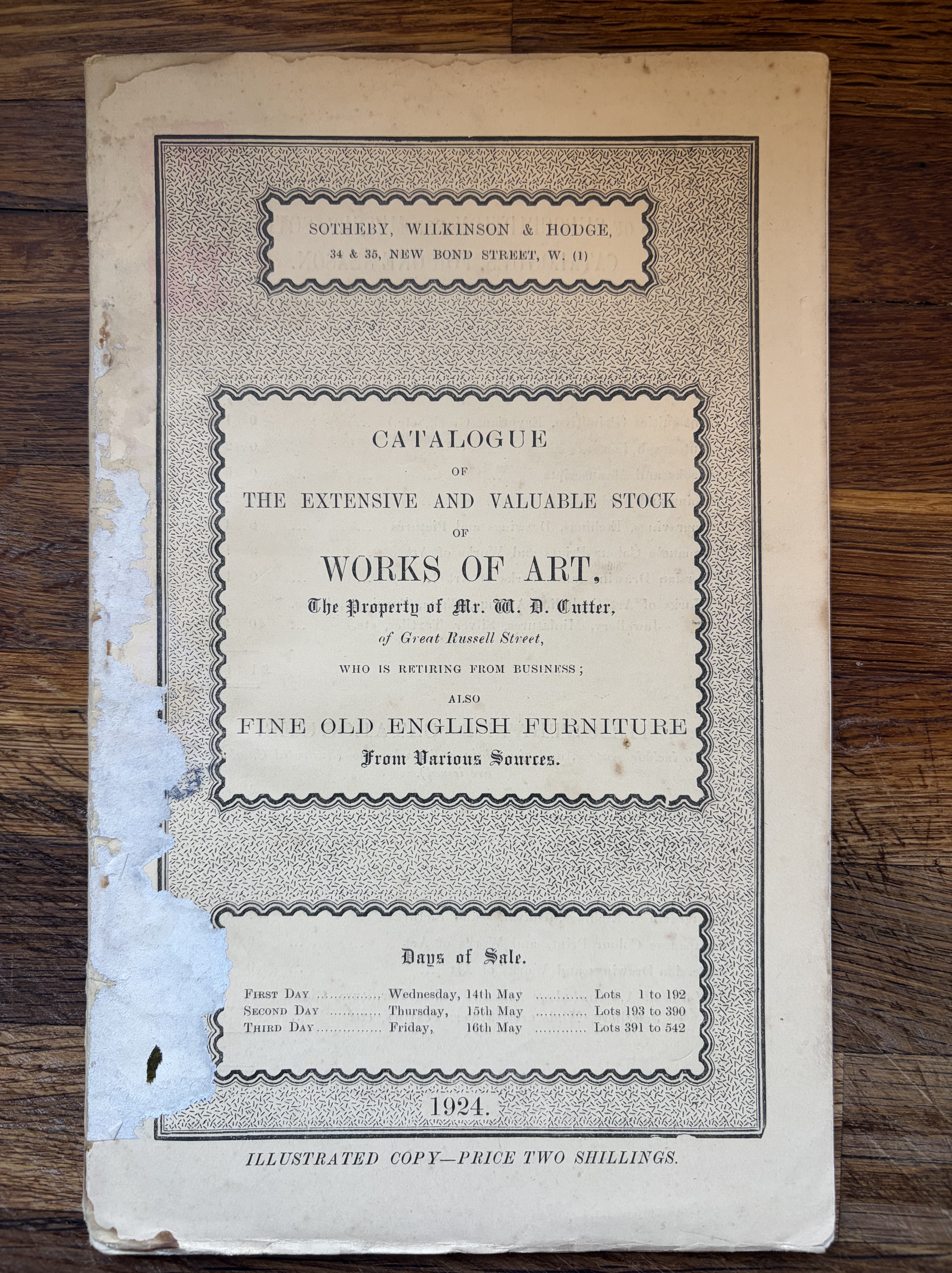
William Doherty Cutter (c.1848-1929) traded as ‘antique furniture dealer and curiosity dealer’ at 36 Great Russell Street, London in the 1870s, but the business can be traced back to as early as the 1860s, started by William’s father William George Cutter, a ‘picture dealer’ in St. James’s in London – William George Cutter was described as a ‘naturalist’ in the 1871 Census. Cutter’s were well known as suppliers of ‘curiosities’ of natural history and ethnography to the British Museum from the late 1860s to c.1900 – their shop was very close to the British Museum in Great Russell Street. Cutter is mentioned in Provenance: Twelve collectors of ethnographic art in England 1760-1990′ edited by H. Waterfield and J.C.H. King (2006), as well as having a short entry in my Biographical Dictionary of 19th century Antique and Curiosity Dealers (2009). Cutter’s appear to have been a very important antique dealers, now little known of course; they were active at the famous Hamilton Palace auction sale in 1882, buying a small number of Lots, including ‘a large cameo, with three heads in profile’ (Lot 2166) for £7.0.0. William George Cutter’s daughter, Eva A. Cutter (born c.1860) also traded as a dealer in natural history specimens and ethnographic artefacts, selling several objects to the British Museum in the late 1890s. Both of W.D. Cutter’s daughters, Marjorie Doherty (born c.1896) and Eva (born c.1890) also worked for their father in his antique dealing business.
What’s fascinating about the auction catalogue of Cutter’s stock is the sheer range and quality of the antiques he held in stock in 1924. This extends far beyond the natural history and ethnographic specimens that Cutter’s are said to have supplied to the British Museum in the second half of the 19th century. The auction sale had 499 Lots of Cutter’s stock, which ranged from bronzes, ivories, Chinese and European porcelain, silver, clocks, marble and terracotta sculptures, Chinese hardstone carvings and cloisonne, as well as some antique furniture, an array of objet d’art and a small number of paintings.
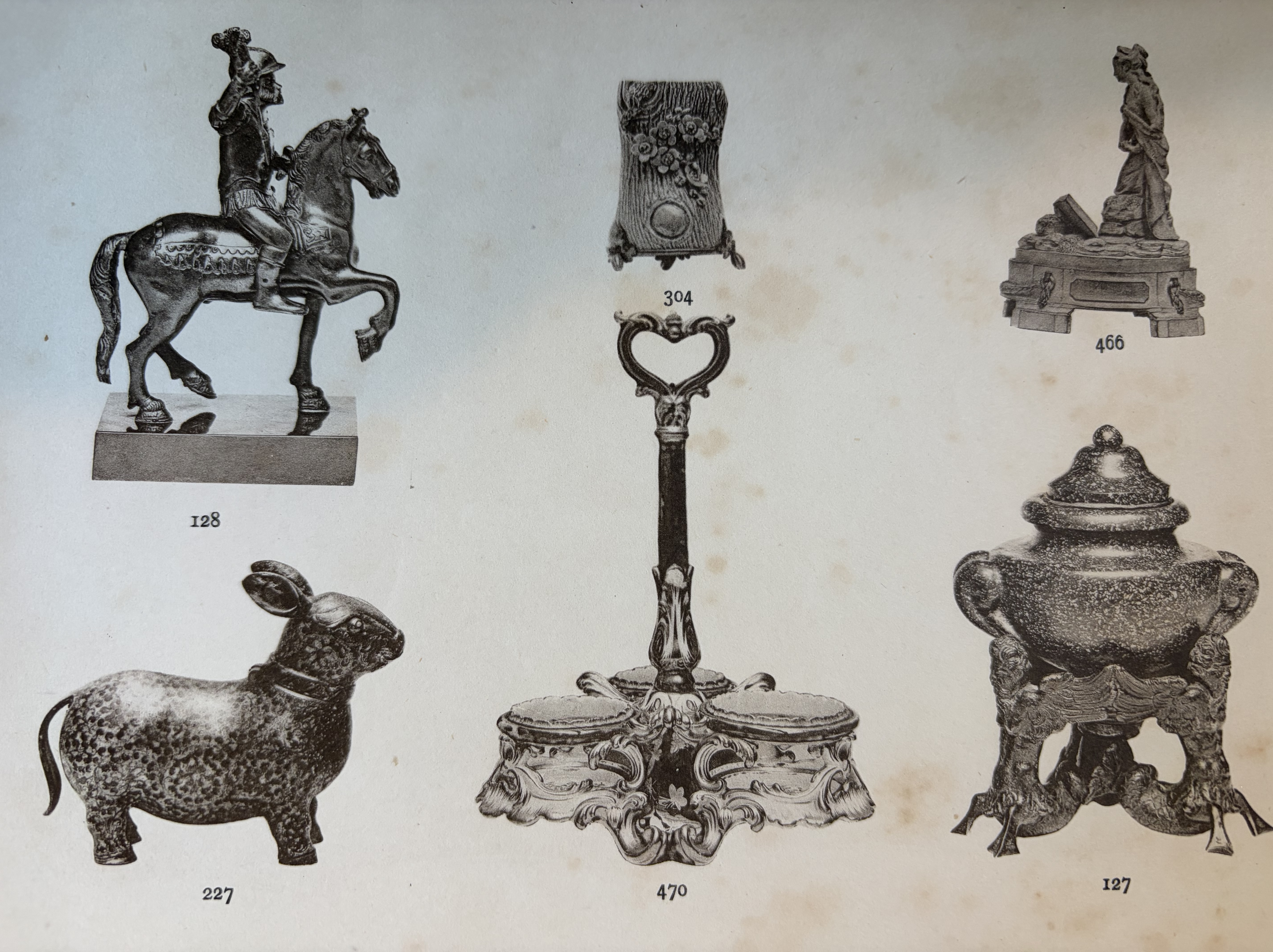
This range of ‘antiques’ is typical of late 19th and early 20th century collecting interests of course, but Cutter seems to have also been something of a specialist in Renaissance bronzes. Lot 135, for example, ‘A FINE INKSTAND, of the school of Riccio…’ (see below, centre – Andrea Briosco, called Riccio, (1470-1532)). The bronze inkstand was sold to ‘Kerin’ for £30 (equivalent to about £13,630, as ‘income value’, according to Measuringworth.com.) Gerald Kerin formed a partnership with the dealer Alfred Spero in 1928 – both Kerin and Spero were dealers based in London specialising in Renaissance bronzes and bought heavily at the Cutter auction sale.
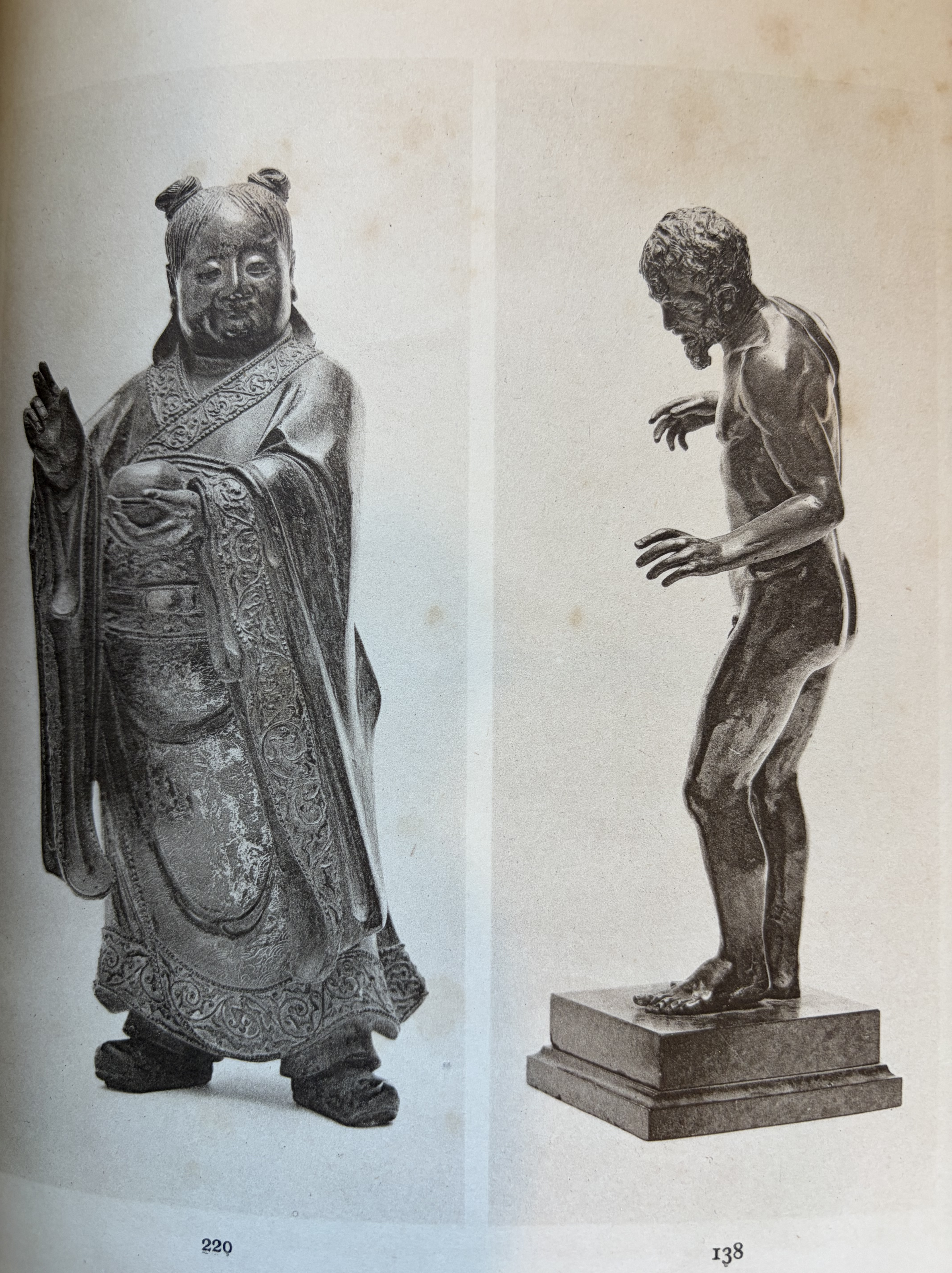
Lot 49 (see below bottom left) ‘A VERY FINE 15th CENTURY IVORY GROUP of ‘The Adoration of the Magi 6 1/2 in.’ was bought by the dealer ‘Garabed’ for £7 & 10 shillings (equivalent to about £3,400). A. Garabed was well-known dealer trading at Pall Mall Safety Deposit, Carlton Street, London at the time. And Lot 153, ‘A VERY FINE FIGURE OF A POPE, in pear-wood, coloured to imitate bronze, full-length in vestments, standing with right arm raised, 6 7/8 in.’,(below bottom right) sold to the dealer ‘Lewis’ for £3 & 10 shillings (equivalent to about £1,590). Lewis could be any number of antique dealers of the Lewis family in the 1920s.
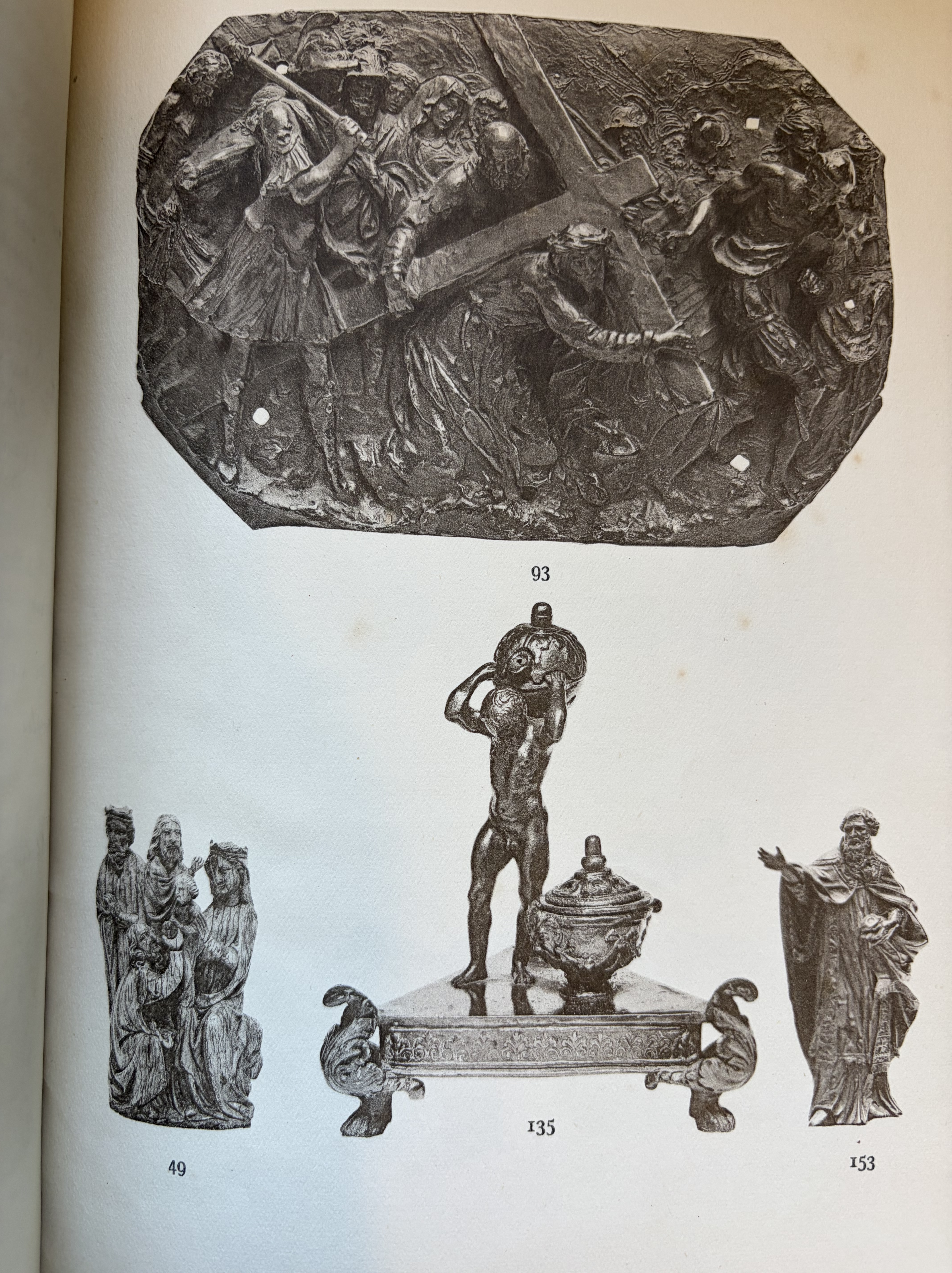
Lot 93,(see above, top middle) ‘A FINE 16th CENTURY PLAQUE of Christ bearing the Cross, a ”cire perdu” casting, with figures in very high relief (up to 1 1/2 in.), oblong, octagonal, 9 1/2 in. by 6 1/2 in.’, was sold to Alfred Spero for £40 (equivalent to £18,170) – the most expensive object sold at the Cutter auction. Alfred Spero was trading from a shop at 33 King Street, St. James’s in London in the 1920s, right next to Christie’s auction rooms.
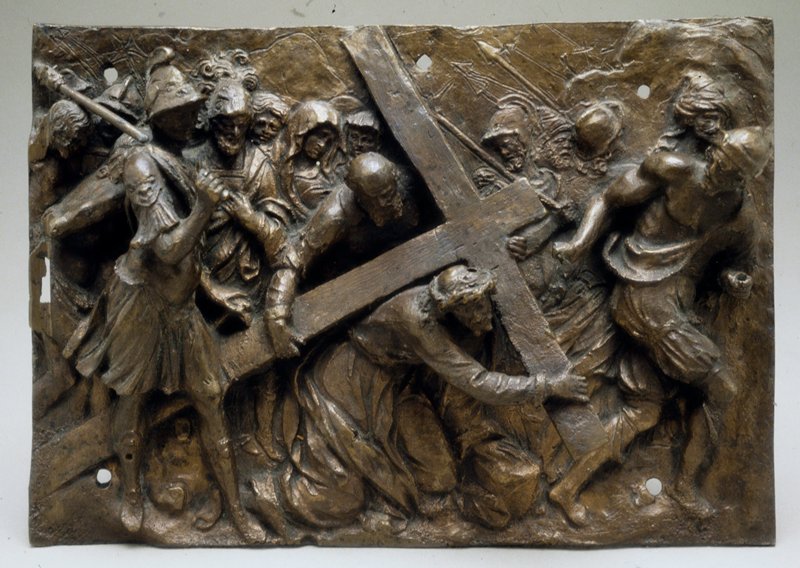
The bronze shown in Cutter’s stock is a well-known casting, previously attributed to Ferdinando Tacca (1619-1686), but is now said to be by Francesco Fanelli (1608-1661). There are three known versions of bronze, in different shapes and sizes, in museum collections in the USA. One version, rectangular in shape, in the collections of The Minneapolis Institute of Art (see below).
Two other versions are octagonal in shape, the same as the example in the Cutter auction. These are in the collections at The Metropolitan Museum of Art in New York and at the Spencer Museum of Art, Kansas, USA (see below).
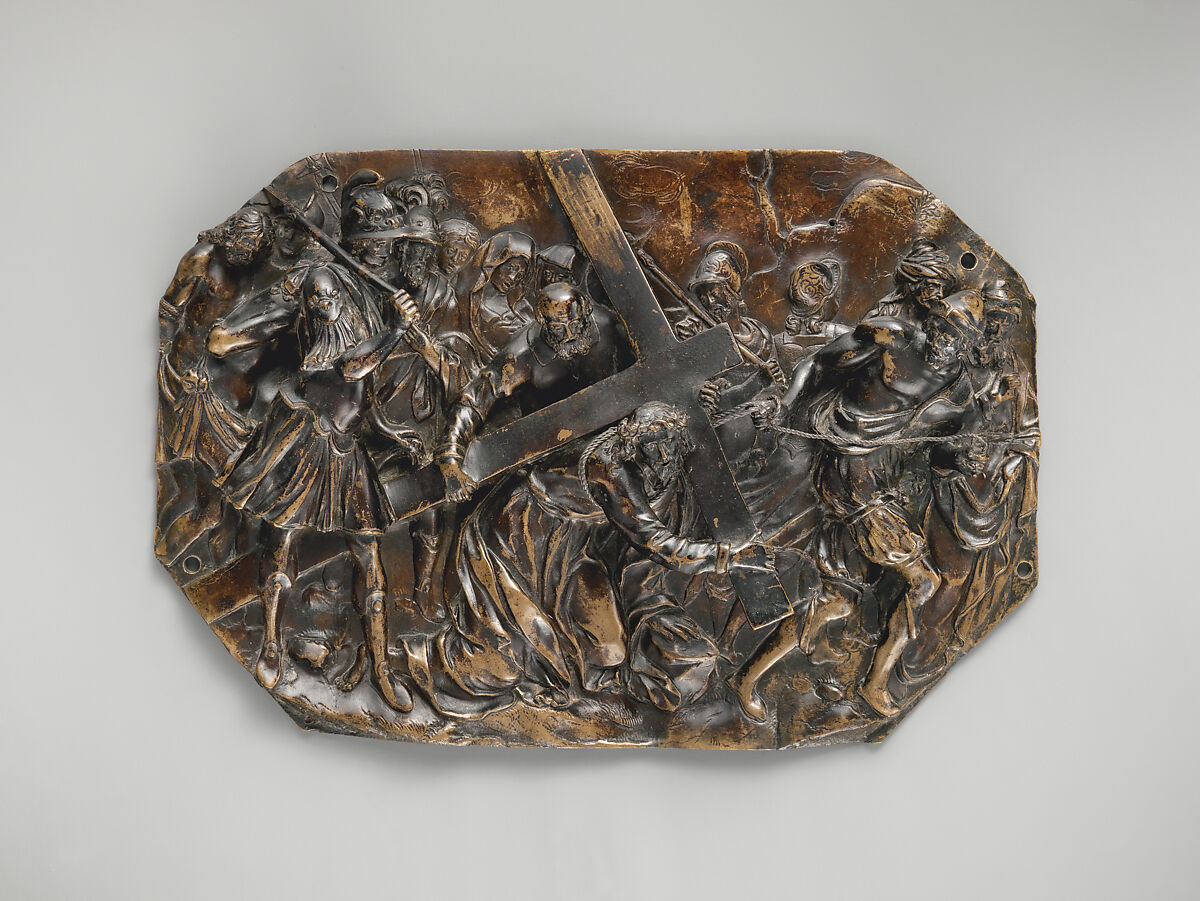
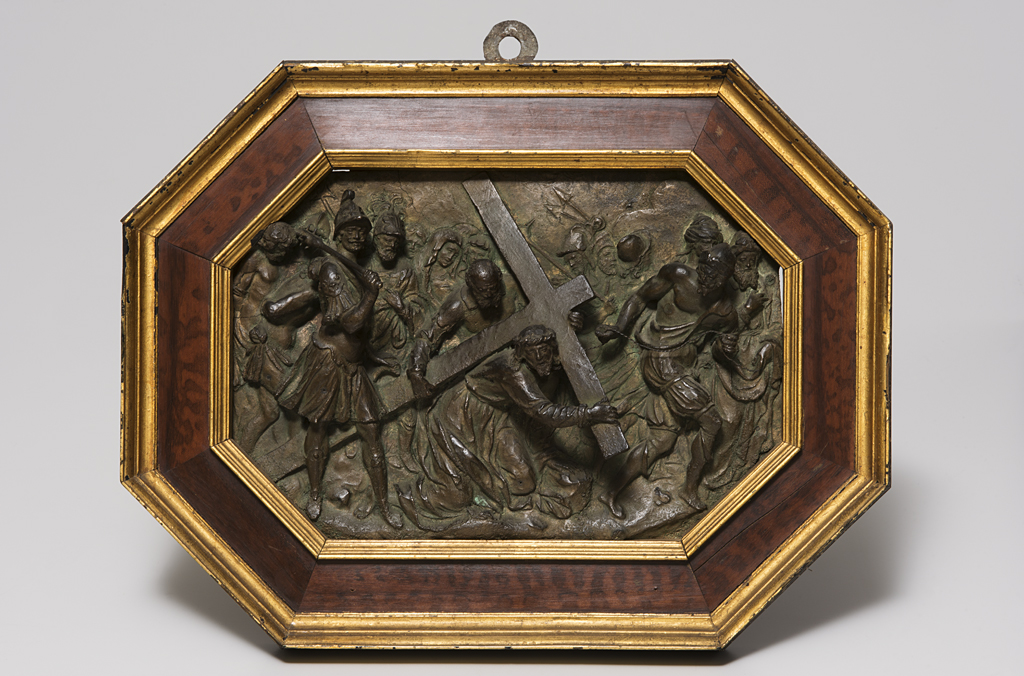
The Metropolitan Museum of Art and the Spencer Museum of Art examples show different fixing holes and other variations, so cannot be the Cutter example, which raises the possibility that Cutter’s example is a previously unrecorded, and as yet unlocated, example of this famous bronze.
Other examples of Renaissance bronzes in the W.D. Cutter auction sale include Lot 128, ‘AN EARLY EQUESTRIAN FIGURE, in pseudo-classical costume, 8 in.’ (sold again to Kerin, at £3.0.0.) (see below top left).
And a bronze sculpture of a man (below, right), Lot 138, ‘A FINE 16th CENTURY FIGURE of a man, with curling hair and beard, standing nude with head turned to right and looking downwards, both arms bent with fingers open 15 1/2 in.’ This was sold for £20.0.0. (to a buyer who’s name is too hard to decipher?).
The Cutter auction catalogue is a rare document of the stock of a formerly well-known, but now forgotten, antique dealer, and illustrates the high quality stock that W.D. Cutter held. The catalogue will be joining the range of antique dealer ephemera at the Brotherton Library at the University of Leeds in due course.
Mark
 antiquedealersblog