Posts tagged ‘York’

September 1, 2026

Behind the Scenes of the Year of the Dealer 11 – Walter Waddingham at Temple Newsam

Here is another blog post in our series of ‘Behind the scenes of the Year of the Dealer’ – this time some further background information on the making of the film focused on the antique dealer Walter Waddingham in the digital trail at Temple Newsam. Here’s the finished film on the YoD website.
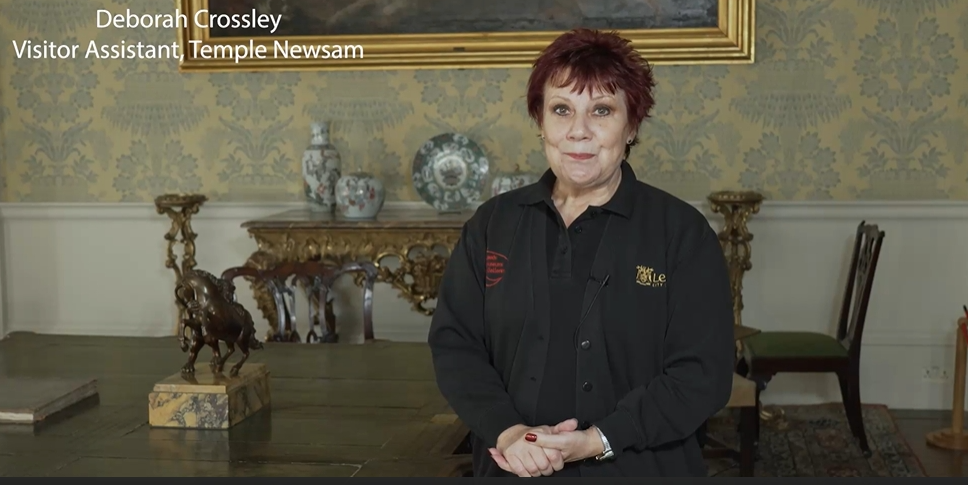
Deborah Crossley introducing the Walter Waddingham library desk in the Year of the Dealer film at Temple Newsam.

Deborah Crossley, who introduces the antique library desk in the film, retired from Temple Newsam recently, but she delivered an excellent introduction in her piece to camera, and in just one take too! (thanks Deborah!).

As with many of the other films we had many more images that we could have used in the Walter Waddingham film but could not find space to actually fit them in without impacting the dwell time for the viewers of the images. One example is a photograph of ‘Pomfret Castle’ in London, which was the original home of the library desk in the 18th century (see below). In the Year of the Dealer films we concentrated more on the history and contextual background of the antique dealers (so for this film, Walter Waddingham) rather than the history of the object (the antique), but the ‘gothic’ library desk does have a fascinating provenance, which no doubt would also have interested Walter Waddingham.
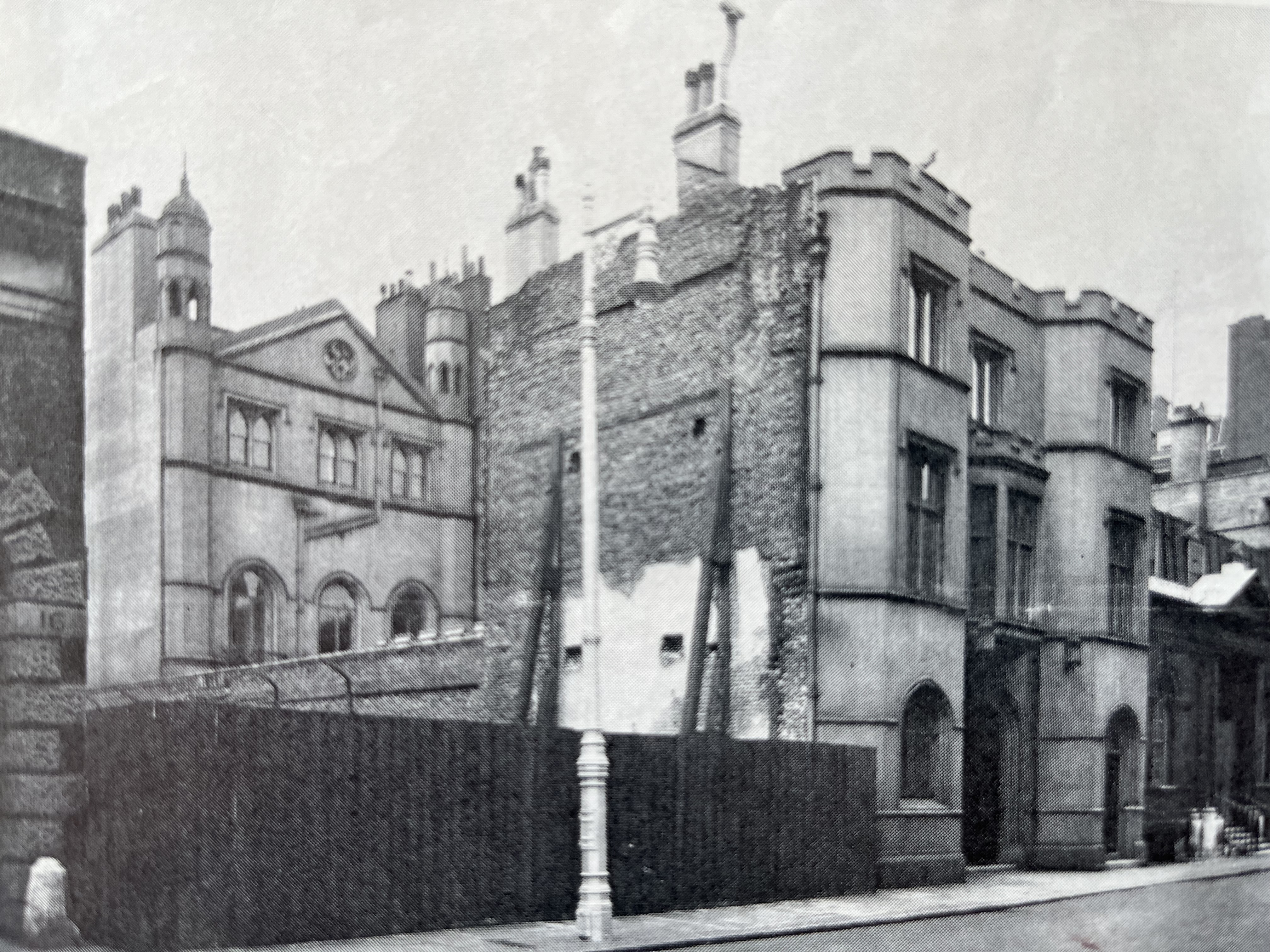
‘Pomfret Castle’, Arlington Street, London, built c.1760, demolished in 1938. Photograph 1934, courtesy of Leeds Museums & Galleries, Temple Newsam (Country Life Picture Library).

The desk may have been made for ‘Pomfret Castle’, which was designed by either Sanderson Miller or Richard Biggs for Henrietta Louisa Fermor (1698-1761), Countess of Pomfret (their country seat was Easton Neston in Northamptonshire), or it may have been part of the furnishings of William Gerard Hamilton (1729-1796), who rented ‘Pomfret Castle’ following the death of the Countess of Pomfret in 1761. Hamilton was known as ‘Single Speech Hamilton’ for allegedly only delivering a maiden speech in the House of Commons (13th November 1755) – the desk in the film retains a brass plaque inscribed ‘William Gerard Hamilton, known as ‘Single Speech Hamilton’ M.P. for 42 years, born January 29 1729, died July 16 1796′.

The desk was later presented, in about 1860, by William Gerard Hamilton’s nephew, Walter Kerr Hamilton (1808-1869), then Bishop of Salisbury, to the See of Salisbury. It then passed into the ownership of the Ecclesiastical Commissioners in 1946, who offered the desk for sale at Christie’s in London in 1950, where it was bought by Walter Waddingham, as we outline in the film.

One other image that we might have used was a screen shot (see below) from the antique dealers project map website (see the map here). We highlighted the importance of Harrogate a a key location in the history of the antique trade in Britain in the Walter Waddingham film.
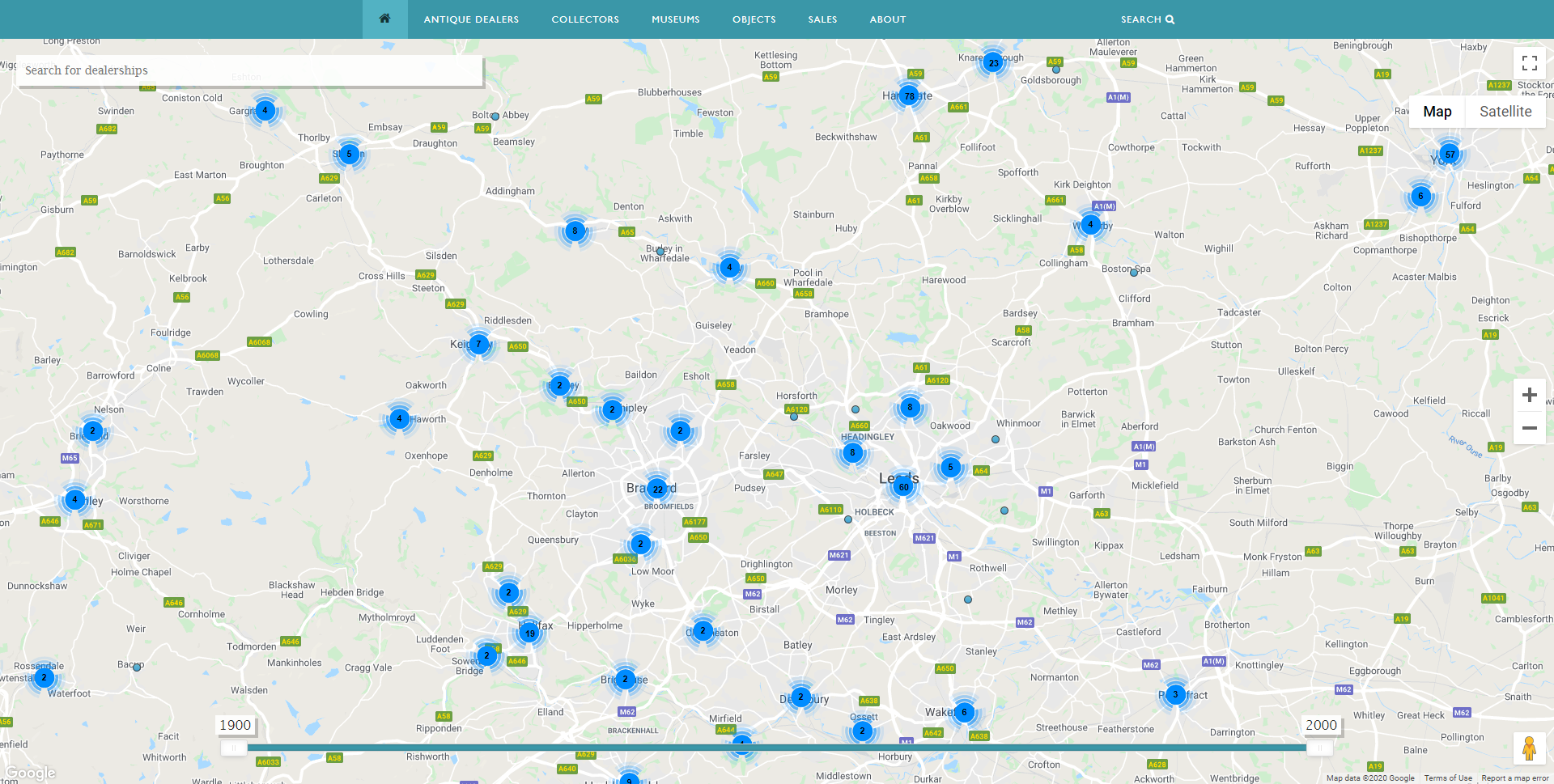
Antique Dealer project Map website. Screenshot – Antique Dealer Research Project, University of Leeds.

You can just see Harrogate towards the top edge of the map, near the middle, underneath the number 78 in the blue circle. Harrogate had 78 antique dealers between c.1900 and c.1969, ahead of Leeds (right in the centre of the map) which had 60 antique dealers and York (top right of the map) (which had 57 antique dealers) in the same period. Harrogate was also the location of another antique dealer featured in the Temple Newsam films – Charles Lumb & Sons, who we will focus on in a forthcoming ‘Behind the Scenes of the Year of the Dealer’ blog post.

In the meantime, there will be another ‘Behind the Scenes of the Year of the Dealer’ next week, so do keep your eye of the blog.

Mark

July 23, 2021

New Oral History Interview – David Love

The various UK Government Lockdowns and Social Distancing requirements over the past 16 months or so have severely restricted our ability to continue with our Oral History of the Antique Trade project. But as we have started to move out of various restrictions we have ‘fired up’ the Oral History project again. And we’re pleased to announce that David Love, of David Love Antiques Limited in Harrogate, generously agreed to be our latest and 43rd interviewee – we interviewed David in late June.

David Love, at his shop in Harrogate, 2021. Photograph, Antique Dealers Research Project, University of Leeds.

David is perhaps one of the most experienced antique dealers in Britain, having been in the antiques trade for more than 50 years. He started in 1969 with his first shop, which he opened at Shipston-on-Stour in Warwickshire, but David had initially begun in the trade by helping out at the shop of his mother, Araxie Love, who had established her own antique dealing business in c.1960 in Richmond, North Yorkshire, acquiring the antique shop run by the dealer Kathleen Agar.

In this very engaging oral history interview David tells us about how he relocated his antique business to Swan Road in Harrogate in the early 1970s, before occupying the premises of the well-known dealer Walter Waddingham in Royal Parade in 1975, and remaining there for 45 years. David has fond memories of Walter, and many other well-known dealers in Harrogate and York and the Yorkshire area – dealers such as Frank and Basil Shaftoe and Reg Smith of ‘Smith’s the Rink’ in Harrogate and Charles Morrison in York – and in the interview he gives a real insight into the Northern antiques trade in the period from the 1970s until the decline of the trade across the UK in the late 1990s.

David was primarily an inter-dealer trader in the 1970s and 1980s, often supplying dealers in the South and in London with antique furniture and a wide range of objects. He recalls the numerous local auction sales that kept the supply chains running, and the extensive buying trips that he would make, starting in Newcastle, Sunderland and the North East of England, and extending to Coldstream, Edinburgh, Perth, Dundee and Glasgow in Scotland, before returning to Harrogate via Carlisle, Kendal and Barnard Castle – calling in at many well-known dealers such as the Sydneys (in Newcastle), Owen Humble (in Jesmond) and Bill Beaton (in Perth and Dundee). These were ‘fun days’ as David describes them, when one would not know what would be found in the various antique shops one visited.

David also tells us of some spectacular finds that he has made over the years, including spotting a previously ‘lost’ ormolu tea urn by the great 18th century manufacturer, businessman and designer Matthew Boulton (1728-1809), which he acquired whilst in the USA. He realised it was something special and this was confirmed when he got home and looked up Nicholas Goodison’s magnificent volume on the work of Matthew Boulton (1974) to find that it was listed in the book as ‘lost’.

In this fascinating interview David also reflects on the changes to the antique trade over the past 50 years and the reasons for those changes, as well as reflecting on the what the future might hold for the antiques trade. The interview will join the rest of the Oral History interviews as part of the archive of the history of the antique trade in Britain and will be made available to the public in due course. In the meantime, we have a few more oral history interviews planned, so do keep your eye on the antique dealers research blog and the project research pages.

Mark

Home Subjects

a working group dedicated to the display of art in the private interior, c. 1715-1914

The Period Room: Museum, Material, Experience

An International Conference hosted by The Bowes Museum and The University of Leeds

H. Blairman & Sons Ltd

A research project investigating the history of the antiques trade in Britain in the 19th & 20th centuries

Museum Studies Now?

'Museum Studies Now?' is an event which aims to discuss and debate museum and heritage studies education provision.

The Burlington Magazine Index Blog

art writing * art works * art market

East India Company at Home, 1757-1857

A research project investigating the history of the antiques trade in Britain in the 19th & 20th centuries