Our next in the series ‘Behind the Scenes of the Year of the Dealer’ returns to The Bowes Museum and the film that focuses on the antique dealers W. F. Greenwood & Sons – you can see the final version of the film HERE. This post follows more rapidly on the previous blog post (9th October 2026) as we slowly catch up with the weekly rhythm of the ‘Behind the Scenes of the Year of the Dealer’ blog posts.
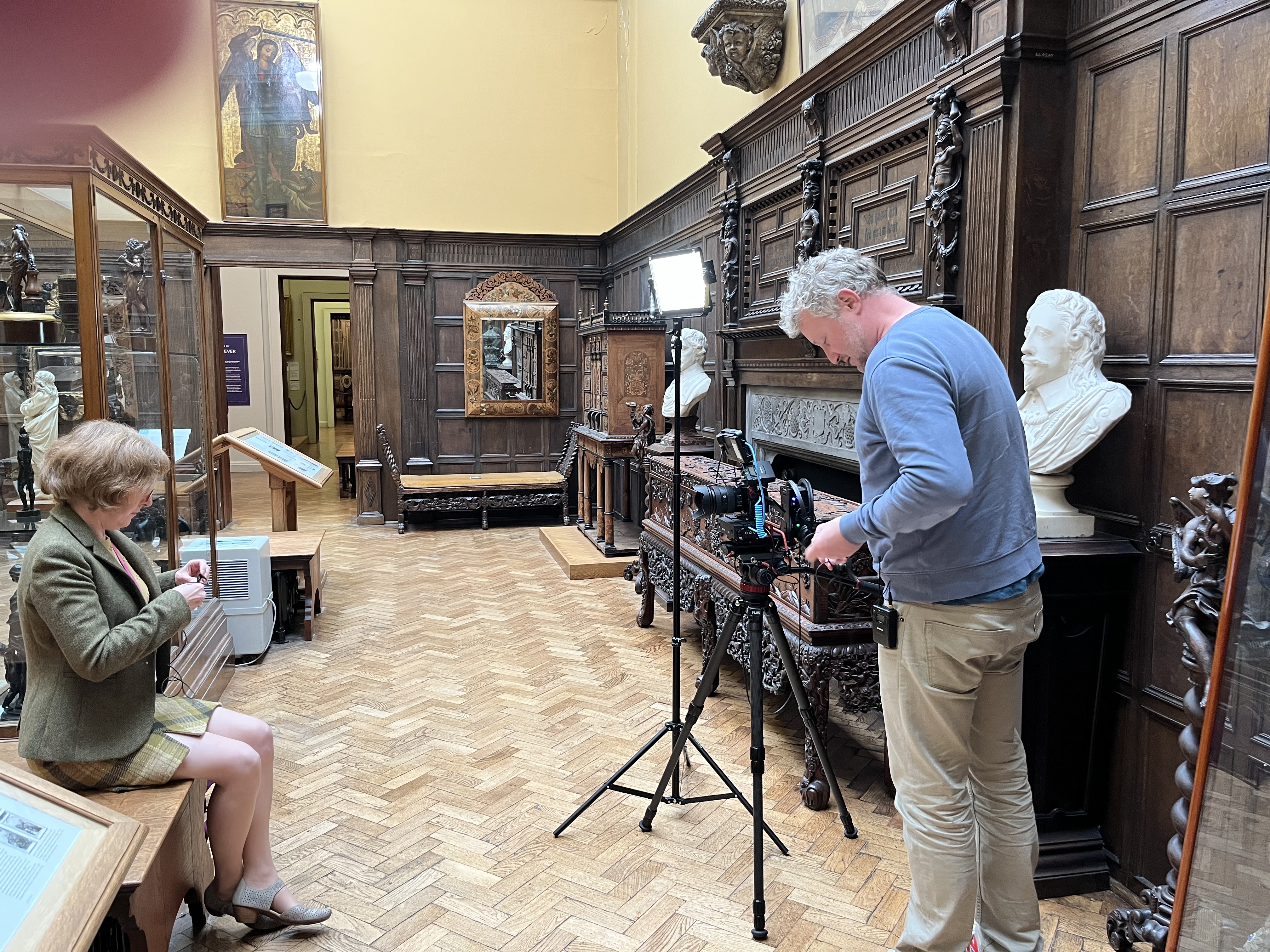
We have posted some blog posts on W. F. Greenwood & Sons in the research blog already – see Blog 4th July 2014 and 25th May 2019 and would not wish to repeat information already highlighted in the previous blog posts and in the Year of the Dealer film. So, we thought our readers might like to know a little more about how the Year of the Dealer films were assembled (it also illustrates how complicated the films were to make!). And it gives us a chance to celebrate the brilliant work of Patrick Bannon, our photographer and film-maker extraordinaire! Here (below) is Patrick on site filming for the Lady Lever Art Gallery Year of the Dealer films.
For each film, we started with a research script, usually of about 5 or 6 minutes worth of audio recording in length, for cutting back to 2 or 3 minutes (mostly), and a set of images. I would first work out a sequence of images in dialogue with the script and then we (Mo and I…the avatars) would record the 5 or 6 minutes of audio. The audio recording for the avatars was always done at our home in the recording studio (ha..I wish!…it was in our spare single bedroom…..see also the Behind the Scenes of the Year of the Dealer No.5 for another brief mention of our ‘recording studio’). We used two high quality audio recorders that had been acquired in 2014 for an earlier part of the Antique Dealer Research Project – for the Antique Dealer Oral History interviews project (one can see how interwoven the various parts of the Antique Dealer Research Project are!). The audio recordings formed the basis of our raw material for Patrick to do his magic in piecing together the audio, the photograph still images, his digital film sequences, and the digital film on site video recordings at the various museum locations. So there was quite a complicated set of resources and practices brought together for the final YoD films.
For the W. F. Greenwood & Sons YoD Film we had two sets of audio recordings – Mo and I (the avatars) and a sequence Patrick cut in from the oral history interview we did with retired antique dealer Tony Lumb back in 2014 – (Tony sadly passed away in December 2025). We also had the extra video/audio recording of Stephen Erskine (Visitor Assistant at The Bowes Museum – Stephen has since retired) introducing the panelling at the museum, which also needed a script for Stephen to work with.
All this required careful identification of the appropriate sequences in the two audio recordings, cut and pasting the audio into the Year of the Dealer film, adding in the video and audio filming sequences at The Bowes Museum, precisely cutting in the sequences of images, and then balancing and levelling the audio sequences to smooth out any background noise and sound levels, aligning images to relevant audio, adding the captions to the images and adjusting the light levels for some of the images, to create the seamless digital film – and all done as if by magic by Patrick!
And of course, whilst we had scripts and images and museum objects to work with, it was also very much a process of trial and error in the construction of the actual films themselves – as Patrick himself said in a recent interview we did with him for our assessment of the research impact of the project, ‘….it was great working in that way because it’s been quite original and innovative’.
Do look out for the next in the series of ‘Behind the Scenes of the Year of the Dealer’.
Mark

