November 28, 2015

Yet more on ‘Quinneys’

Following some earlier blog posts on ‘Quinney’ and the dealer Thomas Rohan (see blog posts December 31st 2014; December 6th 2014; July 27th 2014), I recently came across some more information associated with this fascinating conflation of fact and fiction – as you’ll know, the real antique dealer Thomas Rohan (trading in Bournemouth and Southampton in the period 1903-1937) was the basis for the famous fictional antique dealer ‘Joe Quinney’ in the novel by Horace Vachell (first published in May 1914) – see our interactive research project map site for the entry on Rohan:

www.antiquetrade.leeds.ac.uk/dealerships/34852

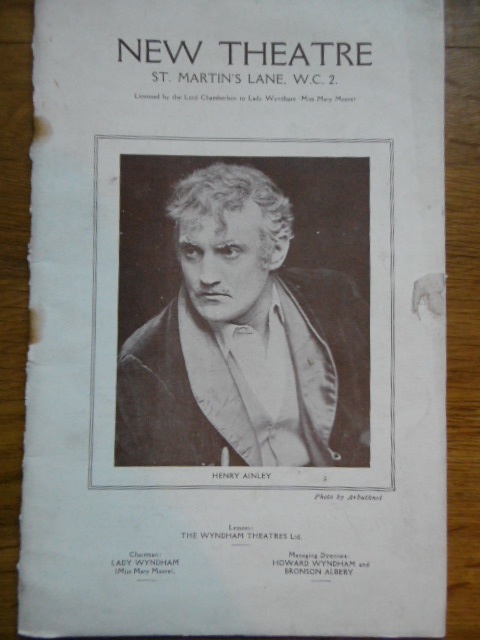
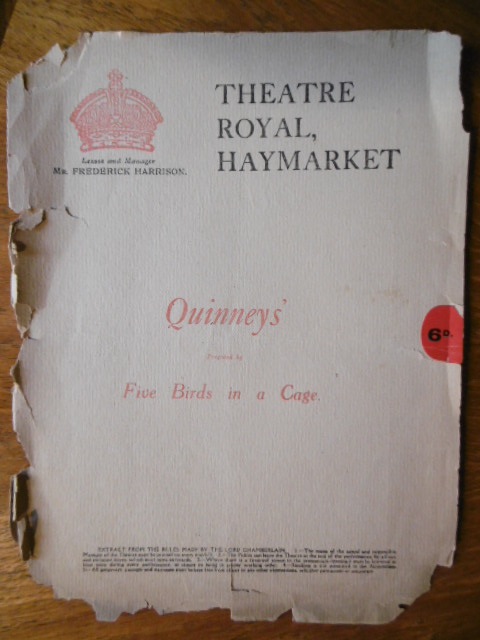
Anyway, recently in a couple of antiquarian book dealers I found two further pieces of ephemera associated with the play ‘Quinneys’ (1915) and the novel ‘Quinneys’ (1914). Firstly, I found a rare copy of the playbill for the first staging of the play ‘Quinneys’ on April 20th 1915, at the Theatre Royal, Haymarket, London – see cover picture:

Quninneys 1915 play

Playbill, ‘Quinneys’, Theatre Royal, Haymarket, 1915. Image copyright, AHRC Antique Dealers Project, 2015.

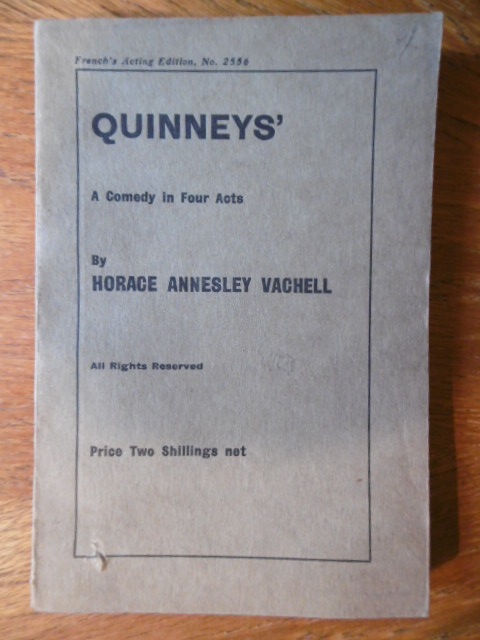
And secondly a copy of the published script of the play (a later copy, probably from the 1950s?) –

Quinneys play script 1915 reprint

‘Quinneys’, play script (1915) – 1950s edition. Image copyright AHRC Antique Dealers project 2015.

henry ainley

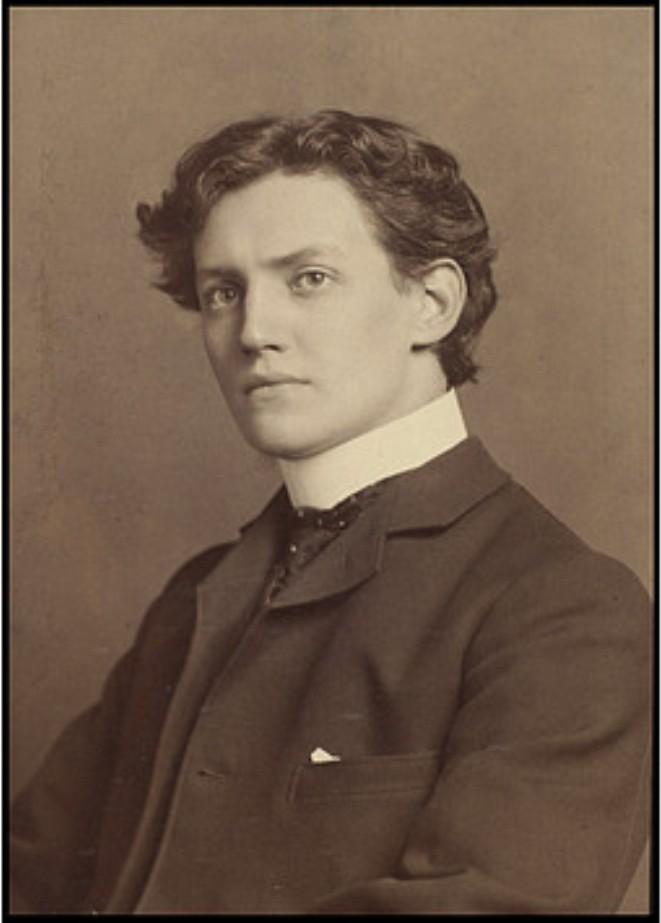
Henry Ainley (1879-1945), British Actor. Image Wikicommons.

The playbill lists the actors in the play – ‘Joe Quinney’ the eponymous antique dealer, was played by the well-known Shakespearian actor Henry Ainley (1879-1945) (see above); incidentally he also played ‘Quinney’ in the 1919 film version of the play…and interesting (as far as we are concerned) Ainley was born in Morley, Leeds, West Yorkshire!. Quinney’s wife, Susan, was played by the British film actress Syndey Fairbrother (1872-1941).

What is also interesting, for the antique dealers project, is that a number of (then) high profile London antique dealers and interior decorators supplied the antique furniture for the play. The dealers listed in the playbill were the interior decorators ‘Thornton Smith Limited, 31 Soho Square’; antique dealers ‘Keeble Limited, 10 Carlisle Street’, ‘Parkenthorpe, Ebury Street’, and ‘Spillmans, St. Martin’s Lane’, who are all listed as supplying the ‘furniture’ and acknowledged for their ‘expert advice in this regard’.

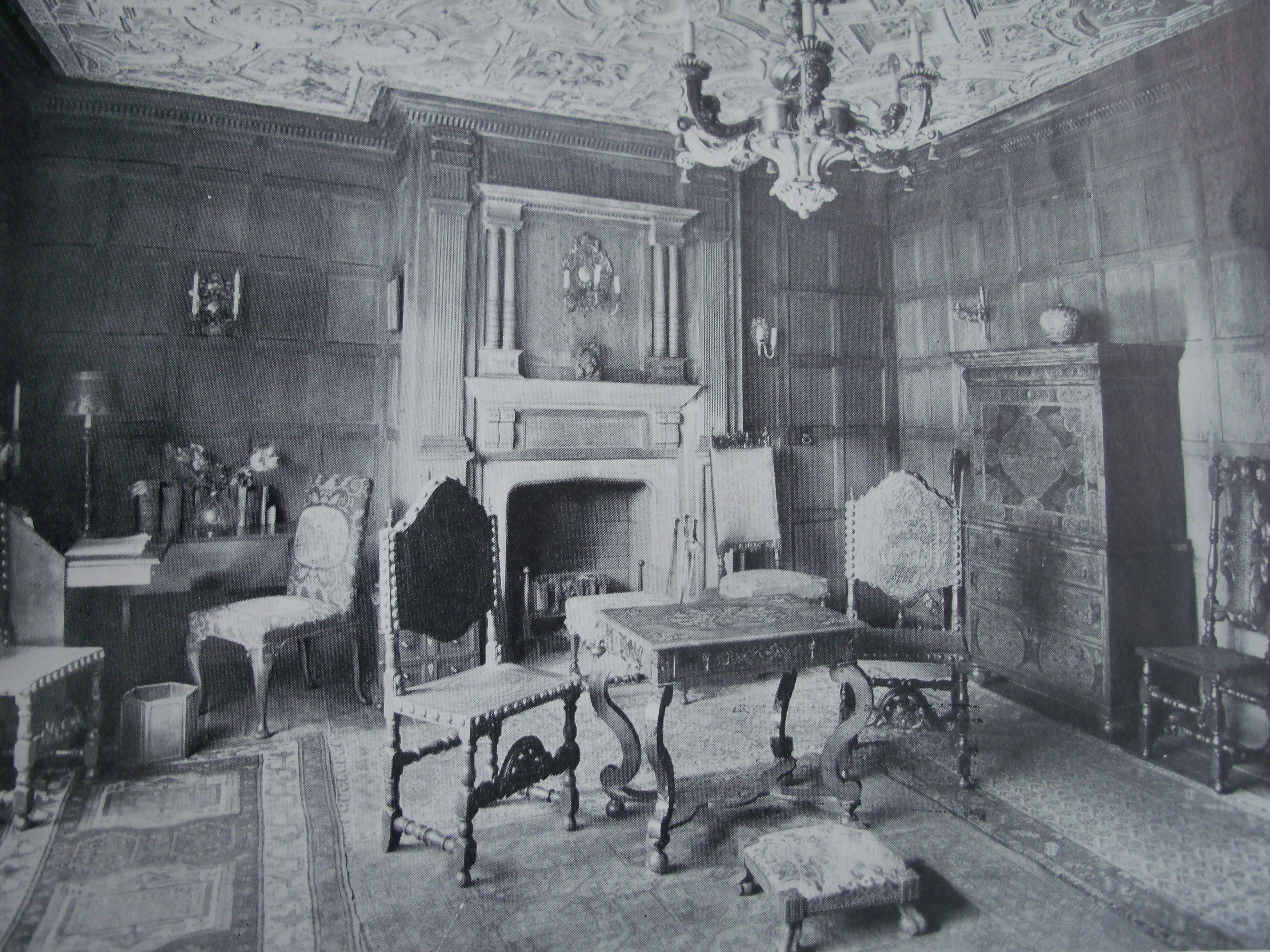
The project interactive map website, at present, includes entries for ‘Keeble’ – and trading at 10 Carlisle Street, indeed we even have an image of the interior of their shop, dated 1927.

Keeble Carlisle House Carlisle Street London Oct 1927 Conn The Oak Room at Carlisle House

Keeble (1914) Ltd, Carlisle Street, ‘Oak Room’, 1927.

Parkenthorpe were trading at the time at 79 Ebury Street, as ‘dealers in antiquities’ – see again our project interactive map.

We can get a sense of the attention to authentic detail in the room settings for the play ‘Quinneys’ from the stage directions in the play script; the play opens in ‘The Sanctuary in Quinney’s house in Soho Square’ (one can note here that there is an extra layer of authenticity here, as the antique dealers Thornton Smith, in real life, also had premises in Soho Square)…and the stage directions continue:

‘The rise of the curtain discloses a beautiful room, filled with rare and costly furniture, prints in colour, miniatures and tapestry. Obviously the room belongs to a collector who is a connoisseur….between the windows is a magnificent Chinese lacquer cabinet, standing on a Charles II gilded and carved stand. On the cabinet is a Kang He mirror-black bottle about twenty inches high. An Adam’s mantelpiece, with dog grate, in which logs are burning….an incised lacquer screen, with a gilded Carolean chair in front of it. Upon the mantelpiece are a set of five blue-and-white jars, Oriental china of the eighteenth century. An old Aubusson carpet is on the parquet floor…..there is not much furniture, but it is of the finest Chippendale period….’

The description suggests a display of all of the most fashionable antiques of the period…the ‘Kang He mirror-black bottle’ was of the, then, hugely expensive, so-called famille-noir Chinese ceramics, collected by major figures such as Lord Lever during the opening decades of the 20th century.

Quinney/Rohan is certainly becoming a fascinating case-study of the evolving social and cultural identity of the antique dealer!

Mark


November 23, 2015

New student volunteers for the interactive map

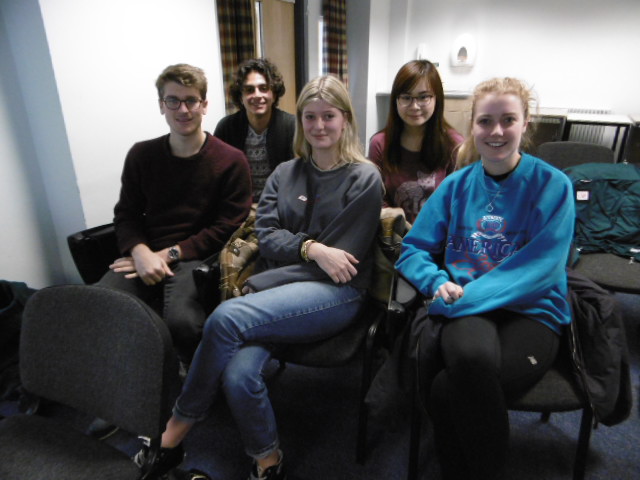
We are very lucky to have some new volunteers for the Antique Dealer project – 5 of our year 2 undergraduates at the University of Leeds have stepped forward to offer help on inputting data into the Interactive Map website for the project.

Leeds Uni UG volunteers

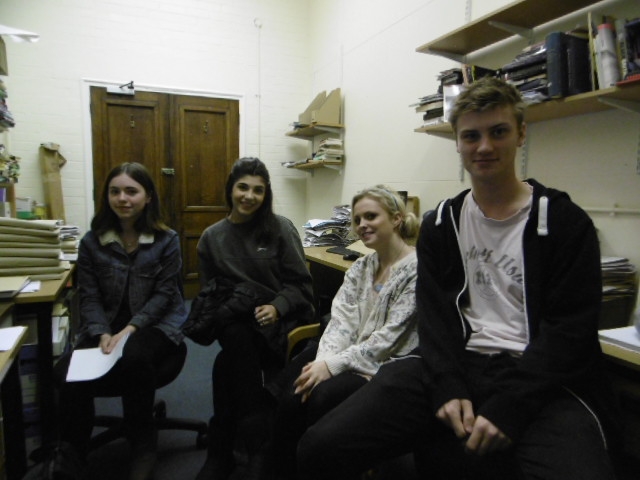
University of Leeds student volunteers – left to right – Henry, Konstantinos, Matilda, Wing, and Minty.

All of the students are taking the undergraduate module ‘The Art Market: Moments, Methodologies and Meanings’ as part of their BA (Hons) programmes in the School of Fine Art, History of Art and Cultural Studies at the University of Leeds – so they have specific expertise in the history of the art market!

It’s great to welcome Henry Dowson, Konstantinos Michailidis, Matlida Humphreys, Wing Li, and Araminta Martin to to the project – they will be adding new dealerships and locations into the interactive website, as well as editing existing locations and correcting incorrect locations of dealerships – so really, really important work!

Thank you to the extraordinary generosity of our UG students at Leeds…they join a growing band of volunteers on the AHRC Antique Dealers project!

Mark

November 3, 2015

BADA Commemorative Plates 1919

Whilst having a meeting with Mark Dodgson, Secretary General of the British Antique Dealers’ Association, on Friday last week (regarding the Antique Dealer project conference in April, amongst other things), I noticed a small display of 6 plates on the windowsill of Mark’s office.

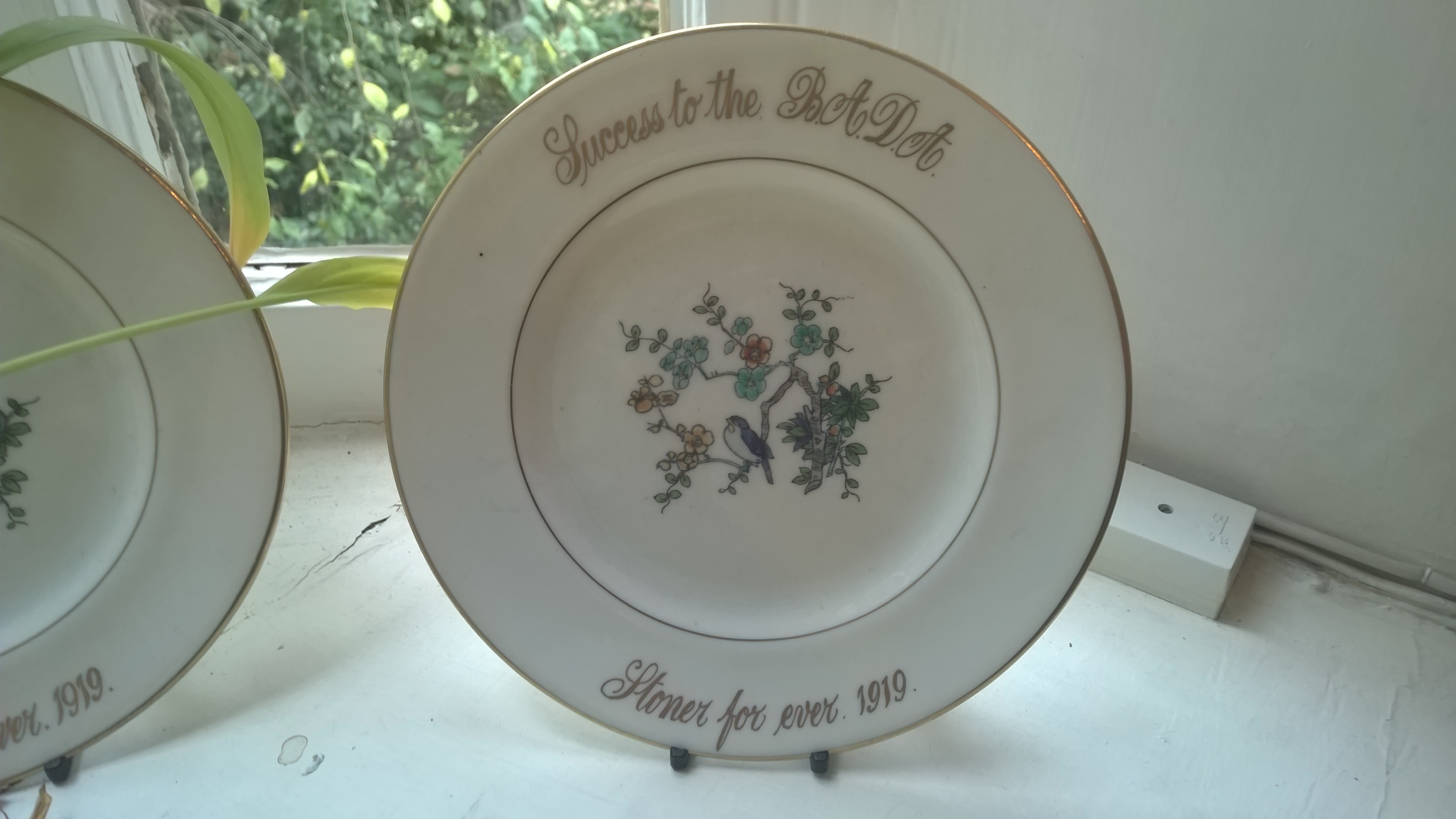
Stoner plate 1919

BADA Commemorative Plate, c.1918-19. Photograph copyright AHRC Antique Dealer project, University of Leeds.

All of the plates had the same painted inscription ‘Success to the BADA’ at the top edge, and each had a separate, individual inscription on the lower edge.  This one (above) has ‘Stoner for ever. 1919.’ on the bottom edge.  The plates themselves are relatively inexpensive, mass-produced objects – (Mark kindly told me they have a printed mark ‘Crown Staffordshire’ on the back) – so they are pretty common everyday ware. Three of the plates have printed decoration of a small bird in a branch of a tree – the style keys into the Chinoiserie revival of the 1910s and 1920s; the other three had similar, but hand-painted, decoration.

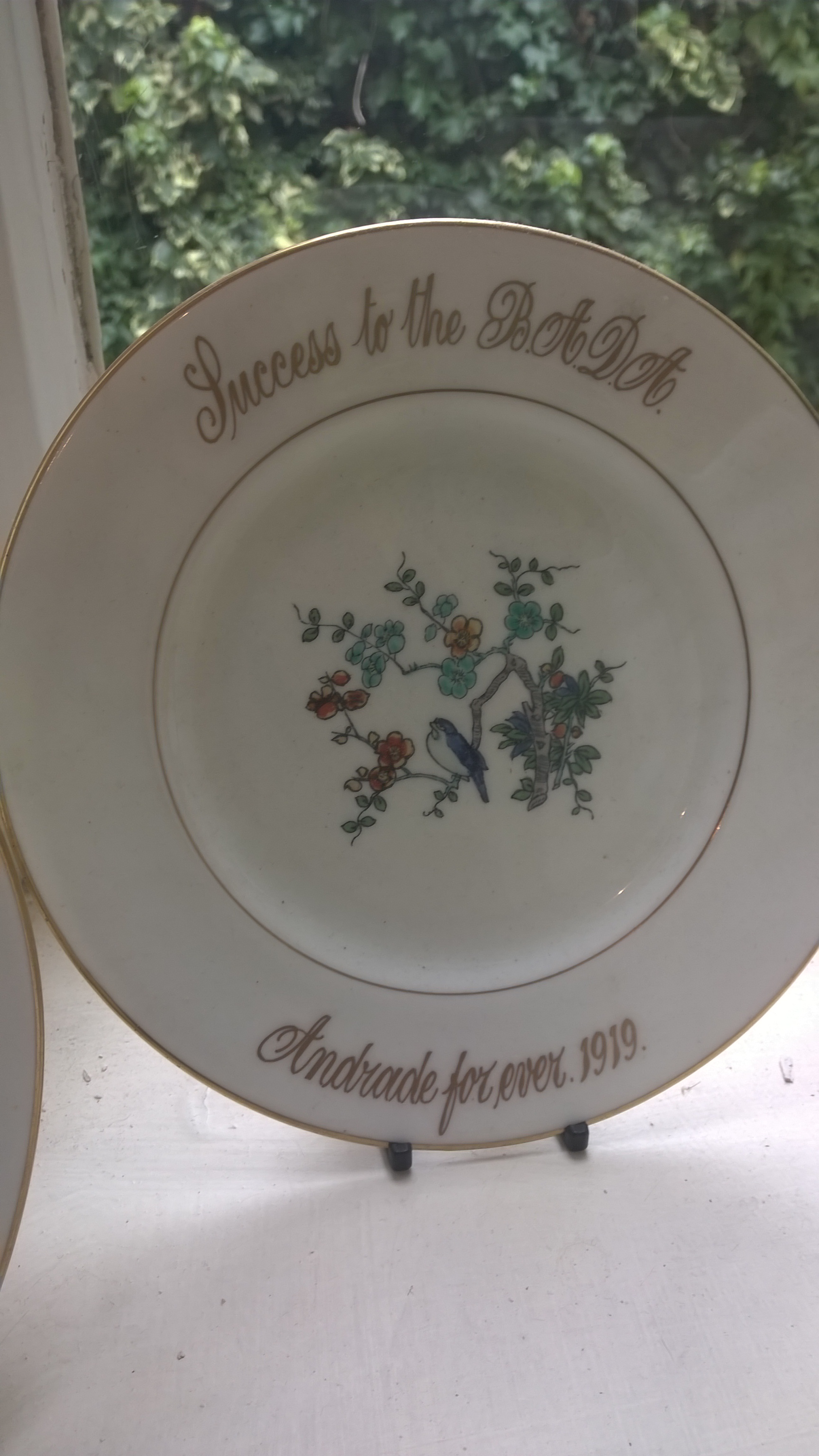
Andrade plate 1919

‘Andrade for ever 1919’. Comemmorative plate. Photography copyright AHRC Antique Dealer project, University of Leeds.

The inscriptions on the plates refer to the foundation of the BADA, which began just a year earlier, on May 7th 1918. The story of the founding of the BADA is by now very well known I guess, but one of the reasons for the founding of the Association was as a response to the proposed Luxury Duty that was to be introduced in the Finance Act of 1918.

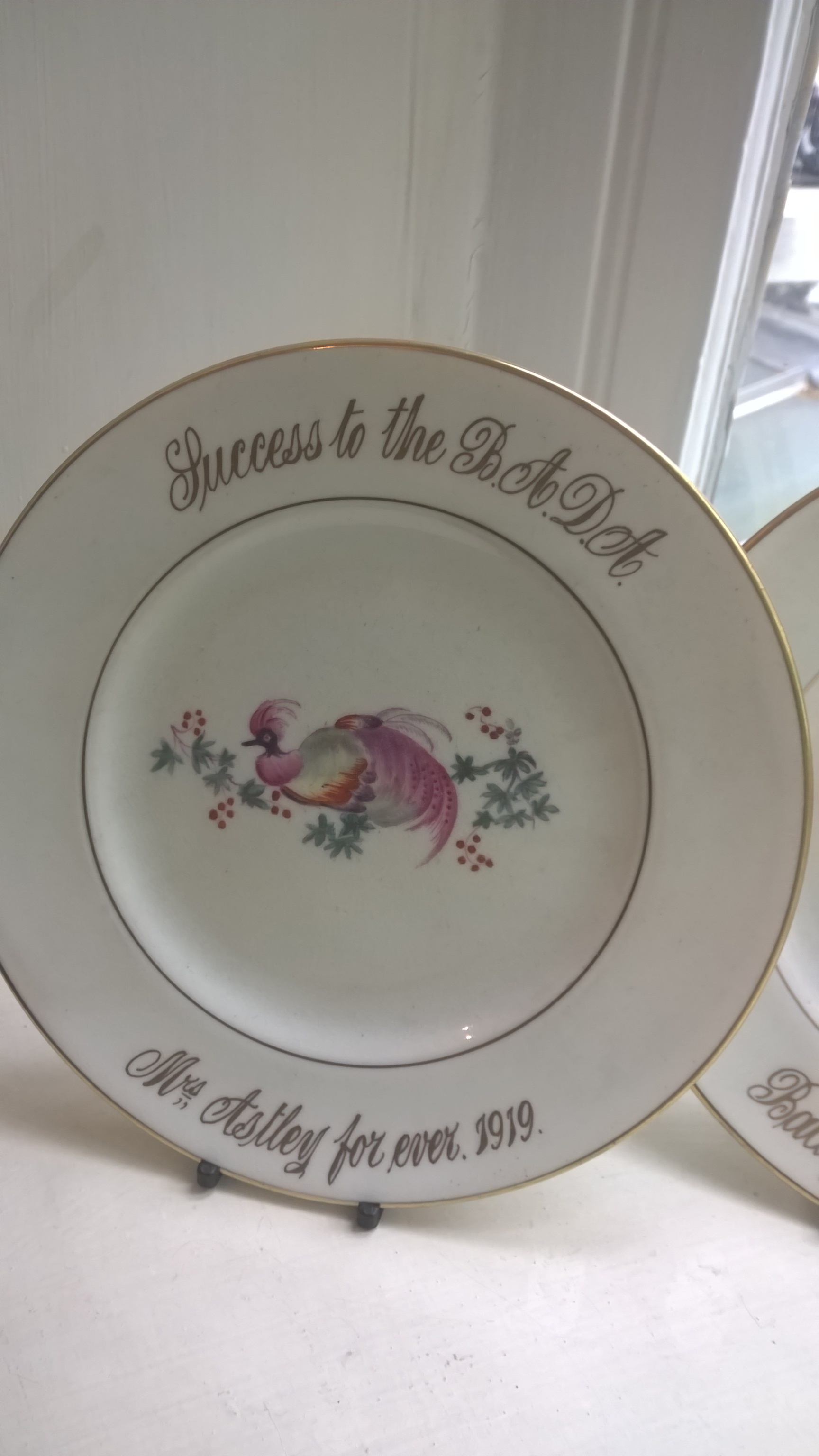
The plates are variously inscribed – the one above is inscribed ‘Andrade for ever. 1919.’ Other plates are inscribed ‘Mrs Astley for ever, 1919.’ (below); ‘Thomas for ever. 1919’; ‘Law for ever. 1919.’; and ‘Evans for ever. 1919’.

Astley plate 1919

‘Mrs Astley for ever. 1919.’ Commemorative plate c.1919. Photograph copyright AHRC Antique Dealer project, University of Leeds.

The plates obviously celebrate founding members or early members of the BADA – Stoner, for example, probably refers to George Stoner, who was one of founder members of the BADA in 1918.  Sadly George Stoner, a Vice-President of the BADA, and the father of Frank and Malcolm Stoner, died aged 50 in 1920, shortly after the foundation of the Association – the dealership was named ‘Stoner & Evans’, and was trading at 3 King Street, St. James’s, London at the time.

‘Andrade’ would be Cyril Andrade, then trading in Duke Street, St. James’s, London; ‘Mrs Astley’ would be Florence Astley, also trading in Duke Street, St. James’s in the same period. There were three further plates – one inscribed ‘Evans for ever. 1919.’ – probably for the Mr Evans who was partner in Stoner & Evans, although there was also a silver dealer, ‘Evans & Co’, but I’d think it was for the chap from Stoner & Evans.

The other plates were inscribed ‘Law for ever. 1919’ for Charles Law, of the dealers ‘Law, Foulsham & Cole, then trading from 7 South Molton Street, London, and ‘Thomas for ever. 1919.’ – Thomas was the formidable dealer C. Rochelle Thomas, the President of the BADA for 1919, and then trading at ‘The Georgian Galleries’ 10, 11 & 12 King Street, St. James’s, London, along with his sons, Victor Joseph Rochelle Thomas and Alfred William Rochelle Thomas.

The plates are fascinating pieces of ephemera associated with the founding of the British Antique Dealers’ Association – I just wondered if there were any more of these plates surviving?…there appear to have been 16 founder members of BADA in 1918, so maybe there are at least another 12 plates somewhere?… but the 6 plates here also include members who were not listed as founders, such as Florence Astley, who must have joined sometime after March 1918 and before the plates were inscribed in 1919…..so perhaps there are scores of them out there!

Mark


October 10, 2015

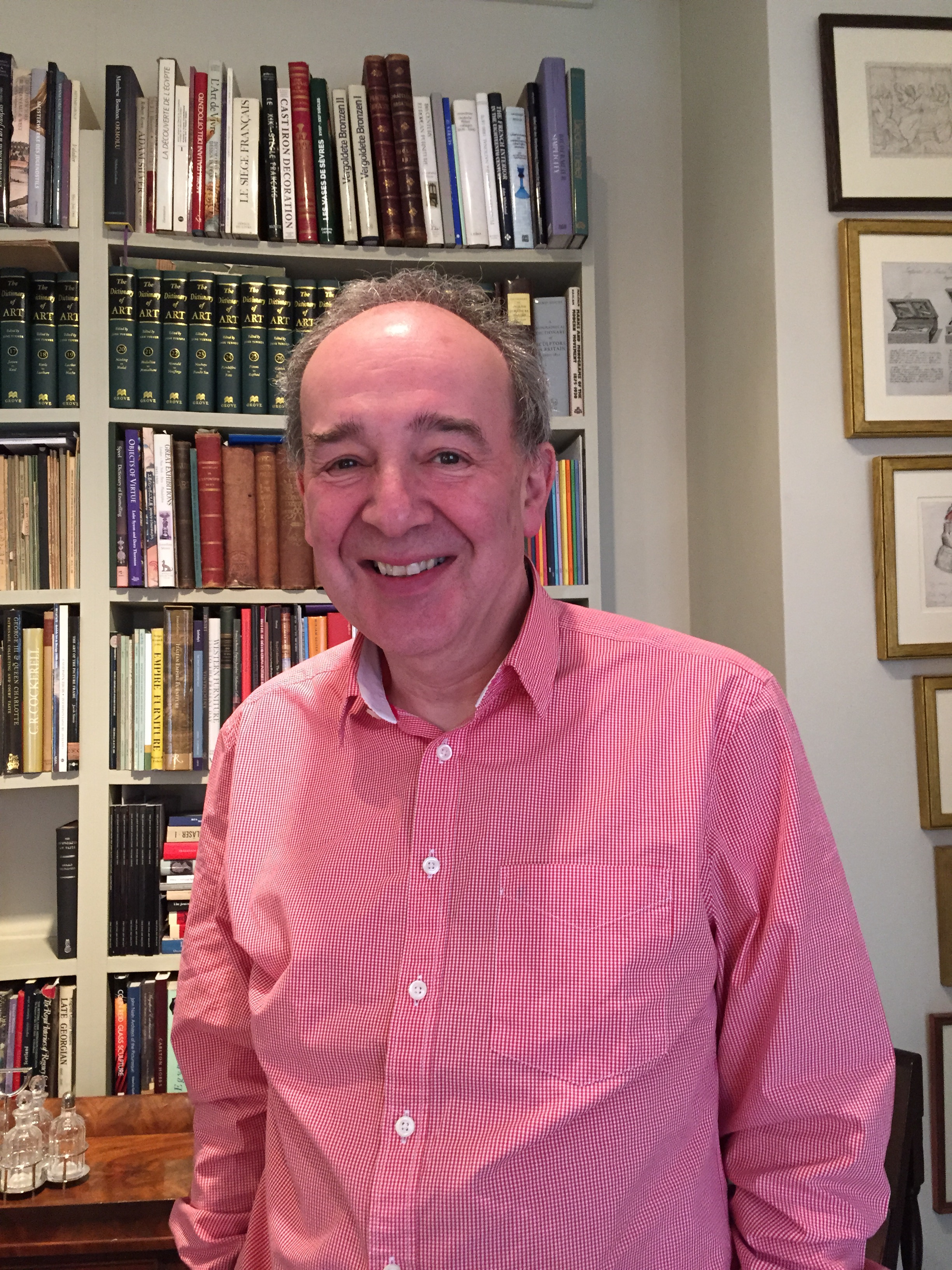
Yet More Oral History Interviews! – Martin Levy, of H. Blairman & Sons

Our oral history research is really gathering pace now – yet another one ‘in the bag’ – this time with Martin Levy, of the old established antique dealers H. Blairman & Sons (established 1884) – very well known to those interested in the history of the antique trade.

M Levy

Martin Levy, 2015. Image copyright H. Blairman & Sons.

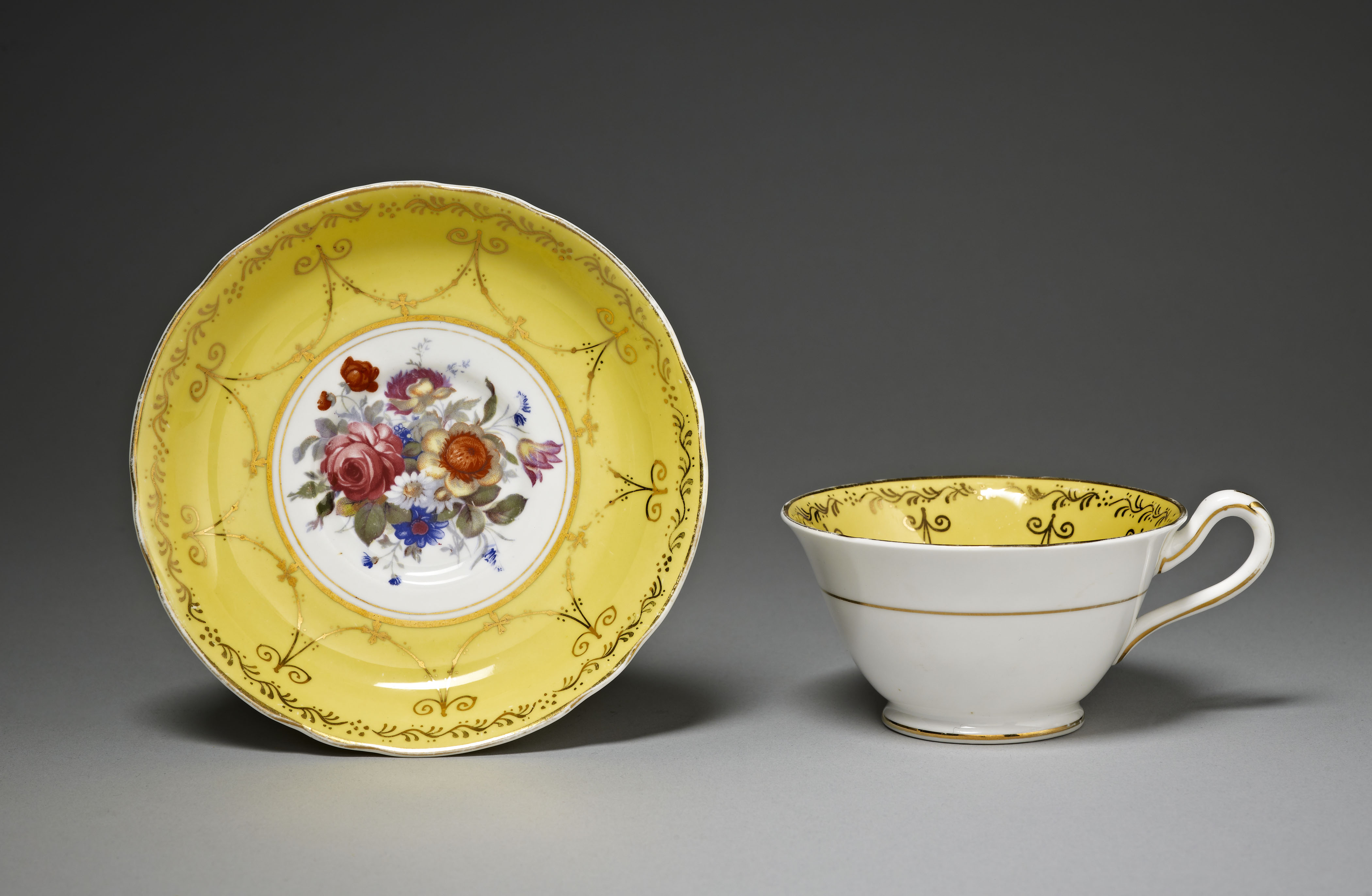
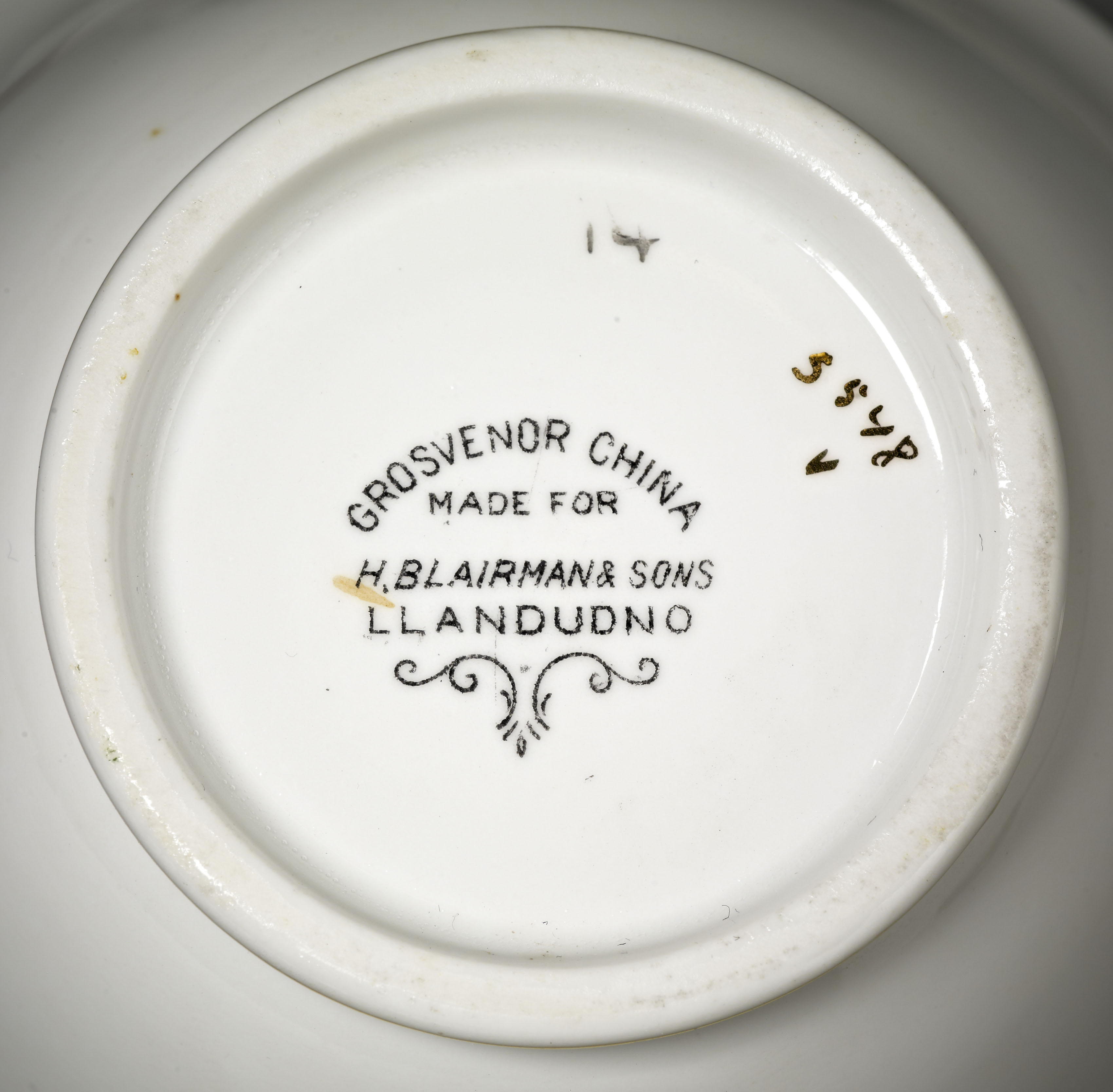
During a fabulously interesting interview Martin outlined the early history of H. Blairman & Sons, from their beginnings in a shop in Llandudno, where, as Martin recently discovered, the business also sold contemporary ceramics alongside antiques – this 19th century cup and saucer, with a back-stamp indicating that it was retailed by H. Blairman is a testament to those trading practices (see our earlier blog entry on these practices too – blog entry for MAY 2014 – and Blairman & Sons website H.Blairman & Sons Limited.

Photograph copyright, Blairman & Sons, London.

Photograph copyright, Blairman & Sons, London.


Photograph copyright Blairman & Sons, London

Photograph copyright Blairman & Sons, London

The Blairman family were originally emigres from Poland in the late 19th century, and initially Harris Blairman (Martin Levy’s great-grandfather) entered into a partnership with a dealer in Birmingham, before establishing the business in Llandudno. For some further detail on the history of H. Blairman & Sons do look at the history of Blairman, composed by Martin, on the Blairman website.

Martin also told us of his interest in 19th century and early 20th century designed objects – in which he has also been something of a pioneer in more recent times – and his memories of working with his father, George Levy (who joined the firm in 1949), as well as Martin’s memories of his own early days after joining the business in the mid 1970s.  Martin also has some wonderfully engaging reflections on the changing taste in antiques, on people that influenced his development as a dealer, and on his passion for objects and their history.

The interview will be soon be made available via the project websites – once we get it edited and etc.

Mark

October 7, 2015

More Oral History Interviews – Frank Partridge

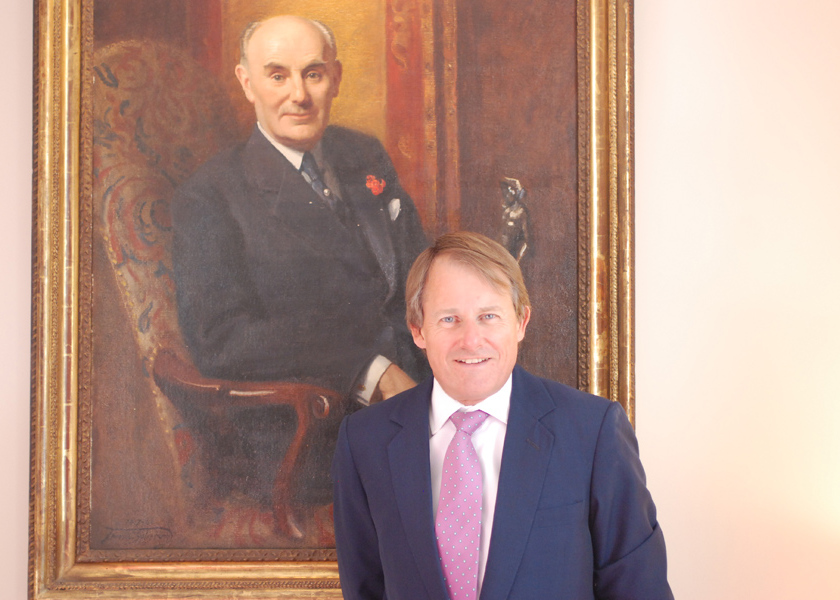
We are gathering quite a collection of Oral History interviews for the Antique Dealers project – we now have 19 interviews in our database…with more still to come! Our latest interviewee was Frank Partridge, the great-grandson of the founder of perhaps one of the world’s most famous antique dealing firms, Frank Partridge & Sons, of London and New York. In a really engaging interview, Frank told us about the early history of Partridge & Sons – the family were originally Cobblers in Hertford apparently, before moving into the antique trade in the late 19th century. Here, below, is Frank Partridge, standing in front of a portrait of his great-grandfather – Frank is a very experienced antique dealer, having been in the antique business for almost 40 years….

Frank Partridge

Frank Partridge. Image copyright Frank Partridge Limited.

Robert Partridge, the brother of Frank’s great-grandfather, was the first to set up in business as an antique dealer, in c.1900 – and here’s an image of R.W. Partridge’s shop in c.1910 – ‘Top Red Gallery’ in King Street, St. James’s, London. Robert was one of four Partridge brothers, all involved in the antique trade; Frank senior set up the eponymous firm in c.1905.

Partridge Top Red Gallery

R.W. Partridge, Top Red Gallery. c.1910.

Frank joined the family business in c.1981, before leaving to set up his own antique business in 2004. As readers of the blog will probably know, Frank Partridge & Sons was sold in 2006, and eventually ceased trading shortly afterwards.   During the interview, Frank offers some fascinating reflections of the changes to the antique trade over the last 40 years – as well as observations on the conditions and networks of the various antique markets in Britain, the USA and in France. He also told us about Partridge’s relationships to major collectors, such a J.Paul Getty, and other international dealers such as French & Company, of New York.

As with all of the other interviews we have completed, we are in the process of editing the interview, ready for uploading into the project websites for future generations of researchers and interested parties, to enjoy.

Mark


September 29, 2015

Oral History Interviews – Harry Apter

Our Oral History interviews continue apace – we recently interviewed Harry Apter, of Apter-Fredericks, the Antique English Furniture Dealers in Fulham Road, London. In a very engaging interview, Harry told us about when he joined the firm of Apter-Fredericks aged 18 and how his father, Bernard Apter, taught him about antique furniture.

Harry Apter Photo

Harry Apter, of Apter-Fredericks, London. Photograph copyright Antique Dealer project, University of Leeds.

Harry also described the significance of Fulham Road as part of the London antique 18th century furniture trade – indeed with so many antique furniture shops in one street it was known as the ‘Brown Mile’ (after ‘Brown Furniture’….the, now rather disparaging, term for 18th century mahogany furniture). Harry also told us about the buying trips he made to Yorkshire and the West Country, of his work on the Vetting Committee at Masterpiece Fair, and his reflections on the future of the antique trade.

Thank you again to Harry for taking the time to talk to the project team.

Mark

September 13, 2015

Antique Dealing in Scotland – Rosehaugh auction 1954

I’m on holiday in Scotland, but still thinking about ‘Antique Dealers’! – we are staying in  small cottage, a converted ‘powerhouse’ c.1900 which was formerly part of the enormous late 19th century house ‘Rosehaugh’, on the Black Isle, near Avoch – anyway whilst whiling away the hours in this beautiful place, I came across a little booklet in the cottage on the history of Rosehaugh (Rosehaugh, a house of its time, John Mills, Hilda Hesling, Magdalene MacLean and Kathleen MacLean, 1996). And antique dealers appear quite prominently in the story of the house – inevitably I would suggest!

The ‘big house’ no longer exists, it was extensively remodelled and extended in the 1890s by the architect William Flockhart, and was demolished in 1959.

Rosehaugh House remodelling by W Flockhart 1883

William Flockhart’s presentation drawing for the proposed remodelling of Rosehuagh, 1893. Image copyright Avoch Heritage Association.


the demolition 1959 view from west

The demolition of Rosehaugh, 1959. Image copyright Avoch HA.

Both during the assembly and dismantling of Rosehaugh, prominent antique dealers played their role; during the construction of the house, J J Duveen supplied much of the historic panelling to the rooms, including this (seemingly) 18th century boiserie for the Drawing Room.

drawing room Duveen

The Drawing Room, Rosehaugh, c.1900. Panelling supplied by Duveen. Image copyright Avoch HA.

It’s probably no coincidence that William Flockhart, the architect of the remodelling at Rosehaugh, also designed the interiors of the New Bond Street showroom of Duveen. And according to the Rosehaugh booklet, Duveen also supplied some Boucher tapestries for the Drawing Room.

The dispersal auction sale also involved the antique trade; the auction was organised and conducted Thomas Love & Sons, Perth, the well-known antique dealers, house furnishers and, obviously, auctioneers, and took place in 1954. Love’s had consigned most of the more valuable contents to sale in London before conducting the auction on site at Rosehaugh – Love & Sons had been established in 1869, as auctioneers and general house furnishers, but also had a large antiques department as part of their business (the business closed in 2009).

the sale 1954 Tho Love and sons

The auction sale at Rosehaugh, 1954. Image copyright Avoch HA.

At the auction sale, which took place over 8 days in late August and early September 1954, a number of antique dealers made significant purchases. A dealer named John Beadle, from Hounslow, London, bought the French panelling that had been supplied by Duveen, paying £400 for the room and lighting fitments. Another object sold, although not known if it was bought by the trade, was a rare Sevres porcelain and ormolu mounted clock by ‘Kinable’ (lot 572, sold with a pair of pastel burners, for £310).

sale cat French clock by Kinable lot 572

Lot 572 in the Rosehaugh auction sale of 1954. ‘A clock by Kinable’. Image copyright Avoch HA.

Dieudonne Kinable (active c.1780-1825) was one of the most prominent clockmakers in Paris in the period, and examples of this ‘lyre’ model of Sevres clock are in several major museum collections, including the V&A, The Royal Collections, The Louvre and The Walters Art Museum in the USA.

Anyway, I thought it was interesting, if as I say perhaps inevitable, that the antique trade played such a central role in both the assembly and dispersal of what must have been a very significant collection of antiques.

Mark


September 2, 2015

The changing geography of the antique trade 1976-2000

Further to our summer competition on the top ten locations for antique shops in Britain in 1976, we thought it would be useful draw from the research into the antique shops of 1976 and do a comparison with the year 2000 – we do this in order to highlight again the academic objectives of the research project and draw further attention to some of the significant changes in the ecology of the antique trade over that period.

As many of you you already know, the British antique trade underwent a significant transformation around the time of the millennium – this was also one of the catalysts for the development of this particular research project – and a large number of antique dealers withdrew from the market or changed their patterns of activity during the last 15 years or so. The catalysts for this transformation are wide ranging and complex, driven as there were by rapid developments in technology, shifts in social behaviour, as well as changes in notions such as ‘expertise’ and the knowledge of objects of value – ‘expertise’ has been both decentered and recalibrated in the last 20 or so years.  Moreover, one of the key drivers for the rapid change in ‘taste’ in the last 20 years also appears to have been a more abstract shift towards the contemporary – the extraordinary rise in the market for contemporary art is just one of a number of symptoms of this shift. In the market for ‘antiques’ we have seen a significant decline in the interest for things such as antique furniture, alongside the increased interest in modern/contemporary and designer furniture and objects. This shift in value systems is of course a consequence of extremely complex social, cultural and political phenomena, and there is no space here to even begin to address the frameworks for these rapid changes – suffice to say that the antique trade has changed significantly over the last 15-20 years – and part of the objectives of the current research project is to investigate this shift.

Anyway, one of the pieces of evidence of the recent changes in the cultural geography of the trade is the shifting patterns and concentrations of antique shops in Britain – and you thought that our summer competition was just a piece of frivolous whimsy! And so we thought a comparison between 1976 and 2000 would be an interesting thing to do; and here are some of the results….they make very interesting reading (we are doing more analysis of this data of course!)

1976-2000 Antique locations – the TOP TEN as they were in the competition:

Brighton (96 dealers in 1976; 46 dealers in 2000) – down 48%

Bournemouth (61 dealers in 1976; 22 dealers in 2000) – down 64%

Bath (51 dealers in 1976; 54 dealers in 2000) – up 6%

Bristol (50 dealers in 1976; 24 dealers in 2000) – down 52%

Manchester (37 dealers in 1976; 21 dealers in 2000) – down 43%

Nottingham (36 dealers in 1976; 13 dealers in 2000) – down 64%

Chester (36 dealers in 1976; 22 dealers in 2000) – down 39%

Harrogate (35 dealers in 1976; 25 dealers in 2000) – down 29%

Sheffield (32 dealers in 1976; 16 dealers in 2000) – down 50%

Birmingham (32 dealers in 1976; 21 dealers in 2000) – down 34%

York (30 dealers in 1976; 10 dealers in 2000) – down 67%

Leeds (30 dealers in 1976; 9 dealers in 2000) – down 70%

Glasgow (30 dealers in 1976; 20 dealers in 2000) – down 33%

Oxford (29 dealers in 1976; 7 dealers in 2000) – down 76%

Windsor (29 dealers in 1976; 19 dealers in 2000) – down 34%

And London – (1233 dealers in 1976; 766 dealers in 2000) – down 38%

The figures themselves are somewhat of a blunt instrument, but they do point towards a significant change in the geography of the antique trade over that period. And beneath these figures are some further significant shifts and changes – an increase in ‘vintage’ and ‘retro’ objects can already be detected in the data for example.

As you can see, all of the top ten locations, apart from Bath, decreased significantly over the last 24 years of the 20th century.  The small increase in the number of dealers in Bath is mirrored in the increase in activity in locations such as Stow-on-the-Wold (1976 -11 dealers; 2000 – 30 dealers) and in other well-known antique centres such as Tetbury (10 dealers in 1976; 26 dealers in 2000), Cheltenham (21 dealers in 1976; 36 dealers in 2000) and Lewes (8 dealers in 1976; 21 dealers in 2000). But these relatively small increases in activity do not mask the rapid decline in the number of antique shops more generally – and this is a trend we are looking into further.

FYI – one of the most intriguing statistics for the concentrations of dealers was at the County level -now of course there are various explanations for the concentrations of antique dealers in a county area – not least of which would be the size of the county itself (and, as we know, county boundaries are always changing too, so comparisons are not always like-for-like).  But guess which county had the most antique dealers in 1976?…..no, it’s not Surrey (198), or Kent (228), or East Sussex (helped by Brighton, which had overall 215)….

Guessed yet?

It was Lancashire!…Yes, Lancashire…who’d have thought it (not me anyway!) – it had 240 dealers in 1976.

Now how many do you think it had in 2000?….

99.

I detect a North-South shift here….and this is very intriguing indeed – the social/cultural demography of the antique trade could be a fascinating barometer of the wider social demography of Britain?

Mark

August 22, 2015

Summer Competition – WINNERS!

Our Summer Competition closed yesterday – thank you to all who sent entries and tried to guess the top THREE locations for Antique Shops in Britain in 1976.  We had entries from all over the UK, we also had one entry from the USA! Thank you to all of those that entered the competition….we hope you enjoyed trying to work out the top three locations.

We are very pleased to announce that we have TWO winners!

Patricia Walsh, from Lancashire, and Tony Loftus, from Yorkshire: well done to both of you – we will be posting your prizes – copies of ‘A Biographical Dictionary of 19th Century Antique & Curiosity Dealers’ – to you this week. Well done both!

Cover

The competition seemed to have been quite tough as none of the entries actually guessed all THREE of the top THREE locations for antique shops in 1976.  But of all the entries, Patricia and Tony both managed to guess TWO of the top THREE (Brighton & Bath), and we thought that they both deserved to win.

And so, you will all want to know the correct answers of course –

The TOP TEN locations (Cities/Towns) for antique shops in Britain in 1976 are:

  1. Brighton (96 dealers)
  2. Bournemouth (61 dealers)
  3. Bath (51 dealers)
  4. Bristol (50 dealers)
  5. Manchester (37 dealers)
  6. Nottingham/Chester (36 dealers)
  7. Harrogate (35 dealers)
  8. Sheffield/Birmingham (32 dealers)
  9. York/Leeds/Glasgow (30 dealers)
  10. Oxford/Windsor (29 dealers)
August 20, 2015

Even More Oral History Interviews! – Gary Baxter

Our busy schedule of Oral History interviews continues apace this week – on Monday 16th August we interviewed Gary Baxter of the well-known Antique English Furniture specialist dealers H.C. Baxter & Sons. In an absolutely exemplary interview, full of rich historical detail, Gary told us about the beginnings of H.C. Baxter & Sons, established in the late 1920s in Chelsea, London. Here’s Gary in his new shop in Lewes, East Sussex, which he now shares with his sister.

Gary Baxter 2015

Gary Baxter, in Lewes, East Sussex, 2015.

Gary is one of the last in a generation and tradition of antique dealers that stretches back into the opening decades of the 20th century – something that the current research project is keen to map and investigate.

Horace Baxter

H.C.M.V.J. Baxter, c.1950s. Photograph courtesy and copyright of Gary Baxter.

Gary told us about his grandfather, the marvelously named, Horace, Claude, Montague, Victor, John, Baxter – who established the business in 1927. H.C. Baxter – here (above) in a photograph kindly loaned to us by Gary. Horace began the firm in partnership with his sister Maud – (Mrs Maud Chalmers), in a business initially called ‘Chalmers and Baxter’. Indeed, it was as ‘Chalmers and Baxter’ that they showed as one of the antique businesses at the inaugural Grosvenor House Antiques Fair in 1934; as this photograph (again kindly loaned to us by Gary) of their stand at Grosveonr House in 1934 illustrates –

Chalmers and Baxter stand GH 1934

Chalmers & Baxter at Grosvenor House Antiques Fair, 1934. Photograph courtesy and copyright Gary Baxter.

Maude, who was, Gary tells us, much more interested in antique jewellery, opened her own separate antique jewellery shop in Knightsbridge by the mid 1930s, leaving Horace in the antique shop in Fulham Road, London.  Horace was joined in the business by his wife (Gary’s grandmother) Florence Ann Baxter, and later by Gary’s father, Terence Baxter, and his uncle, Roy, before Gary joined the business aged 17 in 1978.

In an interview full of absolutely fascinating detail (Gary should certainly have been an historian!) Gary told us about his memories of being taken around the antique shops and auction rooms of Brighton in the early 1960s, and of the extensive buying trips undertaken by his grandfather and father as they sought antique furniture for their dealer customers in London. H. C. Baxter, as many of you will know, were one of the leading trade suppliers of fine quality English 18th and early 19th century antique furniture during the second half of the 20th century. In our interview, lasting over 2 hours (thanks again Gary for your patience!), Gary described the structure of the antique trade and how it operated, changed, and declined during the course of the late 20th century – the interview will be of considerable interest to our research project, as well as being an exceptional resource for future historians of this fascinating cultural phenomena.

Mark


Home Subjects

a working group dedicated to the display of art in the private interior, c. 1715-1914

The Period Room: Museum, Material, Experience

An International Conference hosted by The Bowes Museum and The University of Leeds

H. Blairman & Sons Ltd

A research project investigating the history of the antiques trade in Britain in the 19th & 20th centuries

Museum Studies Now?

'Museum Studies Now?' is an event which aims to discuss and debate museum and heritage studies education provision.

The Burlington Magazine Index Blog

art writing * art works * art market

East India Company at Home, 1757-1857

A research project investigating the history of the antiques trade in Britain in the 19th & 20th centuries