Whilst our ‘Behind the Scenes of the Year of the Dealer’ posts are ongoing for the next 12 months we thought the blog also needs to continue to post our research updates on the antique dealer research project. So, this blog post focuses on one of our usual themes of stories and information from the antique dealer archives. This time it’s the famous dealer in antique oak furniture and related objects, S.W. Wolsey (1895-1980).
We were recently very fortunate to receive a donation of a large number of albums of photographs (of antique oak furniture and objects) that formed the stock of S.W. Wolsey. The albums were kindly donated to the project by Richard Marshall, who recently administered the Estate of the Luff family – thanks again to Richard! Peter Luff was a great friend of Sam Wolsey – Luff and Wolsey wrote a well-known book, Furniture in England: The Age of the Joiner (Arthur Barker Ltd., London, 1968). Indeed, several photographs in the Wolsey archive photograph albums donated by Richard Marshall were also used in the Furniture in England book.
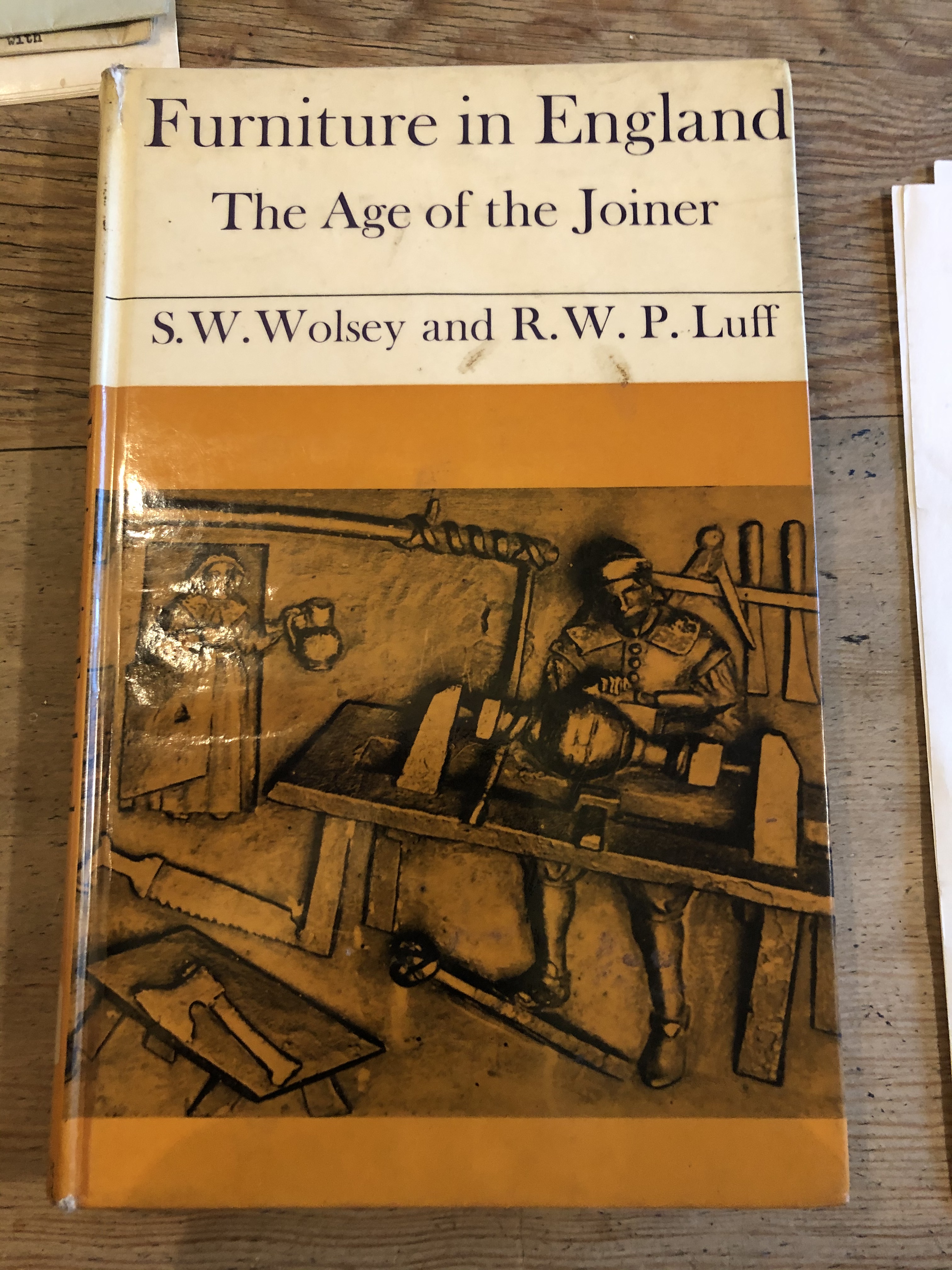
We have posted on S.W. Wolsey on the research blog before (see blog post S.W. Wolsey and Peter Luff 31st December 2020), but just to remind readers, Samuel Wilfred Wolsey was one of the leading dealers in antique oak furniture in the middle decades of the 20th century; the photograph albums contain images of some of the most important oak furniture that passed through the firm of S.W. Wolsey, many of which are now in prominent public museums.
There are scores of objects to highlight in the photograph albums but one example stands out as particularly interesting – especially as it has a long history going back to the start of the ‘modern’ antique trade in the opening decades of the 19th century (see my book The Emergence of the Antique and Curiosity Dealer 1815-1850: the commodification of historical objects (Routledge, 2020), pp.61-72, if you are interested to read more about this.
The object in question is the ‘Lovely Hall’ bed – a 16th century four-post bed that was first illustrated in Samuel Rush Meyrick and Henry Shaw, Specimens of Ancient Furniture (1836) – (see below).

In Specimens of Ancient Furniture (1836) the bed was described by Samuel Rush Meyrick as ‘Bedsted of the Time of Henry the Eight, in the possession of the Rev. Wm. Allen, Lovely Hall, near Blackburn.’ Meyrick’s description continues – ‘This interesting example, which unfortunately has lost its true cornice, no doubt highly enriched, was observed by Mr. Allen in the course of his professional duties, in administering to a dying parishioner the last consolations of religion, and purchased by him after the decease of the sick person from his heir.’ (Specimens, (1836), p.39).
Lovely Hall, Salesbury, near to Blackburn in Lancashire, dates from c.1600 and was owned by the Starkie family from the 1750s until the 1960s, so perhaps Rev. Allen rented the hall from the Starkie family. The bed was transferred to Holme Cliviger Hall, near Burnley, also in Lancashire, sometime after the 1830s, becoming property of the Whittaker family who owned Holme Hall.

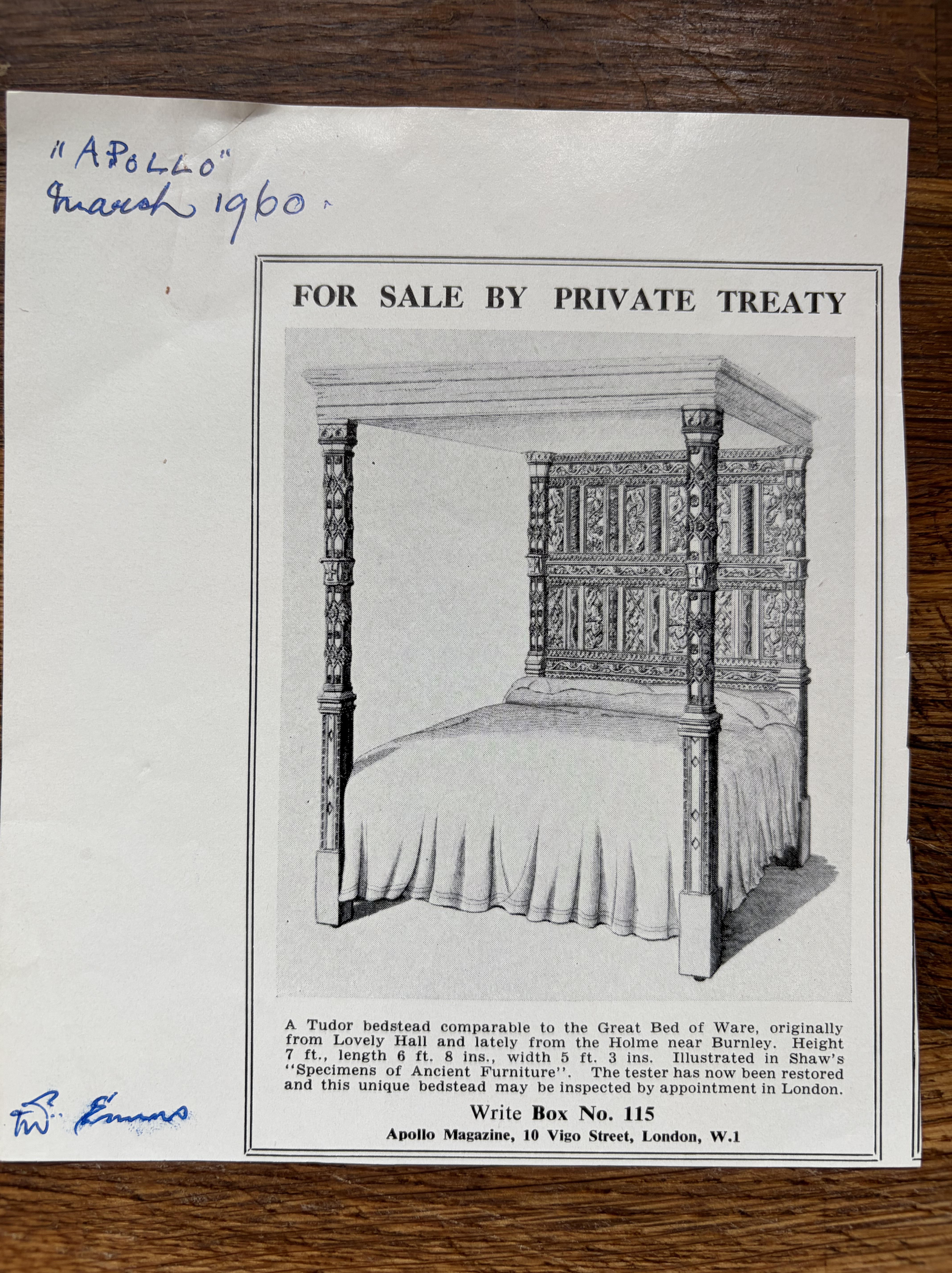
Despite the bed being illustrated in Specimens in 1836 it seems to have been unrecorded again until it appeared on the market in 1960, when it was acquired by S.W. Wolsey. According to some notes by S.W. Wolsey associated with the S.W. Wolsey photograph albums, Wolsey acquired the bed from direct decedents of the Whittaker family. This may be true, but the Whittaker’s sold Holme Hall in 1950 and Wolsey bought the bed from a private collector then living in Putney in South West London (who was not called Whittaker, but may indeed have been a member of the family). The collector had advertised the bed ‘For Sale’ in Apollo magazine in March 1960 (see below) mentioning that the bed was ‘lately from the Holme near Burnley’.
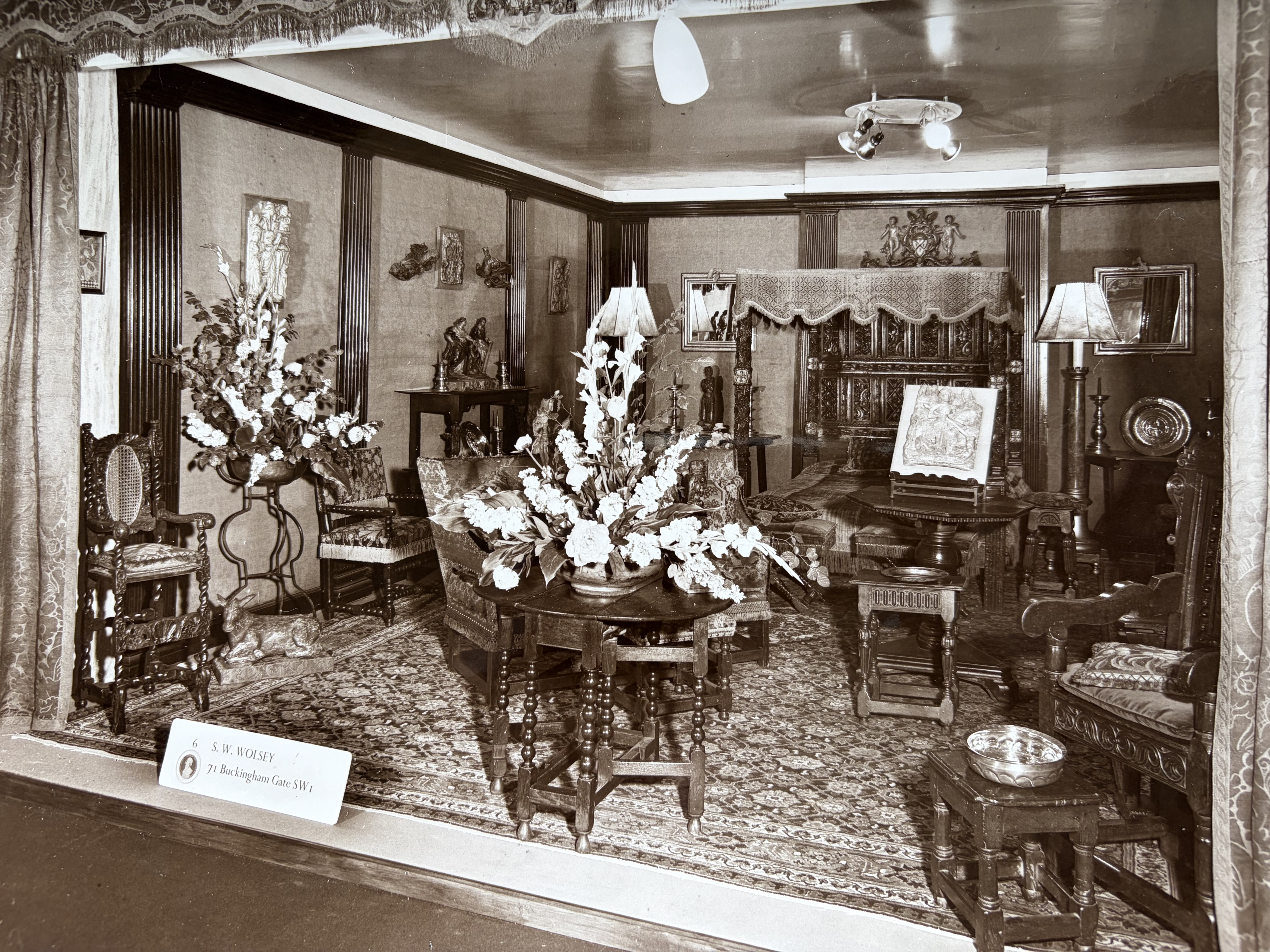
Wolsey displayed his important purchase as a key centrepiece on his stand at the Grosvenor House Antique Dealers Fair in London in June 1961 (see below).
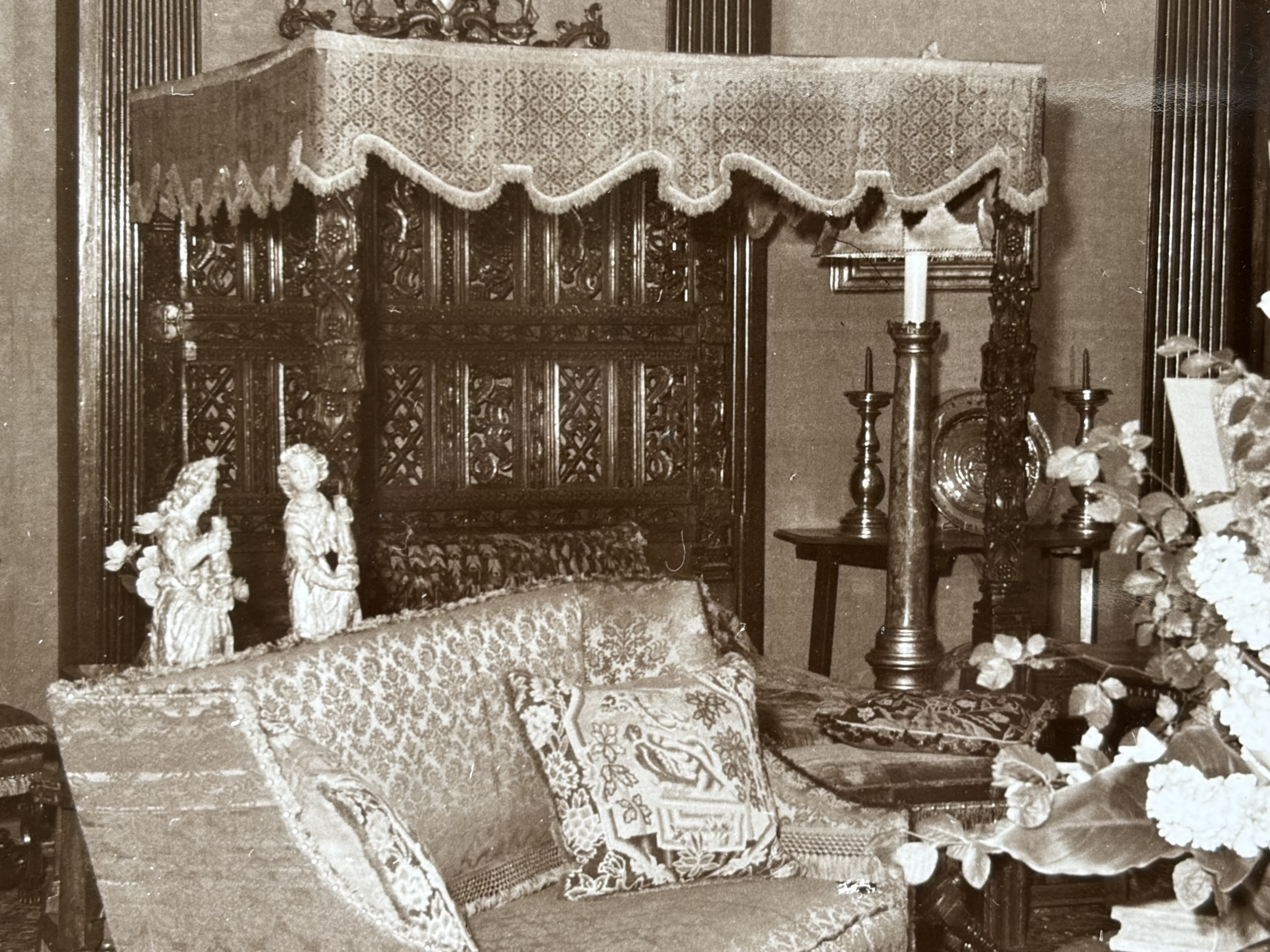
The S.W. Wolsey photograph albums also have several photographs of the bed and details of the frame and carvings, including a photograph of the bed fully assembled in Wolsey’s shop in Buckingham Gate, London (see below).
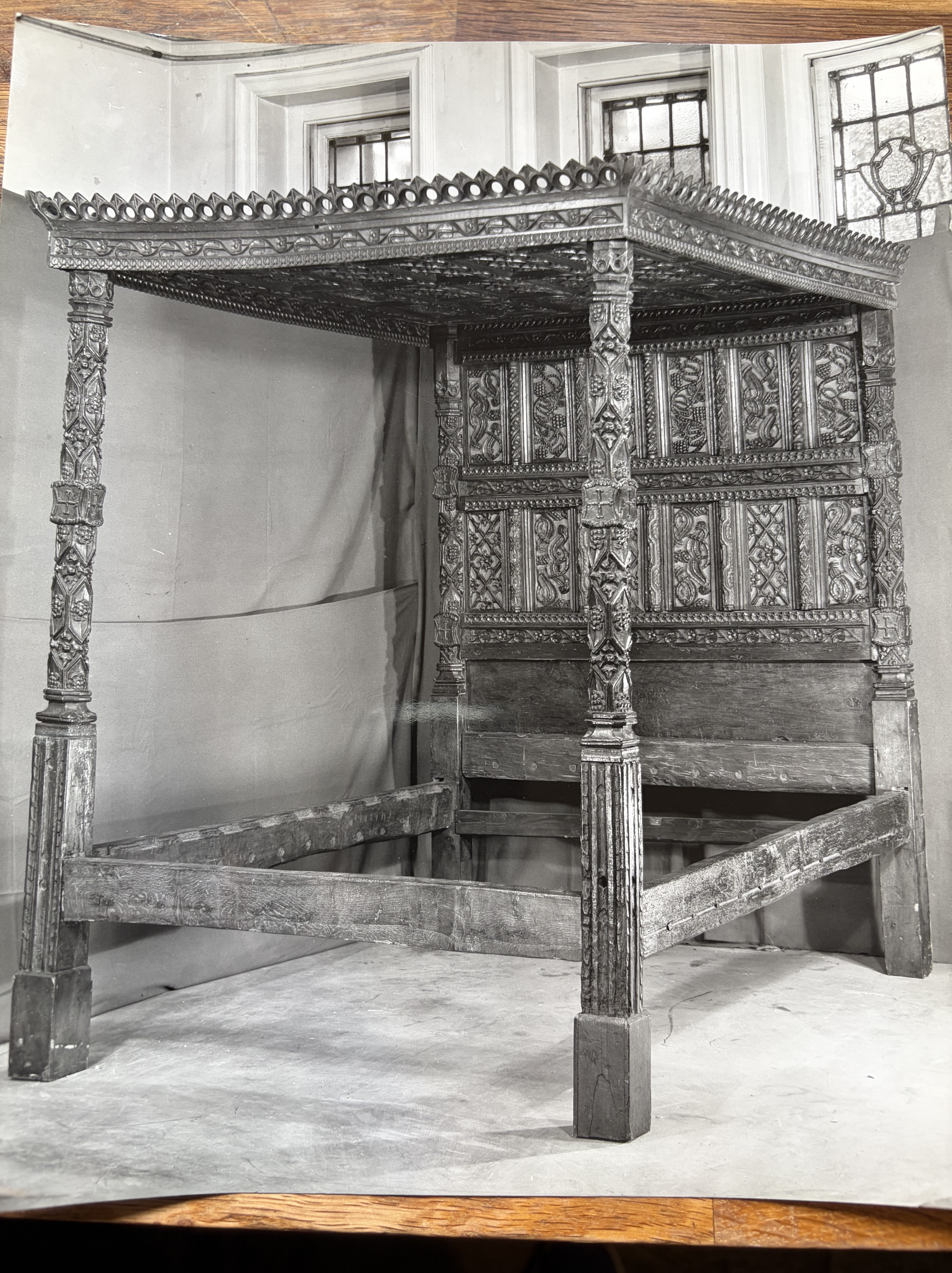
Henry Shaw’s illustration of the bed in Specimens (1836) shows it with a plain cornice. As mentioned, Meyrick’s commentary on the bed highlighted that it had ‘lost its true cornice’ by the 1830s. This was something that S.W. Wolsey also speculated upon in his notes associated with the photograph albums – writing ‘It appears that, following the publication of the Shaw book in 1836, an elaborate and expensive ‘Gothic’ canopy was made for the bed no doubt under the influence of a book by A. Welby Pugin…’ (perhaps Wolsey meant Gothic Furniture in the style of the 15th century designed and etched by A.N.W. Pugin (London, 1835).
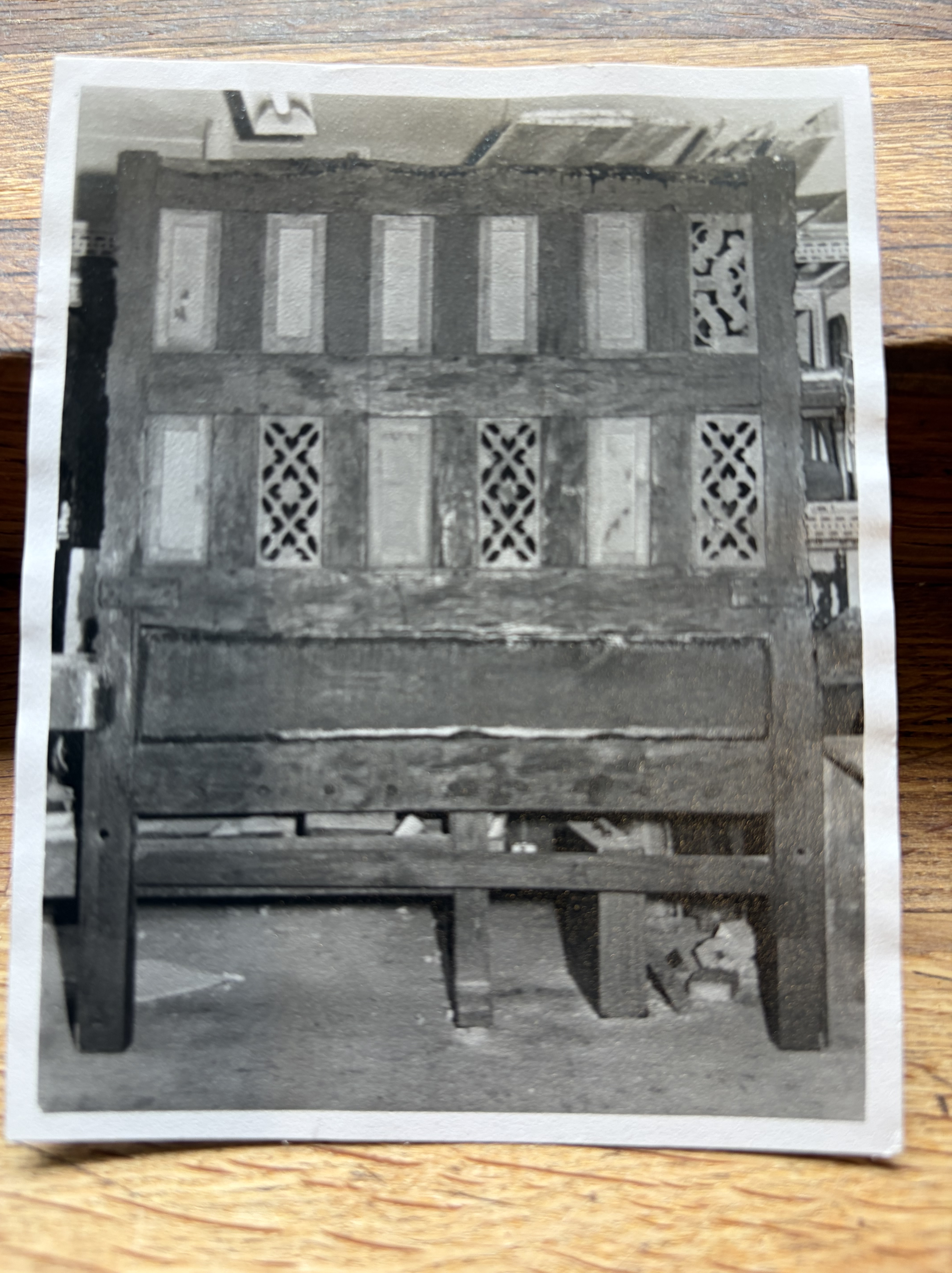
The advertisement of the bed for sale states ‘the tester [canopy/cornice] has now been restored’ but does not indicate how old the restoration might be; it’s probable that the tester was replaced in the 19th century as Wolsey suggests. The Wolsey photographs include some wonderful detailed images of the tester (see below), which as we know is a 19th century copy in the 16th century style; and the headboard (see below) which dates from the 16th century.


It’s interesting that in Wolsey’s display of the bed at the Grosvenor House Antiques Fair (1961), he chose to cover the canopy with a textile hanging – perhaps a compromise to appease the Grosvenor House Antiques Fair vetting committee?
The photographs associated with the bed in the Wolsey photograph albums also include some absolutely fascinating images of the rear of the headboard (see below), which seem to have been taken in a storeroom (perhaps at Wolsey’s shop?). They seem to show various old repairs to the headboard – just as one might expect given that the bed is over 400 years old.
These important photograph albums will be making their way to the Brotherton Library at the University of Leeds in due course. But the key question (for me at least) is where this very famous bed is today? If anyone knows, do send me a note!
Mark


Leave a Reply