Posts tagged ‘Metropolitan Museum’

June 28, 2025

The 1932 Art Treasures Exhibition, London

A couple of months ago my friend and colleague Diana Davis very kindly sent me a link to a short black & white film of the 1932 Art Treasures Exhibition (thank you Diana!), and which obviously pricked my interest as it is full of objects that were being sold by antique dealers. You can watch the film in YouTube (it’s only 2 minutes 49 seconds long) HERE – the original film is part of the wide range of historic films and TV archives held by British Pathe (link HERE).
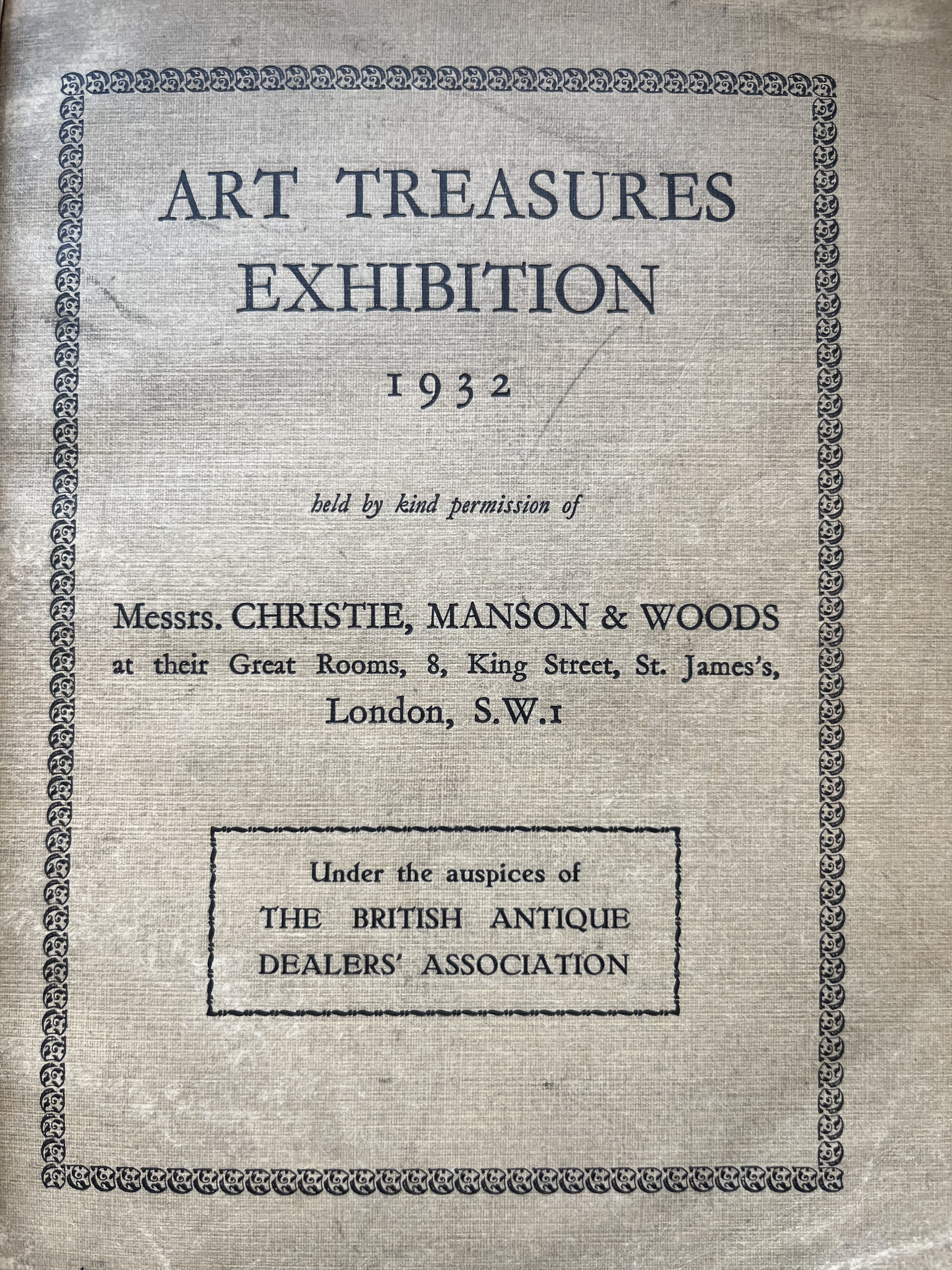
Art Treasures Exhibition 1932 catalogue, front cover. Photo Antique Dealers Research Project, University of Leeds.

The Art Treasures Exhibition, held at Christie’s auction rooms, King Street, London, 12th October to 5th November 1932 and organised by The British Antique Dealer’s Association (BADA) is fairly well-known amongst historians and those interested in the history of the art market. The 1932 exhibition followed on the success of the earlier BADA organised exhibition at Grafton Galleries, London in 1928. Both exhibitions prefigured the establishment of the Grosvenor House Antiques Fair (also known as ‘The Antique Dealers’ Fair’) which began in 1934 – (see also some older blog posts on The Grosvenor House Fair etc in January 31st 2021 and April 23rd 2015).

Fortunately, we have a copy of the 1932 Exhibition catalogue, so it’s possible to match up some of the objects in the film to those in the catalogue and find out which dealers are behind the objects, so I thought it would be an interesting exercise to do that!

The film of the 1932 Exhibition is a fascinating period piece from the early 1930s, obviously created as a publicity newsreel for the exhibition. The narrator (unknown), guides the viewer to some of the highlights of the exhibition at the time, telling the background stories of some of the objects offered for sale by various antique dealers, but also offering a visual insight into the displays at the exhibition. Below, for example, is a screenshot of a general panning shot (do watch the YouTube film for effect) of one of the stands which appears to have a mixture of dealers’ objects – the large pair of urns are certainly item No.237 in the catalogue, ‘A pair of satinwood knife boxes, c.1790, originally made for Lord Northesk’ (the family seat is Ethie Castle, near Arbroath) and offered by the antique dealer Rice & Christy, Wigmore Street, London; the tapestry behind looks like it is No.285 ‘A Beauvais Tapestry, c.1790’, offered by The Spanish Art Gallery, Conduit Street, London; and the display cabinet to the left is certainly No.182 ‘A Chippendale China Cabinet, c.1765′ offered by M. Harris & Sons. So I guess this panning shot was of a collection of various dealers’ objects at the entrance to the exhibition, indicating the sheer range of things offered for sale?
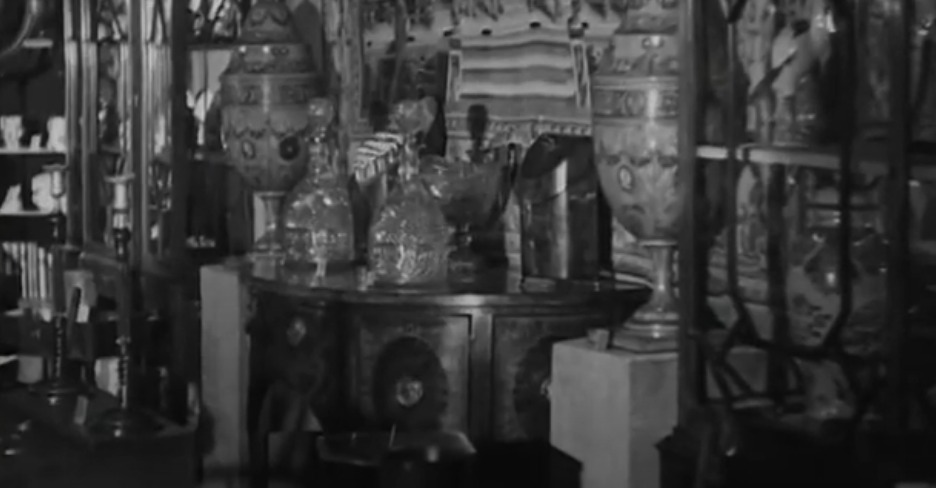
Art Treasures Exhibition 1932, screenshot of general view.

The Exhibition had 1,380 objects, and the film obviously does not cover all of them, but there are 13 objects highlighted in the film, so for those that watch the film, here’s some information on the dealers who were behind the objects (and a little bit of information on where the objects are now, if it has been possible to trace them) – I’ll do this in the sequence of the objects highlighted in the film by the narrator:

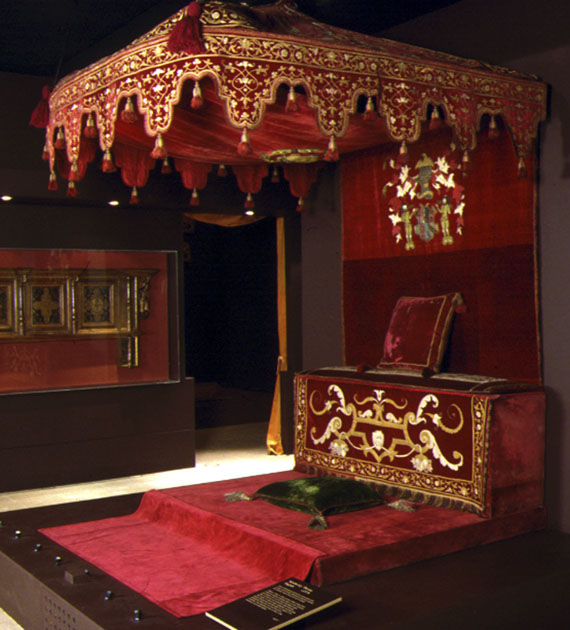
1st object – (see below) in the film the narrator spends a few moments on this object; it is also object No.1 in the catalogue: ‘An embroidered Throne used Queen Elizabeth, English 1578’; this was offered by the well-known London antique dealers Acton Surgey Ltd & Mallett & Son. Thanks to our friends William DeGregorio and Chris Jussel (in the USA) we know that the embroidered throne made its way into the collection of Sir William Burrell (1861-1958) and remains in the Burrell Collection in Glasgow (it is currently in storage at The Burrell – see below).
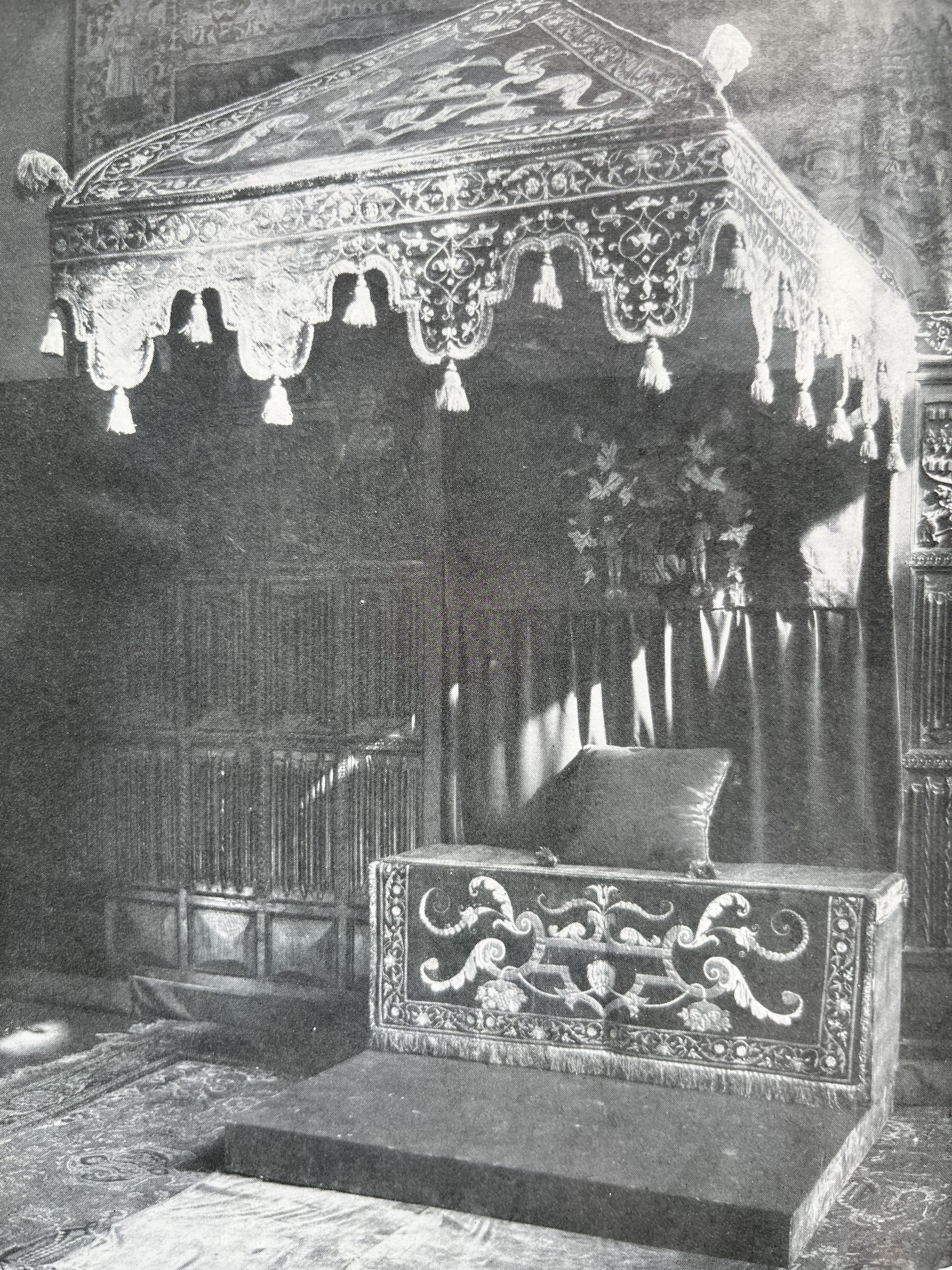
Art Treasures Exhibition catalogue 1932 – ‘An embroidered Throne used by Queen Elizabeth, English 1578’. Photograph, Antique Dealers Research Project, University of Leeds.
The ‘Kimberley Throne’, c.1554-1578, (14.217). The Burrell Collection, Glasgow. Photograph, The Burrell Collection, Glasgow.

2nd object – (see below) mentioned by the narrator is No.2 in the exhibition catalogue, ‘A gold embroidered jacket, lace shirt, and gloves, English, late 16th century’; it was also offered by Acton Surgey Ltd; the jacket is now in the collections of Boston Museum of Fine Arts in the USA. It was purchased from Acton Surgey by the collector Elizabeth Day McCormick (1873-1957) in 1943 and gifted to the Boston MFA. It is not known what happened to the shirt or the gloves; and it has not also been possible to identify the ‘gold and enamelled jewel set with diamonds and rubies’ that the Narrator also mentions.
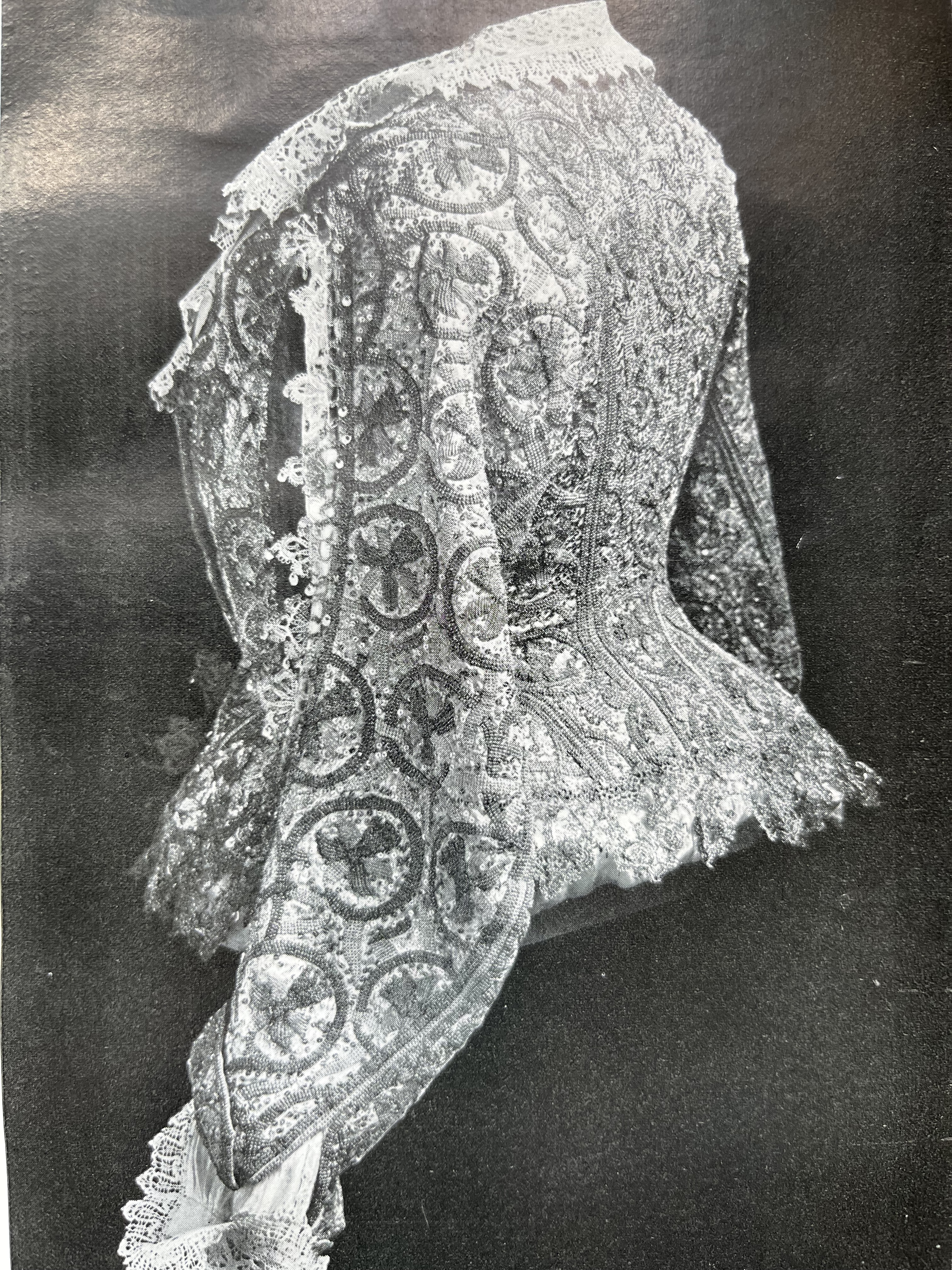
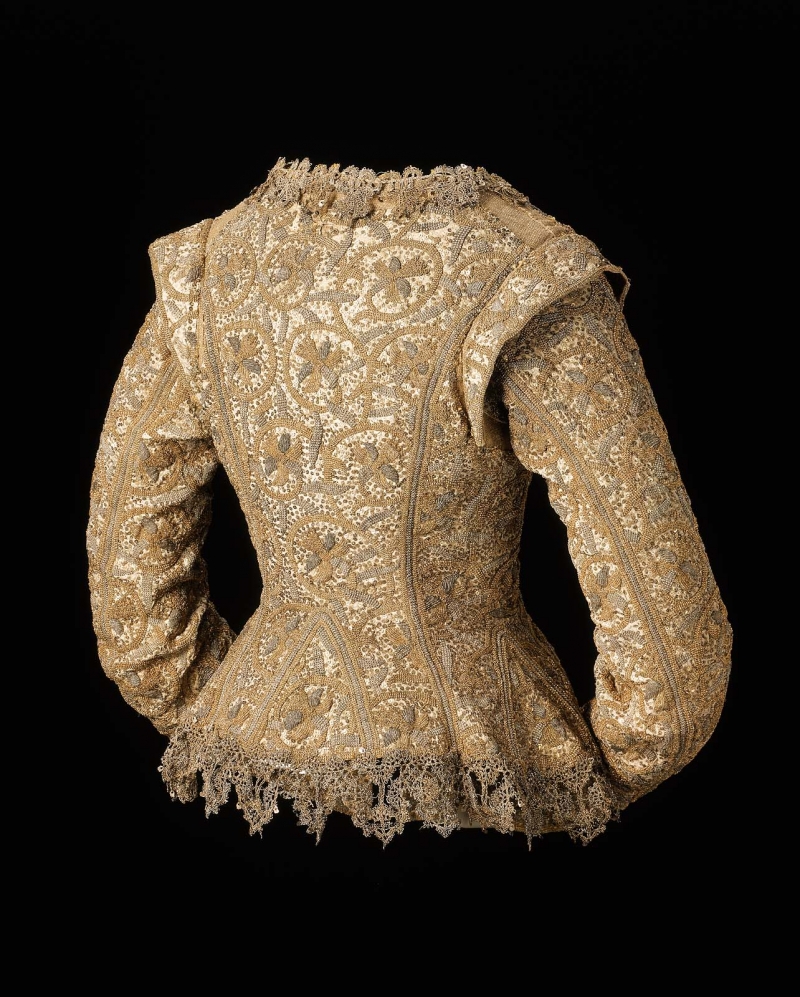
Art Treasures Exhibition catalogue 1932 – ‘A gold embroidered jacket, English, late 16th century’. Photograph, Antique Dealers Research Project, University of Leeds.
‘Women’s Jacket, English about 1610-15 with later alterations’. The Elizabeth Day McCormick Collection, Boston Museum of Fine Arts. 43.243. Image copyright Boston MFA.

3rd object – (see below) the narrator describes a ‘Gothic tapestry, over 400 years old’, this is either No.270 or No.271 in the catalogue. Neither are illustrated in the catalogue, but are both described in the catalogue as ‘A panel of Gothic tapestry, Franco-Flemish, circa 1500’ and both are offered by The Spanish Art Gallery Ltd, Conduit Street, London. It has not been possible to trace the present whereabouts of the tapestry.
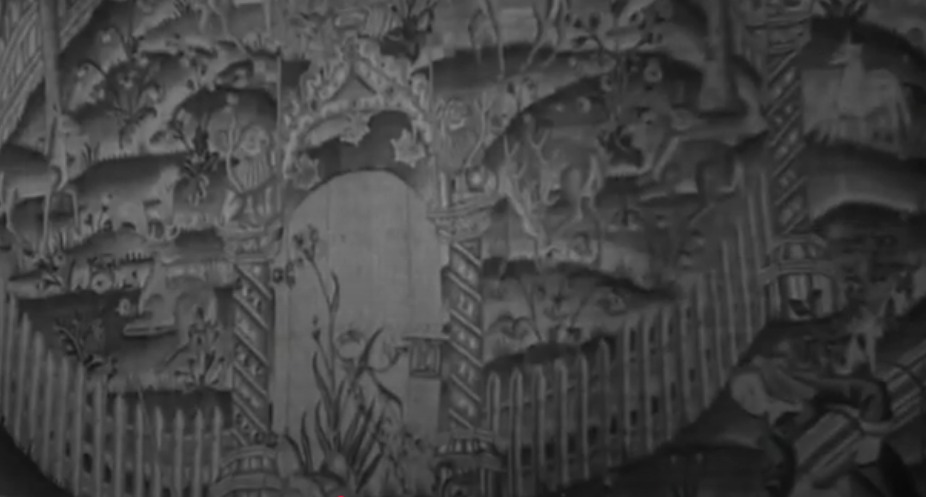
Art Treasures Exhibition 1932 film, screenshot of ‘Gothic tapestry’.

4th object – (see below) this is described by the narrator in the film as ‘a fine specimen of a Henry VII salt-cellar in hour-glass form’. This is No.445 in the catalogue; ‘A Henry VII silver-gilt standing salt, London 1505’. It is also illustrated in the catalogue, and was offered by the antique silver dealers Crichton Brothers, then trading at 22 Old Bond Street, London. It has not been possible to trace the Henry VII salt – the narrator in the film suggested that it was the only known piece of silver with the date 1505, so I guess if it does still exist, it must be easily identifiable? (our friend Chris Coles spotted the salt in a 1969 exhibition catalogue produced by The Goldsmiths Company….so perhaps the salt is in the collections of The Goldsmiths – thanks Chris!)
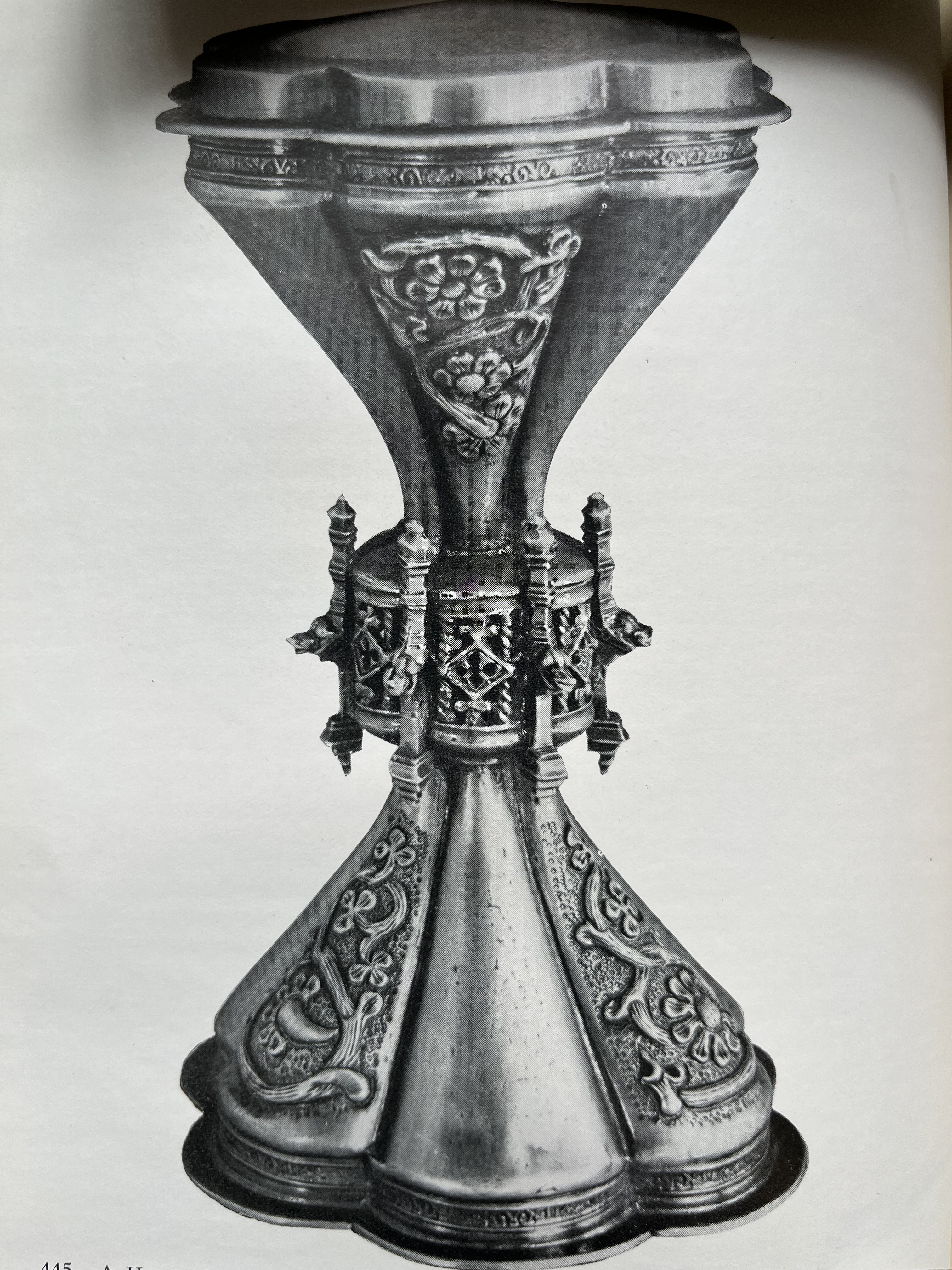
Art Treasures Exhibition catalogue 1932 – ‘A Henry VII silver-gilt standing salt, London 1505’. Photograph, Antique Dealers Research Project, University of Leeds.

5th object – (see below) the narrator describes a ‘stand for a porringer or tankard….previously owned by the diarist Samuel Pepys’. This is No.618 in the catalogue – ‘The Charles II silver-gilt ‘Pepys’ tazza, London 1678′. It is not illustrated in the catalogue, but was also offered by the antique silver dealer Crichton Brothers. The ‘tazza’ is now in the collections of The Clark Institute in Massachusetts in the USA. It was commissioned by Samuel Pepys (1633-1703) in 1678 and was sold at Sotheby’s on 1st April 1931 (Lot 3) to Crichton Brothers, who appear to have sold it to the American silversmith and art curator Peter Guille of New York, who sold it to Robert Sterling Clark in 1946.
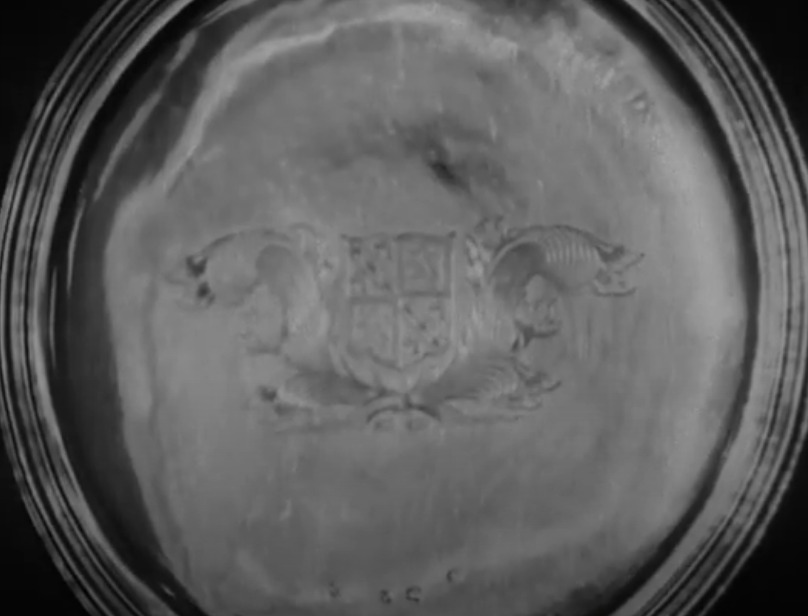
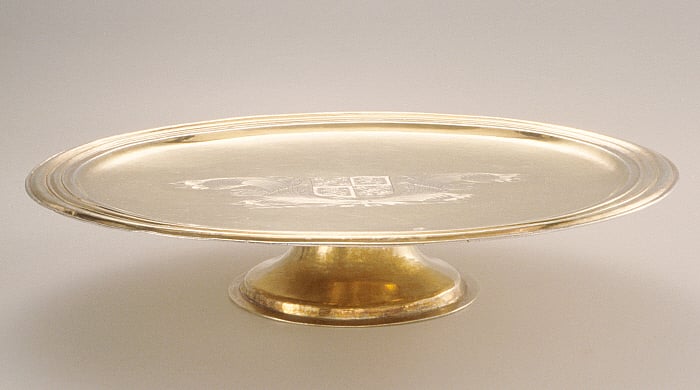
Art Treasures Exhibition 1932 film, screenshot of ‘Pepys’ ‘tazza”.
Footed Salver, silver-gilt, 1678/79. Clark Institute, 1955.298. Image copyright Clark Institute.

6th object – (see below) described by the narrator as a ‘Chippendale chair’, but I can’t find this chair (or even a set of them) listed in the exhibition catalogue; perhaps it was a late edition to the exhibition?
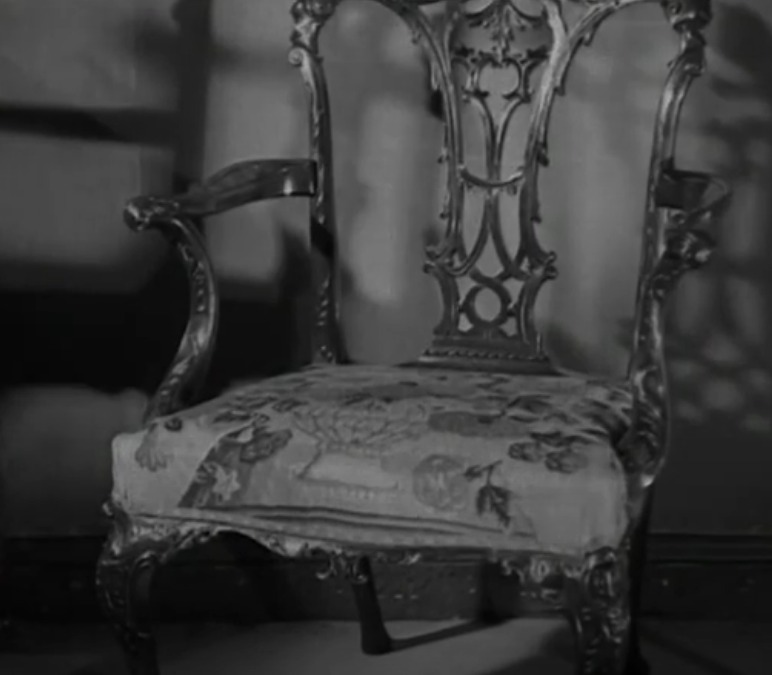
Art Treasures Exhibition 1932 film, screenshot of ‘Chippendale chair’.

7th object – (see below) the narrator describes 3 walnut chairs, ‘made about 1690’. There are a number of such chairs in the exhibition catalogue, but without a photograph of them from the catalogue it has not been possible to identify which of the chairs the narrator is referring too? However, the centre chair, could be No.50 in the catalogue, ‘A William and Mary armchair of small size, circa 1690’, and said to have ‘traditionally been used by Queen Anne’; it was offered for sale by the well-known dealers Moss Harris & Sons.
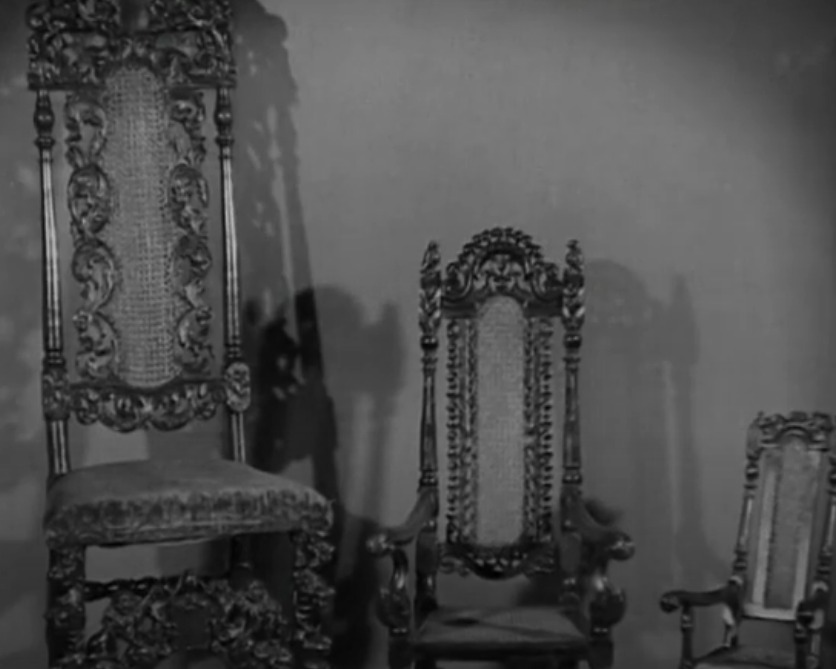
Art Treasures Exhibition 1932 film, screenshot of ‘Walnut chairs’.

8th object – (see below) is described by the narrator as ‘a fine gesso table, formerly at Stowe’, is certainly No.121 in the Exhibition catalogue; it is illustrated and described as ‘A George II gilt side table…formerly at Stowe’ and was offered for sale by the antique dealer and interior decorator Gregory & Co., then trading at 27 Bruton Street, London. The table was originally sold at the auction sale of the contents of Stowe House in 1848, following the bankruptcy of the Duke of Buckingham.
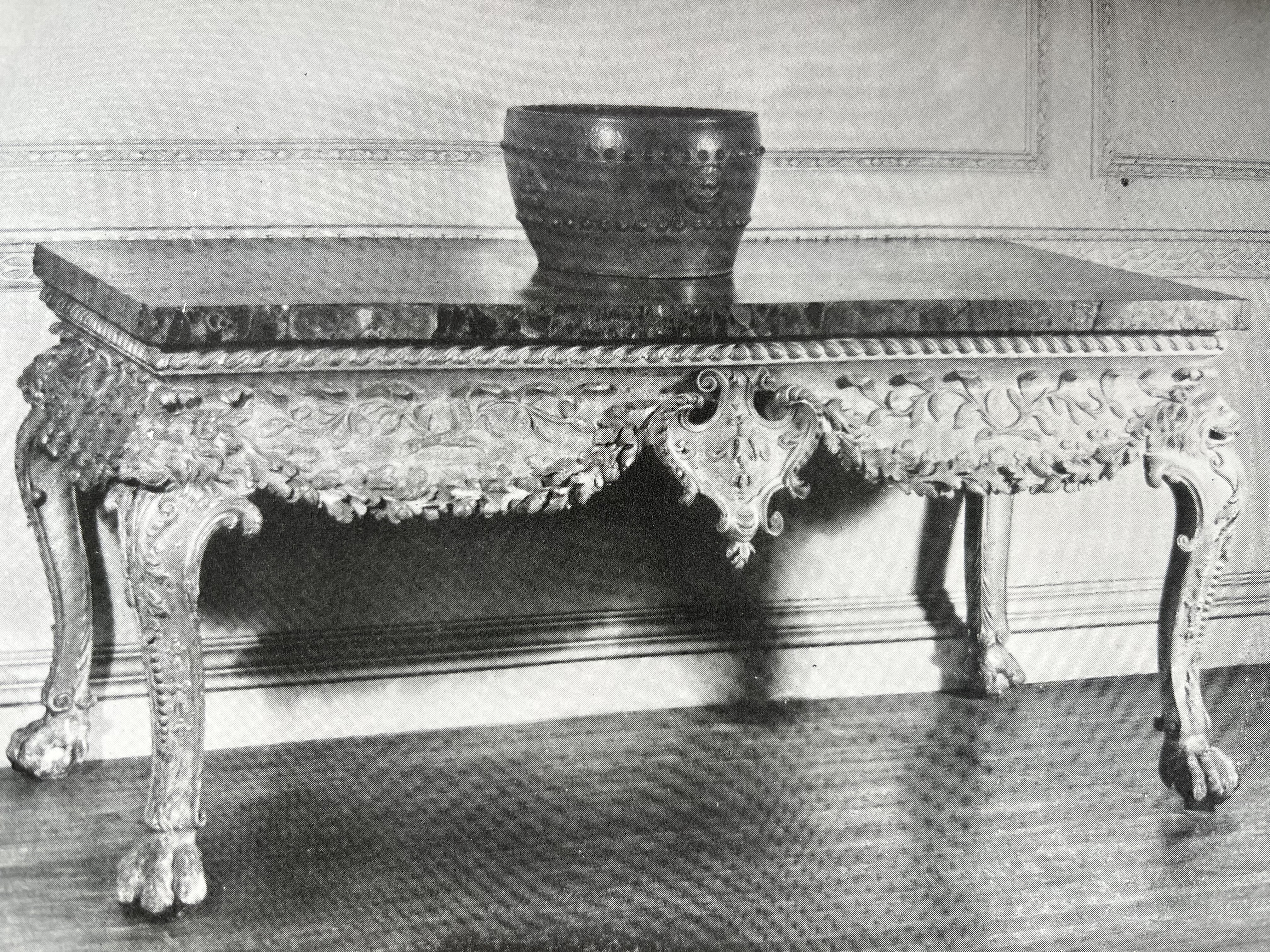
Art Treasures Exhibition catalogue 1932 – ‘A George II gilt side table’. Photograph, Antique Dealers Research Project, University of Leeds.

It has not been possible to trace the whereabouts of the side table, but interestingly, another giltwood side table from Stowe was on display at the 1932 Exhibition; No.98, ‘A George I gilt gesso table, circa 1715’, and offered for sale by the antique dealer A.G. Lewis, Brompton Road, London. This table (see below) is one of a pair (possibly three?) side tables associated with Stowe. In 1930, one table, (perhaps the same one in the 1932 exhibition?) was in the stock of the antique dealer Kent Galleries, Conduit Street (Kent Gallery are associated with The Spanish Gallery who offered the ‘Gothic tapestry’ at the 1932 Exhibition). One of the tables (perhaps the same one?) is now in the V&A Museum (see below too). The V&A table was sold to the V&A by the antique dealer Phillips of Hitchin in 1947, having been through the hands of a number of other antique dealers, including John Bly of Tring and Edinborough of Stamford. All of this highlights the significance of inter-dealer trading that sustained the antique trade for much of the 20th century.
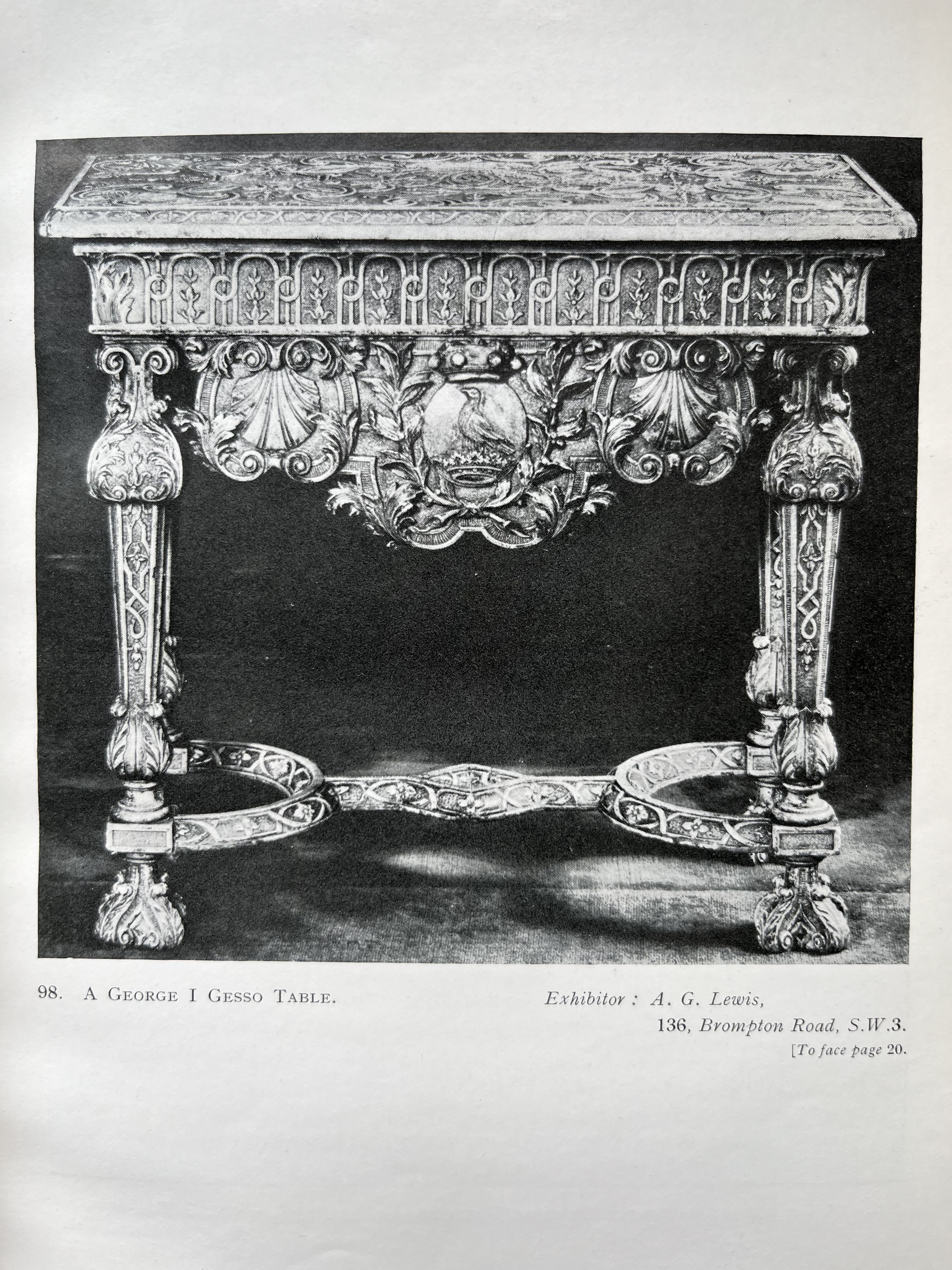
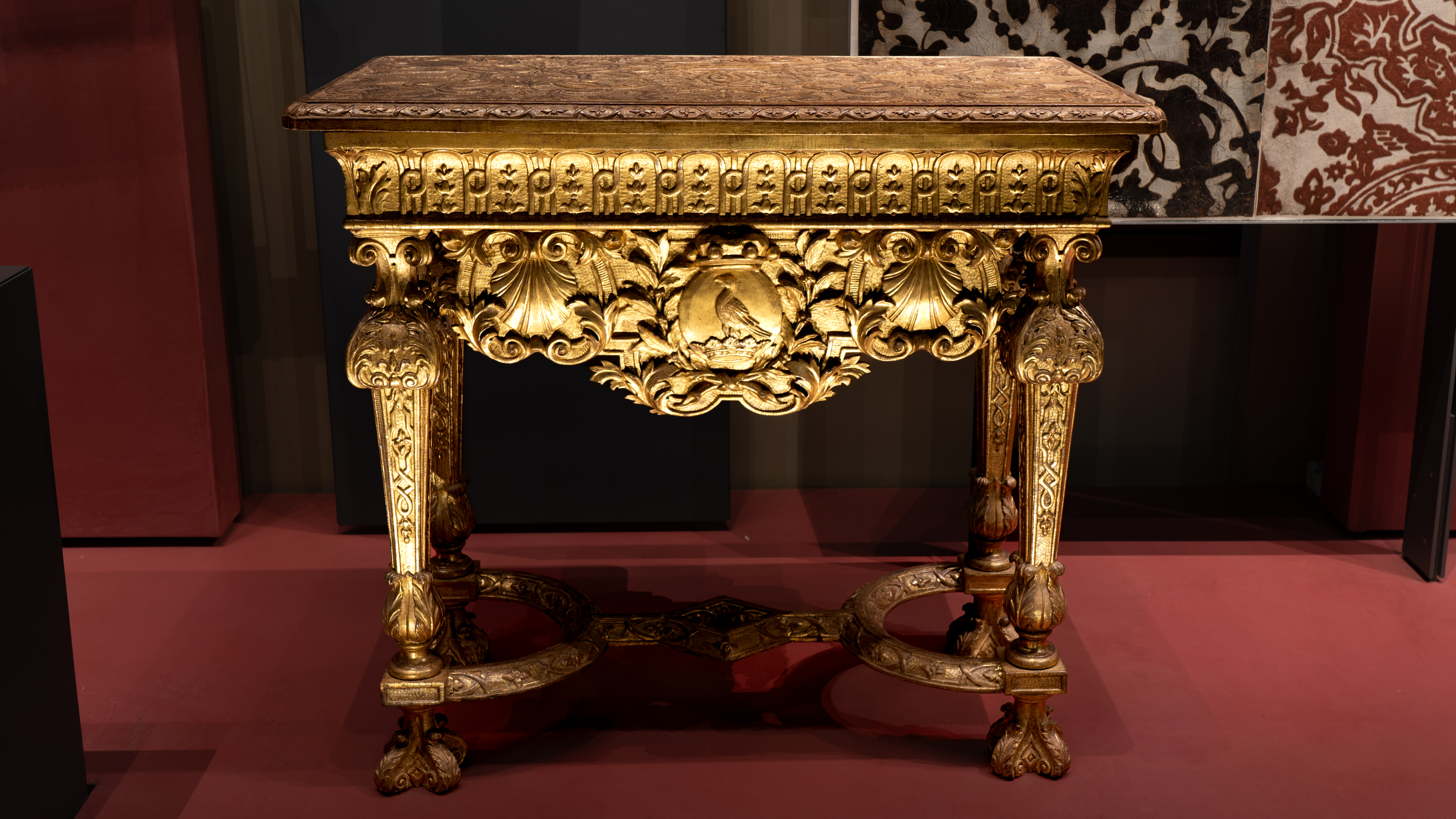
Art Treasures Exhibition catalogue 1932 – ‘A George I gilt gesso table’. Photograph, Antique Dealers Research Project, University of Leeds.
The Stowe side table at the V&A Museum. Photograph, Year of the Dealer project, University of Leeds.

9th object – (see below) the narrator describes a ‘spinning wheel, perfectly usable today’ as the next object. It is a ‘Sheraton spinning wheel, circa 1790….made by John Planta, Fulneck’; it was No.231 in the catalogue and was illustrated and offered for sale by the antique dealer Law, Foulsham & Cole, South Molton Street, London. There are several such spinning wheels by Planta, who was based in Leeds in the late 18th century – one example (although not the one in the 1932 Exhibition), remains in the collections at Temple Newsam, near Leeds.
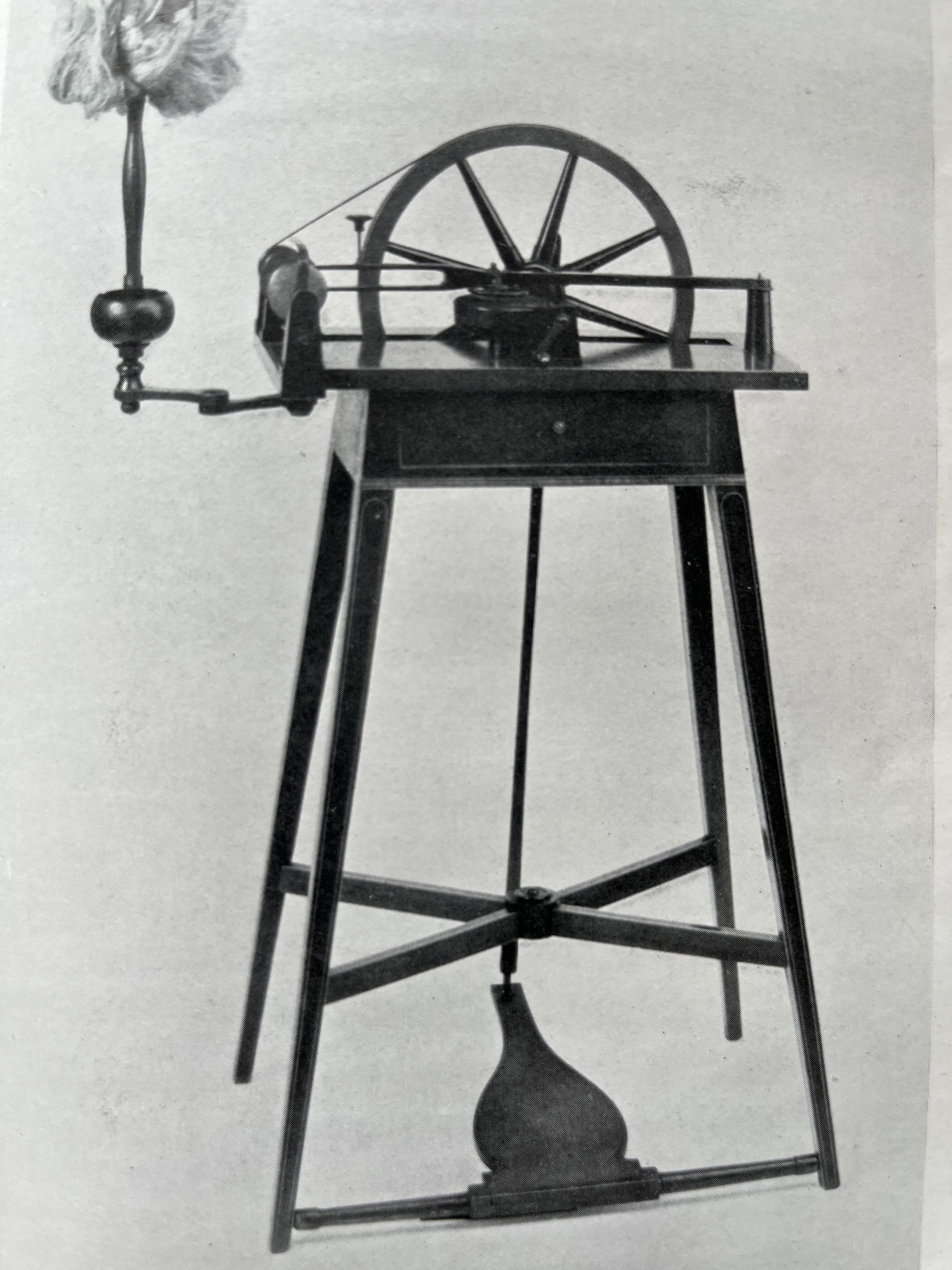
Art Treasures Exhibition catalogue 1932 – ‘A Sheraton spinning wheel, circa 1790’. Photograph, Antique Dealers Research Project, University of Leeds.

10th object – (see below) the narrator describes as a ‘rare cream lacquer cabinet, made towards the end of the 17th century’. This was No.31 in the catalogue, ‘a Charles II lacquer cabinet, circa 1680’ and was offered for sale by the dealer E.H. Benjamin, 39 Brook Street, London. White lacquer cabinets are the rarest of lacquer furniture, but even so it has not been possible to trace the cabinet – perhaps it has been lost? (Chris tells us that the cabinet on stand was in stock with the American antique dealers’ French & Co in 1987 (see below), so perhaps the cabinet is still in the USA?)
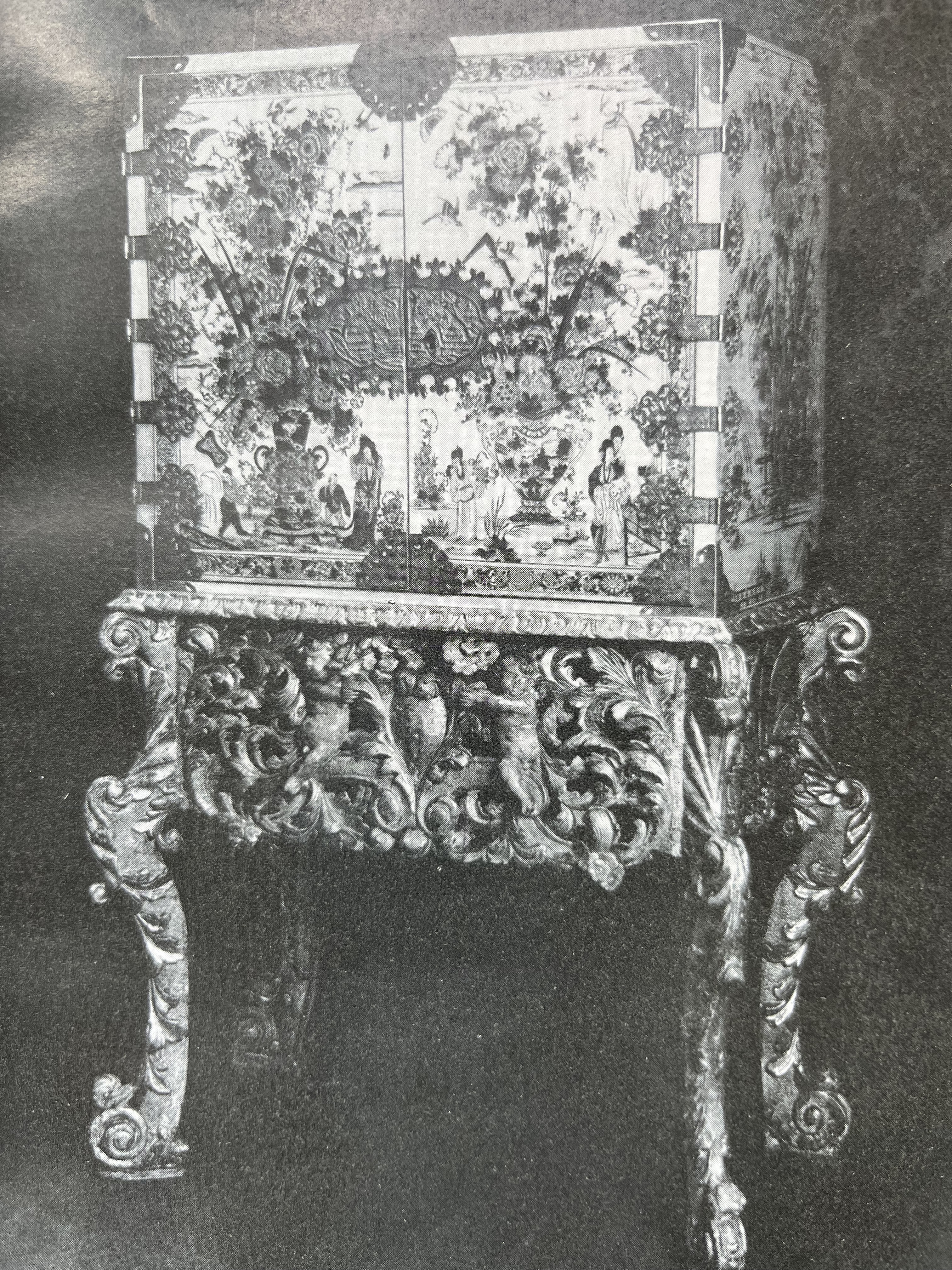
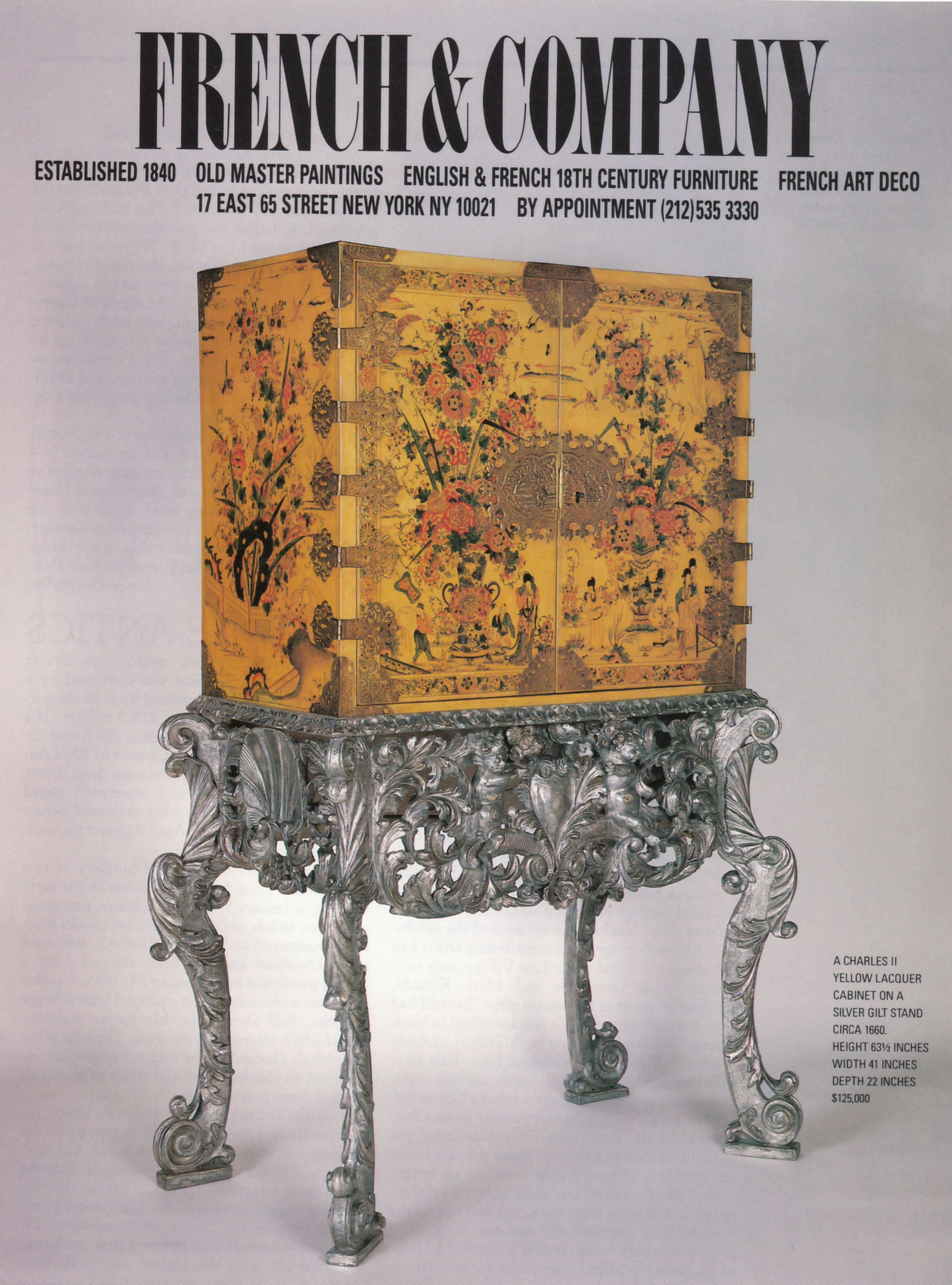
Art Treasures Exhibition catalogue 1932 – ‘A Charles II lacquer cabinet, circa 1680’. Photograph, Antique Dealers Research Project, University of Leeds.
French & Co advert, 1987. Image from Chris Coles.

11th object – (see below) the narrator describes another cabinet, this time ‘a fine Adam satinwood example’ – he mentions that ‘it was purchased by the Queen at her recent visit to the exhibition’ (this would be Queen Mary, a very well-known collector of antiques). The cabinet is No.205 in the catalogue, described as ‘an Adam satinwood cabinet, circa 1780’, but is not illustrated; it was offered for sale by the antique dealer Mallet & Sons, one of Queen Mary’s favourite antique dealers. I can’t find the cabinet in Royal Collections, so perhaps the cabinet was sold from the collections or given away or was destroyed?
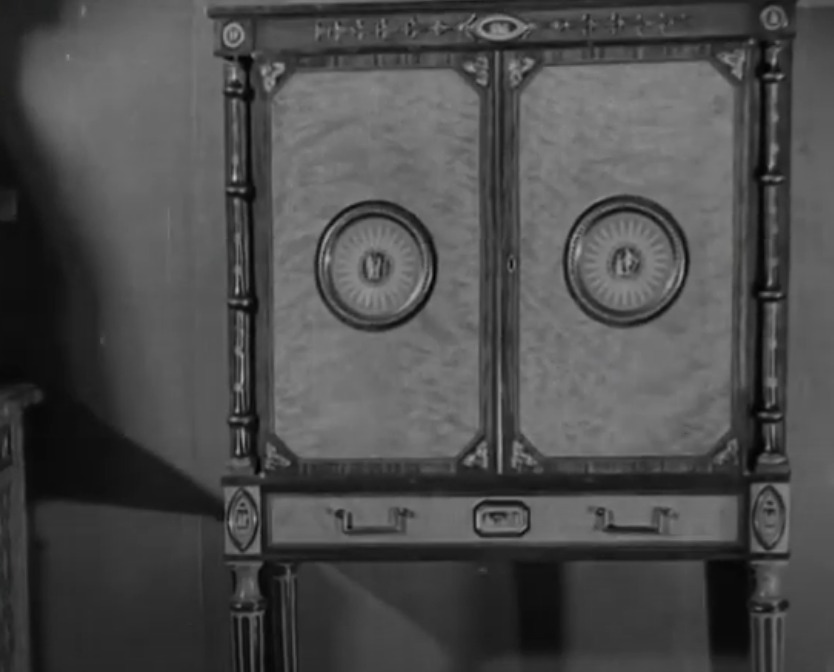
Art Treasures Exhibition 1932 film, screenshot of ‘Adam satinwood cabinet’.

12th object – (see below) the narrator describes ‘a lovely satinwood side table’, ‘one of Lord Nelson’s gifts to Lady Hamilton’. This is one of 3 tables on display at the exhibition, No.241, ‘a set of three satinwood tables, circa 1795’; they were illustrated and were offered for sale by the dealer A.G. Lewis. Like the film, the catalogue mentions that the tables were presented by Lord Nelson to Lady Hamilton. Given the provenance, it’s surprising I can’t find them anywhere? Two of the tables were in the collection of Arthur Sanderson (1846-1915), the well-known collector in Edinburgh; they are listed in the auction sale catalogue of Sanderson’s collection sold by Knight, Frank & Rutley, Hanover Square, London, June 14th-16th 1911 as Lot 540 ‘A PAIR OF SHERATON SHAPED FRONT SIDE-TABLES, which (together with Lot 541 A SHERATON BOOKCASE) were ‘said to have been made by Sheraton for Lord Nelson and given by him to Lady Hamilton at Naples’; (our friend Chris Coles tells me that the Nelson tables were in the collection of the antique dealer George Stoner (of Stoner & Evans) in 1912; and that one of the tables was in the stock of Moss Harris & Sons in 1935; Chris rightly suggests that as the three tables don’t exactly match, they are more likely to have been separated – thanks again Chris!)
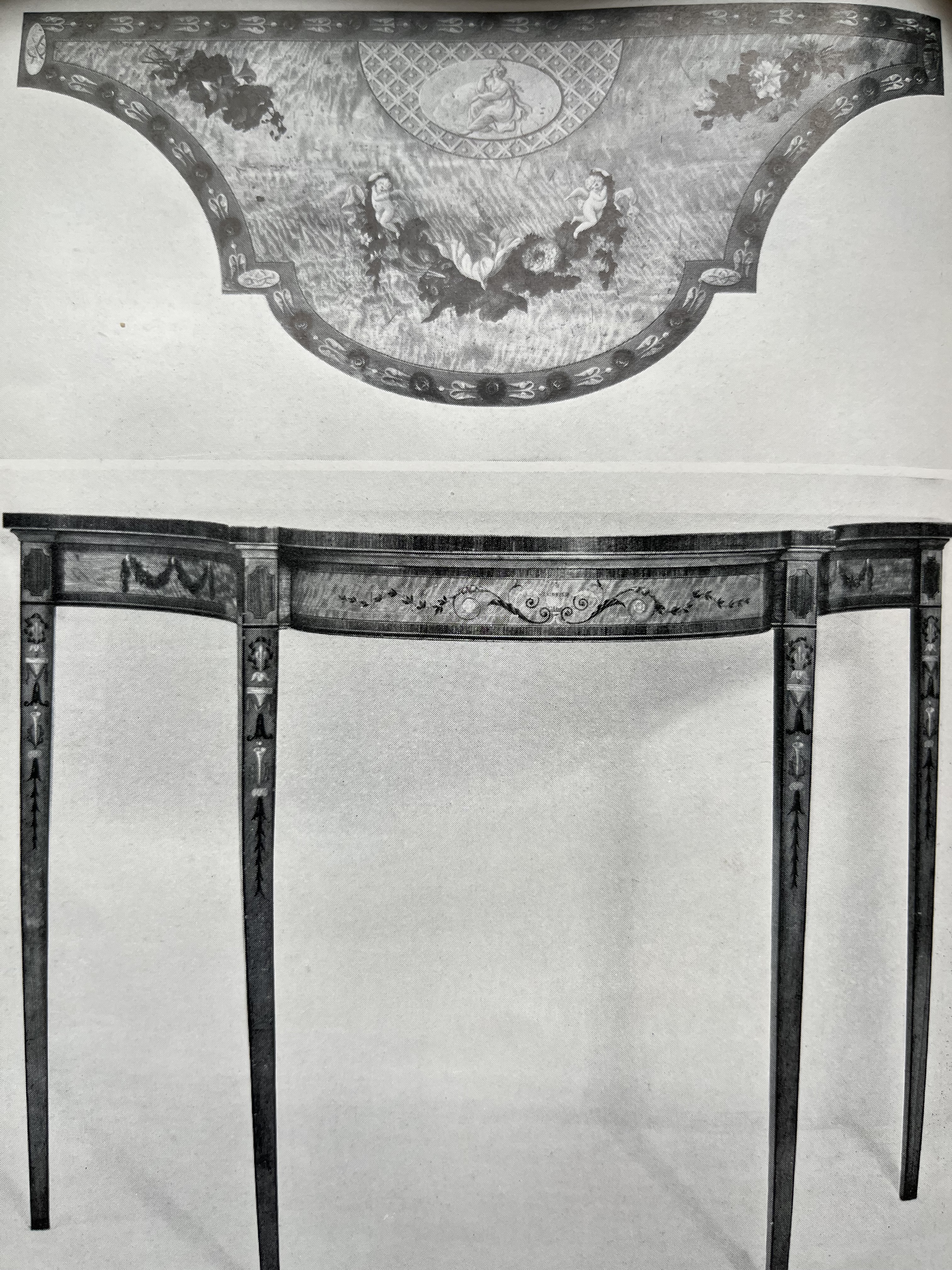
Art Treasures Exhibition catalogue 1932 – ‘A set of three satinwood side tables, circa 1795’. Photograph, Antique Dealers Research Project, University of Leeds.

Finally, 13th object – the narrator highlights that this object (a painting by Rembrandt) is ‘the most valuable object here’. It is No.1355 in the exhibition catalogue, ‘Rembrandt van Rhyn (1606-1669), ‘Aristotle’, signed and dated 1653′. It was offered for sale by the world-famous art dealer Joseph Duveen (1869-1939). Duveen bought and sold the painting several times in the decades before the 1932 exhibition. He sold it to the art collector Alfred W. Erickson (1876-1934) in 1928 for $700,000, before buying it back and selling it to Erickson again in the mid 1930s for $590,000. It is now in the collections at the Metropolitan Museum of Art in New York, where it has been since 1961.
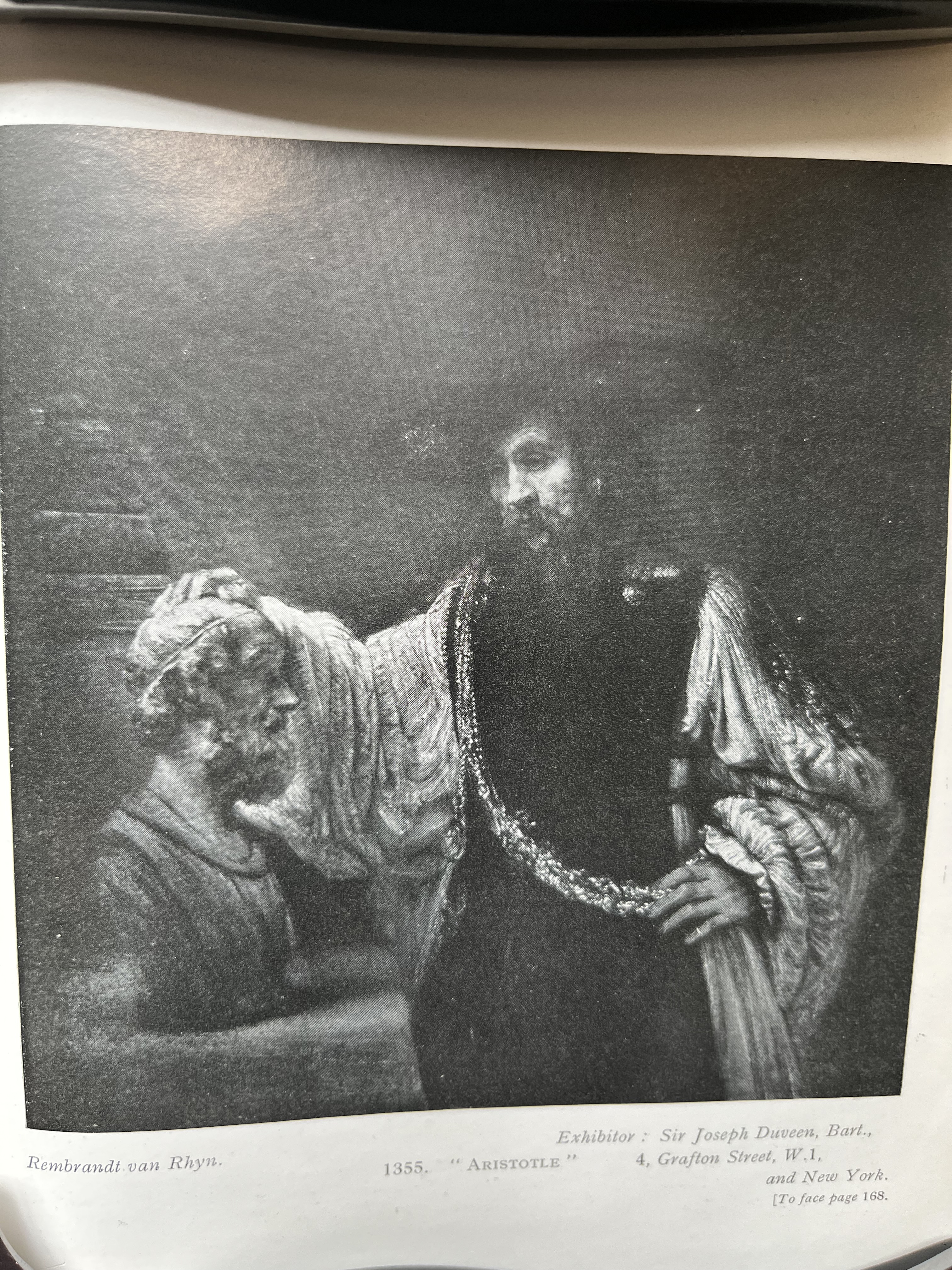
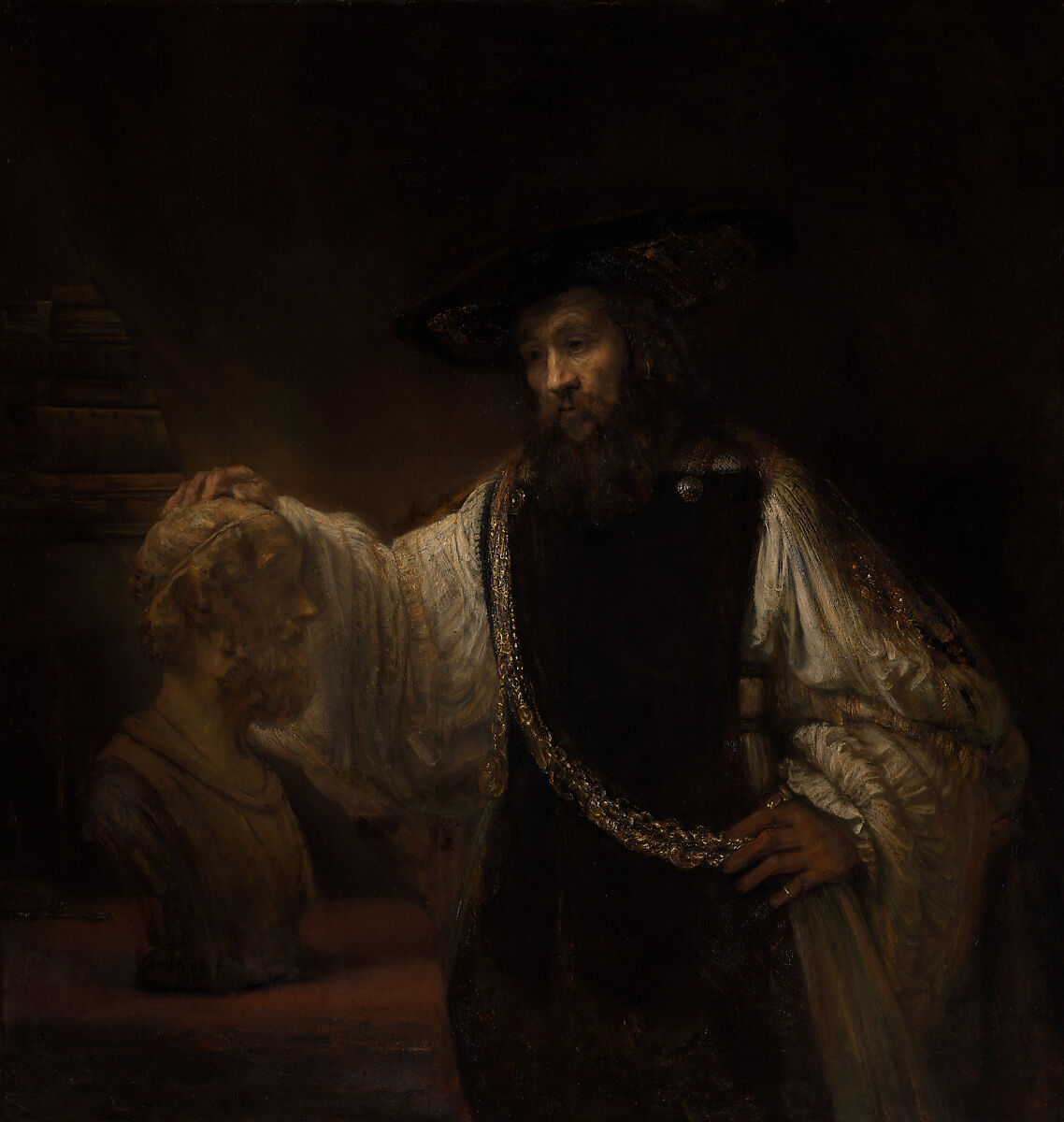
Art Treasures Exhibition catalogue 1932 – ‘Rembrandt van Rhyn….’Aristotle’. Photograph, Antique Dealers Research Project, University of Leeds.
Rembrandt (Rembrandt van Rijn) Aristotle with the bust of Homer (1653). Metropolitan Museum of Art, New York. 61.198. Image copyright Metropolitan Museum of Art, New York.

The film of the Art Treasures Exhibition 1932, together with the catalogue of the exhibition, gives a fascinating insight into the publicity for one of the major commercial art exhibitions of the period and is a further demonstration of the significance of the antique trade in the circulation and consumption of antiques (and paintings) and their role in the development of public museum collections – and thanks again to Diana for sending on the link to the film!

Mark
January 30, 2025

Antique Dealers and Museums

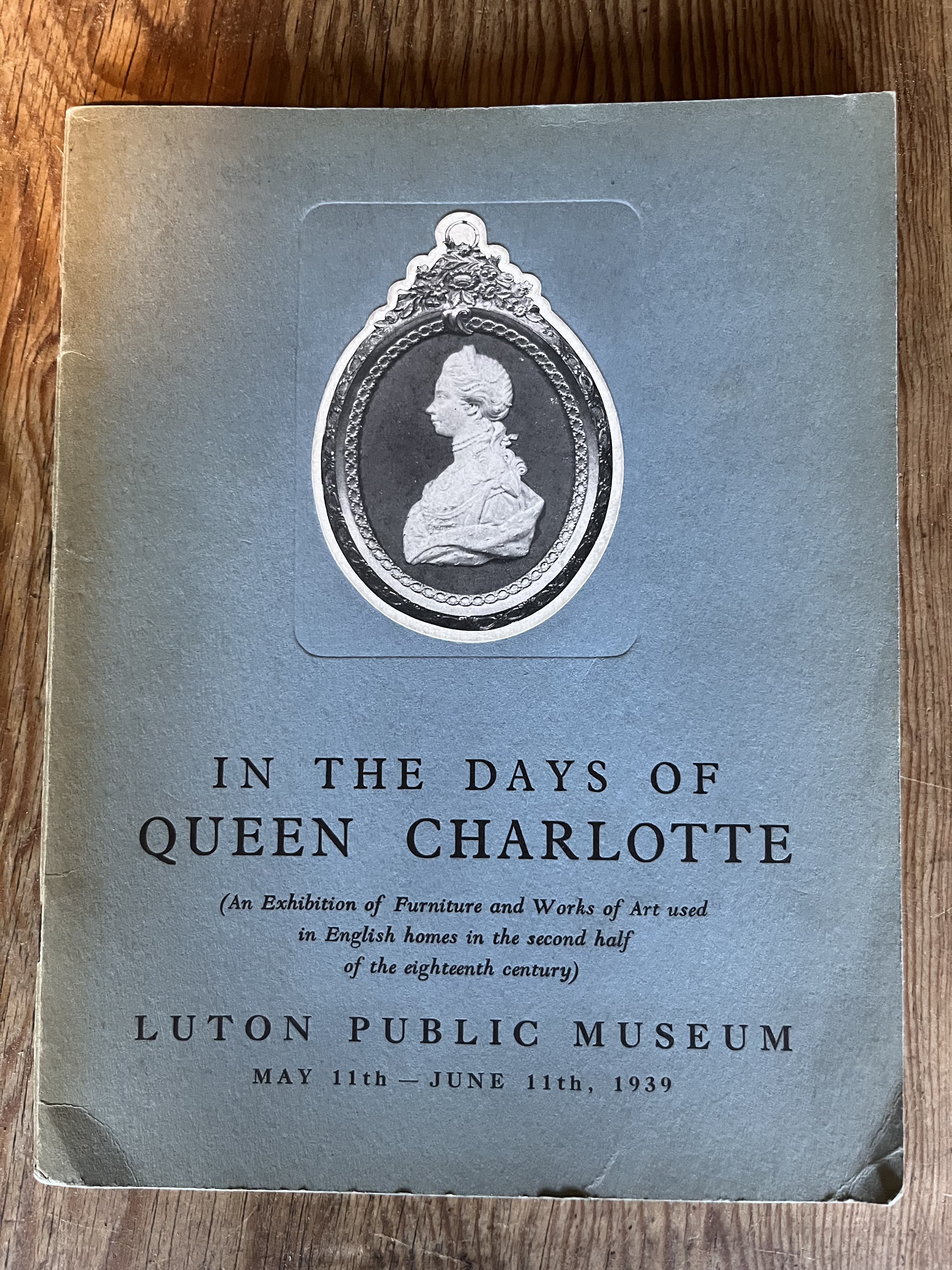
The relationships between the antique trade and public museums is an expansive and complex subject, and there’s not really enough space in a short blog post to do the subject any real justice at all. But a recent addition to the antique dealer project archive of antique dealer ephemera is worth highlighting as it is further evidence of the fascinating dialogue between antique dealers and the public museum. The ephemera in question is a rare survival, an exhibition catalogue of the exhibition ‘In the Days of Queen Charlotte‘ held at Luton Public Museum in May to June 1939.

Exhibition catalogue, Luton Public Museum, ‘In the Days of Queen Charlotte’, May-June 1939. Image, Antique Dealer Research Project, University of Leeds.

The exhibition was organised in collaboration with the British Antique Dealers’ Association and exhibitors included most of the leading antique dealers of the day, such as H. Blairman & Sons, Frank Partridge & Sons, M. Harris & Sons, H. M. Lee, Mallett & Son, S.J. Phillips, S. W Wolsey, Stoner & Evans, J. Rochelle Thomas, and many more. It built on the success of the famous ‘Art Treasures‘ exhibition held at Grafton Galleries in 1928 (also under the auspices of the BADA) and the antique dealers exhibition at Christie’s auction rooms in 1932. However, there was a key distinction between these earlier exhibitions and the Luton Museum exhibition, which was of course that the 1939 exhibition was held in a public museum. I believe this was one of the earliest of what one might call hybrid exhibitions (those staged by the antique trade in public museums) that took place in Britain, and was a catalyst for the much more ambitious collaborations between the antique trade and public museums in the form of public exhibitions that took place later in the 20th century, at The Victoria & Albert Museum in 1962 (organised by CINOA, the International Confederation of Dealers in Works of Art), and again at the V&A Museum in 1968 (organised by the BADA as part of the celebrations of the Golden Jubilee of the establishment of the BADA (1918)). There was also similar dealer exhibitions in public museums in Europe, all organised by CINOA, the earliest of which appears to have been held at the Rijksmuseum in Amsterdam in 1936, with similar exhibitions at the Musee des Arts Decoratifs in Paris in 1954 and at the Historisch Museum in Amsterdam in 1970. And perhaps the most ambitious of these initiatives was the exhibition, ‘The Grand Gallery‘, staged at the Metropolitan Museum of Art in New York in 1974 (again organised by CINOA) and which was partly staged to celebrate the additions to the Metropolitan Museum collections acquired through or gifted by, the New York based antique dealers Joseph and Ernest Brummer.

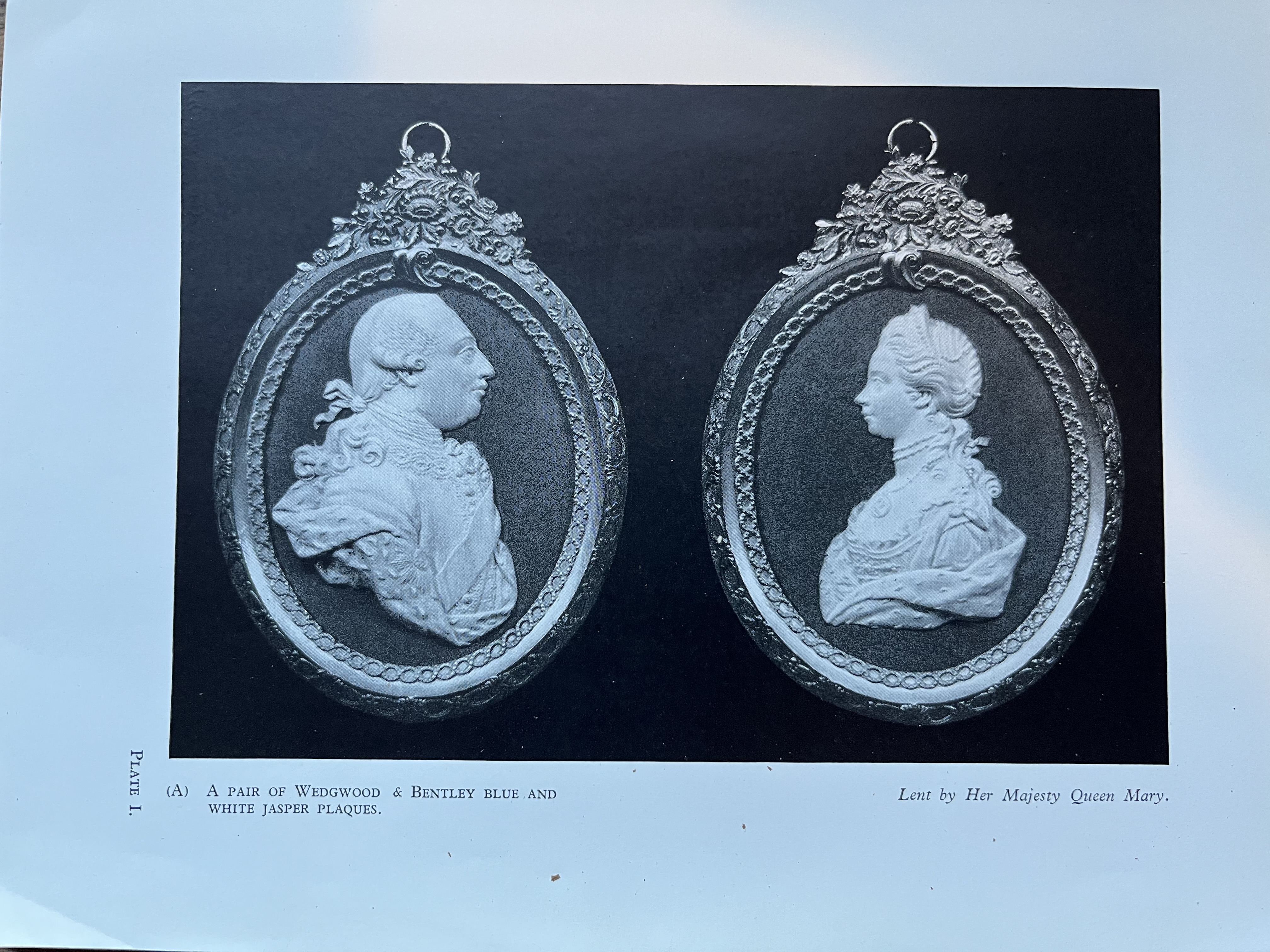
The exhibition at Luton Public Museum, like the other later exhibitions at the various museums, was partly for public education – the exhibitions often had antiques loaned by influential collectors for example. At the Luton Public Museum exhibition, Queen Mary (an avid collector of antiques) loaned a pair of 18th century Wedgwood & Bentley jasper plaques (c.1780), and the Duke of Kent loaned a collection of 20 stipple engravings of members of the Royal Family (published in 1806).

Plate from Luton Public Museum exhibition catalogue, 1939. Photograph, Antique Dealers Research Project, University of Leeds.

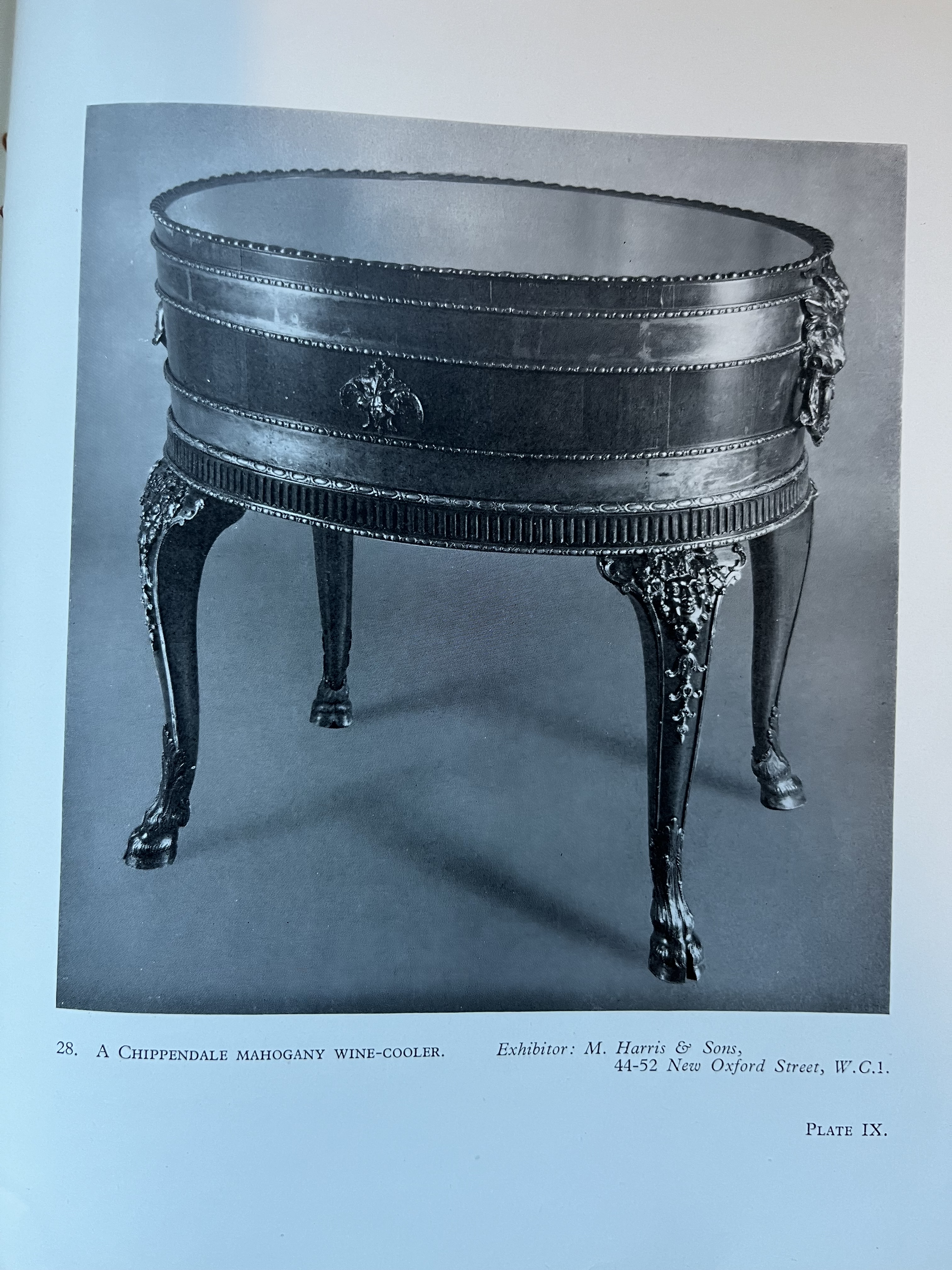
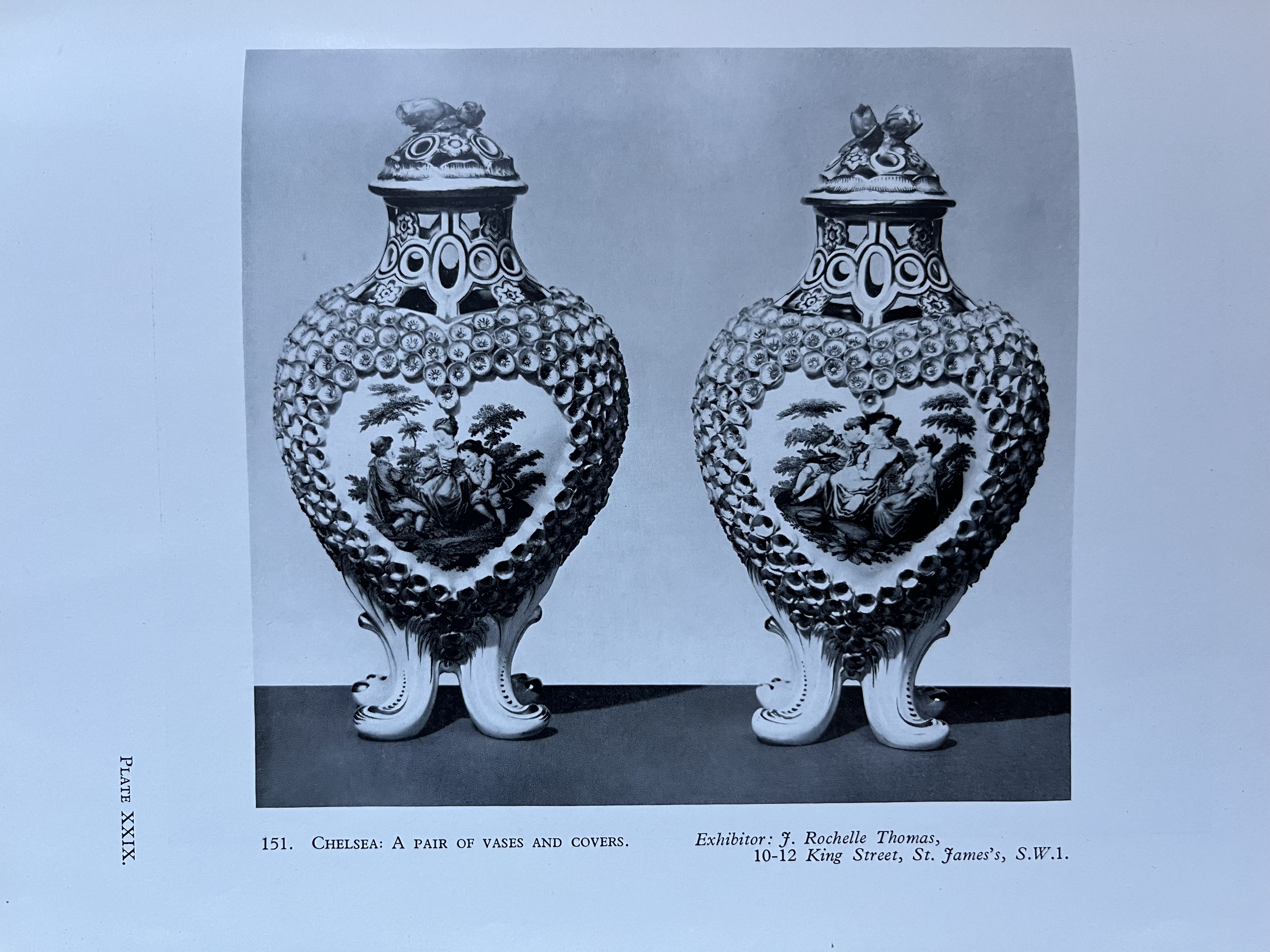
Of course one of the main purposes of these antique dealer organised public museum exhibitions was to showcase, and sell, antiques displayed by antique dealers. Indeed, at the Luton Public Museum exhibition all the objects on display, apart from the loans by Queen Mary and the Duke of Kent, were offered for sale – Moss Harris & Sons offered this 18th century wine cooler (see below) and J. Rochelle Thomas, a pair of 18th century vase and covers (see below).

‘A Chippendale Mahogany Wine-cooler’, exhibited by M. Harris & Sons at the Luton exhibition, 1939. Photograph, Antique Dealer Research Project, University of Leeds.
‘A Pair of Chelsea vases and covers’, exhibited by J. Rochelle Thomas at the Luton Public Museum exhibition, 1939. Photograph, Antique Dealer Research Project, University of Leeds.

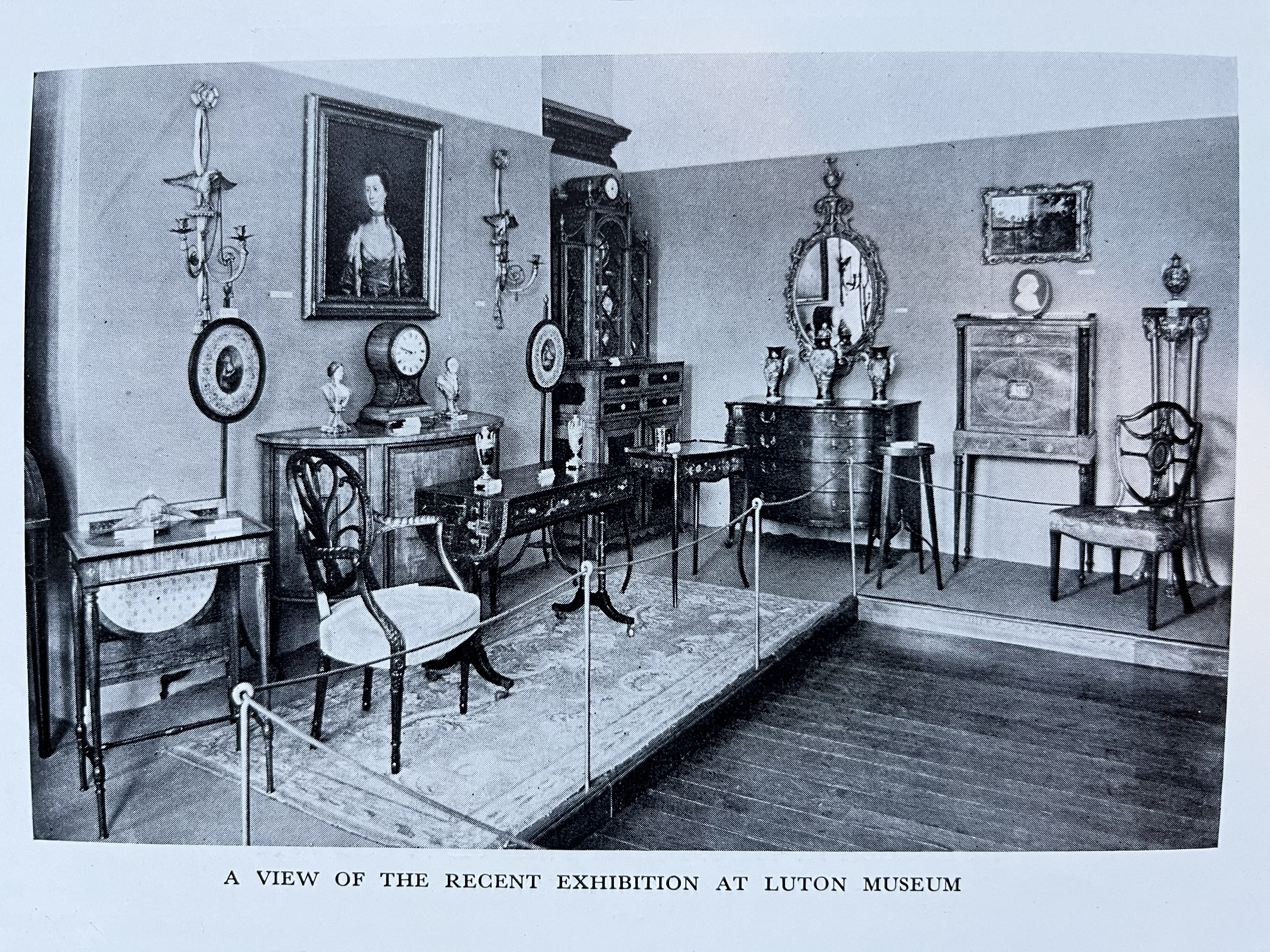
The arrangement of the exhibits at the museum also seemed to mirror the displays of antiques at major antique fairs at the time – such as those at the Antique Dealers Fair held at the Grosvenor House Hotel from 1934 – as one might expect of course – the overlap between modes of display in the worlds of commerce and in the public museum are often much closer than one thinks.

The Luton Public Museum ‘In the Days of Queen Charlotte‘ exhibition, 1939, from Connoisseur, September 1939. Photograph, Antique Dealer Research Project, University of Leeds.

Indeed, all of these antique dealer organised exhibitions draw further attention to the close relationship between the market for antiques (as figured in the presence of antique dealers) and the role of the public museum as a frame for ‘decorative art’ (also known as ‘antiques’ of course). The exhibition I curated at The Bowes Museum back in 2019 – ‘SOLD! The Great British Antiques Story‘, was partly an attempt to draw the attention to the symbiotic relationship between the realm of the art market and the so-called ‘disinterested’ realm of the public museum. If you are interested, you can read more about this in the SOLD! exhibition catalogue – still available, for FREE, as a PDF download via the Antique Dealer Research Project Website HERE.

Mark

April 6, 2017

‘Here it is Now!’ – Phillips of Hitchin in the UK, USA and Australia.

As readers of the Antique Dealer research blog will know, we have recently posted more ‘Where is it Now?’ objects, illustrating images from some of the early 20th century photograph stock albums in the Phillips of Hitchin archive, now at the Brotherton Library Special Collections. We thought you would be interested, and amused perhaps, to hear about a kind of reverse of the ‘Where is it Now?’ theme (a kind of ‘Here it is Now!’) – i.e. the catalyst for this blog post was not an illustration of an object in the PoH archive, attempting to set up a link from the archive to the outside world, but rather a photograph of an object in a public museum, that links back to the archive. Indeed, the photograph generated an investigation of other museum collections, which has further demonstrated the international significance of the Phillips of Hitchin archive.

Anyway, the PoH archive was generously donated to the Brotherton Library Special Collections by Jerome Phillips, the 3rd generation of antique dealers associated with the business that has always been located at The Manor House, Hitchin since it was established in 1884. Jerome retired in 2014, and as many of you will know, is still in regular contact with us at the university; we often update him on the progress with his family business archive – Jerome is, after all, a living extension to the archive!

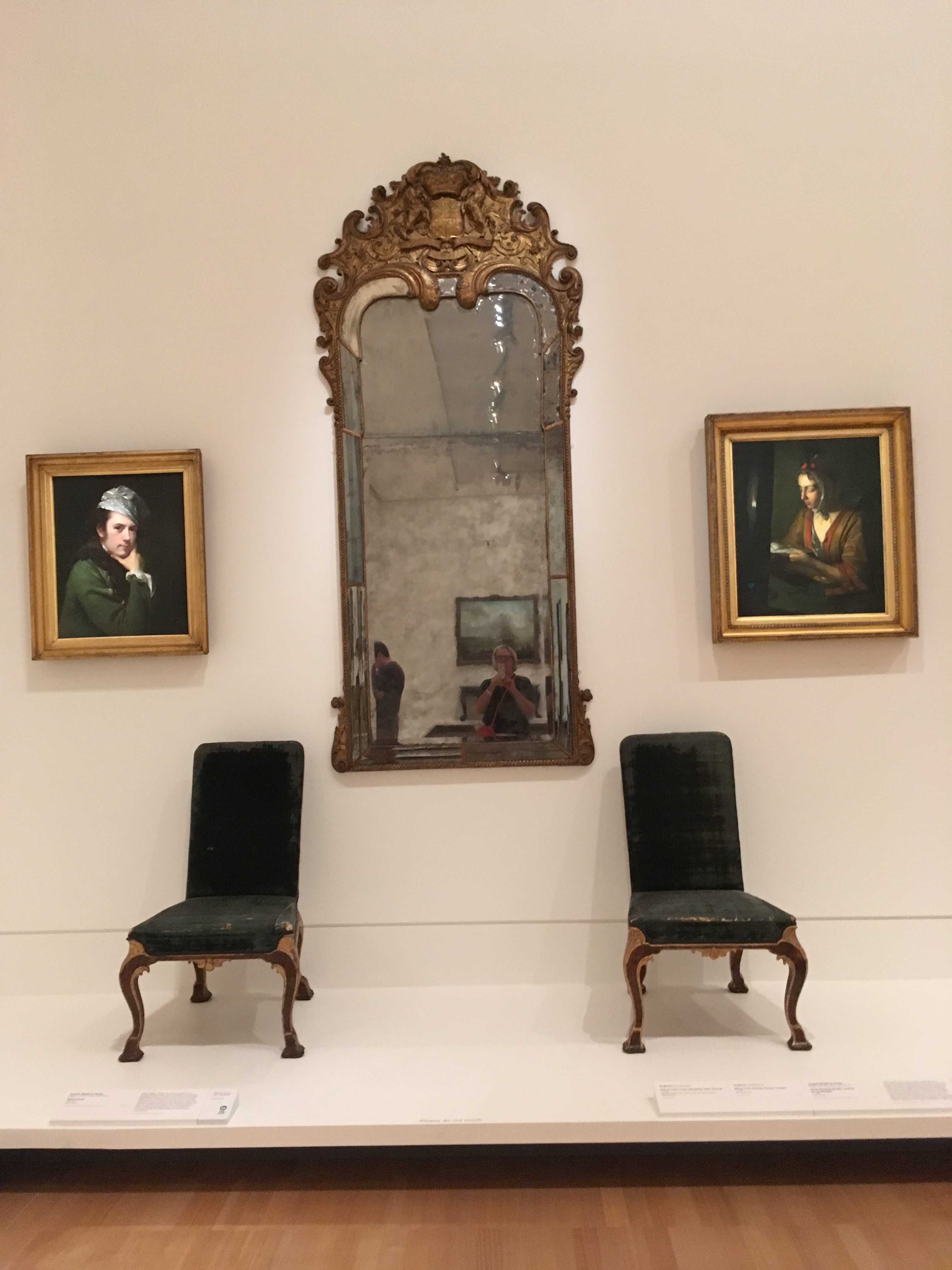
Jerome emailed us recently following an update from us on the archive, and mentioned that his wife, Barbara, was in Australia, and had been to the National Gallery of Victoria in Melbourne and whilst there she spotted a pair of chairs that Phillips of Hitchin had sold to the (then) Victoria State Gallery, Melbourne, in 1961.  Here is Barbara’s photograph of the chairs in situ (you can also spot Barbara reflected in the 18th century mirror!).

Pair of Houghton Hall chairs at the National Gallery of Victoria, Melbourne. Photograph courtesy of Barbara Phillips, 2017.

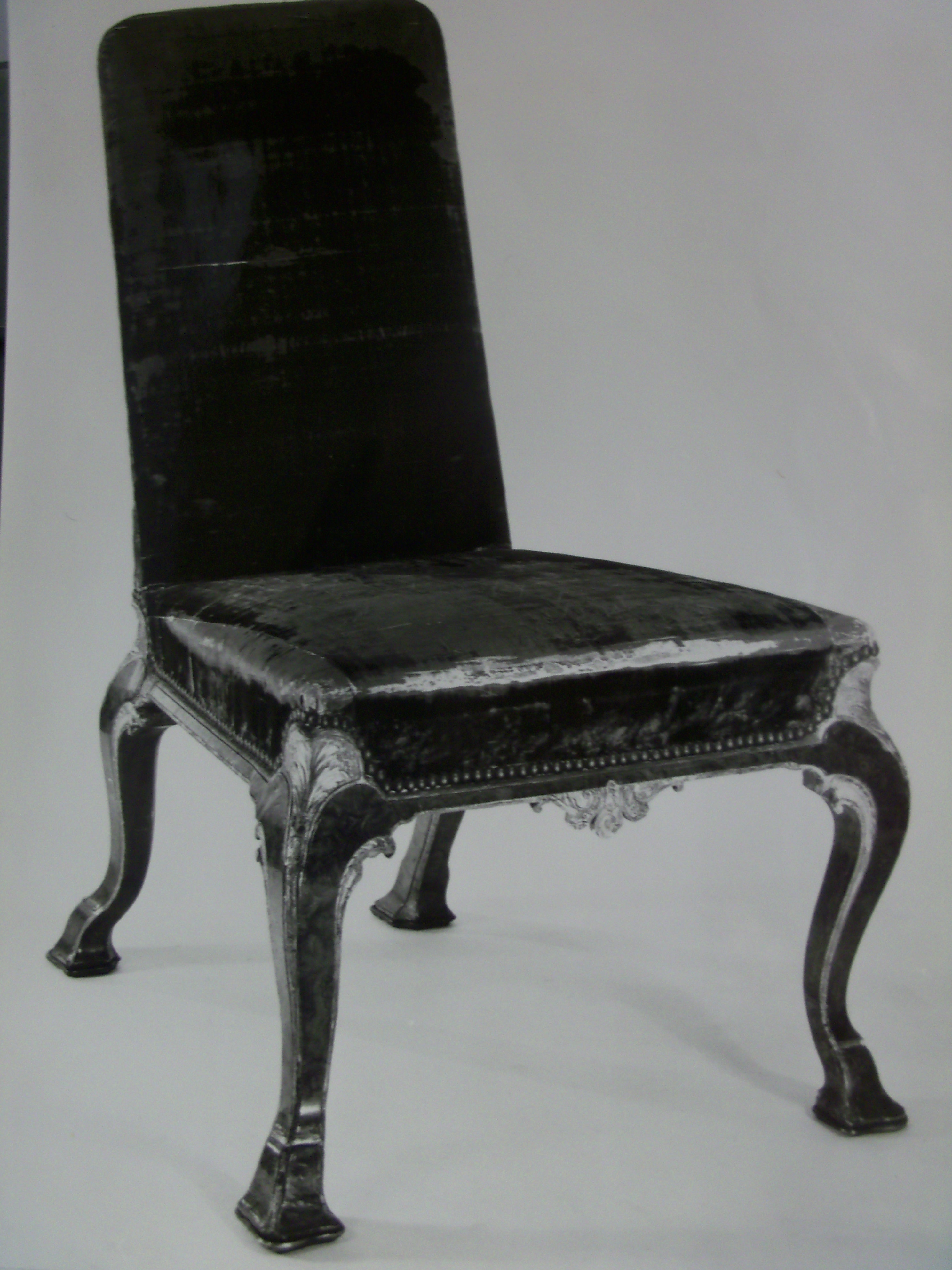
Houghton Hall chair, Temple Newsam House, Leeds. Photo c.1960, courtesy of Temple Newsam House, Leeds.

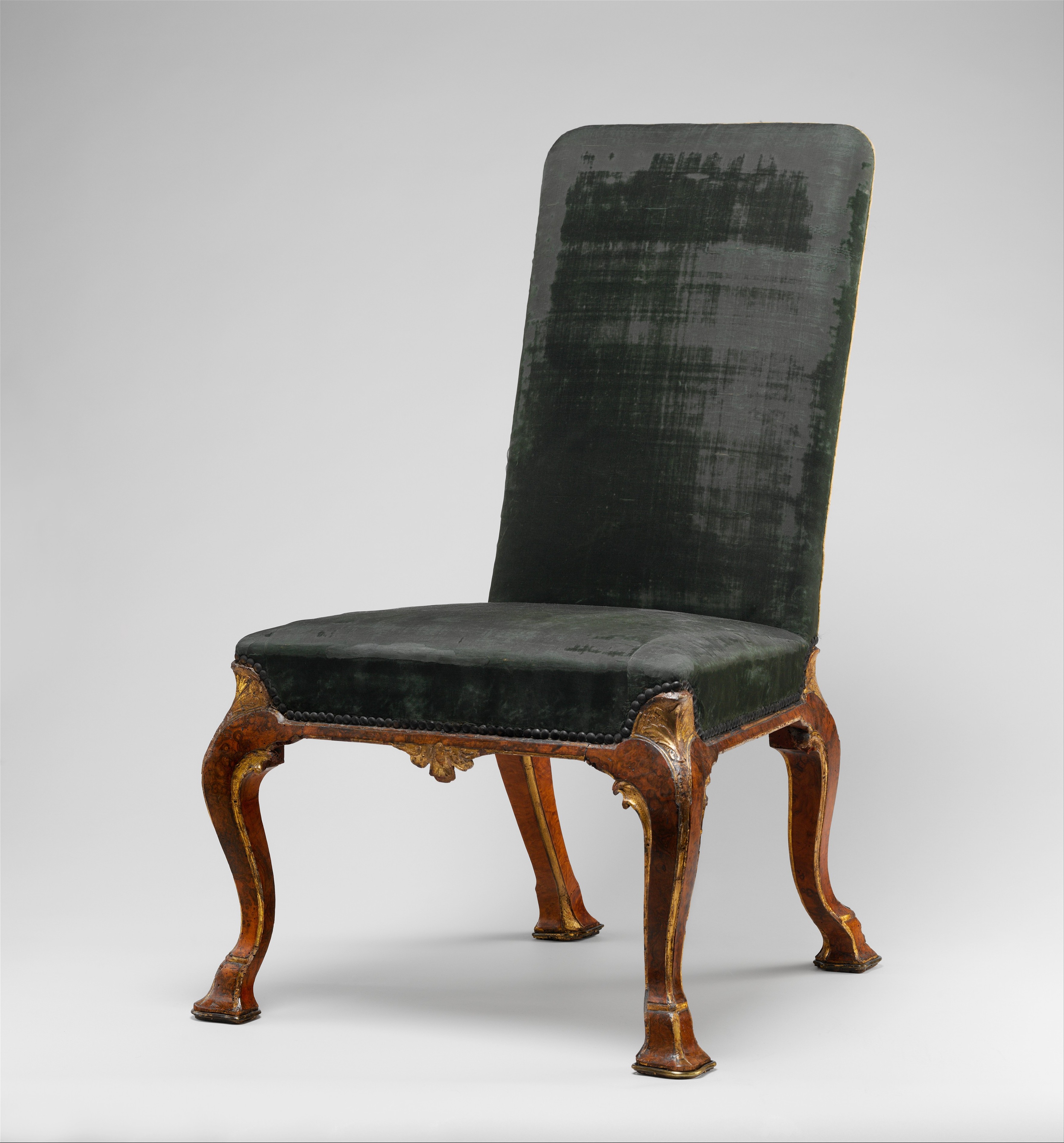
The chairs are related to a set of chairs at Houghton Hall, Norfolk, a very large suite of furniture, including 2 settees, made by Richard Roberts in the period c.1720; the chairs were acquired by the Gallery of Victoria through the Felton Bequest in 1961, through Phillips of Hitchin (see here for a link to the museum catalogue entry).

The pair of chairs now in Australia came from a set of six chairs acquired by Phillips of Hitchin in 1960; Jerome tells us that he thinks his father bought the 6 chairs at auction (not direct from Houghton Hall) – update 23.06.19 – the set of six chairs were sold at Sotheby’s, 29th January 1960, lot 117.  PoH then sold the chairs to four different museums in 1960 and 1961. One chair from the set was sold to Temple Newsam House, Leeds in June 1960, for the sum of £275.00, and described, in the PoH archive invoice as ‘a walnut and parcel gilt chair ensuite with chairs at Houghton Hall’. The chair in the first B&W photograph is the Temple Newsam House example, photographed in c.1960.

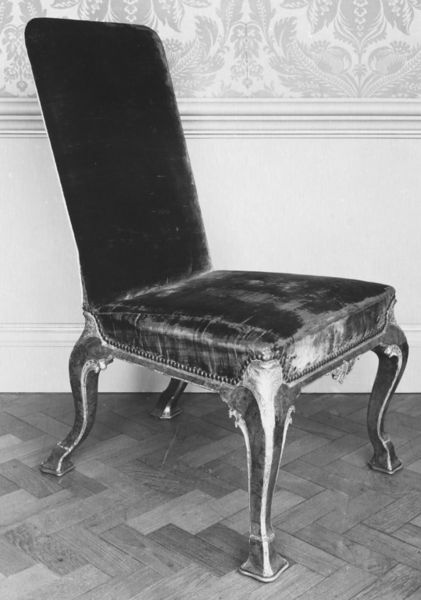
Another single chair was sold to the Victoria & Albert Museum in London in the same year.

Houghton Hall chair, Victoria & Albert Museum. Photograph c.1960. Copyright V&A Museum.

It seems quite strange perhaps that one of the pair of chairs were split up into single objects, rather than being retained as a pair (or indeed retaining the set of 6 chairs together), but the rationale, in the 1960s, was to distribute key examples of objects across as many museums as possible in order to allow more distributed access – this kind of materiality of things was a dominant idea in a period when object-based study was a key element in the structures of knowledge.

It’s interesting to note that the more recent acquisition by the V&A of the remaining large suite of furniture to which these 6 chairs relate, as part of the 2002 Acceptance in Lieu Scheme for the Inheritance Tax Settlement of the Cholmondeley Estate, has stipulated that the remaining suite of furniture remains in situ at Houghton Hall.

Chair in situ at Houghton Hall, Norfolk. Photograph copyright V&A Museum.

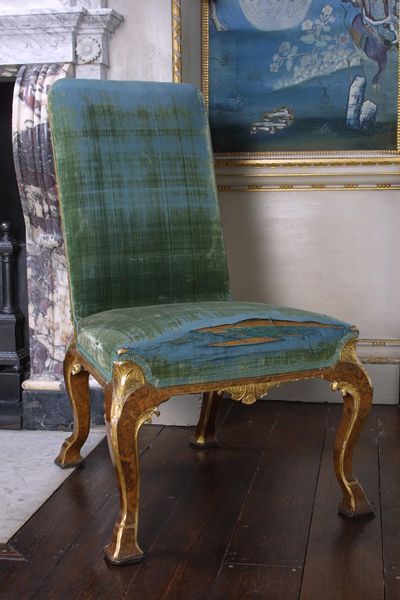
The last pair of chairs from the set of 6 acquired by Phillips of Hitchin were sold by the dealers in 1960 to the Metropolitan Museum in New York, through the Harris Brisbane Dick Fund. Here is a link to the online catalogue for the chairs.

‘Houghton Hall’ chair, c.1720. Metropolitan Museum of Art, New York. Photograph, Metropolitan Museum of Art, 2017.

And so, in this little example of the acquisition and distribution of this suite of Antique Furniture we can see not only the significant role of the antique dealer in the dissemination of objects across three Continents…..but also the shifting significance of the notion of historical context, cultural heritage, and museum collecting policies in the last 50 years or so.  And with that, the growing sense of the significance of the Phillips of Hitchin archive now held at the University of Leeds.

Mark

March 6, 2017

‘Where is it Now?’ – we found the first one!

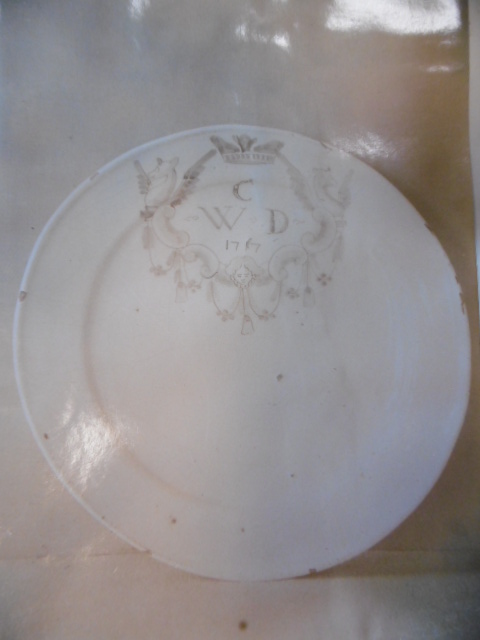
Thanks to Simon Spier, one of our Centre for the Study of the Art & Antiques Market PhD students, we have found the first of the ‘Where is it Now?’ objects. The object in question is a ‘Lambeth’ Delftware plate, dated 1717, with the initials ‘W D C’ painted on the top rim.

ms1999-4-1-52-plaque

Delftware plate, dated 1717. Phillips of Hitchin Archive MS1999/4/1/52. Photograph courtesy of the Brotherton Library Special Collections, University of Leeds, 2017.

The plate was in the stock of the antique dealers Phillips of Hitchin in c.1900, shown above in one of the photograph albums of stock that are part of the Phillips archive at the Brotherton Library Special Collections at the University of Leeds.

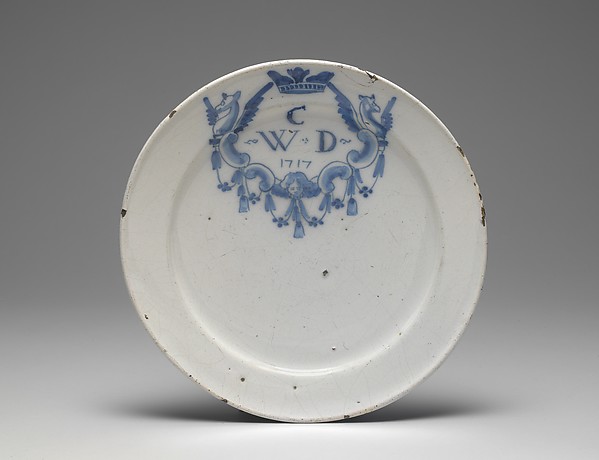
We have discovered that the delftware plate is in the Metropolitan Museum of Art in New York, USA. The plate is currently part of the Met Museum’s collections of European Sculpture and Decorative Arts – here’s a link to the Met Museum collections online for the PLATE 

And here’s the plate itself, in full, glorious colour! The plate is on display in Gallery 710 in the Met Museum if you want to go and see it for yourself.

delftware-plate-1717

Lambeth delftware plate, dated 1717, diameter 9 inches.. Metropolitan Museum of Art, New York, 12.279.9 Rogers Fund, 1913. Photograph copyright The Metropolitan Museum of Art.

The Metropolitan Museum acquired the plate in 1913 (via the Rogers Fund), through the well-known antique dealer Frederick Rathbone (1837-1919). Rathbone was, by 1913, trading at 20 Alfred Place, South Kensington, London, and would have been in his mid 70s when he sold the plate to the Met Museum. He was an acknowledged expert on antique ceramics, especially on Wedgwood and ‘Old English Pottery’; he was famous for helping to assemble the collections of William Hesketh Lever (1851-1925) 1st Viscount Leverhulme, and the extensive collections of 18th century Wedgwood ceramics assembled by Lord Tweedmouth (1820-1894).

It’s not known when, for how much, or to whom, Phillips of Hitchin sold the plate – it may have been sold direct to Rathbone, we have yet to discover that information, but it will be buried in the extensive archives at the Brotherton Library Special Collections.  What we do know is that Phillips bought the plate from the collection of the well-known collector W.H. Booth of Ipswich in Suffolk sometime around 1900.

Anyway, we are pleased at least to have found the first of the ‘Where is it Now?’ objects, and to have provided a little more provenance information to the delftware plate in the collections at the Metropolitan Museum, New York.

Mark


April 13, 2015

Antique Dealers, ‘Period Rooms’ and Museums

Following my short and pithy Tweet re the dealer Seligmann and the maquette for a period room, now on display at Minneapolis Institute of Art we have, thanks to Jennifer Komar Olivarez, Curator of Decorative Art, Textiles and Sculpture at MIA, discovered more about the maquette.  And it’s an unexpected, and fascinating history, and one that draws further attention to the significance of social and cultural networks in the circulation and consumption of ‘antiques’ – something that the ‘Antique Dealers’ research project is keen to explore.

seligmann model MIA

Maquette of the Grand Salon of the Hotel de la Bouexiere. Minneapolis Institute of Art. Photo MW 2015.

The maquette itself, (13in x 23in x 16 ins high) was a model for the Grand Salon of the Hotel de la Bouexiere, from Paris, which was designed 1731-1733, for Jean Gaillard de la Bouexiere (1676-1759), who grew wealthy as a tax collector for the Royal Crown in the 1st half of the 18th century. Here’s one end of the room as you see it at MIA –

hotel bouexiere

Grand Salon, Hotel de la Bouexiere, (c.1731-33). Minneapolis Institute of Art. Photo Wikicommons.

What is interesting about the room (for us), and the maquette specifically, is the ‘trade’ history of it. It seems that the maquette was made by the antique architectural salvage dealer and interior decorator and furniture manufacturer, Robert Carlhian, sometime in the early 1920s.

I was interested to note that the business records of Carlhian (est 1867, and closed c.1988) had been acquired by The Getty (ref 930092 if you’re interested). Carlhian were mainly based in Paris, but had branches in New York, Buenos Aires and Cannes; and during the period 1945-1966 they had a branch in London, in conjunction with the art dealer Wildenstein….so I guess they qualify to be included in the current ‘Antique Dealer’ research project (if we accept the broad definition of ‘antique dealer’ – you’ll need to re=read some of the earlier blog posts to follow the umbra and penumbra of what constitutes ‘antique dealers’ to follow this line of thought).

It seems that the room was sold to the Metropolitan Museum in New York, before being purchased by Minneapolis Institute of Art in 1983.  John Harris, in his excellent survey of the trade in architectural elements – Moving Rooms: the trade in architectural Salvage (Yale, 2007), suggests that the room was acquired by the dealers Dalva Brothers and sold to MIA in 1978 (see Harris, (2007), p.169). Dalva Brothers traded in New York and were established by 1933, but, as far as I know did not have a branch in Britain? The maquette was a gift to MIA from Leon and David Dalva – I guess as part of the purchase.

I also understand that at some stage Arnold Seligmann, Rey & Co also had some dealings with the circulation of the Grand Salon from Hotel de la Bouexiere. What is interesting (to us, as investigators of the history of the Antique Trade) is the networks and connections in these transactions – it’s not so surprising I guess, but no less significant, that the ‘antique trade’ play such a key role in the eventual presentation of this historical object in the public domain.

Mark


March 29, 2015

More on early 20th century antique dealers in New York

Following the blog post on ‘searching for Duveen’ in the streets of New York I thought it would be interesting to find the former locations of some of the other antique dealers I encountered in the archives at the Metropolitan Museum of Art in New York – it’s also the opportunity to share some of the fascinating archive documents in the archives (thanks again to Melissa Bowling, one of the archivists at the Met Museum for helping with the research for the Antique Dealer project!) Most of the dealer galleries dating from the early part of the 20th century seem to have been demolished in the continual processes of renewal of the architectural landscape of New York city, (as you’ll see in the comments below) – but I did find one building that still remains (although no longer the premises of an antique dealer).

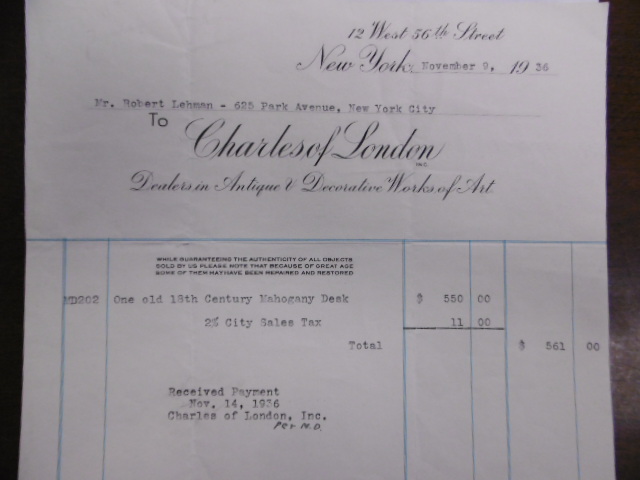
Some of you may know of the dealership ‘C.Charles’ – he was a brother of the famous Joseph Duveen; he was, apparently, not allowed to use the trading name of ‘Duveen’ (there’s only ONE Duveen I guess), so began trading as ‘C. Charles’ in London in the opening decades of the 20th century, and by the 1930s was trading as ‘Charles of London’ in the USA. Here’s a fascinating invoice from ‘Charles of London’ dated November 9th 1936, for an ‘Old 18th Century Mahogany Desk’, sold to the famous American collector Robert Lehman for $550 – (I couldn’t trace this object in the Met Museum collections….).

charles inv 9.11.36

Invoice ‘Charles of London’ November 9th, 1936. Box 37, Folder 12, Robert Lehman Papers, The Metropolitan Museum of Art Archives. Courtesy of the Metropolitan Museum Archives.

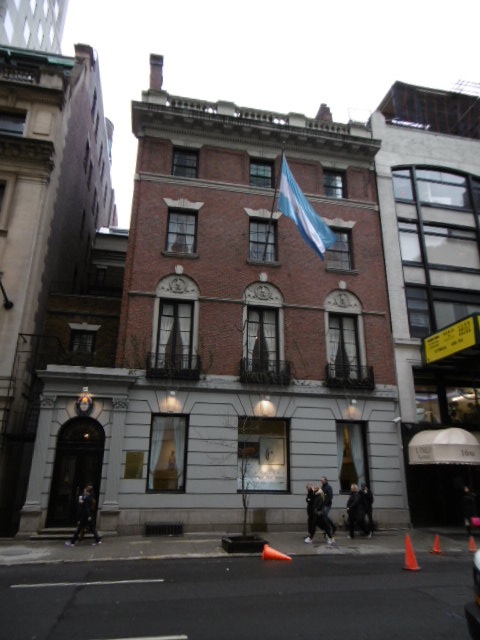
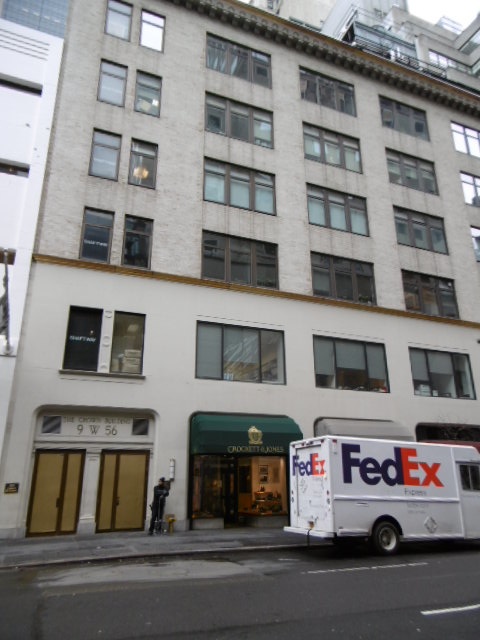
In my walks around New York searching for the locations of former antique dealer galleries I found Charles Duveen’s gallery at 12 West 56th Street – a very elegant (as one might expect) building, designed in a similar vein to Joseph Duveen’s spectacular purpose built gallery on 5th Avenue (see previous blog post).

Charles 12 west 56th  st NY

Charles of London former gallery at 12 West 56th Street New York. Photo MW March 2015.

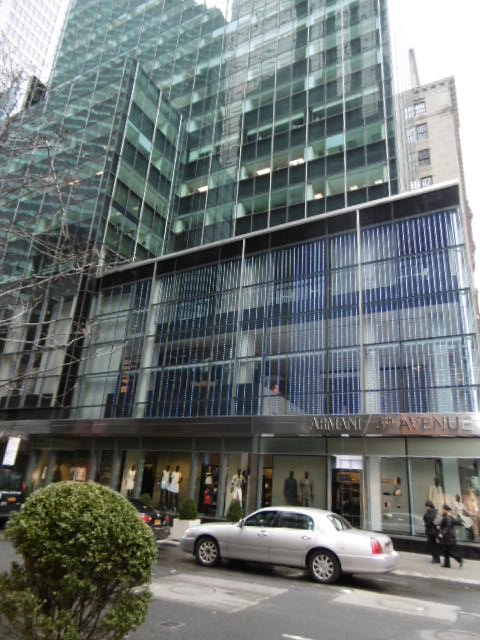
There were a few other letters and invoices from dealers I found in the archives, and I managed to find the former locations of the dealers – as I say, sadly the buildings themselves no longer exist. The location of the galleries of the famous antique dealers French & Co at 6 East 56th Street are now (maybe appropriately!) occupied by Armani –

former French and Co 6 East 56th st NY

Former location of French & Co (1916). Photo MW March 2015.

French and Co were at 6 East 56th Street, New York by 1916, as this invoice (again photographed by kind permission of the Metropolitan Museum Archives) demonstrates –

french invoice 7.9.15 det

Invoice, French & Co., 1916. Box 4, Folder 16, Durr Friedley Records, 1906-1918 (1917-1918) The Metropolitan Museum of Art Archives. Courtesy of the Metropolitan Museum Archives.

(I’ll come back to the contents of the invoice itself in another blog post…).

French & Co had moved to 210 East 57th Street by the 1930s, but again the building they occupied no longer remains…..

former French and co 210 East 57th st NY

Former location of French & Co, 210 East 57th Street, New York in the 1930s. Photo MW March 2015.

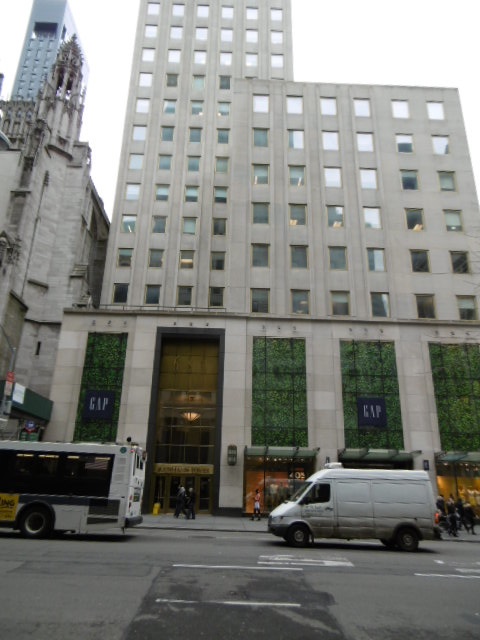
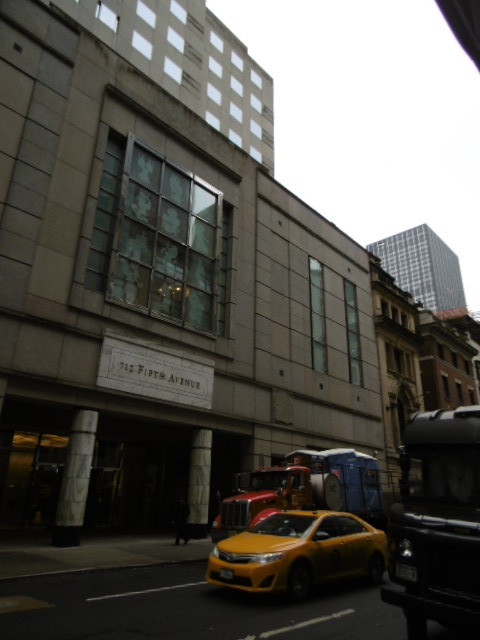
And here’s the former location of the dealer A.S. Drey, ‘Antique Paintings and Works of Art’, who, according to a note in the Metropolitan Museum of Art Archives moved to 680 5th Avenue, New York in 1929. The location is now occupied by shops and offices.

former Drey 680 5th Ave NY

Former location of A.S. Drey, 680 5th Avenue, New York in 1929. Photo MW March 2015.

And, just for the record, I also found the former New York locations at 6 West 56th Street for Frank Partridge & Sons (they were at this address from at least the early 1920s until at least the late 1960s – Partridge & Sons, like many of the dealers highlighted in this blog, are no longer trading).

former Partridge shop 6 West 56th st NY

Former location of Frank Partridge & Sons, 6 West 56th Street, New York. Photo MW March 2015.


And the locations of ‘Arnold Seligmann, Rey & Company Incorporated’ trading at 7 West 36th Street, New York in 1916, are now shops and offices….

former Seligmann shop 7 West 36th st NY

Former location of Arnold Seligmann, Rey & Co., 7 West 36th Street, New York. Photo MW March 2015.

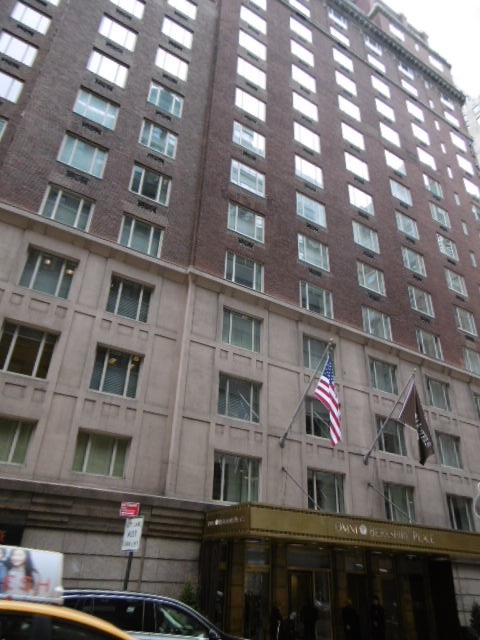
Likewise the former location of the antique dealer and interior decorators ‘White Allom’ (led by Sir Charles Allom) at 19 East 52nd Street, New York in 1914, are now occupied by an hotel.

former White Allom 19 East 52nd st NY

Former location of the galleries of White Allom, 19 East 52nd Street, New York in 1914. Photo MW March 2015.

As you can see, the archives at the Met Museum were a catalyst for a fruitful perambulation around a (very cold) New York….
Mark


March 22, 2015

Project Research in the USA

Just arrived in New York, for the first leg of a mammoth research field trip to the USA, as part of the AHRC Antique Dealer project. We’ll be investigating museum archives at the Metropolitan Museum of Art, here in New York, before heading up to Boston Museum of Fine Arts on Saturday 28th March for similar research. From there I head to Philadelphia, then Wilmington, to The Winterthur on 31st March to look at the dealer archives held at The Winterthur (Vernay, Needham and Koopman – all British-related antique dealers of course). Then on Saturday 4th April off to Chicago, to look at the Chicago Institute of Art archives; then on Wednesday 8th April I’m heading across to Minneapolis and the Minneapolis Institute of Art for a few days to investigate their archives. And finally, on this exhausting tour, ending up in Los Angeles at the Getty Research Institute during 11th-18th April to consult the dealer archives there (French & Co and Durlacher…as well as Duveen of course).

The rationale for this extensive research trip to USA is to investigate the relationships between the British Antique trade and the development of public museums in America – the connections are considerable. We’re also planning do undertake some oral history interviews whilst we’re here in USA, and have some very significant figures in the history of the antique trade lined up for interview!

I’ll be posting updates on the blog on the discoveries (research-wise), so do keep an eye on the Blog!
Mark

Home Subjects

a working group dedicated to the display of art in the private interior, c. 1715-1914

The Period Room: Museum, Material, Experience

An International Conference hosted by The Bowes Museum and The University of Leeds

H. Blairman & Sons Ltd

A research project investigating the history of the antiques trade in Britain in the 19th & 20th centuries

Museum Studies Now?

'Museum Studies Now?' is an event which aims to discuss and debate museum and heritage studies education provision.

The Burlington Magazine Index Blog

art writing * art works * art market

East India Company at Home, 1757-1857

A research project investigating the history of the antiques trade in Britain in the 19th & 20th centuries