Archive for ‘Uncategorized’

April 30, 2014

Bull in a furniture shop?

In certain circles there has always been a certain degree of bad feeling towards the antiques trade-in rather the same way as lawyers and second-hand car salesmen. Needless to say this is almost always undeserved and seems to stem largely from jealousy, particularly due to the level of mark-up applied by a successful dealer selling a piece that they may have bought very cheaply for example. In this post I would like to focus on one notorious dealer who has gained a lot of adverse press coverage over the years. In this case, however, there is no doubt that the bad press is wholly proportionate.

Wilfred Bull was an Essex-based furniture dealer who made his name in the days of the antiques boom in the 70s and 80s, becoming well-known as a good trade source for the top dealers and becoming extremely rich in the process. Things changed dramatically in 1985 when he murdered his wife in his showroom and attempted to pass it off as the work of a crazed burglar. Needless to say Mr Bull ended up in prison but this wasn’t the end of his brush with infamy.  Whilst in prison he attempted to sell part of his collection of rhino horn, valued at £2 million and acquired before his imprisonment, on the black market as a way of financing his life after his expected release. Despite having his sentence extended as a result of this second indiscretion, he won a landmark Court of Appeal ruling in 1998 and was thus able to sell off part of his haul.

As with any trade there will always be a few bad apples and sadly Mr Bull’s name is now known for all of the wrong reasons.

Chris Coles,

Project volunteer research assistant.

The winding-up sale for Wilfred Bull's firm conducted by Sotheby's

The winding-up sale for Wilfred Bull’s firm conducted by Sotheby’s

April 22, 2014

Dealer’s Shops – images of developing locations and use of historic premises

Our database of images of Antique Dealer shops continues to grow. In the previous post I directed attention to the significances of the changing interior display of dealerships, and in the present post I thought it would be interesting to focus on exterior views and the range of buildings used by the trade; and to direct attention to the significance of the changing locations adopted by the trade over the course of the 20th century…..and some interesting aspects are evident – one is the growth of the ‘Country Antique Shop’.

In my earlier research into the history of the antique and curiosity trade (see publications in my research profile if you’re interested!) I made an observation that in the 19th century the emergence of the antique shop appears to have been almost exclusively an urban phenomenon, and that the ‘country antique shop’ was a later (20th century) development in the history of the trade.  This is also borne out when one investigates the store of images we have as part of this new project.  The Country Antique Shop we are so familiar with appears to have been a first half 20th century development, and here’s a selection of images we have just to give the briefest insight into this history.

Here’s an image, from 1921, of one of the most famous antique furniture dealers, Moss Harris & Sons (est 1868)…at 40-54 New Oxford Strett, London.

Image

There have been many hundreds of dealers in London of course; here’s just one more, Walter Bird’s shop, Kensington Church Street, London, an image taken in c.1945:

Image

Beyond antique shops in London and other urban areas such as Manchester and Birmingham, as well as in historic towns such as Bath and Warwick, the ‘country antique shop’ appears to have begun to proliferate from the second quarter of the 20th century – with an increased expansion during the 1940s and 1950s, which seems to have been a particularly important period. Locations such as ‘The Cotswolds’ and tourist towns in Sussex, Devon etc., appear to have been the preferred locations for many dealers during this period.

Here’s Forge House, Broadway, Worcestershire, in 1953; and one can also note that the historical nature of the building itself is a key driver for the appropriate adoption of such premises by the trade:

Image

Here’s Shirley Brown’s ‘shop’, at Tredington, Warwickshire, also in 1953:

Image

And, to close, a couple of ‘shops’ in Devon, that illustrate the wide range of buildings, and trading practices, adopted by the trade; here’s A K Halsey, Boffins Boft, Kingsbridge, Devon, also taken in 1953.

Image

And finally, R. E. Martin, trading from home, as it appears…at ‘Tucketts’, Trusham, near Chudleigh, Devon, in 1961.

Image

The project will be investigating the history of these locations, changing trading premises, and other developments as part of this broader ‘cultural history’ of the Antique Trade in the 20th century….so watch this space!

Mark

April 6, 2014

Images of Dealer shops

Recently been gathering more and more images of antique dealer shops, interior photographs as well as exterior photographs, so I thought I’d share a few images – we will be creating a database of images for the interactive website, and once that goes ‘live’ everyone will be able to see all the images we have to date – we’ve only just started to scratch the surface here, so there will be many, many more images to come, but at present I reckon we have a few hundred images….

Anyway, here’s some to whet the appetite – they are actually quite revealing about display practices in the antique trade at various points in the 20th century. Here’s ‘C. Charles’ shop – (this is J. Duveen’s brother, Charles Duveen, who was paid by his brother not to use the surname Duveen..); the date of the image is c.1903, when C. Charles traded at 27-29 New Bond Street, London.

Image

The stock seems typical for a ‘high-end’ dealer, selling mainly to ‘Gilded Age’ American clients.  The display seems to be sightly more dispersed than many of the packed-out displays in antique and curiosity shops of the 19th century, but there’s still a fairly random jumble of various objects; there’s certainly no attempt here to replicate a ‘historic room’ display, or to theme the objects in any recognizable sense.

Contrast Charles Duveen’s gallery with a display of c.1903 of the house furnishers, furniture makers, and antique dealers, ‘Gillows’, 406 Oxford Street, London; Waring and Gillow was established in 1897, following the merger of Gillows (Lancaster), (est c.1730) and Waring of Liverpool. As ‘house furnishers’ Gillows have chosen to create a ‘room set’ effect; there’s also an obvious mixture of ‘antiques’ with reproductions made by the firm itself.

Image

To set these metropolitan dealer shops in a contrast, here’s a provincial dealership, Perry and Phillips, trading in Bridgnorth, Shropshire –

Image

The photograph is of their shop interior in c.1922 – quite a packed-out display, which must have been typical of many antique shops in the period – they have resonance to the displays of antique shops in the 19th century, and we still encounter such modes of display today of course.

Some, specialist dealerships, required different, discrete modes of display – this astonishing (to me anyway) image of the interior of the famous dealer in Chinese Works of Art, John Sparks, of c.1937, when Sparks was trading at 128 Mount Street, London (still a very smart address), is indicative of specialist methods of display, illustrative of the potential modes of engagement with the objects themselves.

Image

The display obviously keys into the evolving aesthetic of British Modernism at the time, but also nods towards the specific modes of engagement, and the significance of the optic and the haptic in the appreciation of such works of art; it’s also worth pointing out that the display also keys into the stripped back, minimalist aesthetics of Chinese and Japanese art works themselves.  John Sparks had created a very carefully planned, very thoughtful response to the objects that they sold, and produced a display that does look astonishingly modern.

Mark

March 29, 2014

Project Advisory Board Meeting at Temple Newsam House, Leeds

We had our 2nd Advisory Board meeting at Temple Newsam House in Leeds on Friday 28th March. Thank you to our Advisory Board members (Reinhold Behringer, Georgina Gough, Martin Levy, James Lomax, Camilla Nichol, Judith Phillips, Emma Slocombe, and Christopher Wilk) for their continued support, advice and counsel for the Antique Dealers project. We thank James Lomax and Martin Levy, who did a little ‘trade tour’ of the collections at Temple Newsam House –

Image

Temple Newsam House

James is emeritus curator of Temple Newsam, and Martin is the director of H. Blairman and Sons and they both talked so engagingly about the decorative and fine art objects that entered the collections via the antiques trade and are on display at Temple Newsam. Indeed, Martin had many personal recollections of the acquisition stories of many of the objects on display, including a set of 4 giltwood torcheres (see below) which Martin discovered in an auction in Switzerland in 2007 and negotiated their return to Temple Newsam House – they were originally supplied to Temple Newsam by James Pascall, for the Picture Gallery, in the 1740s, but sold from the house in 1922.

Image

Giltwood Torcheres by James Pascall, c.1746

There were lots of fascinating anecdotes from James and Martin, stories that one never hears about – especially when one considers  the acquisition of museum objects! Some of the stories of the acquisition of objects at Temple Newsam are public knowledge – (for example, the then, in 1965, world record price of £43,050 for the Chippendale Library Table, formerly at Harewood House in Yorkshire) –

Image

Library Table, by Thomas Chippendale, c.1771.

But Martin also told us that his father, George Levy, who bid at auction for the table, only just managed to acquire the table on behalf of Leeds City Collections (of which Temple Newsam House is a part) – George Levy managed to persuade the consortium of philanthropists who wished to buy the table for Leeds to allow him to go just one extra bid over their suggested limit for the table…..it very nearly got away!

There were so many more fascinating stories about the acquisition of some of the objects at Temple Newsam…part of the research project is to investigate these ‘hidden histories’!

Mark


March 27, 2014

Portobello Road

We were very interested to read the letter from Kathleen Skin (aged 93)! published in the letters column of the Antiques Trade Gazette this week. See ATG 22nd March 2014. Kathleen briefly outlined her memories of her time as a dealer trading in the famous Portobello Road during WWII, with some absolutely fascinating reflections – we’re hoping to interview Kathleen as part of the oral history parts of the Antique Trade research project.

And thanks to Editor of the ATG, Ivan Macquisten for sending us the PDF of the letters page, and for writing to Kathleen on our behalf to try to set up a meeting (Thanks Ivan!)

here’s the PDF of the letter – Kathleen Skin letter ATG

As part of the project we will be investigating the history of Portobello Road Antiques markets in more detail, so keep your eye on the developments.

Mark


March 23, 2014

Phillips of Hitchin – more images of dealer shops

In anticipation of my visit tomorrow to speak to Jerome Phillips, of Phillips of Hitchin – (founded by Jerome’s grandfather Frederick William Phillips in 1884) I thought I’d post an image of the interior of Phillips’ ‘shop’….The Manor House, Hitchin….

Image

….which they have occupied since the 1880s – this photograph dates from c.1910. Phillips had (still have) the advantage of course of being able to display their antique furniture etc in an appropriately historic setting. In the early decades of the 20th century such strategies also keyed into the increasing numbers of publications on historic houses (Muthesius etc) and furniture history (Macquiod, Edwards, Cescinsky etc etc) and the fashion for recreated interiors. Indeed F.W. Phillips could not only furnish your home with appropriate antiques, they could also build an ‘antique’ home for you…as this advertisement from c.1910 suggests…

Image

…as the caption states…’A modern house built by Messrs Phillips from old materials. Estimates for this half-timber work maybe be had on application…’……A very ‘Modern Antique’.

Mark

March 15, 2014

More photographs of dealer shops

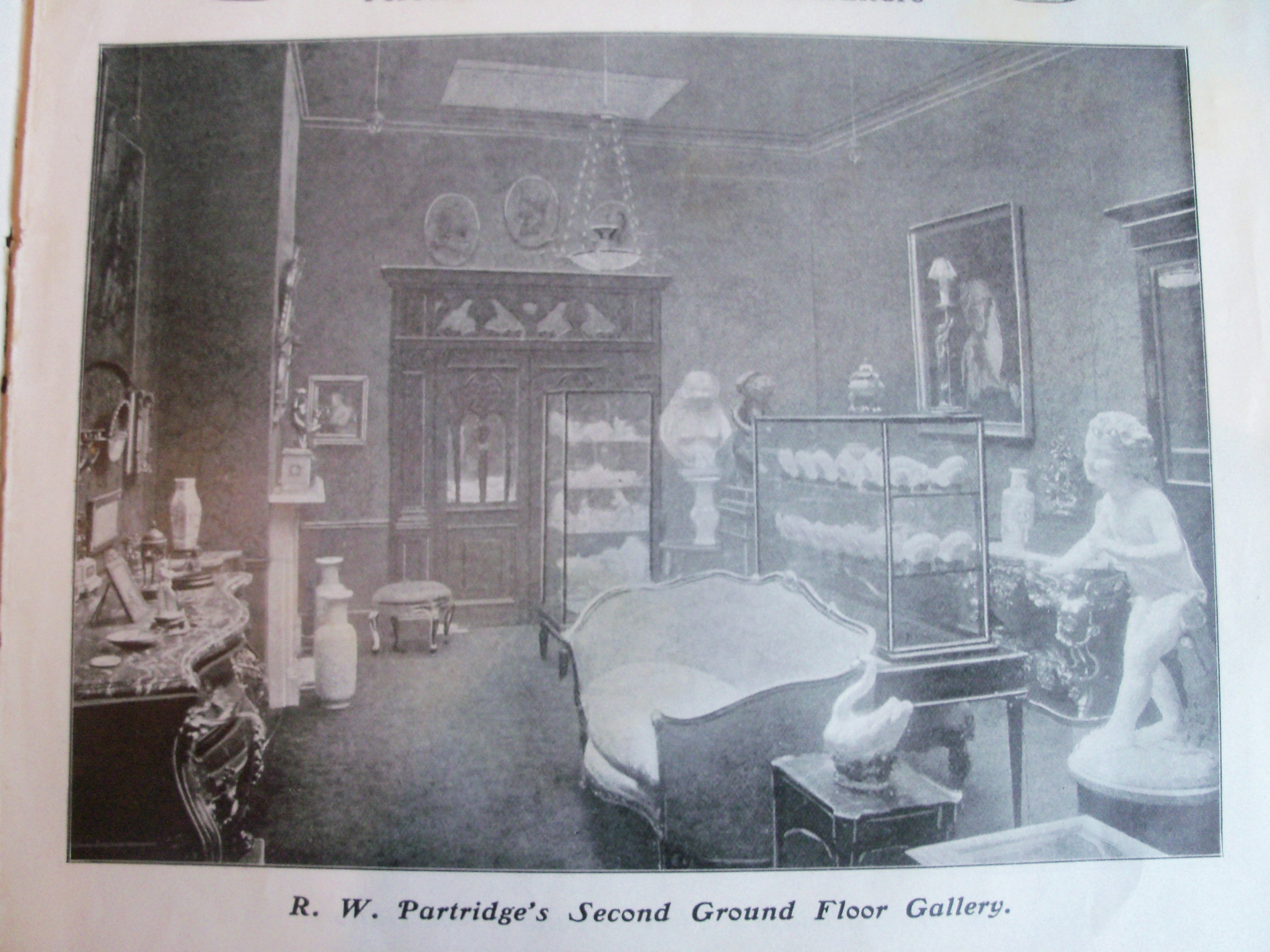
Following the last blog entry on images of dealer shops I found some more photographs of R.W. Partridge’s shop in St. James’s Street, London.  They really do give a flavour of the ways in which antiques were displayed (in the top market London trade at least) in the opening decades of the 20th century. Here’s the ‘Interior of the shop’: Image

Still quite a crowded space….and here’s the ‘Second Floor Gallery’: Image

Which illustrates the range of art and antiques offered for sale.  And the ‘Top Red Gallery’: Image

I assume it was the ‘red’ gallery because the wallpaper was red?….As part of the project we are assembling an image database of dealer’s shops, interiors and exteriors, they provide such a fascinating picture of the changing fashioning in displaying, selling and marketing antiques over the course of the 20th century.

Mark

March 9, 2014

Images of dealer shops

We’re compiling a database of images of dealer shops…interior and exterior photographs. Here’s an example of the interior of R.W. Partridge’s shop at 19 St James’s Street, London, in c.1910.  It was, interestingly, called ‘Chippendale Gallery’…it looks rather stacked out…..Image

…..a bit like a warehouse, rather than a swish emporium in St. James’s…..!

The images (subject to any copyright restrictions of course) will be archived in the interactive project website…so if you do come across any images of dealer shops (especially prior to the 1950s) do send them on to us at antiquedealers@leeds.ac.uk

Make sure you send all associated information with any images though (date, name of dealer, location etc etc)…

Mark

March 7, 2014

Dealer information from the other side of the World!

Thank you to Mabel Jowsey, from Dunedin, New Zealand, who very kindly send us family history information on the antiques dealer John (Jack) Craggs – youngest brother of Mabel’s husband’s grandmother. John Craggs (1881-1969) traded from a shop at 3 High Street, Tenby, Pembrokeshire, and apparently he sold objects to the London trade, including Mallett….it’s great to know that the project is making connections over 11,000 miles away!

Mark

Tags:
March 7, 2014

Dealer history – submitted information: Arthur Kauffmann

Thank you to Michael Kauffmann, who sent us a little booklet on the history of his father Arthur Kauffmann, the well-known art dealer trading in Grafton Street in London (1939-77) and later in Knightsbridge. Image

Arthur famously sold the Master of Flemalle’s ‘Entombment of Christ’ to the collector Count Seilern – it’s now at the Courtauld Gallery in London. Arthur sounded like a real character – as Michael says, ‘he was still bidding at the sale of the Robert von Hirsch collection at Sotheby’s in 1978 when he was 91 years old.’

Thanks Michael for sending this information.

Mark

Tags:
Home Subjects

a working group dedicated to the display of art in the private interior, c. 1715-1914

The Period Room: Museum, Material, Experience

An International Conference hosted by The Bowes Museum and The University of Leeds

H. Blairman & Sons Ltd

A research project investigating the history of the antiques trade in Britain in the 19th & 20th centuries

Museum Studies Now?

'Museum Studies Now?' is an event which aims to discuss and debate museum and heritage studies education provision.

The Burlington Magazine Index Blog

art writing * art works * art market

East India Company at Home, 1757-1857

A research project investigating the history of the antiques trade in Britain in the 19th & 20th centuries