Archive for ‘Uncategorized’

August 13, 2014

Oral History Interviews – Bill Beaton

We completed another of our oral history interviews on Monday 11th August – up at Kinross in Scotland, with William (Bill) Beaton.  Bill is in his 80s and retired from antique dealing about 25 years ago!  He started his antique dealing activities with his father, Walter Beaton, in about 1946 just after WWII, at his father’s shop at 37 Albert Square, Dundee.  Walter had opened his shop in c.1930, following 10 years working for an antique dealer in Dundee named Norries, and Bill continued the business in Dundee until his father retired in 1963, when Bill took over and subsequently moved the shop to Perth in 1970. Both Walter and Bill were members of BADA – Bill acted as Vice President at one stage.
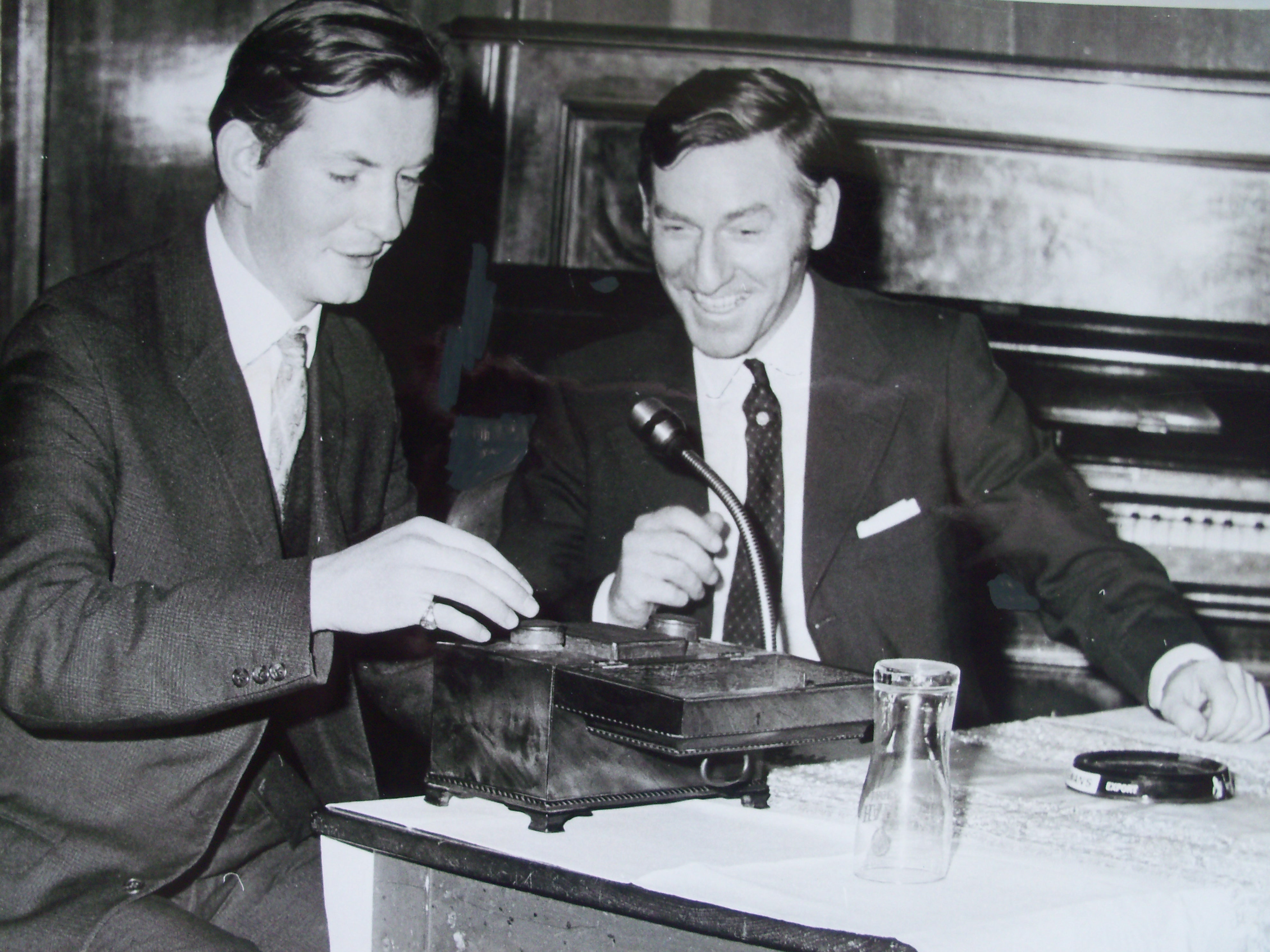
Bill Beaton (right) with Henry Fotheringham, c.1965. Copyright Perthshire Advertiser.

Bill Beaton (right) with Henry Fothringham, c.1965. Copyright Perthshire Advertiser. Courtesy of Bill Beaton.

Here is Bill (on the right), in c.1965, with his friend and colleague Henry Fothringham (a member of the Angus family, who also traded as an antique dealer, under the trading name of Grantully Castle Antiques), at the ‘Scottish Antiques Fair’.  Incidentally Bill was one of the founders of the Scottish Antiques fair, which was held in Edinburgh between 1964 and the mid 1970s. Here’s Bill’s stand at the fair, in c.1965.
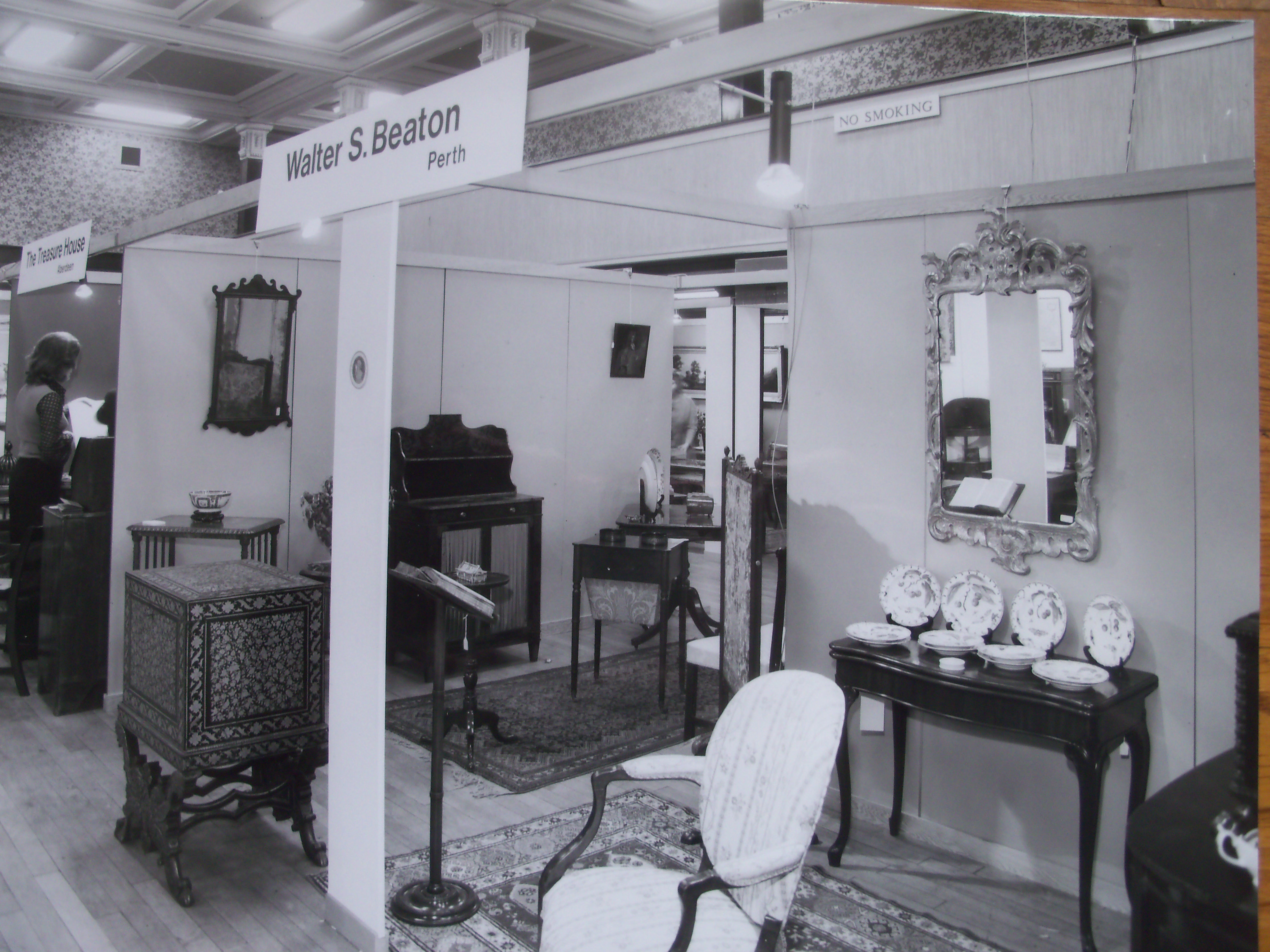
Courtesy of Bill Beaton.

Courtesy of Bill Beaton.

Bill and I talked for a few hours and he recalled his first country house auction sale, (Cusworth Hall, near Doncaster, in the 1950s – where his father had put him under the watchful guidance of the well-known dealer Walter Waddingham of Harrogate) and memories of fellow dealers, and objects that passed through his hands – including a rare painting by the 17th century artist Melchoir de Hondecoeter (bought from a furniture dealer in Harrogate in the 1960s) and a ‘Chippendale’ double partners desk from a well-known (Royal) Scottish country house!

Amongst the many interesting things that Bill’s father sold was an 18th century  French clock by Jacques Droiz Leschot, which was also noticed by the writer of the Antique Yearbook for 1950 – who writes;

‘We found in the main Albert Square [in Dundee], number 37, the shop of Mr. W.S. Beaton [Bill’s father], where the 18th century mahogany furniture, the fine silver, the glass and Chinese porcelain were polished and in splendid condition, where a collection of snuff boxes was up to Bond Street standard, and where a gold and enamelled singing-bird clock by Jacques Droiz Leschot was one of the most precious works of art we had seen for many a month. You must visit Dundee and Beaton.’ (Antiques Yearbook, 1950, p.557).

Bill still remembered the clock after all those years, and actually found a B&W photograph of it!
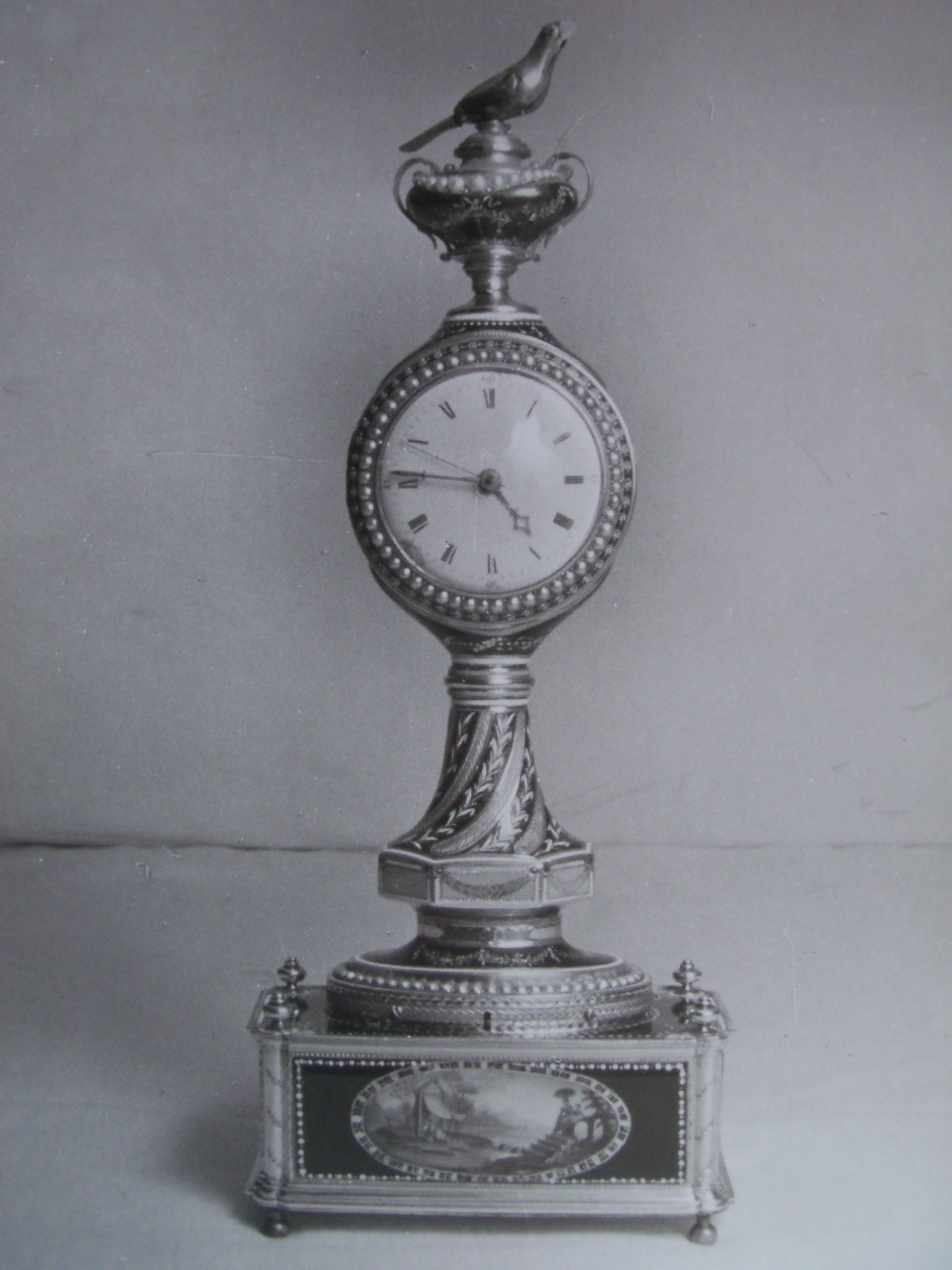
Photograph courtesy of Bill Beaton.

Photograph courtesy of Bill Beaton.

You will be able to listen to the interview with Bill in a few weeks, once we’ve edited it and uploaded it to the project website.

Mark
August 3, 2014

Antique Markets and Centres

The research for the antique dealer project is progressing, and we’re now very near to launching the interactive project website – keep your eyes open!

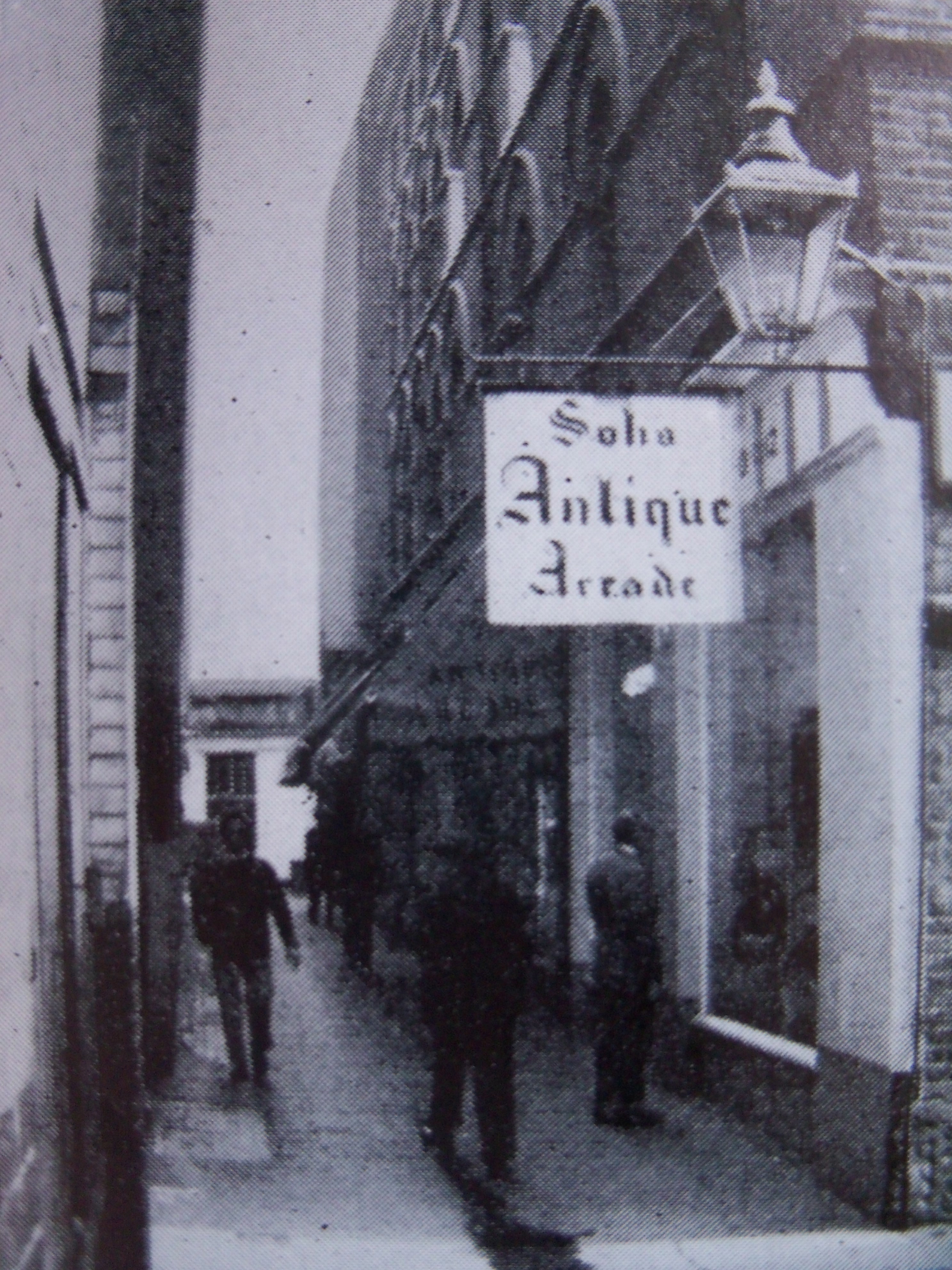
One interesting ‘theme’ for further investigation that has emerged during these early phases of the research is the development of ‘antique centres’ and ‘antique markets’. They are now such a familiar sight of course, with places such as Helmswell, in Lincolnshire (the largest ‘antique centre’ in Europe) but our research is starting to uncover the significance of a particular moment in the development of antique centres in Britain.  It seems that the mid to late 1960s saw an increasing number of antique centres appearing all over the country. The Soho Antique Arcade, for example, which opened in in St. Anne’s Court, off Wardour Street in London in 1966 – see below.

Soho Arcade

There were earlier arcades of course, (the architectural form and commercial innovations developed from the early 19th century – particularly in London with developments such as The Burlington Arcade (1819) – and earlier Antique Centres – the London Silver Vaults in Chancery Lane is perhaps the earliest antique centre, dating back to 1885.

In terms of Antique Centres, the Red Lion Antique Market in Portobello Road was opened as early as 1951, but it seems that the 1960s was a particular period for an expansion in the antique markets and centres.  Camden Passage, London (1960), Bermondsey, London (early 1960s), Chelsea, London (1965), as well as antique markets and centres in the regions – Birmingham (1966); Bath, Guinea Lane (1968); Halifax, Yorkshire (1969); Woburn Abbey (1967) – sadly closed last year. We’ve traced more than 50 of them so far in the period 1950-1980.

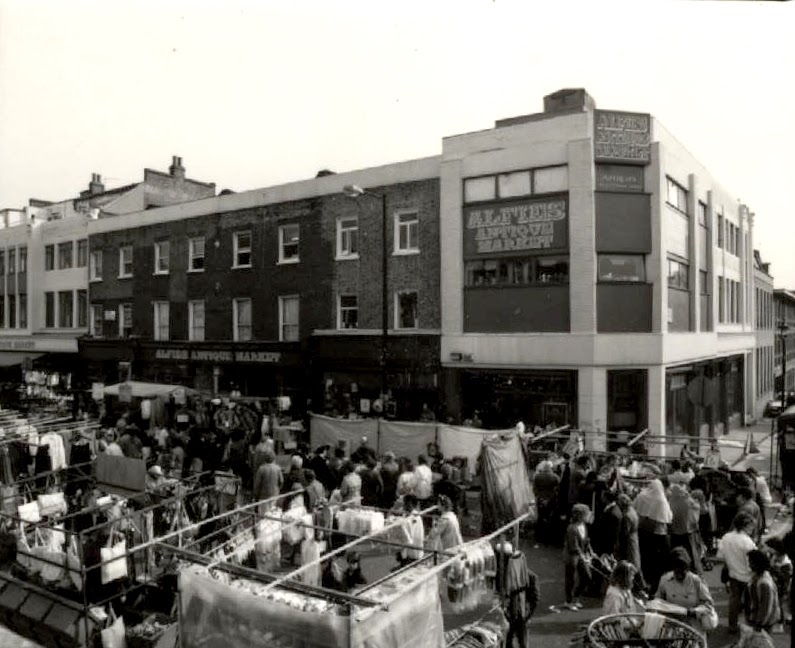
The doyen of the London Antique Centres is no doubt Bennie Gray, who established his first antique centre in Bartlett Street, London in 1964.  Gray did not invent the form, but refined it prodigiously, opening The Antique Hypermarket, Kensington, (1968), Antiquarius, Chelsea (1970) Alfies, North London (1976) – (see left), Alfies Antique Market 1970s


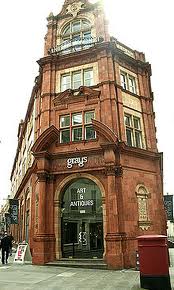
and finally the eponymous Grays, Davies Street (1977) – (below). Grays The phenomena of antique centres and markets, their naming (they seem to borrow heavily from American culture in the 60s?), and what they tell us about the changing cultural geography of the antique trade are key questions for the project – we’ll keep you posted on further developments.

Mark

July 27, 2014

Thomas Rohan, Dealer and Author – and ‘Quinney’

Some of you may be aware of the novels about an antique dealer called ‘Quinney’, in the writings of Horace Annesley Vachell – Vachell published a number of novels about the adventures of Quinney, starting in 1914, with the original novel, called ‘Quinneys’.  The novels are interesting period pieces and tell us a lot about the characterisations of the antique dealer in the first half of the 20th century – and part of the research for the current project will be focusing on an investigation of these literary constructions, and their meanings and influence on the characterisation of the antique dealer in the wider public domain.  One interesting result of the popularity of Vachell’s novels is the number of real dealerships called ‘Quinneys’ that emerged, right across the country – we’ve traced at least 11 so far; as far as I know there is only one dealership named ‘Quinnney’s’ left trading…in Warwick.

100_3712

The novels themselves are fascinating, and contain lightly veiled characterisations of real dealers – a ‘Mr Pheasant’ is quite obviously an allusion to the well-known London dealer ‘Partridge’ for example – and there are several other fictional dealers that seem to relate to factual ones – ‘Primmer of Bath’ could only be Mallett I suppose, and ‘Gustavus Lark’, who ‘wore a cut-away coat, with an orchid in the lapel of it’….and was ‘smoking an imposing cigar’, in one scene from the original novel ‘Quinneys’…is this the infamous Duveen?….

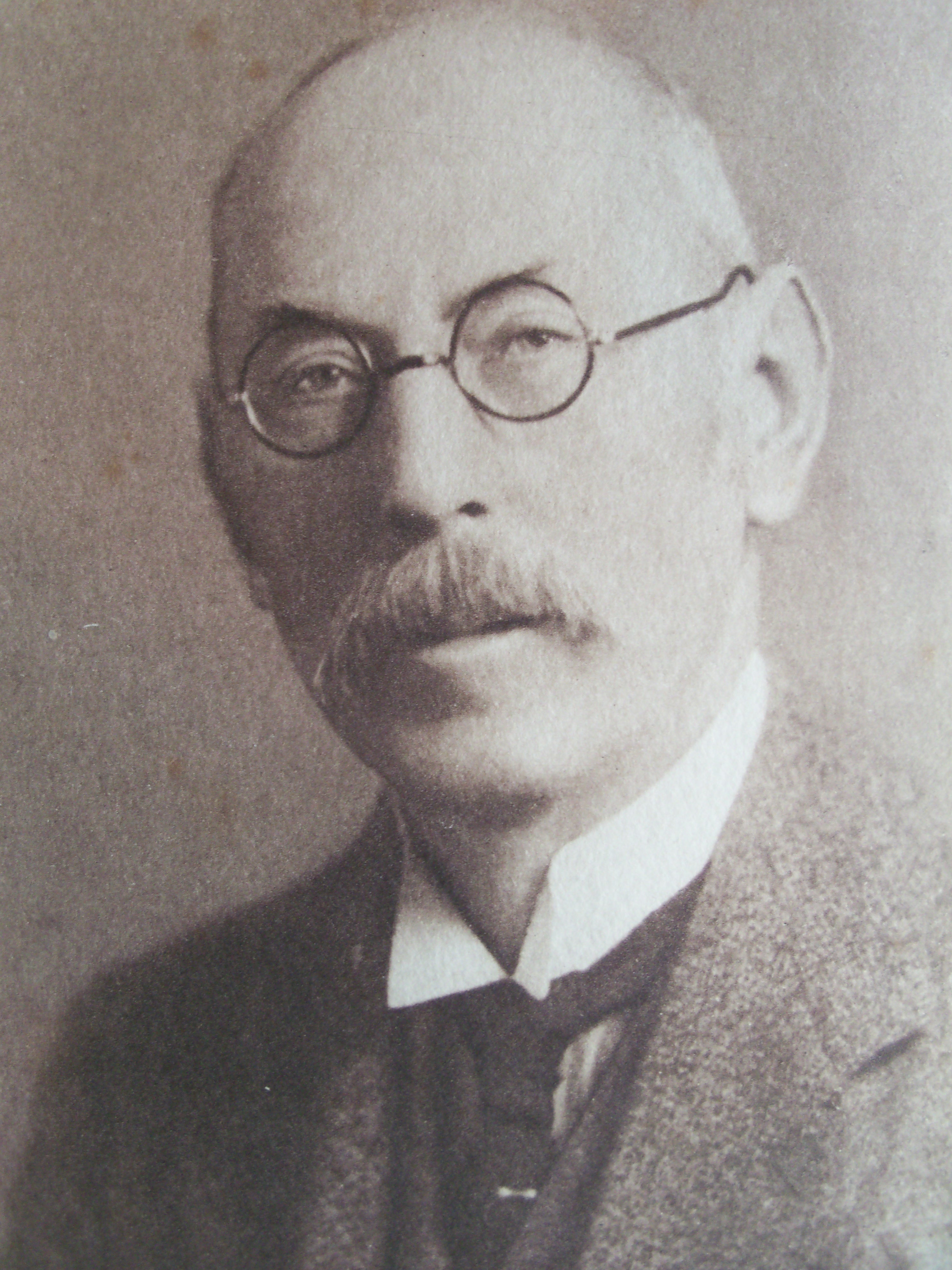
One fact that is less well known is that Vachell based his character Quinney on the real dealer Thomas Rohan, who was trading in Bournemouth in the first quarter of the 20th century. Rohan was himself a very successful author, publishing many books on collecting and on the antique trade itself – most famously in ‘Confessions of a Dealer’ (1924)

Here’s a photograph of Thomas Rohan, and an image of his first shop: 100_3710100_3709Rohan, as I mentioned, was also a prolific author, publishing many books, mainly on collecting, such as ‘Old Beautiful’ (1926)…as well as writing novels – his novel ‘Billy Ditt, the Romance of a Chippendale Chair’ (1932) traces the fortunes of a chair, made by Thomas Chippendale in the 18th century, as it passed through various hands – I can’t say it’s a literary masterpiece, but it is an intriguing book, and of course, is crucial to our cultural understanding of the history of the antique trade itself.

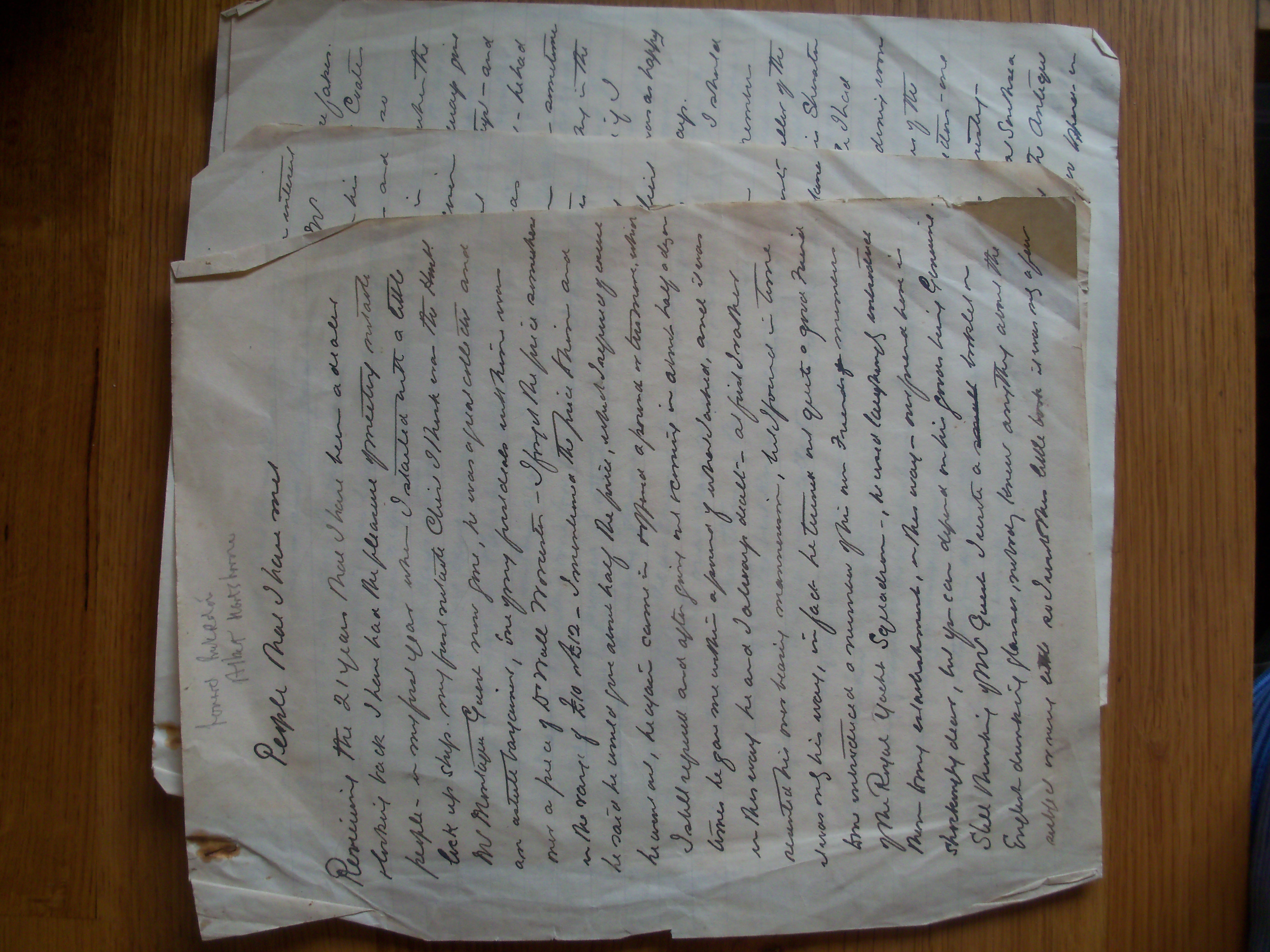
One exciting development (for me anyway!) is that I recently managed to acquire this short manuscript from a book dealer: 100_3708

The MS is only a short document, entitled ‘People that I have met’; it is undated and unsigned, but seems to date from c.1920, and I am certain that this is part of the original writings of Thomas Rohan.  It contains musings on his life as a dealer, and on the collectors that he sold antique objects.  Quite apart from this being a lucky and serendipitous find, it’s also now a brilliant resource for the antique dealer project and will play a key role in the research into the literary characterisations of the dealer…watch this space!

Mark

July 16, 2014

Ramus Brothers, Dealers in Works of Art

Our friend and colleague Andy Ramus, great grandson of the famous Henry Ramus ‘Fine Art Dealer’, very kindly sent us a link to his latest blog entry on Ramus: see Andy’s blog here:

Andy Ramus Blog

I’ve had a series of very productive and convivial email exchanges with Andy over the last few years as part of my own research into the development of the 19th century antique and curiosity trade, and Andy very generously shared his own research into the Ramus family with me – Thank you again Andy!

Andy sketches out a fascinating story of the Ramus family of art dealers and their partners and art dealer colleagues in the late 19th and early 20th centuries. Henry Ramus & Company, ‘Fine Art Dealers’ were trading at 68 Wardour Street, London in c.1900, after moving from Manchester where Ramus was a ‘picture-frame maker’ – for those of you that follow these things, the business move from ‘picture-frame maker’ to ‘art dealer’ is a familiar pathway for 19th century art dealers.

As far as the Antique Dealer project is concerned, Henry Ramus will regrettably not be included in our database for the project – his primary trading activities as a ‘Fine Art’ dealer will exclude him from the current project, which, as you’ll know, focuses on the ‘decorative art’ trade, and dealers in antiques. We’ll explain more about the structure of the research focus in our introductory essays on the (soon to be seen) interactive website – it is on it’s way by the way!….Henry’s cousin, Isaac Ramus (1827-1901), was a ‘Dealer in Works of Art’ at various addresses in London in the second half of the 19th century; his business eventually settled in Piccadilly, London, and in 1901, after his death, was continued by his sons Jacob and Albert as Ramus Brothers, Dealers in Works of Art’ – Isaac, Jacob and Albert WILL be in our project database.

Andy’s blog also very usefully directs attention to the dealer practice of the ‘ring’ or ”knockout’ (see Andy’s blog for more details) – the history of which is also something we’ll be investigating as part of the antique dealer project…..so keep your eye on the outputs!

Thanks again Andy!

Mark

July 4, 2014

Antique Dealer archives – Stair and Andrew c.1910-1915

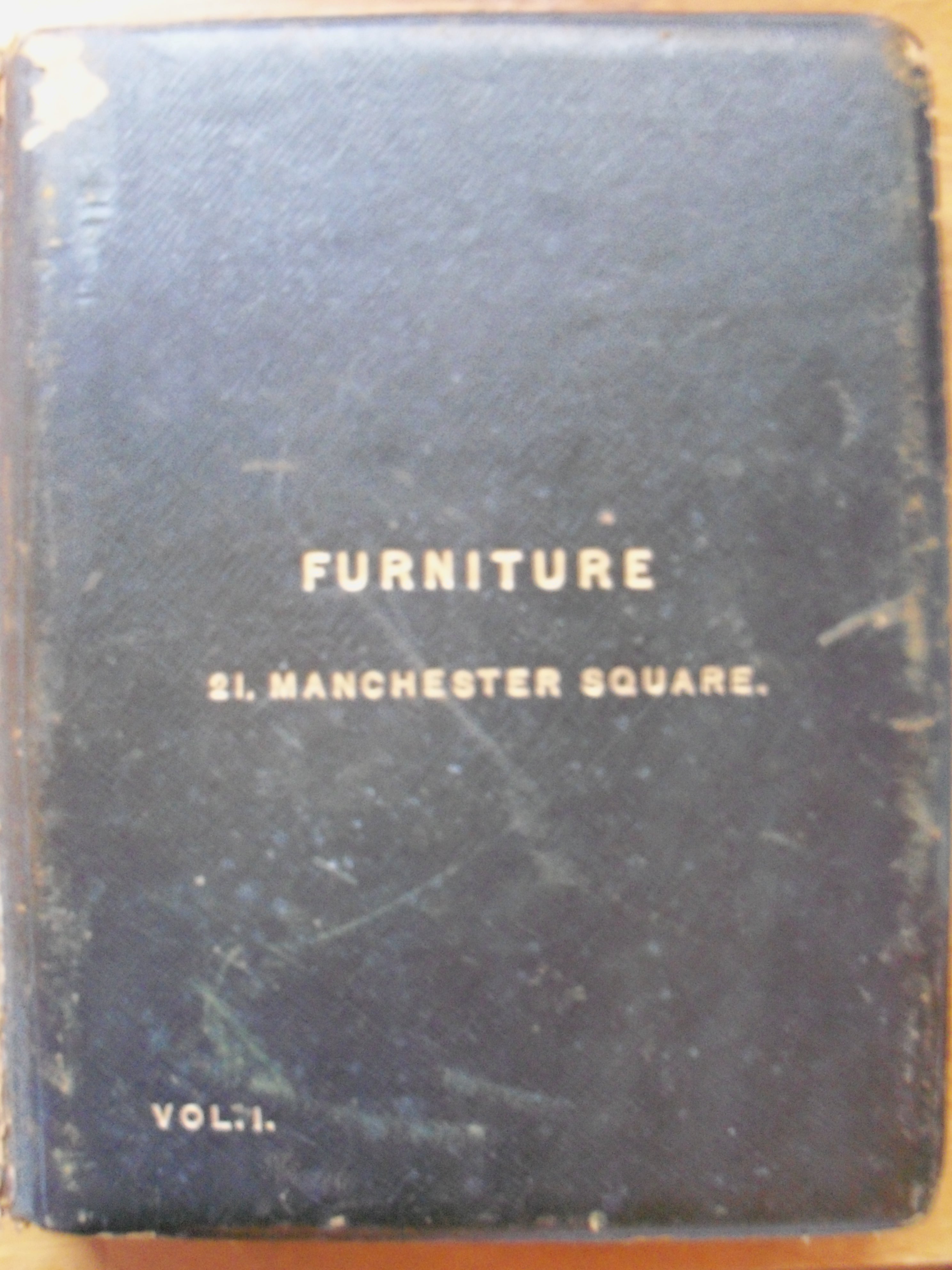
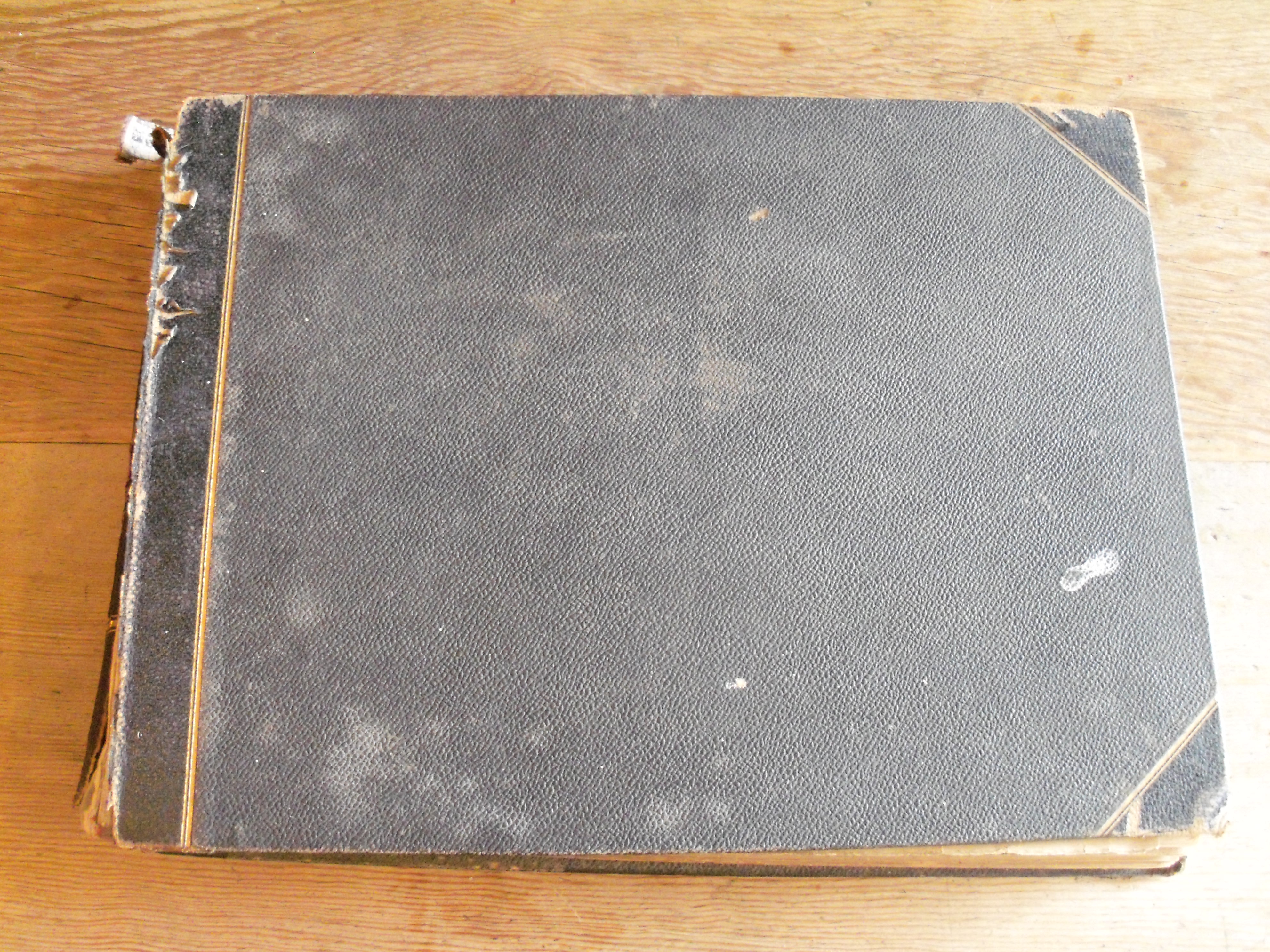
We have also recently discovered 2 volumes clippings and photographs of antique furniture, ceramics, glass and silver etc that came from the antique dealers Stair & Andrew.  The volumes appear to have been visual resources for the directors of Stair & Andrew, and bear several stamps ‘Stair and Andrew Ltd., Director’. The volumes are undated, but appear to date from the period around 1910-1915.

100_2914 This volume, titled, ‘Furniture, 21 Manchester Square, Vol.1.’ contains a whole range of clippings from publications such as Country Life, and Connoisseur. They appear to have been used by the Directors of Stair & Andrew to identify and date objects. The earliest date recorded in the clippings in the volumes is 1904.

100_2915


We’re also doing further research on this album….!

Mark

July 4, 2014

Antique Dealer photograph album 1940s, 1950s

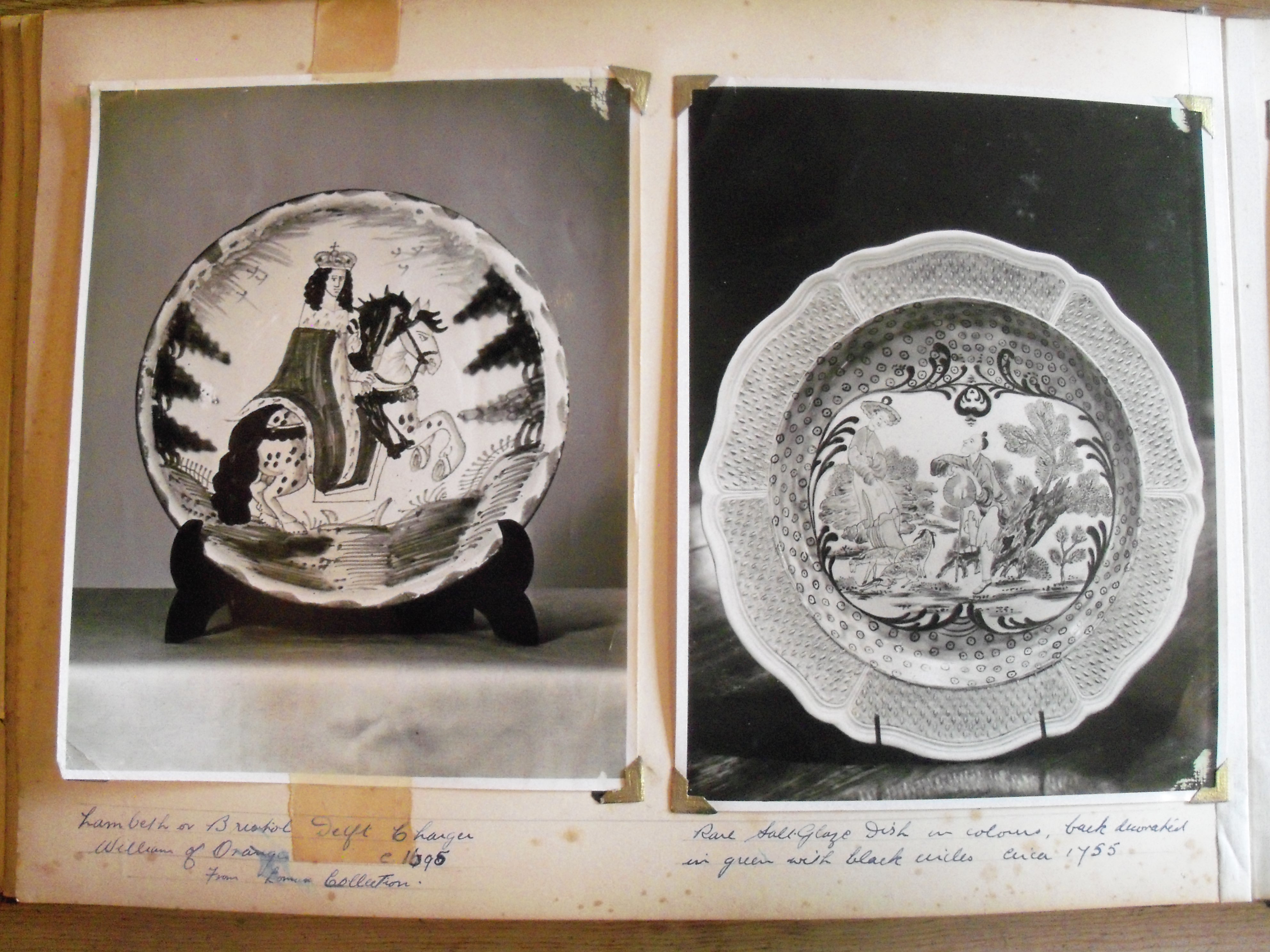
As part of the research project we’re looking at a whole range of dealer material in national and regional archives, and we have been working through material in various locations.  We are always on the look out for interesting antique dealer related archive materials that also occasionally come onto the market –  and recently, at Mellors & Kirk’s auction sale in Nottingham, I managed to acquire this fascinating photograph album. Greenwood archive cover

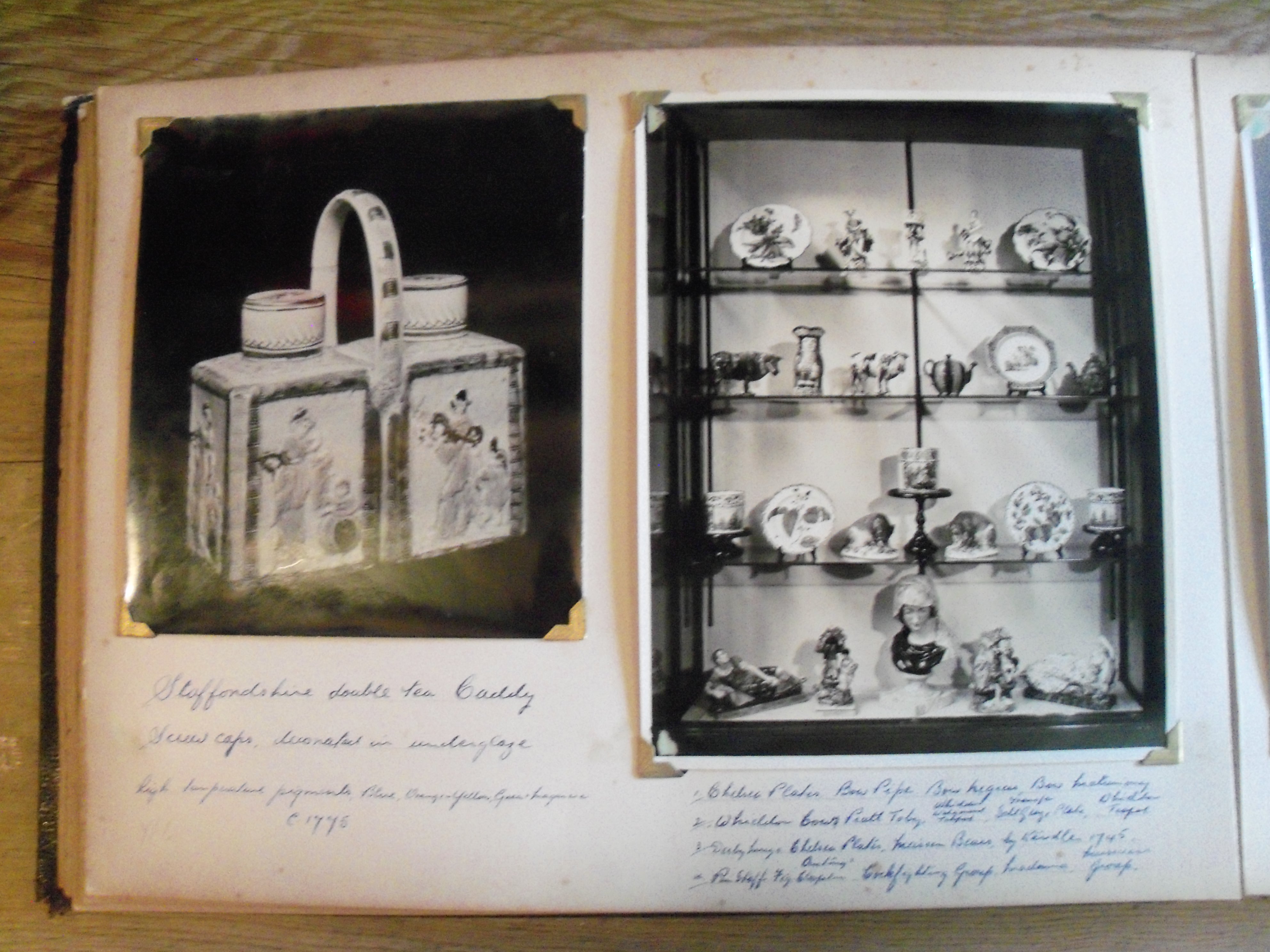
The album appears to date from the 1940s and into the 1950s (one of the photograph captions in the first few pages is dated 1949) and is full of B&W photographs of ceramics, all, apparently antique dealer stock.  Greenwood archive photo 1They provide a fascinating insight into dealer practices in the 1940s and 1950s – with, as is usual practice, prices (probably prices paid?) in code penciled in next to the descriptions.  This page (above), shows a ‘Staffordshire double tea caddy, screw caps, decorated in underglaze high temperature pigments, Blue , Orange, Yellow, Green,and Maganese.’

Dated ‘c.1775’, with a pencil code Y/-/-. Obviously pounds, shillings and pence. The right-hand photograph has a range of English ceramics.

Many of the photographs have the stamp of ‘Will Acton A.R.P.S. Photographer, 3 Kings Sq. York’. One photograph has a pencil inscription ‘W.E.(sic) Greenwood’  and another is stamped verso with the dealer stamp of W.F. Greenwood and Sons, Stonegate, York. The photographs certainly appear to be one of the stock books of W.F. Greenwood & Sons, the very well known antique dealers trading from York and Harrogate in Yorkshire throughout the 20th century. Greenwood was established in the mid 19th century, initially as cabinetmakers and gradually moved to trading in antique furniture and other objects. The firm ceased trading in antiques about 10 years ago, but their Stonegate shop still exists in York – with a framed photograph of a visit by Queen Mary fixed to the exteriors of the shop!

I’m aware of some other archive material from Greenwood and Sons, located in Yorkshire and will soon be checking this present album with the photo archive already located.

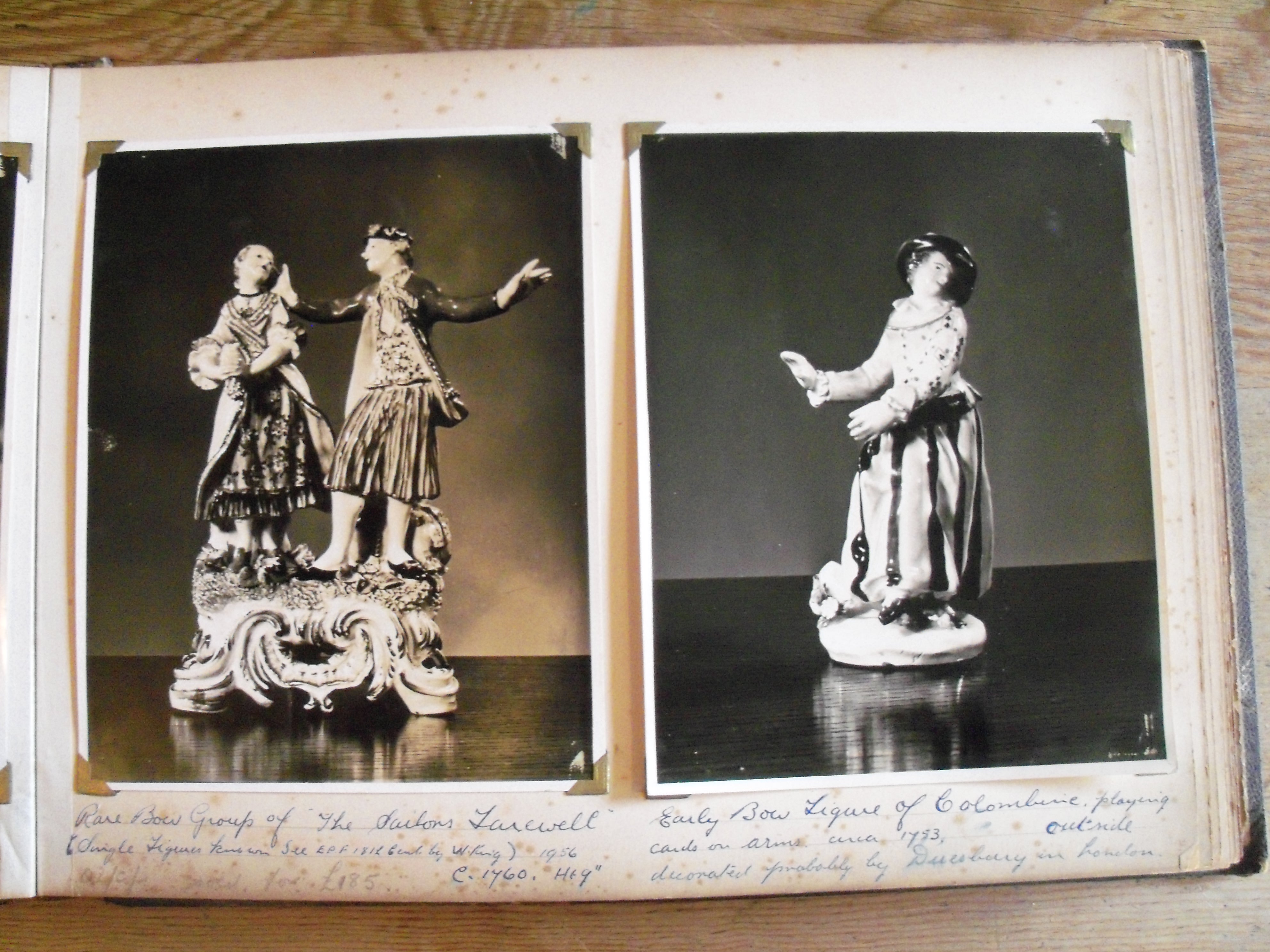
Greenwood archive photo 2 Some of the photographs, such as this one (above) also record the prices the object was sold for – the photograph on the left here, ‘Rare Bow Group of the Sailors Farewell…c.1760’, with pencil code ‘QL/C/-, was recorded as ‘sold for £185’ – the caption is dated 1956.  Greenwood archive photo 4


We will be doing some more detailed investigation of this album over the coming months, and will post a summary of the results on the project blog…so watch this space!

Mark

June 21, 2014

Dealer Catalogues – S. Richards, Antique Dealer, Nottingham c.1900

As some of the older blog posts have highlighted, antique dealers have been producing catalogues of stock since the late 19th century  (see blog posts).  We have been gathering various examples as part of the research project;  amongst the most interesting are those produced by the dealer S. Richards in the late 19th and early 20th century. S. Richards traded in Nottingham in the period c.1890-1920 and his catalogues, published monthly, offer a fascinating insight into the taste, classifications, descriptions, and prices for antiques in the period. Richards seems to have produced these hand-drawn catalogues from the early 1890s up until the end of the First World War, posting them out to collectors. He sold a very wide range of antiques and ‘curios’ and the pages illustrate what remain as standard ‘antique’ collectable objects.

Here are a few examples of Richards’ catalogues – in this one, (below) dated August 1913, Richards has hand-drawn objects from his stock and provided descriptions and prices for his customers.  (top left in the catalogue) is a drawing ‘No.1’ of what Richards describes as ‘a pair of figures of a king and queen in flowing robes, finely carved in wood…..Early 17th century.’ they were priced at £12.10.0. Below those are ‘a pair of candlesticks, well modelled in Bronze….Good patina. Italian workmanship of the early 17th century’, and priced at £7.0.0. ‘No.5’ is an interesting carved wooden box, which Richards states is made by ‘Bayarre (?) of Nancy’, and priced at £10.0.0. He also illustrates some Battersea enamel candlesticks (£8.0.0.), a Battersea enamel box, ‘slightly repaired’ (£7.10.0.) and a carved and silver-mounted coconut shell £3.10.0.

S. Richards catalogue 1913

S. Richards catalogue 1913

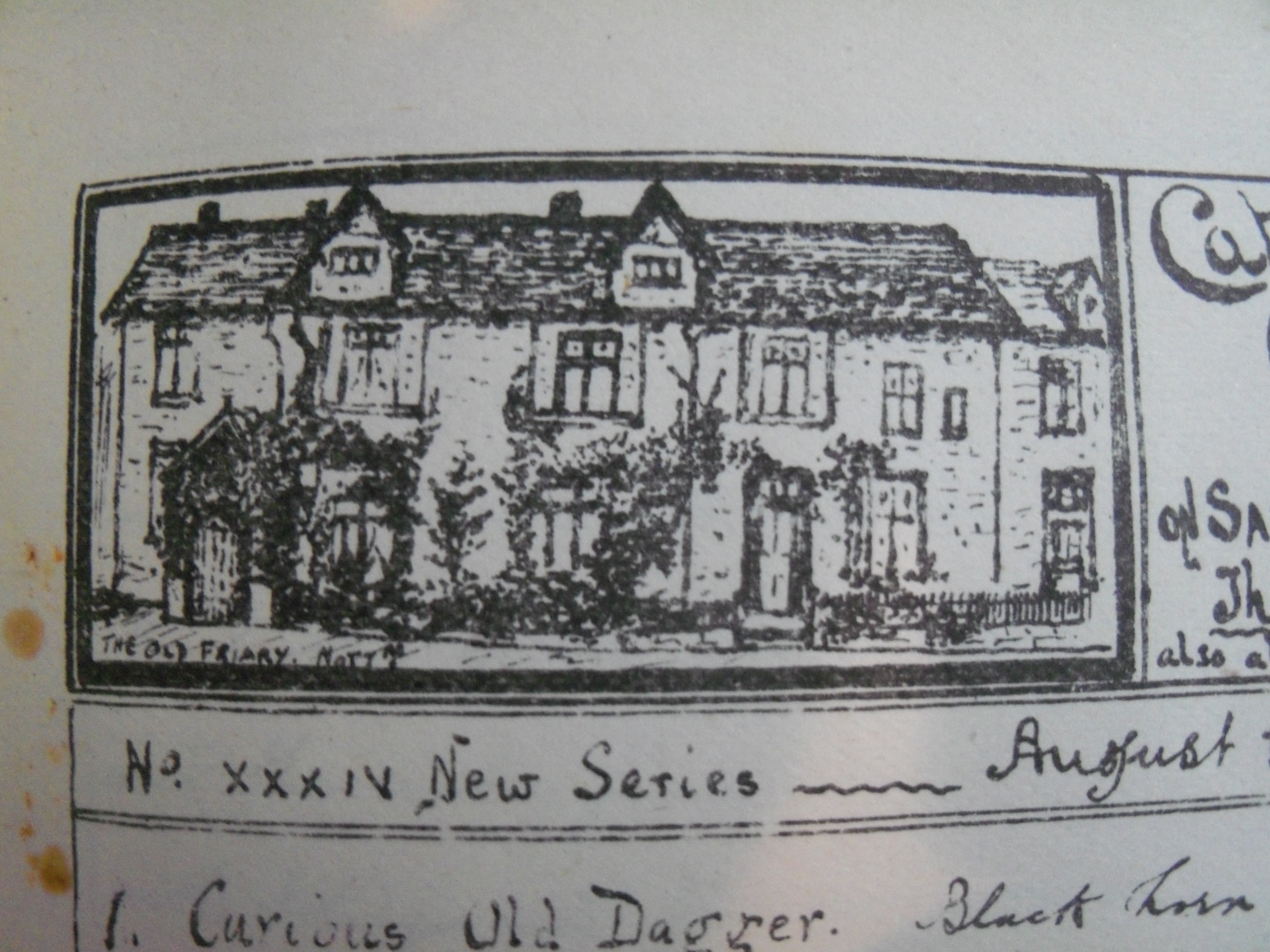
Below is the title page from an earlier issue of August 1893, showing his shop in Friar Lane, Nottingham.

S. Richards catalogue, 1893; private collection.

S. Richards catalogue, 1893. Private Collection.

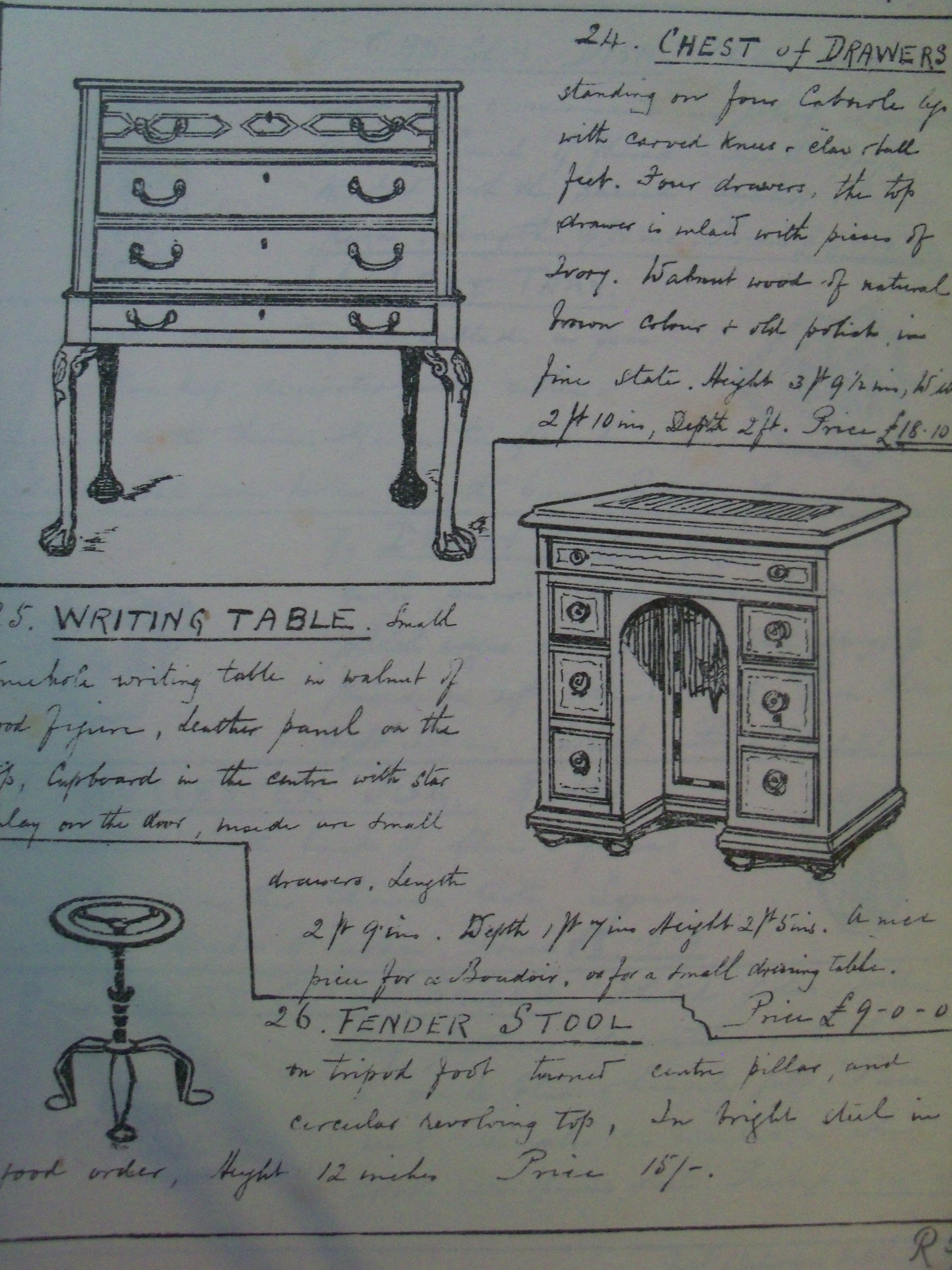
The catalogues appear to of a regular and similar format – small objects on the opening pages, followed by larger objects and furniture towards the end. There are some very interesting examples of the antique furniture – here is a page, again from a catalogue issued in 1913. The ‘Chest of Drawers’, (No.24), described as ‘walnut wood’ with ‘the top inlaid with pieces of ivory’ was priced at £18.10.0. – although I’m not sure it would  pass the current standards for authenticity!

S. Richards catalogue April/May 1913; private collection.

S. Richards catalogue April/May 1913. Private collection.

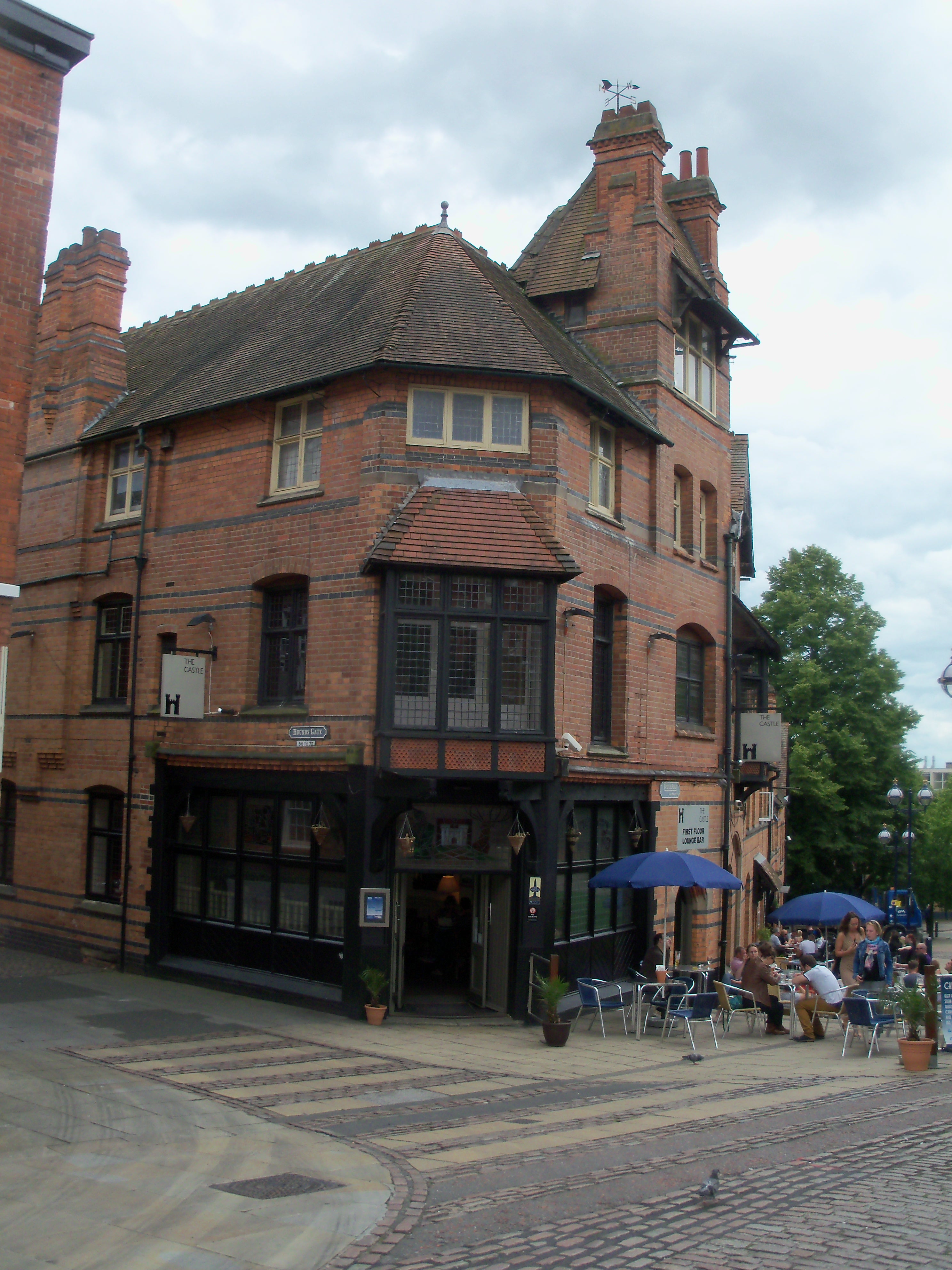
What is equally interesting (I think!) is that the other shop that Richards occupied in c.1900, located at 77 Houndgate, Nottingham, looks almost exactly the same as it did when he sketched it for his catalogues. Here’s Richards’ hand-drawn image from 1891. –

S. Richards catalogue 1891; private collection.

S. Richards catalogue 1891. Private collection.

And here’s my photograph of the shop in Houndgate (now the Castle Public House) in June 2014.

Houndgate, Nottingham, 2014

Houndgate, Nottingham 2014. Photograph MW.

Mark

June 15, 2014

Oral History Interviews – Peta Smyth and Kate Thurlow

The oral history interviews are gathering pace!…Emma Slocombe, curator at the National Trust, at Knole and a member of the Advisory Board for the Antique Dealers project very kindly helped out with an interview for the project last week.  Emma interviewed the dealers Peta Smyth and Kate Thurlow about their memories of the trade.  Both Peta and Kate started their antique dealing careers in Portobello Road (just like Kathleen Skin, one of our other interviewees!), before moving through various shops in Kensington Church Street, Kings Road and Pimlico, in London. Emma’s interview with Peta and Kate will be apart of the growing archive of dealer memories and will be available via the project website over the coming months.

Mark


June 15, 2014

Oral History Interviews – Robin Butler

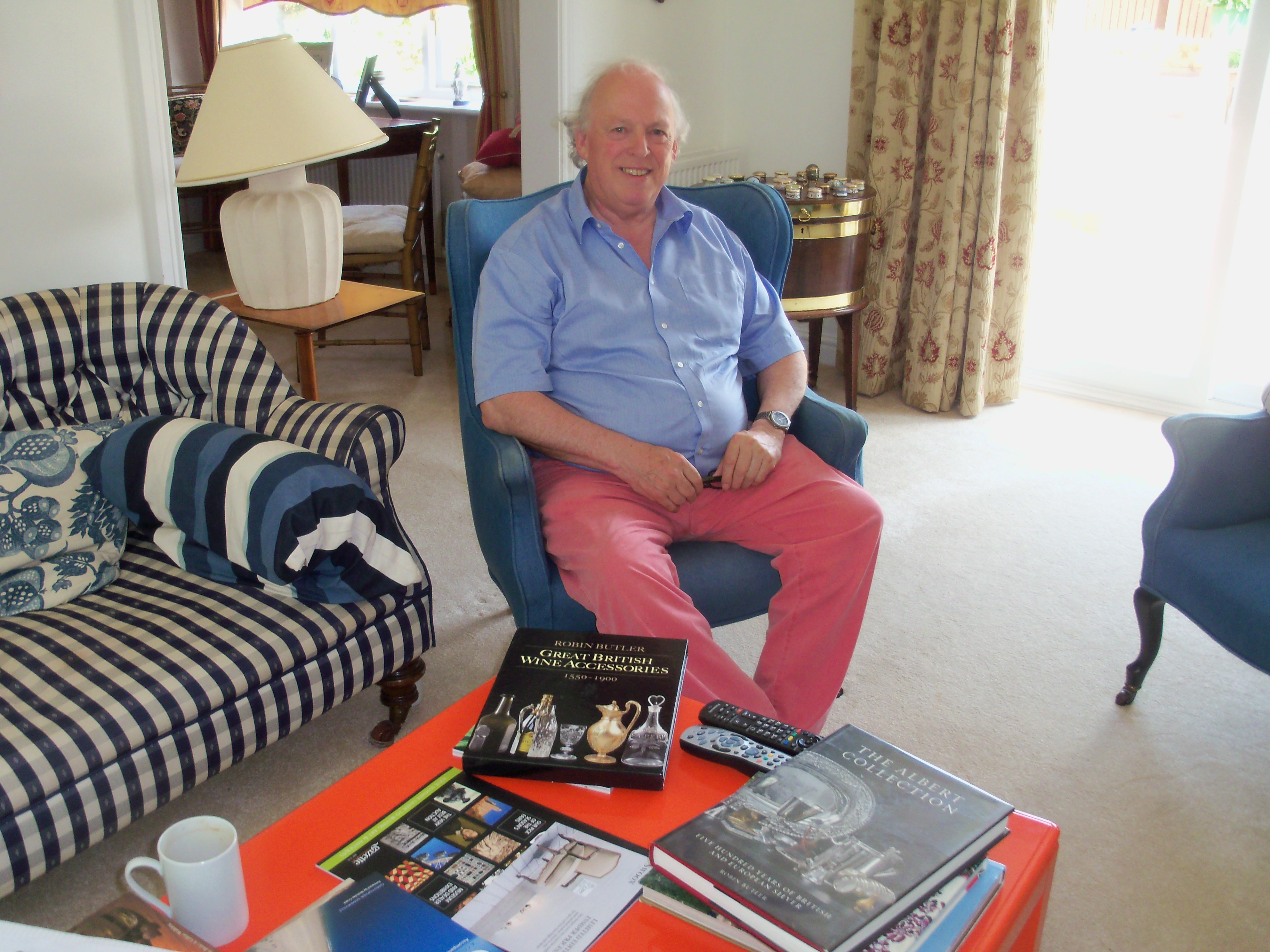
Thank you to antique dealer Robin Butler – Butler’s Antiques – for generously being an interviewee for the Antique Dealer Project. Robin has been in the trade for over 50 years, having first started in the father’s antique business, G. Noel Butler, in Honiton, Devon in the late 1950s.  Here’s Robin, at his home in Braintree.

Robin Butler

Robin Butler

Robin, who is also a noted author of several books on antique wine accessories, and antique furniture, has some fascinating memories of the antique trade.  He told us about his father’s shop/house in Honiton, established in the 1930s – and which is still in the family, now run by Robin’s brother Roderick, at Marwood House Robin also outlined how he became a specialist dealer in wine antiques, following a very successful exhibition he staged at his shop at 8 and a half High Street Honiton in the 1980s; and how he became the (temporary) owner of a spectacular giltwood sofa, formerly the property of William Beckford from Fonthill Splendens

We hope to put some extracts from the oral history interviews on the project website over the next few weeks, so keep you eye on the project!

Mark

May 30, 2014

Antique Dealing….and other practices

The history of the trade in antiques is composed of a complex mixture of overlapping practices and activities. In the early 19th century, when we can say that the present trade began, antique and curiosity dealers emerged from the furniture-making community, from the ‘rag-trade’, the second -hand trade more generally, and modern china and glass sellers….amongst others…. ..if you’re interested, see my work A Biographical Dictionary of 19th Century Antique and Curiosity Dealers (Regional Furniture Society, 2009 & 2011 – copies still available!…£20…(sorry about the advert!….) – But anyway, historically, the trade has always comprised a series of interrelated selling and manufacturing practices.  Indeed, during the course of the investigations for the current project and the history of the antique trade in the 20th century these overlapping practices continued – here’s just one example of the practices of ‘antique dealing’ operating alongside other activities – some of these are obvious (interior decorating for example, and furniture making…which many dealers today are involved in). But antique dealers have also regularly sold a range of ‘modern’ things alongside what one might describe as ‘traditional’ antiques (the notion of ‘antique’ is quite obviously a mutable term!).

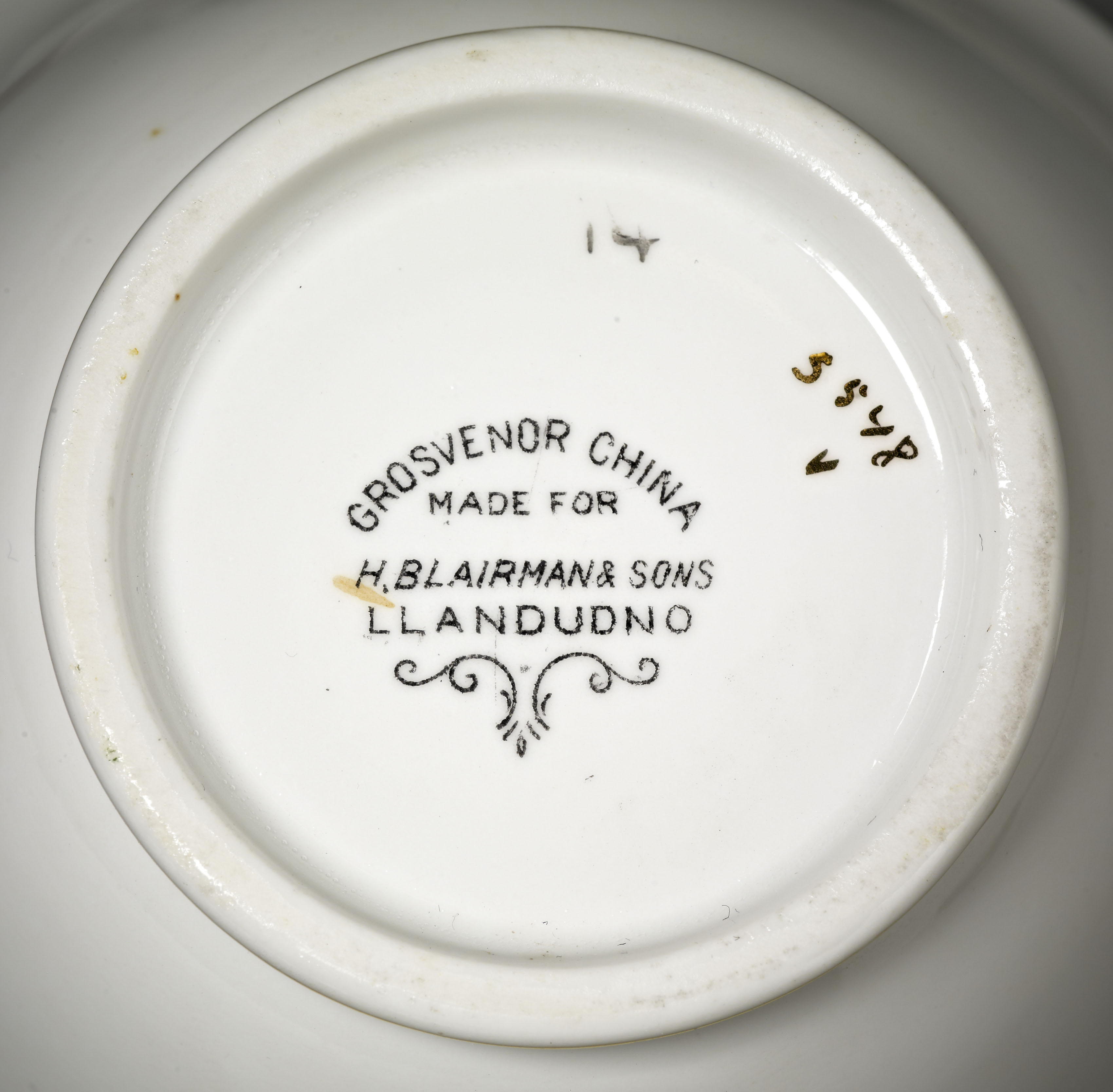
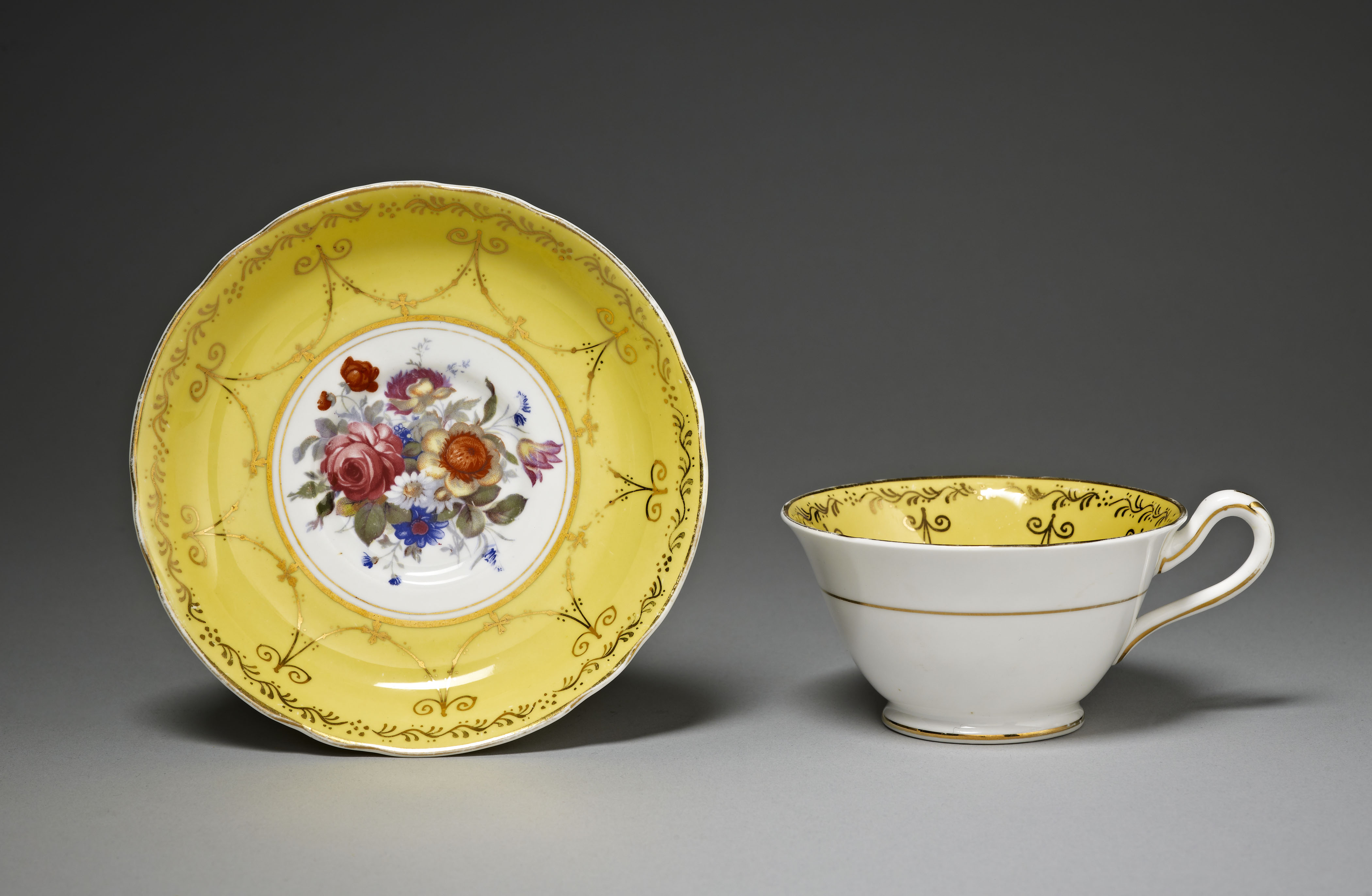
Anyway, Martin Levy (of Blairman & Sons, London) sent us this image of a tea-cup and saucer, which was apparently retailed by Blairman, when the firm was then trading in Llandudno, Wales (they had a shop there from the 1880s).

Photograph copyright Blairman & Sons, London

Photograph copyright Blairman & Sons, London

Photograph copyright, Blairman & Sons, London.

Photograph copyright, Blairman & Sons, London.

We reckon the tea-cup and saucer dates from c.1890-1910, so would have been a ‘modern’ thing when sold by Blairman at the time. The retailing of ‘contemporary’ products is interesting, especially given the recent shift to the contemporary and the changes in the activities of, what were often considered to be ‘traditional’ dealerships – it’s now not that unusual to enter an ‘antique shop’ and be confronted by modern and contemporary design amongst the ‘brown furniture’ and ‘antique’ objects…..

There are many other examples of other practices that the antique trade have been involved in over the years and we hope to include information of these activities as part of our ‘cultural geography’ of the antique trade…

Mark


Home Subjects

a working group dedicated to the display of art in the private interior, c. 1715-1914

The Period Room: Museum, Material, Experience

An International Conference hosted by The Bowes Museum and The University of Leeds

H. Blairman & Sons Ltd

A research project investigating the history of the antiques trade in Britain in the 19th & 20th centuries

Museum Studies Now?

'Museum Studies Now?' is an event which aims to discuss and debate museum and heritage studies education provision.

The Burlington Magazine Index Blog

art writing * art works * art market

East India Company at Home, 1757-1857

A research project investigating the history of the antiques trade in Britain in the 19th & 20th centuries