Author Archive

May 24, 2015

More Oral History Interviews

Our oral history interviews are gathering pace – we’ve completed 4 more interviews in the last few weeks….and we’ll post details of all of the interviews in the next few days…but in the meantime, one of our latest interviews was with Christopher Claxton Stevens, late of the leading dealers in Antique English Furniture, Norman Adams, of Hans Road in London. Christopher was interviewed by our Research Fellow, Lizzy Jamieson.

Christopher Claxton Stevens photo 1

Christopher Claxton Stevens. Photograph courtesy of Christopher Claxton Stevens.

Christopher joined Norman Adams Antiques in 1981, after beginning his career at Christie’s – and joined Stewart Whittington in running the business, which was then, unusually, a trust, following the death of Norman Adams in 1979.  Norman Adams (established in 1923) was well known for his ‘eye’ for colour and the patina of antique furniture, and this concentration on the aesthetic, over the privileging of provenance or history of antique furniture, placed Norman Adams in a particular tradition of dealers – and it was pleasing to hear that this particular tradition was continued by Christopher and Stuart.

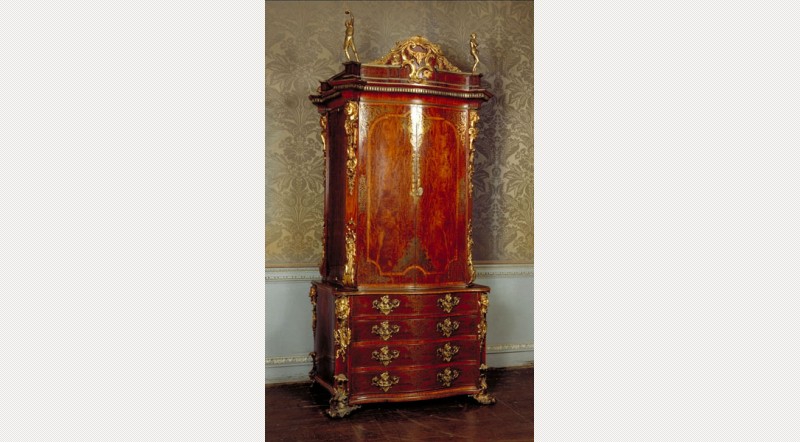
Our interview with Christopher provided a personal insight into the history of the firm and included a fascinating range of first person perspectives on the business, including Christopher’s role in the sale of the famous ‘Murray Cabinet’ to Temple Newsam House, Leeds, in 1986 – the Murray Cabinet had already been through the hands of Norman Adams in 1950, when it was sold by Adams to the collector Arthur Ball; it was then re-purchased by the firm following the death of Ball and was subsequently sold by the firm to Temple Newsam House – here is the magnificent cabinet, still on display in Leeds:

murray

The Murray Cabinet, Temple Newsam House. Courtesy of Leeds Museums & Galleries.

Our interview with Christopher is part of a fascinating series of interviews with antique dealers, all of which will soon be available via the project websites – so do watch this space for updates!

Mark

May 3, 2015

Oral Histories making progress – interview with Andrew Burne

The oral history research strand in the Antique Dealers research project continues to make progress – we still have a HUGE list of people to talk to though!

In January, Chris Coles, one of our most active and supportive volunteer researchers, undertook an oral history interview recording with Andrew Burne, of the antique glass specialists W.G.T. Burne (Antique Glass) Limited. W.G.T. Burne are based in London, and were established by Andrew’s father in 1936.

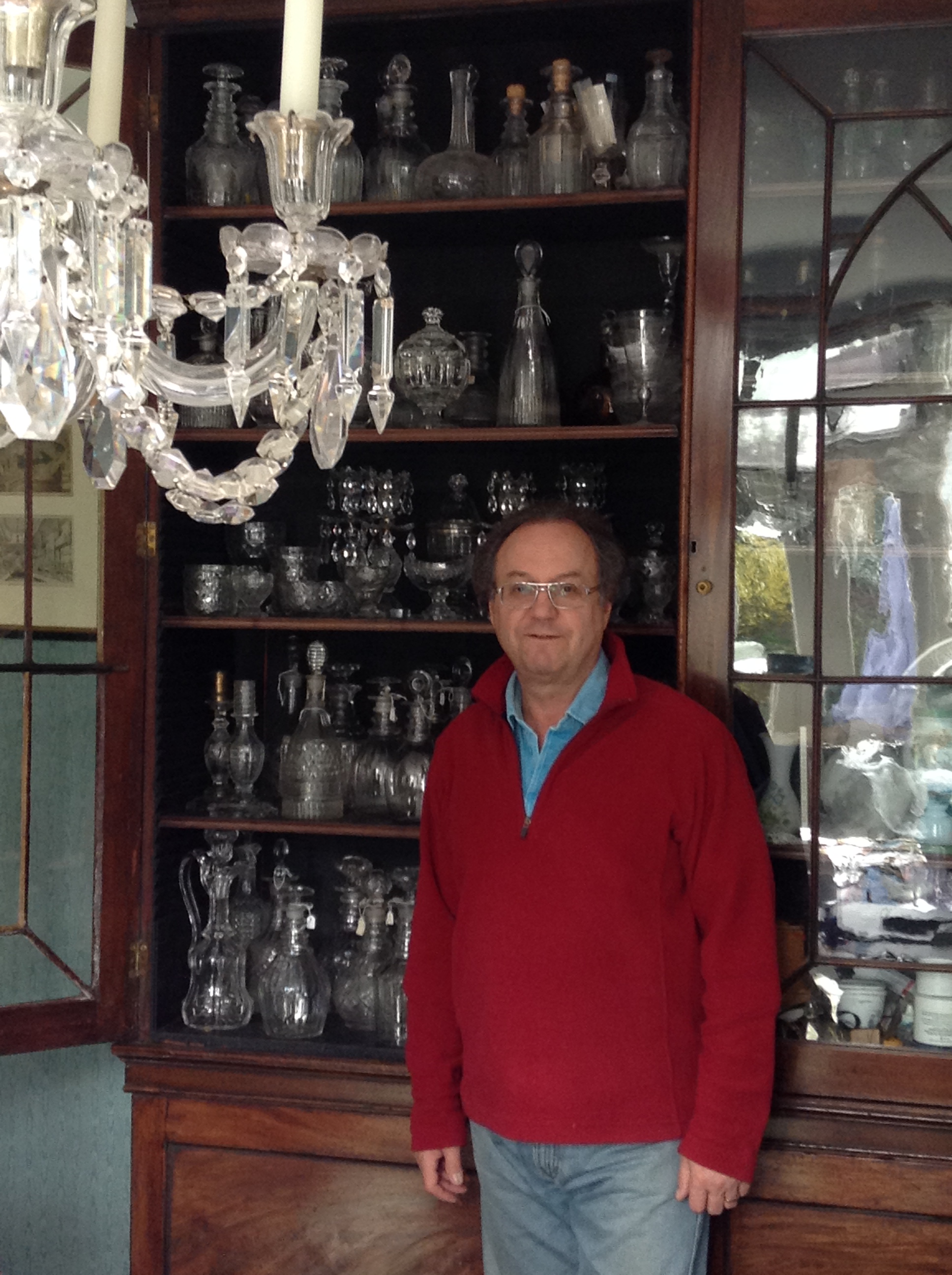
Andrew Burne

Andrew Burne, of W.G.T. Burne (Antique Glass) Limited. Photo courtesy of Andrew Burne.

In a wide-ranging interview, Andrew told us about the early history of W.G.T. Burne – his father initially worked for the well-known specialist glass dealer, and author, Arthur Churchill, before setting up on his own in 1936. Andrew also shared his memories of other specialist glass dealers, including Delomosne and Maureen Thompson. There were also fascinating stories about buying trips taken with his father, and the early morning starts to buy in the antique markets at Bermondsey and Portobello in London….as well as an occasion when the actor and singer Dean Martin came into the shop. W.G.T. Burne sold many things to major collectors and museums, and also sold chandeliers to The White House, and Buckingham Palace.

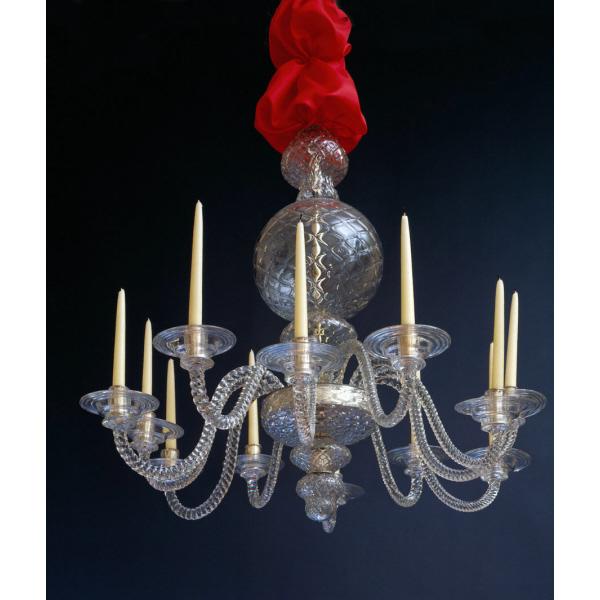
Amongst the ‘good finds’ that Andrew remembered was one of a set of early 18th century glass chandeliers, originally from Lincoln Assembly Rooms, which were bought from an auction at Christie’s South Kensington – the chandelier is now in the collections of Saint Louis Art Museum, in the USA. In the interview, Andrew recalled that the chandelier was sold by W.G.T. Burne to Hotspur, but it seems that the eventual dealer who sold the object to Saint Louis Art Museum (in 1993) was H. Blairman & Sons (see provenance information on the chandelier on the Saint Louis Art Museum Collections online).  Here’s a photograph of the chandelier from the museum website – and it’s a spectacular thing!

lincoln assembly room chandelier

Glass Chandelier, c.1740, from Lincoln Assembly Rooms. Saint Louis Art Museum. Funds given by Mr and Mrs Joseph Pulitzer and museum purchase, 1993. Image from Saint Louis Art Museum website.

An edited version of the oral history interview with Andrew (and all of the oral history interviews) will be available soon via the Antique Dealer project website.

Mark

May 2, 2015

New member of the Project Advisory Board

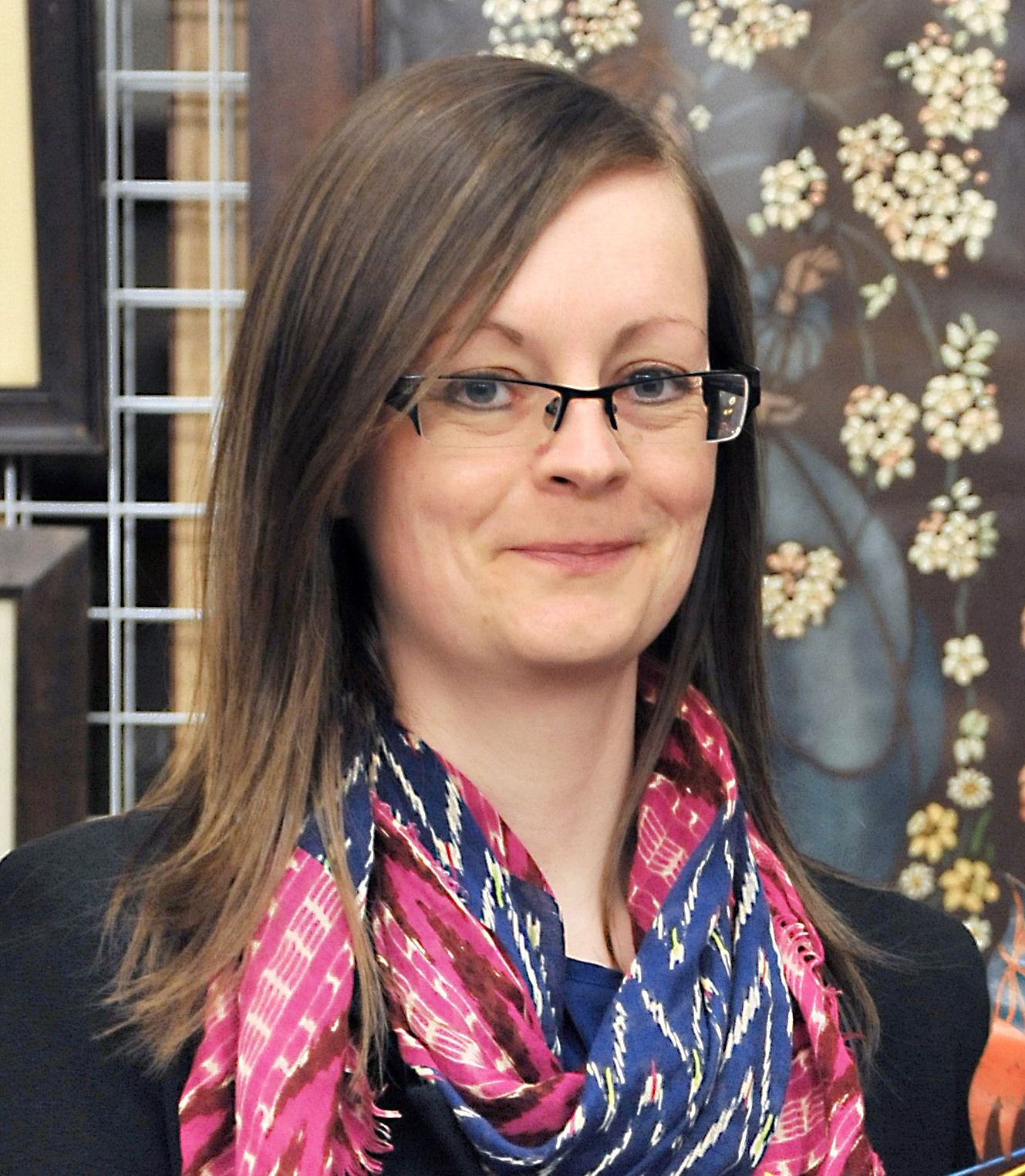
We are very pleased to welcome Yvonne Hardman, the new Head of Collections and Programmes at Leeds Museums & Galleries, to the Antique Dealer project Advisory Board.  Yvonne has recently, and very generously, stepped into the Advisory Board vacancy left by our friend and colleague Camilla Nichol, the former Head of Collections at Leeds Museums & Galleries (Camila, as you may know, left Leeds Museums to take up a position in Cambridge).

yvonne hardman

Yvonne Hardman, Head of Collections and Programmes at Leeds Museums and galleries

Yvonne’s role at Leeds Museums is to manage the team of curators, registrars, conservators, community engagement and digital media staff – so quite a job!….the Advisory Board role, by comparison, will be a doddle!

Until March 2015 Yvonne was the Art Gallery Officer at Touchstones Rochdale, where she had been for ten years, and prior to this she held posts at the Atkinson Art Gallery, Southport and the Grundy Art Gallery, Blackpool. From 2003-2009 she was on the board of directors at Manchester Craft & Design Centre and has been an Artistic and Quality Assessor for Arts Council England since 2009. She brings a wealth of museum-related experience to the Advisory Board, and we very much look forward to formally welcoming Yvonne to the project at future meetings.


April 25, 2015

Defining ‘Antique Dealers’ – in 1916.

For those of you that have been following the Antique Dealer Project blog, you’ll know that the question of how one draws the defining line around ‘antique dealers/antique dealing’ has been something that has been a consistent focus in the development of the project.  Indeed, one of the objectives of our forthcoming ‘interactive antique dealer’ website (YES…it’s on its way very soon!..at last!) is precisely to allow us to further reflect on the changing parameters of ‘antique dealing’, as a set of social, cultural, economic, and political practices. For earlier blog posts on these changing parameters, see reflections on the changing definitions of ‘antique dealers’ and the richly patterned semantic shifts in the classifications in the antique trade, in posts on ‘Semantics’; ‘Connell & Sons’; ‘the architecture of the trade’; and ‘antique dealing and other practices’.

Anyway, whilst at The Getty Research Institute for the History of Art and the Humanities, (The GRI) in the Special Collections and Visual Resources room as part of the USA research trip, I came across a newspaper clipping in the French & Company papers (ref. 990051, Box 9) –  French & Co were mentioned in the newspaper article, hence the inclusion of the clipping in the archive.

The clipping was from The New York Herald, (Saturday 8th July, 1916, p.3); it is a fascinating, and somewhat provocative, article entitled ‘Art and Junk are One under French Law and Junkmen and Antiquaries are Equal‘, which was composed by one of the Herald’s (unnamed) journalists. One could write an essay on the rich series of semantic meanings in the article – and it’s also interesting (to me anyway) that the writer tries (desperately) to separate ‘art’ from ‘junk’…but there’s no space here to deal with the implications of this dichotomy.

The article itself reports on a French legal case, brought against a collector/dealer named Kelekian, who was, according to the Herald, a ‘racing stable proprietor and owner of Art Galleries in Paris, Cairo and New York.’  Essentially it seems that in 1916 the French courts had ruled that art and antique dealers must be classed as 2nd hand dealers, and comply with the requirement that they should make their stock books accessible to the Police and also should be required to ‘wear tags’ to indicate their ‘profession’.  There’s a clear rational for this of course, relating to the historical propensity of 2nd hand dealers being the (often unwitting) recipients of stolen goods, hence the introduction of laws that often required dealers in 2nd hand material to hold on to goods for 7 days before selling them on; and the requirement that stock books be open to scrutiny. It is worth mentioning here that the marginal practices of the second-hand trade have often reduced to stereotypes/tropes – Dickens’ ‘Fagin’ is just one of numerous literary constructions that play to those notions.

However, the implications of the French Court ruling, as the writer of the article expressed it, would be that ‘dealers inspired productions of Great Artists are required to Classify themselves with Buyers of Old Junk.’  The writer opined, ‘if junk is art to a Paris Court, specimens of Gothic religious inspiration in sculpture, a Renaissance Poignard hilt, carved by Cellini, and Chippendale furniture are all junk – merely junk!’….and continued ‘the comparison between junk and art is “strange” no matter how the imagination is stretched’, concluding, somewhat hyperbolically, that ‘The End of the World must be at hand’.

You can read the full article, thanks to Fulton History, who have scanned and uploaded the full texts of the New York Herald – see Fulton History – and here’s the scan of the article itself: New York NY Herald 1916 – 6110

BTW – I defy anyone’s eye not to drift towards the contiguous article, entitled ‘Bites Golf Ball; boy may die’ (how could you resist!)…the final paragraph in that article suggests a rather disturbing value structure of the market/economy and that of a human life (if one believes the reporter of course)…………now that must tantalise you to read the PDF?…

The article also contains fascinating interviews (kind of ‘vox pop’) on the French Court ruling with various dealers in New York, including, Stephen Bourgeois, Raymond Guille (of the antique silver dealers, Critchen Brothers) and the famous Joseph Duveen, who, like the gatekeeper to the art market that he was, gave a terse ‘no comment!’……

What is particularly interesting is that the writer in 1916 directs attention to the ambiguity of how, and where, and when, one defines the ‘dealer’.  ‘Where is one to draw the line?’, states the writer, emphasising this ‘problem’ by posing the question, would ‘a collector’, ‘selling part of a collection’, be a ‘junkman?’….(in the eyes of the French Law, at least).

It is precisely these shifting frameworks, and the mutability in the notion of the ‘antique dealer’, that is the focus of the current research project.

Mark.


April 17, 2015

Gill and Reigate in The Minneapolis Institute of Arts

The museum archives at Minneapolis Institute of Arts are a fantastic resource for researching the synergies between the development of museum collections and the history of the antique trade. Thanks again for all their help with the Antique Dealers research project to Jennifer Olivarez and Dawn Fahlstrom in the curatorial offices at MIA!  As I discovered, the ‘object files’ at MIA record scores of transactions with antique dealers, both in the USA (as you would expect), and via the British trade (as you would expect!).

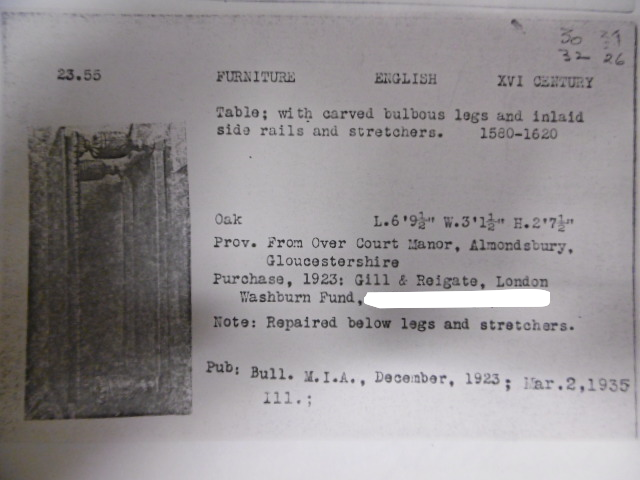
This accession record card (ref 23.55) for a ‘XVIth Century table’, which entered the collections at MIA in 1923 (facilitated by the Washburn Fund), records just one of those transactions, and also highlights the relationships between the museum and the market. The accession record card describes a ‘table: with carved bulbous legs and inlaid side rails and stretchers, 1580-1620’ – ‘from Over Court Manor, Almondsbury, Gloucestershire’ – with a ‘Note: repaired below legs and stretchers’. The table was purchased from the British based antique dealers Gill& Reigate (who also had a branch in New York in the 1920s – hence, I expect, the sale direct to MIA).

gill and reigate 1923

Museum Accession Record Card, 23.55. ‘Furniture, English XVI Century’. Showing accession of a XVIth century table, supplied by Gill & Reigate in 1923 (purchase price redacted). Courtesy of Minneapolis Institute of Arts. Photo MW 2015.

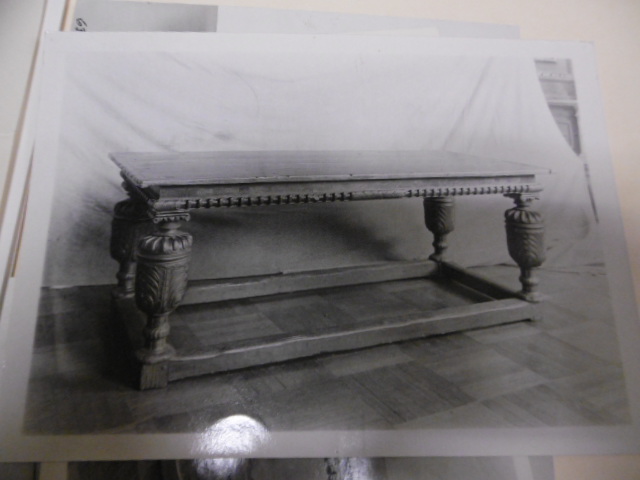
The archive file also contains a copy of the black & white photograph of the table (which is the vertically displayed photocopy image in the accession record card above) – and which appears to be original Gill & Reigate dealer record photograph –

gill and reigate 1923 3

Museum object file 23.55. Photograph of XVIth century table. Courtesy of The Minneapolis Institute of Arts. Photo MW 2015.

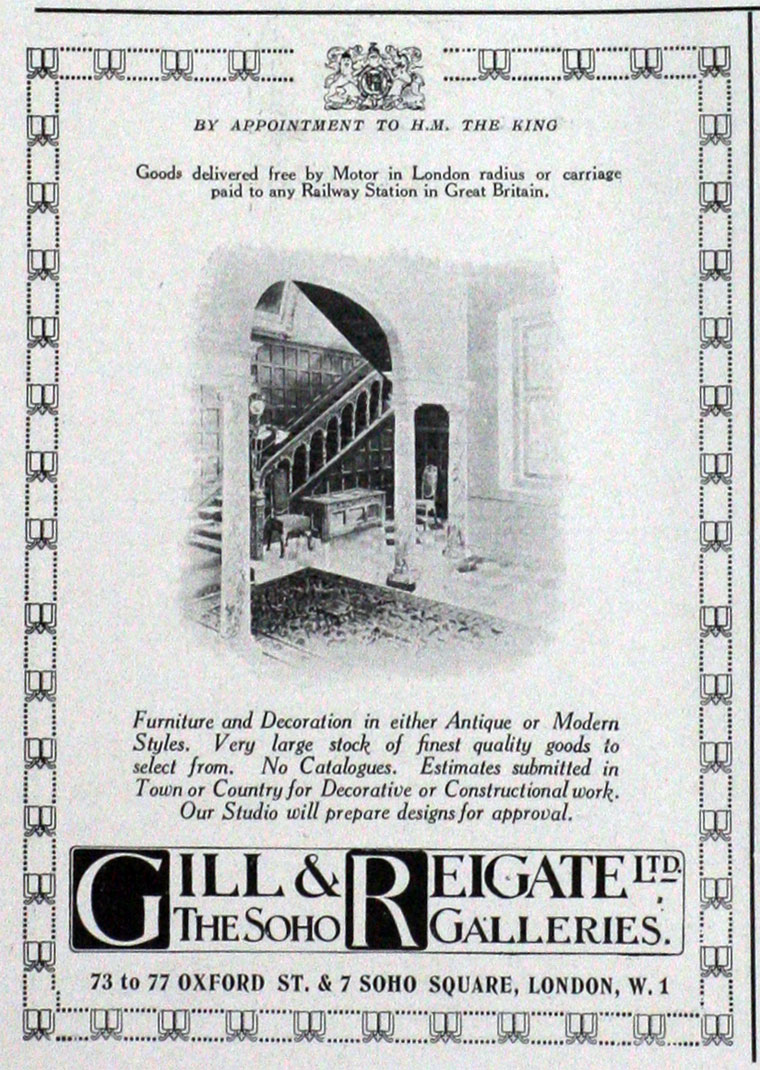
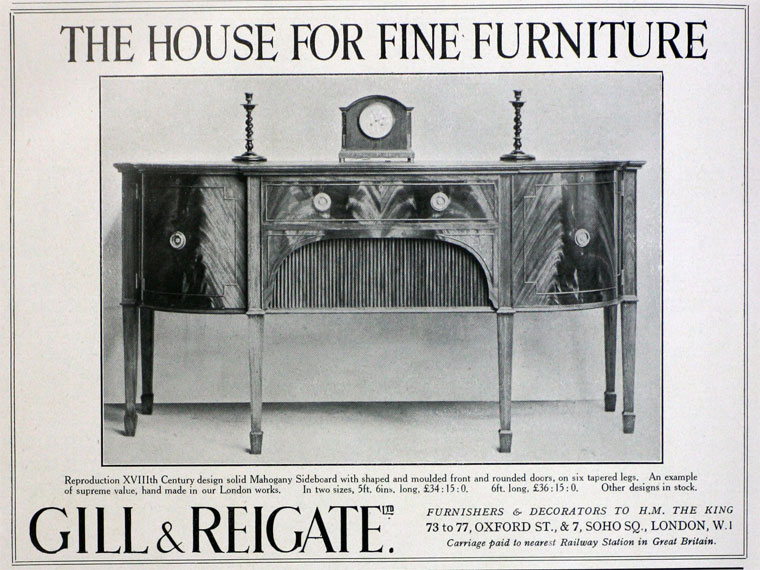
The antique dealers, decorators, and furniture manufacturers and retailers, Gill & Reigate Limited were trading at 73-77 Oxford Street and at 7 Soho Square, London when they supplied the table to The Minneapolis Institute of Art.  The firm were established in the 1890s, and by the 1920s were already well-patronised enough to have been granted a Royal Warrant.  These advertisements from the 1920s illustrate the changing locations of the firm, as they moved from Oxford Street and Soho Square in the 1910s and 1920s (also trading as ‘The Soho Galleries’)……

G and R 1921

Advertisement for Gill & Reigate, 1921.

G and R 1927

Advertisement for Gill & Reigate, 1927.


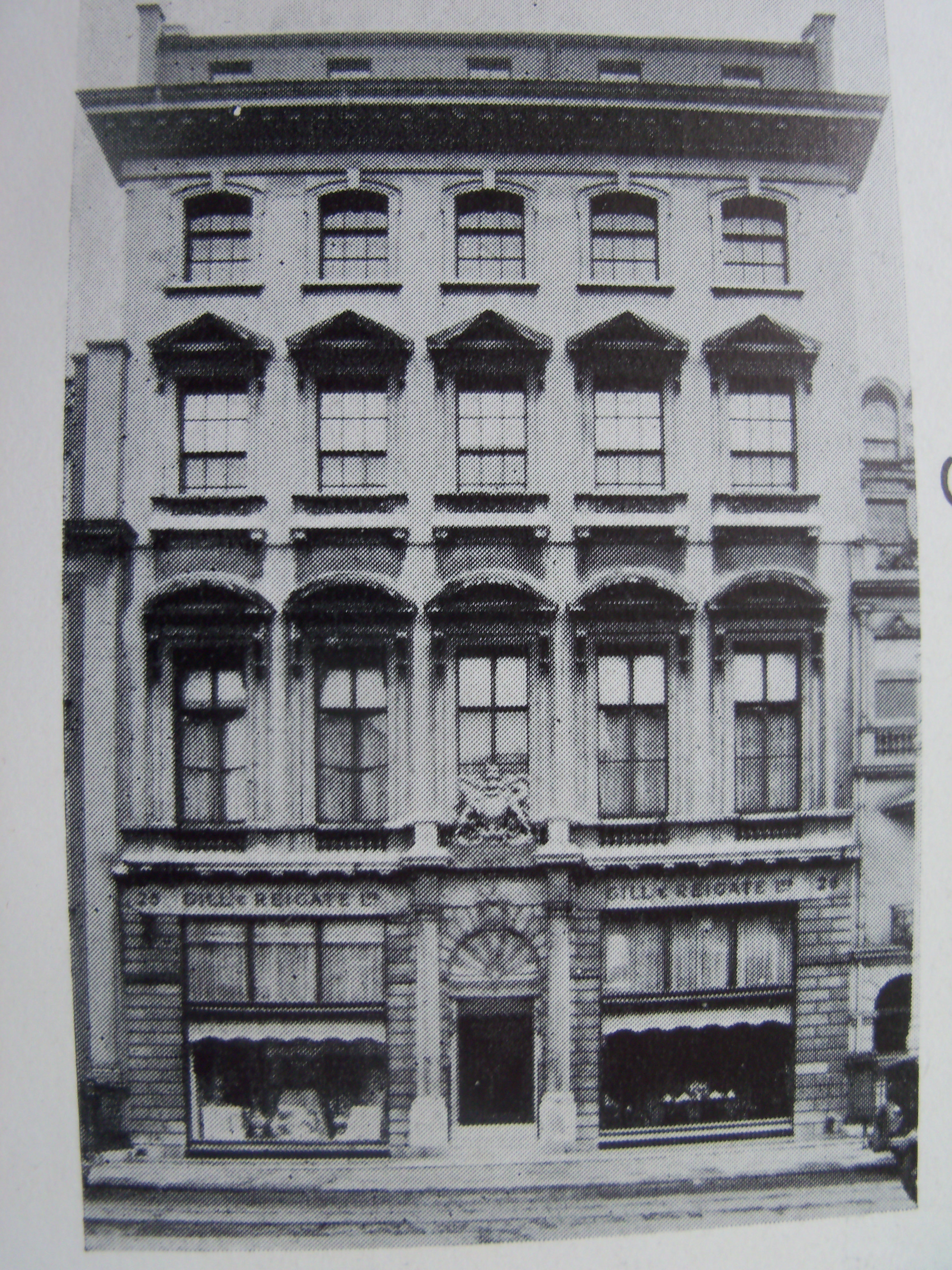
…………to these very elegant premises in George Street, London W1 in the early 1930s (see below).

Gill and Reigate 25 26 George Street London June 1937 Conn

Gill & Reigate, 25-26 George Street, London W1, c.1930.

The archive at MIA also contains a letter from Gill & Reigate, from their Oxford Street address, dated 17th August 1923, addressed to Russell A. Plimpton Esq., who had only a couple of years earlier (1921) taken up the post of Director of Minneapolis Institute of Arts.


gill and reigate 1923 1

Letter from Gill & Reigate Limited, to Russell Plimpton, Minneapolis Institute of Arts, 17th August 1923. Museum object file 23.55. Courtesy of The Minneapolis Institute of Arts. Photo MW 2015.

The letter is essentially part of an exchange between Gill & Reigate and the Director at MIA focused on establishing the provenance, and by extension of course the authenticity, of the table – and this (authenticity) was something that was becoming ever more important in the period – if you are interested do look up Stefan Muthesius’s important and groundbreaking essay on this subject, ‘Why do we buy Old Furniture? aspects on the authentic antique in Britain, 1870-1910’ (Art History, vol. 11, No.2, pp. 231-254, June 1988).

Anyway, the letter states that the table ‘originally stood in Overcourt Manor, Almondsbury, Gloucestershire’, and continues, ‘Overcourt is an old Elizabethan Manor, and the table was in the possession of the Cann-Lippincott’s who were Lords of the Manor. The table had only lately been moved from there to Whitechurch, Salop, where Mr Gill procured it.’ What the writer of the letter  omits to say is the link between Over Court and Whitechurch…..it would be interesting to know how and why the table ended up in Whitechurch where Mr Gill ‘procured it’….but maybe I fall into the trap of rehearsing the trope of the dealer as ‘problem’…and the history of antique dealers is much more complex, and richly patterned, that that old chestnut!

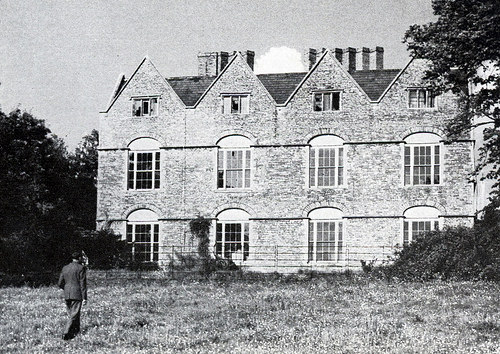
Incidentally, Over Court Manor unfortunately no longer exists, it was destroyed by fire in 1977.  Apparently only the gate arch to the Manor remains….

Overcourt Manor

Over Court, Almondsbury, undated, but maybe early c.1970s?. Photo Paul B. Townsend – wikicommons.

There’s much more to say about the fabulous archives at Minneapolis Institute of Arts……so do keep your eye on the Antique Dealer Project Blog.

Mark

April 13, 2015

Antique Dealers, ‘Period Rooms’ and Museums

Following my short and pithy Tweet re the dealer Seligmann and the maquette for a period room, now on display at Minneapolis Institute of Art we have, thanks to Jennifer Komar Olivarez, Curator of Decorative Art, Textiles and Sculpture at MIA, discovered more about the maquette.  And it’s an unexpected, and fascinating history, and one that draws further attention to the significance of social and cultural networks in the circulation and consumption of ‘antiques’ – something that the ‘Antique Dealers’ research project is keen to explore.

seligmann model MIA

Maquette of the Grand Salon of the Hotel de la Bouexiere. Minneapolis Institute of Art. Photo MW 2015.

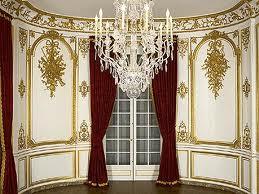
The maquette itself, (13in x 23in x 16 ins high) was a model for the Grand Salon of the Hotel de la Bouexiere, from Paris, which was designed 1731-1733, for Jean Gaillard de la Bouexiere (1676-1759), who grew wealthy as a tax collector for the Royal Crown in the 1st half of the 18th century. Here’s one end of the room as you see it at MIA –

hotel bouexiere

Grand Salon, Hotel de la Bouexiere, (c.1731-33). Minneapolis Institute of Art. Photo Wikicommons.

What is interesting about the room (for us), and the maquette specifically, is the ‘trade’ history of it. It seems that the maquette was made by the antique architectural salvage dealer and interior decorator and furniture manufacturer, Robert Carlhian, sometime in the early 1920s.

I was interested to note that the business records of Carlhian (est 1867, and closed c.1988) had been acquired by The Getty (ref 930092 if you’re interested). Carlhian were mainly based in Paris, but had branches in New York, Buenos Aires and Cannes; and during the period 1945-1966 they had a branch in London, in conjunction with the art dealer Wildenstein….so I guess they qualify to be included in the current ‘Antique Dealer’ research project (if we accept the broad definition of ‘antique dealer’ – you’ll need to re=read some of the earlier blog posts to follow the umbra and penumbra of what constitutes ‘antique dealers’ to follow this line of thought).

It seems that the room was sold to the Metropolitan Museum in New York, before being purchased by Minneapolis Institute of Art in 1983.  John Harris, in his excellent survey of the trade in architectural elements – Moving Rooms: the trade in architectural Salvage (Yale, 2007), suggests that the room was acquired by the dealers Dalva Brothers and sold to MIA in 1978 (see Harris, (2007), p.169). Dalva Brothers traded in New York and were established by 1933, but, as far as I know did not have a branch in Britain? The maquette was a gift to MIA from Leon and David Dalva – I guess as part of the purchase.

I also understand that at some stage Arnold Seligmann, Rey & Co also had some dealings with the circulation of the Grand Salon from Hotel de la Bouexiere. What is interesting (to us, as investigators of the history of the Antique Trade) is the networks and connections in these transactions – it’s not so surprising I guess, but no less significant, that the ‘antique trade’ play such a key role in the eventual presentation of this historical object in the public domain.

Mark


April 6, 2015

Vernay Archives at Winterthur

The antique dealer related archives at The Winterthur are an amazing resource, and the archive team there, led by Jeanne Solenksy, are simply great; they are certainly the most accommodating of archive teams (thank you to all!). And thanks again also to Chris Jussel (see previous blog posts) for donating the archive of Vernay & Jussel, and that of J.J. Wolff, to Winterhur archives – it was such a generous, and insightful, thing to do….without such ‘blue sky’ thinking we would not have such rich resources to investigate the history of the antique trade. As you probably know, antique dealer archives in public archive collections are very rare indeed.

Anyway, as readers of the blog may also know (see previous blog posts), the dealer Arthur Stannard Vernay (c.1877-1960) was one of the most important dealers operating in the USA in the period prior to WWI and up to the 1960s. He was born in Weymouth, in the UK, and Chris Jussel tells us, (in the oral history interview we did last week) that Arthur Vernay was originally called Arthur Avant, but changed his name to ‘Vernay’ in about 1903 or 1904 when he came to the USA. Vernay eventually had shops in New York, and in Boston, Massachusetts, but he also had a shop in London, at 217 Piccadilly, probably in the late 1910s-20s, (217 Piccadilly may also be the same location as Vernay’s address at Trafalgar House, 1 Waterloo Place?); Vernay also took a house at 51 Berkeley Square in the late 1920s, which also possibly operated as a showroom too.  So whilst he is primarily an antique dealer with associations in the USA, he qualifies as a suitable subject for the present ‘Antique Dealers in Britain in the 20th century’ project by virtue of his shop in London.

FYI – Vernay is also famous for his interest in collecting animal specimens, many of which he donated to the American Museum of Natural History, in New York – indeed the ‘Vernay-Faunthorpe Hall of South Asiatic Mammals‘ named in 1930 after Vernay and his friend and fellow explorer Colonel John Faunthorpe, remains at the AMNH.

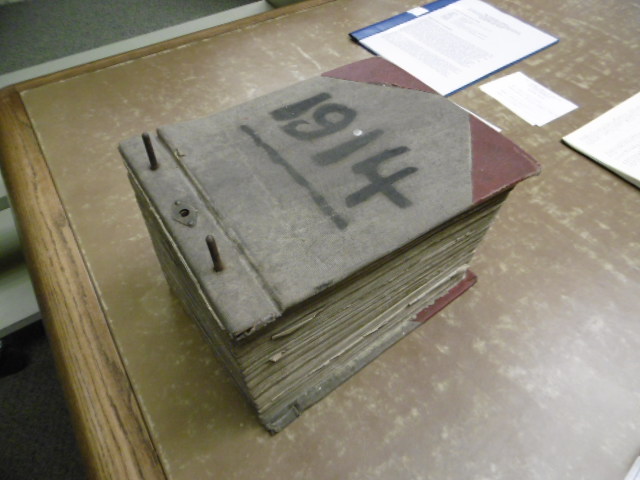
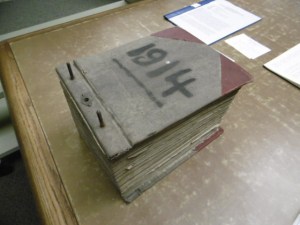
The sales ledgers at Wintherthur contain all the sales made by Arthur Vernay from 1914 until the 1960s; from 1940 the business was continued by Chris Jussel’s father, Stephen Jussel, (Chris took over the business in 1972). The business records prior to 1914 were destroyed by fire, but the remaining early business records are a fascinating research resource, and contain detailed stock books and sales ledgers as well as other ephemera.  This example (below) is the 1914 sales ledger, and the copy invoice (image below) is to ‘Mrs J. P. Morgan’ wife of the famous collector; it is dated December 1914 and describes ‘One Chippendale pole screen with petit point frame, circa 1760’…sold for the princely sum of $450.
Vernay 1914 2

Vernay sales ledger, 1914. Coll 739 04×126.37. Courtesy, The Winterthur Library: Joseph Downs Collection of Manuscripts and Printed Ephemera.

vernay dec 1914 sale

Vernay copy invoice, December 1914. Coll. 739 04×126.37. Courtesy, The Winterthur Library: Joseph Downs Collection of Manuscripts and Printed Ephemera.

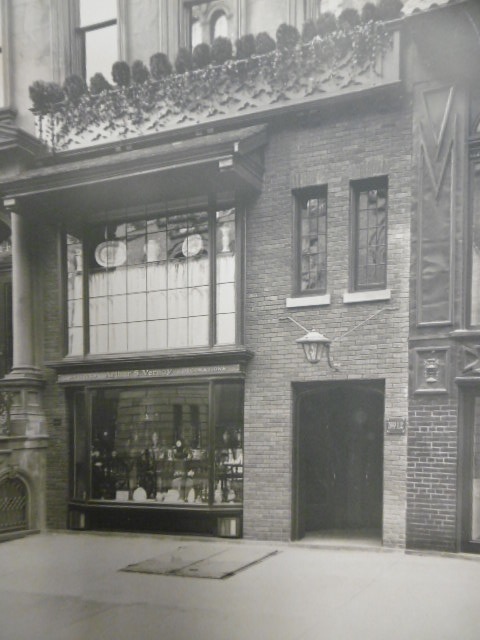
Vernay opened his first shop at East 45th Street, in New York in 1906 (the archives at Winterthur have a printed announcement dated March 1906) – his first premises are shown below.

vernay shop e 45th st ny 1910?

Arthur Vernay, first shop (1906) at East 45th Street, New York. Image c.1910. Coll. 739 07×56 Series IV. Courtesy, The Winterthur Library: Joseph Downs Collection of Manuscripts and Printed Ephemera.

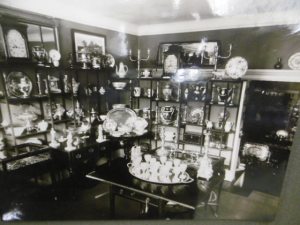
The archives also have some photographs of one of the rooms in the interior of Vernay’s first shop, probably taken in c.1910 – which show what must have been a typical assembly of ‘antique’ objects of interest to collectors and furnishers in the period.
vernay 1st int 1910

Vernay shop interior, East 59th Street, New York, c.1910. Coll. 739 07×56 Series IV. Courtesy, The Winterthur Library: Joseph Downs Collection of Manuscripts and Printed Ephemera.

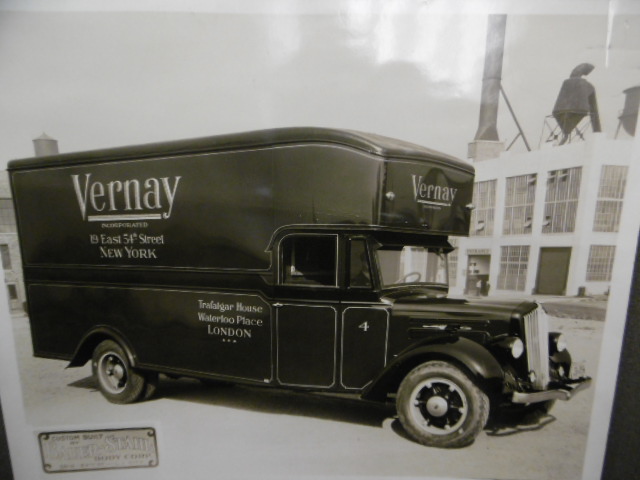
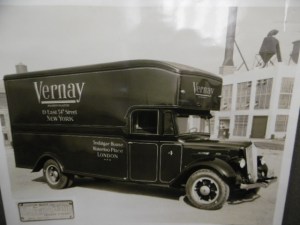
The archives also have a photograph of Vernay’s first delivery van, with it’s own livery! – (Chris Jussel tells me that the van was a Packard type, and was a bespoke model, and quite expensive) – as befitting the culturally significant goods that Vernay sold!
vernay van

Vernay delivery van c.1930s. Coll. 739 04×56 Series IV. Courtesy, The Winterthur Library: Joseph Downs Collection of Manuscripts and Printed Ephemera.

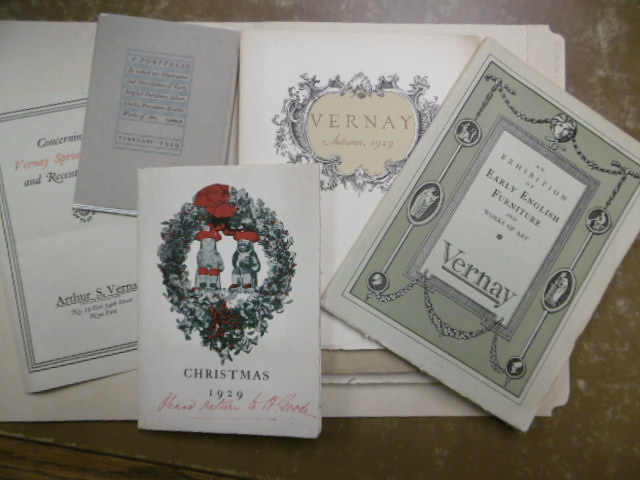
Like many other antique dealers we are studying, (and as previous entries on the Antique Dealer blog have highlighted) Vernay regularly produced catalogues of his stock of antiques, and staged temporary exhibitions to generate interest in particular kinds of objects, or periods/styles and etc. The archive also contains examples of this ephemera, and they clearly demonstrate how sophisticated an operation the Vernay business was. Here’s a selection from the late 1920s –
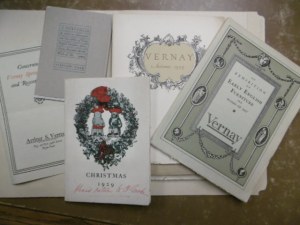
vernay 1929

Vernay catalogues, 1920s. Coll. 739 04×126.77. Courtesy, The Winterthur Library: Joseph Downs Collection of Manuscripts and Printed Ephemera.

And a selection from the 1940s –
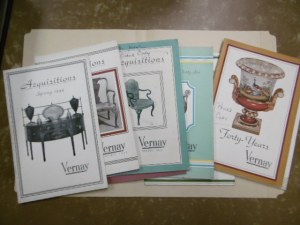
vernay 1944

Vernay catalogues from the 1940s. Coll. 739 04×126.123. Courtesy, The Winterthur Library: Joseph Downs Collection of Manuscripts and Printed Ephemera.

There’s so much more to say about the Vernay, Vernay & Jussel, and the Wolff archives at Winterthur, they are an astonishing survival, and an amazing resource. We certainly hope to do further research on Vernay, and develop this as a potential ‘case study’ for the forthcoming edited book on the ‘British Antique Trade in the 20th Century’ which will be one of the outputs for this AHRC funded research project.

Mark



April 5, 2015

New Project Volunteer Researchers – introducing Graham Panico

I forgot to mention, before I came away on this extended research trip to the USA, that we have a new project volunteer – Graham Panico. I met Graham a few weeks ago at the Dorman Museum in Middlesbrough, and he has enthusiastically stepped forward to help with the research for the project!…Thank you Graham!

By way of introduction, here is a short biography on Graham – (we hope that Graham will compose a blog entry – he mentioned something on the significance of Antique Fairs, which would be fascinating….)

Mark

‘Graham, as a young undergraduate, discovered the world of Art Deco and the associated ceramics of its British variation – at a time in the early 1980’s when the style was experiencing a renewed popularity amongst those collectors and dealers ‘in the know’ and aware of its emerging and growing market. He began to collect hand-decorated, but mass-produced, examples of pottery and other Art Deco objects that could be found in shops and at flea markets and fairs all across the North East of England and having graduated in 1985, his growing collection formed the basis of an initial opening stock as he began to deal, like many collectors before him, in 20th Century Decorative Art later that year.

Having opened his first shop within an Antiques Centre in Darlington in 1986 Graham moved to larger premises in 1987. This allowed an expansion into furniture and furnishings and a wider eventual dateline applied to the stock which traversed the Gothic Revival of the 19th Century to the post-modernism of the 1980s and was supported by a varied customer base of private collectors and trade buyers until 2005. From 2006 the skills and knowledge Graham accrued in a retail context have increasingly been applied in academic environments and he has taught on the contextual studies modules of various undergraduate programmes in the North East and in London. He considers the business of dealing in design to be a very flexible one and since the closure of his shop, Graham has continued to sell antiques, art and 20th Century design via specialist fairs, through auction and occasionally online.’

April 1, 2015

The semantics of the antique trade

One (just one) of the research objectives of the Antique Dealers project is to map, analyse and contextualise the changing language of description and classification used by the antique trade over the period 1900-2000 – and our interactive website (soon to be officially launched) will begin the process of tracking the huge variety of classifications and descriptions that reflect, as well as act as catalysts for, the specialist marketing practices deployed by, and developed by, the trade.  So, for example, some of the questions we are thinking about are when, and where, did antique dealers begin to call themselves ‘Old English Furniture Dealers’, and when/where did ‘antique furniture dealers’ emerge to be a dominant trade classification/description…or when/where did ‘Old Chelsea Porcelain’ emerge as a description deployed by antique dealers…or ‘Old Irish Glass’….?

The language of description and layering of classifications suggest subtle (and sometimes less so subtle) positioning within the complex collecting and classificatory structures of the antique markets over time.

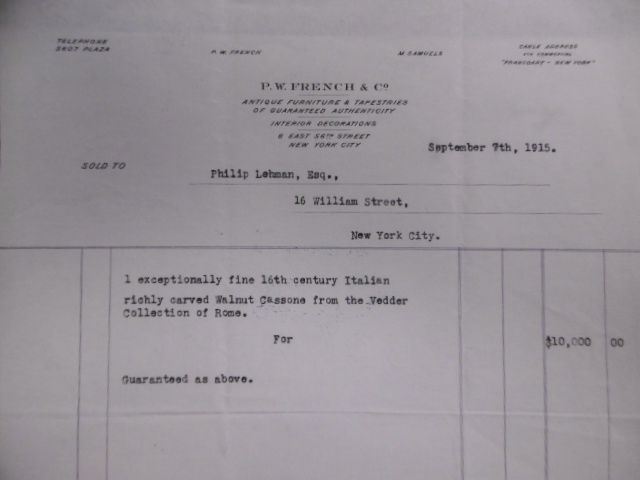
Within the archives of the Metropolitan Museum are some interesting examples of the changing landscape of antique dealer descriptions –

french invoice 7.9.15 det

Invoice from French & Co, 1915, Box 37 Folder 40, Robert Lehman papers, The Metropolitan Museum of Art Archives. Courtesy of the Metropolitan Museum of Art Archives.

Here, (above) in 1915, the well-known dealers, French & Co, describe themselves as selling ‘Antique Furniture and Tapestries of Guaranteed Authenticity’, and also list ‘Interior Decorators’ as a practice.  Later letterheads and invoices issued by French & Co., in the 1950s, for example, classify them as selling ‘Works of Art’.

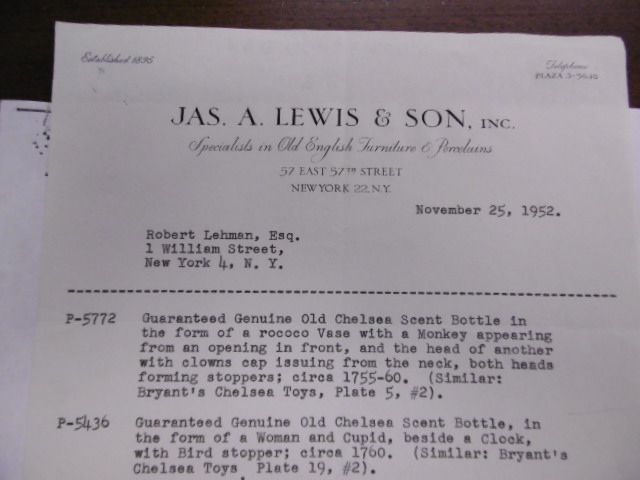
By contrast, an invoice issued in 1952 by James A. Lewis & Son Inc., the American branch of the London antique dealers, indicated that they were ‘Specialists in Old English Furniture & Porcelains’ –

lewis inv 25.11.52 det

Invoice from James Lewis & Son, 1952, Box 38 Folder 15, Robert Lehman papers. The Metropolitan Museum Archives. Courtesy of The Metropolitan Museum Archives.

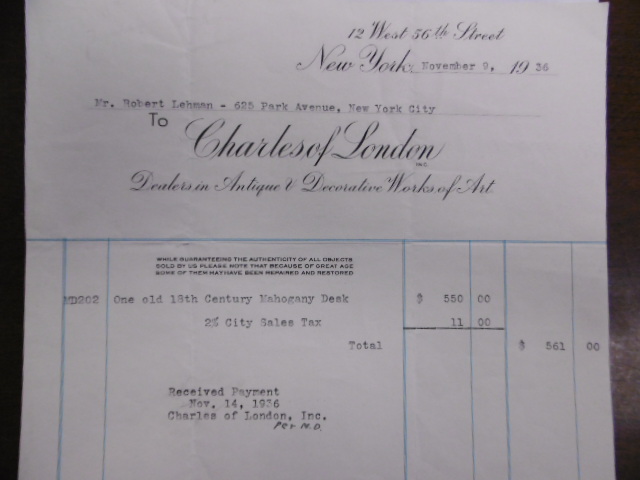
Whereas ‘Charles of London’ (Charles Duveen, we encountered in previous blog entries) described themselves as ‘Dealers in Antique & Decorative Works of Art’ in 1936 – (see below) –

charles inv 9.11.36

Invoice from Charles of London, 1936, Box 37 Folder 12, Robert Lehman papers. The Metropolitan Museum of Art Archives. Courtesy of The Metropolitan Museum Archives.


And the specialist ceramics (as we might say today) dealer H.R. Hancock described themselves in an invoice of 1934 as dealers in ‘Old Chinese Porcelain, Furniture and Works of Art’ – (see below) –

hancock inv 9.10.34 det

Invoice, H.R. Hancock, 1934, Box 38 Folder 2, Robert Lehman papers. The Metropolitan Museum of Art Archives. Courtesy of The Metropolitan Museum Archives.

An investigation of the framework of meanings behind these changes and shifts are a key part of the antique dealer research project.

Mark
March 30, 2015

Oral History Interview with Chris Jussel

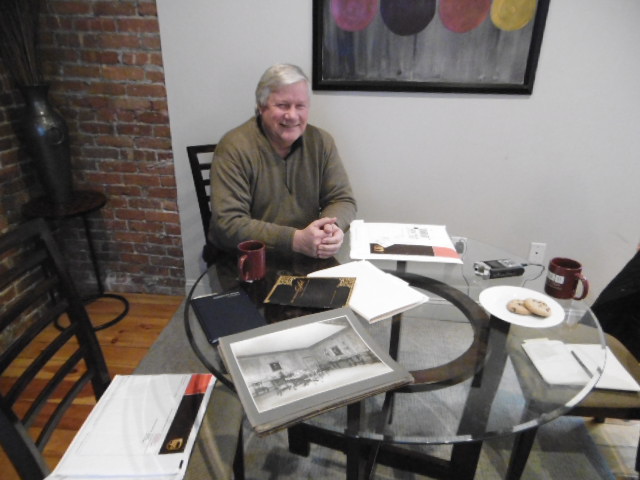
Thanks to Chris Jussel, formerly of Vernay & Jussel, and J.J. Wolff Antiques in New York, for coming to meet me in Boston MA to do an oral history interview as part of the Antique Dealers research project. The interview with Chris will be part of the growing archive of oral history interviews with members of the antique trade that will be made available via the project websites soon. As well as being one of the most prominent antique dealers in America, Chris, as you probably know, was also formerly the presenter on the USA version of ‘Antiques Roadshow’, as well as Vice President of Sotheby’s Trust and Estates Division (1999-2003) and Vice President of Samuel T. Freeman & Co auctioneers between 2007-2009 – he is currently a private art and antiques consultant. Here’s Chris, in the little apartment I’ve rented for my short stay in Boston –

Chris Jussel March 2015

Chris Jussel, in Boston, March 2015.

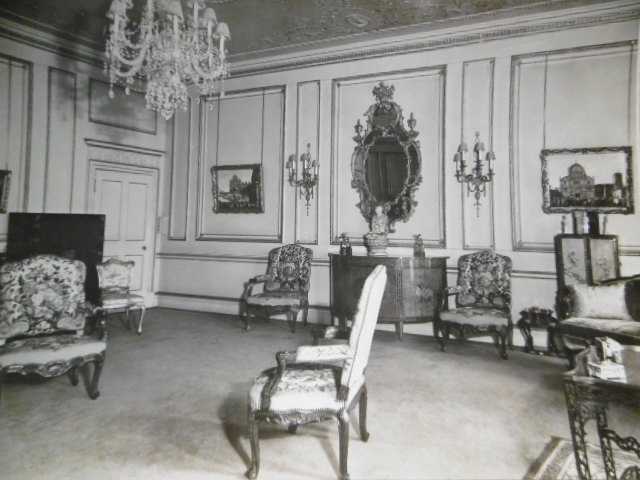
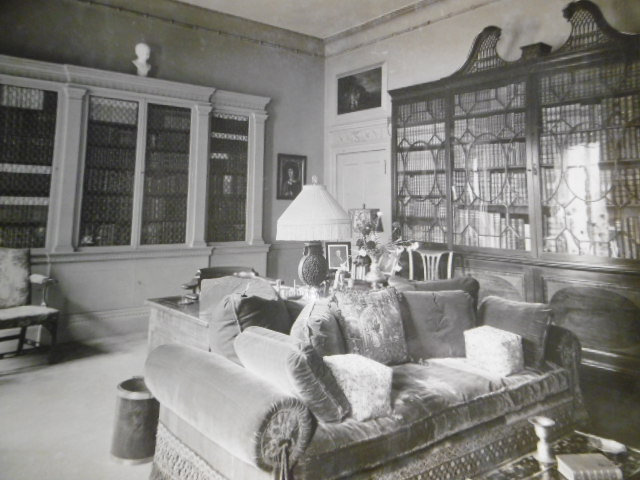
Chris told us about the early beginnings of Arthur Vernay, who opened his antique gallery in New York in c.1906; by 1925 Vernay had a 5 storey building filled with antiques and was one of the most important dealers in New York in the period.  Vernay, was actually born in England, in Weymouth we believe, so the links to the British trade here are important.  Chris also allowed me to copy a set of fabulous B&W photographs of the interiors of Arthur Vernay’s house at 51 Berkeley Square, London, taken during the late 1920s – the images are a potent illustration of the taste for furnishing with antiques in the 1920s. Here’s some of the photographs –

Vernay 1927-29 7

Arthur Vernay, 51 Berkeley Square, London house interior, c.1929. Image courtesy of Chris Jussel.

Vernay 1927-29 6

Arthur Vernay, 51 Berkeley Square, London house interior, c.1929. Image courtesy of Chris Jussel.

Vernay 1927-29 8

Arthur Vernay, 51 Berkeley Square, London house interior, c.1929. Image courtesy of Chris Jussel.

The interview with Chris was fascinating and wide ranging – he told us about the history of his father joining the firm of Arthur Vernay in 1928, and then how the business was continued by his father after Vernay retired in 1940 – before Chris joined the firm in 1972 and renamed the business Vernay & Jussel. Chris consolidated the business in 1978 with the purchase of the then well established dealership J.J. Wolff.  Chris closed the business in 1994 to develop other extensive business interests.

Amongst other antique dealers that Chris recalled were Partridge & Sons, French & co and Stair – some of the most important English furniture dealers in the history of the antique trade.  Chris also told us about the complex practices and processes of the antique trade in the period – including some fascinating anecdotes about dealers such as ‘Charles of London’ (Charles Duveen – see previous blog post for some further info on Charles) and many other characters in the trade. The interview will be a very valuable contribution to the evolving history of the antique trade!

Mark


Home Subjects

a working group dedicated to the display of art in the private interior, c. 1715-1914

The Period Room: Museum, Material, Experience

An International Conference hosted by The Bowes Museum and The University of Leeds

H. Blairman & Sons Ltd

A research project investigating the history of the antiques trade in Britain in the 19th & 20th centuries

Museum Studies Now?

'Museum Studies Now?' is an event which aims to discuss and debate museum and heritage studies education provision.

The Burlington Magazine Index Blog

art writing * art works * art market

East India Company at Home, 1757-1857

A research project investigating the history of the antiques trade in Britain in the 19th & 20th centuries