We thought you would be interested to hear that the bookings for the re-staging of the play ‘Quinneys’ are now open. The performance will be at The Witham Community Theatre in Barnard Castle, County Durham. You can book here:
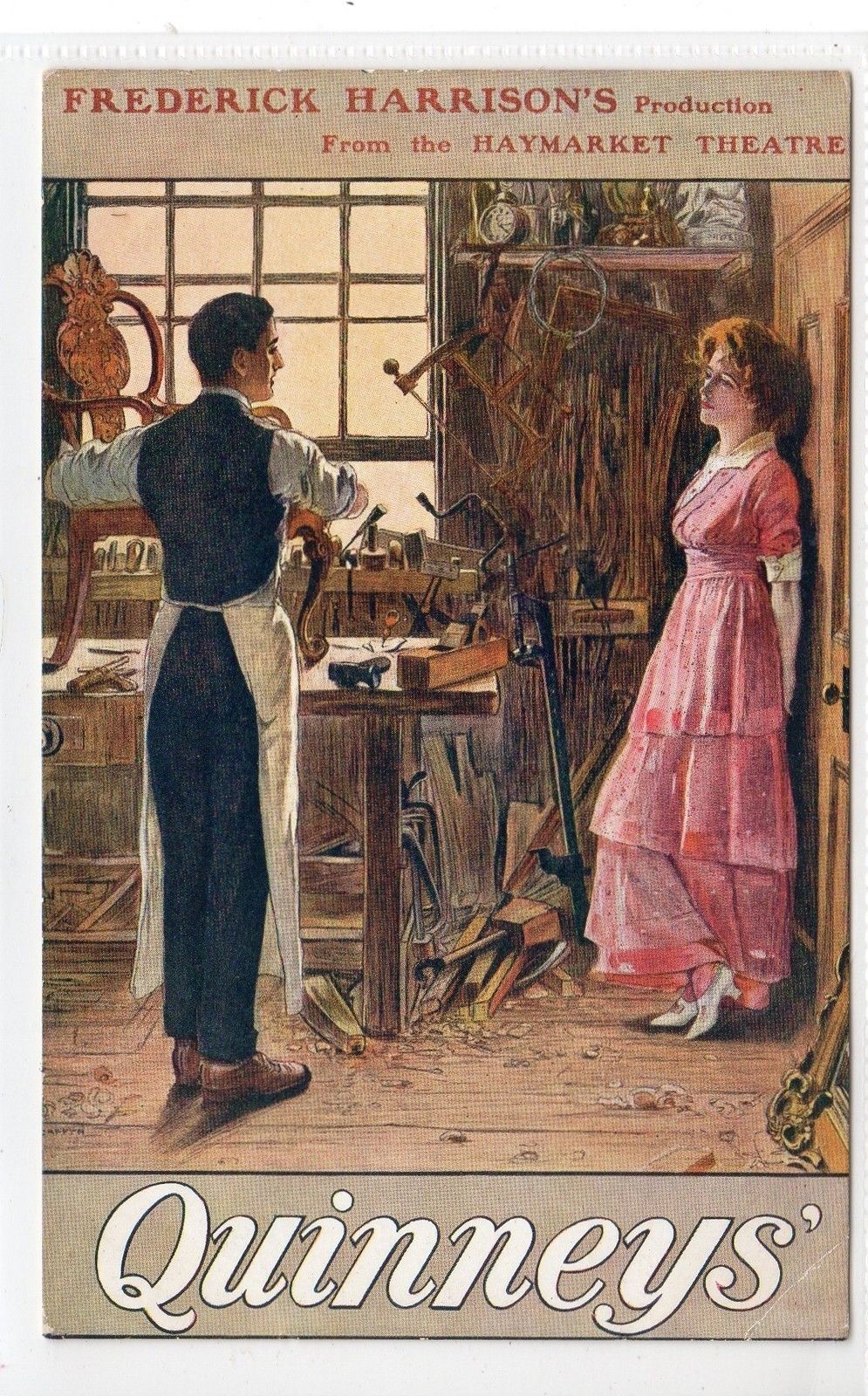
Playbill for the performance of Quinneys at Birmingham theatre in 1925.
As you may know, we are re-staging the play as part of the AHRC funded ‘SOLD! The Year of the Dealer: antique dealers, art markets and museums’ project, which runs until May 2020. The performance will be by student actors from the University of Leeds, School of Performance & Cultural Industries; the play is to be directed by Dr George Rodosthenous, who leads on the MA in Theatre Directing at the University of Leeds.
Quinneys was written as a novel in 1914 by the prolific writer Horace A. Vachell and is about the life and activities of the fictional antique dealer ‘Joseph Quinney’. The play ‘Quinneys’ followed in 1915 and was regularly performed during the period 1915 until the 1950s – it even made it to theatres in New York! The character of Joe Quinney was based on the real-life antique dealer Thomas Rohan, who was trading in Bournemouth and Southampton during the early 1900s until the 1930s – for more on Quinneys and Thomas Rohan do take a look at some of the previous posts in the antique dealers research blog.
And as fiction mirrors fact, the play and the subsequent novel led to the growth in the number of antique shops called ‘Quinneys’ – we have so far traced about 20 shops called ‘Quinneys’ in the UK…as far as we know there’s only one left…Quinneys of Warwick, which is still trading after nearly 90 years!….
We hope that you will be able to make it to the performance of Quinneys. There is a wine reception at 6.30pm, prior to the performance, where you can have a glass of wine and some nibbles and chat and meet with many people involved in, or following the ‘Antique Dealers Research Projects’. The Year of the Dealer project is covering the costs for the wine reception and all performance fees and costs, but as The Witham is a community theatre, we are hoping to support them with some funding and have agreed with them that there should be a nominal £5.00 cost for the tickets for the performance – all the ticket monies will go towards the projects at the The Witham.
The performance will take place on SATURDAY 28th March 2020. Wine Reception at 6.30pm; Play at 7.30pm; close by 9.30pm at the latest.
We do hope that you will be able to make it – and enjoy a rare performance of a key document on the history and characterization of Antique Dealers!
The first of our THREE In Conversation events as part of the AHRC funded ‘Year of the Dealer’ project (2019-2020) was held at the Lady Lever Art Gallery, Port Sunlight, near Liverpool on Thursday 21st November -there are TWO further In Conversation events; one at Temple Newsam, Leeds on Thursday 23rd April 2020; and a final In Conversation at the Victoria & Albert Museum, London, on Thursday 7th May 2020.
The In Conversation events are themed around an on-going, public-facing conversation on the historical and contemporary relationships between the art market and museums and the wider research project to investigate the history of antique dealing in Britain in the 19th and 20th centuries – a subject explored in the original AHRC funded project ‘Antique Dealers: the British Antique Trade in the 20th century, a cultural geography’ (2013-2016) and the various research initiatives and projects that both underpinned and have been subsequently developed from, this fascinating and previously very little studied area of British cultural life – you can of course follow all the projects associated with this strand of research in our new project website ‘Antique Dealers’ at the University of Leeds.
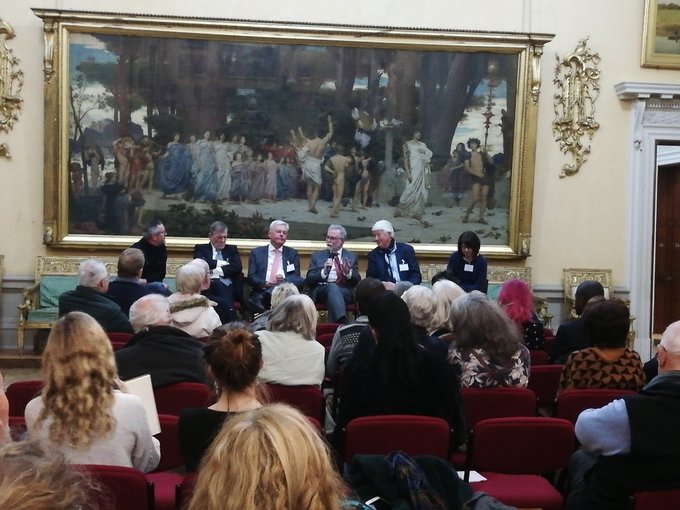
Our In Conversation at the Lady Lever Art Gallery was focused on the collecting activities of William Hesketh Lever (1851-1925), the founder of the Lady Lever Art Gallery – with a theme of collecting and the art market ‘Then & Now’ – the market for decorative art (or Antiques as one might also call them) in the late 19th and early 20th century and the market for decorative art/antiques today. We had a very distinguished panel of experts for the In Conversation – from right to left in the photograph below are Sandra Penketh, Director of Art Galleries and Collections Care at National Museums, Liverpool; Robin Emmerson, curator emeritus, Lady Lever Art Gallery; Colin Simpson, Principal Museums Officer, Wirral Museums; Prof Nick Pearce, Professor of Art History at Glasgow University; Peter Woods, antique dealer and collector and me – Mark Westgarth, University of Leeds. We also had an excellent and packed audience of interested and interesting people – including lots of people from the local area and with associations with the Lady Lever Art Gallery – but it was good to see people from much further afield too – some had travelled all the way from London and the South East of England! Thank you to everyone on the Panel and everyone who attended for making the event such a success!
In Conversation at the Lady Lever Art Gallery, 21st November 2019.
The discussion and debate was lively and informative, with each of the participants on the Panel offering reflections on the art market, collecting and museums from historical and contemporary perspectives (from various ‘stakeholders’ if you like – museum professionals, academics, and professional antique dealers and collectors) . There were also some great questions from the assembled audience. I don’t think we exhausted the theme at all (certainly not in the relatively short time we had for the ‘In Conversation’) – indeed, its just as well we have many more events and activities as part of the ‘Year of the Dealer’ project!
It was great to see the project had so engaged the participants, and bodes well for future events. I’d like to thank everyone at the Lady Lever Art Gallery – Sandra Penketh, Alyson Pollard, Dave Moffat – and the events team at Lady Lever – Joel, Caroline, Nina and Kimmi – and all the support staff, for all of their help with the development and delivery of the In Conversation. And of course the Year of the Dealer project team, Eleanor, Vanessa, Simon and Gemma, for all their hard work too.
Do keep a look out for future events as part of the ‘Year of the Dealer’ project each of the In Conversation events are free to attend (bookings will open soon for the Temple Newsam and V&A Museum events) – we also have a wine reception for each on the In Conversations (if you needed any further incentive to come along of course!). We hope to see you at Temple Newsam and at the V&A Museum next year. Do keep you eye on the events pages on the Year of the Dealer project website.
The first event as part of the year-long AHRC-funded ‘Follow-on’ ‘Impact and Engagement’ project ‘SOLD! The Year of the Dealer: antique dealers, art markets and museums’ takes place at the Lady Lever Art Gallery on THURSDAY 21st November at 6.00pm until 8.00pm. The event is FREE – and we also have a free wine reception at 6.00pm – everyone is welcome and you can book your place online at either the Lady Lever Art Gallery website or the YoD Website at the University of Leeds. Here are the links:
The YoD project seeks to disseminate the rich seam of research on the history of the antique trade through a series of public engagement events, activities and public museum heritage trails. The collaborating partners are The Victoria & Albert Museum, London, The National Museum, Scotland, Edinburgh, The Bowes Museum, Barnard Castle, Temple Newsam, Leeds, The Lady Lever Art Gallery, Liverpool, The Ashmolean Museum, Oxford and Preston Park Museum, Stockton. We also have as cultural partners, The Witham Community Arts Centre, Barnard Castle, and The Stanley & Audrey Burton Gallery, University of Leeds; together with one of the world’s leading antique dealers, H. Blairman & Sons, London. The project aims to draw attention to the relationships between the art market and public museums and to share expertise, experience and perspectives among stakeholders. It aims to increase public engagement with the significance of the history of the antique trade in British cultural life.
Our event at the Lady Lever Art Gallery is an ‘In Conversation’ event, which brings together museum curators, academics and art and antique dealers with expert knowledge of the collections at the Lady Lever Art Gallery to discuss and debate the theme of ‘Collecting, Then & Now’. We have brought together an expert panel, including, Professor Nick Pearce, Glasgow University, Robin Emmerson, former curator at the Lady Lever Art Gallery, Sandra Penketh, Director of Galleries, Liverpool, Colin Simpson, Curator, Williamson Art Gallery & Museum, Peter Wood, Antique Dealer & Collector, and Dr Mark Westgarth, University of Leeds.
The questions to be addressed in the ‘In Conversation’ are based on the premise that in the late 19th and early 20th centuries William Hesketh Lever, later 1st Lord Leverhulme, assembled vast collections of antique furniture, decorative objects and paintings, some of which formed the Lady Lever Art Gallery 1922, dedicated to his late wife Elizabeth, but how and what did Lever collect in the early twentieth century?….and if assembling his collections today, what would Lever acquire?…..and what was kind of art market did Lever encounter in the early twentieth century and what kind of art market would Lever encounter today?
We hope it will be a lively and interesting discussion – and of course there is plenty of time to ask questions during the final section of the In Conversation. Do come along, have a glass of wine and listen to what we hope will be a fascinating debate.
The scehudule for the event is:
6.00pm – Welcome, with wine reception
6.30pm – In Conversation
7.20pm – Questions from audience
8.00pm – Close
Hope to see you at the Lady Lever Art Gallery on 21st November; and do look out for future events in the Year of the Dealer project over the coming months. Keep your eye on the Year of the Dealer project website – Year of the Dealer at Leeds.ac.uk
Thank you to Frances Allitt and the team at the Antiques Trade Gazette (ATG) for the news piece on the launch of the SOLD! The Year of the Dealer project. Frances composed a short promotional piece in the ATG this week – See – ATG Year of the Dealer. We have been busy in planning meetings the last few weeks, at the V&A Museum, Lady Lever Art Gallery, Temple Newsam and at the University of Leeds, settling on final dates for some of the planned events and activities – you can follow updates on the Year of the Dealer project website – Click Here.
In the coming weeks we are planning further project meetings with the rest of the project partners. There’s still a lot of work to do, but the Year of the Dealer is beginning to take shape and the final lists of the 20 objects that will form each of the proposed curated ‘dealer trails’ through the galleries at the 7 major museum partners are coming together. We can give you an exclusive preview of just one of the 20 key objects identified for the ‘Year of the Dealer’ antique dealer trail for Temple Newsam in Leeds –
Library Table, c.1770, by Thomas Chippendale; formerly at Harewood House, near Leeds, now at Temple Newsam, Leeds. Photograph courtesy of Leeds Museums & Galleries
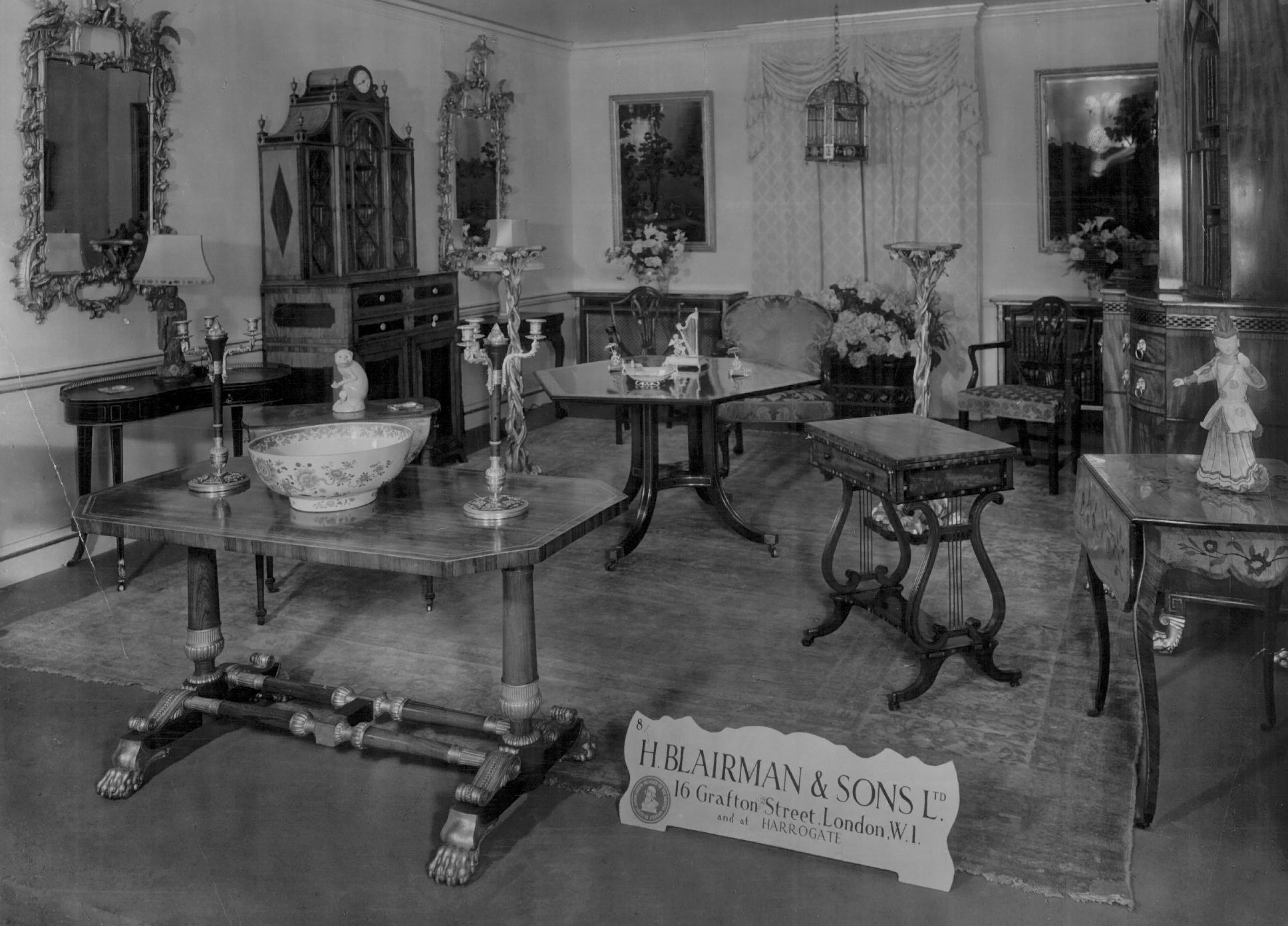
And here it is – the famous Library Table made by Thomas Chippendale, c.1770 for Harewood House, near Leeds. The ‘Year of the Dealer’ trail will obviously mention Chippendale in the story about the Library Table but the main focus of the trails will be the stories about the antique dealers that lie behind the acquisition of the objects by the museums. For the Harewood Library Table the story we will be foregrounding is how it was acquired by Temple Newsam through the antique dealers’ H. Blairman & Sons in July 1965. The Library Table was purchased by the antique dealer George Levy, Director of H. Blairman & Sons, at Christie’s auction sale of artworks from Lord Harewood’s estate in London on 1st July 1965 (the table was lot 57). Blairman’s were established in 1884 and George Levy had joined the business in 1949 – here’s the H. Blairman & Sons stand at the famous Grosvenor House Antiques Fair, London, in June 1950, the year after George Levy joined the business.
H. Blairman & Sons stand at the Grosvenor House Antiques Fair 1950. Photograph courtesy of H. Blairman & Sons.
The 1965 auction sale of the Harewood Library Table generated a great deal of interest at the time – one anonymous reporter writing in Tatler 30th June 1965, the day before the auction, wrote, ‘There is little doubt that such an item will cause a lively stir in the saleroom and I shall be surprised if it does not eventually reach five figures.’ Martin Levy (the son of George Levy), and who remains the owner and director of H. Blairman & Sons, recalls that his father persuaded the group of Yorkshire businessmen who had agreed to support the acquisition of the Harewood table for Leeds Museums & Galleries, that he should bid the agreed limit of 40,000 guineas ‘plus one’ at the Christie’s auction – this was to ensure that if Blairman entered the bidding on the ‘wrong foot’ so to speak – i.e. if they entered the bidding at say 20,000 guineas and their maximum bid was 40,000 guineas, they may end up with a bid at 39,000 guineas, with the opposition having the bid of 40,000 guineas…so a bid of ‘plus one’ would potentially secure the object – indeed, George Levy’s suggestion proved prescient, as the final and successful auction bid was 41,000 guineas!
41,000 guineas (a guinea is £1 + 1 shilling) equated to £43,050 in 1965 and was at the time acknowledged as a world record price for a piece of English furniture. This was indeed an enormous sum for a piece of antique furniture; the equivalent value today would be about £2,450,000 (see Measuring Worth.com). It’s always difficult to work out relative values of course, and the notion of a ‘world record price’ is no less complex – Gerald Reitlinger (The Economics of Taste, volume 3, 1963 and which was obviously published slightly before the auction sale of the Harewood Library Table) cites several ‘world record’ prices for English furniture – (Reitlinger’s data is derived from artworks circulating on the auction market of course…we don’t know about any values from private treaty sales…). Reitlinger cites 10,000 guineas (£10,605) in at an auction in 1928, paid for a Queen Anne console table with matching mirror and torcheres (what is often called a ‘trio’), and sold from the collections of Earl Howe, as the world record auction price for English furniture in the 1920s; although Reitlinger also notes the sale, in 1921, of one of the famous ‘Raynham Commodes’, (also attributed to Chippendale) which made £3,900 (equating to £1,721,000 today).
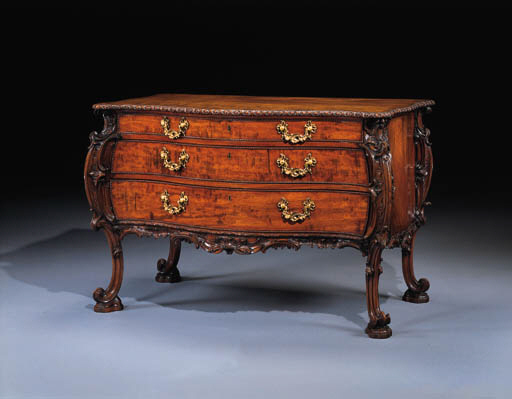
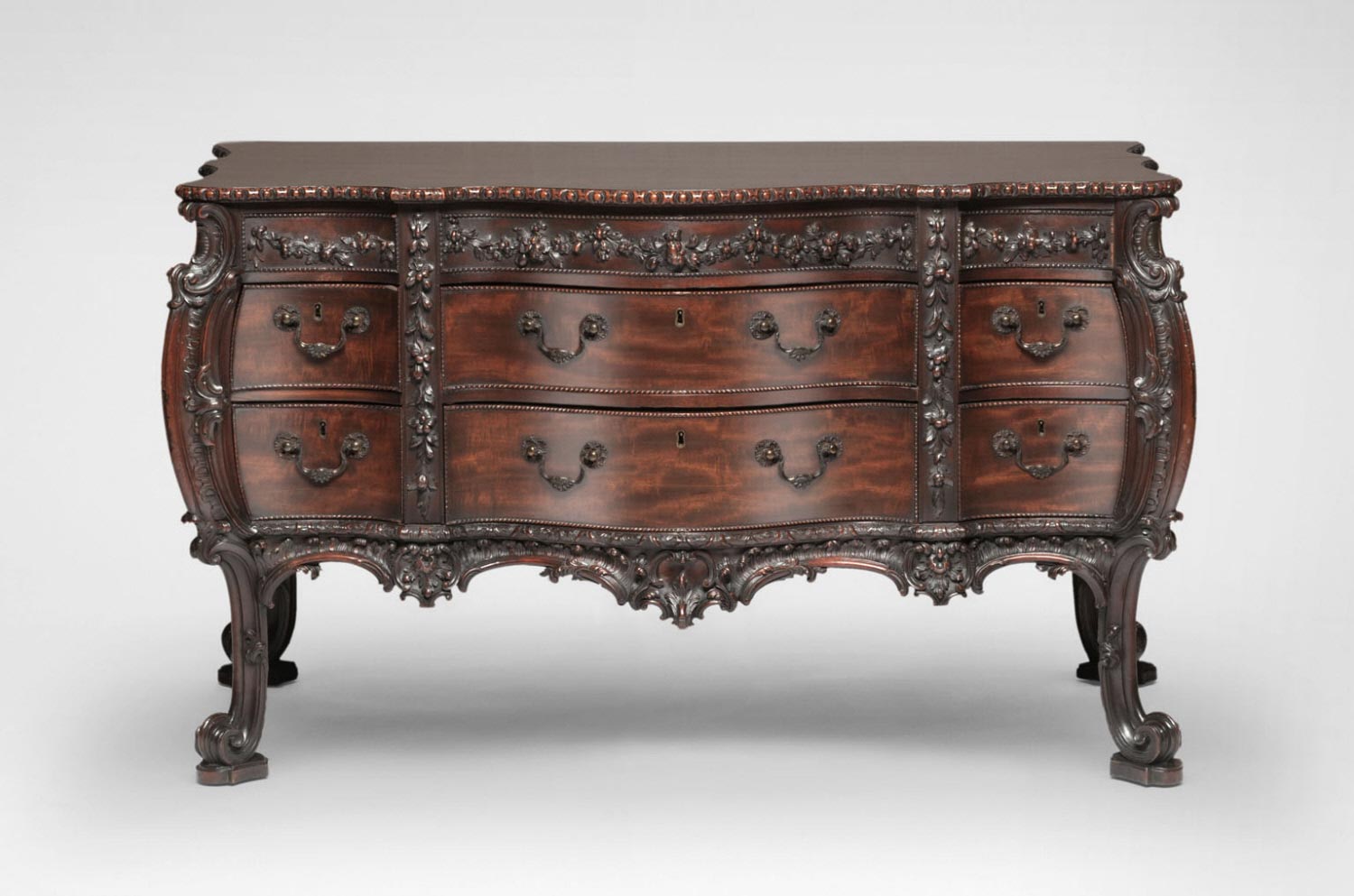
According to Reitlinger the ‘world record’ of £10,605 of 1928 stood until 1961 when he recorded that one of the famous ‘Rainham Commodes’ (also called ‘Raynham’) was sold in New York for £25,000 – I’m not so sure about this?…According to the newspaper reports at the time (30th June 1961) the piece that sold for £25,000 in New York was, and I quote, ‘an Adam-Chippendale satinwood and mahogany marquetry serpentine-front commode in the French taste. A masterpiece of design probably executed by Chippendale himself.’ The ‘Rainham Commode’ is, as many of you will know, a mahogany commode (sans marquetry) – here’s a couple of illustrations of ‘Rainham/Raynham’ model commodes – left is an 18th century mahogany commode, described as ‘possibly supplied to…Raynham Hall, Norfolk’ and which was sold at Christie’s New York in 1998 (for c. $1,500,000) at the auction sale of the stock of the New York antique dealer French & Co. This commode incidentally was previously in the stock of the antique dealer Walter Waddingham, of Harrogate, in 1955, and was shown by Waddingham at the famous Grosvenor House Antiques Fair in the same year. On the right is an acknowledged ‘Raynham Hall’ commode – this one is now at the Philadelphia Art Museum in the USA, and was acquired in 1941 having been in the collections of both H.H. Mulliner (1861-1924) and William Randolph Hearst (1863-1951).
18th century commode, sold at the auction sale of the stock of the dealer French & Co. – Christie’s New York 1998. Photograph copyright Christie’s New York. 18th century commode, from Raynham Hall, Norfolk. Philadelphia Museum of Art, USA. Purchased with the John D. McIllhenny Fund, 1941. Photograph copyright Philadelphia Museum of Art.
The history of the ‘Rainham’ and ‘Raynham’ commodes is also complicated by the fact that the well-known collector of English furniture, H. H. Mulliner, purchased Rainham Hall, which is in Essex, in 1920 as a suitable home for his extraordinary collection of antique English furniture; Mulliner’s collection is said to have included a commode from Raynham Hall, Norfolk – so maybe there is more unravelling to do on these ‘Raynham’ and ‘Rainham’ commodes?
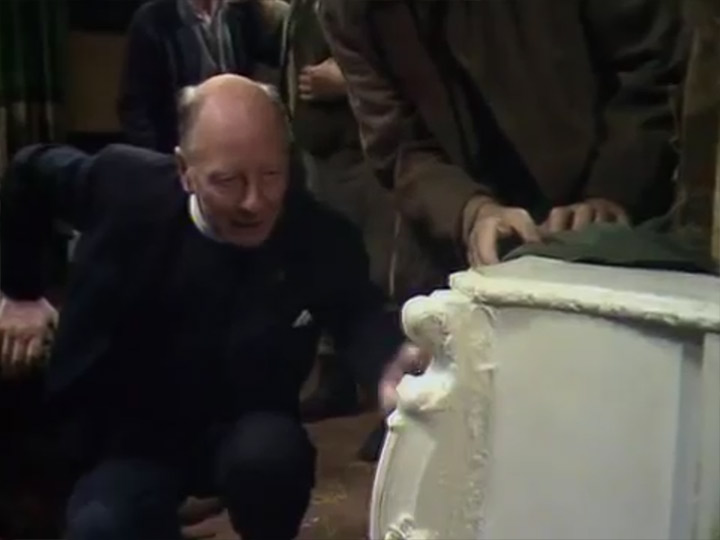
The Norfolk Raynham Commode was actually made much more famous in the popular television series’ Tales of the Unexpected (1980), in a version of Roald Dahl’s short story ‘Parson’s Pleasure‘ (1959). In the TV version, in which John Gielgud plays the crooked antique dealer ‘Cyril Boggis’, Mr Boggis stumbles across a piece of Chippendale furniture in an old farmhouse – and the model for the piece of Chippendale furniture is the ‘Raynham Commode’ – you can just see the commode, painted white, in this film still from the episode of Tales of the Unexpected.
Still from ‘Parson’s Pleasure’ in Tales of the Unexpected (1980).
Roald Dahl was a very keen collector of antique furniture himself, and specifically mentions the Raynham commode in his short story – as Dahl writes; ‘He knew, as does every other dealer in Europe and America, that among the most celebrated and coveted examples of eighteenth-century English furniture in existence are the three famous pieces known as ‘The Chippendale Commodes’….coming out of Raynham Hall, Norfolk.’ (Parson’s Pleasure, in Kiss, Kiss, p.78). Dahl mirrors the real-life history of the Raynham commode in his story – during the negotiations between ‘Mr Boggis’ and the farmers who own the commode, one of the farmers (‘Bert’) asks his fellow farmer to fetch ‘that bit of paper you found at the back of one of them drawers’ (Parson’s Pleasure, in Kiss, Kiss, p.82) – this proved to be the original bill for the commode, supplied by Thomas Chippendale; mimicking an article by the furniture historian Herbert Cescinsky published in Burlington Magazine in June 1921 which highlighted the presence, then as now, lost, of the original bill for one of the ‘Raynham’ commodes.
But anyway, besides this fascinating interweaving of fact and fiction in the history of the Raynham Commodes, what we hope that the Year of the Dealer trails will draw attention to is the complex relationships between cultural value and economic value. Indeed, if we take the Measuring Worth.com calculations for these auction sale values of English furniture we can see that the notion of a ‘World Record price’ is a notoriously difficult thing to nail down. For example, the economic value of the Queen Anne ‘trio’ sold in 1928 of 10,000 guineas (£10,605) was the equivalent of c.£5,000,000; and the ‘Rainham Commode’ sold in 1961 for £25,000 (if indeed it was the ‘Rainham Commode) was the equivalent of just £1,881,000. So technically the Queen Anne ‘trio’ sold in 1928 still holds the ‘world record’ for a piece of English furniture sold at auction, even surpassing the auction sale of the Harewood Library Table in 1965 (equivalent of £2,450,000).
But then again, there’s more to ‘World Records’ that merely economic calculations; they are complex cultural and social signifiers that both transcend and complexify the blunt instrument of economic value.
We are very excited to announce that the ‘Year of the Dealer’ project has officially started – the new project website is being constructed (thanks to Peter Edwards in University of Leeds, Arts, Humanities & Cultures Faculty IT team) – you can see the new website here – Year of the Dealer website
The ‘Year of the Dealer’ project is a collaboration between the University of Leeds, the University of Southampton, 7 major national and regional museums (The Victoria & Albert Museum, The National Museum, Scotland, The Ashmolean Museum, The Lady Lever Art Gallery, The Bowes Museum, Temple Newsam, Preston Park Museum and the Stanley & Audrey Burton Gallery), together with a regional community theatre (The Witham, Barnard Castle) and one of the UK’s leading antique dealing businesses (H. Blairman & Sons). The project runs from 1st June 2019 until 31st May 2020 and is an ‘Impact and Engagement’ project funded (£100,000) by the Arts and Humanities Research Council (AHRC). Over the next 12 months the Year of the Dealer will be organizing a series of events, activities and museum object trails, using the research arising from the AHRC funded (£231,592) research project ‘Antique Dealers: the British Antique Trade in the 20th century’ AH/K0029371/1 (2013-2016).
C. Charles, Brook Street shop interior, c.1903. Photograph, Connoisseur 1903.
Through these events and activities the project aims to draw attention to the relationships between the art market and public museums and to share expertise, experience and perspectives among stakeholders and to increase public engagement with the significance of the history of the antique trade in British cultural life.
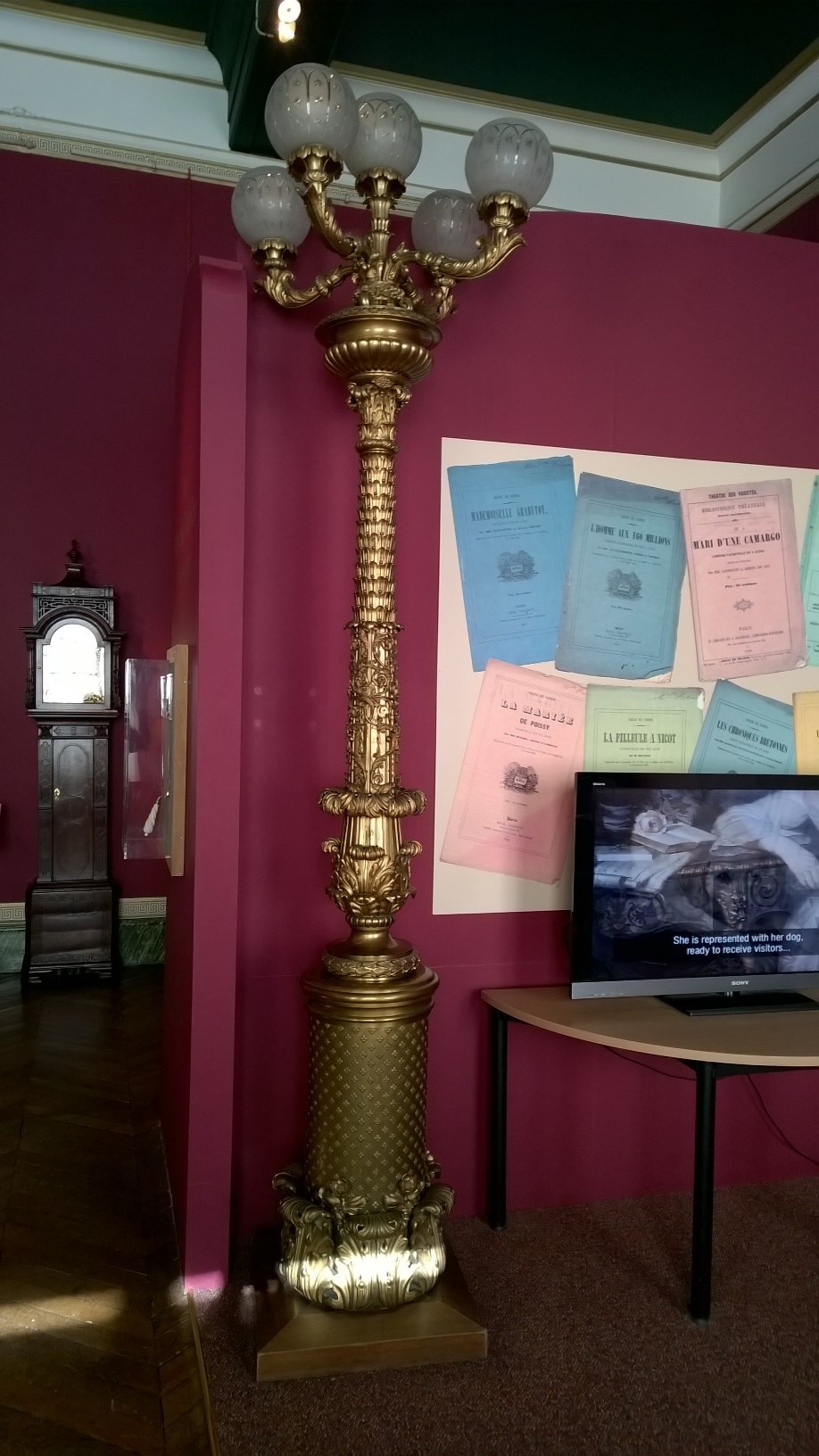
The Year of the Dealer will reveal new and previously marginalised stories of world-renowned and familiar museum objects through the co-production of a series of 7 museum ‘hidden history’ trails; each trail will have a curated selection of up to 20 museum objects foregrounding the history of antique dealers in the biography of the museum object. So, for example, at The Bowes Museum, we will be drawing renewed attention to some of the museum objects by telling the story about the antique dealers who sold the object to the museum – this rare pair of gilded bronze lamps, made by William Collins in 1823………..
One of a pair of gilded bronze lamps at The Bowes Museum. Photograph, antique dealers project 2018.
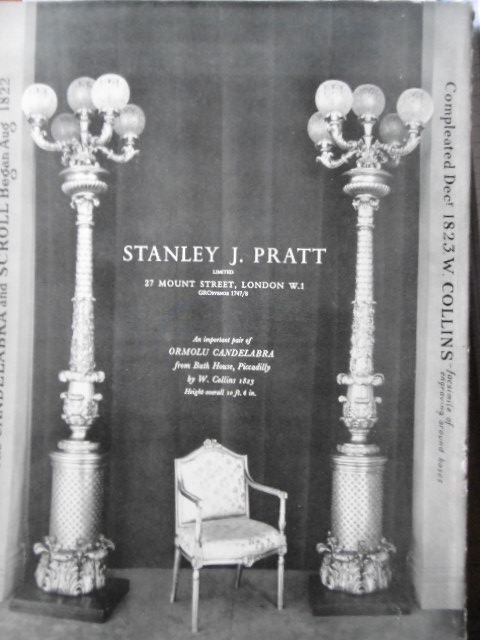
…………………..will be reinterpreted through the Year of the Dealer trail in the museum as a pair of lamps sold to the Bowes Museum in 1960 by Stanley J. Pratt, a leading antique dealer then trading in ultra-fashionable Mount Street, London. How Pratt acquired the lamps and how they ended up at The Bowes Museum will be key elements in the ‘story’ about the objects. Stanley Pratt came from a well-known family of antique dealers dating back into the 19th century; indeed the Pratt family of dealers were established, according to their own publicity, in 1860, and so sold the lamps to The Bowes Museum in their centenary year!
Advertisement by Stanley J. Pratt illustrating the pair of gilded bronze lamps. Connoisseur, June 1960.
Besides the 7 museum trails, the project will also stage 4 art market themed knowledge exchange workshops and 3 public engagement ‘In Conversation’ events, hosted by the partner museums. The workshops will consider the relationships between the art market and public museums, drawing in historical and contemporary perspectives and will also consider the challenges and future opportunities for the relationships between museums and the art market. The ‘In Conversation’ events invite key art market professionals, museum professionals, academics and commentators to discuss and debate the subject of the art market and public museums – all the events will be free, thanks to the Arts and Humanities Research Council (AHRC) funding.
Other activities as part of the Year of the Dealer project include museum front of house staff and volunteer training workshops at each of the 7 partner museums to ensure that the project research and objectives are disseminated and cascaded to the front-line interface with the public.
We will also be re-staging the play ‘Quinney’s (1915) at the Witham Theatre, Barnard Castle, and are organizing an associated workshop, ‘Dealing with Authenticity’ at The Bowes Museum, Barnard Castle.
Poster for Quinney’s production at Birmingham Theatre, 1925.
‘Quinney’s’ is the story of the fictional antique dealer Joseph Quinney. The play and the workshop aim to critically engage the general public with the central role that ‘authenticity’ has played in the art market, and to explore and critique the trope of the antique dealer as a problematic character, often associated with fakes and forgeries and the ‘love of money’. The workshop will be interdisciplinary in scope, drawing on theatre and performance studies and material culture studies as well as the history of antique dealers.
As you can see, there are plans for a very rich series of events, activities and collaborations over the course of the Year of the Dealer project – but we have a great team to help deliver the project – my colleague from University of Southampton, Dr Eleanor Quince, and Vanessa Jones, our project administrator, and my colleagues at the University of Leeds, Professor Jonathan Pitches and Dr George Rodosthenous, and of course all of the curators and staff at the all 10 collaborating partners and a small team of PhD research students to help keep the project on track!……it’s no doubt going to be exhausting, but we hope it will also be a really engaging project…and one that will have real Impact!
We hope to see you at some of the events – we already have some events fixed in the project calendar…so do keep an eye on the project website and the antique dealers research blog.



 antiquedealersblog