Some exciting news (I hope!) – the final part of The Year of the Dealer project is finally ready for launch. It’s been an absolutely mammoth task, spanning the last few years, creating the digital film trails, but we are very nearly ready to press the button and make the project ‘live’. We are aiming to press the launch button in mid April – we’re just working with our fantastic partner museums to make sure everything lines up and we’ll be good to go!
The Year of the Dealer project has involved multiple outputs over the last few years, including a film (Quinneys 2021), workshops and events, and an art-film ‘Echo’ – you can read all about the project on the Antique Dealer Research Project website
Year of the Dealer project website 2026.
The Year of the Dealer digital trails is the final part of the (current) project and has involved creating 50 short digital trails in collaboration with 5 of the UK’s leading museums – The Bowes Museum, The Lady Lever Art Gallery, Preston Park Museum, Temple Newsam, and the V&A Museum. We have picked 10 objects at each museum and told the stories of the antique dealers behind the objects. All 57 digital films (there are also 7 introductory and supplementary films) will go ‘live’ in a couple of weeks and will be live for a year, to make 2026-2027 The Year of the Dealer!
To whet your appetite, here’s a promotional film we have made, highlighting the Year of the Dealer project (see below).
Do watch out for the Year of the Dealer when it launches – and we will be posting updates on the Antique Dealer Research blog about the Year of the Dealer digital films and associated events throughout the coming year.
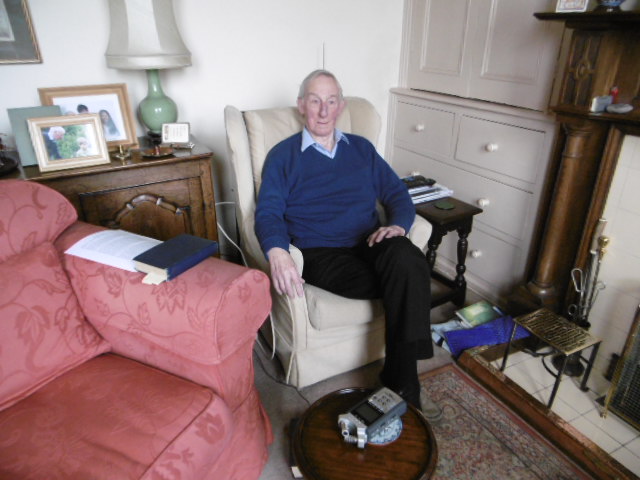
We were very sad indeed to hear that Tony Lumb, of the very well-known antique dealers Charles Lumb & Sons of Harrogate, Yorkshire, passed away over the Christmas period. Tony, together with his wife Mary, was a great supporter of the Antique Dealers Research Project at the University of Leeds – in fact we conducted an oral history interview with Tony and Mary (and James Lomax, former curator at Temple Newsam, Leeds) back in 2014 and we have very fond memories of Tony and Mary – they both came along to the premier of our film of the play ‘Quinneys’ (1915) which we made in 2021, screened at York Picture House in November 2021.
Tony Lumb at home in Knaresborough, 2014. Photograph, Antique Dealers Research Project, University of Leeds.
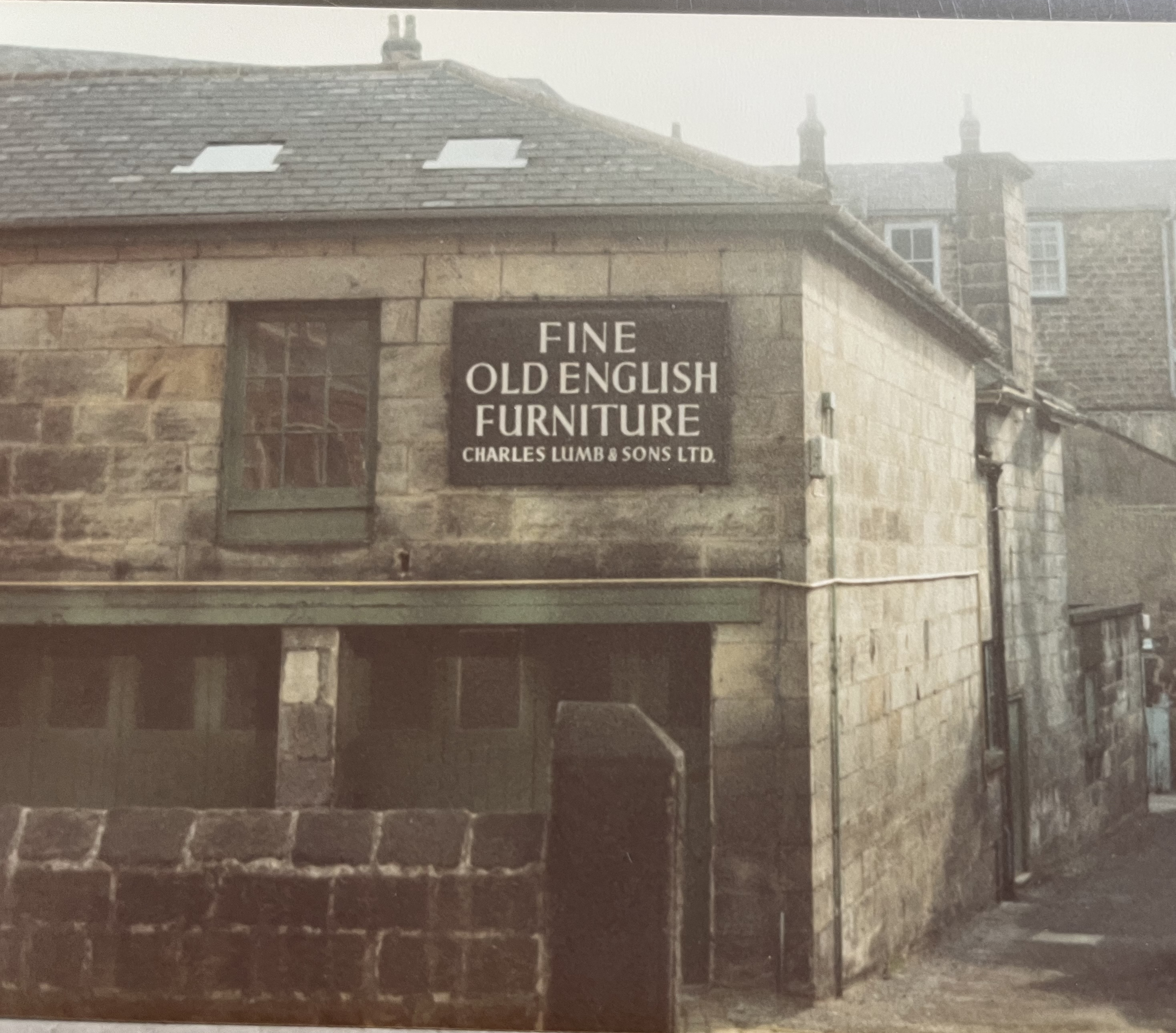
Tony was born in 1935 and joined his family antique dealing business, Charles Lumb & Sons, in 1956 after completing his National Service. The business had been started by Tony’s grandfather, Charles Lumb (1878-1963), who was born in Dewsbury, Yorkshire in 1878 and trained as a cabinetmaker; he established Charles Lumb & Sons as antique dealers in Harrogate in 1907. Below is a photograph of one of the early business premises of Charles Lumb, a small 19th century workshop where Charles Lumb traded from just after the end of the First World War in 1918 or 1919 – the photograph is from the 1980s, when Charles Lumb & Sons still owned the property and used it as a store for their stock of antiques.
Charles Lumb & Sons, Montpellier Street/Montpellier Mews, Harrogate; shop/workshop opened in about 1918/19. Photograph courtesy of Tony and Mary Lumb.
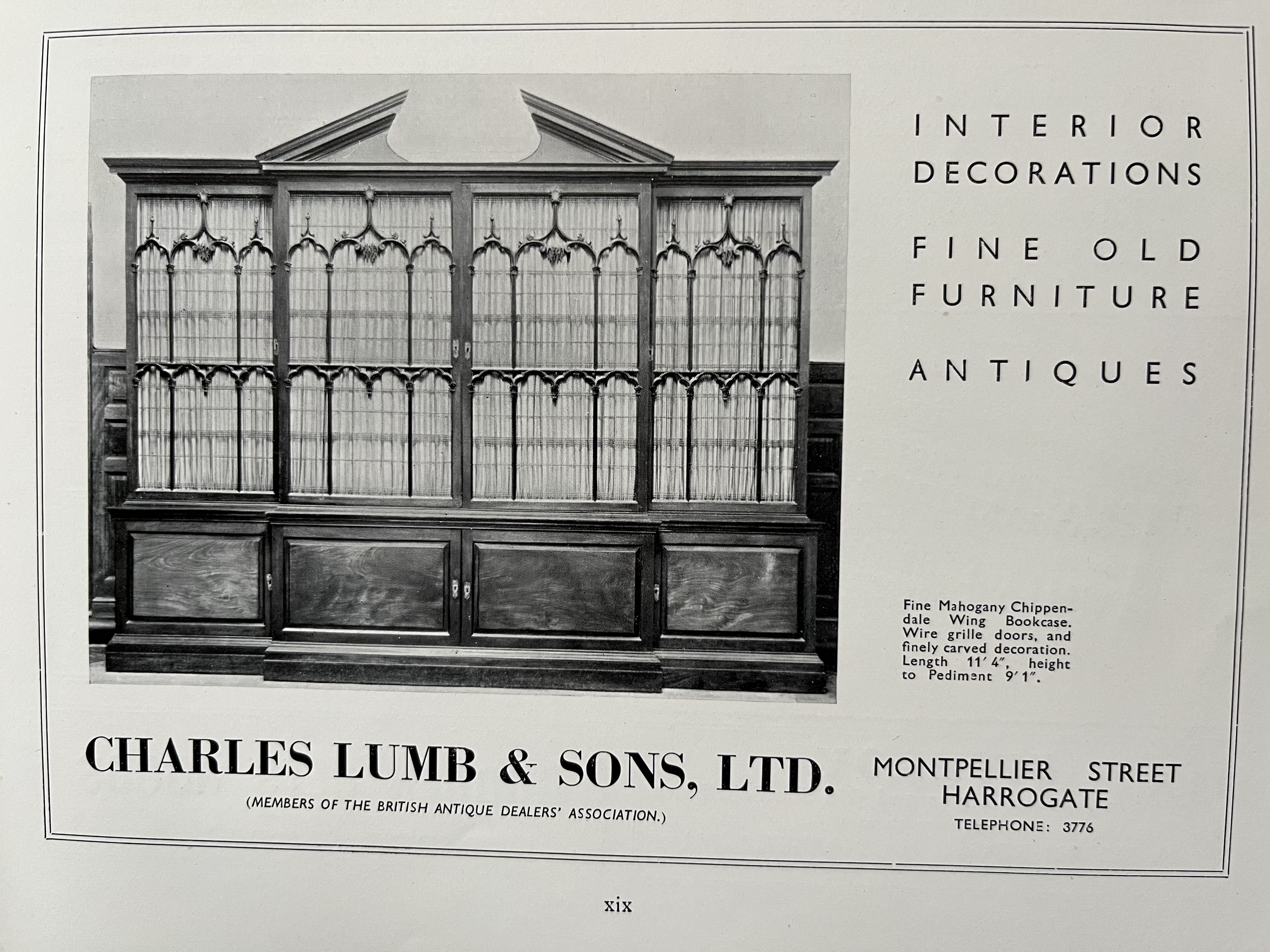
Charles Lumb opened a shop in Swan Road in Harrogate in the early 1920s, before moving to larger premises in Montpellier Street, Harrogate in the 1930s. Below is an advertisement produced by Charles Lumb & Sons in 1938, trading from their Montpellier Street address.
Charles Lumb & Sons, advertisement, Apollo, August 1938. Photograph, Antique Dealers Research Project, University of Leeds.
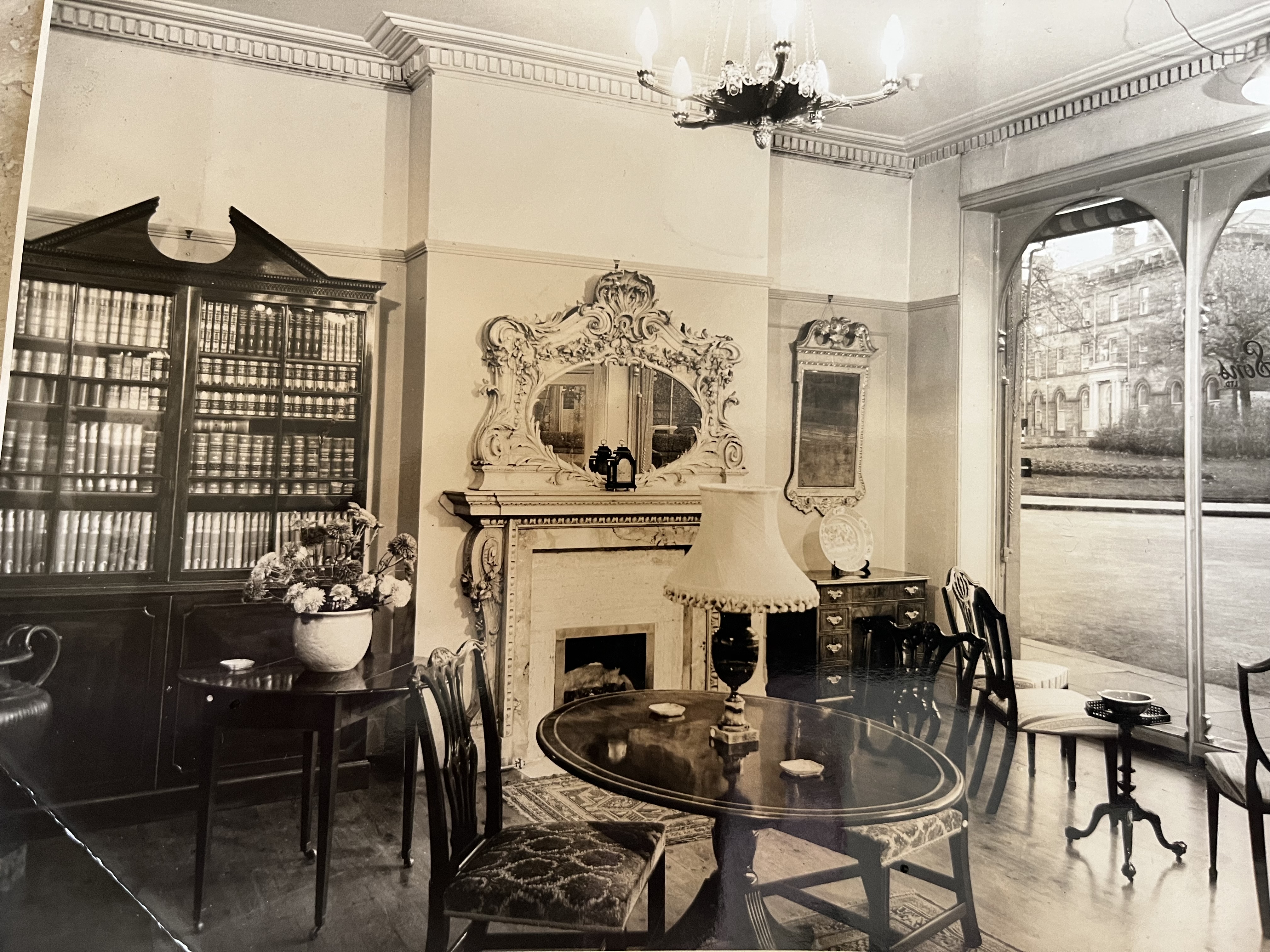
Tony’s father, Frank Lumb and his uncle Reg, together with Tony, ran the antique business after Charles Lumb died in 1963. By then they had moved the business, opening a new shop at 34 Montpellier Parade, Harrogate in 1947, and were one of the most important antique dealers in the UK. Below is a photograph of Charles Lumb’s shop at Montpellier Parade in 1954, just a couple of years before Tony Lumb joined the business in 1956.
Charles Lumb & Sons, Montpellier Parade shop interior, 1954. Photograph courtesy of Tony and Mary Lumb.
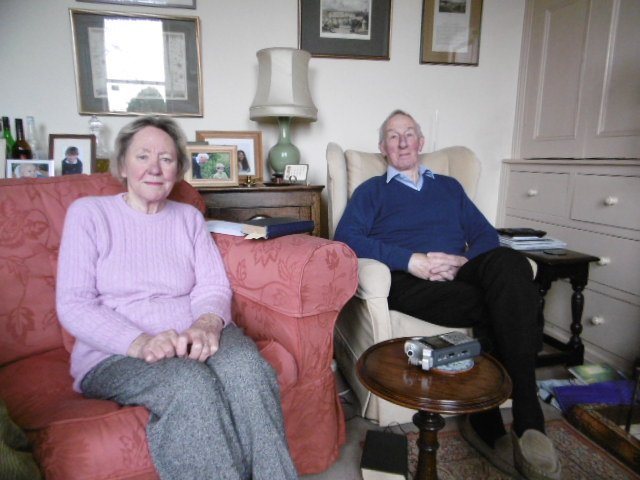
When Reg Lumb died in 1976 Frank, with Tony and Mary, continued to run the antique dealing business; Frank Lumb was working in the antique shop until his early 90s; he died aged 97 in 1993. Tony and Mary finally closed Charles Lumb & Sons in 2012.
Mary and Tony Lumb, 2014. Photograph, Antique Dealers Research Project, University of Leeds.
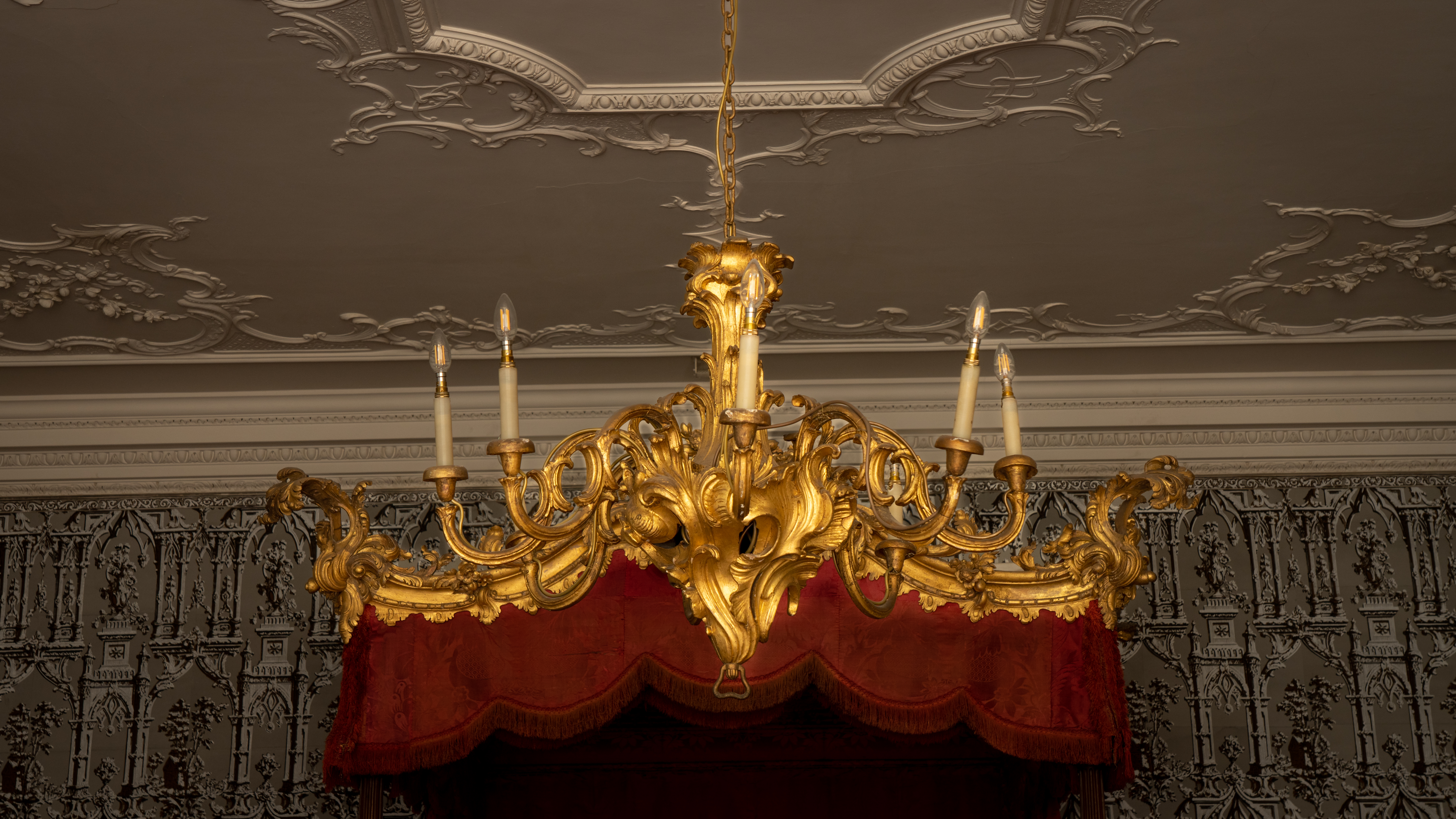
Tony served on the Council of the British Antique Dealers Association (BADA) in the 1970s, and served as Vice President of the BADA during the early 1980s. He was always interested in the developments of the Antique Dealers Research Project at the University of Leeds, and were so sorry to hear that he had passed away. We were particularly sorry that Tony will not see the launch of the Year of the Dealer project (which launches on 1st March 2026) – Charles Lumb & Sons are the subject of one of the ‘dealer trails’ films at Temple Newsam, the country house museum near Leeds. This wonderful 18th century Dutch giltwood chandelier (see below) is featured in the short film focused on Charles Lumb & Sons – (the chandelier was sold to Temple Newsam by Charles Lumb & Sons in 1950, for £159 and 10 shillings).
18th century Dutch giltwood chandelier at Temple Newsam, Leeds. Photograph, Antique Dealers Research Project, University of Leeds and Leeds Museums & Galleries.
We send our sincerest condolences to Mary and the Lumb family.
Our popular theme of Antique Shops Then & Now continues with part IV. This time we look to Scotland and one of the largest antique dealing businesses in Scotland, John Bell of Aberdeen.
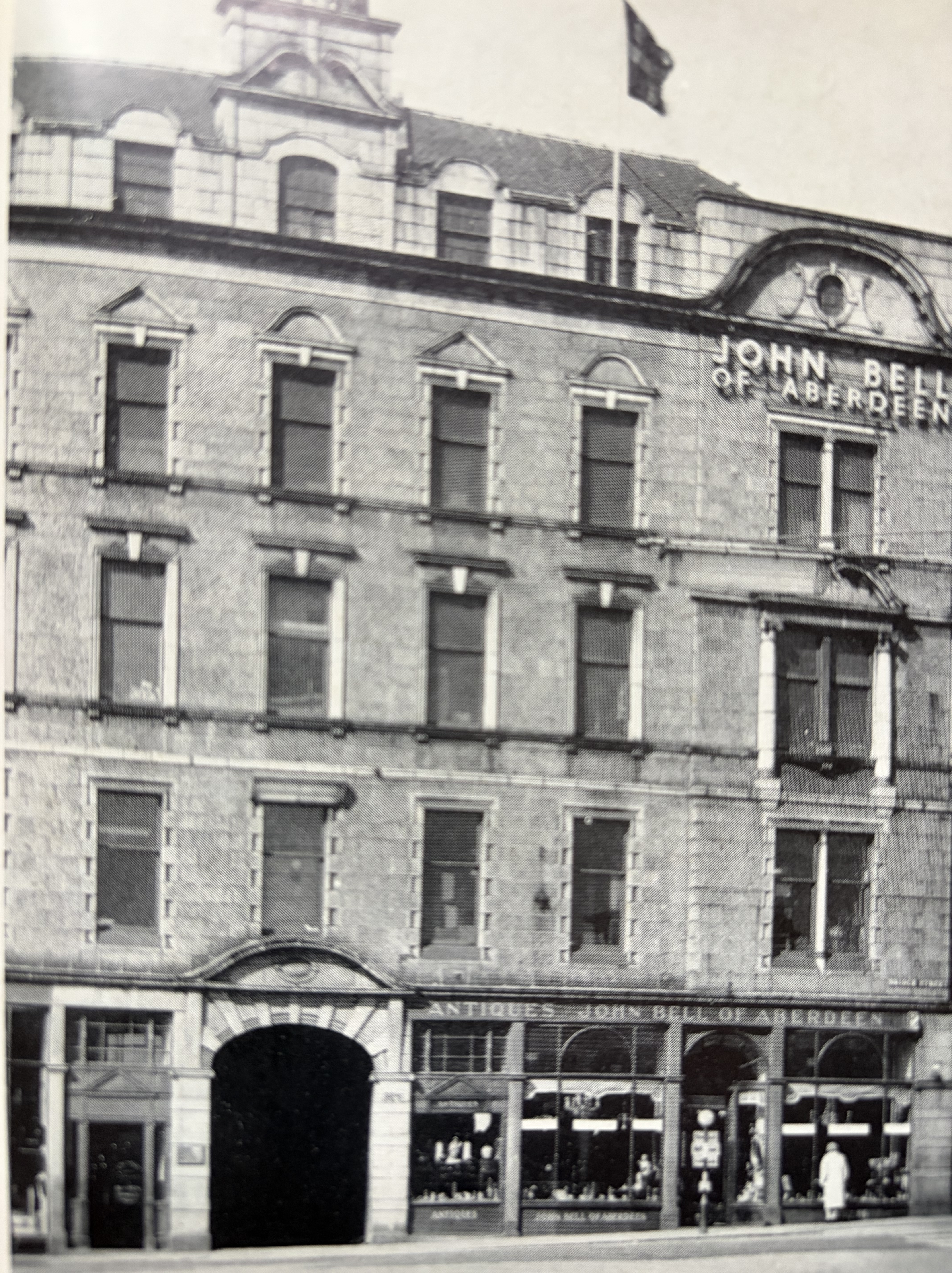
Below is John Bell’s shop at 56-58 Bridge Street, Aberdeen in the 1950s.
John Bell of Aberdeen, Bridge Street, Aberdeen, c.1957. Image Antiques Yearbook 1957/1958 (Tantivy Press). Photograph Antique Dealers Research Project, University of Leeds.
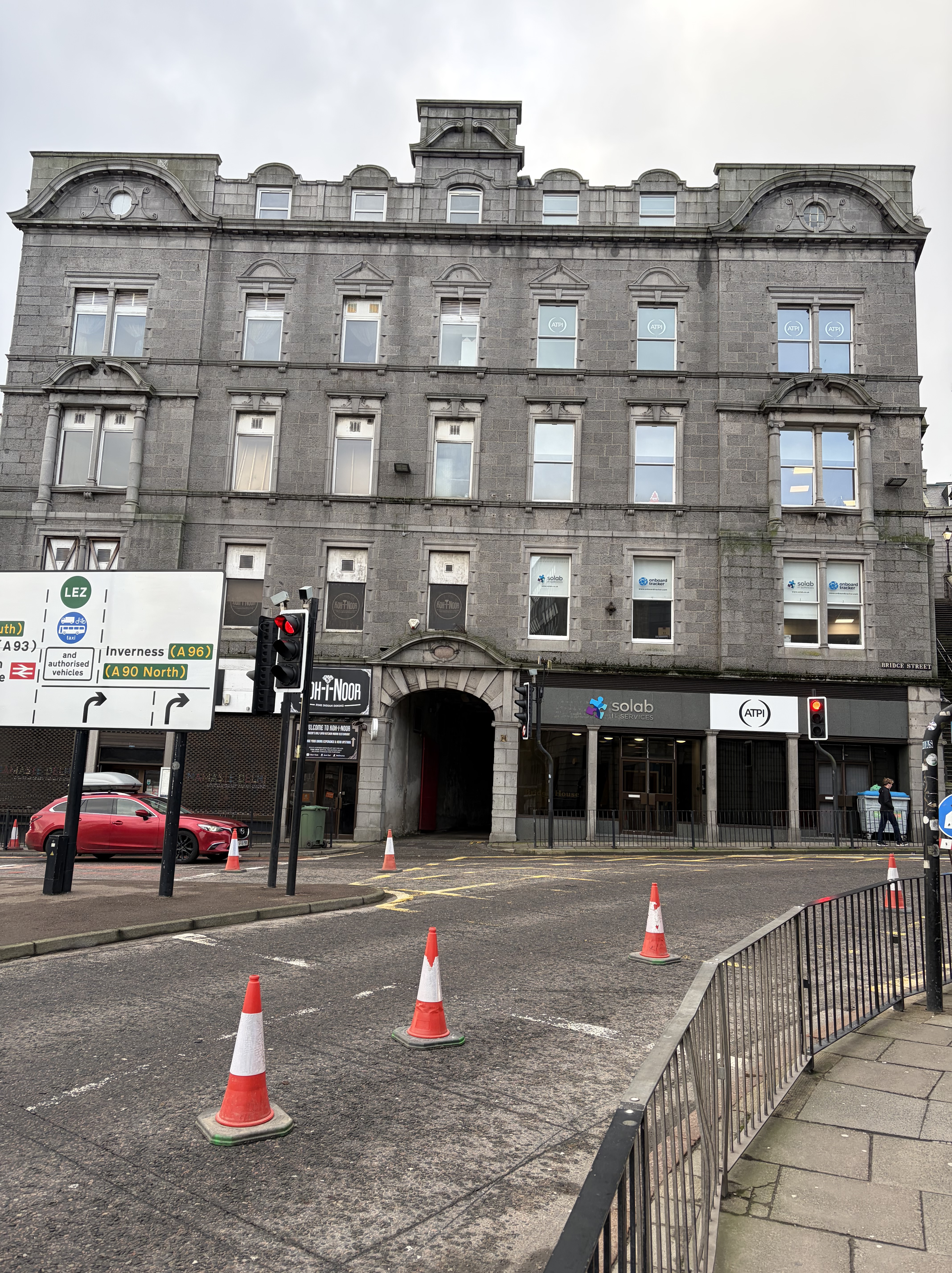
And here’s the same building in 2026; no longer an antique shop of course, but one can get a sense of the scale of the John Bell business in its heyday – it was an enormous operation, occupying half of the whole building in Bridge Street, over 4 floors.
Bridge Street, Aberdeen, former antique shop of John Bell of Aberdeen, 2026. Photograph Antique Dealers Research Project University of Leeds.
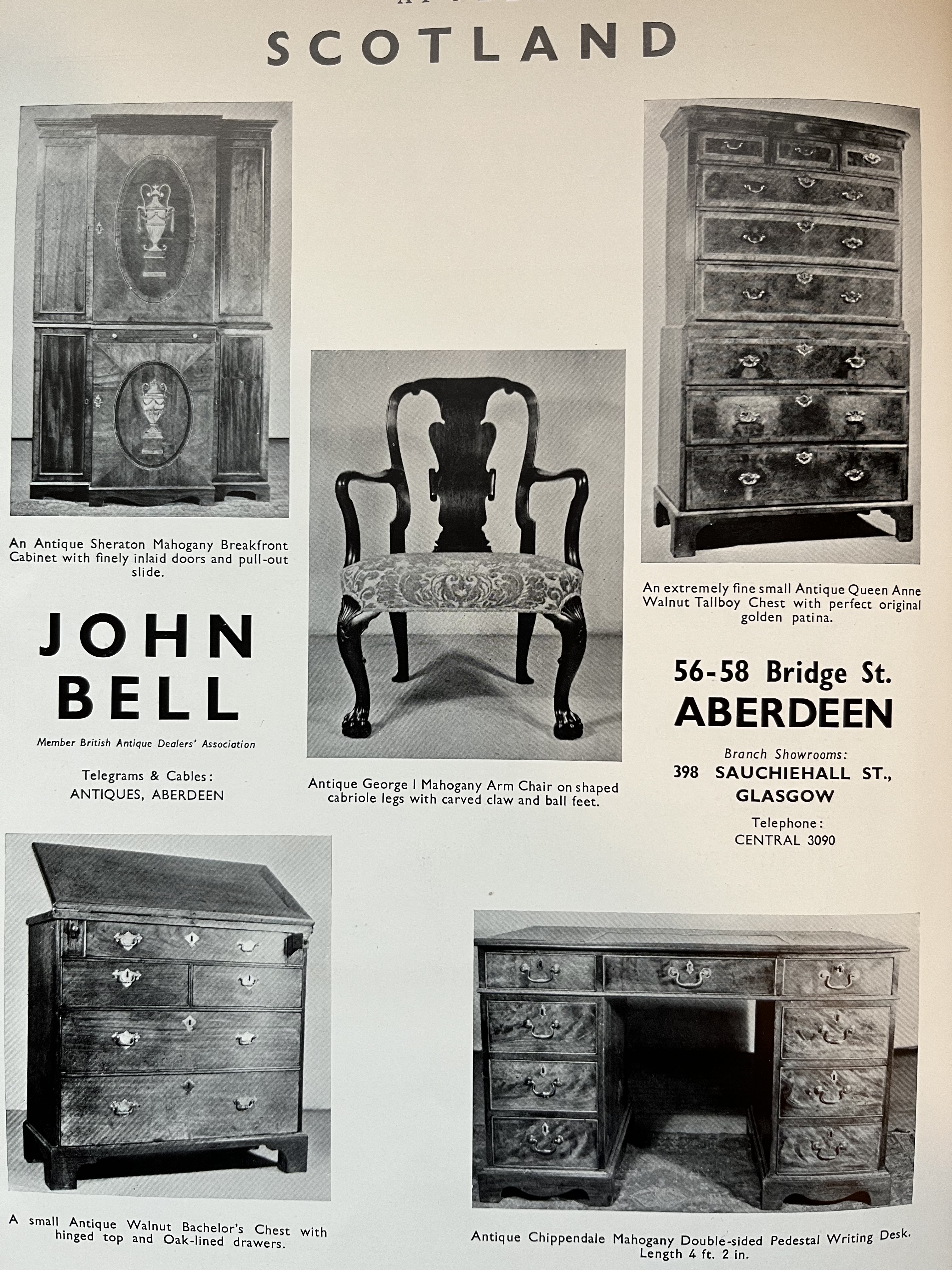
Some readers of the Blog may remember the advertisements of John Bell in various magazines; these were a constant presence from the 1920s up until the 1980s. Below is one of their adverts from 1938, when they were trading from their Bridge Street, Aberdeen shop (which they opened in the early 1930s) and at Sauchiehall Street in Glasgow. Bell had bought the famous antique dealing business of Robert Lauder in Glasgow in 1938 and their branch at 398 Sauchiehall Street was Lauder’s old shop. John Bell also opened another branch in Braemar in the 1950s, only open during the Spring and Summer, no doubt to key into the Scottish tourist trade.
Advertisement for John Bell antique dealers, Apollo magazine, July 1938. Antique Dealers Research Project, University of Leeds.
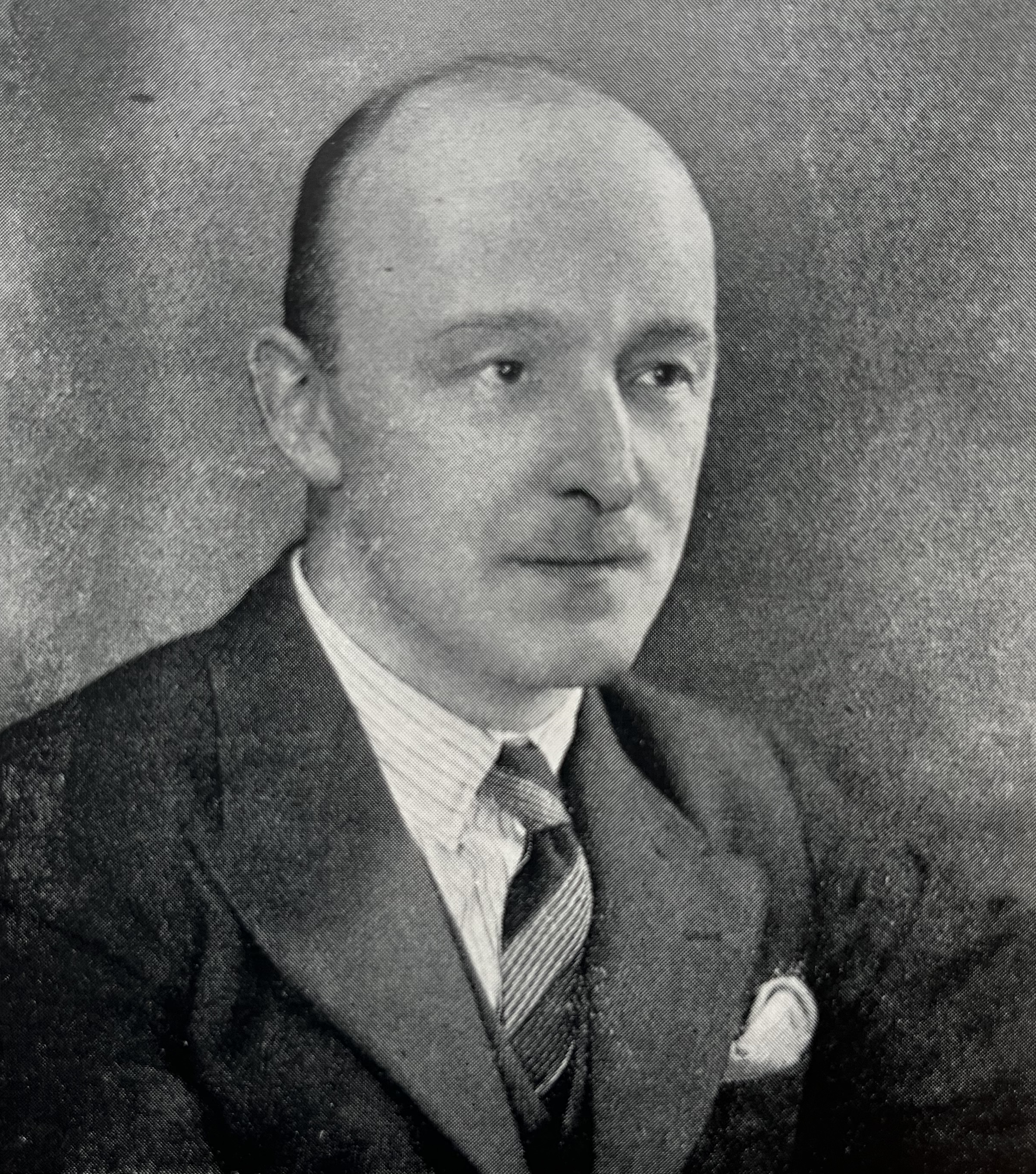
John Bell was established in 1905 and became of the most successful and important antique dealers in Britain. John Bell (1870-1914) sadly died in 1914, and the antique dealing business was continued by his son, W.S. Bell (1898-1973), who was only 16 years old at the time of his father’s death. Here’s W.S. Bell in 1936, around the time he opened the Bridge Street shop.
W.S. Bell, of John Bell of Aberdeen, 1936. Photograph Antique Dealers Research Project, University of Leeds.
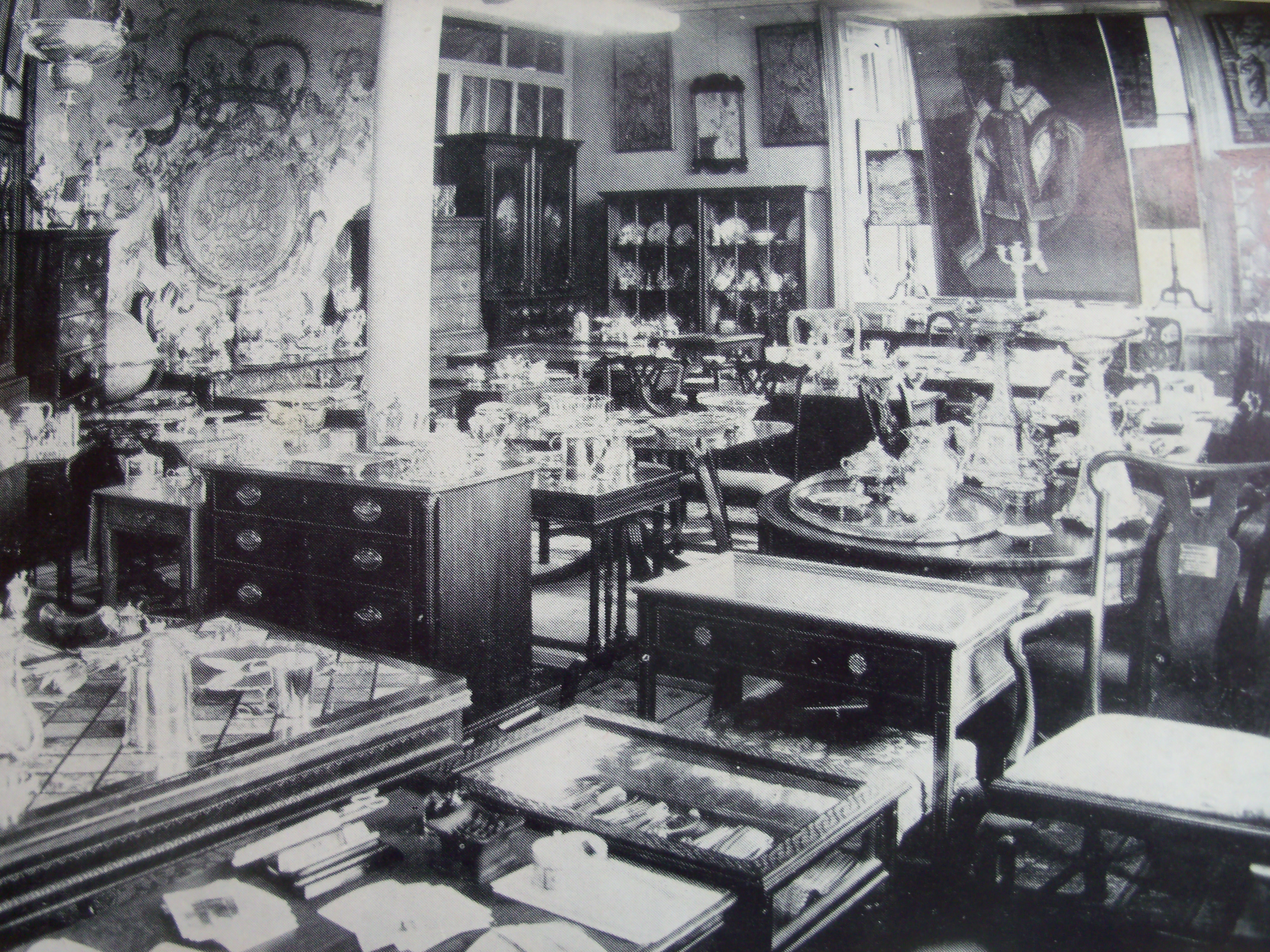
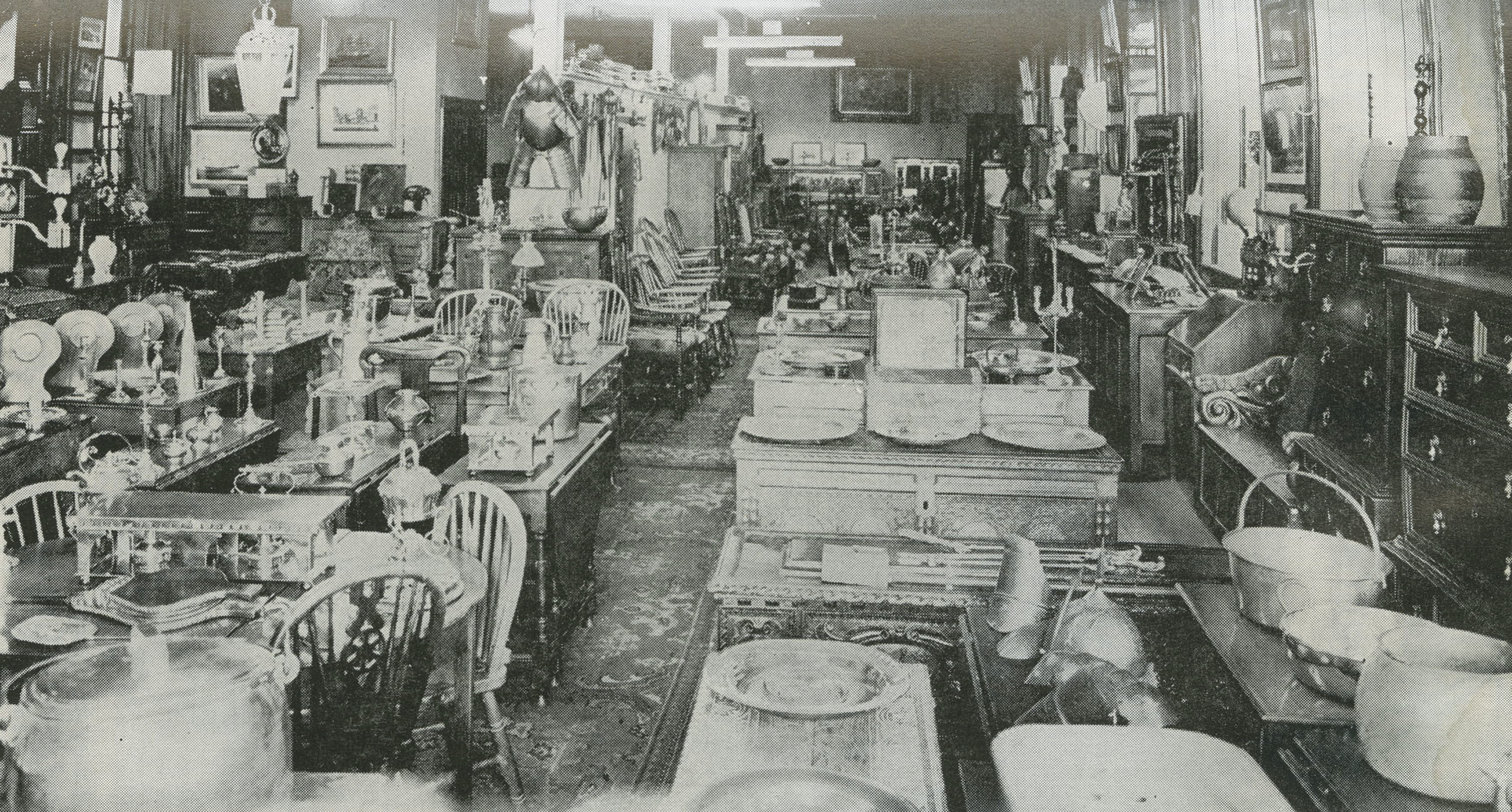
William S. Bell expanded the business, creating one of the largest retail, wholesale and export antique dealers in the UK. They also built an extensive export trade with American dealers and collectors, sending vast quantities of antiques to the USA; as well as to the expanding markets for British antiques in Australia and South Africa. Here’s one of the showrooms in John Bell’s shop in Bridge Street in about 1957 (see below).
John Bell of Aberdeen, Bridge Street, Aberdeen, c.1957. Image Antiques Yearbook 1957/1958 (Tantivy Press). Photograph Antique Dealers Research Project, University of Leeds.
Bell’s shop is packed a range of antiques that would have been attractive to middle class antique collectors and furnishers in the 1950s – 18th century furniture dominated, but as you can see also on display is extensive amounts of antique sliver, as well as antique ceramics and some paintings and tapestries.
One gets a sense of the sheer scale of John Bell’s business in this other image of another showroom in the Bridge Street antique shop (also from the 1950s) – (see below). This showroom looks much more aimed at the wholesale and export markets, with antiques stacked in rows; there’s also earlier antique furniture for sale (mostly 17th and 18th century oak) as well as a much wider range of collectables, suitable for export.
John Bell of Aberdeen, Bridge Street, Aberdeen, c.1958. Image Antiques Yearbook 1957/1958 (Tantivy Press). Photograph Antique Dealers Research Project, University of Leeds.
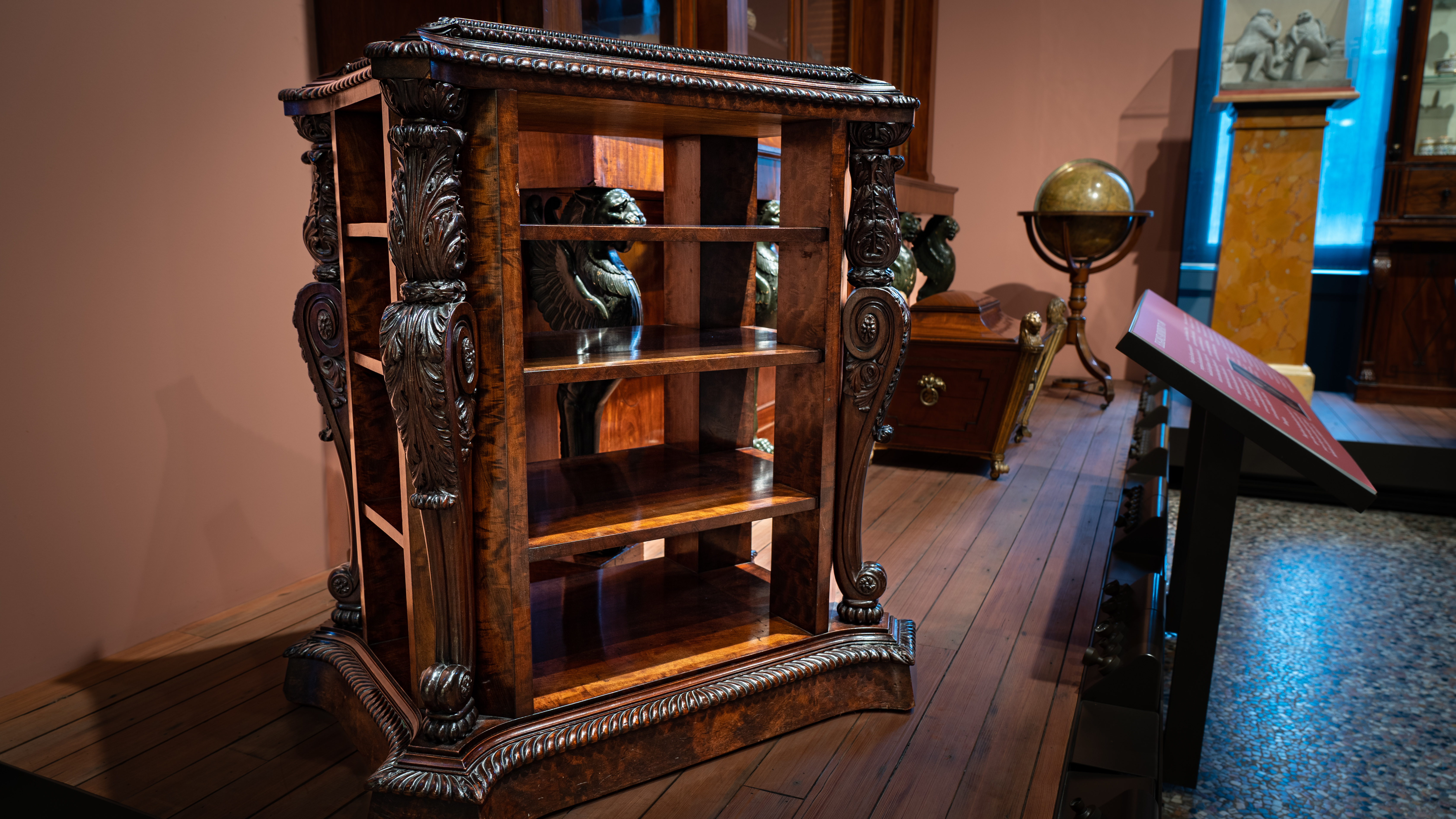
John Bell of Aberdeen are the subject of one of the little films in our Project – ‘Sold! The Year of the Dealer’, and we are very excited to announce that the YoD is finally being launched to the public on 1st April 2026. The John Bell antique in the Year of the Dealer films is in the suite of 10 films at The Bowes Museum in Barnard Castle – it’s an early 19th century bookcase, which was sold to The Bowes Museum by John Bell of Aberdeen in 1962 (so about the time of the photographs of John Bell’s shop) for £195. Here’s the bookcase (see below).
Early 19th century bookcase, sold to The Bowes Museum in 1962 by John Bell of Aberdeen. Photograph, Antique Dealers Research Project & The Bowes Museum.
The YoD films will soon be available to view – in fact we’re going to do a series of posts on the research blog about the YoD project in the coming weeks – so do keep your eye on the Blog!
A couple of months ago my friend and colleague Diana Davis very kindly sent me a link to a short black & white film of the 1932 Art Treasures Exhibition (thank you Diana!), and which obviously pricked my interest as it is full of objects that were being sold by antique dealers. You can watch the film in YouTube (it’s only 2 minutes 49 seconds long) HERE – the original film is part of the wide range of historic films and TV archives held by British Pathe (link HERE).
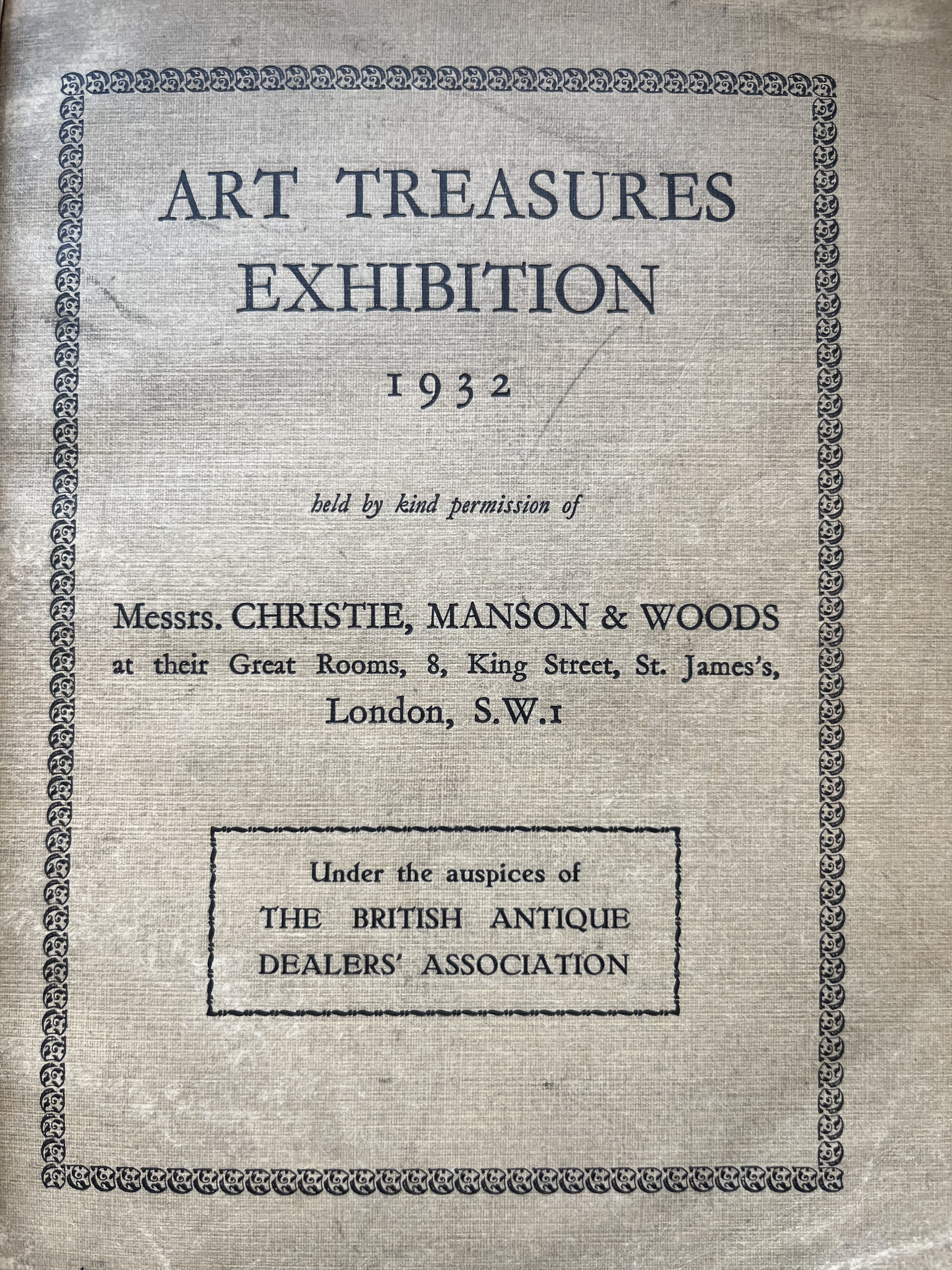
Art Treasures Exhibition 1932 catalogue, front cover. Photo Antique Dealers Research Project, University of Leeds.
The Art Treasures Exhibition, held at Christie’s auction rooms, King Street, London, 12th October to 5th November 1932 and organised by The British Antique Dealer’s Association (BADA) is fairly well-known amongst historians and those interested in the history of the art market. The 1932 exhibition followed on the success of the earlier BADA organised exhibition at Grafton Galleries, London in 1928. Both exhibitions prefigured the establishment of the Grosvenor House Antiques Fair (also known as ‘The Antique Dealers’ Fair’) which began in 1934 – (see also some older blog posts on The Grosvenor House Fair etc in January 31st 2021 and April 23rd 2015).
Fortunately, we have a copy of the 1932 Exhibition catalogue, so it’s possible to match up some of the objects in the film to those in the catalogue and find out which dealers are behind the objects, so I thought it would be an interesting exercise to do that!
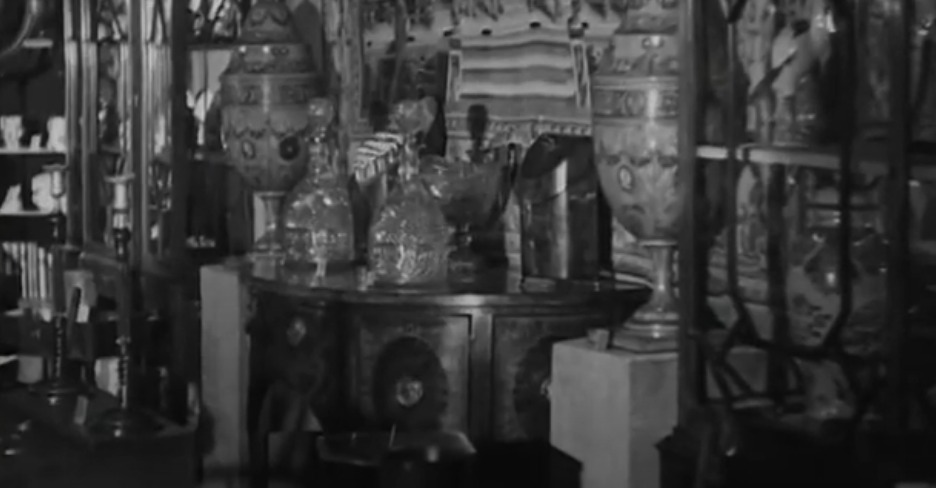
The film of the 1932 Exhibition is a fascinating period piece from the early 1930s, obviously created as a publicity newsreel for the exhibition. The narrator (unknown), guides the viewer to some of the highlights of the exhibition at the time, telling the background stories of some of the objects offered for sale by various antique dealers, but also offering a visual insight into the displays at the exhibition. Below, for example, is a screenshot of a general panning shot (do watch the YouTube film for effect) of one of the stands which appears to have a mixture of dealers’ objects – the large pair of urns are certainly item No.237 in the catalogue, ‘A pair of satinwood knife boxes, c.1790, originally made for Lord Northesk’ (the family seat is Ethie Castle, near Arbroath) and offered by the antique dealer Rice & Christy, Wigmore Street, London; the tapestry behind looks like it is No.285 ‘A Beauvais Tapestry, c.1790’, offered by The Spanish Art Gallery, Conduit Street, London; and the display cabinet to the left is certainly No.182 ‘A Chippendale China Cabinet, c.1765′ offered by M. Harris & Sons. So I guess this panning shot was of a collection of various dealers’ objects at the entrance to the exhibition, indicating the sheer range of things offered for sale?
Art Treasures Exhibition 1932, screenshot of general view.
The Exhibition had 1,380 objects, and the film obviously does not cover all of them, but there are 13objects highlighted in the film, so for those that watch the film, here’s some information on the dealers who were behind the objects (and a little bit of information on where the objects are now, if it has been possible to trace them) – I’ll do this in the sequence of the objects highlighted in the film by the narrator:
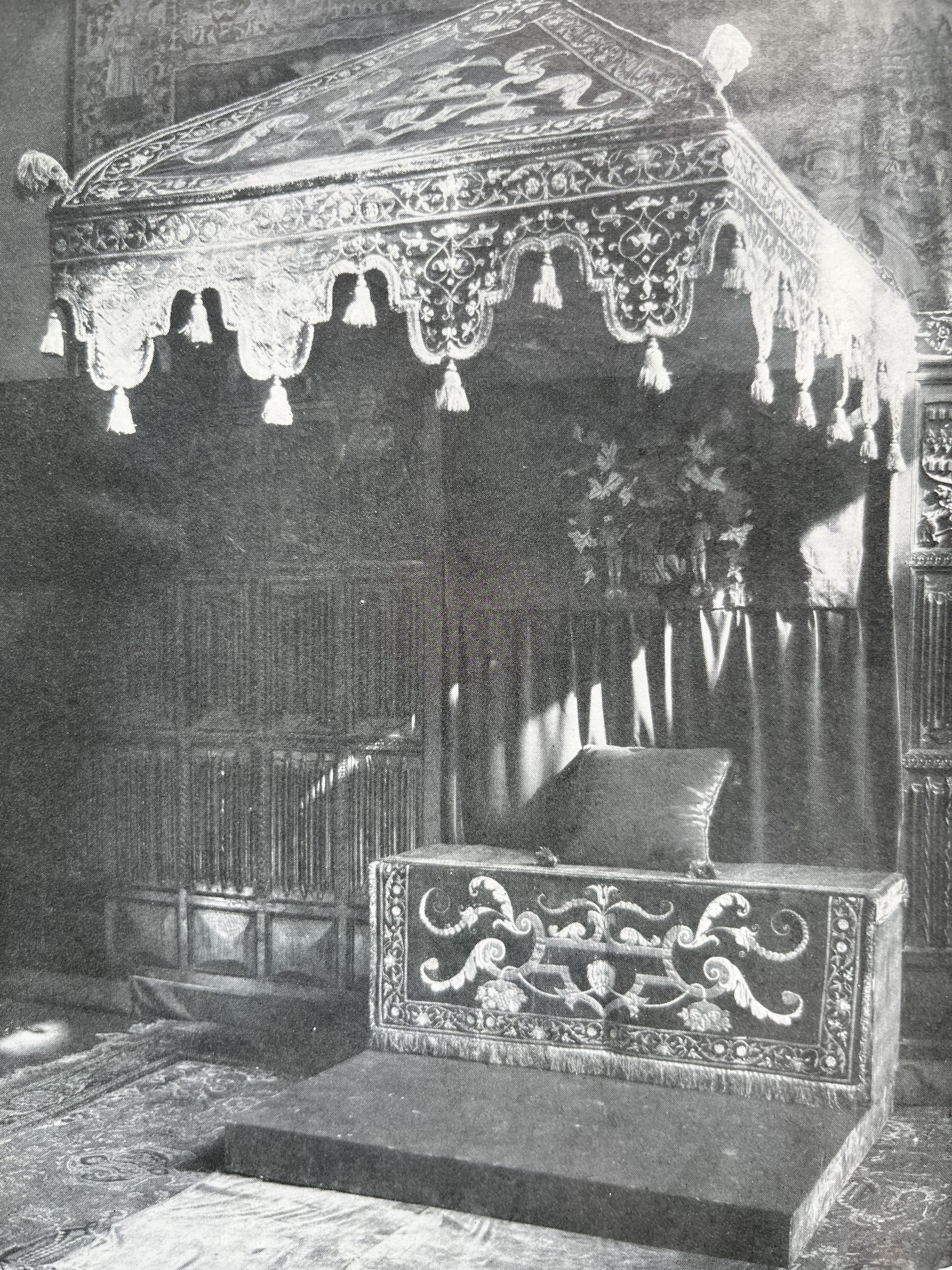
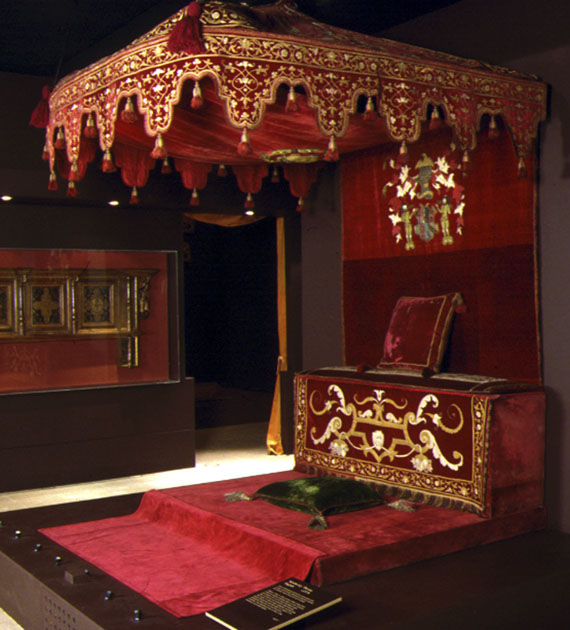
1st object – (see below) in the film the narrator spends a few moments on this object; it is also object No.1 in the catalogue: ‘An embroidered Throne used Queen Elizabeth, English 1578’; this was offered by the well-known London antique dealers Acton Surgey Ltd & Mallett & Son. Thanks to our friends William DeGregorio and Chris Jussel (in the USA) we know that the embroidered throne made its way into the collection of Sir William Burrell (1861-1958) and remains in the Burrell Collection in Glasgow (it is currently in storage at The Burrell – see below).
Art Treasures Exhibition catalogue 1932 – ‘An embroidered Throne used by Queen Elizabeth, English 1578’. Photograph, Antique Dealers Research Project, University of Leeds.The ‘Kimberley Throne’, c.1554-1578, (14.217). The Burrell Collection, Glasgow. Photograph, The Burrell Collection, Glasgow.
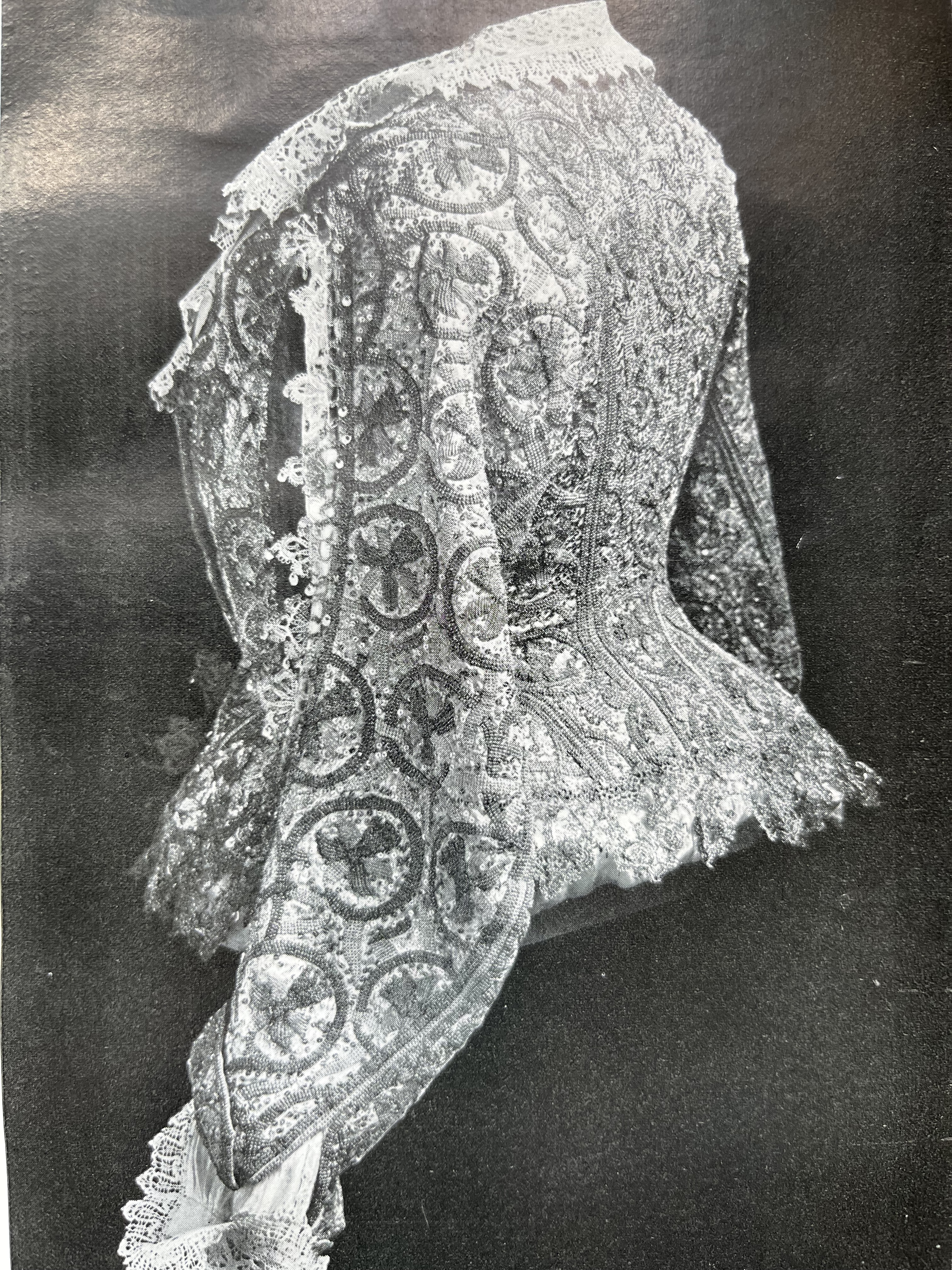
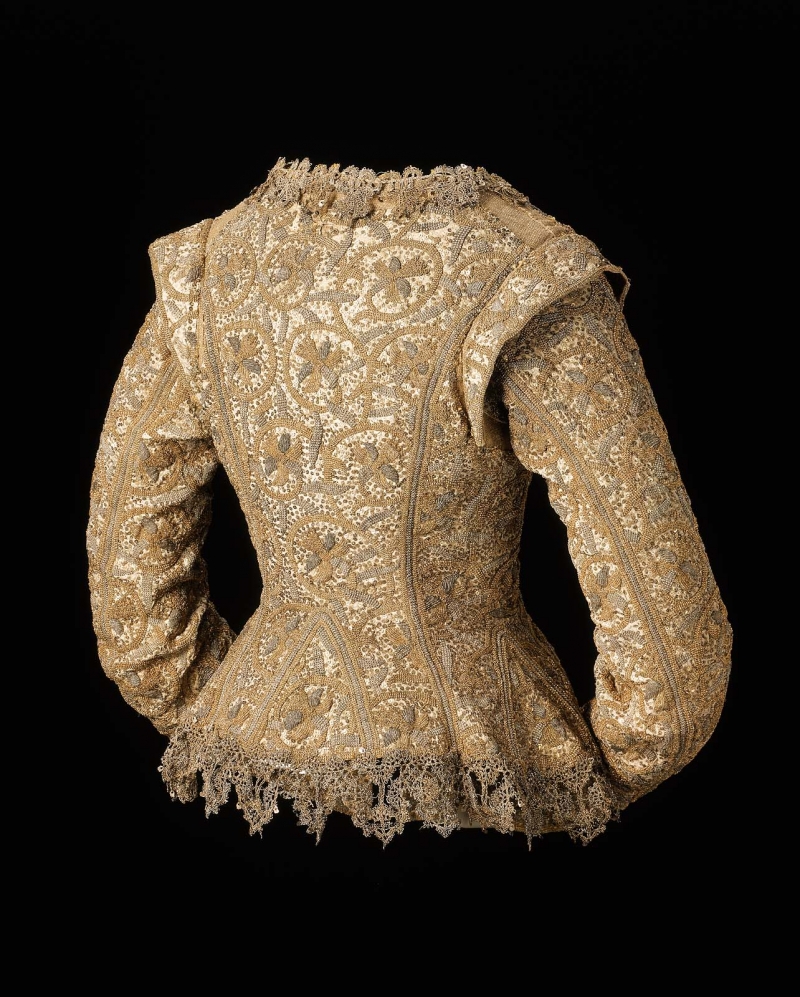
2nd object – (see below) mentioned by the narrator is No.2 in the exhibition catalogue, ‘A gold embroidered jacket, lace shirt, and gloves, English, late 16th century’; it was also offered by Acton Surgey Ltd; the jacket is now in the collections of Boston Museum of Fine Arts in the USA. It was purchased from Acton Surgey by the collector Elizabeth Day McCormick (1873-1957) in 1943 and gifted to the Boston MFA. It is not known what happened to the shirt or the gloves; and it has not also been possible to identify the ‘gold and enamelled jewel set with diamonds and rubies’ that the Narrator also mentions.
Art Treasures Exhibition catalogue 1932 – ‘A gold embroidered jacket, English, late 16th century’. Photograph, Antique Dealers Research Project, University of Leeds.‘Women’s Jacket, English about 1610-15 with later alterations’. The Elizabeth Day McCormick Collection, Boston Museum of Fine Arts. 43.243. Image copyright Boston MFA.
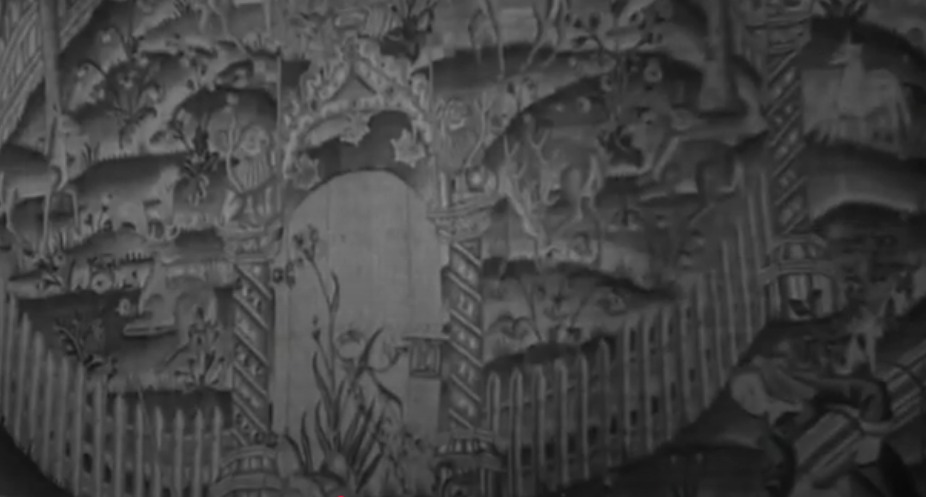
3rd object – (see below) the narrator describes a ‘Gothic tapestry, over 400 years old’, this is either No.270 or No.271 in the catalogue. Neither are illustrated in the catalogue, but are both described in the catalogue as ‘A panel of Gothic tapestry, Franco-Flemish, circa 1500’ and both are offered by The Spanish Art Gallery Ltd, Conduit Street, London. It has not been possible to trace the present whereabouts of the tapestry.
Art Treasures Exhibition 1932 film, screenshot of ‘Gothic tapestry’.
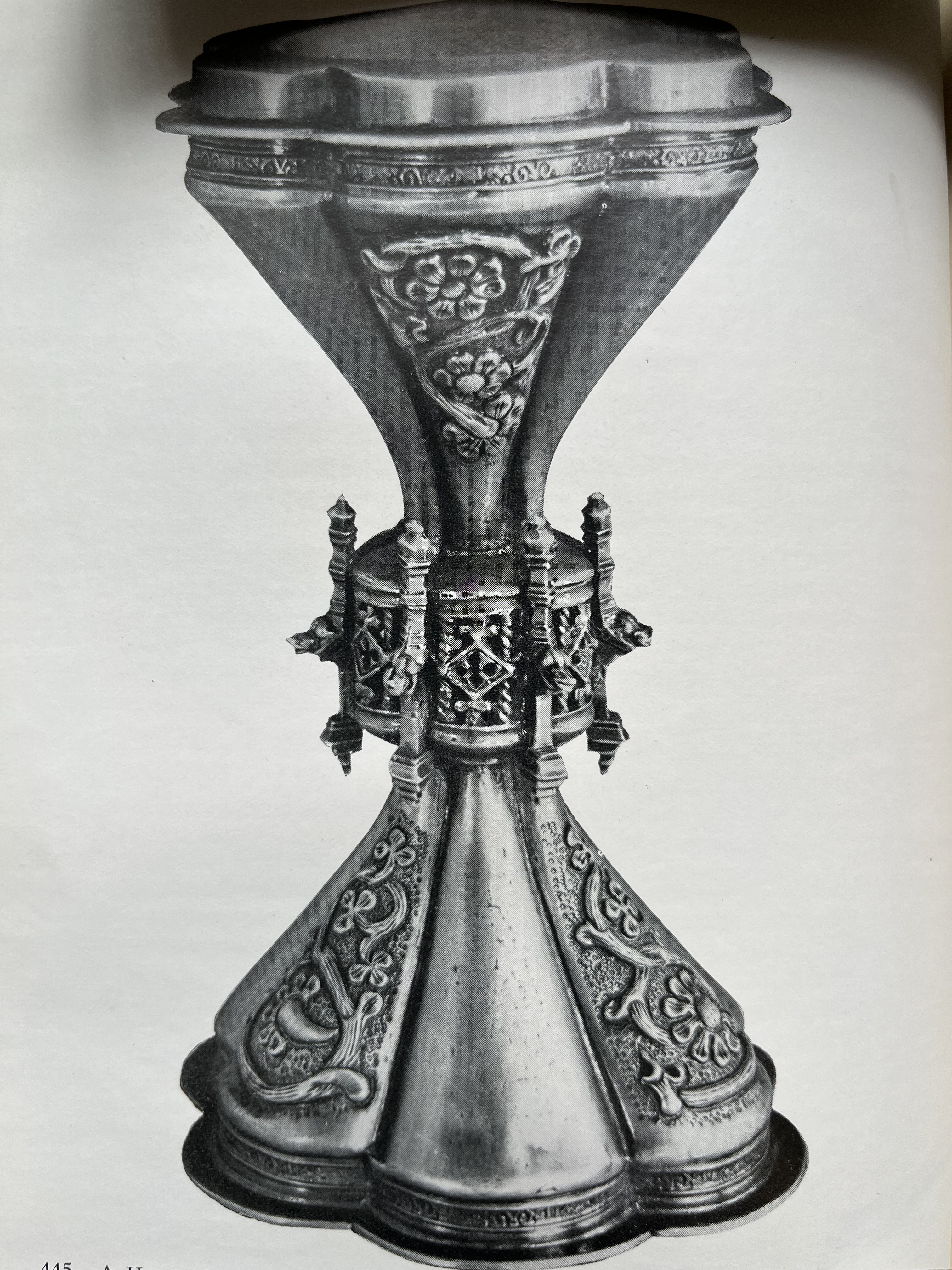
4th object – (see below) this is described by the narrator in the film as ‘a fine specimen of a Henry VII salt-cellar in hour-glass form’. This is No.445 in the catalogue; ‘A Henry VII silver-gilt standing salt, London 1505’. It is also illustrated in the catalogue, and was offered by the antique silver dealers Crichton Brothers, then trading at 22 Old Bond Street, London. It has not been possible to trace the Henry VII salt – the narrator in the film suggested that it was the only known piece of silver with the date 1505, so I guess if it does still exist, it must be easily identifiable? (our friend Chris Coles spotted the salt in a 1969 exhibition catalogue produced by The Goldsmiths Company….so perhaps the salt is in the collections of The Goldsmiths – thanks Chris!)
Art Treasures Exhibition catalogue 1932 – ‘A Henry VII silver-gilt standing salt, London 1505’. Photograph, Antique Dealers Research Project, University of Leeds.
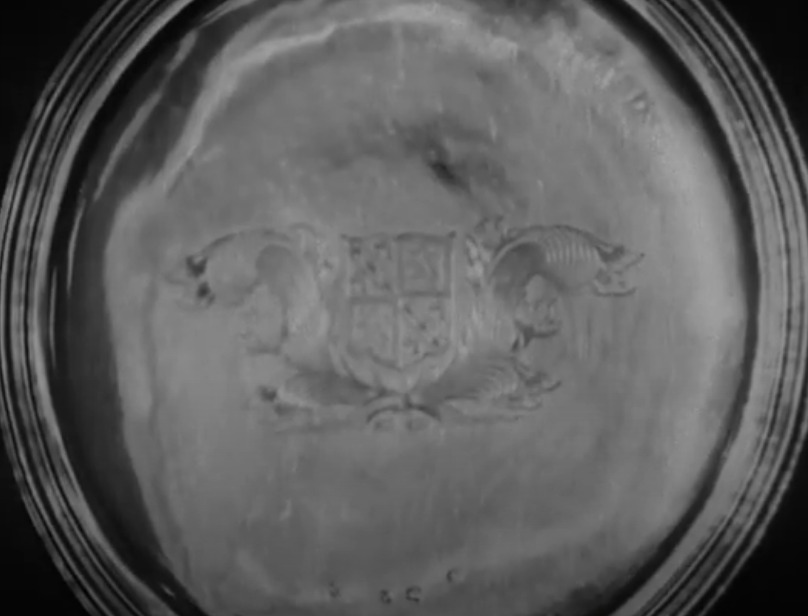
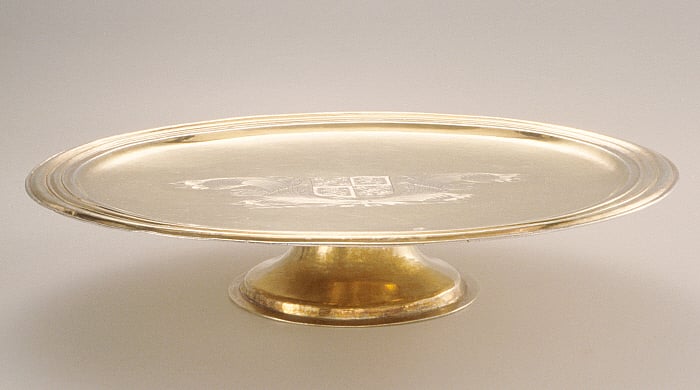
5th object – (see below) the narrator describes a ‘stand for a porringer or tankard….previously owned by the diarist Samuel Pepys’. This is No.618 in the catalogue – ‘The Charles II silver-gilt ‘Pepys’ tazza, London 1678′. It is not illustrated in the catalogue, but was also offered by the antique silver dealer Crichton Brothers. The ‘tazza’ is now in the collections of The Clark Institute in Massachusetts in the USA. It was commissioned by Samuel Pepys (1633-1703) in 1678 and was sold at Sotheby’s on 1st April 1931 (Lot 3) to Crichton Brothers, who appear to have sold it to the American silversmith and art curator Peter Guille of New York, who sold it to Robert Sterling Clark in 1946.
Art Treasures Exhibition 1932 film, screenshot of ‘Pepys’ ‘tazza”.Footed Salver, silver-gilt, 1678/79. Clark Institute, 1955.298. Image copyright Clark Institute.
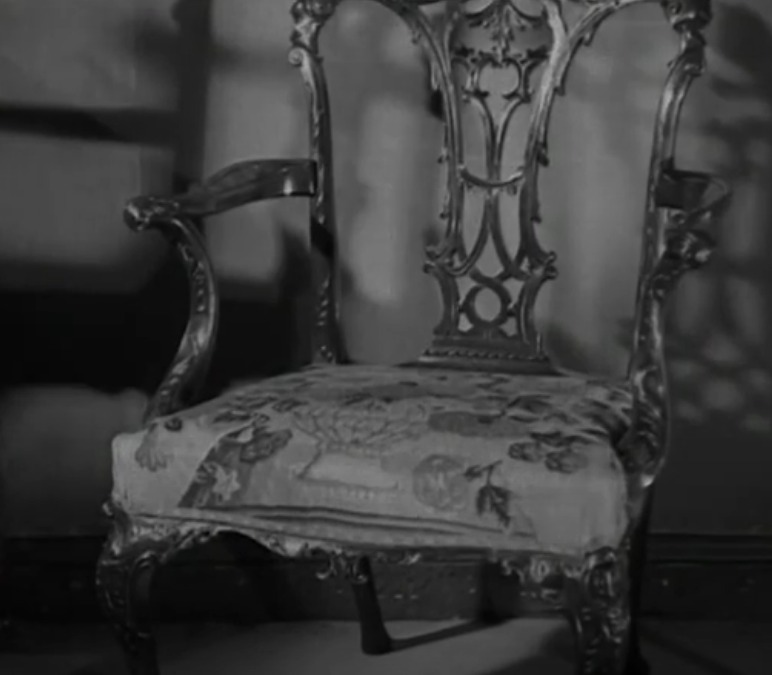
6th object – (see below) described by the narrator as a ‘Chippendale chair’, but I can’t find this chair (or even a set of them) listed in the exhibition catalogue; perhaps it was a late edition to the exhibition?
Art Treasures Exhibition 1932 film, screenshot of ‘Chippendale chair’.
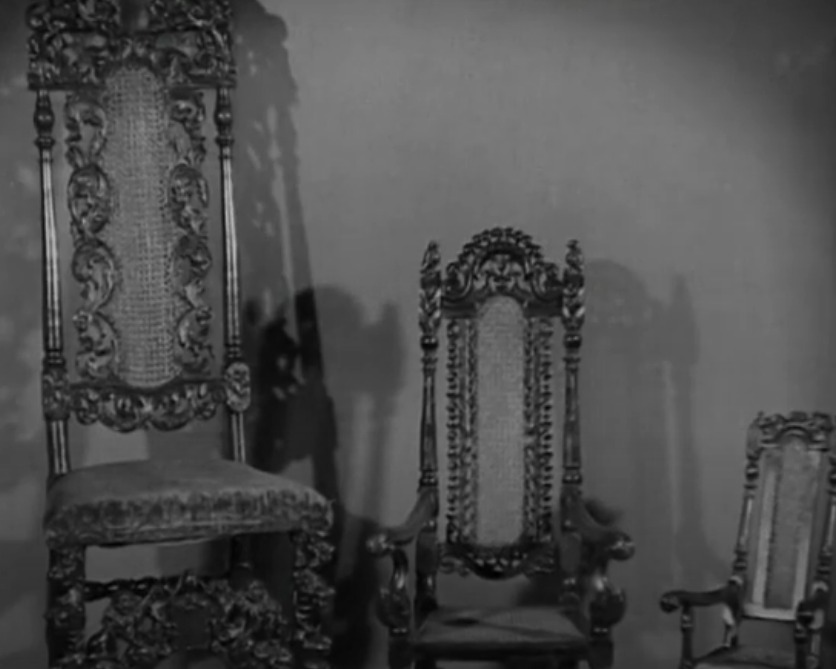
7th object – (see below) the narrator describes 3 walnut chairs, ‘made about 1690’. There are a number of such chairs in the exhibition catalogue, but without a photograph of them from the catalogue it has not been possible to identify which of the chairs the narrator is referring too? However, the centre chair, could be No.50 in the catalogue, ‘A William and Mary armchair of small size, circa 1690’, and said to have ‘traditionally been used by Queen Anne’; it was offered for sale by the well-known dealers Moss Harris & Sons.
Art Treasures Exhibition 1932 film, screenshot of ‘Walnut chairs’.
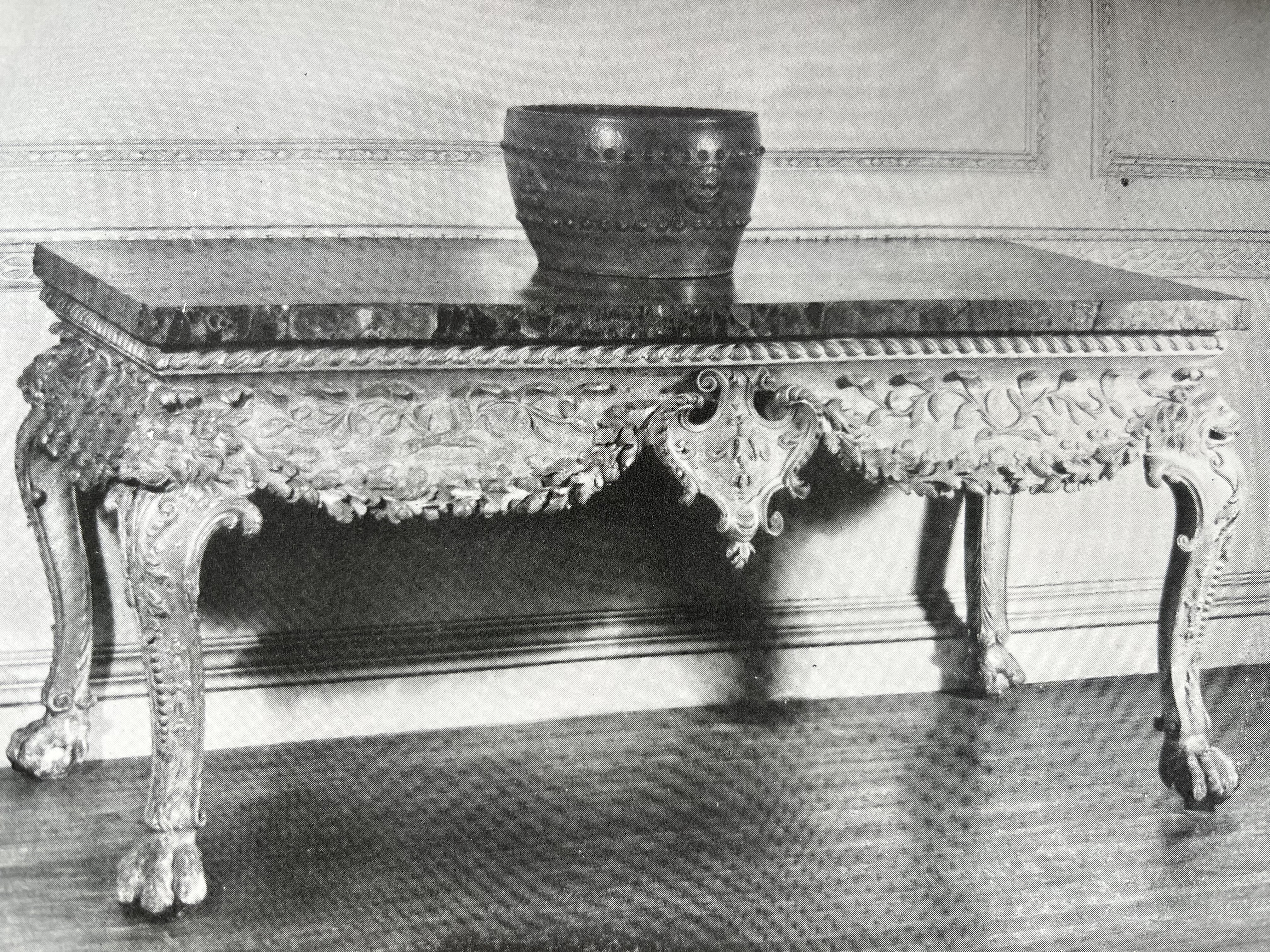
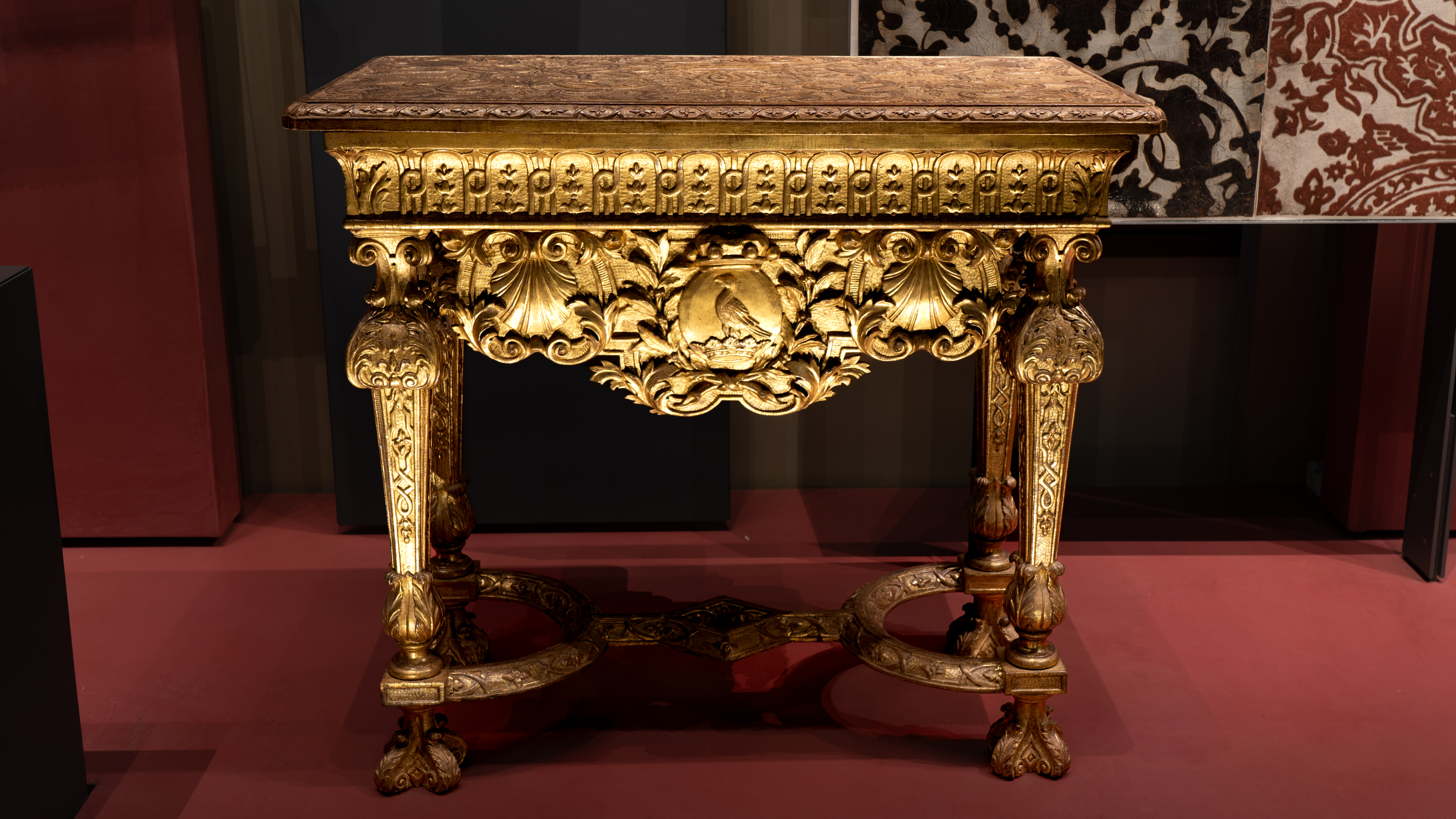
8th object – (see below) is described by the narrator as ‘a fine gesso table, formerly at Stowe’, is certainly No.121 in the Exhibition catalogue; it is illustrated and described as ‘A George II gilt side table…formerly at Stowe’ and was offered for sale by the antique dealer and interior decorator Gregory & Co., then trading at 27 Bruton Street, London. The table was originally sold at the auction sale of the contents of Stowe House in 1848, following the bankruptcy of the Duke of Buckingham.
Art Treasures Exhibition catalogue 1932 – ‘A George II gilt side table’. Photograph, Antique Dealers Research Project, University of Leeds.
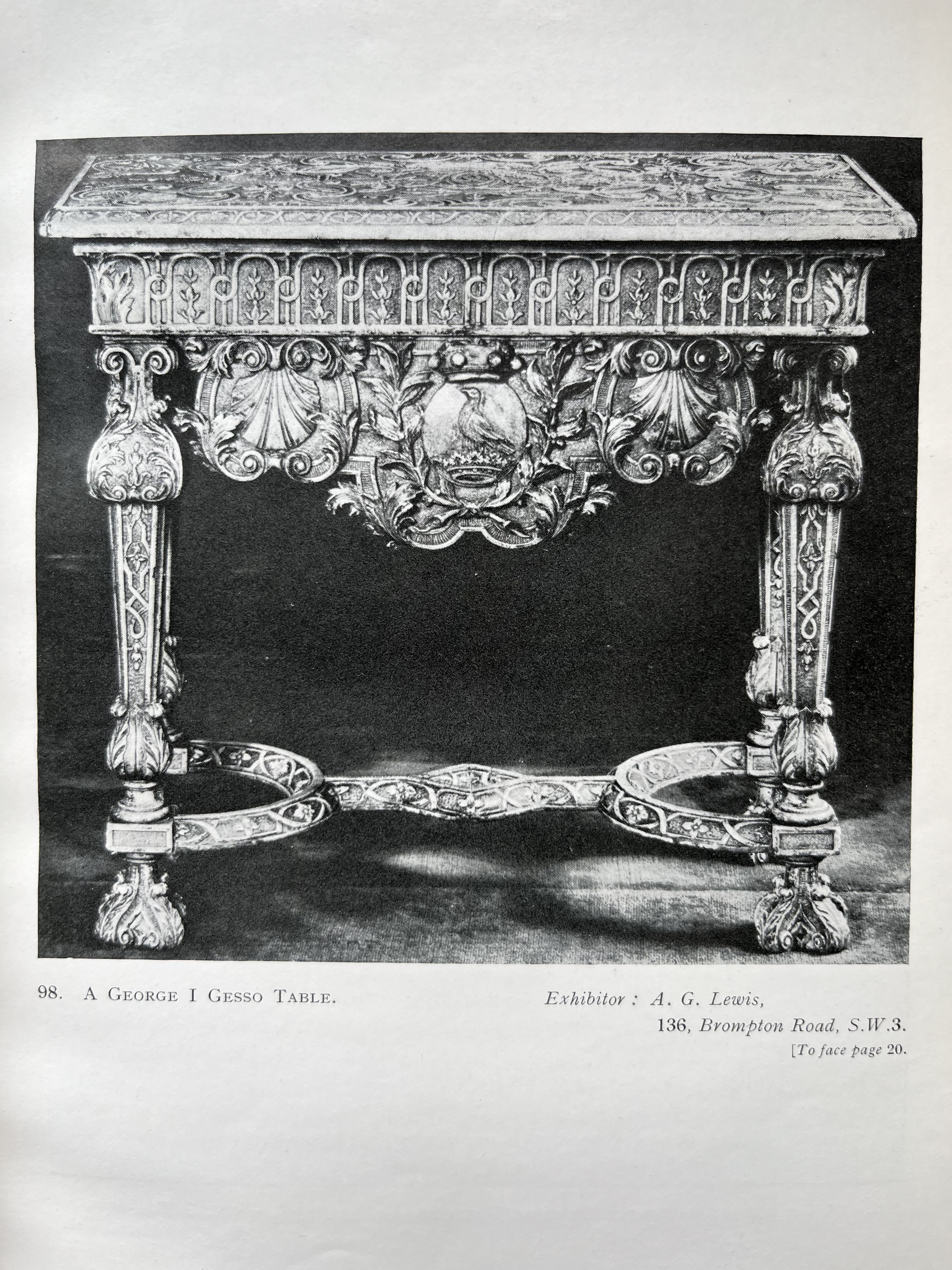
It has not been possible to trace the whereabouts of the side table, but interestingly, another giltwood side table from Stowe was on display at the 1932 Exhibition; No.98, ‘A George I gilt gesso table, circa 1715’, and offered for sale by the antique dealer A.G. Lewis, Brompton Road, London. This table (see below) is one of a pair (possibly three?) side tables associated with Stowe. In 1930, one table, (perhaps the same one in the 1932 exhibition?) was in the stock of the antique dealer Kent Galleries, Conduit Street (Kent Gallery are associated with The Spanish Gallery who offered the ‘Gothic tapestry’ at the 1932 Exhibition). One of the tables (perhaps the same one?) is now in the V&A Museum (see below too). The V&A table was sold to the V&A by the antique dealer Phillips of Hitchin in 1947, having been through the hands of a number of other antique dealers, including John Bly of Tring and Edinborough of Stamford. All of this highlights the significance of inter-dealer trading that sustained the antique trade for much of the 20th century.
Art Treasures Exhibition catalogue 1932 – ‘A George I gilt gesso table’. Photograph, Antique Dealers Research Project, University of Leeds.The Stowe side table at the V&A Museum. Photograph, Year of the Dealer project, University of Leeds.
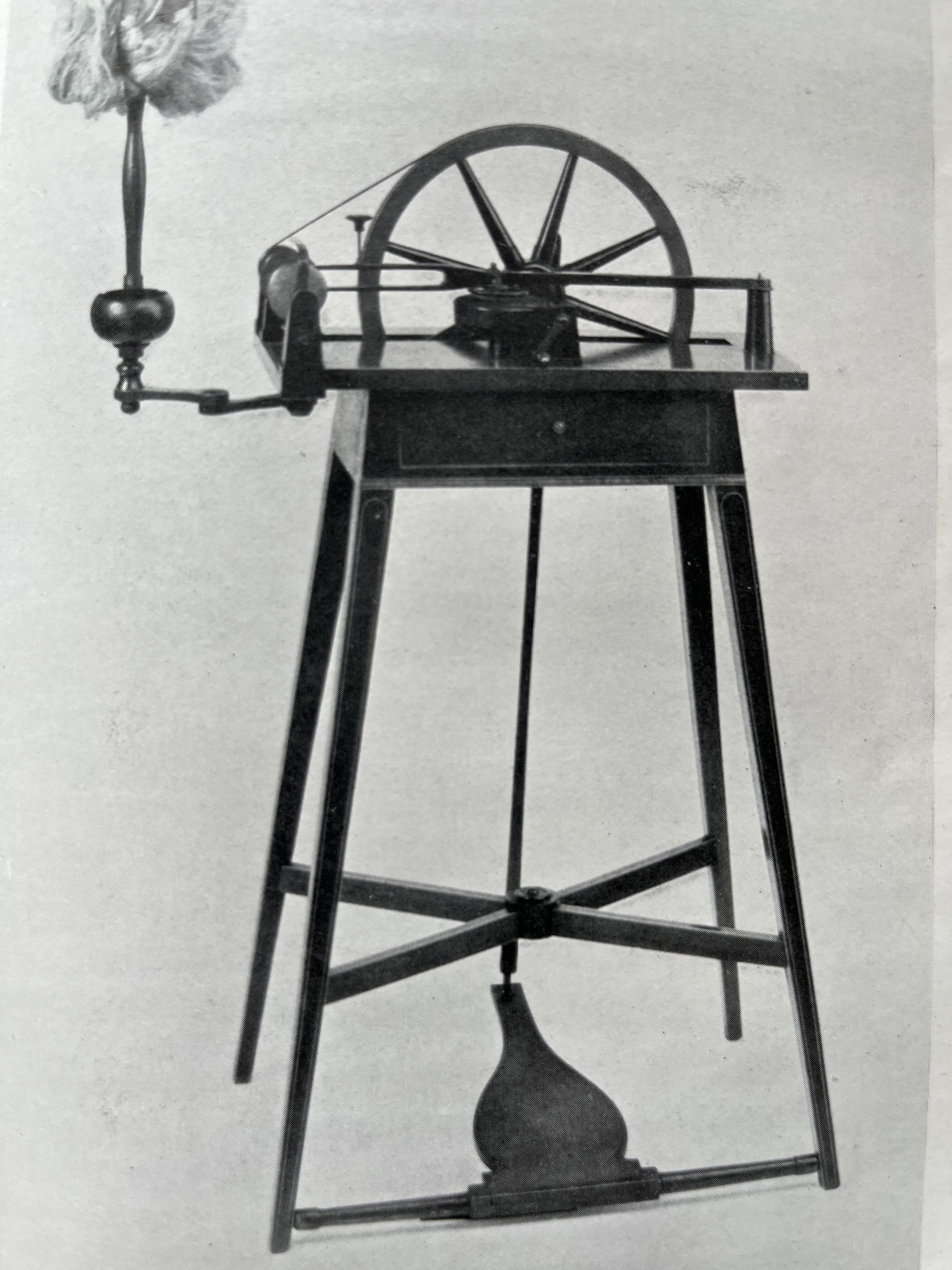
9th object – (see below) the narrator describes a ‘spinning wheel, perfectly usable today’ as the next object. It is a ‘Sheraton spinning wheel, circa 1790….made by John Planta, Fulneck’; it was No.231 in the catalogue and was illustrated and offered for sale by the antique dealer Law, Foulsham & Cole, South Molton Street, London. There are several such spinning wheels by Planta, who was based in Leeds in the late 18th century – one example (although not the one in the 1932 Exhibition), remains in the collections at Temple Newsam, near Leeds.
Art Treasures Exhibition catalogue 1932 – ‘A Sheraton spinning wheel, circa 1790’. Photograph, Antique Dealers Research Project, University of Leeds.
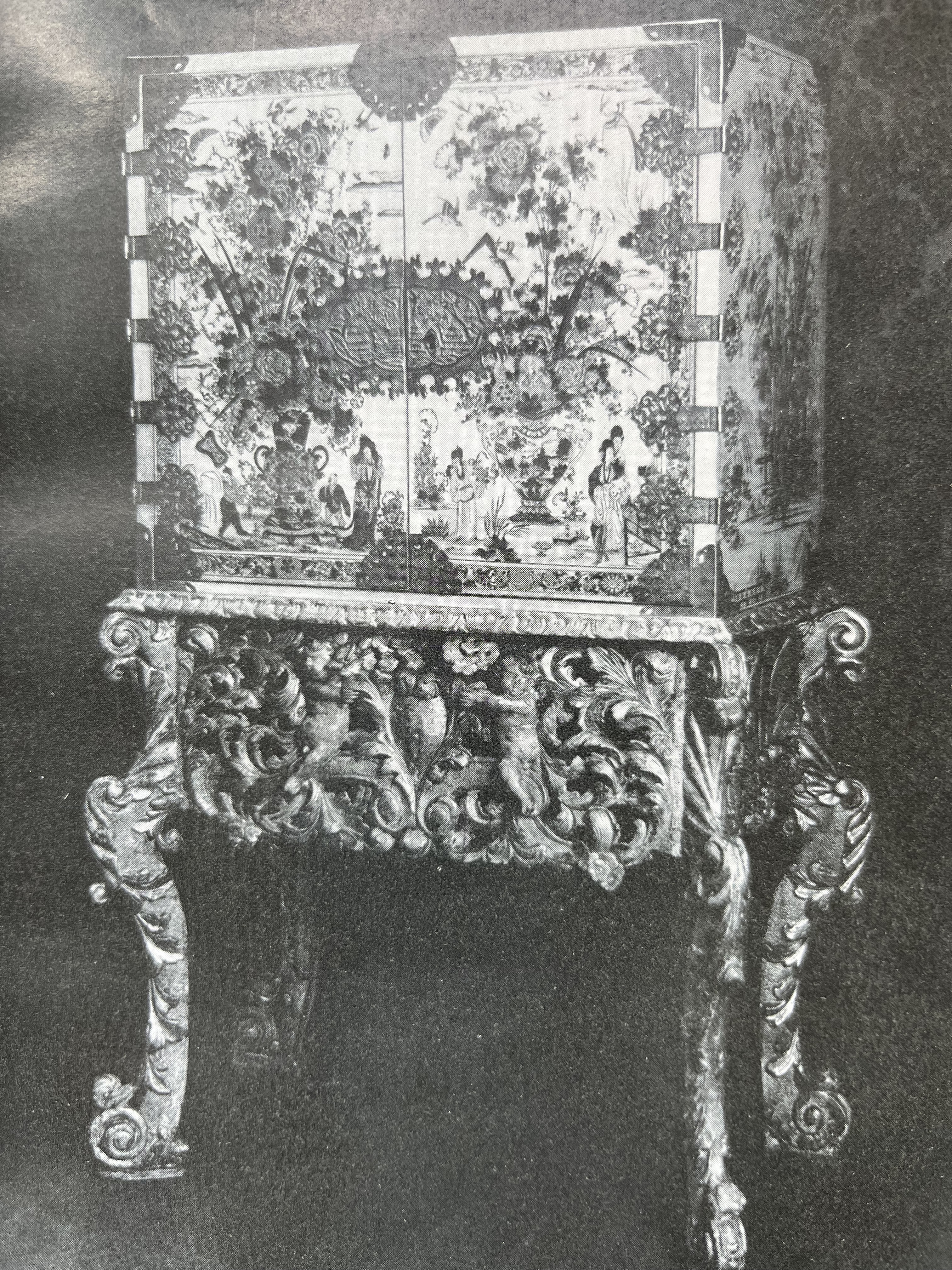
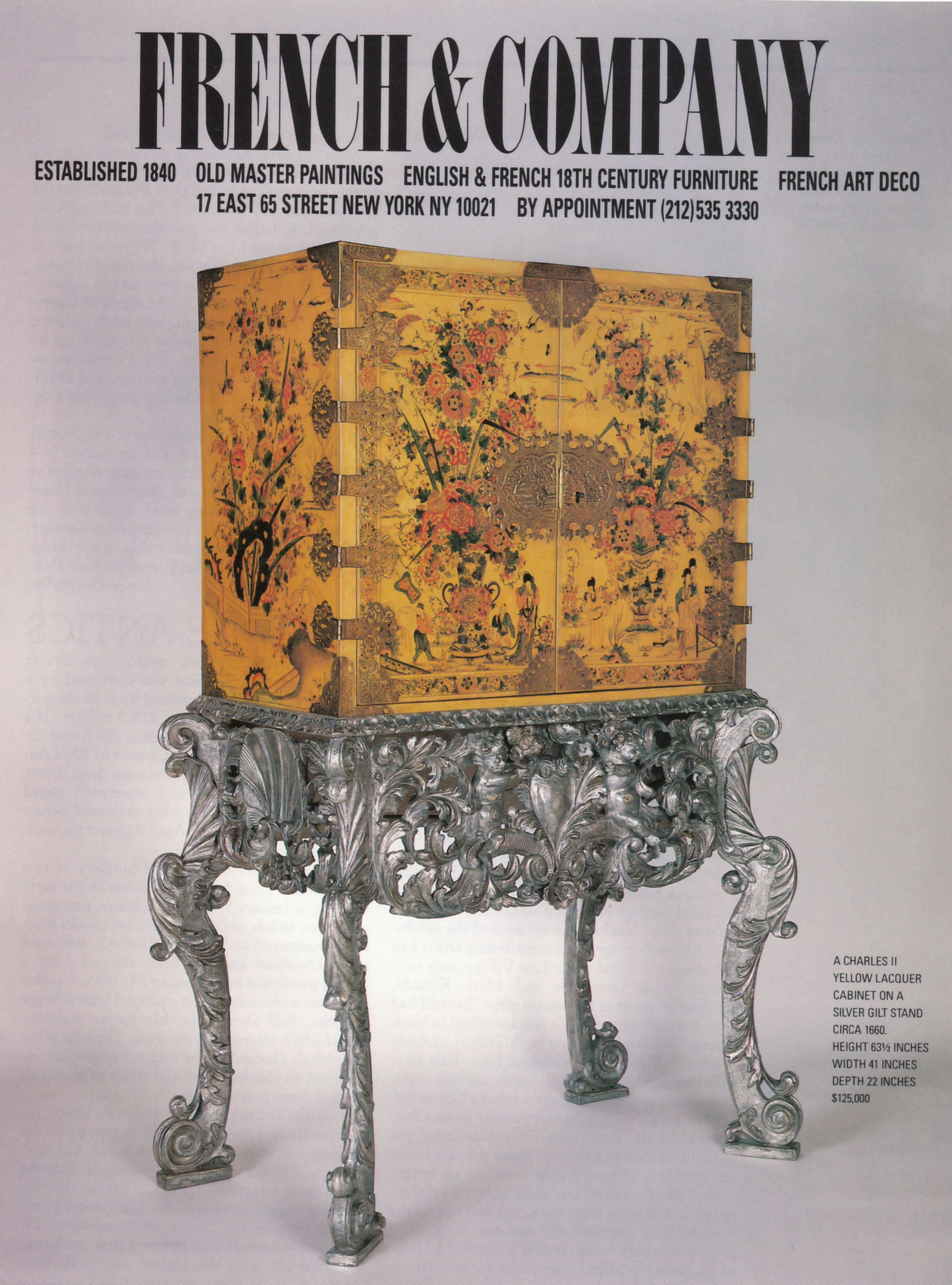
10th object – (see below) the narrator describes as a ‘rare cream lacquer cabinet, made towards the end of the 17th century’. This was No.31 in the catalogue, ‘a Charles II lacquer cabinet, circa 1680’ and was offered for sale by the dealer E.H. Benjamin, 39 Brook Street, London. White lacquer cabinets are the rarest of lacquer furniture, but even so it has not been possible to trace the cabinet – perhaps it has been lost? (Chris tells us that the cabinet on stand was in stock with the American antique dealers’ French & Co in 1987 (see below), so perhaps the cabinet is still in the USA?)
Art Treasures Exhibition catalogue 1932 – ‘A Charles II lacquer cabinet, circa 1680’. Photograph, Antique Dealers Research Project, University of Leeds.French & Co advert, 1987. Image from Chris Coles.
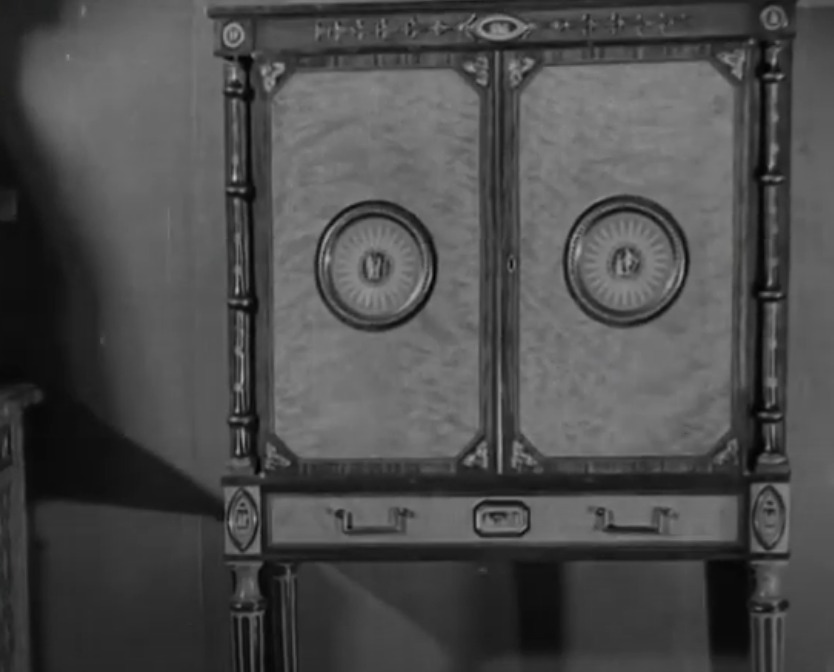
11th object – (see below) the narrator describes another cabinet, this time ‘a fine Adam satinwood example’ – he mentions that ‘it was purchased by the Queen at her recent visit to the exhibition’ (this would be Queen Mary, a very well-known collector of antiques). The cabinet is No.205 in the catalogue, described as ‘an Adam satinwood cabinet, circa 1780’, but is not illustrated; it was offered for sale by the antique dealer Mallet & Sons, one of Queen Mary’s favourite antique dealers. I can’t find the cabinet in Royal Collections, so perhaps the cabinet was sold from the collections or given away or was destroyed?
Art Treasures Exhibition 1932 film, screenshot of ‘Adam satinwood cabinet’.
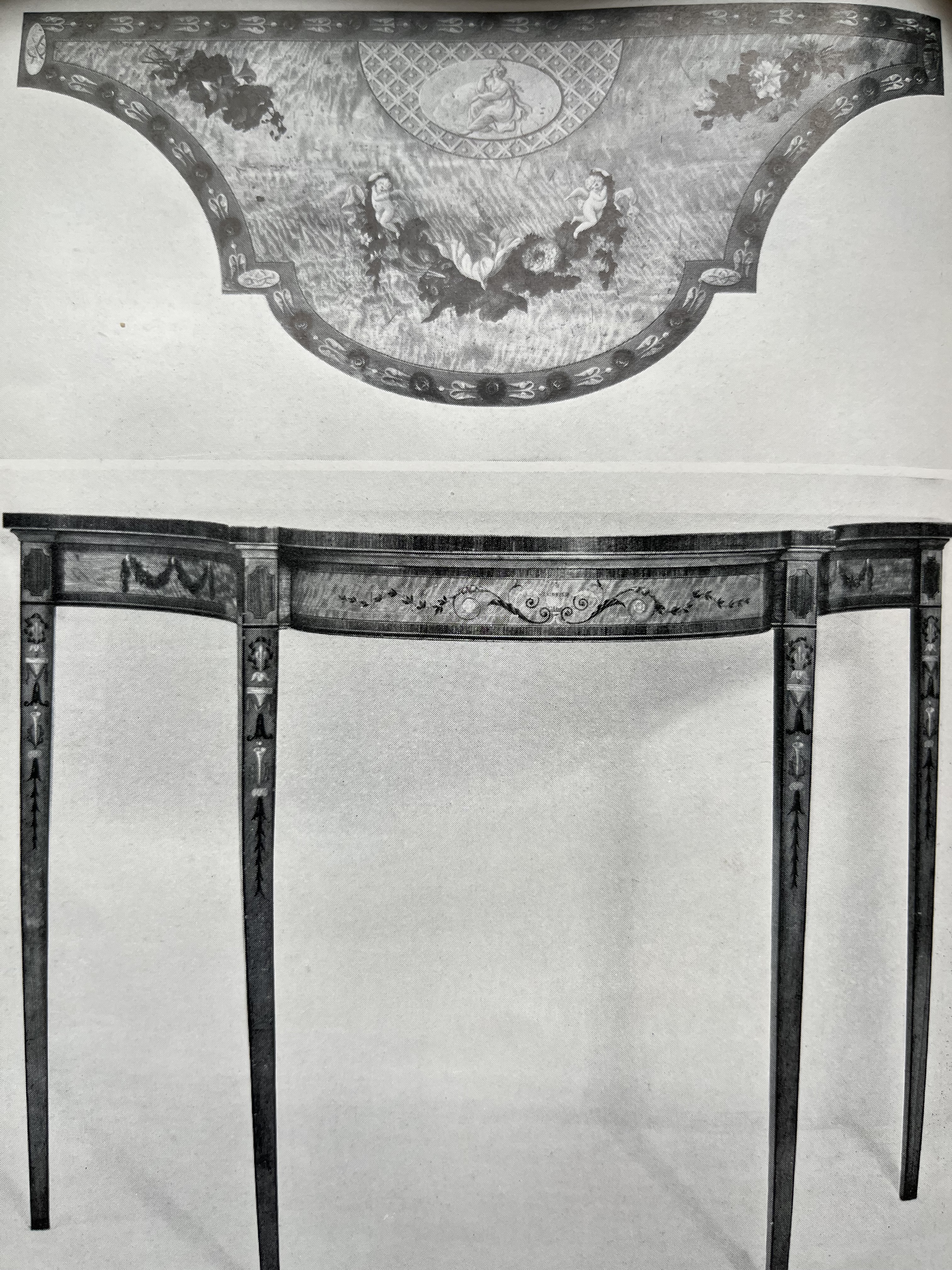
12th object – (see below) the narrator describes ‘a lovely satinwood side table’, ‘one of Lord Nelson’s gifts to Lady Hamilton’. This is one of 3 tables on display at the exhibition, No.241, ‘a set of three satinwood tables, circa 1795’; they were illustrated and were offered for sale by the dealer A.G. Lewis. Like the film, the catalogue mentions that the tables were presented by Lord Nelson to Lady Hamilton. Given the provenance, it’s surprising I can’t find them anywhere? Two of the tables were in the collection of Arthur Sanderson (1846-1915), the well-known collector in Edinburgh; they are listed in the auction sale catalogue of Sanderson’s collection sold by Knight, Frank & Rutley, Hanover Square, London, June 14th-16th 1911 as Lot 540 ‘A PAIR OF SHERATON SHAPED FRONT SIDE-TABLES, which (together with Lot 541 A SHERATON BOOKCASE) were ‘said to have been made by Sheraton for Lord Nelson and given by him to Lady Hamilton at Naples’; (our friend Chris Coles tells me that the Nelson tables were in the collection of the antique dealer George Stoner (of Stoner & Evans) in 1912; and that one of the tables was in the stock of Moss Harris & Sons in 1935; Chris rightly suggests that as the three tables don’t exactly match, they are more likely to have been separated – thanks again Chris!)
Art Treasures Exhibition catalogue 1932 – ‘A set of three satinwood side tables, circa 1795’. Photograph, Antique Dealers Research Project, University of Leeds.
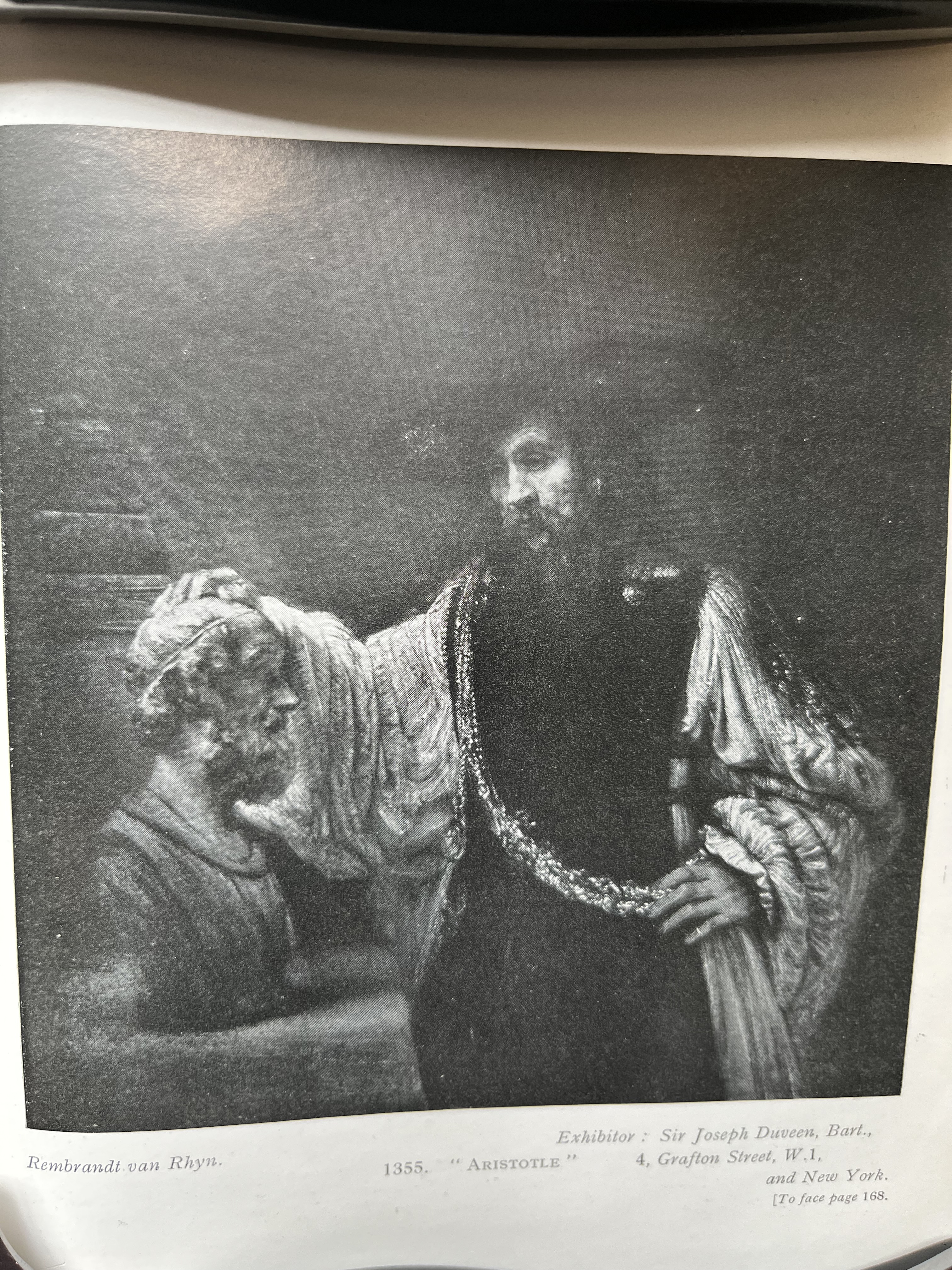
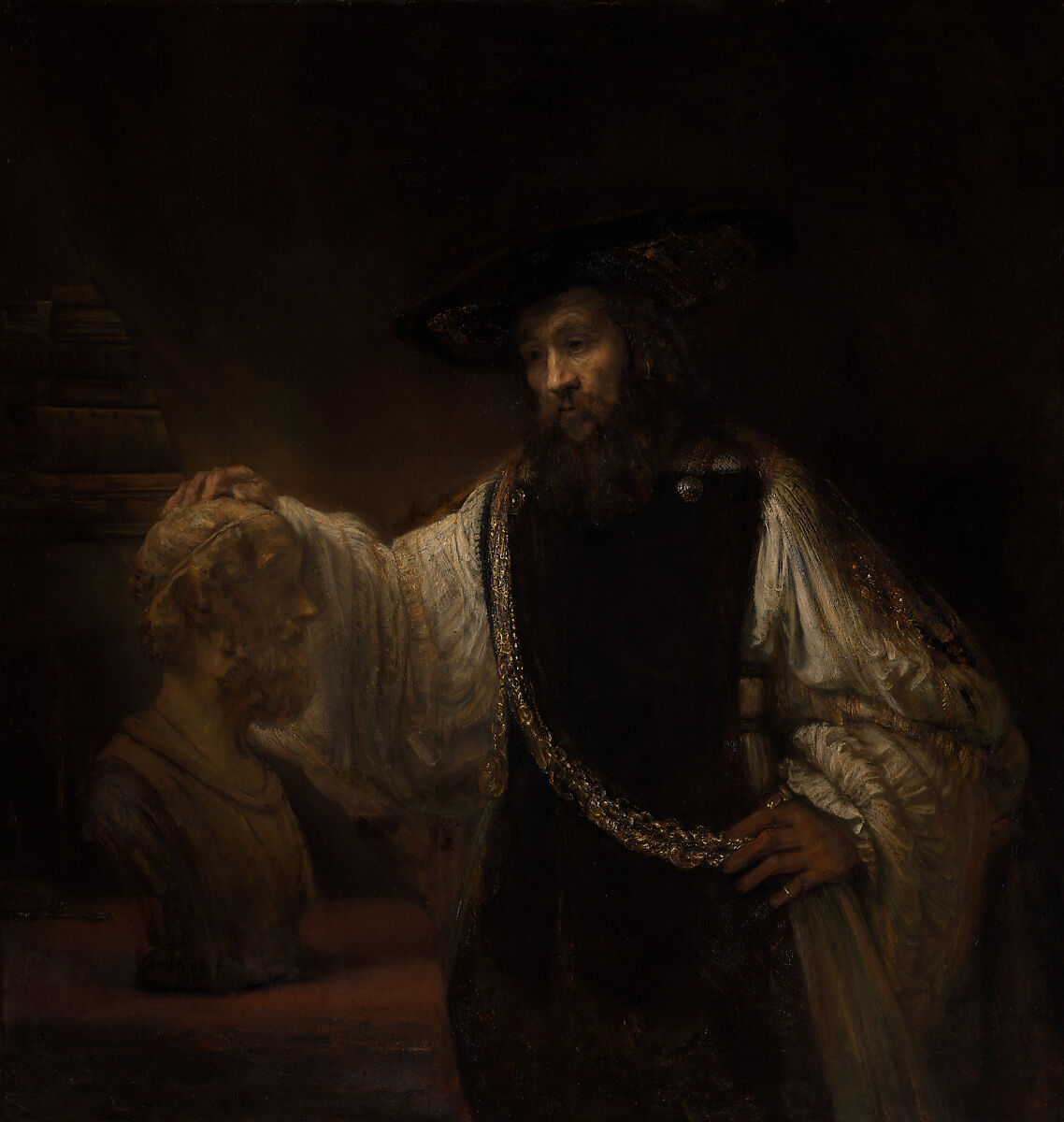
Finally, 13th object – the narrator highlights that this object (a painting by Rembrandt) is ‘the most valuable object here’. It is No.1355 in the exhibition catalogue, ‘Rembrandt van Rhyn (1606-1669), ‘Aristotle’, signed and dated 1653′. It was offered for sale by the world-famous art dealer Joseph Duveen (1869-1939). Duveen bought and sold the painting several times in the decades before the 1932 exhibition. He sold it to the art collector Alfred W. Erickson (1876-1934) in 1928 for $700,000, before buying it back and selling it to Erickson again in the mid 1930s for $590,000. It is now in the collections at the Metropolitan Museum of Art in New York, where it has been since 1961.
Art Treasures Exhibition catalogue 1932 – ‘Rembrandt van Rhyn….’Aristotle’. Photograph, Antique Dealers Research Project, University of Leeds.Rembrandt (Rembrandt van Rijn) Aristotle with the bust of Homer (1653). Metropolitan Museum of Art, New York. 61.198. Image copyright Metropolitan Museum of Art, New York.
The film of the Art Treasures Exhibition 1932, together with the catalogue of the exhibition, gives a fascinating insight into the publicity for one of the major commercial art exhibitions of the period and is a further demonstration of the significance of the antique trade in the circulation and consumption of antiques (and paintings) and their role in the development of public museum collections – and thanks again to Diana for sending on the link to the film!
It is with very great sadness that we heard that Robin Kern sadly passed away on 2nd November. We have our own reflections on Robin and on the antique dealing business of Hotspur further below, but Chris Coles, who undertook our oral history interview with Robin back in 2016, has also composed a personal tribute to Robin.
Robin Kern, of Hotspur Limited, in 1999. Photograph courtesy of Robin Kern.
A Personal Tribute to Robin Kernfrom Chris Coles
Mark has very kindly allowed me to write a few words about Robin Kern. I first met Robin whilst still working at the British Museum. I had fortuitously seen an advert in the Antiques Trade Gazette that Mark had placed, asking for volunteers for the Antique Dealers Project. Thankfully I applied and was accepted and Mark very kindly allowed me to conduct some of the oral history interviews. One of those interviews was with Robin Kern at his beautiful home in Notting Hill. I had previously met Robin some years before at his premises in Kinnerton Mews, having already closed the Lowndes Street shop. I had actually visited him as a result of a visitor to my department at the BM who had told me that she was researching dummy boards. I knew that Robin had a pair in stock at that time and suggested that she went to see him. She emailed me afterwards to say how well she had been treated and that I should go and see him myself and I did. This bringing together of academics and researchers and members of the trade was entirely typical of the way that Robin conducted himself and it was no surprise at all that some of his best friends, and greatest clients, included the likes of Christopher Gilbert buying for Temple Newsam and Sir Nicholas Goodison the expert on Matthew Boulton and barometers. As John Hill said so perfectly in his eulogy at Robin’s funeral
‘He was a gifted mentor, using his passion for diplomacy and his velvet touch……Robin and Brian built a strong bond of friendship and trust between like-minded souls and Hotspur was to feel a bit like a private members club’.
When I interviewed Robin for the project he spoke with understandable pride about some of the many famous private collections he had helped to form such as those for the McAlpine family, Jon Gerstenfeld, Fred Krehbiel and Jon Bryan. It is no exaggeration to say that Hotspur took the marketing of purely English furniture and works of art to a new level amongst the trade and virtually every great collection of such pieces will include something that passed through the firm’s hands at one stage or another.
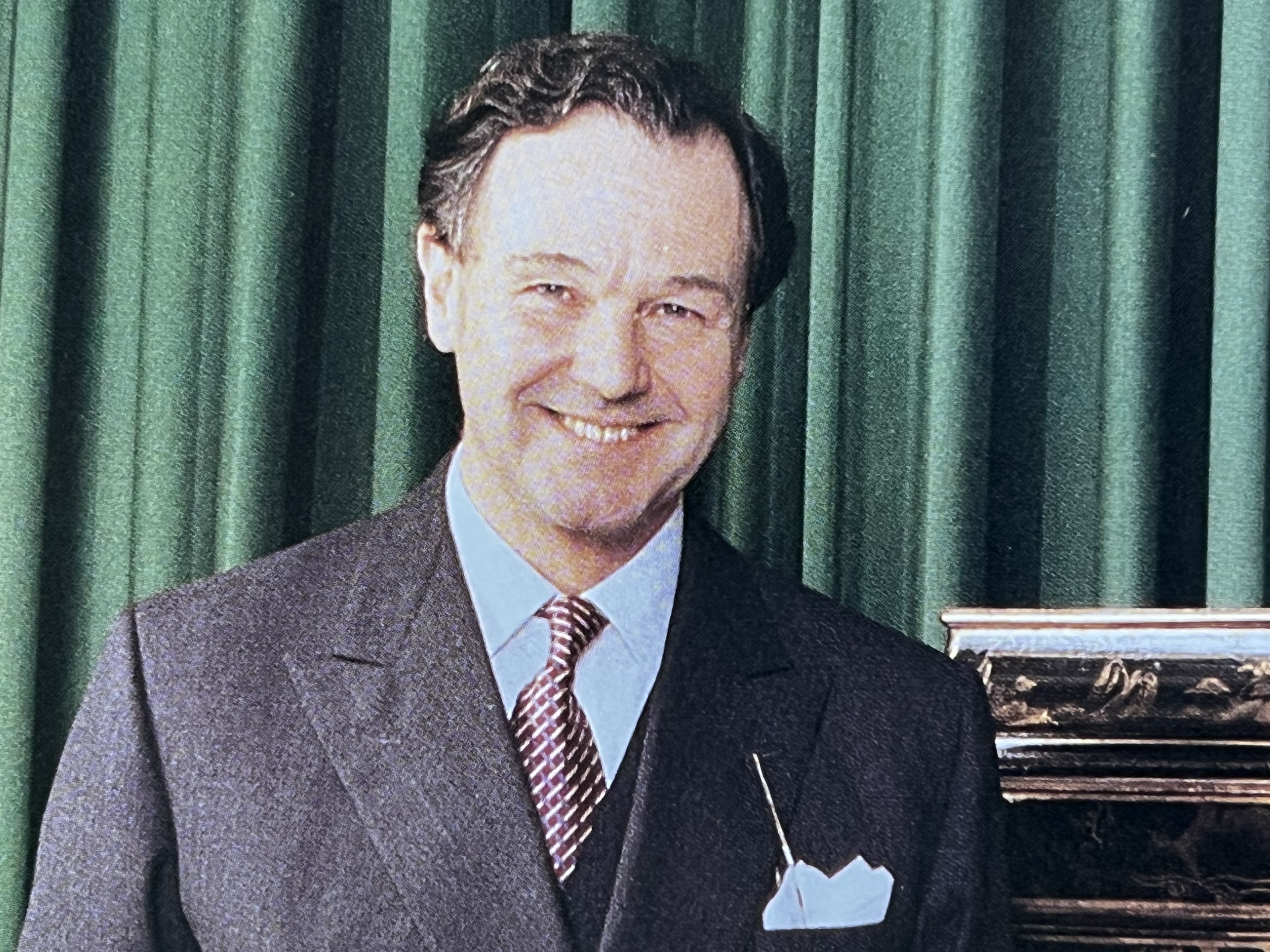
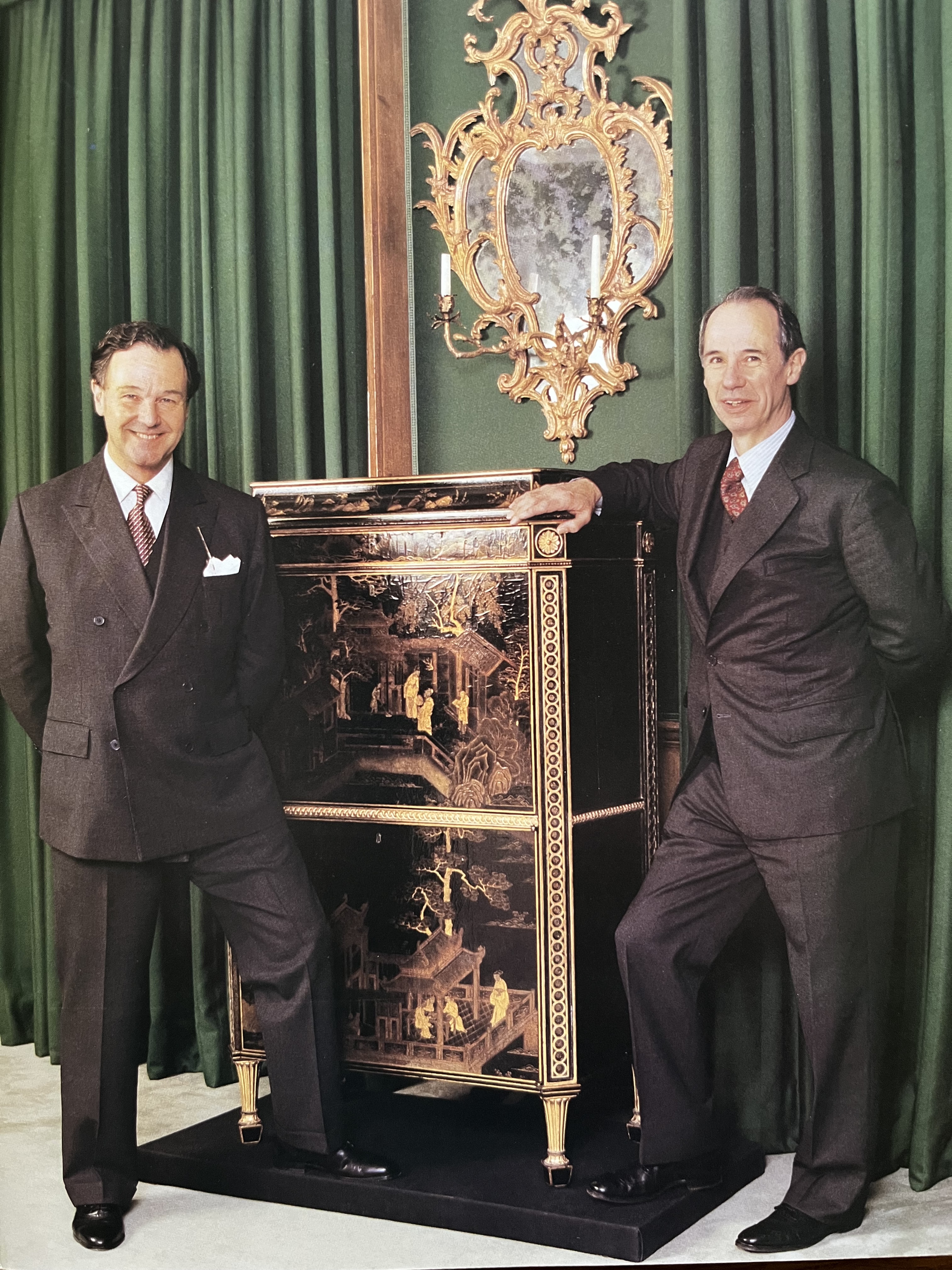
When conducting the oral history interviews, it was always our policy to get a photograph of the interviewee for use in the relevant section on the website. Robin was insistent that we use the image of him and his brother Brian with the Chippendale lacquer secretaire, now at Temple Newsam (see photograph below), that featured in the Hotspur anniversary book. He didn’t want anyone to be under the impression that the firm’s success was down to him alone and wanted Brian, who had already tragically passed away by that time, to get his full share of the credit. The two brothers took over running the firm in the most difficult of circumstances, both of their parents having been killed in a tragic car crash. Under the brothers’ stewardship, however, the firm flourished and moved on to the next level and the respect and affection for Robin was obvious from the remarkable turnout for his funeral which was attended by almost everyone involved in the current high end furniture trade and plenty in other branches of the antiques trade as well.
Robin’s generosity towards the Antique Dealers Project was cemented by his decision to give all of the remaining copies of the Hotspur anniversary book to Mark for use as university prizes and this, again, was typical of his outlook in life, always trying to help others and never hinder.
All of us involved in the furniture trade in Britain and America owe a huge debt of gratitude to Robin for raising the profile and standard of dealing in our area and for his personal kindness and generosity. He was a titan of the trade who will be sadly missed and I send my condolences to his widow Odile, herself also a great dealer, and the rest of the Kern family.
Robin Kern (1938-2024) – Thank you Chris for your contribution to the Antique Dealers Research Blog. Robin’s obituary was also published in the Antiques Trade Gazette (ATG 23rd November 2024), p.79 (composed by his friend, Simon Phillips of Ronald Phillips Limited, London). Below are my own reflections on Robin and the significance of the antique dealers’ Hotspur Limited.
Robin Kern with his brother Brian at Hotspur with the black lacquer secretaire from Harewood House, Yorkshire, sold to Temple Newsam, Leeds, in 1999. Photograph, Robin Kern.
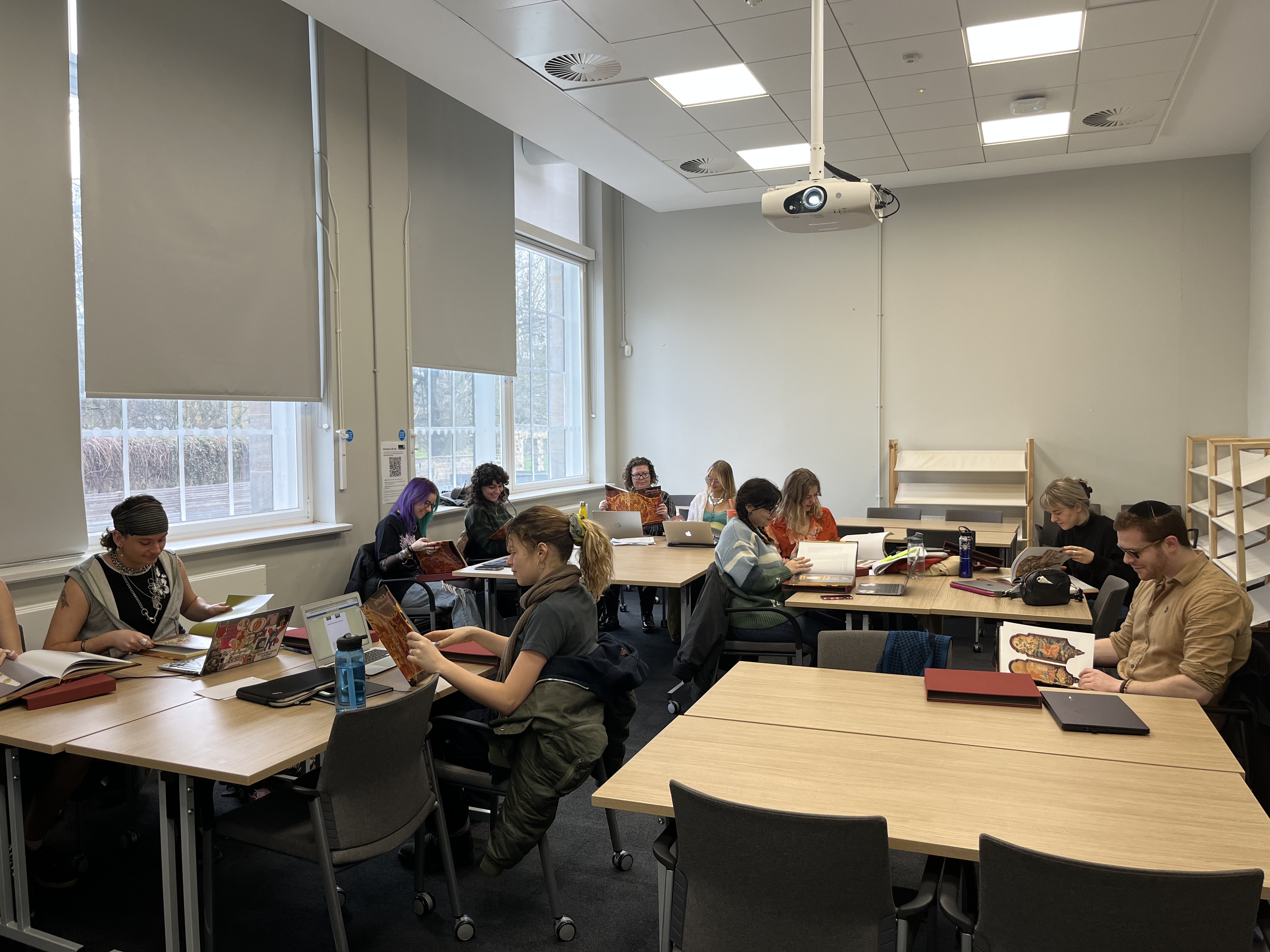
I remember meeting Robin in London at his store in Chelsea, back in 2018. I had driven down from Leeds to collect a very large pile of copies of the book published to celebrate the 80th anniversary of the founding of Hotspur (2004) Hotspur: Eighty Years of Antiques Dealing which, with typical generosity (as Chris mentioned above) Robin had given to the Antique Dealer Research Project to distribute to students enrolled on the module I teach at the University of Leeds (called ‘Antique Dealers: the market for ‘decorative art’ from curiosities to retro’). It is a 3rd year undergraduate module, the focus of which I believe is unique in UK universities, and which I’ve been running for almost 10 years now. Robin give us dozens and dozens of spare copies of the Hotspur book, which I distribute each year to eager students studying the history of antique dealing. Here’s a photograph of the undergraduate students enjoying the book from 2023 (and which I also would send to Robin as evidence of the real impact of his generosity!)
BA students with copies of ‘Hotspur’ in 2023. Photograph, University of Leeds.
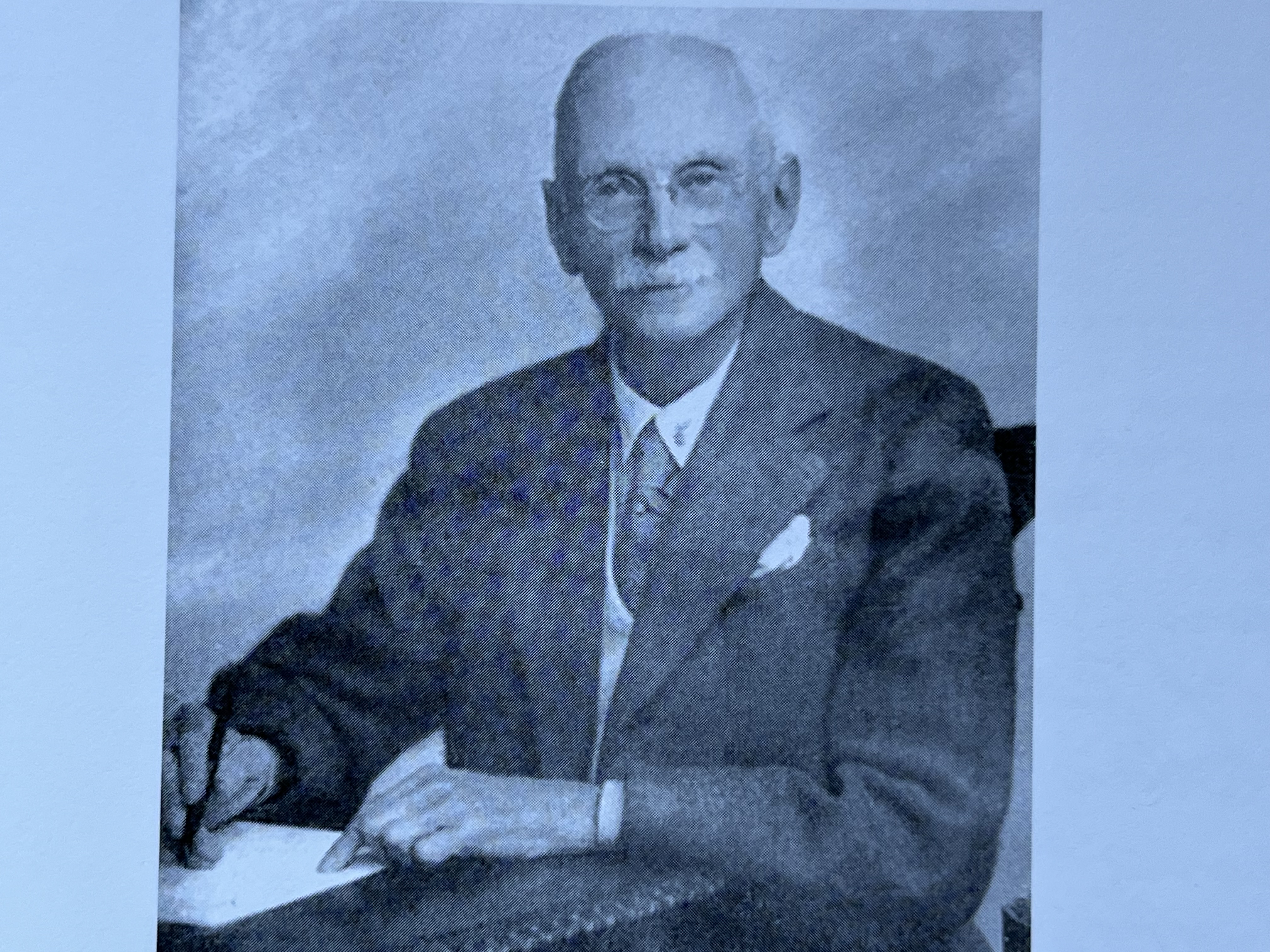
The antique dealing business, Hotspur Limited, was founded by Robin’s grandfather, Frederick Kern (see below) together with Robin’s father, Robert (Rob) Kern (see below) in 1924. Frederick had been a director of the London branch of the decorators and antique dealers Carlhain and Beaumartz, as Nicholas Goodison described in the history of Hotspur, ‘[Frederick] was with the firm for twenty years until it closed in 1914, and was then briefly in business at 27 Soho Square as a director of Monday, Kern and Herbert, where he was in charge of the ‘Antique Department and Reproductions” (Goodison & Kern, Hotspur: eighty years of antiques dealing (Two Associates, London, 2004), p.19.
Frederick Kern (1868-1958) in c.1955. Photograph, Robin Kern.Robert Kern in 1974. Photograph Robin Kern.
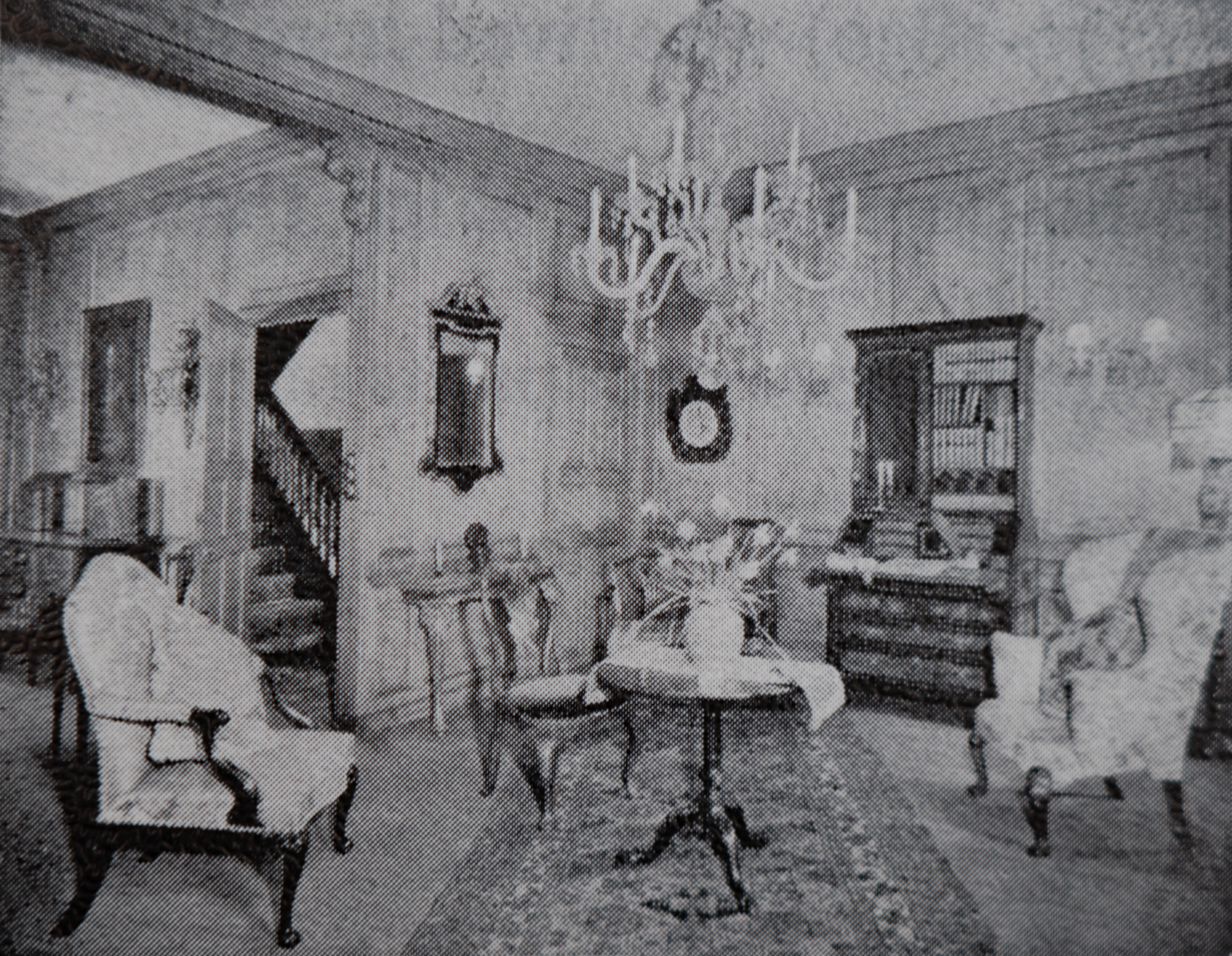
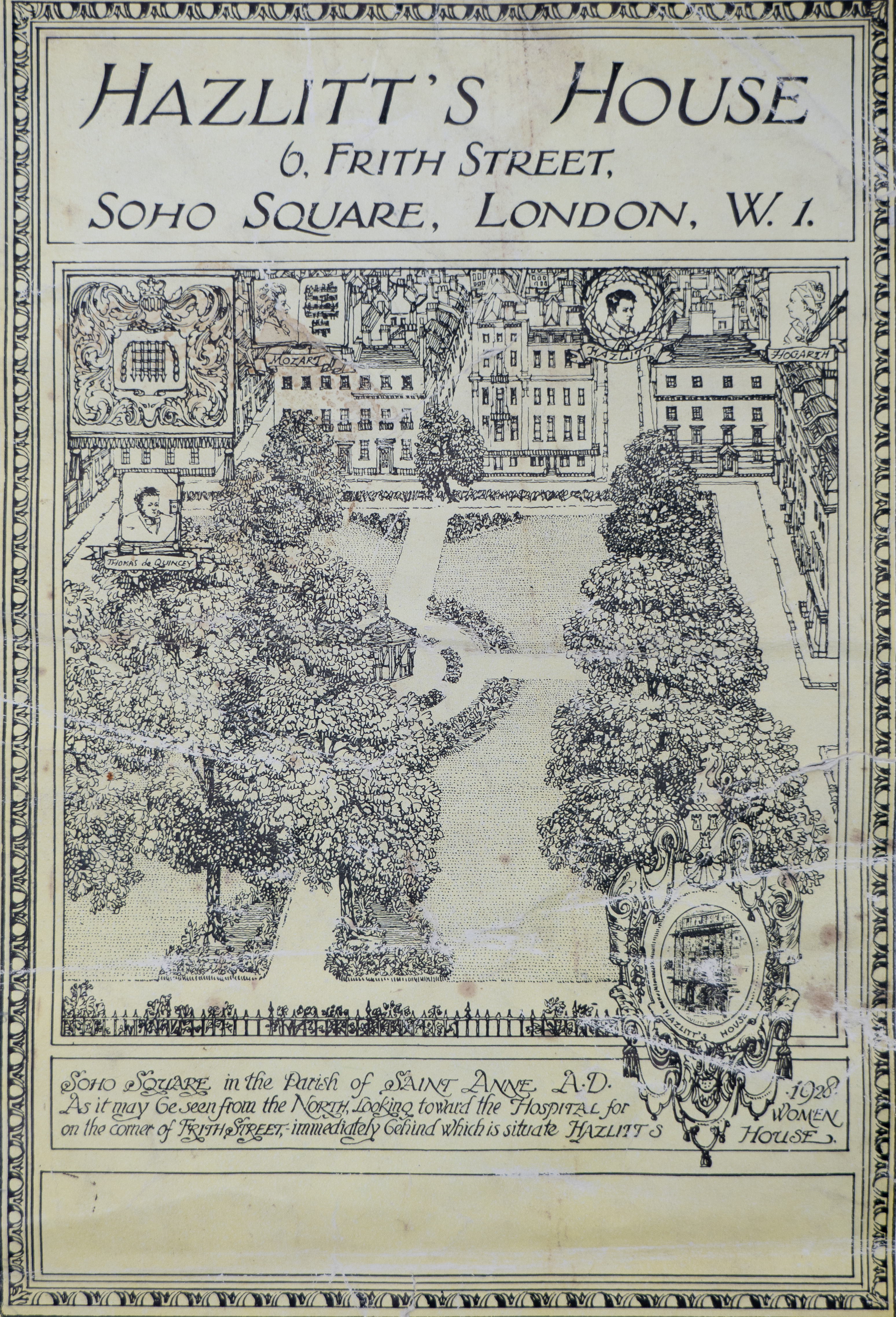
Hotspur’s first antique shop was at 16 Buckingham Palace Road in London, before moving to 6 Frith Street, near Soho Square in London by the late 1920s. The building in Frith Street occupied by Hotspur Ltd was formerly the home of the writer William Hazlitt (1778-1830) and the interiors were perfect for displays of English antique furniture that Hotspur were famous for buying and selling.
Hotspur Limited, 6 Frith Street, London, interior. Photograph, Robin Kern.Sales brochure produced by Hotspur in 1928. Photograph, Antique Dealer Research Project University of Leeds.
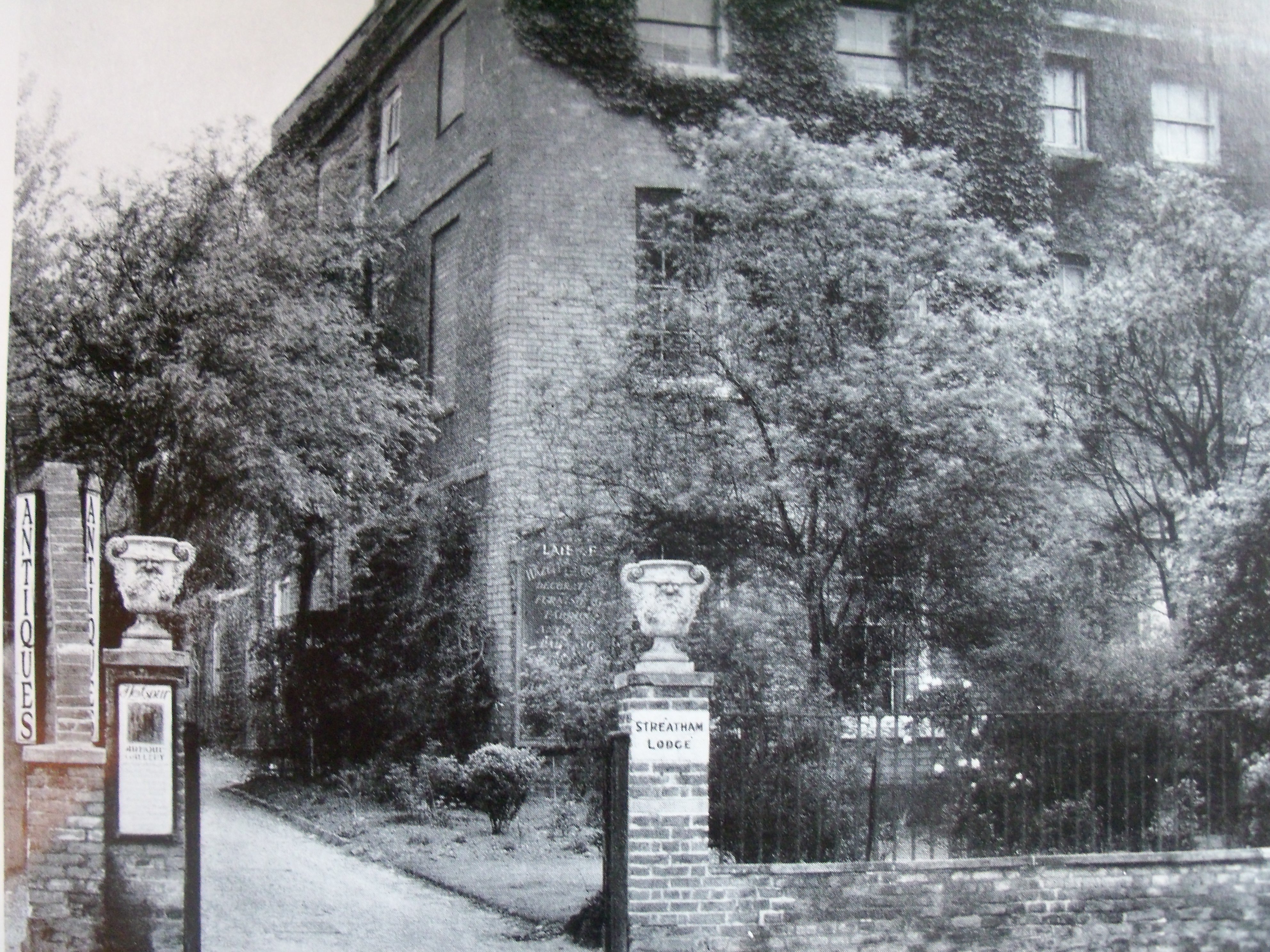
In 1939, to avoid bombing during the Second World War, Hotspur relocated to Streatham Lodge, Richmond, a rather grand 17th century house, again with period rooms ideal for the display of English antique furniture.
Streatham Lodge, the business location of Hotspur from 1939 to 1951. Photograph, Robin Kern.
In 1951 Frederick and Rob Kern moved Hotspur back to central London, to 14 Lowndes Street, a very smart street near Belgrave Square, and in 1956 Robin joined his father in the business, followed by his younger brother Brian in 1963. Robin and Brian’s father and mother, Rob and Betty, were tragically killed in a road accident in 1977. Brian retired from the business in 1999, but Robin continued, finally closing the doors in 2008.
Hotspur were one of the leading dealers in the highest quality antique furniture, especially English furniture of the ‘classic’ period 1680-1830. As Chris mentions (above) they helped build many of the most important collections of antique furniture in the mid-to-late-20th century in both the UK and the USA. Hotspur were also central to building of the antique furniture collection of Noel Terry (1899-1979), which remain on display at Fairfax House in York
Our memories of Robin are of a highly principled and exceptionally generous person. We are privileged to have included Robin and Hotspur as part of the Antique Dealers Research Project at the University of Leeds. Indeed, we are working quickly to make the oral history interview that we undertook with Robin and Chris Coles available to listeners (we are just sorting out the images so we can make that interview live on the project website). You may also be interested to hear that Hotspur are one of the antique dealers that are highlighted as part of the Year of the Dealer digital trails – the sale of the Harewood House secretaire (and the story of Hotspur), shown above, is one of the 10 objects in the digital trail at Temple Newsam, Leeds. We hope to have news of the launch of the Year of the Dealer trails in January, so do keep you eye on the Blog.
But before that, we send our sincerest condolences and best wishes to Robin’s family and friends.
As readers of the antique dealers Blog will know, we’ve been acquiring antique dealer ephemera for many years now – dealer catalogues, photographs and archives, as part of the on-going research project into the history of the antique trade in Britain. Much of this material, including the extraordinary collection of antique dealer archives, is housed at the Brotherton Library Special Collections at the University of Leeds.
More recently, we’ve been seeking out paintings depicting antique shops – we recently acquired, for example, a naïve painting (oil on canvas, c.1880, signed ‘M. Davis’) of the shop of Mr Deadman at an auction in The Netherlands of all places – ‘Ye Old Beckenham Curio Shoppe’ (see below). The shop depicted in the painting was in High Street, Beckenham in Kent (the building, which appears to be 16th century, was demolished by the 1930s). Frederick William Deadman (either the same dealer or perhaps a relative) was still trading as an antique dealer in the late 1930s – from a shop in Station Road, Freshwater on the Isle of Wight.
M. Davis ‘Ye Old Beckenham Curio Shoppe’, oil on canvas 24 in x 17 in; c.1880. Private Collection.
This painting has been added to our growing collection of paintings of antique shops, all of which demonstrate how important the idea of the antique shop has been in British cultural life. An earlier acquisition, of an equally naïve painting, illustrates this point. The painting, a watercolour, (10.5 in x 15 in, by H. Middleton-Holding, c.1910) of an antique shop in York Street, London, was acquired at auction in Shaftesbury, Dorset in 2019. It’s also a rather naïve work, but is charmingly rendered (see below):
H. Middleton-Holding, ‘York Street, Westminster, London’ watercolour, (10.5 in x 15 in), c.1910. Private Collection.
The artist has copied an engraving of the same scene, much more competently rendered and published in The Daily Chronicle on Tuesday September 27th in either 1904 or 1911, a copy of which is pasted to the backboard of the painting (see below) – (unfortunately, the actual year of the publication is obscured by some brown paper tape). The newspaper article outlines the history of the buildings in York Street, London and their occupiers, including the political philosopher Jeremy Bentham (1748-1832) and the highwayman Dick Turpin (1705-1739).
Backboard of the watercolour by H. Middleton-Holding. Private Collection.
The main shop in the scene, No. 32 York Street, was the location of a well-known female antique dealer, Mrs Amelia Jane Hardingham, who owned several antique shops in York Street (nos. 28-32), and began trading as an antique dealer in about 1900, in Waterloo Road, London. According to the article in The Daily Chronicle no.32 York Street was famous as the home of the artist George Morland (1763-1804) – perhaps that is why H. Middleton-Holding painted the scene again?
Amelia Hardingham’s shop was also captured in a photograph in c.1910 (see below).
A. Hardingham, Dealer in Works of Art, 32 York Street, London, c.1910. Photograph, The Victoria & Albert Museum, copyright V&A Museum.
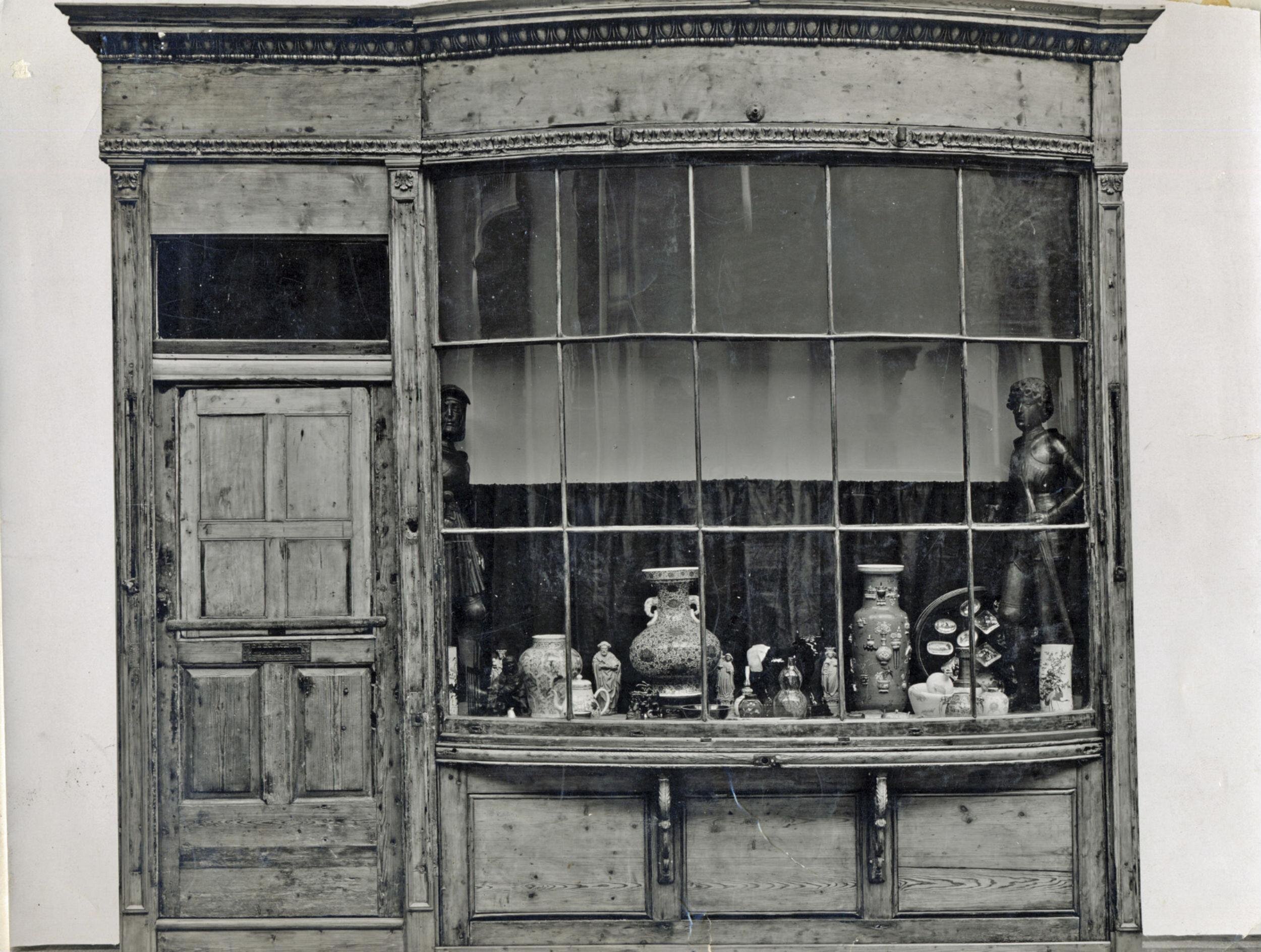
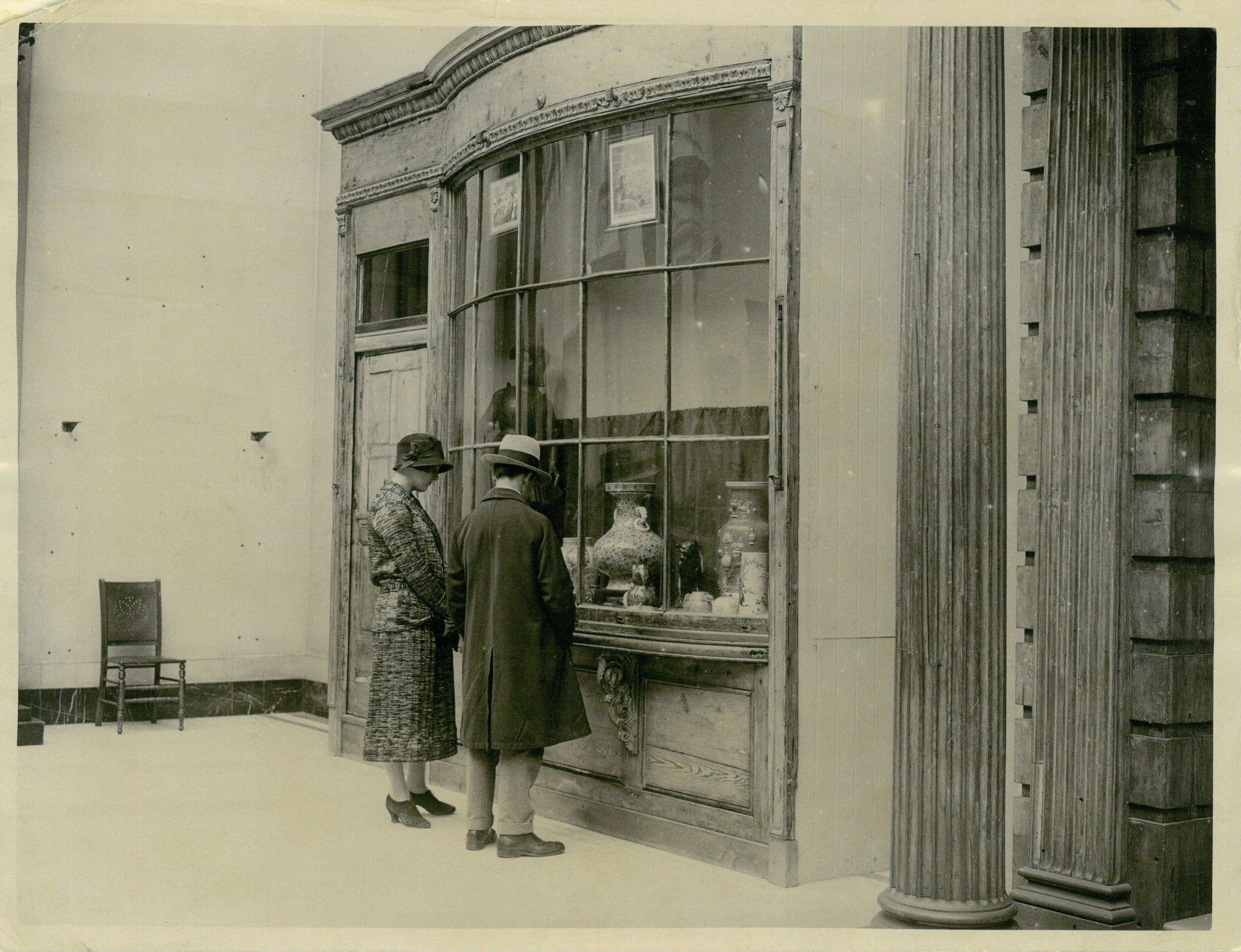
Amelia Hardingham’s antique shop was swept away when the buildings on York Street were demolished in 1923 to create ‘Petty France’, but the shop front of her shop was saved. It was gifted to the Victoria & Albert Museum by the Army Council (which owned the buildings) as a fine example of a late 18th century shop front. In fact, as those who visited the exhibition, ‘SOLD! The Great British Antiques Story‘ at The Bowes Museum in 2019, may remember we used an image of Amelia Hardingham’s shop front as part of the introductory interpretation at the exhibition. Indeed, when the 18th century shop front was put on display at the V&A in 1924, it was set up as a display reproducing Amelia Hardingham’s antique shop (see below).
18th century shop front on display at the V&A Museum, 1924 – W.88-1923. Photograph, The Victoria & Albert Museum. Copyright V&A Museum.
The antique shop display at the V&A Museum caused some consternation in the Press at the time, with some commentators questioning if it was appropriate that an antique shop display should be in a museum!
18th century shop front, displayed as an antique shop, at the V&A Museum in 1924. Photograph, The Victoria & Albert Museum. Copyright V&A Museum.
Readers of the Blog may also be interested to hear that women antique dealers (including Amelia Hardingham) are also the focus of some of our ‘Year of the Dealer‘ digital trails – we have ‘women antique dealer’ themes in our Trails at The Victoria & Albert Museum, The Bowes Museum and at Preston Park Museum as part of this project – so do keep your eyes open for our Year of the Dealer Trails public launch in September. As for paintings of representations of antique shops, we have acquired several other paintings over the last few years and will create another Blog post illustrating those in the next few months, so keep you eye on the Blog!
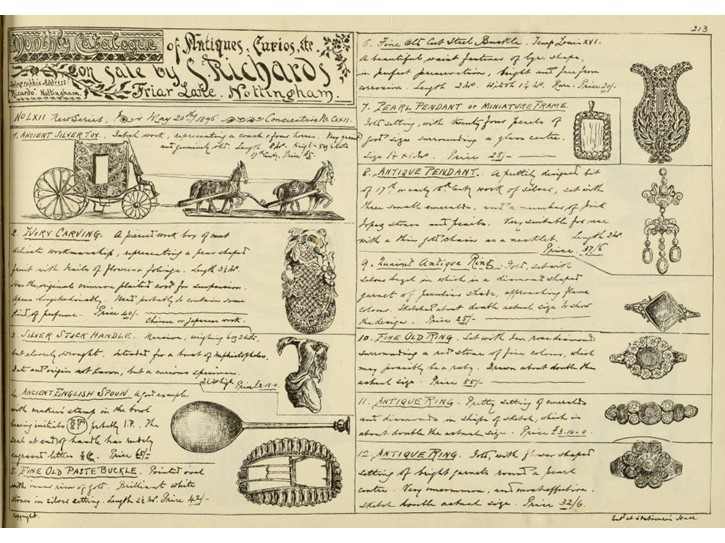
Readers of the Antique Dealers’ blog will be aware that we have previously posted a couple blog entries on the antique dealer Samuel Richards (1859-1927) (see blog posts November 2018 & June 2014). Richards is well-known for producing charming and detailed lithographed catalogues of his stock of antiques, which he issued monthly (with a few exceptions) from the early 1890s until the period around the First World War. Richards’ catalogues are quite rare – there are a few copies at the Victoria & Albert Museum Art Library in London, bound together in a couple of volumes. We also have a small number of bound copies in the John Evan Bedford Library of Furniture History at the Brotherton Library Special Collections at the University of Leeds, thanks to the very generous bequest of the late John Bedford (1941-2019). The Brotherton Special Collections also has a couple more bound copies of Richards catalogues, very generously bought at auction (in Nottingham no less) in 2018 and donated by our friend and keen supporter of the antique dealer research project, Simon Myers, of the antique dealer R.N. Myers & Sons of Gargrave in North Yorkshire (thank you again Simon).
Samuel Richards, Nottingham, Catalogue of Stock, May 20th, 1896. Photograph, Antique Dealers’ Research Project, University of Leeds.
Richards drew the illustrations in the catalogues himself, producing them monthly and sending them out to collectors all over the UK – although Richards quite often felt the need to apologise for missing a month (due to sheer volume of work, he says) in some of the monthly catalogues.
Samuel Richards, Nottingham, catalogue of stock of antiques, April 1912. Photograph, Antique Dealers Research Project, University of Leeds.
Whilst such lithographed catalogues produced by antique dealers were not unique to Richards (see blog post of the catalogues produced by A. W. & F. Little, of Bristol, in the same period – Blog Post February 2022), Richards seems to have been particularly prolific.
As a result of these fascinating catalogues, we have been doing more research on Samuel Richards over the past few months and have discovered new information about his activities an antique dealer in the period 1890s to 1920s. Richards was born in Nottingham in 1859, and died in Loughborough in 1927. He appears to have run his antique dealing business in Nottingham, but lived most of his life in Loughborough. The Census (1901) records Richards aged 42, a ‘dealer in antiquities’ (as antiques were often called at the time), living at 1 Park Street, Loughborough, with his wife Maud (aged 38), his son Arthur (aged 9), and daughters Winifred (aged 5) and Nora (aged 4), together with a servant, Fanny (aged 16). Richards appears to have owned or rented another property in Herrick Road in Loughborough at the same time. Richards antique shops were located in Nottingham, at 77 Houndgate and at The Old Friary, Friary Lane – he seems to have operated from both premises from the 1890s until his retirement from business in c.1919 – his son Arthur (1891-1976) appears to have worked with his father in the antique shops from about 1908, perhaps until his father’s retirement in c.1919. Richards shop at 77 Houndgate was crammed full of antiques (see photograph from 1892, below) typical of the material he illustrated in his monthly catalogues.
Samuel Richards antique shop, 77 Houndgate, Nottingham, 1892. Photograph, Antique Dealers Research Project, University of Leeds.
You can just make out the exterior appearance of Richards’ Houndgate antique shop in the title page of some of his catalogues – see below).
Samuel Richards, catalogue of stock of antiques, 1891. Photograph, Antique Dealer Research Project, University of Leeds.
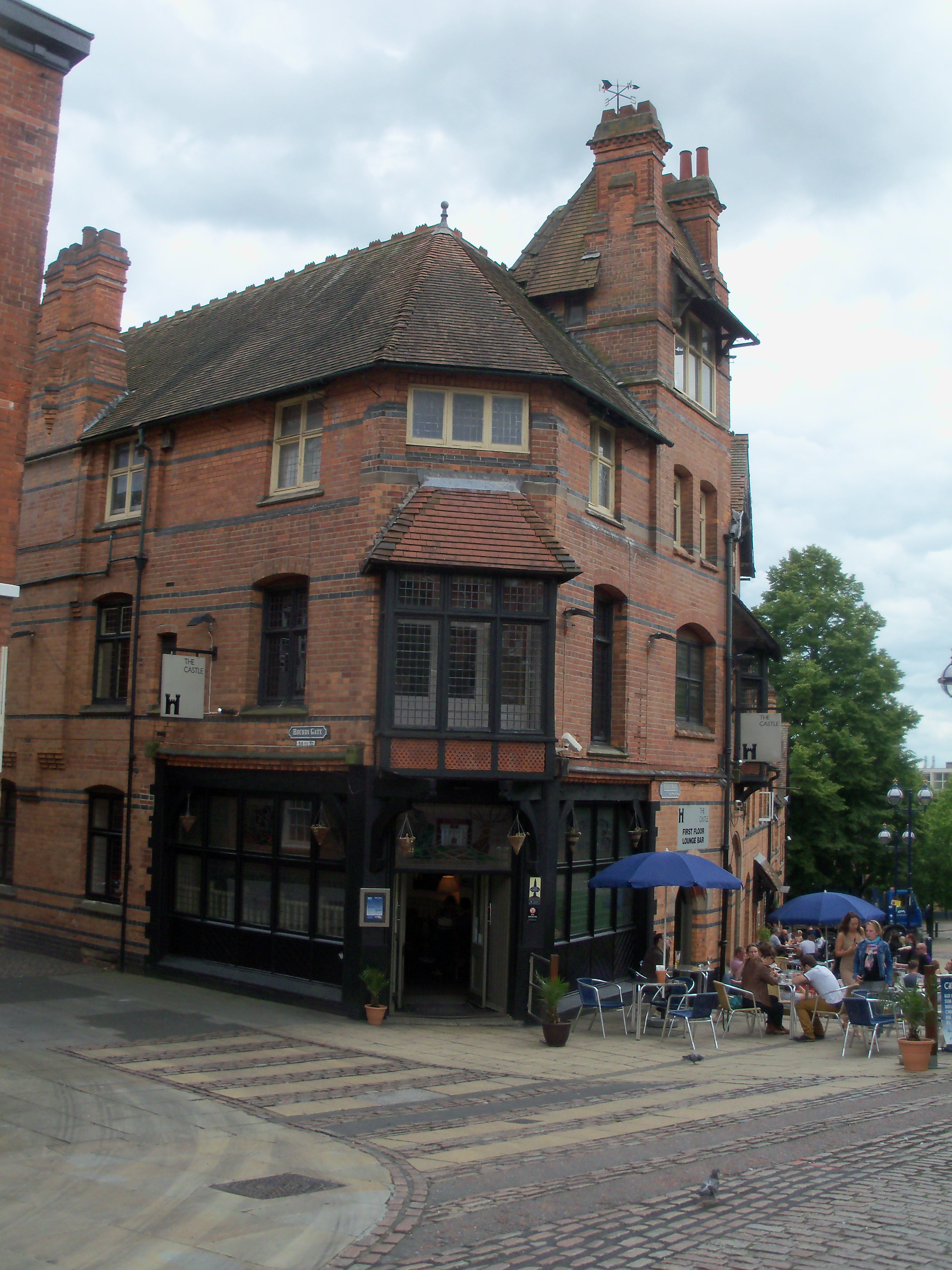
And as mentioned in the previous blog post in June 2014, the building that housed Richards’ Houndgate antique shop still exists (see below).
Building that housed Samuel Richards antique shop, photographed in 2014. Photograph, Antique Dealers Research Project, University of Leeds.
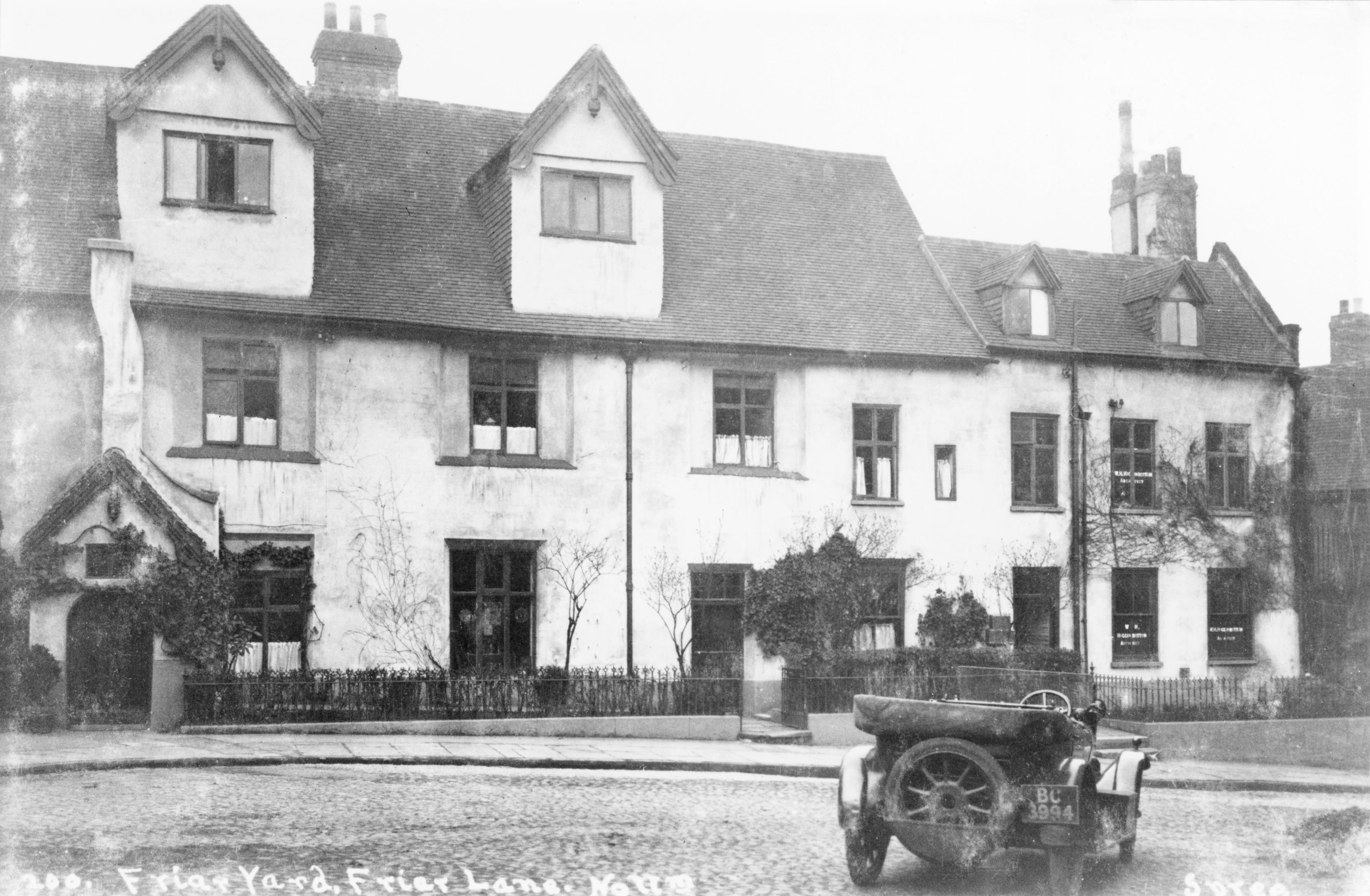
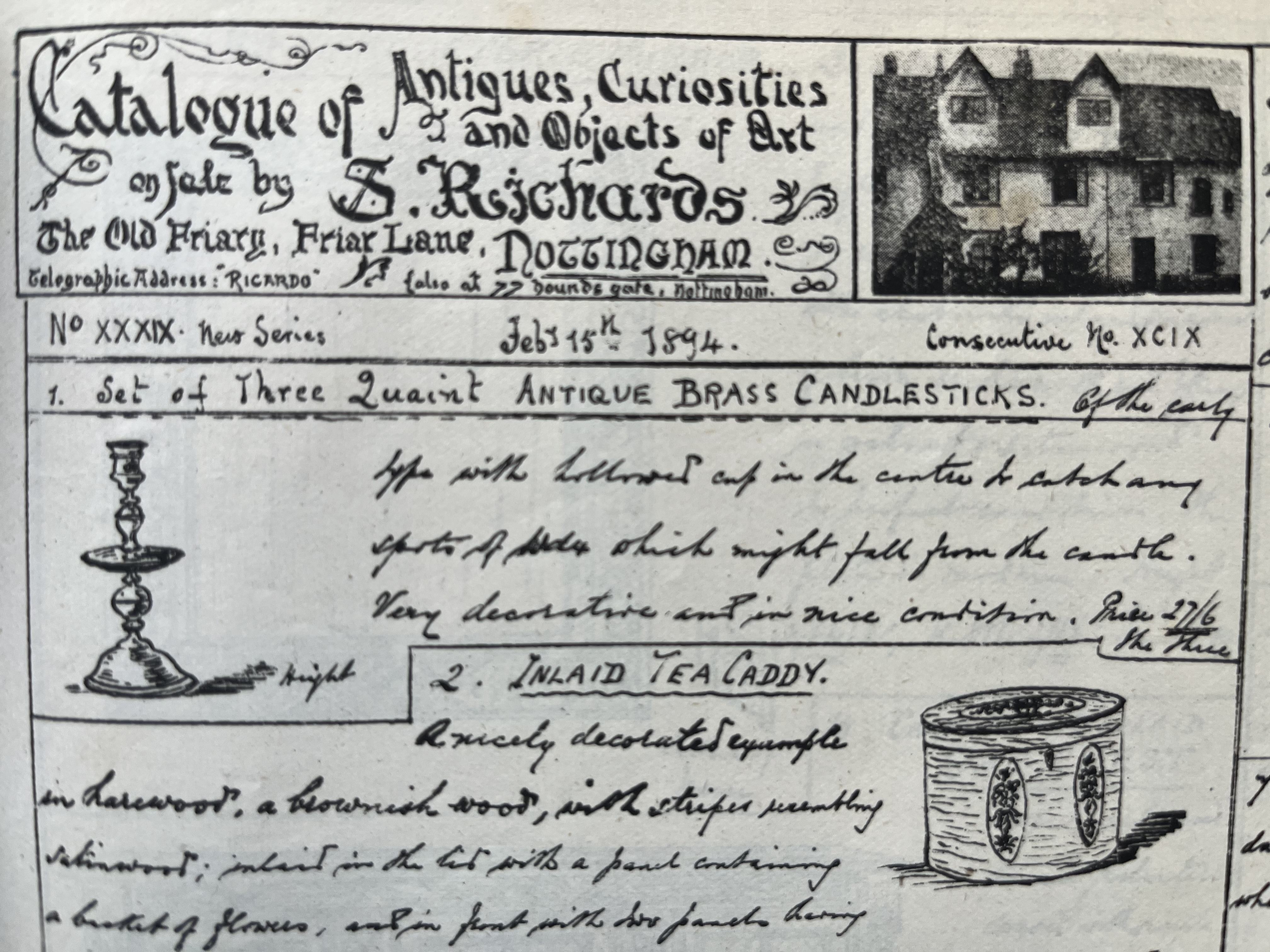
Richards’ other shop, The Old Friary in Friary Lane, Nottingham, was a much more famous building. He appears to have rented The Old Friary from the early 1890s until c.1919. The Old Friary was a 17th century building, rebuilt as part of a much earlier series of buildings that were part of Whitefriars Priory (built c.1276).
The Old Friary, Nottingham, c.1927, just shortly prior to its demolition. Image courtesy of Getty Images as part of the Year of the Dealer project 2023.
The Old Friary was also partly rebuilt in the 16th century and more famous for its associations with Dorothy Vernon (1544-1584) of Haddon Hall fame; Vernon is supposed to have lived at the Old Friary with her husband John Manners (1534-1611). In 1902 Charles Major published his famous romance novel ‘Dorothy Vernon of Haddon Hall’ which may have increased traffic to Richards’ shop. Certainly, such historic associations would have been of interest to an antiquary such as Richards and to his customers. The Old Friary was demolished in 1927. You can also just make out a photograph of The Old Friary in the title page of some of his catalogues of stock of antiques (see below).
Samuel Richards, catalogue of stock of antiques, February 1894. Photograph, Antique Dealer Research Project, University of Leeds.
We also have some exciting news about Samuel Richards – he is the focus of one of our Year of the Dealer Project digital trails (see Year of the Dealer Project) – at the Lady Lever Art Gallery at Port Sunlight, near Liverpool. Richards sold a large amount of ‘antique straw-work’ objects to Sir William Lever in 1915, one specimen of which we have included in the Year of the Dealer trail at the Lady Lever (see below). So, keep your eye out for the official launch of the Year of the Dealer trails this summer.
Mark
Early 19th century Straw-work box. French. Sold by Samuel Richards to William Lever in 1915. Lady Lever Art Gallery, Port Sunlight. Photograph, Antique Dealer Research Project, University of Leeds.
2022 is coming to a close – so we’d like to wish all readers and followers of the Antique Dealer Research Project blog a very Happy and Healthy New Year!
We thought a fitting image for a Happy New Year is the advertising calendar, produced by the antique dealer Charles Morse, for his very first antique shop, ‘Mr Pickwick’s Antiques’ in 1947 – and thanks again to Charlotte Morse (and Ben) for so kindly letting us use the image again.
Calendar, 1947, ‘Mr Pickwick’s Antiques’ (Charles Morse). Image courtesy of Charlotte Morse.
We will continue to post on the Research Blog in 2023 with our usual selection of posts on the history of antique dealing and various related themes. In April 2023 we will reach the 10th (yes 10th!) anniversary of the Antique Dealer Research Blog. Over the years we have amassed an archive of blog posts amounting to more than 120,000 words, and several hundred images – and in that time we have had more than 70,000 visits to the Research Blog – thank you all that read the blog!
Early in 2023 we’ll have some exciting news to report on the on-going Year of the Dealer project (see the Year of the Dealer project website at the University of Leeds), with the launch of our Year of the Dealer Digital Trails at a selection of our project collaborator museums – so do watch out for news of the Digital Trails in late February 2023.
As you may know, we have been making a film of the play ‘Quinneys’ (1915) at The Stage on campus at the University of Leeds as part of the Arts & Humanities Research Council funded ‘SOLD! The Year of the Dealer’ project. The filming was completed on 2nd July and we are now in the process of editing all the sections of film and creating the final version of Quinneys (2021). We are aiming to premiere the film later in the year, probably in November or December, at a cinema in Leeds, and, hopefully also in London – do keep you eye on the antique dealer blog and the project website for updates.
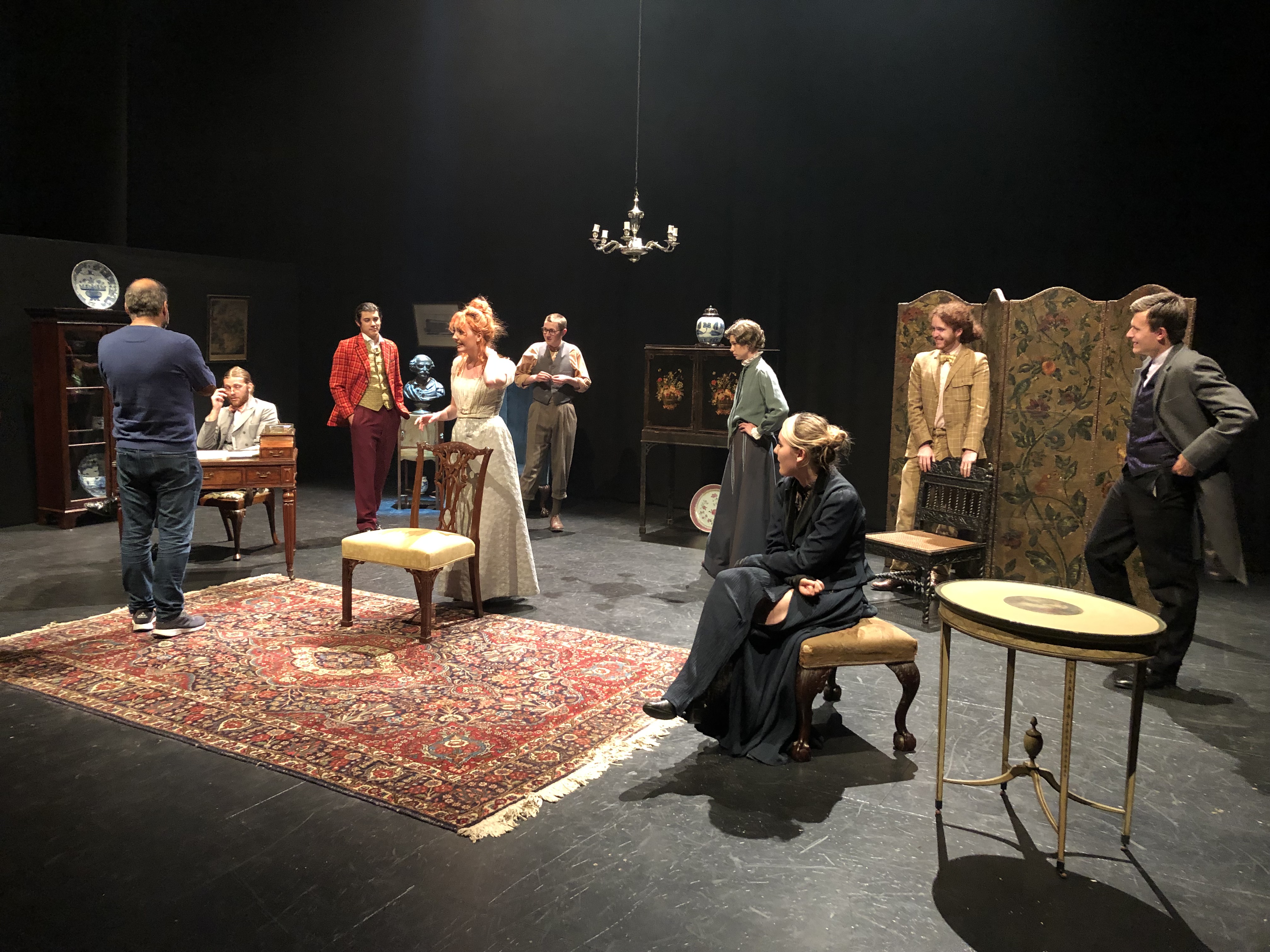
Thanks to our amazing director of the film, Dr. George Rodosthenous, all the student actors, Samuel Parmenter (as Joseph Quinney); Hannah Rooney (as Mrs Susan Quinney); Annabel Marlow (as Posy Quinney); Fergus Johnston (as James Miggott); India Walton (as Mable Dredge); Malcolm Webb (as Sam Tomlin); Stephenson Catney (as Cyrus P. Hunsaker); and Sebastian de Pury (as Dupont Jordan) – as well as Samantha Willetts (as Theatre Company Manager and lighting design); Andy Mills (as technician) – and our cameraman Patrick Bannon, we managed to get the film ‘in the can’ over an exhausting 5 days (9am-9pm!) – helped by delicious pizza! Here’s the full cast after filming, on the Quinneys (2021) ‘Sanctuary’ set, with George –
Cast of Quinneys in rehearsal with George Rodosthenous at The Stage, University of Leeds. Photograph, Year of the Dealer project, 2021.
Rehearsals were a real challenge, with all the Covid-19 restrictions and social distancing etc. We had to wear masks when not actually on set and about to film – here’s the actors all masked up early on in the rehearsals:
Cast of Quinneys in rehearsal with George Rodosthenous at The Stage, University of Leeds. Photograph, Year of the Dealer project, 2021.
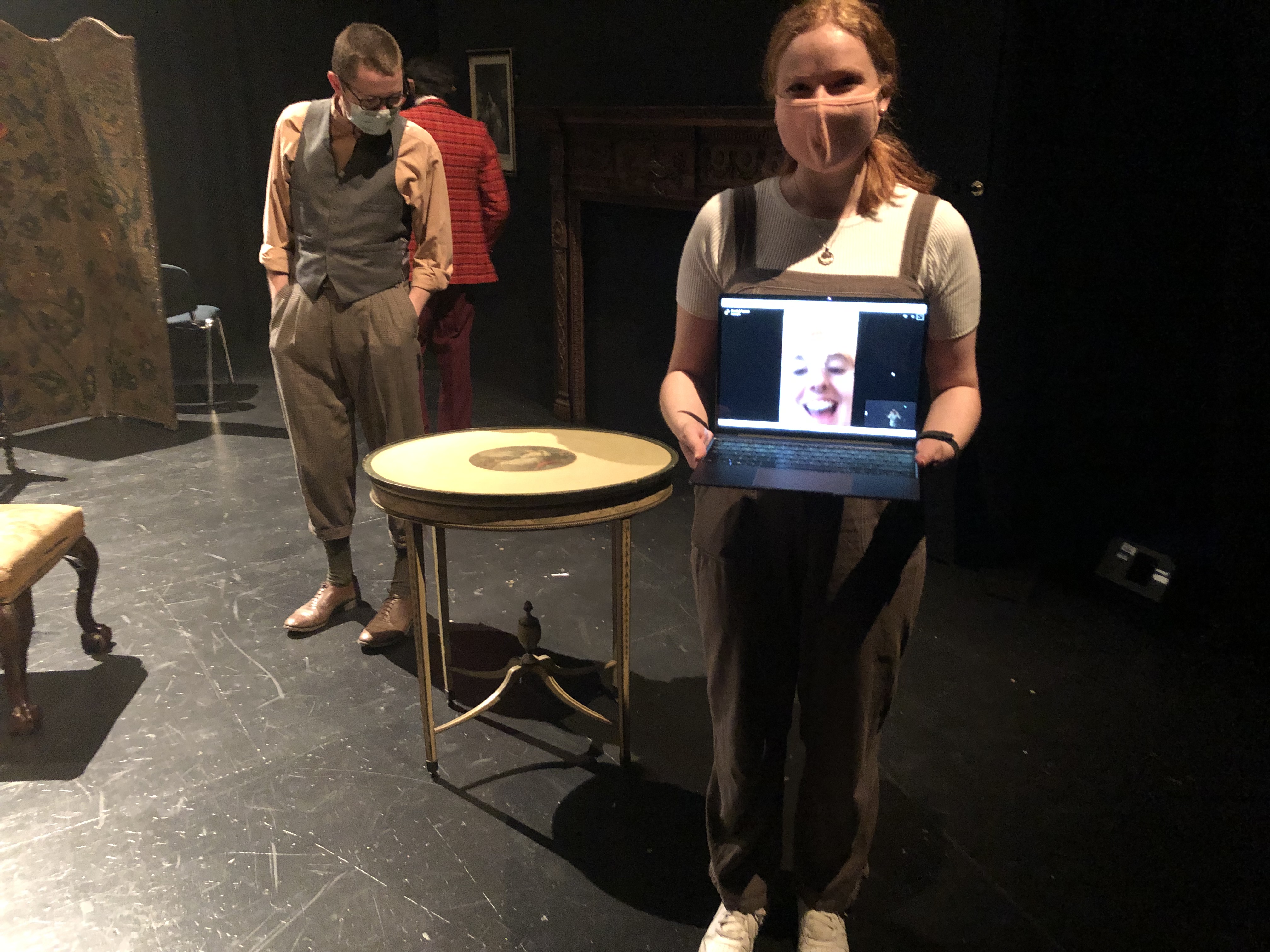
Annabel Marlow, who plays Posy Quinney (Quinney’s daughter) in the film, was still self-isolating on the first day of filming, so we had to do the rehearsals with Annabel on Zoom via a laptop – a very surreal, J.G. Ballard-esque experience! Here’s Samantha Willetts (Company Manager) holding the laptop with Annabel (‘Posy’) on screen.
Samantha Willetts holding ‘Posy’ (Annabel Marlow) – rehearsals for Quinneys. Photograph, Year of the Dealer project, 2021.
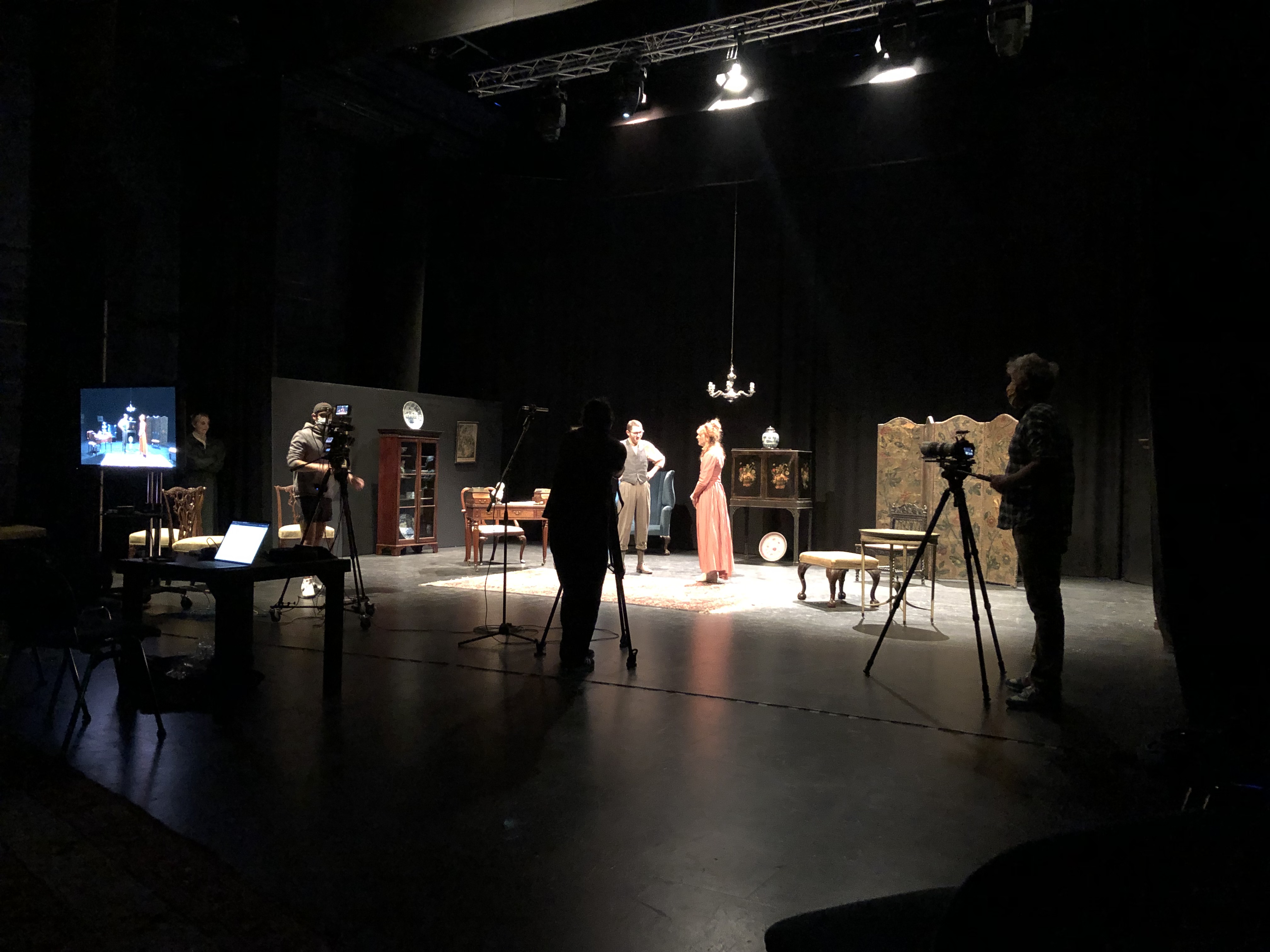
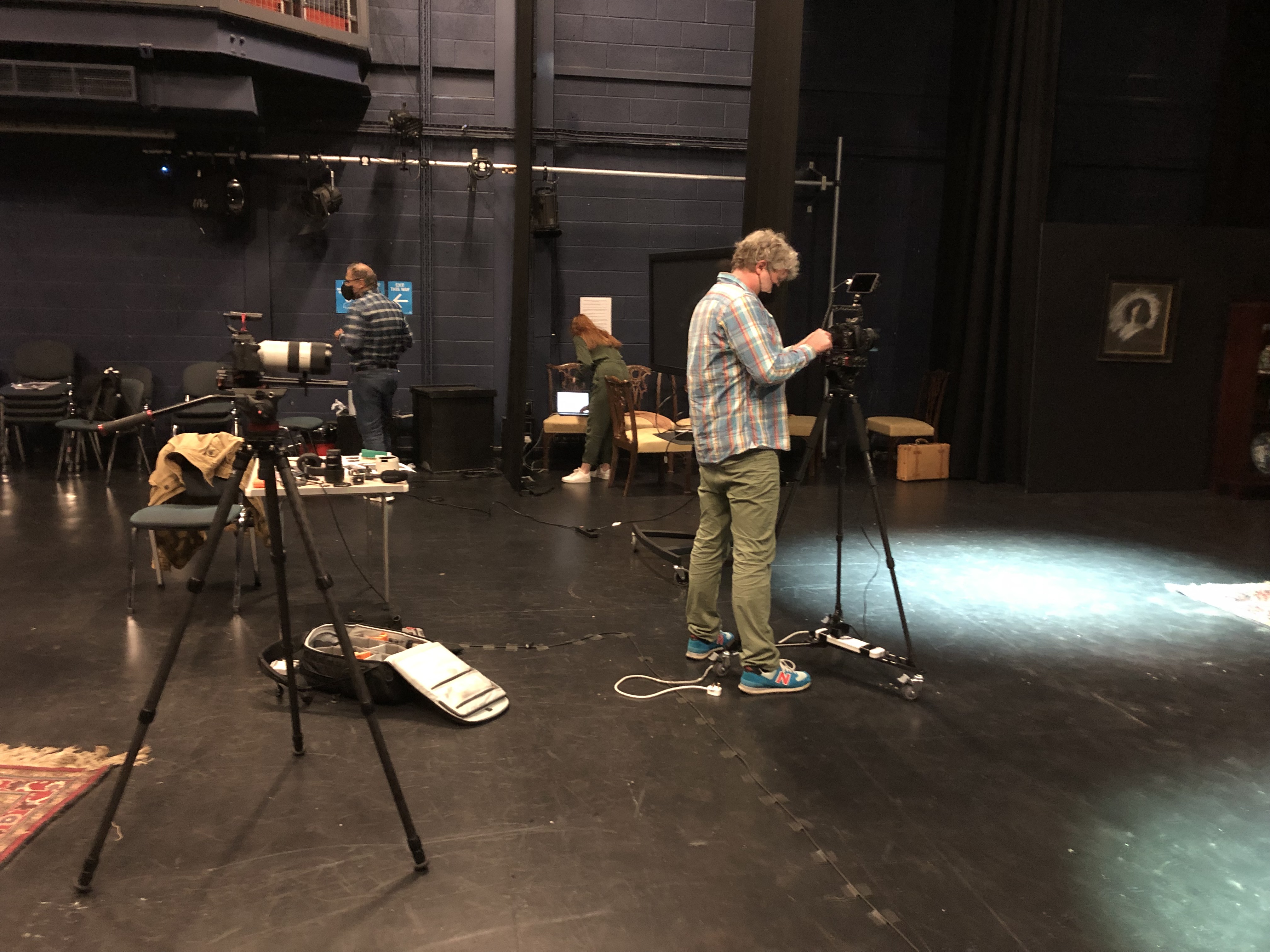
Filming Quinneys was a very complex operation, with some very sophisticated technical kit, and it required very detailed planning and execution – here’s a long shot of the setup for filming, with Patrick Bannon (far right) and the team manning the cameras.
Filming Quinneys. Photograph, Year of the Dealer project, 2021.
And another photograph of Patrick checking the camera ready for filming another scene of Quinneys (2021) –
Filming Quinneys. Photograph, Year of the Dealer project, 2021.
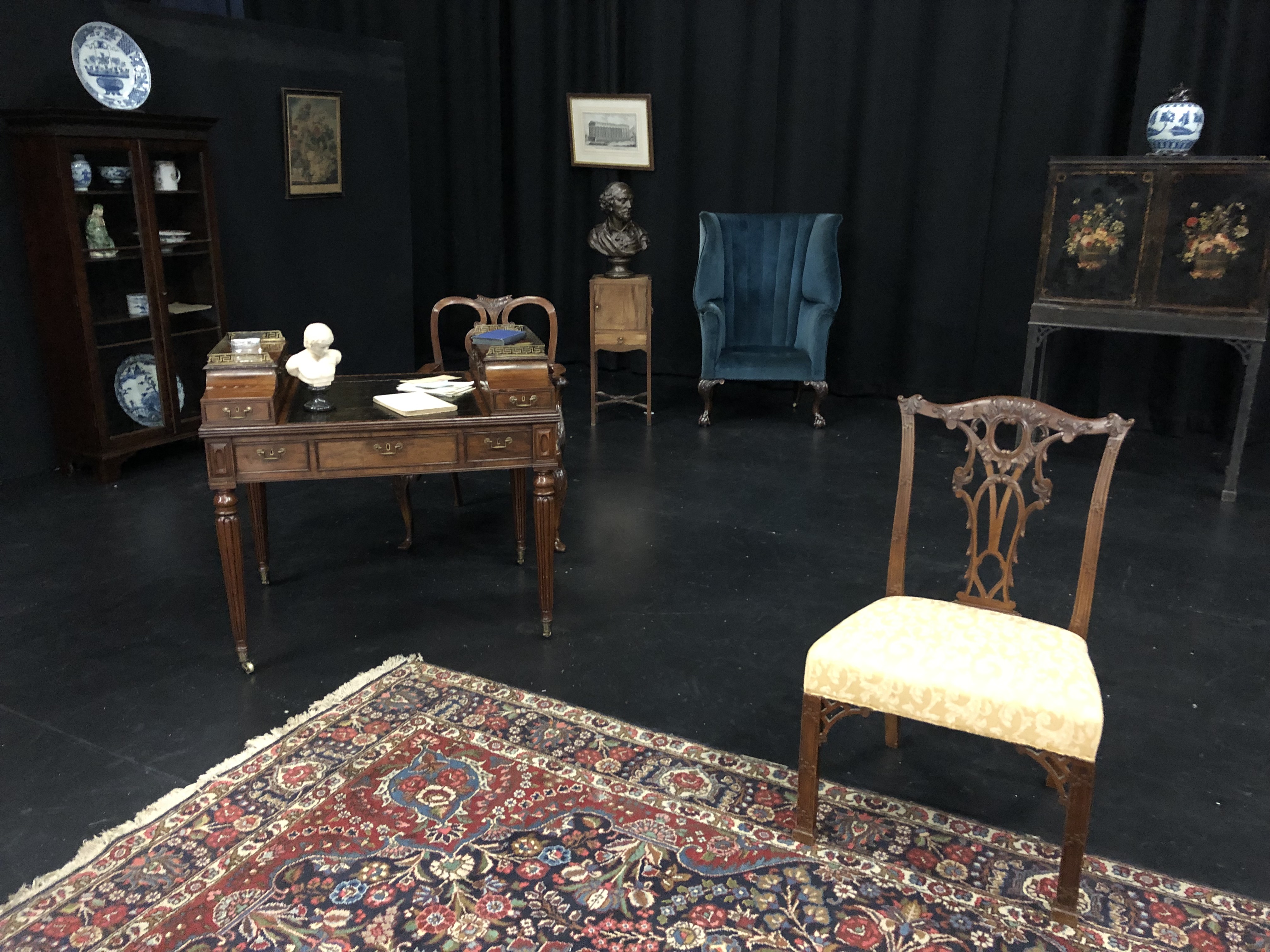
As well as the actors ‘starring’ in Quinneys the antiques on Set were also key characters in the film, as they were in the original staging of the play in 1915. All the objects on Set were genuine antiques, and, like the original versions of the play in 1915, were loaned by leading antique dealers. In 1915 dealers such as Walter & Ernest Thornton-Smith and M. Harris & Sons loaned antiques. And below is a photograph of the Set for Quinneys’ ‘Sanctuary’ in 2021.
The Set for Quinneys’ ‘Sanctuary’. Photograph, Year of the Dealer project, 2021.
The antiques for Quinneys (2021) were very generously loaned by David Love Antiques, Harrogate, Simon Myers of R.N. Myers & Sons, Gargrave, and Tony Lumb of Charles Lumb & Sons, formerly of Harrogate. We were very lucky to have such wonderful antiques for the Set, and would like to say thank you again to David, Simon and Tony for all their help and support.
Here is a final photograph of all the cast of Quinneys (2021) on Set in Quinneys’ ‘Sanctuary’. We very much look forward to welcoming everyone to the premiere of Quinneys later in the year. Keep you eye on the project website for more details.
Mark
Cast of Quinneys (2021). Photograph, Year of the Dealer project, 2021.
We are delighted to announce that the Arts & Humanities Research Council (AHRC) funded project, ‘Sold! The Year of the Dealer’ has emerged from hibernation and we have started rehearsals again for the restaging of the play ‘Quinneys’ (1915). Thanks to a further extension to the Year of the Dealer project from the AHRC we can now continue the project, which now ends on 31st December 2021. We will update you on the remaining proposed events and the museum trails later in the summer, but for now, we are all really excited to announce that Quinneys is alive and well.
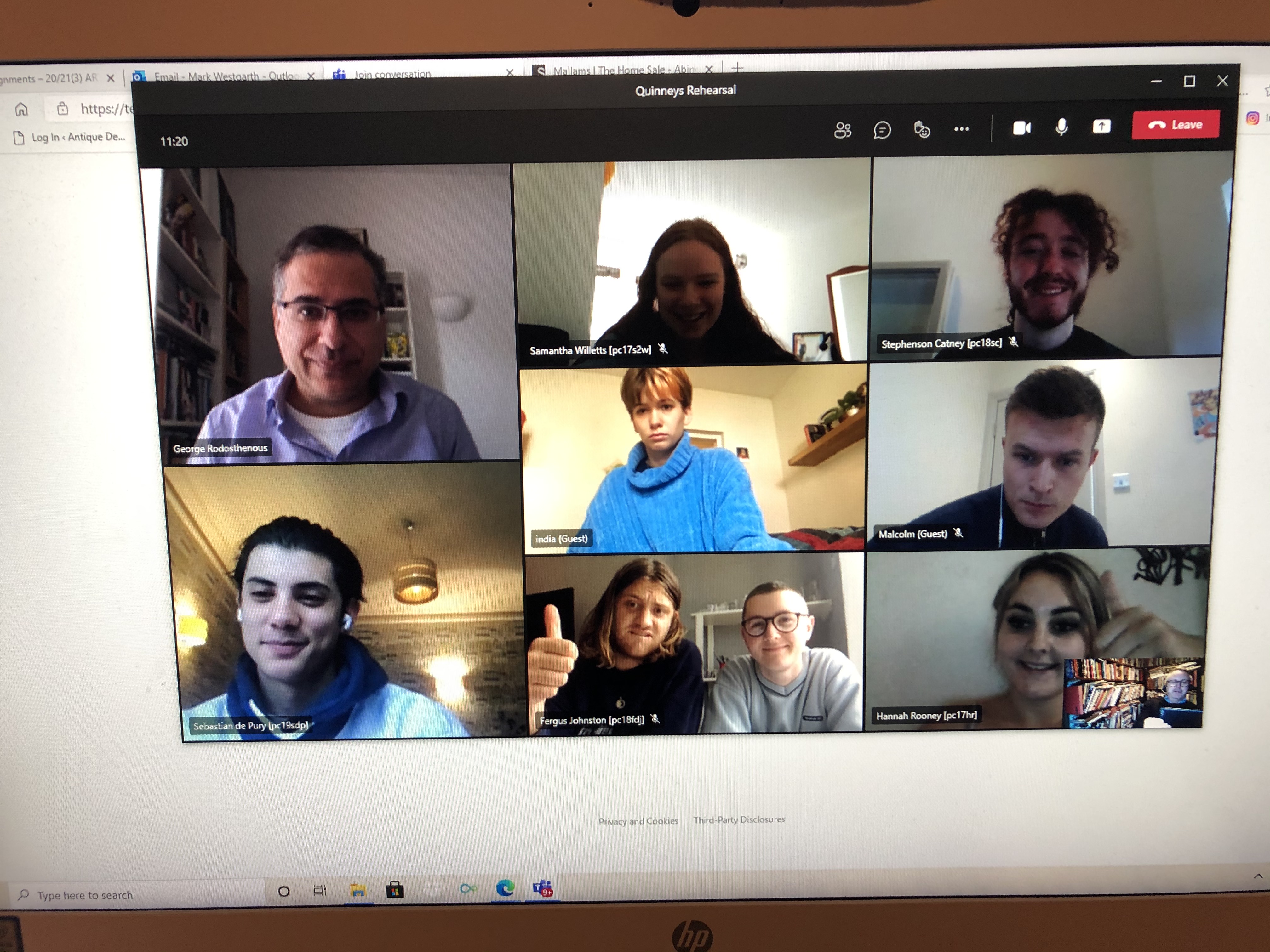
Rehearsals are currently taking place online via TEAMS – which makes it an interesting if somewhat challenging experience, but our actors and George Rodosthenous, our Director, are doing brilliant work in this virtual space. Here’s a screen shot of the most recent rehearsal, with George (top left) directing the actors, and with Samantha Willetts (top middle) our new Theatre Company Manager and Lighting Designer. The actors are – Stephenson Catney (top right) who will be playing the part of the American millionaire collector Cyrus P. Hunsaker; Sebastian du Pury (bottom left) one of our new actors, playing the part of the American millionaire collector Dupont Jordan; India Walton (centre middle) playing the part of Mabel Dredge, Quinneys’ typist and a love interest of James Miggott in the play; Malcolm Webb (right middle) another of our new actors, playing the part of the antique dealer Sam Tomlin; Samuel Parmeter (left) and Fergus Johnston (right) (centre bottom), playing the parts of the antique dealer Joseph Quinney and James Miggott, Quinney’s workshop foreman, respectively; and Hannah Rooney (left bottom), playing the part of Mrs Susan Quinney. We are missing Annabel Marlow is this photograph (who plays Posy Quinney, the daughter of Susan and Joseph Quinney, and the other live interest of James Miggott) – and there’s a tiny image of me (Mark) in the bottom right corner, taking the photograph!
Quinneys rehearsal on TEAMS at the University of Leeds.
The pandemic has of course meant that we have had to rethink our plans to restage a performance of the play in a theatre – but the exciting news on the Quinneys project is that we are making a film of the play instead. We will be filming Quinneys at the University of Leeds in early July and following that we are planning to have a ‘premiere’ of the film at a cinema later in the year – so do look out for updates on the antique dealer project website antiquedealers.leeds.ac.uk and on this Blog of course.
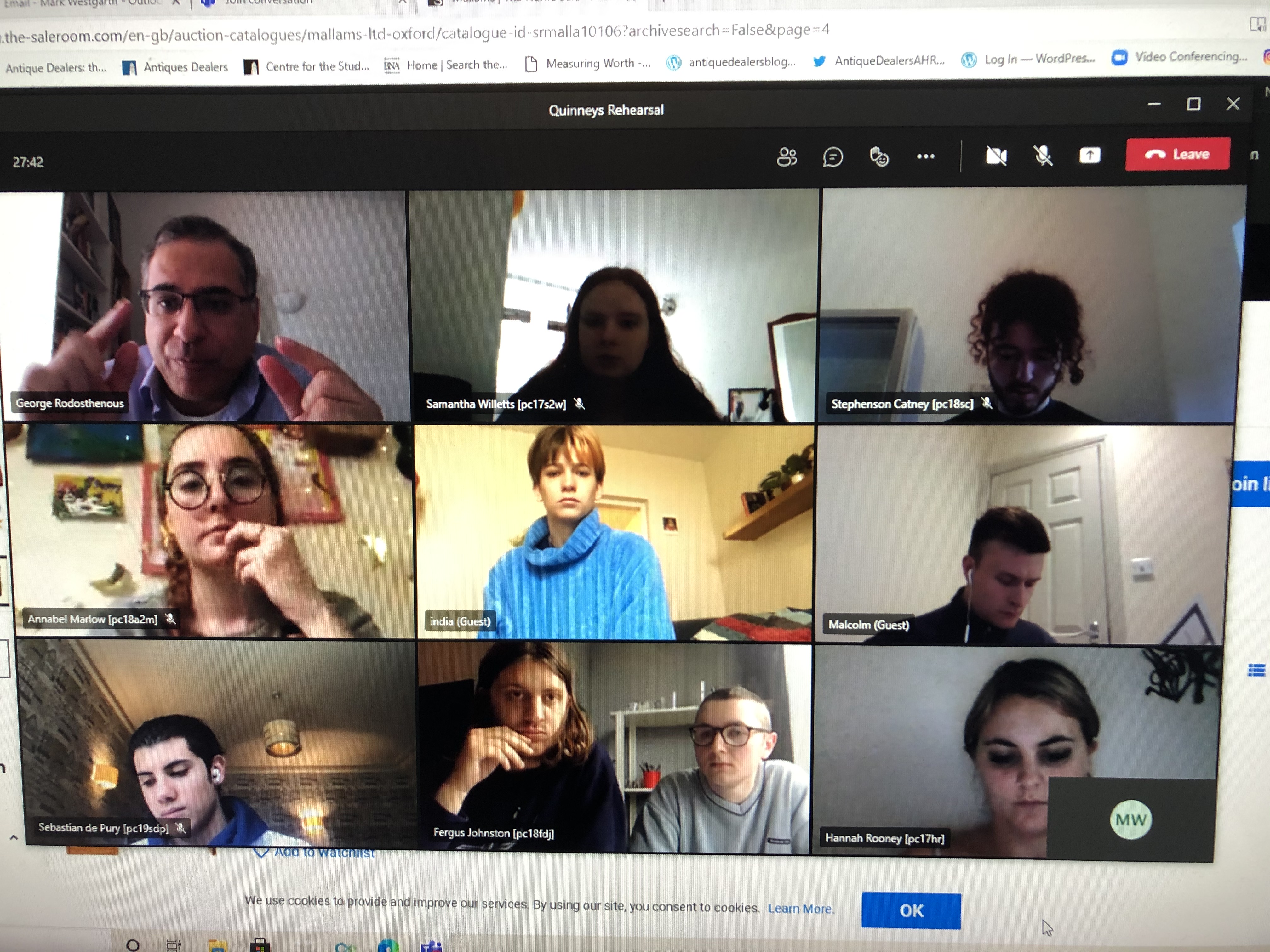
In the meantime, here’s another photograph of the Quinneys rehearsals on TEAMS, with all the actors – and this time including Annabel Marlow (left centre), who pays Posy Quinney in the play/film.
Quinneys rehearsals on TEAMS at the University of Leeds.
We very much look forward to welcoming everyone to the World Premiere of our film of Quinneys later this year.









 antiquedealersblog