One of our occasional guest blog posts – this time another post from our friend Chris Coles. Thanks Chris for such a fascinating blog post! – Mark
One of the real pleasures involved with researching antiques is uncovering some of the stories relating to dealers of the past who might now have slipped into obscurity. The Antique Dealer Research Project map website is always the best place to start of course and so, when I discovered that a piece I was researching had provenance to a firm named Baliol Ltd (not Balliol like the Oxford college) I was intrigued. Here is the link to the Baliol page on the project website https://antiquetrade.leeds.ac.uk/dealerships/37156
The firm advertised in Country Life and Connoisseur but not particularly regularly. They were certainly not amongst the firms who showed stock for sale in every issue and, as such, their importance as a dealership has perhaps been overlooked. This short post is an attempt to rectify this and also a call to those who may have more information about the firm to get in touch and help preserve the name for future generations.
Baliol-what we know so far
All the adverts for the firm that I have been able to locate have come from 1931, which also seems to be the year when the firm came to some prominence. The first reference I have found to the firm is from April 1931, but not in an advert, rather in a reference to a court case. The same text appeared in a vast number of newspapers, syndicated across the UK, but the version transcribed below appeared in the Dundee Courier on the 14th of April 1931. The article reads as follows:
‘FURNITURE ALLEGED TO HAVE BEEN FAKED
Two captains, a widow, furniture which was alleged to have been “faked”, and a cheque for £450 figured in a case at Marlborough Police Court, London, yesterday. The men were Capt. H. J. Newnes, of Royal Crescent, Holland Park, London, and Capt. A Salisbury Devenport, of Marylebone Road, London. The widow was Mrs Stubbs, managing director of Baliol Ltd., Albemarle Street, London. The two men were charged with conspiring together to obtain a cheque for £450 from Baliol Ltd.
It was alleged that Newnes called on Mrs Stubbs and suggested she should see some furniture which Devenport had in store. He is alleged to have said it had been in Devenport’s family for more than 100 years. Mrs Stubbs went and saw a chair and a table, which, it was alleged, Devenport told her were genuine Chippendale. She gave him a cheque for £450, taking the furniture by taxi to her stores. She offered Newnes £10 as commission. The next day, it was stated, Mrs Stubbs had the furniture examined by an expert, who said it was faked. Both men denied the charge, and the hearing was adjourned’.
Both men were found guilty of all charges.
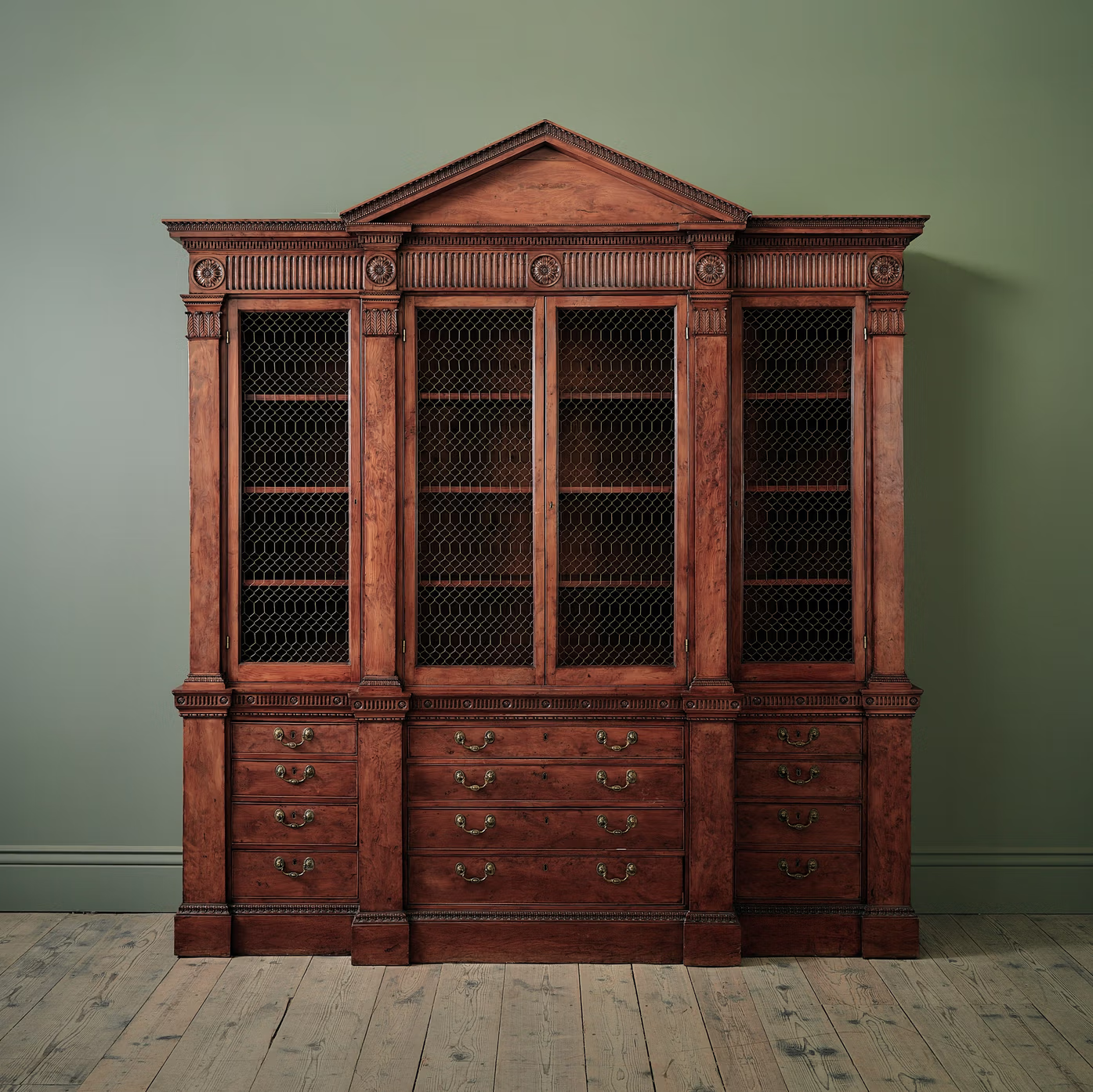
Clearly Mrs Stubbs’ knowledge of antique English furniture was a little deficient in this instance, but the quality of the pieces they dealt in is illustrative of their importance in the history of the antique trade. For example, Country Life (9th of May 1931) carried a write-up about pieces in stock at ‘Messrs Baliol’s of Albemarle Street’ which included ‘a large break-front bookcase…made of yew wood of mellow colour. The centre section of the upper stage is surmounted by a pediment, and this stage is flanked by pilasters with leaf capitals. The cupboard doors are fitted with wire trellis. In the lower stage, which is fitted with drawers, is a fluted and pateraed frieze corresponding to that of the upper stage but narrower’.
This piece, described so beautifully by the author of the article J. De Serre, is highly likely to be a very famous bookcase which was subsequently acquired by Randolph and taken to Grosvenor House in 1937. This piece was latterly in the Simon Sainsbury collection, having passed through the hands of antique dealers Mallett & Sons (twice) and Hotspur Ltd., and is now with Hawker Antiques, part of Jamb Ltd, on the Pimlico Road – see www.jamb.co.uk (see below).
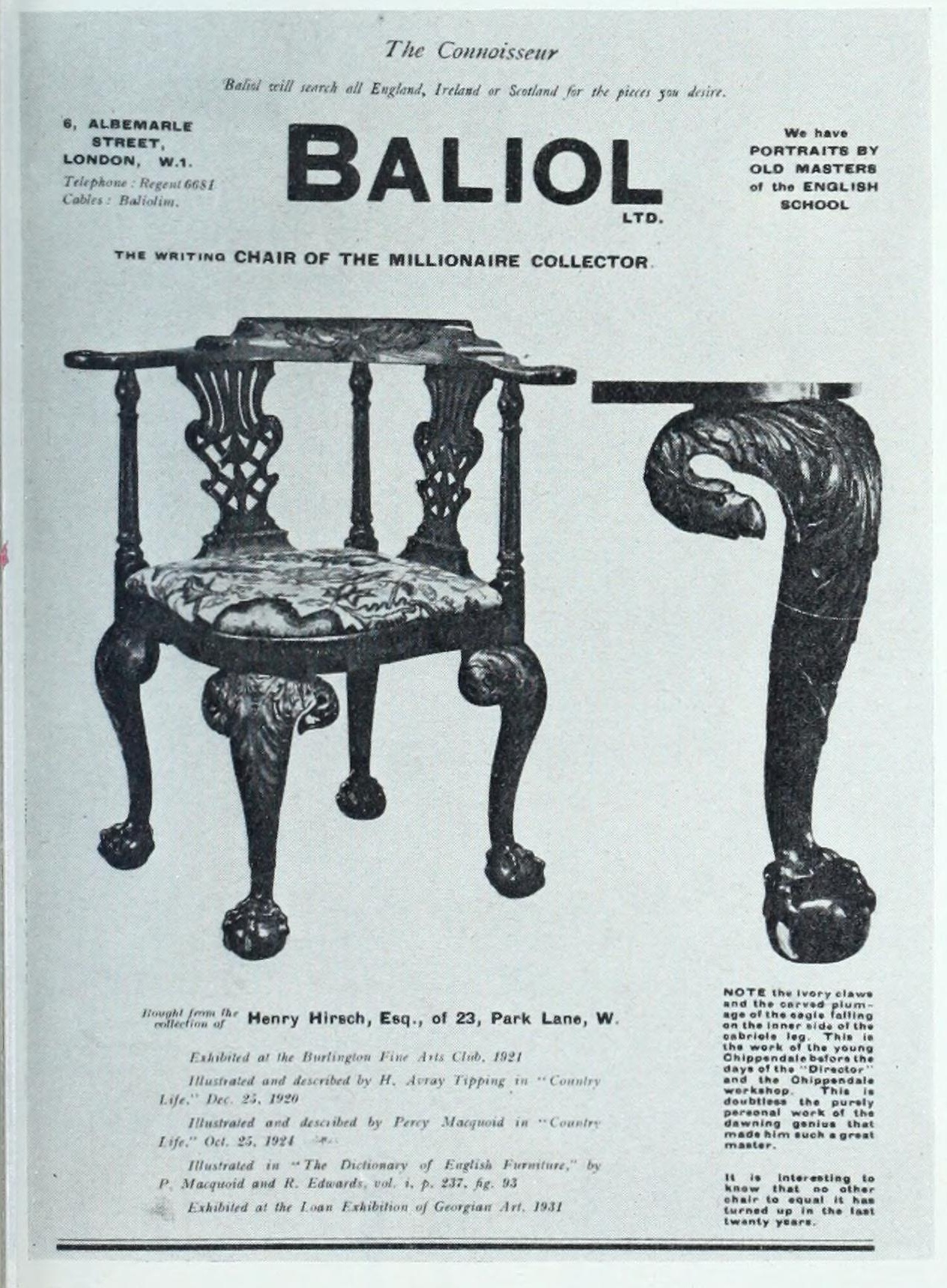
The bookcase would be a jewel in any antique furniture dealer’s stock but it was certainly not the only very fine piece Baliol handled. In 1931 they acquired the famous corner writing chair, immortalised in the Dictionary of English Furniture that had belonged to the famous collector Henry Hirsch and graced his Park Lane mansion. In 1976, Connoisseur ran a feature on adverts of the 1920s and erroneously reprinted the Balliol advert for the chair which had featured in the magazine, presumably in July 1931 (see below). The text of the firm’s advert highlights the Hirsch provenance, using the tag line ‘The writing chair of the millionaire collector Henry Hirsch’. The chair also featured in Christie’s yearbook 1931, having achieved the very high price of £1008 in the Hirsch sale on the 10th of June 1931 (lot 70).
Another advert was placed by Baliol Ltd in The Art Newspaper (16th May 1931) (see below) adds a lot of additional information to our understanding of the firm. It also makes clear that the firm dealt in ‘Old Masters, furniture, tapestries, needlework and Chinese porcelain’ with ‘a guarantee of authenticity given with everything’. With lots of stories about fakes and forgeries circulating in the press, such statements in antique dealer’s adverts were quite common in the period. The firm also appealed to the trade, stating ‘Trade please note – Baliol will search all England, Ireland or Scotland for the pieces you require’.
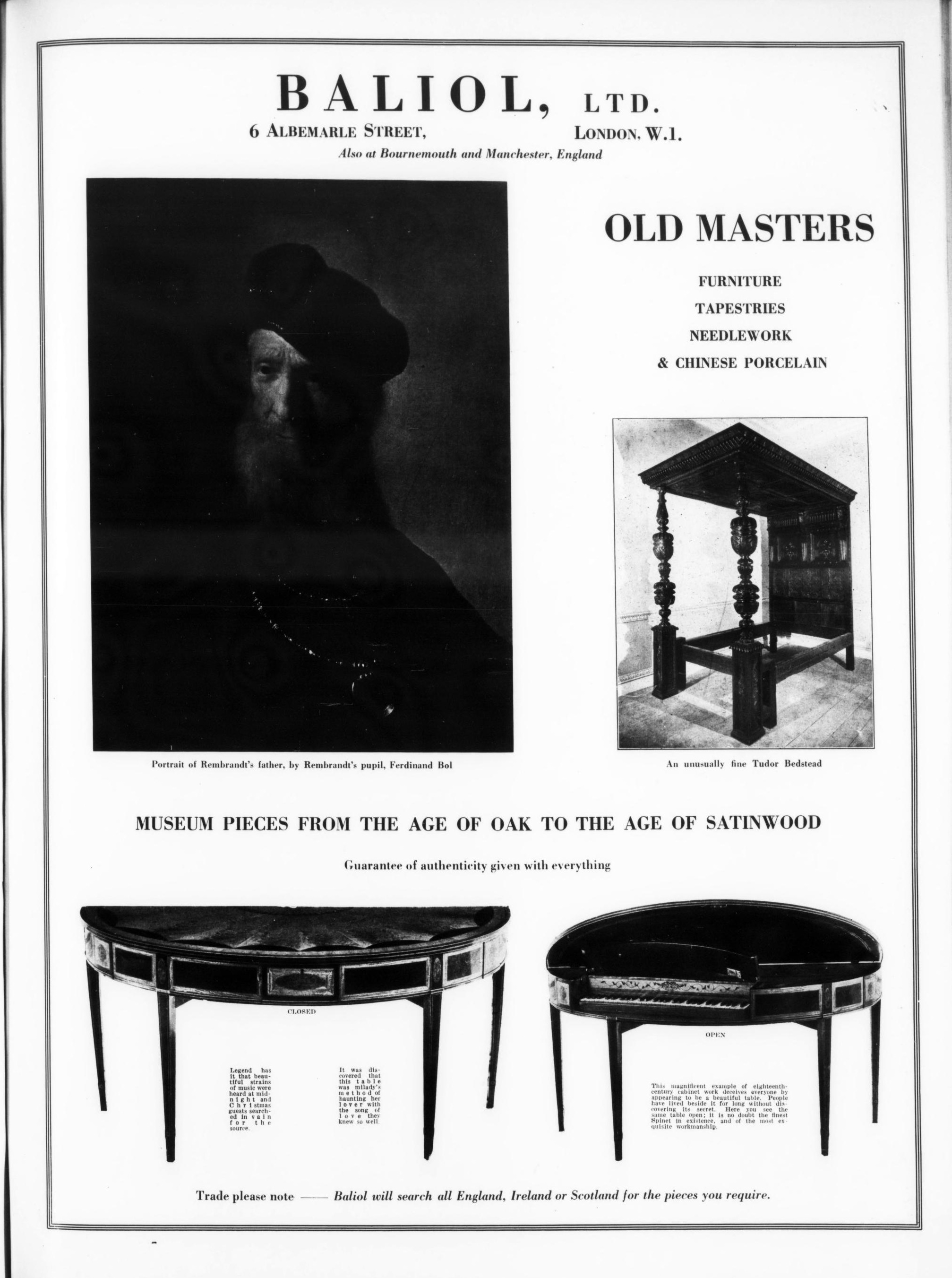
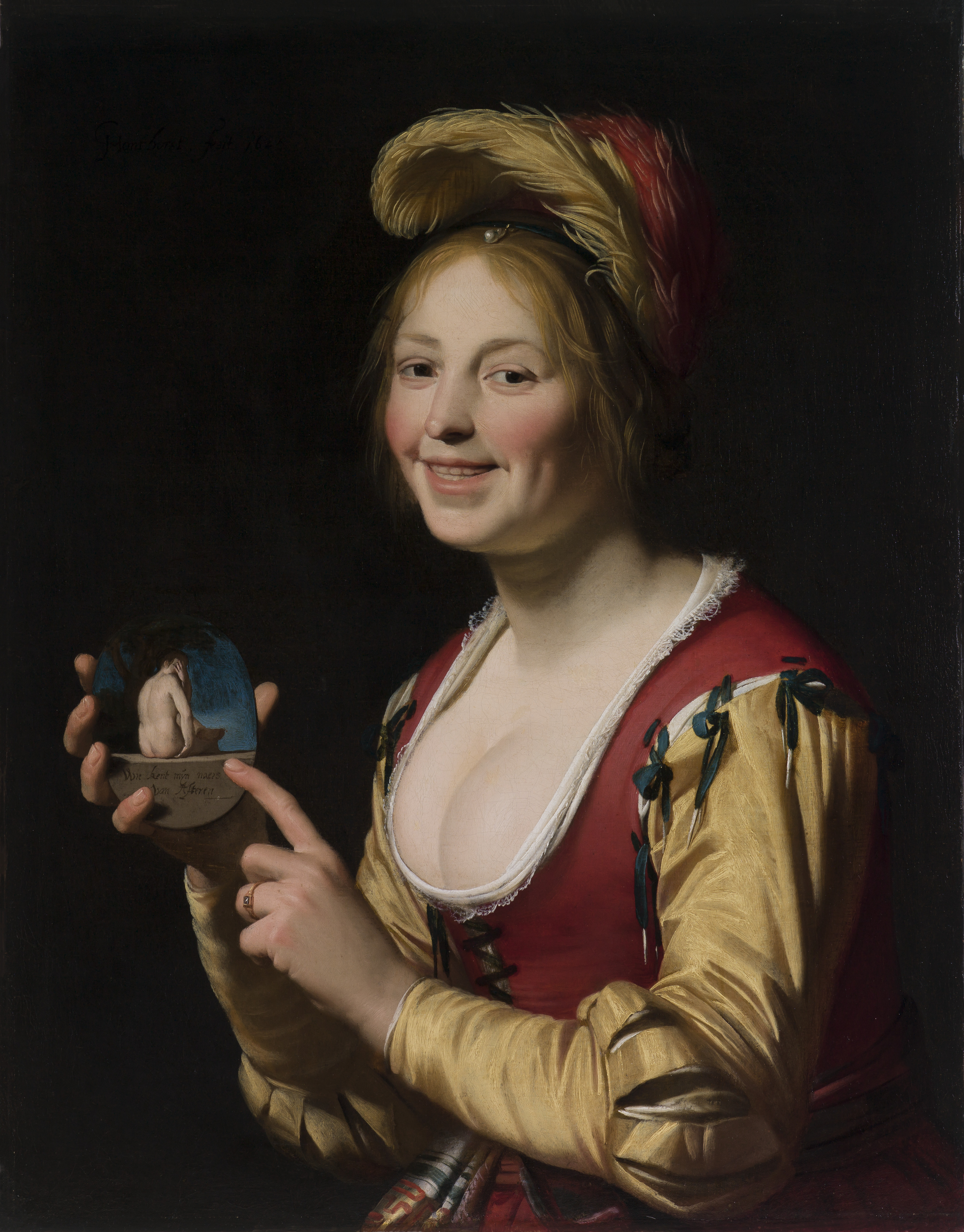
In terms of stock, they showed a Tudor oak bed and a beautiful demilune table piano, the case probably by William Moore of Dublin. This lovely piano was clearly not a quick seller as it was still available when profiled by Country Life on the 1st of August 1931. But it’s clear that Baliol sold ‘Old Master’ paintings alongside antique furniture. They illustrated a painting by Ferdinand Bol (1616-1680); they also had a very fine Dutch painting by Gerrit van Honthorst (1592-1656) in 1931, ‘Smiling Girl, a Courtesan, holding an obscene image’ (1625), which Baliol bought at Christie’s on 3rd July 1931 (lot 85), and is now in the collection of the Saint Louis Art Museum, Saint Louis, Missouri, USA (63.1954).
The advert also states that the firm had branches ‘at Bournemouth and Manchester’. I haven’t found any further information about the Manchester premises, but an advert in the property section of Country Life (8th October 1932) sheds fascinating light on the Bournemouth arm of the business.
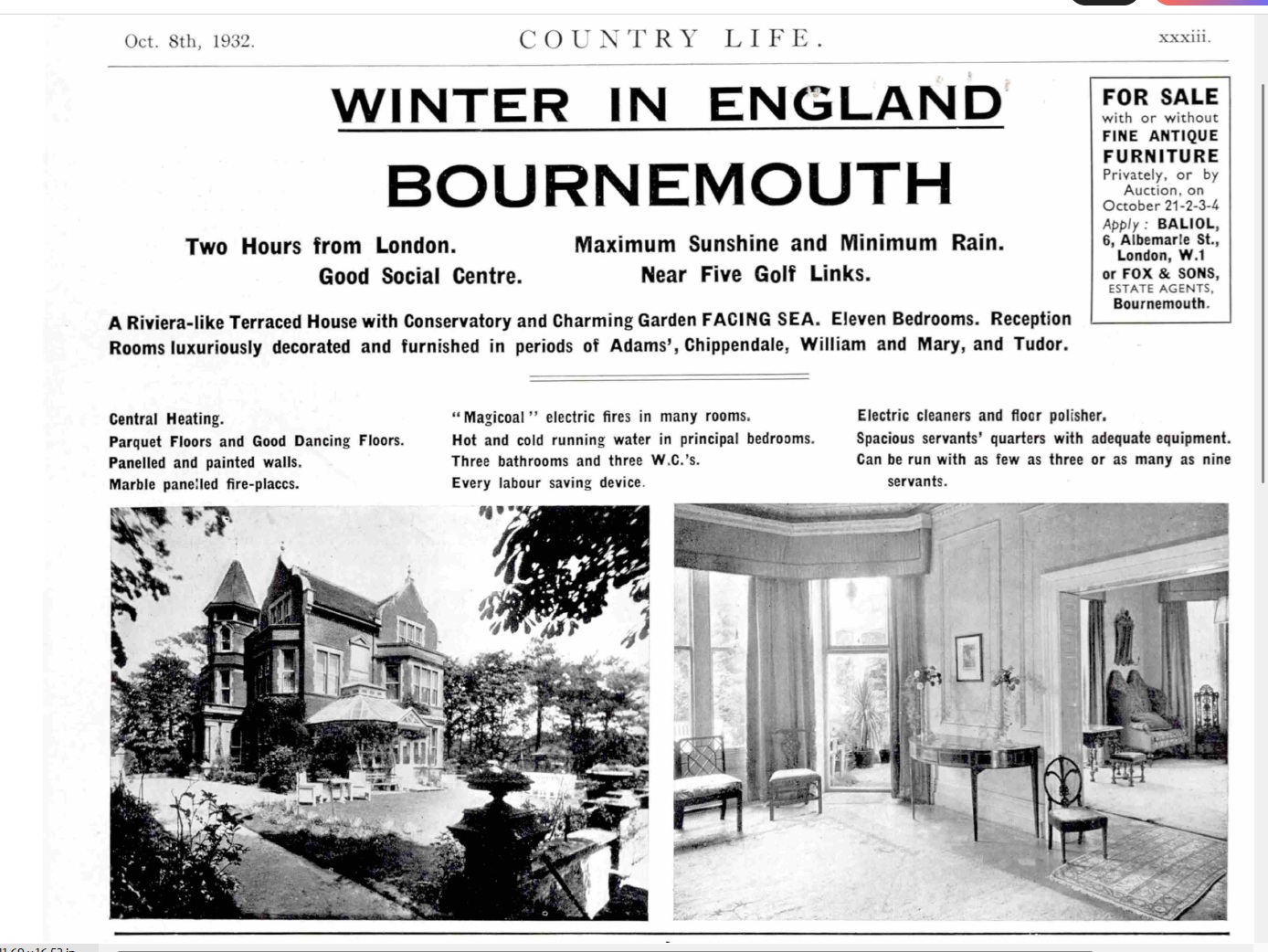
The advert shows a detached mansion in Bournemouth which was offered for sale ‘with or without fine antique furniture’. We are told that the ‘Riviera-like terraced house’ has ‘reception rooms luxuriously decorated and furnished in periods of Adams’ (sic), Chippendale, William and Mary and Tudor’. The image of one of the interiors shows some lovely pieces of antique furniture, including a William and Mary settee, a Hepplewhite chair, a cockpen chair and the William Moore-type table piano. Presumably, Baliol realised that having a display property on the English Riviera in the fashionable town of Bournemouth was a perfect way to capture those clients holidaying in the milder climes.
Clearly the firm traded at the very highest level, but seemingly only for a very short period. Where the interesting name for the firm came from is certainly one question I would like answered. I have found the name Baliol being used as the middle name of some important families and wonder whether there was any familial link between any of these and Mrs Stubbs?
Please do get in touch if you have any further information on Baliol Ltd. Post a comment on the Blog or email us at antiquedealers@leeds.ac.uk
Chris Coles.