Posts tagged ‘H.M. Lee’

July 27, 2025

Early 20th century auction catalogues – dealer provenance, Levine & Sons.

We were fortunate to acquire a small cache of old auction catalogues at auction last week (thank to Keys Auctioneers in Norfolk for the careful packing and posting!). I normally look out for old auction catalogues anyway as they are increasingly rare (especially small local auction sales of country house contents), but this set of catalogues has proved to be especially interesting as they had previously belonged to members of the well-known Levine family of antique dealers based in Norfolk. They give us a fascinating insight into early-and-mid 20th century antique dealing.
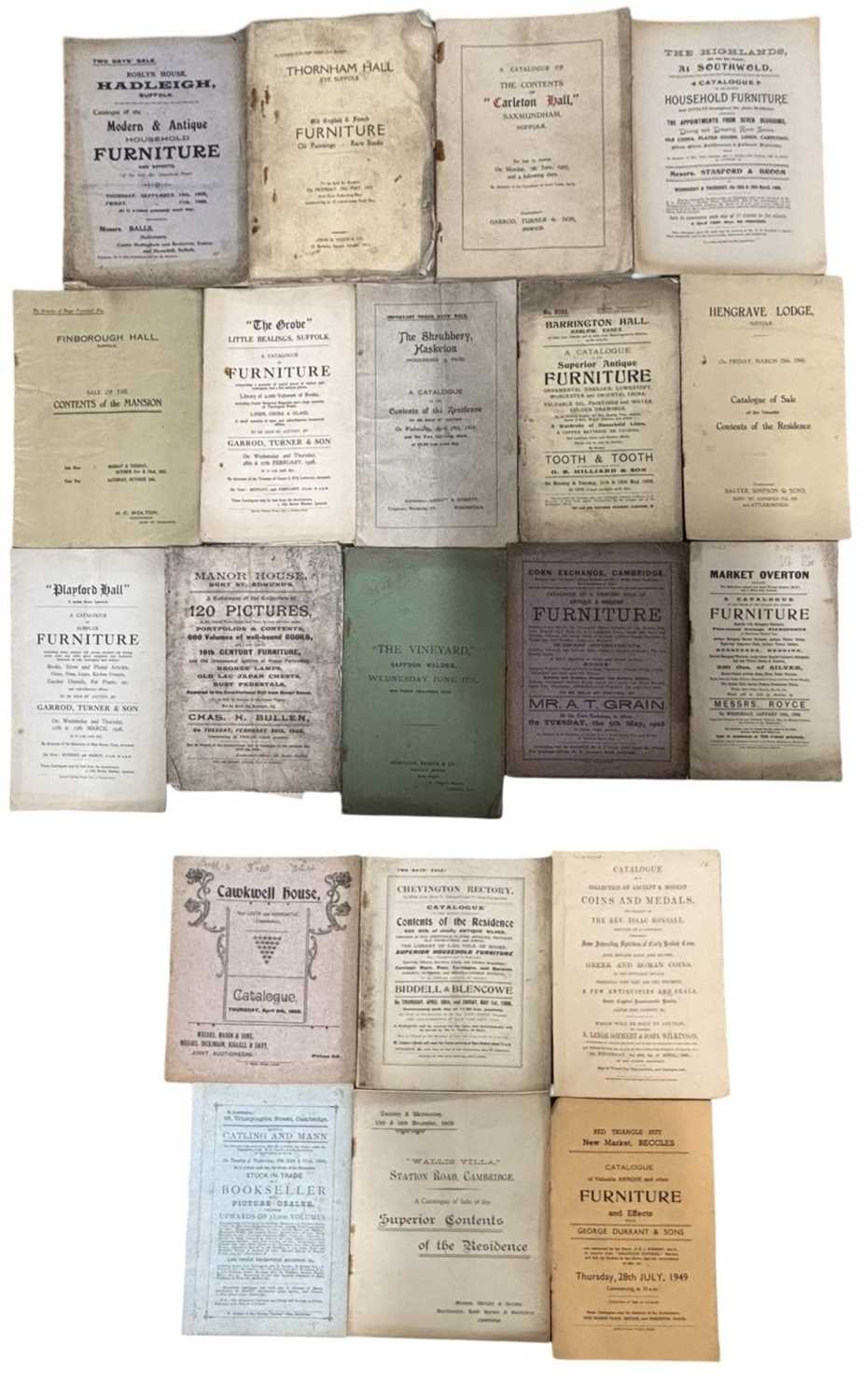
19th and 20th century auction catalogues sold by Key Auctioneers 16th-17th July 2025. Photograph, Keys Auctioneers.

The Levine family started as antique dealers in Norfolk in the 1860s with shops in Norwich and Cromer. Levine became specialists in antique silver, becoming a member of the British Antique Dealer’s Association (BADA) in 1920. Louis Levine (1865-1946) established Louis Levine & Son in the late 19th century and had shops in Prince of Wales Road, Norwich in 1900 – he was described as ‘Dealer in Plate, Jewels and etc.’ and as ‘Dealer in Antiquities’ in the 1901 and 1911 Census; he also had a shop in Church Street, Cromer and a shop in London (192 Finchley Road) from the mid 1920s. Rueben Levine (1865-1927), the son of a jeweller Moses Levine, was another member of the Levine family of antique dealers, establishing his business in 1891. Another family member, Edward David Levine (1906-1984) established an antique dealing business in 1931, employing his brothers Victor Jacob Levine (1896-1934) and Henry Levine (1904-1978); Henry established his own antique dealing business in 1935. It’s not unusual for a family to generate multiple antique dealing businesses – see our ‘guest’ blogpost in May 2025 by Andy King on the Lock family of dealers.

The auction catalogues range in date from the 1870s to the 1940s and relate to some significant country house auctions in Norfolk, Suffolk and the surrounding area, including Playford Hall, Ipswich (contents sold by Garrod, Turner & Son in March 1936); Finborough Hall, Suffolk (contents sold by H.C. Wolton in October 1935); Hengrave Hall, Suffolk (contents sold by Salter, Simpson & Sons in March 1946), Carelton Hall, Saxmundham, Suffolk (contents sold by John D. Wood in June 1937) and which was destroyed by fire in 1941, and Thornham Hall, Eye, Suffolk (contents sold by Garrod, Turner & Son in May 1937), which was partially demolished following the auction of the contents and finally destroyed in a fire in 1954.
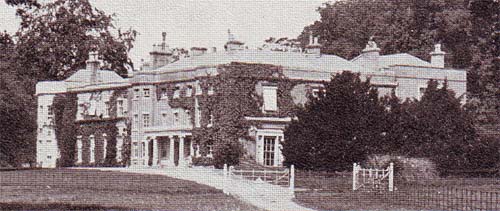
Carelton Hall, Saxmundham, Suffolk, c.1930. https://creativecommons.org/licenses/by-sa/2.0/

These 1930s and 1940s auction catalogues seem to relate to the Levine antique dealing business at 74a Prince of Wales Road, Norwich run by ‘R. Levine’, (Rueben Levine) established in 1891. A signature in an auctioneers slip that still remains in the Thornham Hall catalogue is that of ‘G. J. Levine’ (not quite sure who this is in the Levine family?) and an address 74a Prince of Wales Road, Norwich.
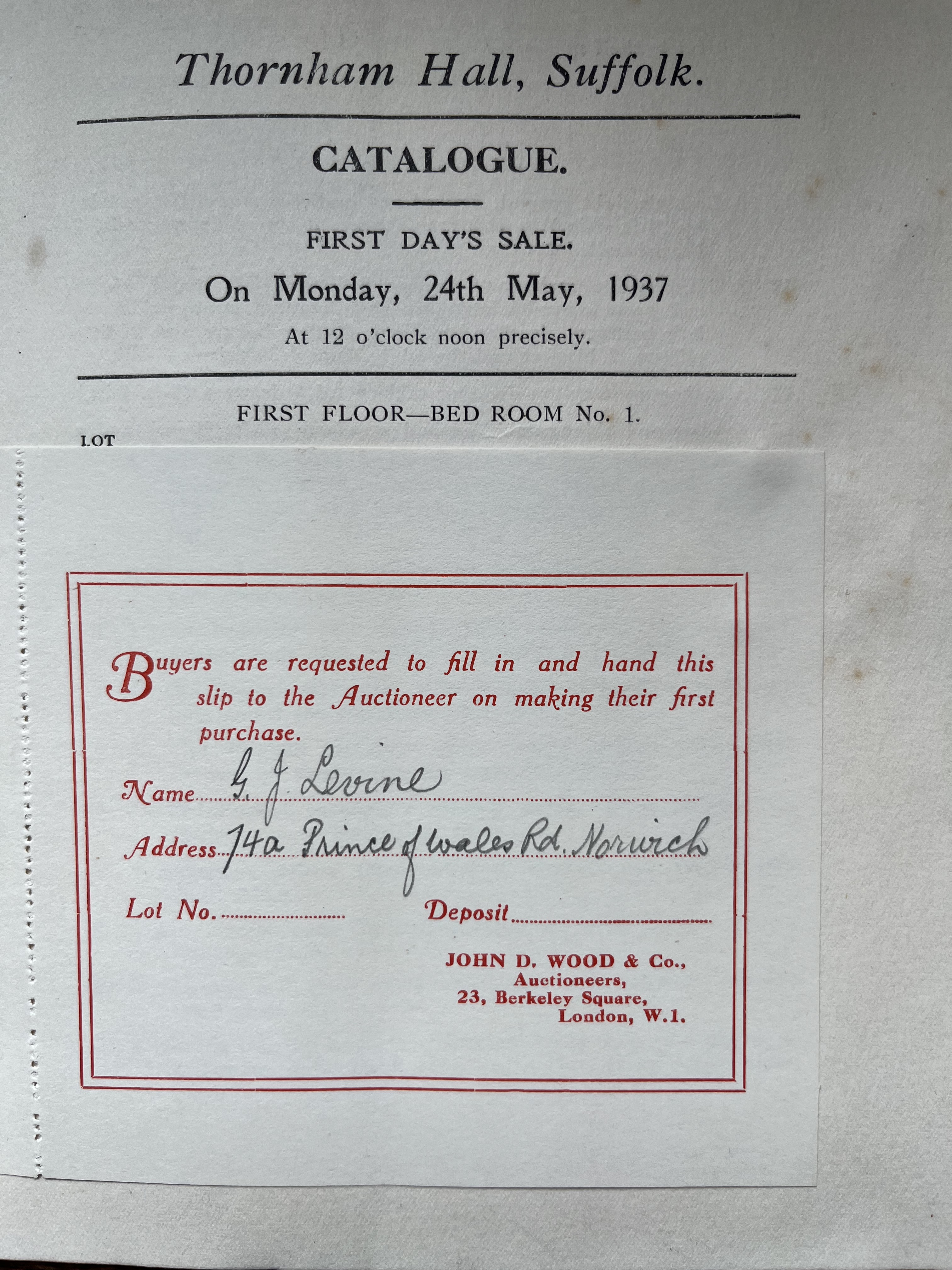
Thornham Hall auction catalogue with auctioneers slip. Photograph, Antique Dealer Research Project, University of Leeds.

The Thornham Hall catalogue also contains annotations made by Levine, indicating maximum bids and some prices realised (in pounds, shillings and pence) with the names of other antique dealers who had bought important lots. Below (see picture), Lot 573, ‘A WILLIAM KENT SIDE TABLE’ was bought for £63 by the London dealer Isaac Staal & Sons (Levine writes it as ‘Stall’) important dealers in antique furniture with a smart shop in Brompton Road, London at the time. Lot 575, ‘A GEORGE 1ST MAHOGANY SUITE’ made the enormous sum of 385 guineas (£404 and 5 shillings – equivalent to about £148,000 at the time). Unfortunately there are no illustrations of the Lots in the catalogue.
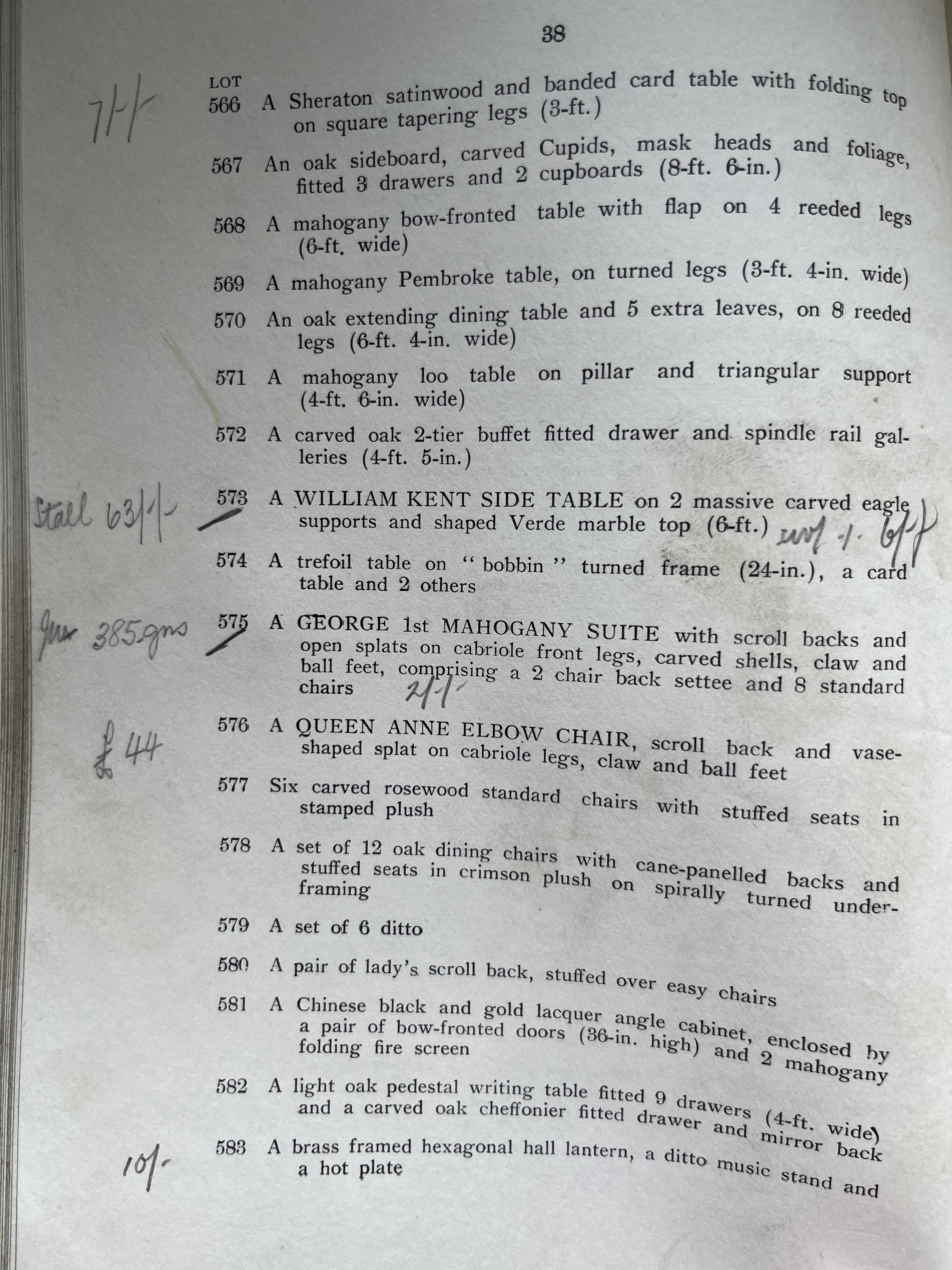
Thornham Hall auction catalogue with Levine’s annotations. Photograph, Antique Dealer Research Project, University of Leeds.

Levine tends to write out dealer names in full next to the Lot numbers and there are some familiar dealers listed as buyers – Rixon, Lee, Mannheim, Cohen etc. The buyer of Lot 575 is noted as ‘JW’, listed by Levine as the buyer of many Lots at the Thornham Hall auction. ‘JW’ is obviously someone familiar to Levine and is almost certainly the dealer John Wordingham. Wordingham established his antique dealing business in 1908 and was a member of the BADA. He had been a neighbour of Levine at 74 Prince of Wales Road in the 1920s, but by the 1930s (at the time of the auction) he was trading from the famous 16th century ‘Augustine Stewards House’, Tombland, Norwich. Below is a photograph of Wordingham’s shop in 1935 just a couple of years before the Thornham Hall auction.
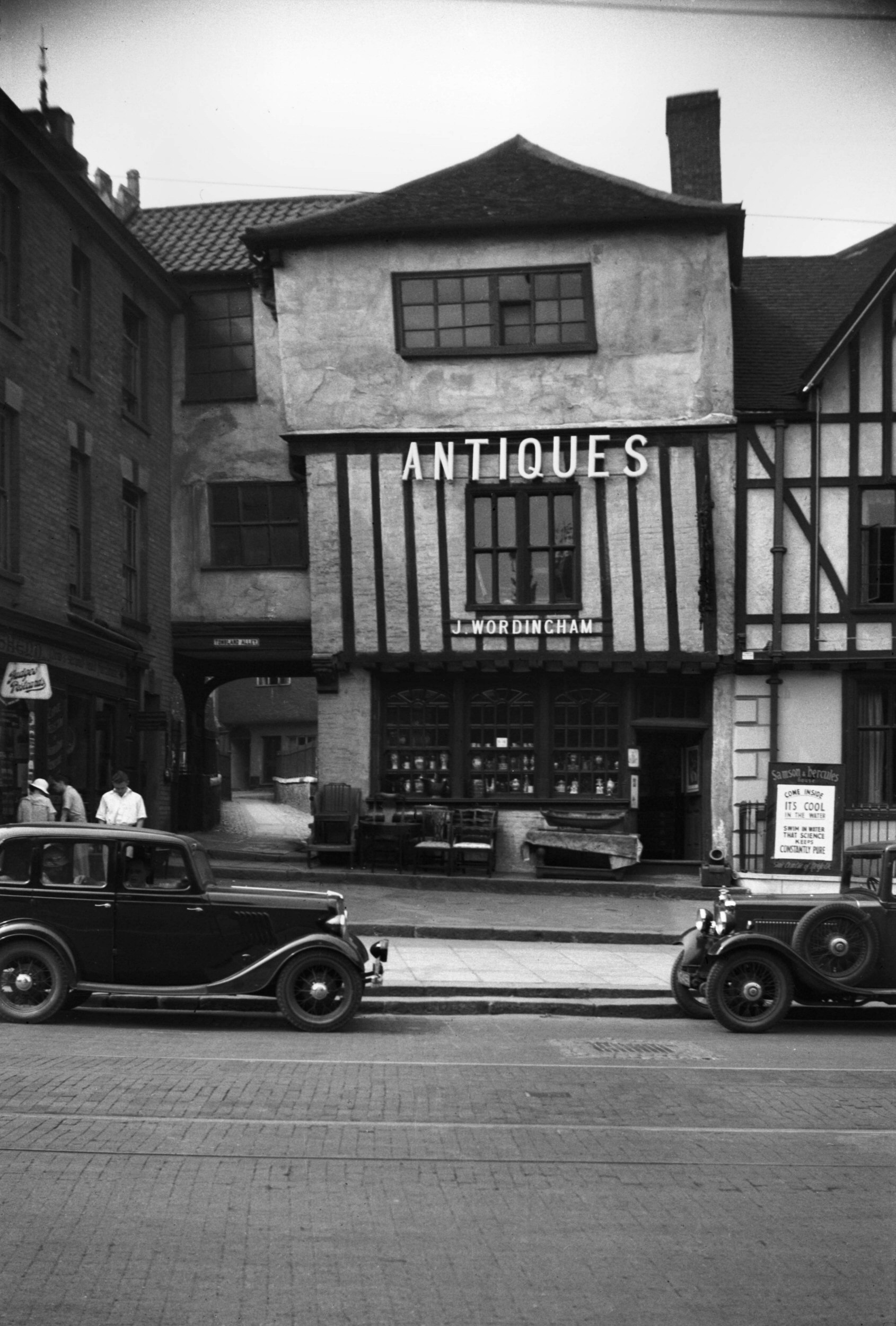
J. Wordingham antique shop, Augustine Steward House, Tombland, Norwich. Photograph George Plunkett.co.uk.

The auction catalogue of ‘The Shubbery, Hasketon, Woodbridge, Suffolk’ (contents sold by Arnott & Everett in April 1939) clearly illustrates the specialist interest of the Levine family as antique silver dealers. In the sections of antique silver in the catalogue (see below) there are lots of annotations and prices with names of various well-known London-based antique silver dealers as buyers – ‘Kaye’ (Angel & Kaye, silver dealers established in the 1930s); ‘Black’ (David Black, silver dealer established in 1915).
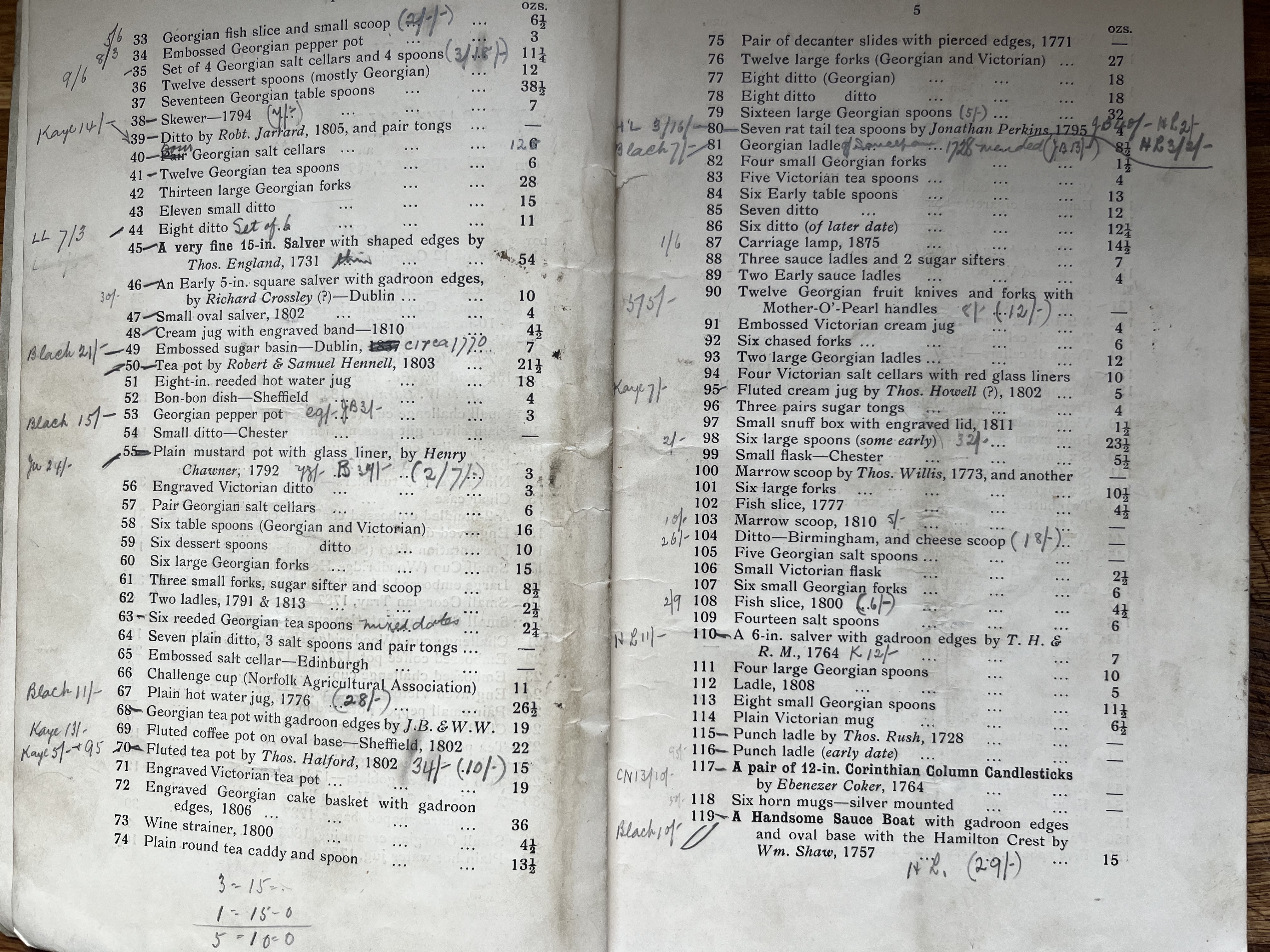
The Shubbery, Hasketon, auction catalogue, 1939. Photograph, Antique Dealer Research Project, University of Leeds.

As well as the catalogues from the 1930s and 1940s, six of the catalogues date from 1908 and have various annotations signed by ‘R. Levine’ so maybe by Rueben Levine (1865-1927) himself? The catalogue of the contents of ‘Manor House, Bury St. Edmunds’ (sold by Charles Bullen in February 1908) is particularly interesting.
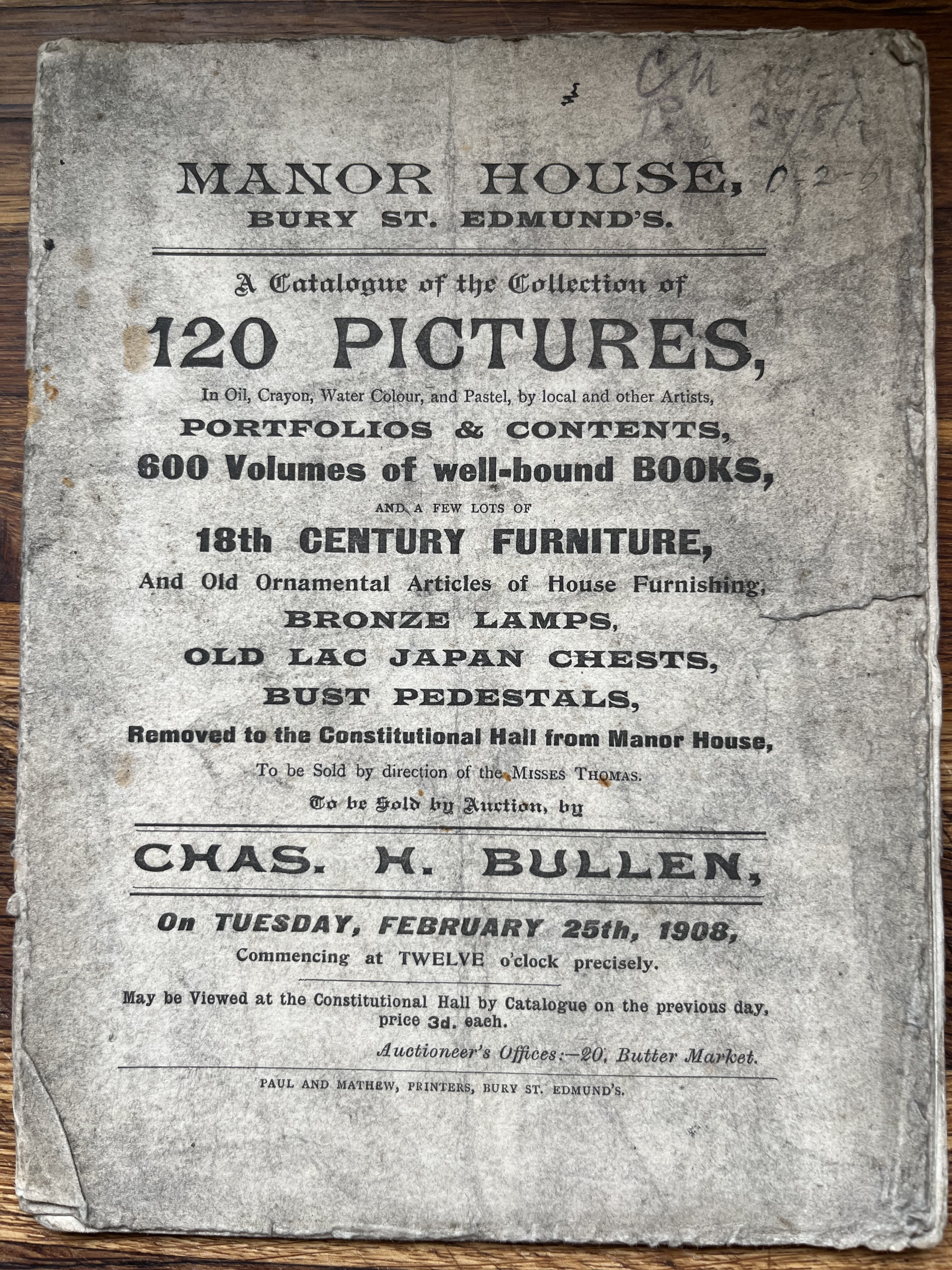
Manor House, Bury St. Edmunds, auction catalogue, 1908. Photograph, Antique Dealer Research Project, University of Leeds.

The Manor House catalogue has two intriguing hand written notes on the verso of the front cover (see below). The notes relate to 2 paintings sold at the auction. The note written in pen (to the left in the photograph) states ‘I hold in partnership with Owen Roe. 2 pictures Lots 121 & 135’, which cost a ‘total of £47-10-0’. It also has a note at the bottom stating ‘O. Roe paid me a Cheque for his share of above Viz £23-10-0 & has the 2 pictures to Sell. Feb 25-1908’. Owen Roe was an antique dealer trading from various shops in Cambridge, the business began in the late 19th century and continued in the family until the mid 1970s.
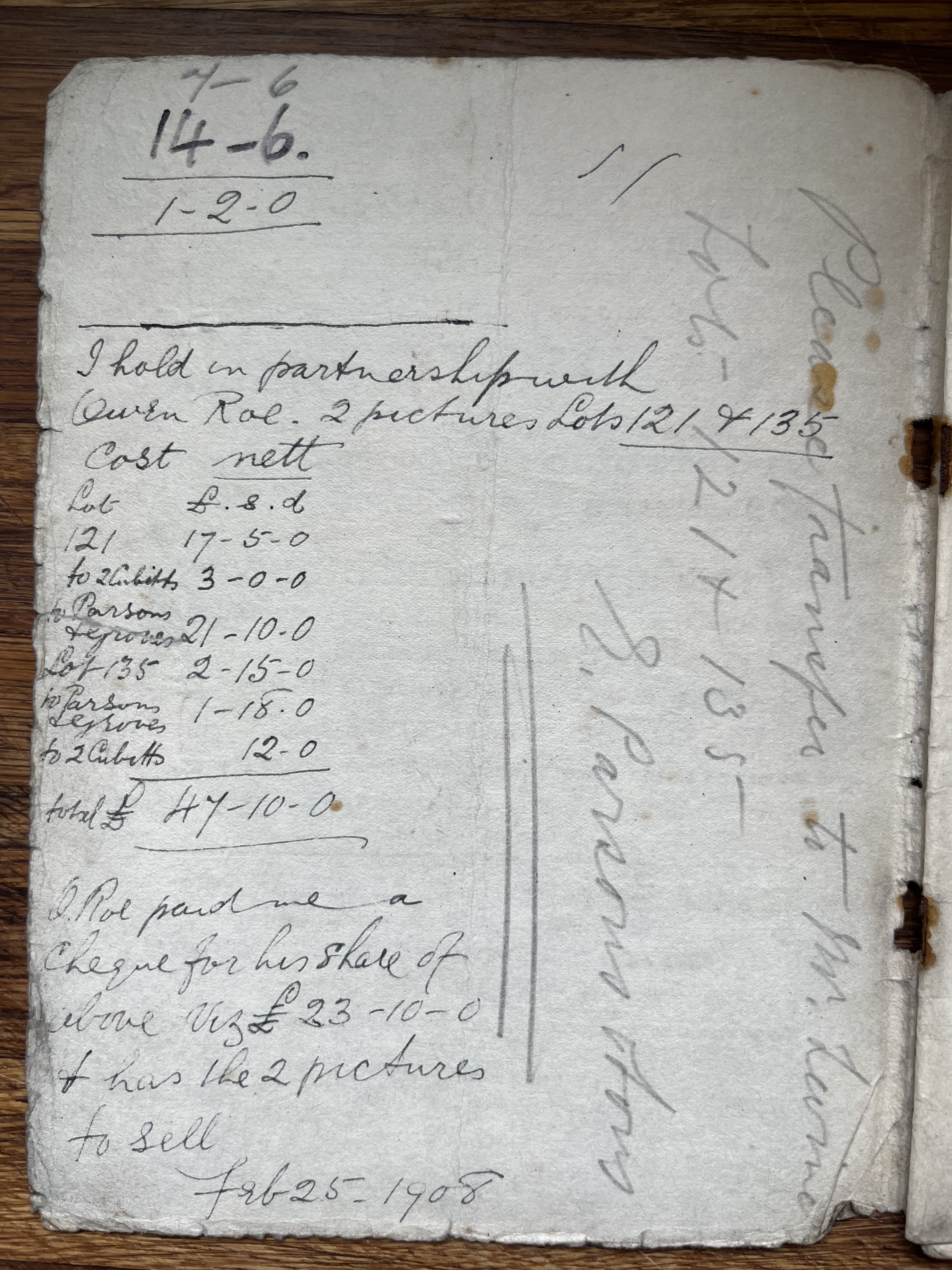
Manor House, Bury St. Edmunds, auction catalogue, 1908. Photograph, Antique Dealer Research Project, University of Leeds.

What is really interesting about the note is the list of sums of money to the left, which state: ‘Lot 121’ ‘£17-5-0’, and then below, ‘to 2 Cubitts £3-0-0’; ‘to Parsons & Sons £21-0-0’; then ‘Lot 135’ ‘£2-15-0’, and then below, ‘to Parsons & Sons £1-18-0’; ‘to 2 Cubitts 12-0’; ‘total £47-10-0’ – (I seem to make it £46-10-0, but maths is not my best subject!). Now this all looks somewhat opaque until one notices the other handwritten note in pencil (at 90 degrees) to the right. Here it states ‘Please transfer to Mr Levine lots 121 & 135, E. Parsons & sons’.

What these handwritten notes seem to point towards is an auction ‘ring’. ‘Please transfer to Mr Levine’ indicates that ‘E. Parsons’ was the buyer of the paintings at the auction but for some reason transferred his purchases to Levine. This is classic ‘ring’ activity – indeed one of the key aspects of attempts to stop the ‘ring’ is that auctioneers now specifically disallow transfers between buyers.

For those that are not aware – the ‘ring’ is where dealers would agree amongst each other not to bid against one another at an auction; one dealer was designated by the other dealers to bid for the Lot or Lots at the auction. The dealers would then re-auction any Lots bought in the ‘ring’ in a private auction (known as the ‘knockout’) after the auction (often in the local pub or other venue). The resulting price difference between the object sold at the public auction and the price eventually realised at the private auction was distributed amongst the participants of the ‘ring’. The practice was legal throughout the 19th century, although it was highly criticized. Indeed, it was not until the 1920s that the legitimacy of the practice became more formally and legally questioned, and not until 1927 that the practice was made a criminal offence (The Auctions (Bidding Agreements) Act 1927). So in 1908, when Levine, Roe, Parsons and Cubitt bought/sold the 2 paintings at the Manor House auction, the practice was frowned upon, but not yet illegal.

You can read a little more about the auction ring in the exhibition catalogue ‘SOLD! The Great British Antiques Story’ (exhibition at The Bowes Museum in 2019) – the catalogue for the exhibition is freely available online via White Rose Depository.

There is further evidence of the operation of an auction ‘ring’ at the 1908 Manor House sale when one looks at the catalogue entries for Lot 121 and Lot 135 (see below). There are a number of annotations associated with the Lots – Lot 121, for example, has a note stating ‘£14’, but also has ‘OR’ (Owen Roe) ’65/-‘ (65 shillings, which was £3-5-0); and ‘RL’ (Rueben Levine) ’46/-‘ (46 shillings, which was £2-6-0). For Lot 135, there are similar annotations – ‘C60/-‘ (which I guess refers to Cubitt and 60 shillings, which was £3); ‘P55/-‘ (which I guess refers to Parsons and 55 shillings, which was £2-15 shillings), and ‘RL 5/-/-‘ (which I guess refers to Reuben Levine and 5 pounds). Above this in the top left is another list of sums of money ‘£17-5-0’ with ‘£46’ beneath it, and then [lot]121 ‘£63-5-0’ and [lot]135 ‘£7.15-0’, with a sum total of ‘£71-0-0’. These notes seem to indicate bids or commitments by Parsons, Cubitt, Roe and Levine for the 2 paintings.
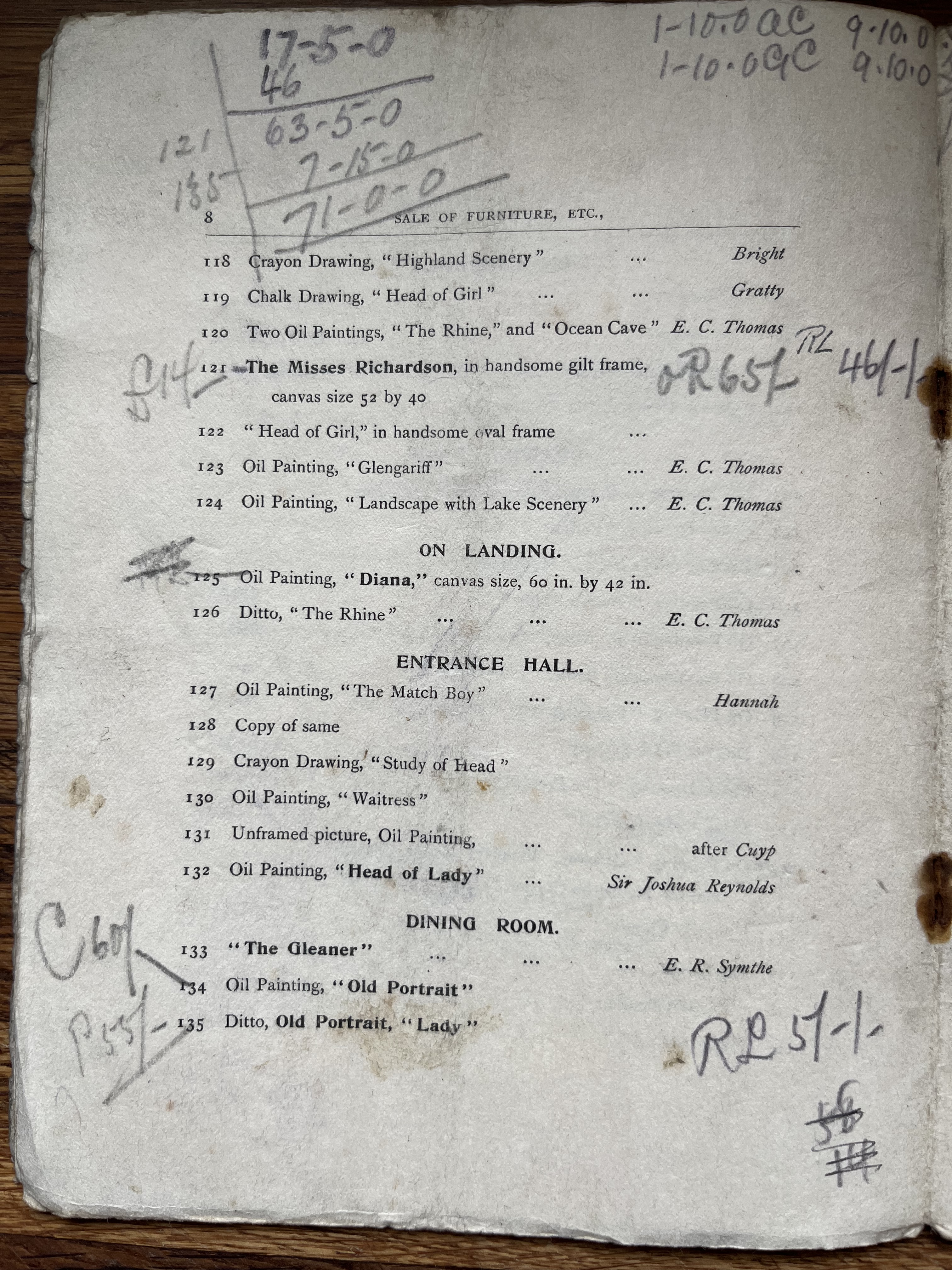
Manor House, Bury St. Edmunds, auction catalogue, 1908. Photograph, Antique Dealer Research Project, University of Leeds.

But who were Parsons & Sons and Cubitt? Parsons & Sons were antique dealers who by the 1920s were trading in the then ultra-fashionable Brompton Road, London. Cubitt & Sons were also well-known antique dealers, trading in Norwich and London – in fact at the time of the auction sale in 1908 they occupied the building next door to what would become John Wordingham’s shop in Tombland in Norwich, the famous ‘Hercules House’ (see the building below – you can just see what would become Wordingham’s shop in the 1930s to the left). George Cubitt also operated as an auctioneer in the same period, also trading from Hercules House (also known as ‘Hercules and Samson House’); in fact George Cubitt took the famous auction at Walsingham Abbey, Norfolk in September 1916.
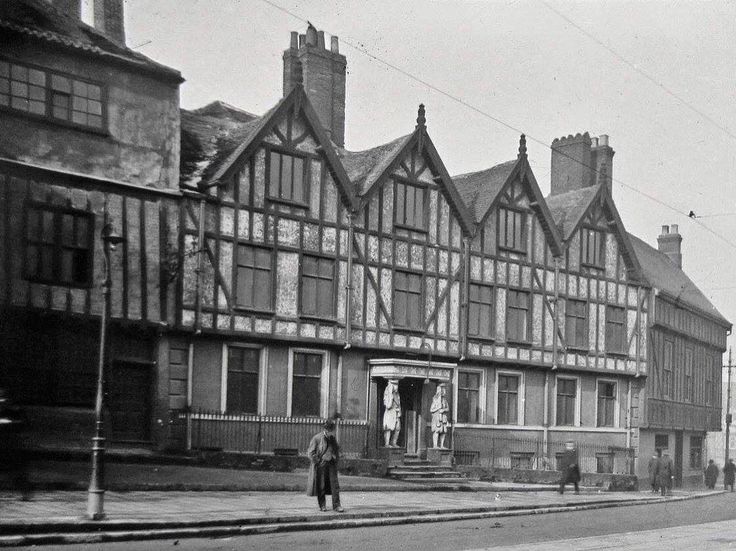
Hercules House, Tombland, Norwich, c.1900.

So, this little cache of country house auction catalogues contain fascinating insights into the workings of the antique trade in the early-to-mid 20th century and are a really significant acquisition for the antique dealer archives and ephemera we are assembling at the University of Leeds. They will, of course, be joining the other dealer material at the Brotherton Library Special Collections at the University of Leeds in due course.

Mark
January 30, 2025

Antique Dealers and Museums

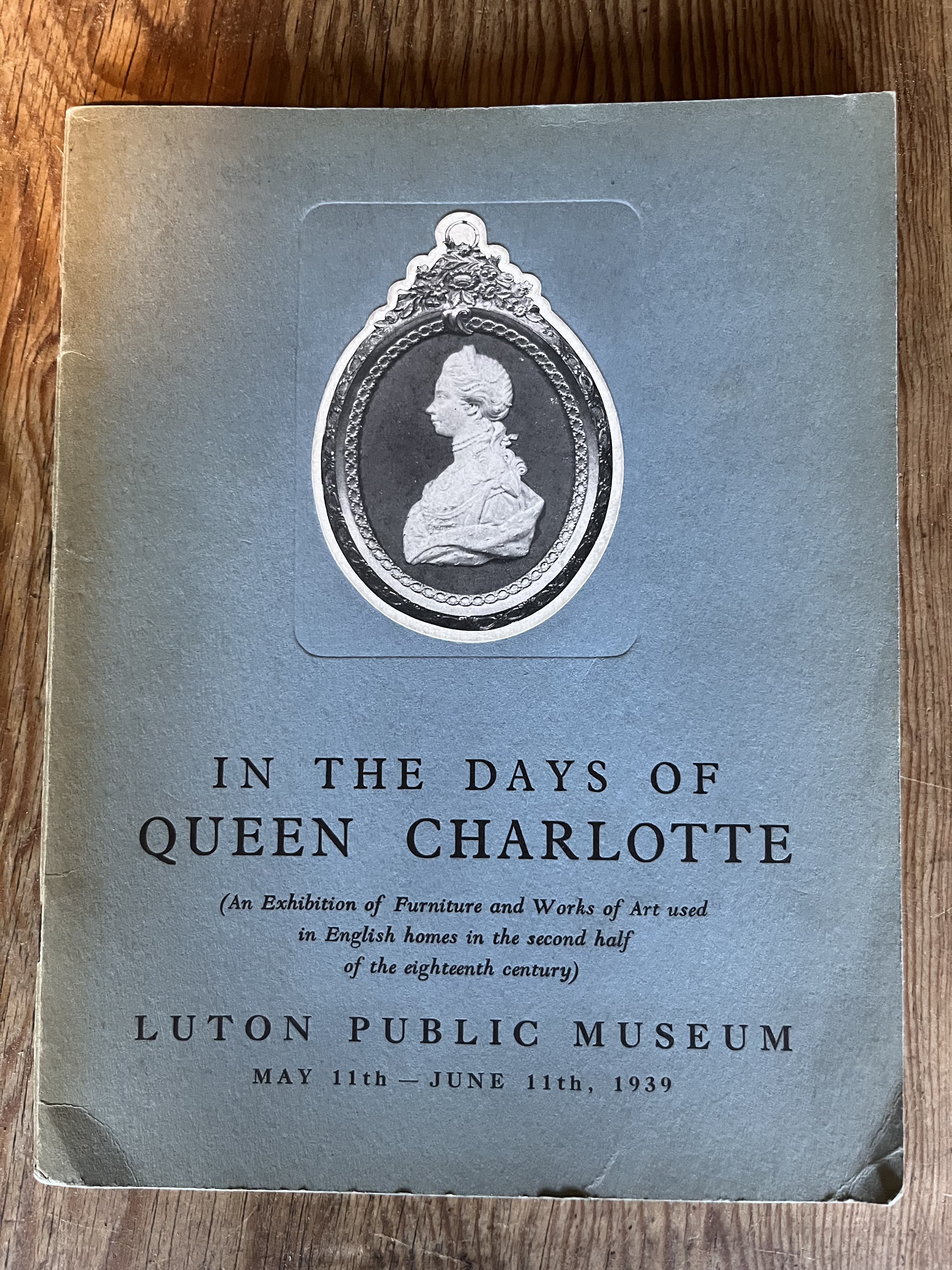
The relationships between the antique trade and public museums is an expansive and complex subject, and there’s not really enough space in a short blog post to do the subject any real justice at all. But a recent addition to the antique dealer project archive of antique dealer ephemera is worth highlighting as it is further evidence of the fascinating dialogue between antique dealers and the public museum. The ephemera in question is a rare survival, an exhibition catalogue of the exhibition ‘In the Days of Queen Charlotte‘ held at Luton Public Museum in May to June 1939.

Exhibition catalogue, Luton Public Museum, ‘In the Days of Queen Charlotte’, May-June 1939. Image, Antique Dealer Research Project, University of Leeds.

The exhibition was organised in collaboration with the British Antique Dealers’ Association and exhibitors included most of the leading antique dealers of the day, such as H. Blairman & Sons, Frank Partridge & Sons, M. Harris & Sons, H. M. Lee, Mallett & Son, S.J. Phillips, S. W Wolsey, Stoner & Evans, J. Rochelle Thomas, and many more. It built on the success of the famous ‘Art Treasures‘ exhibition held at Grafton Galleries in 1928 (also under the auspices of the BADA) and the antique dealers exhibition at Christie’s auction rooms in 1932. However, there was a key distinction between these earlier exhibitions and the Luton Museum exhibition, which was of course that the 1939 exhibition was held in a public museum. I believe this was one of the earliest of what one might call hybrid exhibitions (those staged by the antique trade in public museums) that took place in Britain, and was a catalyst for the much more ambitious collaborations between the antique trade and public museums in the form of public exhibitions that took place later in the 20th century, at The Victoria & Albert Museum in 1962 (organised by CINOA, the International Confederation of Dealers in Works of Art), and again at the V&A Museum in 1968 (organised by the BADA as part of the celebrations of the Golden Jubilee of the establishment of the BADA (1918)). There was also similar dealer exhibitions in public museums in Europe, all organised by CINOA, the earliest of which appears to have been held at the Rijksmuseum in Amsterdam in 1936, with similar exhibitions at the Musee des Arts Decoratifs in Paris in 1954 and at the Historisch Museum in Amsterdam in 1970. And perhaps the most ambitious of these initiatives was the exhibition, ‘The Grand Gallery‘, staged at the Metropolitan Museum of Art in New York in 1974 (again organised by CINOA) and which was partly staged to celebrate the additions to the Metropolitan Museum collections acquired through or gifted by, the New York based antique dealers Joseph and Ernest Brummer.

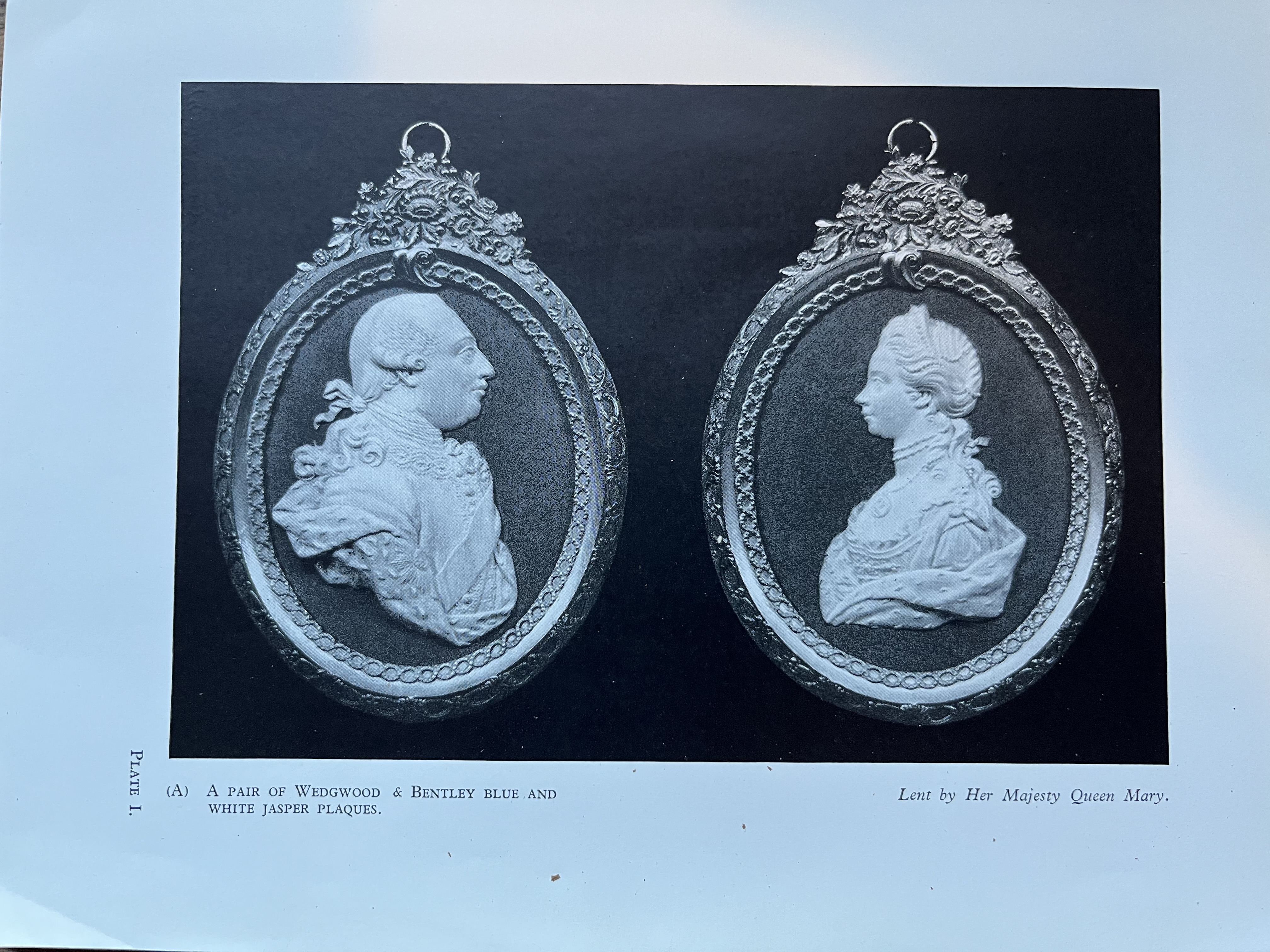
The exhibition at Luton Public Museum, like the other later exhibitions at the various museums, was partly for public education – the exhibitions often had antiques loaned by influential collectors for example. At the Luton Public Museum exhibition, Queen Mary (an avid collector of antiques) loaned a pair of 18th century Wedgwood & Bentley jasper plaques (c.1780), and the Duke of Kent loaned a collection of 20 stipple engravings of members of the Royal Family (published in 1806).

Plate from Luton Public Museum exhibition catalogue, 1939. Photograph, Antique Dealers Research Project, University of Leeds.

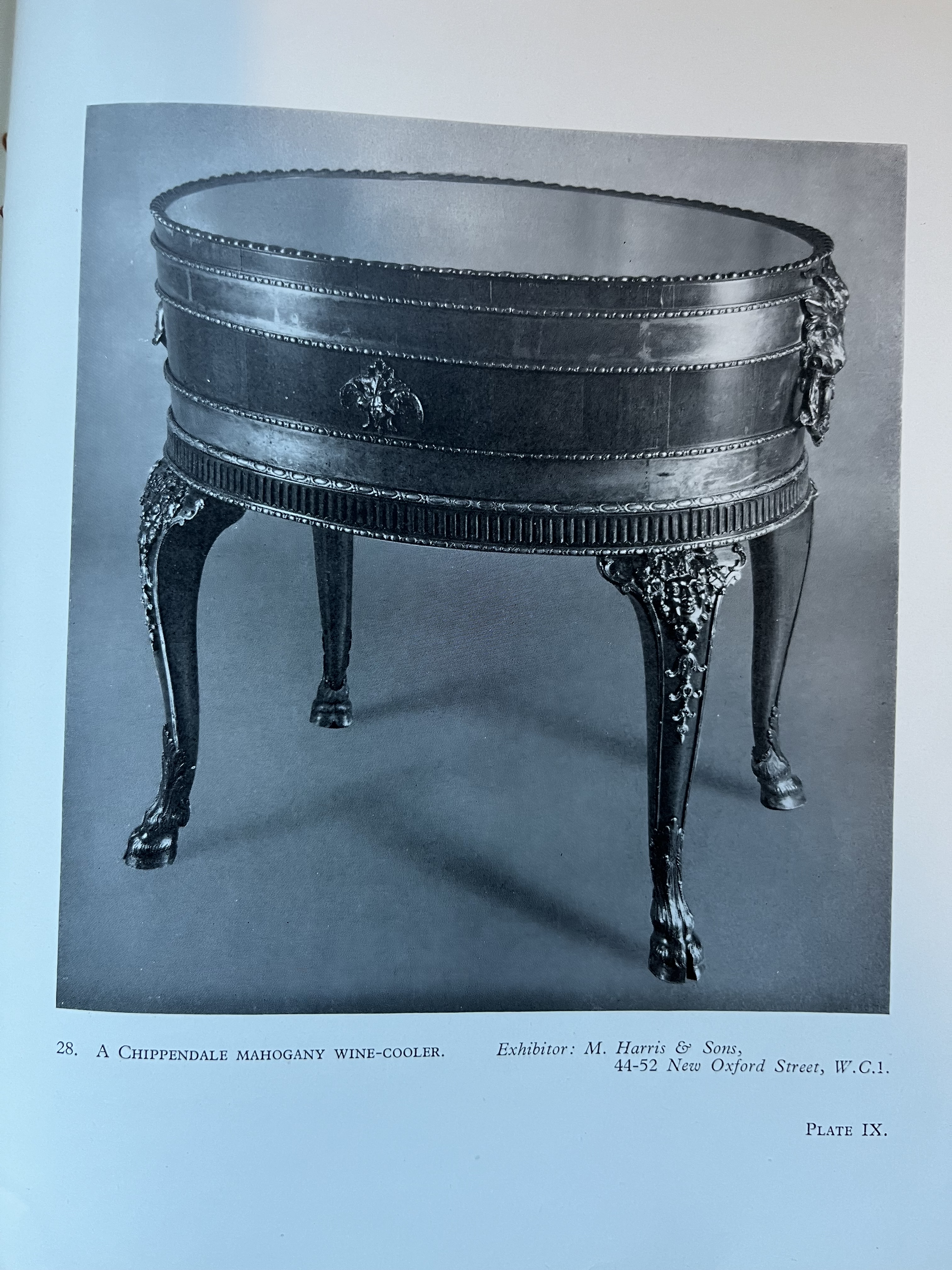
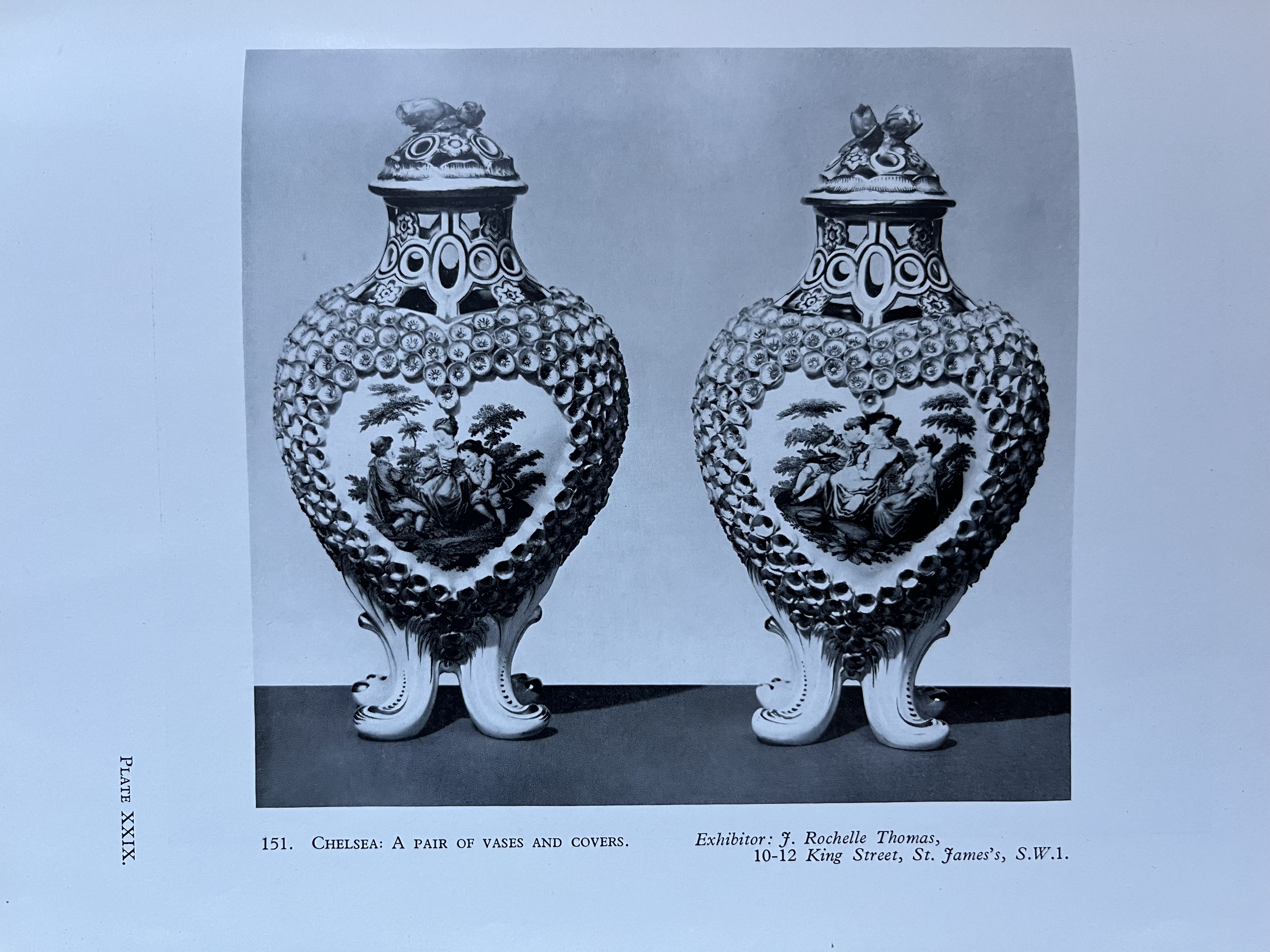
Of course one of the main purposes of these antique dealer organised public museum exhibitions was to showcase, and sell, antiques displayed by antique dealers. Indeed, at the Luton Public Museum exhibition all the objects on display, apart from the loans by Queen Mary and the Duke of Kent, were offered for sale – Moss Harris & Sons offered this 18th century wine cooler (see below) and J. Rochelle Thomas, a pair of 18th century vase and covers (see below).

‘A Chippendale Mahogany Wine-cooler’, exhibited by M. Harris & Sons at the Luton exhibition, 1939. Photograph, Antique Dealer Research Project, University of Leeds.
‘A Pair of Chelsea vases and covers’, exhibited by J. Rochelle Thomas at the Luton Public Museum exhibition, 1939. Photograph, Antique Dealer Research Project, University of Leeds.

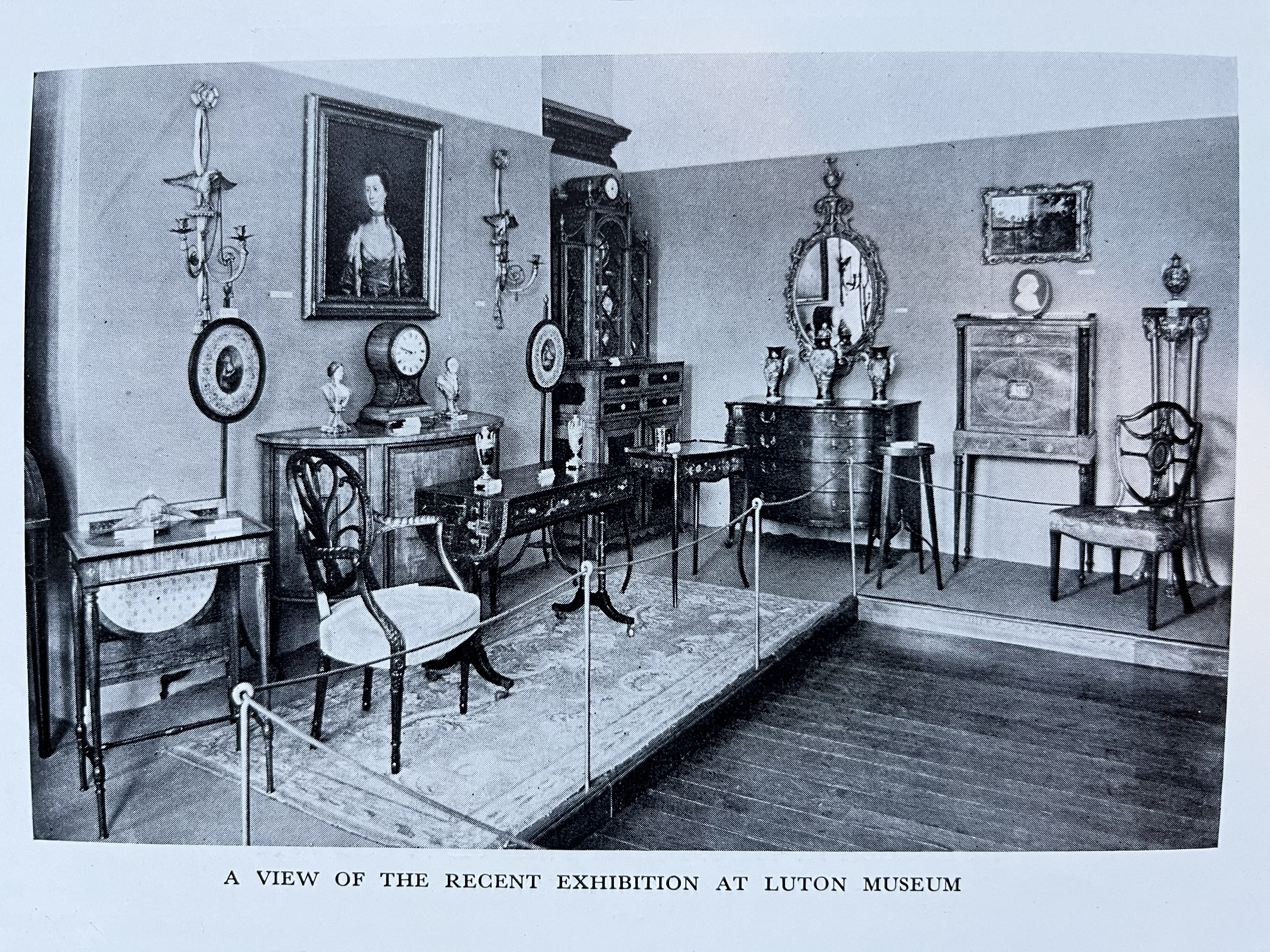
The arrangement of the exhibits at the museum also seemed to mirror the displays of antiques at major antique fairs at the time – such as those at the Antique Dealers Fair held at the Grosvenor House Hotel from 1934 – as one might expect of course – the overlap between modes of display in the worlds of commerce and in the public museum are often much closer than one thinks.

The Luton Public Museum ‘In the Days of Queen Charlotte‘ exhibition, 1939, from Connoisseur, September 1939. Photograph, Antique Dealer Research Project, University of Leeds.

Indeed, all of these antique dealer organised exhibitions draw further attention to the close relationship between the market for antiques (as figured in the presence of antique dealers) and the role of the public museum as a frame for ‘decorative art’ (also known as ‘antiques’ of course). The exhibition I curated at The Bowes Museum back in 2019 – ‘SOLD! The Great British Antiques Story‘, was partly an attempt to draw the attention to the symbiotic relationship between the realm of the art market and the so-called ‘disinterested’ realm of the public museum. If you are interested, you can read more about this in the SOLD! exhibition catalogue – still available, for FREE, as a PDF download via the Antique Dealer Research Project Website HERE.

Mark

July 26, 2017

More new archives! H.M. Lee & R.A. Lee archives arrive at University – and an object biography

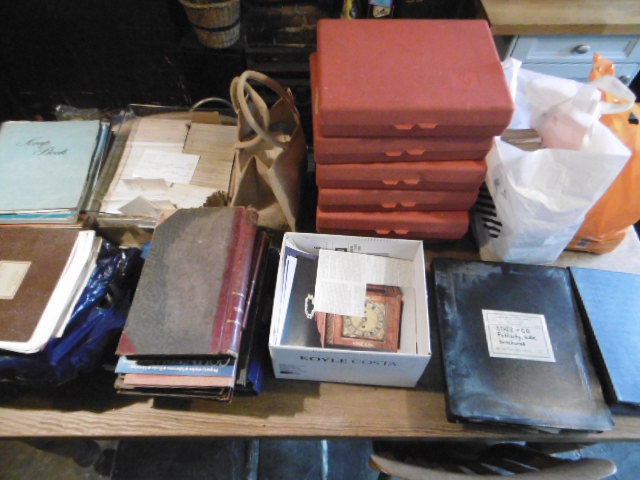
Our corpus of antique dealer archives continues to expand – this week we accepted delivery of the archive of the world famous antique dealers Henry Morton Lee and Ronald A. Lee, generously donated to the Brotherton Library Special Collections at the University of Leeds by Georgina Gough, the daughter of Ronald Lee. The archive (shown below before deposit in the Special Collections) comprises a selection of stock books, sales ledgers, press cuttings and photographs of stock, together with what appears to be a complete run of stock cards, dating from the 1920s to the 1990s.

H.M. Lee and R.A. Lee archive. Brotherton Library Special Collections.

The Lee family antique dealing business began in Kingston on Thames just after WWI (Henry Morton Lee began as a hairdresser in London, counting King Edward VII as a customer); Ronald Lee joined his father in the business in 1931 before eventually setting up on his own in 1949 – the business closed in the 1990s.

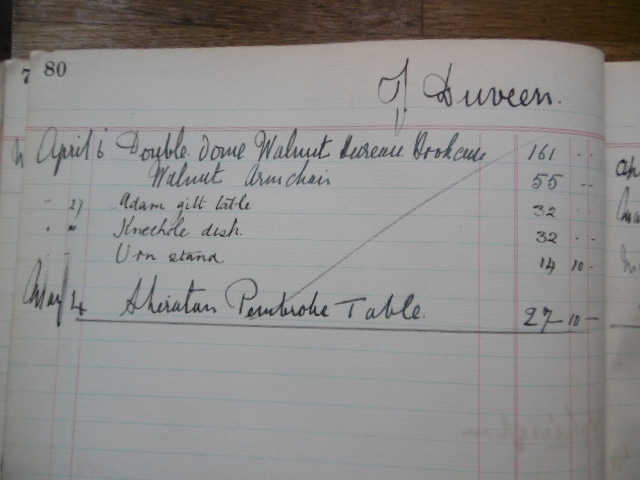
During the 1920s and 1930s Henry Lee sold a vast array of objects to many of the most important dealers of the day, including Joseph Duveen (1869-1939), the son of Joseph Joel Duveen of the world-renowned Duveen dynasty of dealers – here’s just one page of sales to Duveen, in 1927 – Henry sold him, amongst other things, ‘a Double Dome Walnut Bureau Bookcase..£161.0.0’ and a ‘Walnut armchair £55.0.0.’ –  very fashionable, and very expensive, objects in the 1920s and 1930s.

Lee Archive, sales ledger – entry for Duveen, 1927. Brotherton Library Special Collections, University of Leeds.

Ronald Lee, like his father Henry, was a highly successful dealer, and was also an expert on clocks – especially the clockmaker Joseph Knibb and family (Ronald wrote the biography of the Knibb family of clockmakers in 1965 – still a key work on the subject).  Ronald sold an astonishingly wide range of objects, to collectors and museums all over the world – a key driver for Lee appears to have been the historical significance of objects (as well as their beauty of course);  he was clearly an antiquarian dealer, demonstrated by the historical importance of many of the objects he sold –

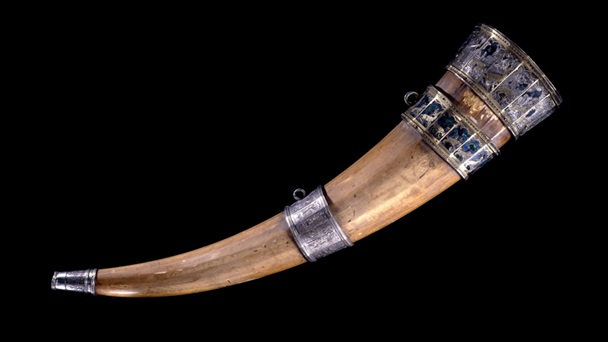
The Savernake Horn for example – sold (in partnership with the well-known silver dealer S.J. Phillips) to the British Museum in 1975.

The Savernake Horn, 1100-99 with 14th century mounts. Image copyright The British Museum.

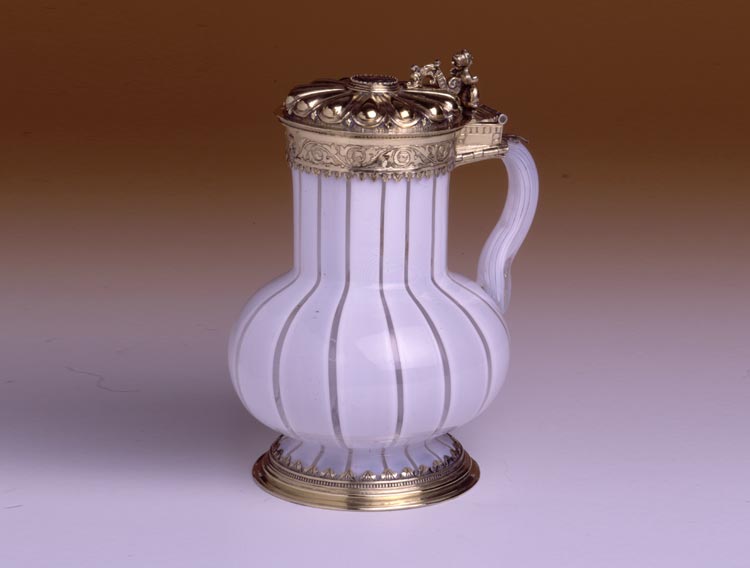
And the so-called ‘Katherine Parr Pott’, (see below) sold to the Museum of London in 1967 – this glass tankard, with silver mounts dated 1546-47, emblazoned with the arms of Sir William Parr, was bought by Ronald Lee from Sudeley Castle – the glass body is now believed to be an 18th or 19th century replacement. The tankard has an illustrious history, having been acquired by the collector Horace Walpole in 1758 (cost £2.19.0) and sold at the dispersal of the Collections at Strawberry Hill (Walople’s house) in 1842 and bought by John Dent for £3.13.6 – the Dent-Brocklehurst family, at Sudeley Castle, Gloucestershire, sold the Parr Pot to Ronald Lee in 1967, before Lee sold the tankard to the Museum of London for £18,214.00 in the same year.  The tankard was subject to an Export Stop because of its historical significance; according to the archive it seems that Lee had initially and successfully negotiated a sale to the Boston Museum of Fine Art in the USA, but funds were raised through the British Government, The Art Fund, The Pilgrim Trust and the Goldsmiths Company to save the tankard for the Nation.

The Parr Pot. Image copyright, The Museum of London.

The ‘Parr Pot’ is just one of a wide range of fascinating stories about the acquisitions made by Ronald Lee in the Lee archive…there are far too many to recount in a short blog post, but it is worth retelling the story of the acquisition, and subsequent sale, of one of the most interesting objects that Ronald Lee sold – the story demonstrates the significance of ‘Object Biographies’ in the conceptualization (and reconceptualization) of objects – it is also a story that re-embeds the significance of the narrative of the personal into these now very public objects.

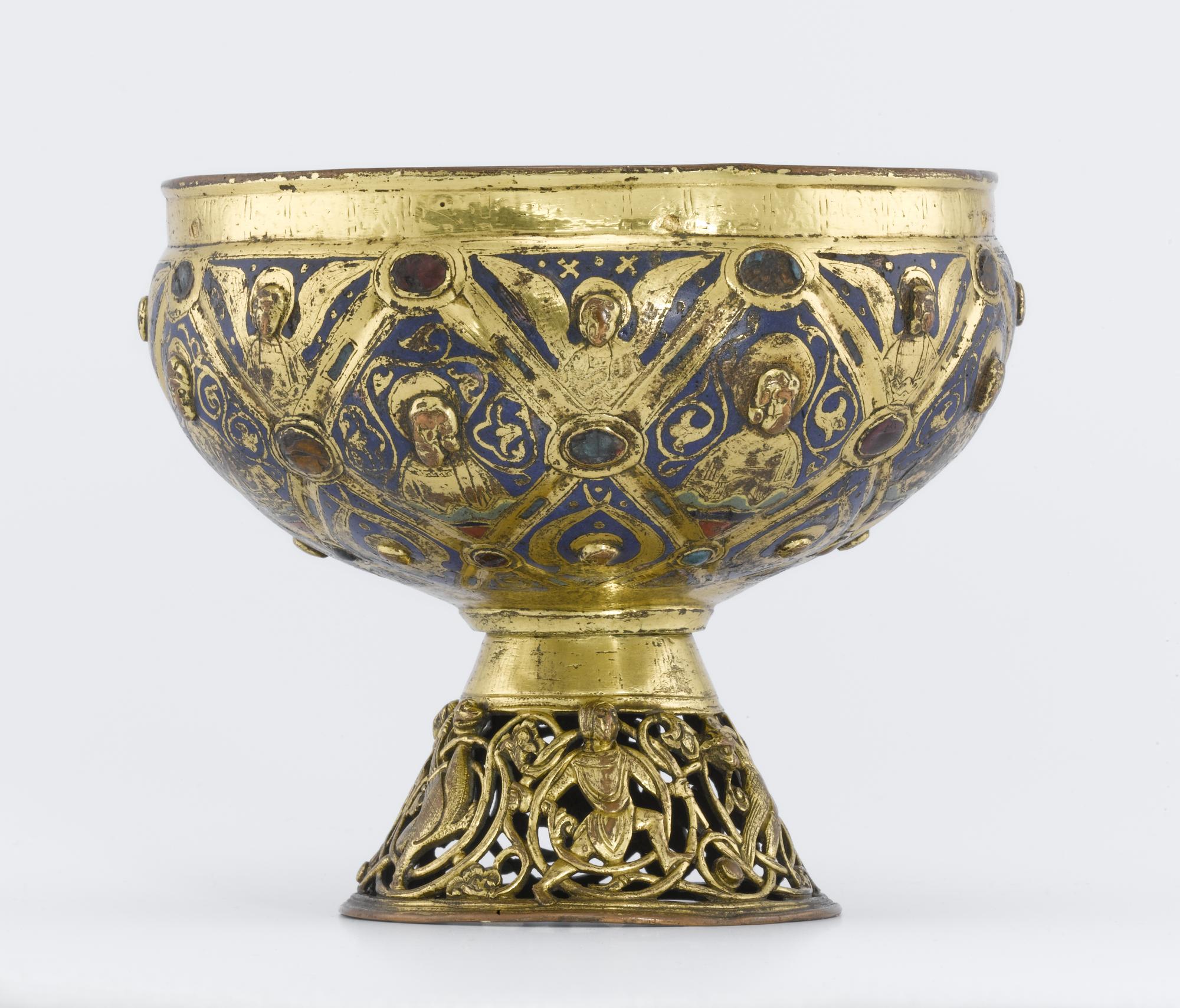
Anyway, in 1966 Ronald Lee negotiated the sale of what was then considered to be an exceptionally rare 13th century Limoges enamel Ciborium to the (then) Royal Scottish Museum (now National Museum of Scotland).

Ciborium, in the 13th century style – probably 19th century. Photograph copyright National Museum of Scotland.

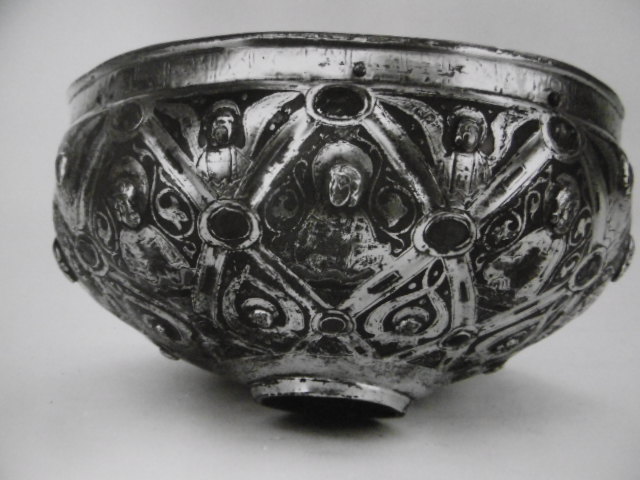
Lee spotted the bowl of the Ciborium, then lacking it’s foot at an auction sale at Sotheby’s in April 1965.

Ciborium Bowl, lacking foot – photograph copyright Sotheby’s 1965.

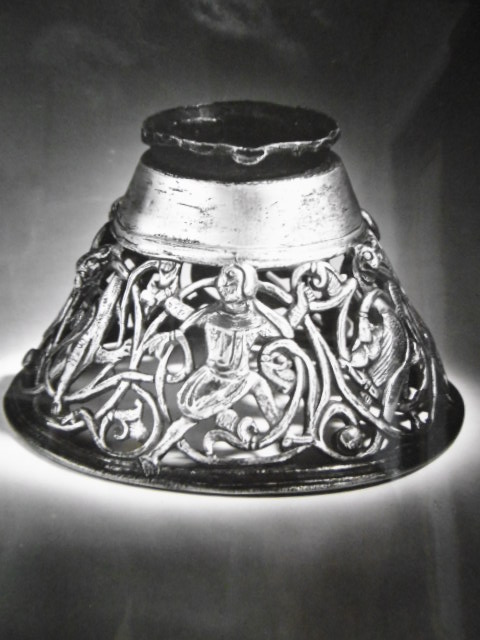
He had, a few years earlier, again it seems at a Sotheby’s auction, acquired the stem/foot from a similarly dated object, and which (so Georgina Gough, Ronald Lee’s daughter tells us) Ronald had given to his wife as a little present –

Ciborium Foot; Photograph, Lee Archive, Brotherton Library Special Collections, University of Leeds.

Seeing the bowl at Sotheby’s presented the opportunity of reuniting the foot and bowl and Ronald Lee had to do the right thing  – (it must be a common practice in all antique dealer families that objects are inherently unstable….and always subject to potential future sale…). The story was reported in the Press at the time, recounting the breathless moment when the foot and bowl fitted together as one – rather like the story of Cinderella and the glass slipper!

But anyway, Lee offered the Ciborium, now with its foot, to the Royal Scottish Museum in 1966, and the then Keeper of Art, Cyril Aldred, approved the acquisition and the object entered the collections in Edinburgh.  The Ciborium was lauded as a major acquisition, it was one of the most expensive objects ever acquired by sale by the museum at that time – costing £8,500 – an enormous sum in 1965.  It was related to the Master Alpais, the creator of the 13th century Ciborium in the collections of the Louvre Museum in Paris, and to a similiar Ciborium in the collections at the British Museum in London; the world renowned scholar and curator at the Victoria and Albert Museum, John F. Hayward considered these comparisons and the significance of the Ciborium in an extensive article ‘A Newly discovered Limoges ciborium’ in Connoisseur (vol CLIX, pp.240-1). So consensus at the time, from leading experts, curators, and one of the leading antique dealers, was that the Ciborium was of the 13th century, and possibly associated with the workshop of the Master Alpais.

But authenticity is also an unstable concept – indeed, if we can borrow, and slightly amend, a phrase from Georg Simmel (1858-1918), the philosopher and critic, and founder of the discipline of anthropology, (he writes that ‘value is not a property of objects, but a judgement by a subject’), then perhaps we can say that authenticity is also not a property of an object, but a judgement by a subject –  Time, and, more importantly, new knowledge structures have repositioned the Ciborium, and it now considered to be a 19th century copy – for a full, and excellent account of the art historical and scientific analysis of the Ciborium at NMS and a comparison with that at the British Museum  see ‘The Heritage of ‘Maitre Alpais’ edited by Susan La Niece, Stefan Rohrs and Bet McLeod, (British Museum Press, 2010).

There is no moral to this story as such – I hesitate to rehearse the notion ‘caveat emptor!’, especially as I am writing about antique dealers, and I’m conscious that to rehearse this story is also to further embed the trope of the dealer as ‘problematic’ in the cultural consciousness – but it remains a fascinating story about an object, and how its meaning, and significance, is reframed as it moves between discrete, but intimately interconnected realms.  As this story recounts, the meaning of the Ciborium shifted as it moved between the realms of objects of commerce and economic value to those of heritage and museums, but, crucially, it retained its commodity status, and its status shifted again as new approaches and methods established, (indeed constituted) the authenticity of the object.

But for me, being an old Romantic, the enduring story about the Ciborium is the very human story of Georgina’s recalling that the foot of the Ciborium was a present (albeit temporary) for Mrs Lee.

All the while these objects acquire significant status in museums, they remain as catalysts for innumerable personally situated memories, of the private, intimate relationships we have with things.

Mark

Home Subjects

a working group dedicated to the display of art in the private interior, c. 1715-1914

The Period Room: Museum, Material, Experience

An International Conference hosted by The Bowes Museum and The University of Leeds

H. Blairman & Sons Ltd

A research project investigating the history of the antiques trade in Britain in the 19th & 20th centuries

Museum Studies Now?

'Museum Studies Now?' is an event which aims to discuss and debate museum and heritage studies education provision.

The Burlington Magazine Index Blog

art writing * art works * art market

East India Company at Home, 1757-1857

A research project investigating the history of the antiques trade in Britain in the 19th & 20th centuries