Archive for ‘Uncategorized’

July 27, 2020

Milestone for the Antique Dealers Map website

Our Antique Dealer interactive map website has hit a momentous milestone this month – we now have more than 10,000 antique dealer shop locations in the map of Britain for the period 1900-2000 – there are 10,456 if one includes dealers with branches of their businesses in the USA and elsewhere in the world.  Here’s the link to the MAP website if you want take a look antiquedealers.leeds.ac.uk

The map is still very much a work in progress and there are many more dealers to add, but we’ve been concentrating on adding dealers for the period from 1900 to c.1970 – when I say ‘we’, recently it’s actually just been me…..indeed, adding dealers to the map during the Corona Virus Lockdown has been a really mind-soothing job.  I guess I’ve added more than 3,500 over the past few months.  It’s been detailed, repetitive work, but it’s also been truly fascinating seeing the map evolve and change as more and more antique dealers are added. And with so many dealers in the map you can now begin to see the changing spacial geography of the trade emerge.

I can share some preliminary insights with you, through the amazing technology of screen-capture! Here, for example (below), is the bird’s eye view of the clusters of total numbers of antique dealers in Britain in the period 1900-1930 – the colour of the dots indicates the concentration of dealers in an area – blue for lower numbers, red for higher numbers, pink for highest concentration.
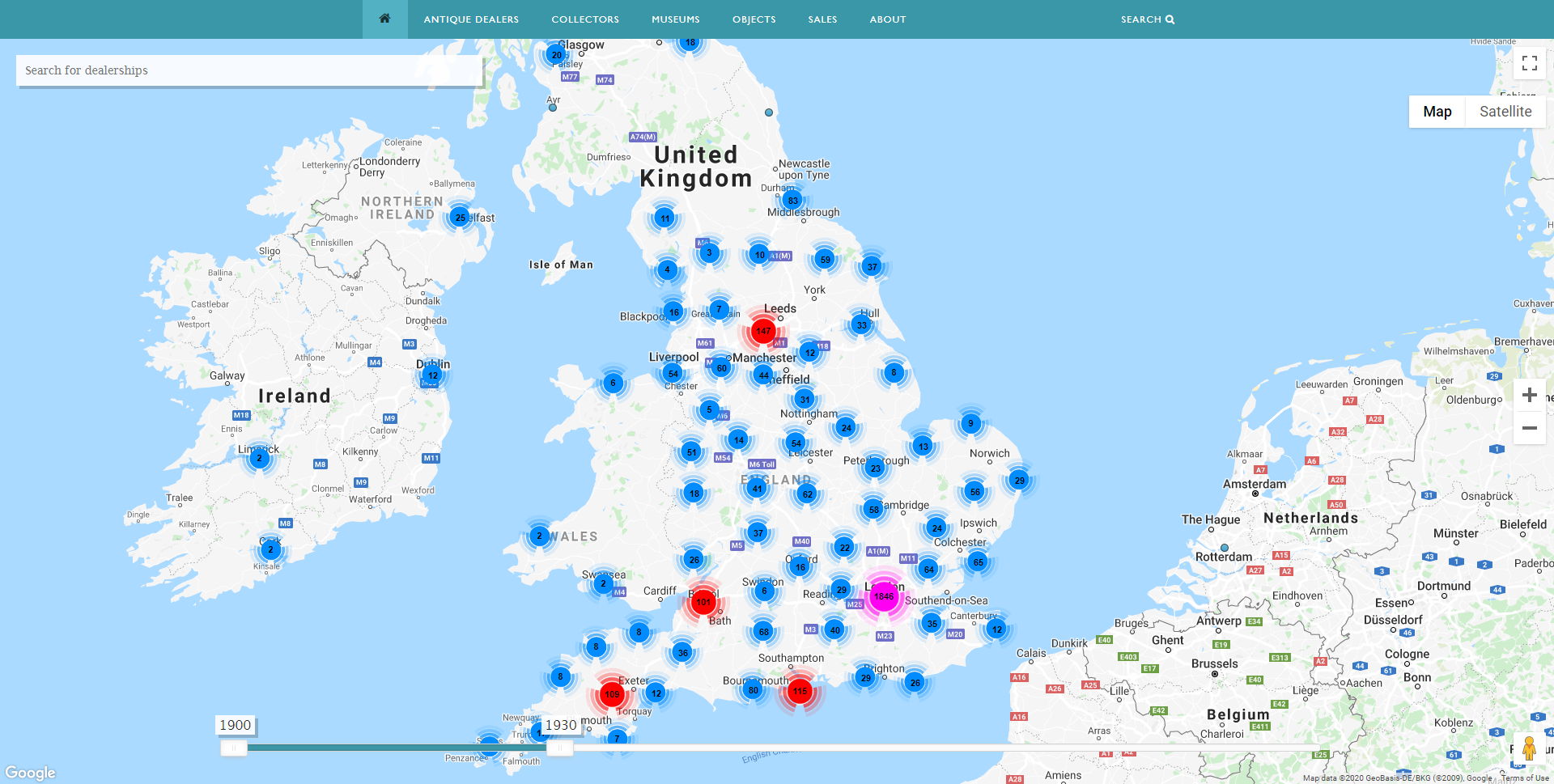
Antique Dealers Map showing dealers in Britain 1900-1930. Image, Antique Dealers Project, University of Leeds.

As you can see (above), there are clusters of dealers in various regions and cities and towns across Britain in 1930, but several areas are worthy of note and can be compared with the same visual representation in the screen shot of dealers in Britain in the Map in the period 1900-2000 (below).  One thing that emerges in the 1930 map (above) is that London has by far the largest concentration of antique dealers (1,846 in 1930); one can also note the number of dealers on the South Coast – Bournemouth area has 80 dealers and the Portsmouth area 115 dealers in 1930.  To the west, the Exeter area has 109 dealers; and Bath/Bristol has 101 dealers in the same period.  If one moves North, one can see that Leeds and surrounding locations (which would include Harrogate and York in this map view) have 147; the North East of England has 83 dealers.  Note however, the area around Sussex and Hampshire border, to the south west of London, which has 40 dealers in 1930; and note around Brighton and the South Sussex coast, which has c.50 dealers.

In the screen shot of the same map showing dealers 1900-2000 (below) – (note however that the map will be mainly concentrating on dealers dating from up to c.1970) – one can see some striking developments in the changing geography of the antique trade.
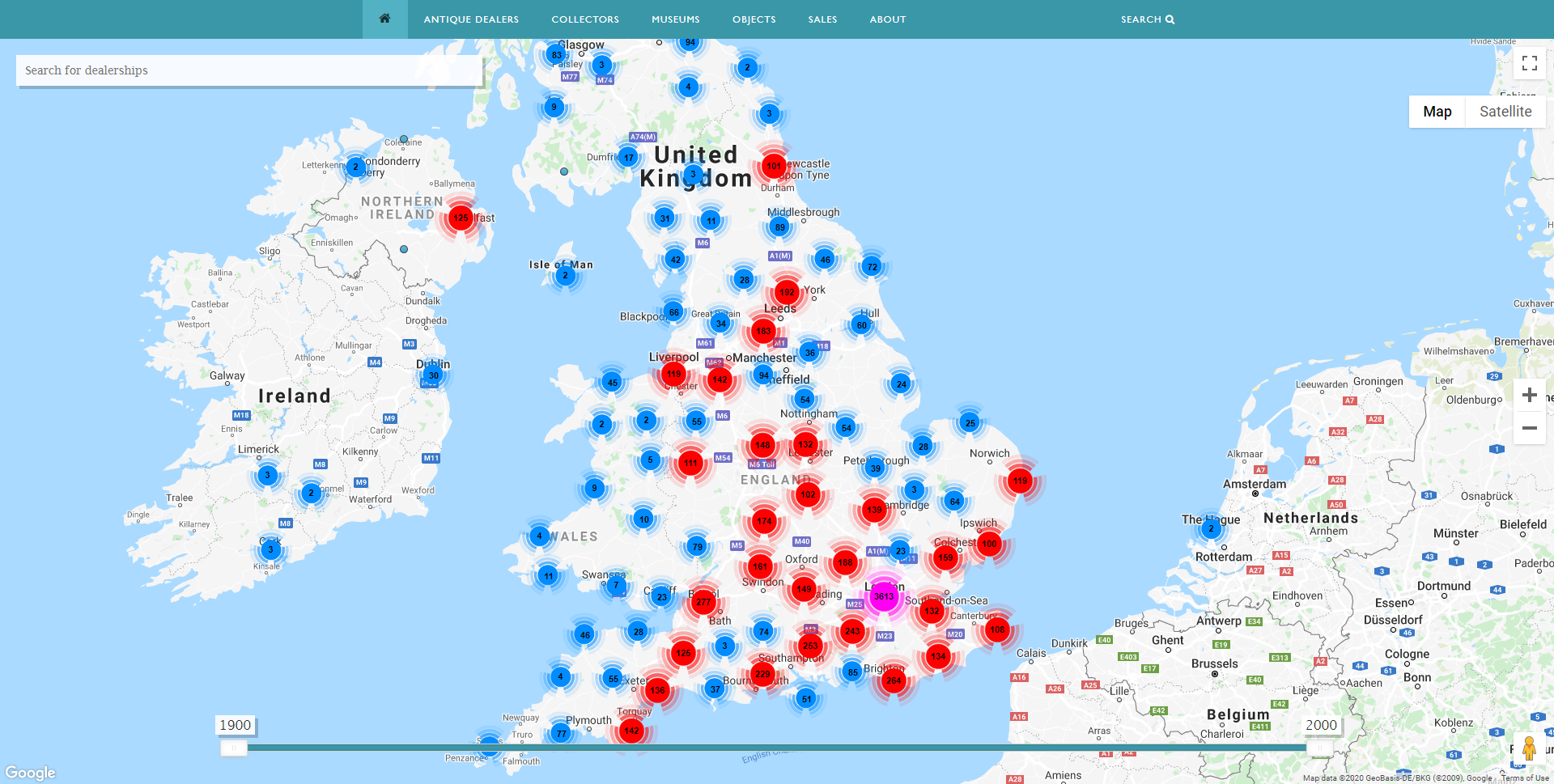
Antique Dealers Map showing dealers in Britain 1900-2000. Image, Antique Dealers project, University of Leeds.

In the view (above), the number of antique dealers has increased enormously across all areas of Britain since 1930. The numbers of dealers in London alone has grown to more than 3,600 by c.1970; the Brighton area has also expanded considerably to 264 dealers (from c.50 in 1930). The Bournemouth area (including Portsmouth) has gained steady growth, and now has c.300 dealers (in c.1930 the area had c.200 dealers); the number of dealers in the Exeter and Torquay area has expanded to c.140 in each location (increasing from c.120 to c.300 for the area over the period). There has also been an increase in the number of dealers in Bath and Bristol, rising from 101 to 277. The Leeds area, including Harrogate and York, has expanded to c.400 dealers, doubling in size since c.1930. The North East, by contrast, has gained a much smaller percentage, expanding from 83 dealers in 1930 to c.100 dealers by c.1970.  What is really striking however, is the expansion of dealers around Hampshire/Sussex area – here the numbers of dealers has grown exponentially from just 40 dealers in 1930, to 243 dealers by c.1970.  Indeed, the whole area of the South East has seen the largest increase in the numbers of dealers, with not just the larger satellite towns around London seeing an increase in dealers, but dozens of smaller villages in the ‘Home Counties’ (those counties surrounding London such as Berkshire, Sussex, Essex, Kent etc) attracting antique dealers.

This change is itself a symptom of the expanding market for antiques in the Post World War II era, but also a consequence of the development of increasing numbers of amateur collectors opening antiques shops in the 1950s and 1960s – a development that had particular effect in and around London and the South and South East. One other thing to note (although not illustrated in the map) is that during the 1950s and 1960s there was also a significant increase in the number of antique shops that were called ‘Ye Olde’ or some other generic name, rather than being named after the owner of the person that owned the business – so, for example, by the late 1960s there are dozens of shops called ‘Old Bakehouse Antiques’ or ‘Old Malthouse Antiques’, or ‘Cottage Antiques’; there is also a new development in quaint names for antique shops – ‘Old Things’, ‘Quaint Conceit’, ‘Year Dot’, ‘The Shambles’ etc. These developments, which seem to be concentrated in the ‘Home Counties’ also appear to be the result of the increasing presence of former amateur collectors entering the antique trade during the 1950s and 1960s.

We can see more granulation in the results by focusing in further on some discrete locations and exploring the changing landscape of the antique trade at regional and county levels.  Here, for example (below) is the birds eye view of the numbers of antique dealers in the South Coast of England in 1930.
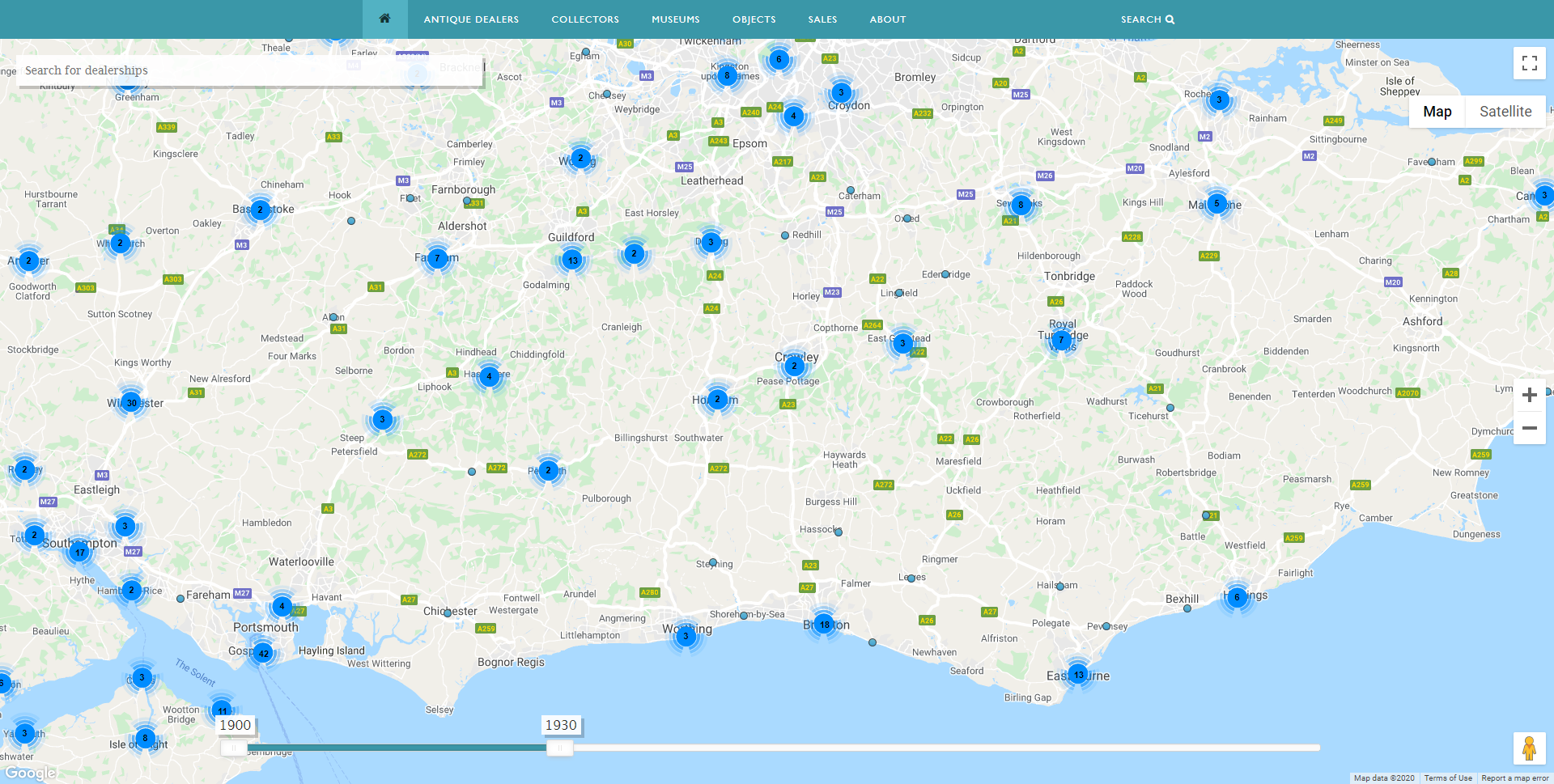
Antique Dealers Map – showing dealer location on South Coast of England 1900-1930. Image, Antique Dealers research project, University of Leeds.

In this map (above), which gives a closer view of the South Coast, we can see that the town of Brighton had 18 dealers in 1930; Eastbourne had 13 dealers; Sevenoaks had 8 dealers; Tunbridge Wells had 7 dealers; Maidstone, 5 dealers; Winchester, which was a very popular location for dealers in the opening decades of the 20th century, had 30 dealers.  Portsmouth has c.50 dealers and Southampton c.25 dealers.  There are also a few towns dotted across the South East with just a single dealer (represented by a small blue dot), but most towns, if they had any dealers at all, only had 2 or 3 antique dealers.

If we explore the South Coast map in the period 1900-2000 (see below) (and which, as I say, concentrates on the period up to c.1970) we can see the scale of the change in the region between 1930 and c.1970.
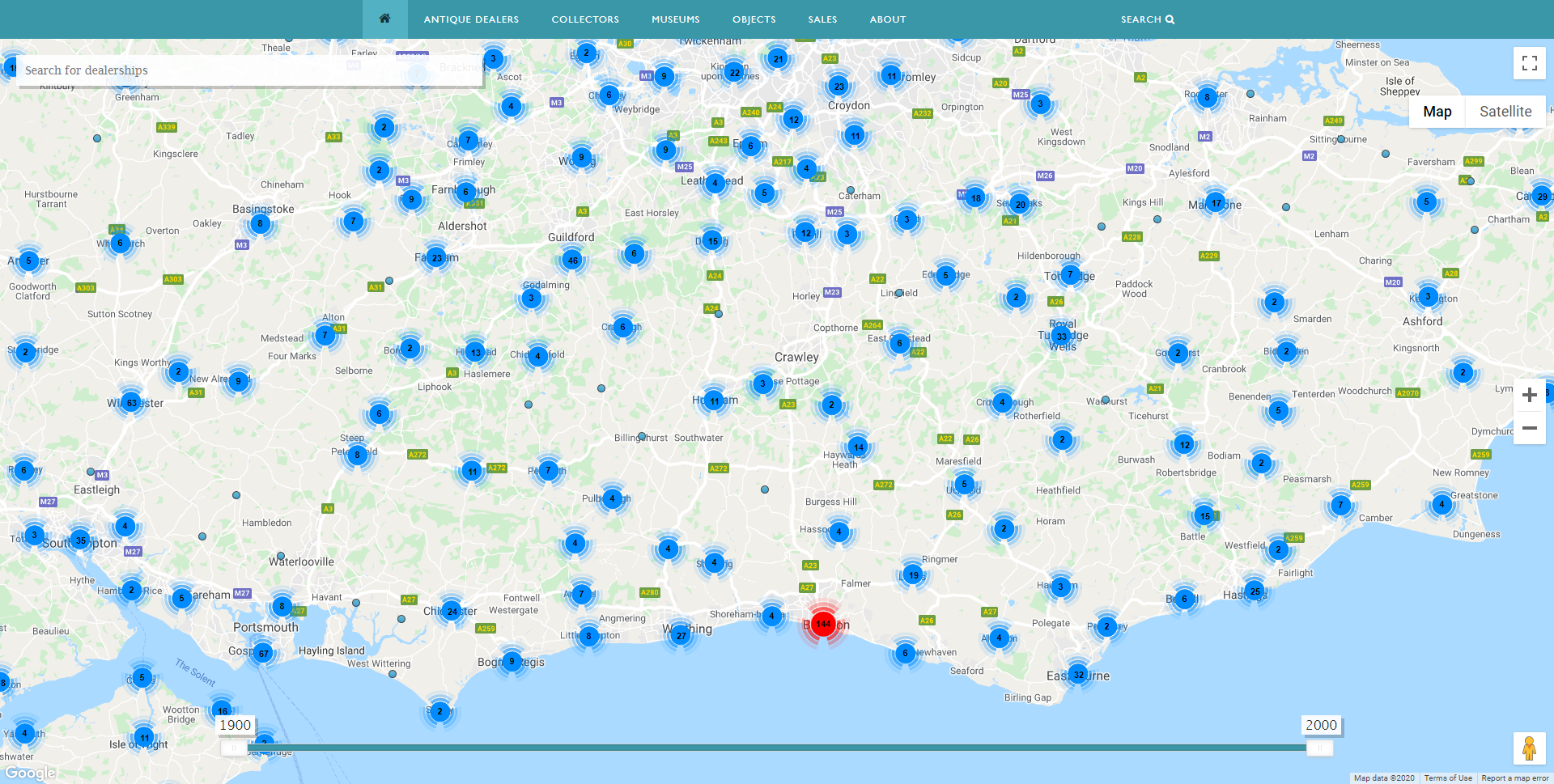
Antique Dealers Map – showing number of dealers on South Coats of England 1900-2000. Image, Antique Dealers research project, University of Leeds.

In this view (above), the number of dealers in Brighton has expanded to 144 (from just 18 dealers in 1930); Eastbourne now has 32 dealers; Sevenoaks has 20 dealers; Tunbridge Wells has attracted 33 dealers; Maidstone has 17 dealers. But even Winchester, which had comparatively high concentration of antique dealers even in 1930 (30 dealers) has more than doubled in size to 63 dealers. Portsmouth has also expanded to 75 dealers and Southampton has increased too, rising from 25 dealers to 45 dealers. But the real growth can be seen in the large numbers of dealers in the smaller satellite towns around the South East, each of which has expanded the numbers of dealers – and many towns now boasting 10 or more antique dealers.

Below is another section of the map, this time a bird’s eye views of the South West of England – with the counties of Somerset and Devon – this view is of the area showing the number of antique dealers in 1930.
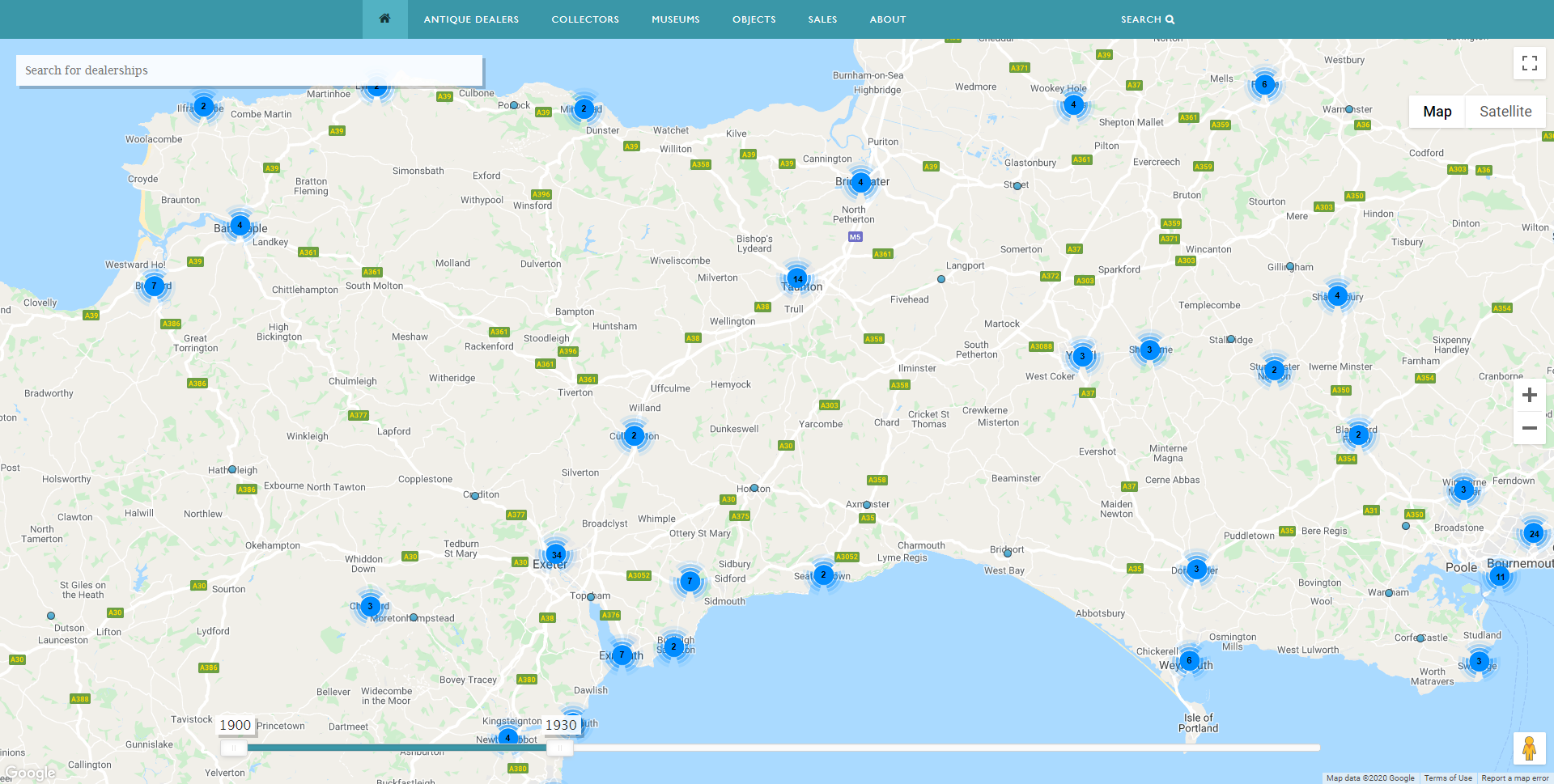
Antique Dealers Map – showing number of dealers in Devon and Somerset 1900-1930. Image, Antiques Dealers research project, University of Leeds.

In this view (above), The city of Exeter, which was an attractive location for antique dealers due to it’s historic architectural fabric and as a centre for tourism, has 34 dealers; Taunton, the County Town of Somerset, has 14 dealers.  On the North Devon coast, Bideford has 7 dealers and several of the other coastal towns have a quite a few dealers even by 1930.

If we explore the same Devon and Somerset locations in the period 1900-2000 (see below) – (but up to c.1970, as I say) we can again see the changes to the geography of the trade.
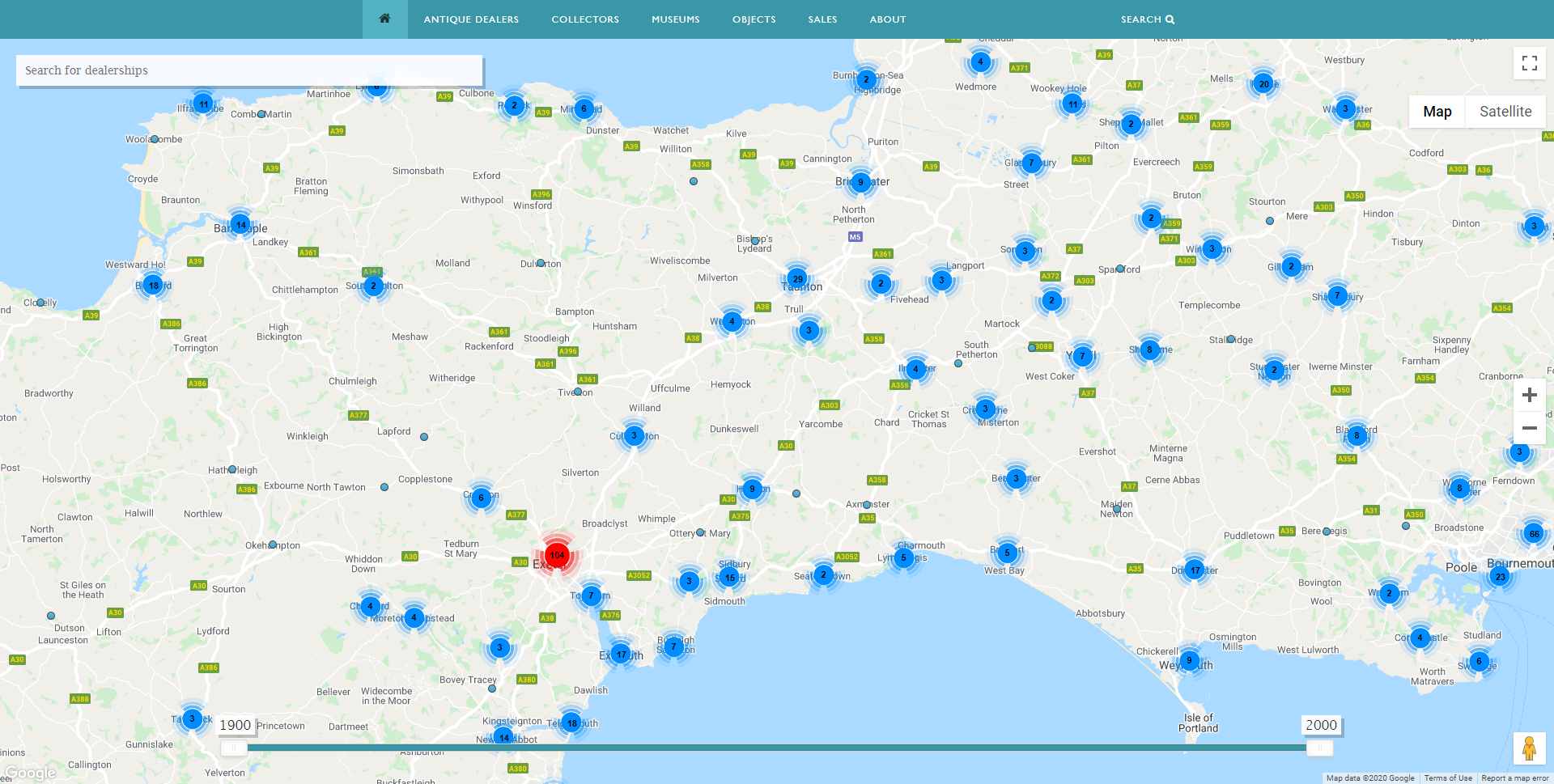
Antique Dealer Map, showing dealer locations in Devon and Somerset 1900-2000. Image, Antique Dealers research project, University of Leeds.

Here (above), the number of antique dealers in Exeter has expanded to 104 from 34; Taunton now has 29 dealers; Bideford has 18 dealers; Barnstaple 14 dealers.  But there is also striking growth in the number of dealers across all the county towns as well, and an increasing number of small villages have also been chosen as key locations for antique shops (represented by the small, single blue dots on the map).  This expansion was itself a symptom of the influence of tourism, but also of the regular (weekly) buying trips to the West Country made by the London and South East antiques trade.

But what of the North East of England, an area often seen as being far removed from the tourist hotspots of the West Country and the South Coast of England? Below is a screen shot of the map for the North East:
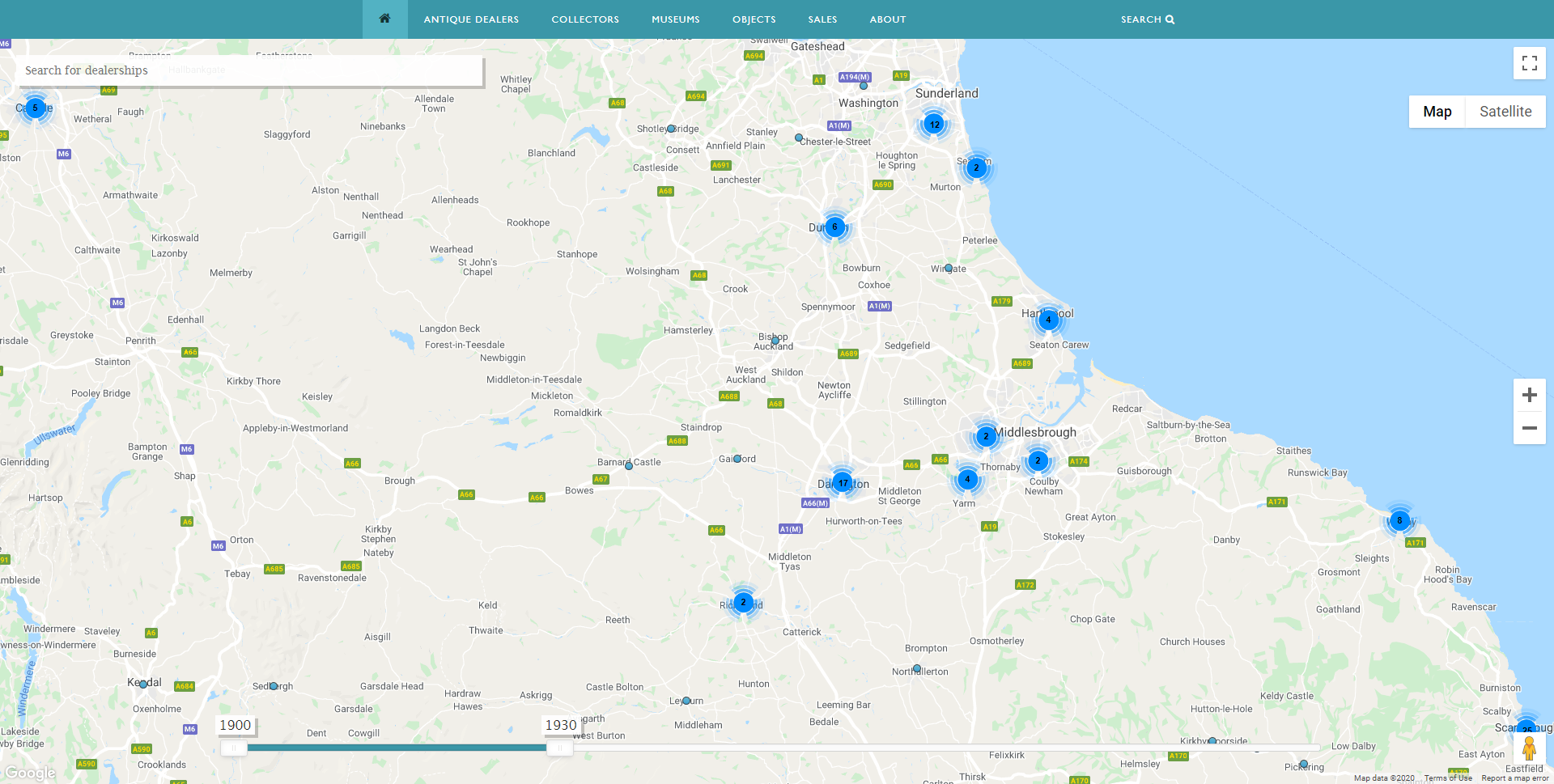
Antique Dealers Map – showing number of dealers in the North East of England 1900-1930. Image, Antique Dealers research project, University of Leeds.

We can note (above), that there were in fact quite a number of dealers in the North East in the period 1900-1930 – there were, of course, some very wealthy individuals in the North East, with fortunes built on Shipbuilding and industrial production – so it’s not really surprising that towns like Darlington already had 17 antique dealers by 1930; or that the area around Sunderland had 14 dealers.  Durham, a historic city like Exeter, by contrast, only had 6 antique dealers in 1930.  Scarborough was a particular hot-spot though, with 25 antique dealers by 1930.  One can also note the small number of towns with just a single dealer (see Kendal, Barnard Castle, Leyburn etc).

Compare this (below) to the map showing the number of dealers in the North East of England in 1900-2000 (mainly up to c.1970, as I say):
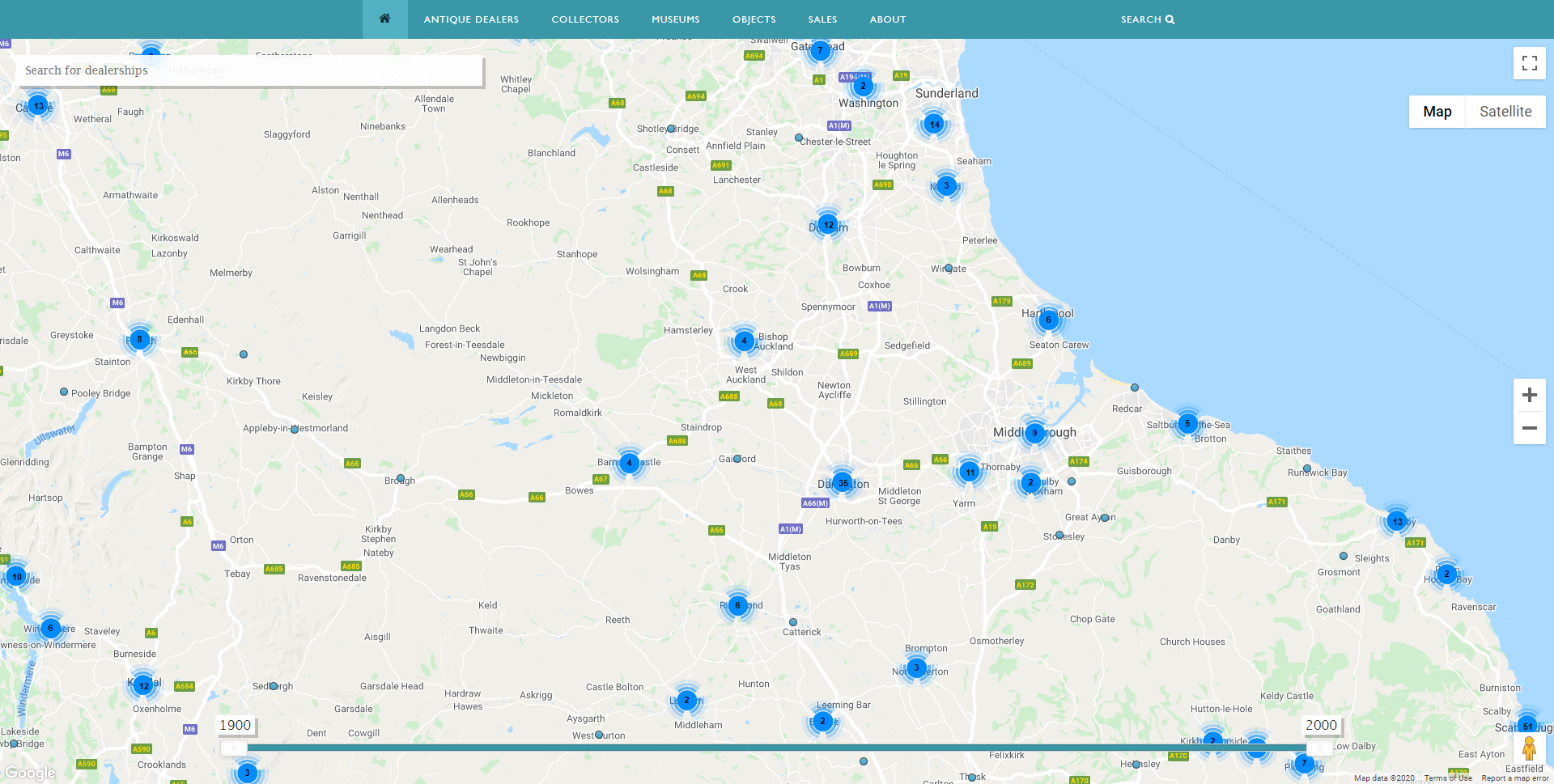
Antique Dealers Map – showing number of dealers in North East England 1900-2000. Image, Antique Dealers research project, University of Leeds.

In the map (above) of the North East of England, the number of dealers in various locations has increased significantly, but nothing like the expansion seen in the South and the South East of England.  In the North East, for example, Darlington, has seen the number of dealers increase from 17 to 35.  But in the Sunderland area, there are c.15 dealers, which was about the same as it was in 1930.  In Durham, there were now 12 antique dealers (up from 6 in 1930).  Scarborough has seen a significant increase though, with 61 dealers by c.1970, up from 25 in 1930. Carlisle had 5 dealers in 1930, but has expanded to 13 dealers by c.1970. But perhaps the greatest change is in the numbers of antique dealers in the smaller, tourism driven towns, such as Kendal (which had just 1 dealer in 1930 and now boasts 12 dealers), and in towns like Ambleside (0 dealers in 1930, but 10 dealers by c.1970); and Penrith (0 dealers in 1930, but 8 dealers by c.1970).

In North Yorkshire, inland from the coastal town of Scarborough, there were already a number of locations long associated with the antiques trade, as this section of the map (below) of the number of dealers in the are in 1930 illustrates.  Here, Harrogate (with 44 dealers) and York (with 45 dealers), as well as Leeds (with c.45 dealers) dominate the landscape in 1930. But there are also a small number of antique dealers in Knaresborough (9), in Bradford (9 dealers) and Halifax (9 dealers) by 1930.
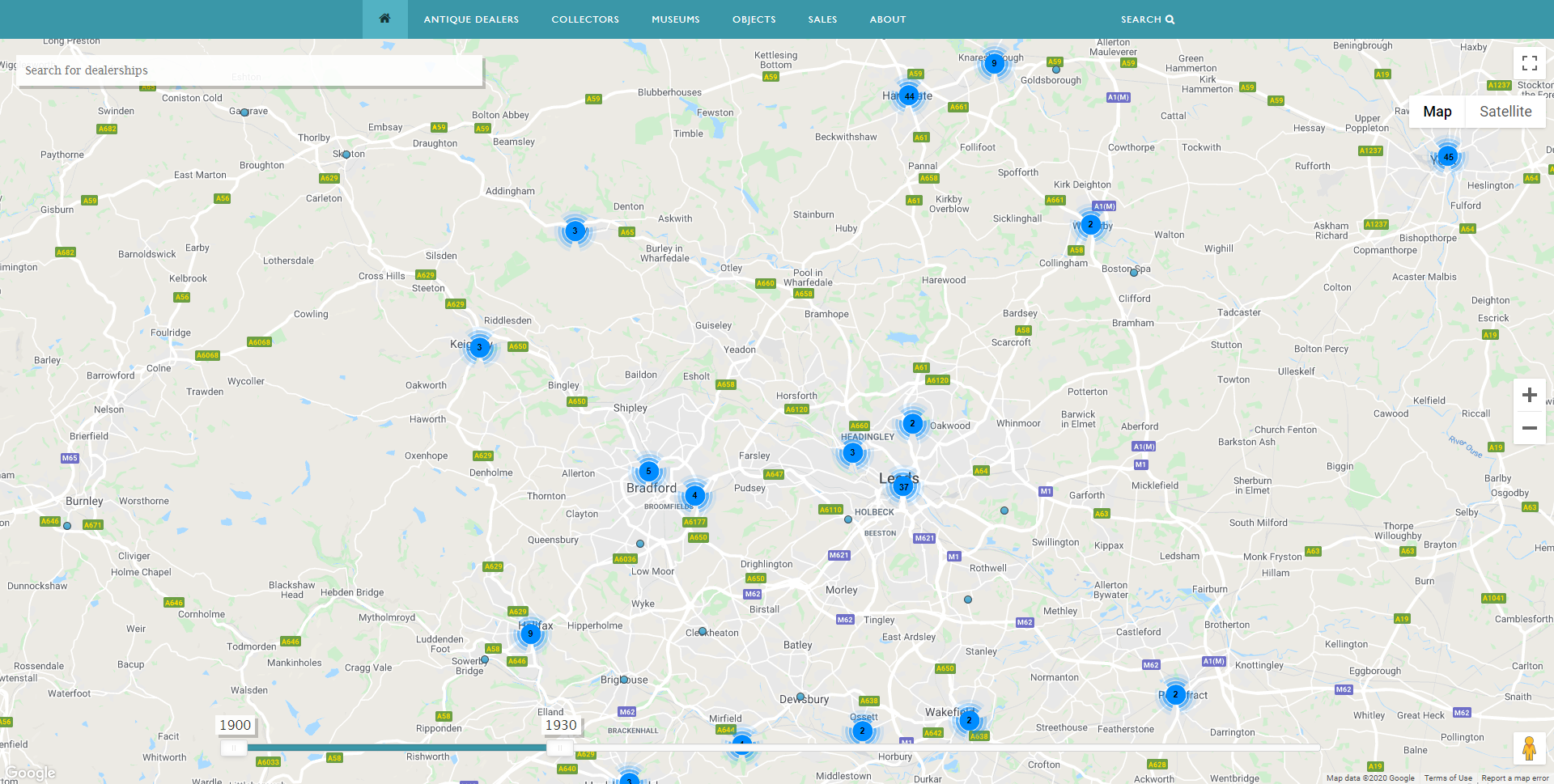
Antique Dealer Map – showing numbers of dealers in Yorkshire in 1900-1930. Image, Antique Dealers research project, University of Leeds.

In the Yorkshire region in the period 1900-2000 (below) (focused on dealer locations up to c.1970 again), the number of antique dealers in Harrogate has risen to 78; in York, to 63, and in Leeds to c.80. And the numbers of dealers in Knaresborough, Bradford and Halifax, have all increased to c.23 in each location. There is also a general increase in the number of dealers in the towns west and south of Leeds.
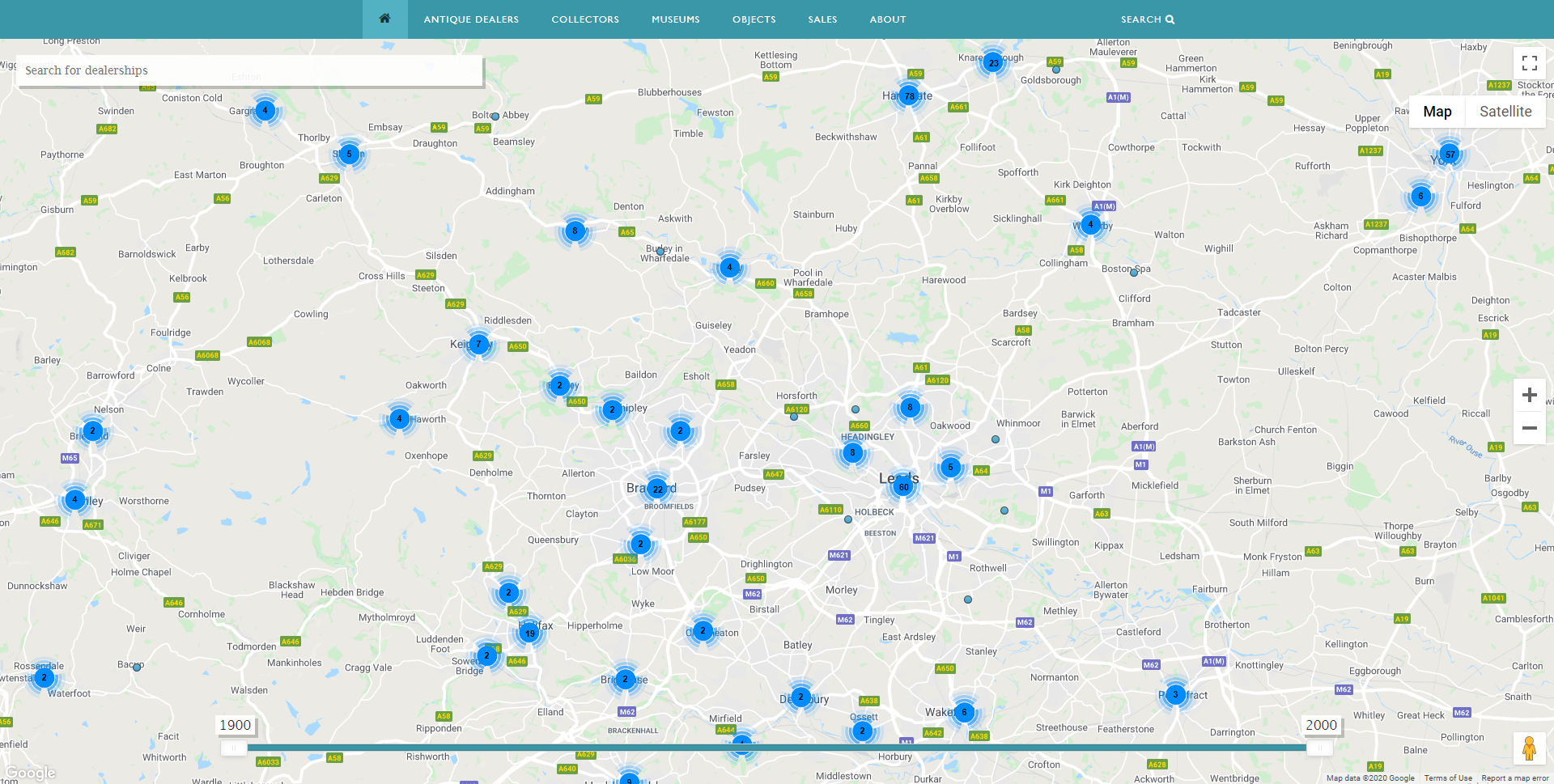
Antique Dealer Map – showing number of dealers in Yorkshire 1900-2000. Image, Antique Dealers research project, University of Leeds.

In the East Midlands of England, around the Norfolk and Suffolk areas, we see similar patterns of growth between 1930 and c.1970. In the map of 1900-1930 (see map below), the city of Norwich, again a location associated with tourism and with an important historic architectural fabric, had 39 antique dealers by 1930.  And one can also notice a few locations on the north Norfolk coast with small numbers of dealers (Cromer, with 3 dealers for example). Indeed, further down the coast, into Suffolk, in the towns of Lowestoft (9 dealers) and Southwold (6 dealers), the presence of antique dealers illustrates the continuing legacy of tourism in the development of the antique trade.  Further inland, the town of Bury St. Edmunds, again with a significant historic fabric, had 10 dealers in 1930.  Inland further still, Peterborough was also an important location, attracting 17 dealers by 1930.
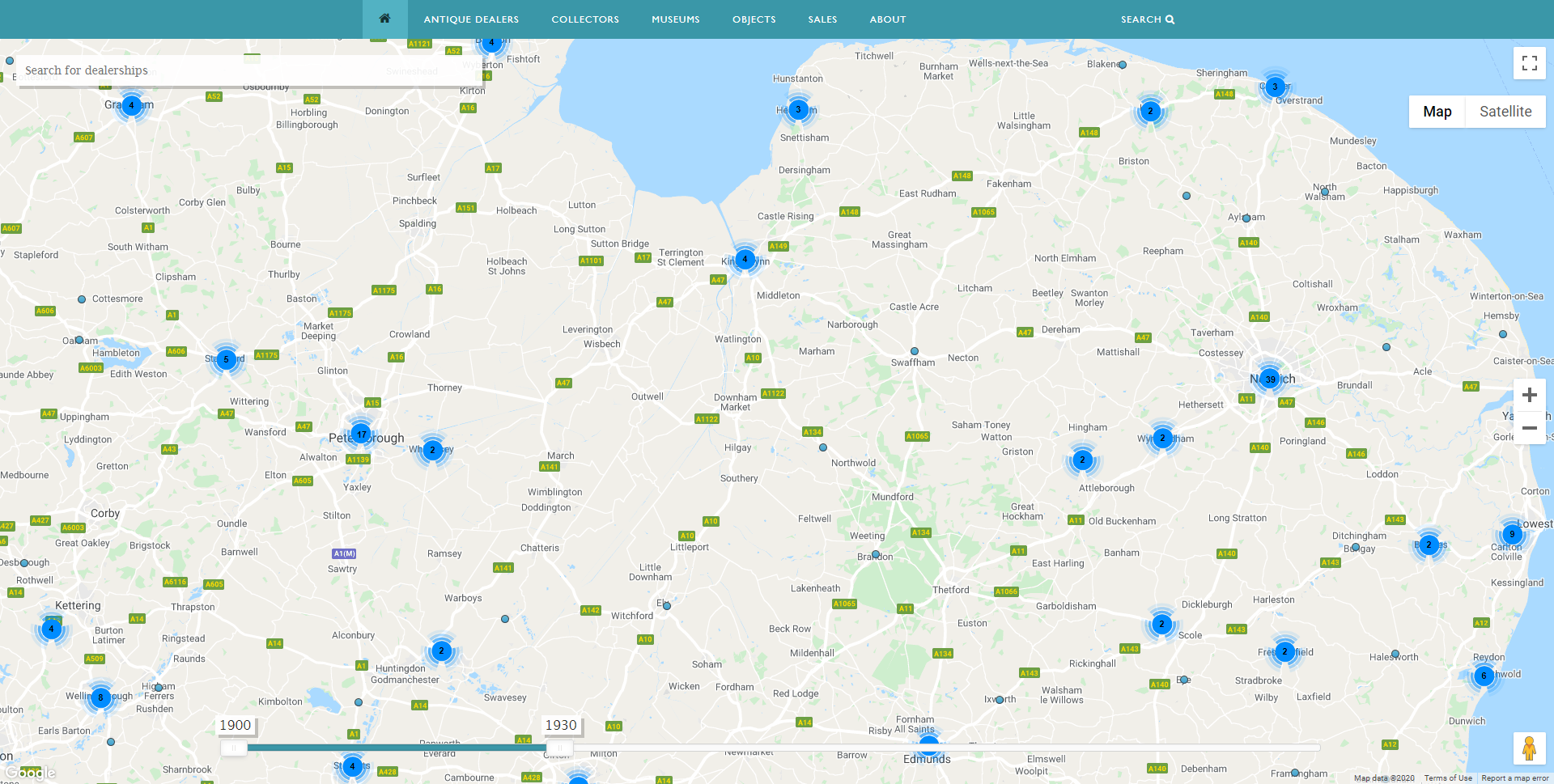
Antique Dealer Map – showing the locations of antique dealers in East Midlands 1900-1930. Image, Antique Dealers research project, University of Leeds.

Looking at the same locations in the map of 1900-2000, (focused on dealers up to c.1970) (see below), we can see some significant increases in the number of dealers in popular tourist locations.
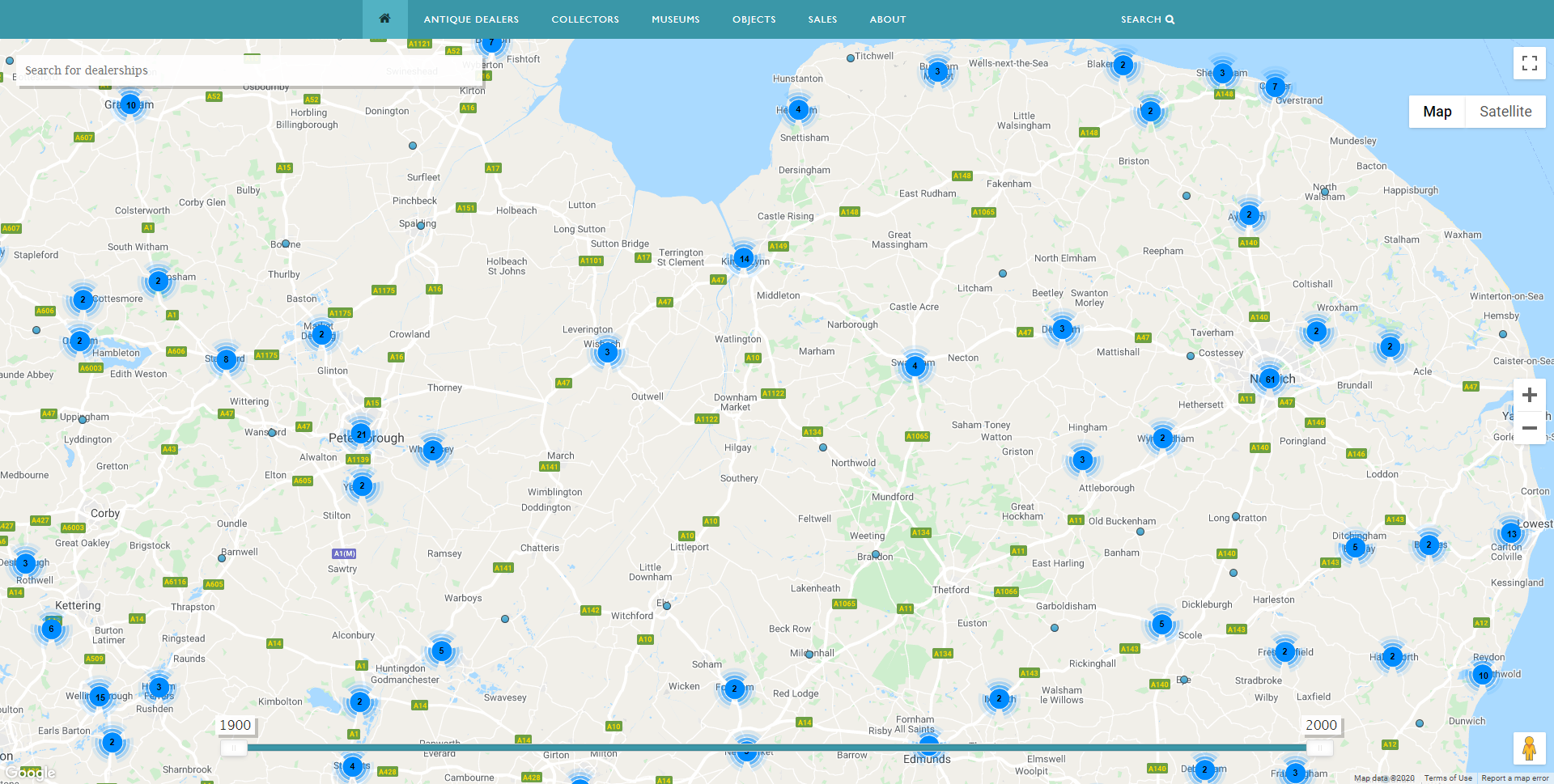
Antique Dealer Map – showing numbers of dealers in East Midlands in the period 1900-1930. Image, Antique Dealers research project, University of Leeds.

In this map (above), the number of dealers based in Norwich has risen to 61 (from 39) by c.1970.  And the coastal towns of north Norfolk have also seen a significant increase in the numbers of dealers – Cromer now has 7 dealers, and there are a number of other towns and villages on the north Norfolk coast that now have antique shops. The Suffolk coastal towns of Lowestoft and Southwold have also seen the numbers of dealers increase (Lowestoft has risen to 13; Southwold to 10). Bury St. Edmunds also has an increase in the number of dealers, rising to 25 dealers in c.1970, from 10 dealers in 1930.  Further inland, in Peterborough, there has been a less significant rise in the number of dealers, increasing to 21 dealers in c.1970, from 17 dealers in 1930.  But again, what is striking is the general increase in the number of locations that have attracted antique shops by c.1970, with dozens of villages across Norfolk and Suffolk being chosen as key locations by antique dealers.

And finally, a look at the most important location for antique dealers in Britain – London.  The map (below) shows the number of antique dealers across the capital in the period 1900-1930. Here, the West End of London dominates the landscape, with 826 dealers in 1930, followed by North London, with 236 dealers; then the Kensington area, with 224 dealers, and South West London (Fulham and Chelsea) with 213 dealers; and finally East London, with 70 dealers in 1930.
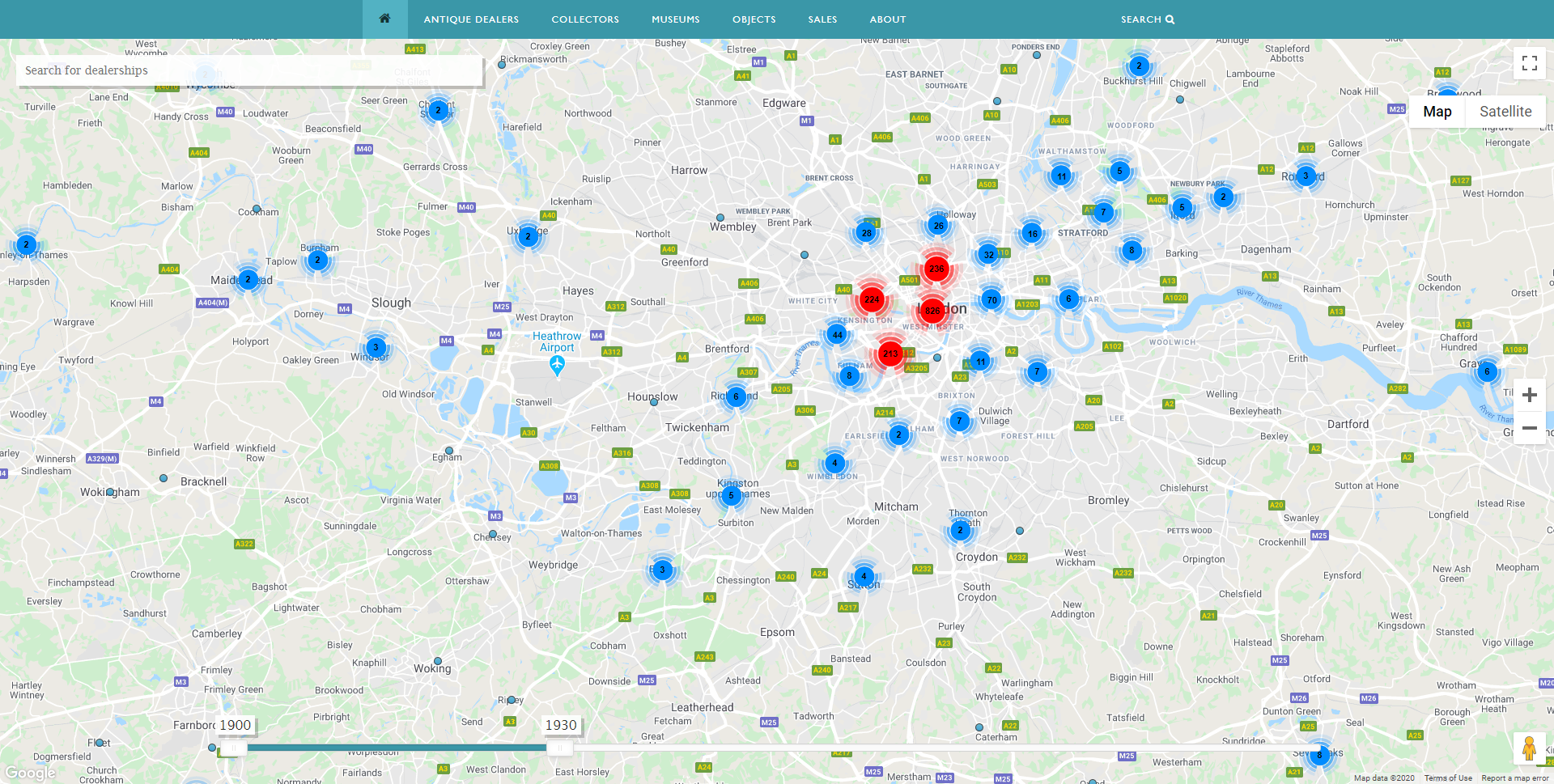
Antique Dealer Map – showing the numbers of dealers in London in 1900-200. Image, Antique Dealers research project, University of Leeds.

By c.1970, these already very high numbers of antique dealers (compared to anywhere else in Britain at least) had increased again, as this final map (below) of the same area illustrates.  Here the numbers of antique dealers in the West End has risen to c.1500; in the North of London growth has remained virtually static though (220 dealers in c.1970); the Kensington area has seen a significant increase in the numbers of dealers, from 224 (in 1930) to 484 (in c.1970). But the biggest percentage increase of dealers in a single area in London appears to have taken place in South West London, in Fulham and Chelsea, which saw an increase in the numbers of dealers from 213 (in 1930) to 516 in c.1970. This area had some of the most high profile locations in the biography of the antique trade – Fulham Road, the King’s Road, and streets such as Beauchamp Place and Brompton Road.
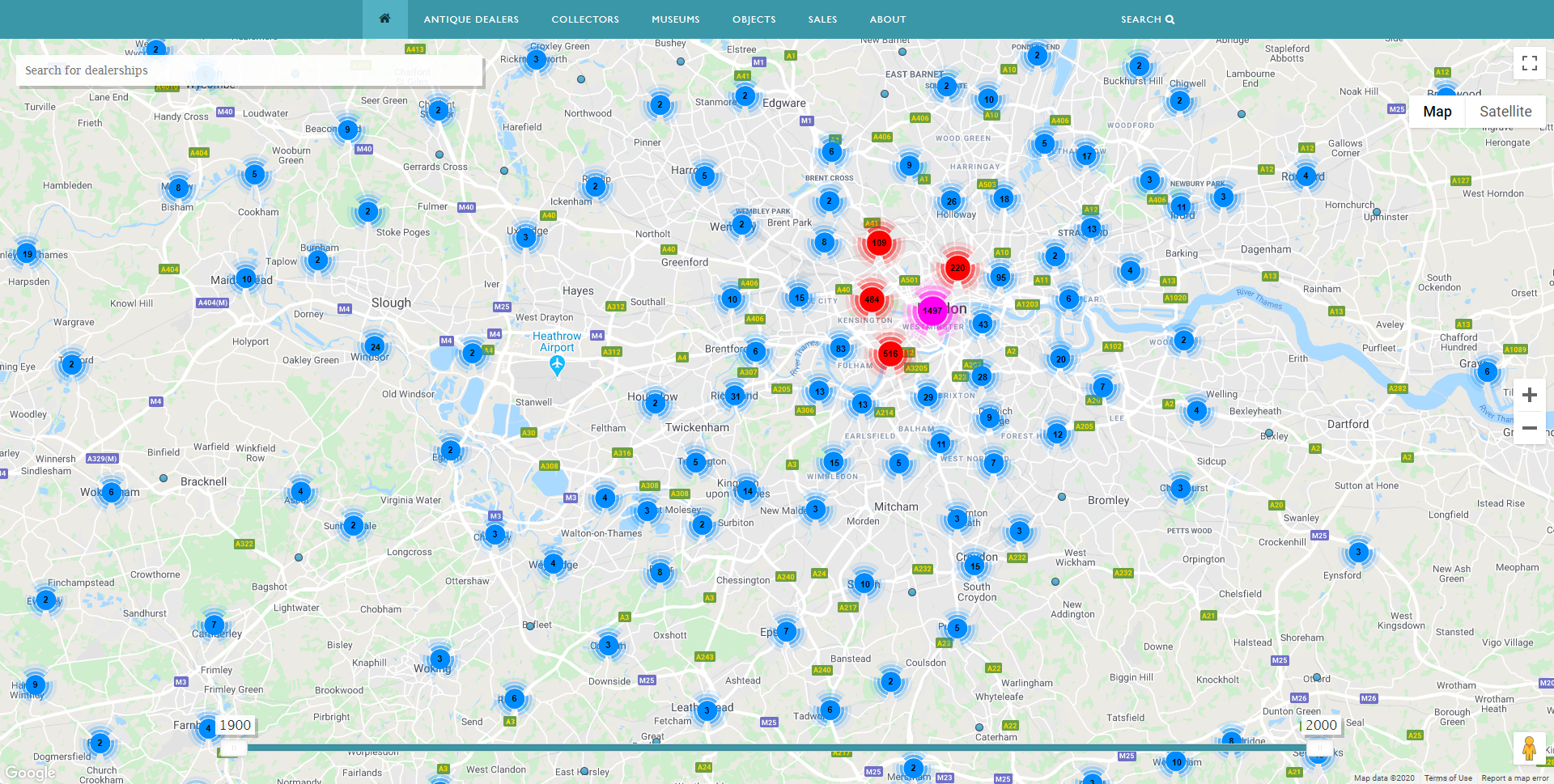
There’s still a lot more to say about these changing geographies, and their significance, and still many more dealers to add into the map – there was a further expansion of the antique trade in the 1970s and 1980s, before the rapid contraction during the late 1990s, all of which we hope the Antique Dealer Map will illustrate.  But I hope this brief overview demonstrates the rich potential of the Antique Dealer Map as a key resource in the ongoing research into the history of the antique trade in Britain.

Mark

June 29, 2020

Emergence of the Antique & Curiosity Dealer book published

I thought you may be interested to hear that my new book, The Emergence of the Antique & Curiosity Dealer in Britain 1815-1850: the commodification of historical objects has finally been published, and it has now been released from the warehouses that have been holding it (in India I think?).  The book has been a very (very) long time in gestation – 10 years in fact, and I won’t bore you with the complicated history of its genesis – suffice to say that I have been busy with many, many other things.  And, for all those that are sitting on what they think are long dead book projects, the Emergence is a testament to keeping faith, and a testament to the many people who have supported me over the years; and of course to my publisher, Routledge (who were ‘Ashgate’, when I signed the contract back in the day!) for keeping faith too – and a special thanks to all at Routledge for their patience.  I can’t say what people will think of the book of course, but I hope someone out there likes it, or at least appreciates the effort!

Here’s the blurb for the book, in case you wonder what it’s actually about – Rather than the customary focus on the activities of individual collectors, The Emergence of the Antique and Curiosity Dealer in Britain 1815-1850: The Commodification of Historical Objects illuminates the less-studied roles played by dealers in the nineteenth-century antique and curiosity markets. Set against the recent ‘art market turn’ in scholarly literature, this volume examines the role, activities, agency and influence of antique and curiosity dealers as they emerged in the opening decades of the nineteenth century. This study begins at the end of the Napoleonic Wars, when dealers began their wholesale importations of historical objects; it closes during the 1850s, after which the trade became increasingly specialized, reflecting the rise of historical museums such as the South Kensington Museum (V&A). Focusing on the archive of the early-nineteenth-century London dealer John Coleman Isaac (c.1803-1887), as well as drawing on a wide range of other archival and contextual material, Mark Westgarth considers the emergence of the dealer in relation to a broad historical and cultural landscape. The emergence of the antique and curiosity dealer was part of the rapid economic, social, political and cultural change of early-nineteenth-century Britain, centered around ideas of antiquarianism, the commercialization of culture, and a distinctive and evolving interest in historical objects. This book will be of interest to scholars in art history, histories of collecting, museum and heritage studies, and nineteenth century culture.

I’m sorry it’s rather expensive – at £120 it’s quite a whack (as they say!), but that’s academic publishing for you I guess; the economic model must take account of the fact that only half a dozen people will actually buy it!?…My other book (SOLD! The Great British Antiques Story) by contrast, is FREE, as you may know (thanks to the Paul Mellon Centre for Studies in British Art).

Anyway, if you are at all interested in this arcane subject, then Emergence may be one for you.

Mark
May 23, 2020

Antique Silver Dealers – Jay, Richard Attenborough & Co. archive

It’s amazing what turns up at auction sometimes – during ‘Lockdown’ I seem to have ‘saleroom.com’ constantly running in the background whilst I’m writing on my PC; last week, at Keys Fine Art in Aylsham, Norfolk, a rather dishevelled old album caught my eye. Lot 217, described as ‘Vintage Album containing various photographs of hallmarked silver and other artworks’ sounded rather intriguing, and I recognised the type of photographs and that it was probably a silver dealer’s album – so I had to buy it of course; it was a bargain I think, just £12 plus commissions and postage, so cost about £24 all told (and thank you to Keys Fine Art Auctions for packaging the lot so well and posting it so promptly!).


‘Vintage Album’, Keys Fine Art Auctions, Norfolk.

The album arrived in the post this week. I guess the album itself dates from c.1900 – it has an old title on the original red leather spine ‘Photographs & Records of Cups and Presentation Plate’ – although it has been recovered in plain brown paper at some stage, and as you can see it is in a very distressed condition.

The album turned out to be a fascinating record of the well-known London-based silversmiths and antique silver dealers ‘Jay, Richard Attenborough & Co Ltd‘.  In some business letters, dating from the 1920s and which have been pasted into the album, Attenborough described themselves as ‘Goldsmiths, Diamond Merchants and Watchmakers’; they traded from 142-144 Oxford Street, London, from c.1905 until the late 1950s, although like many 20th century antique silver dealers (such as Harman & Lambert, or Birch & Gaydon), Attenborough can trace their genealogy into the 18th century – their business letterhead states that they were established in 1796. The Attenborough business was acquired by the silversmith James Charles Jay in 1887 and by 1904 had become Jay, Richard Attenborough & Co Ltd – the business seems to have closed sometime in the 1960s? They were listed as ‘antique silver dealers’ in the London Trade Directories in the 1920s-1950s. As silversmiths, Attenborough also sold antique silver and indeed the album exemplifies the continued tradition within silversmithing of buying and selling second-hand and antique silver. The famous firm of S.J. Phillips, for example, began as silversmiths and jewellers in the 19th century and many other antique silver dealers can trace their origins as silversmiths.

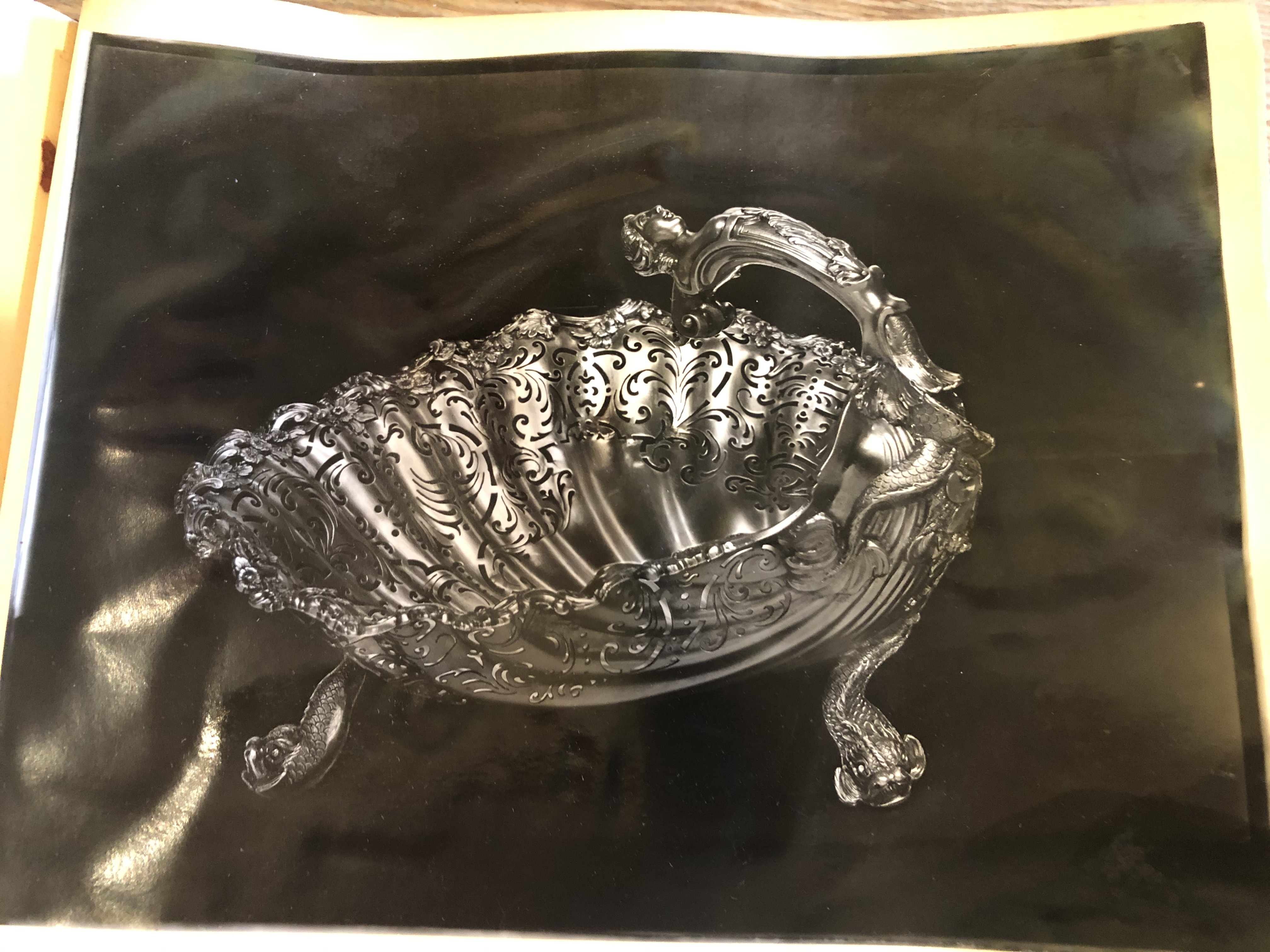
The contents of the album are mainly photographs of modern silver made by Attenborough in the 1920s to the 1950s, but there are also many photos of 18th and 19th century antique silver, including this amazing George II silver basket – in the style of Paul de Lamerie (1688-1751).

George II Silver Basket; Jay, Richard Attenborough & Co Ltd album, photograph c.1930s?

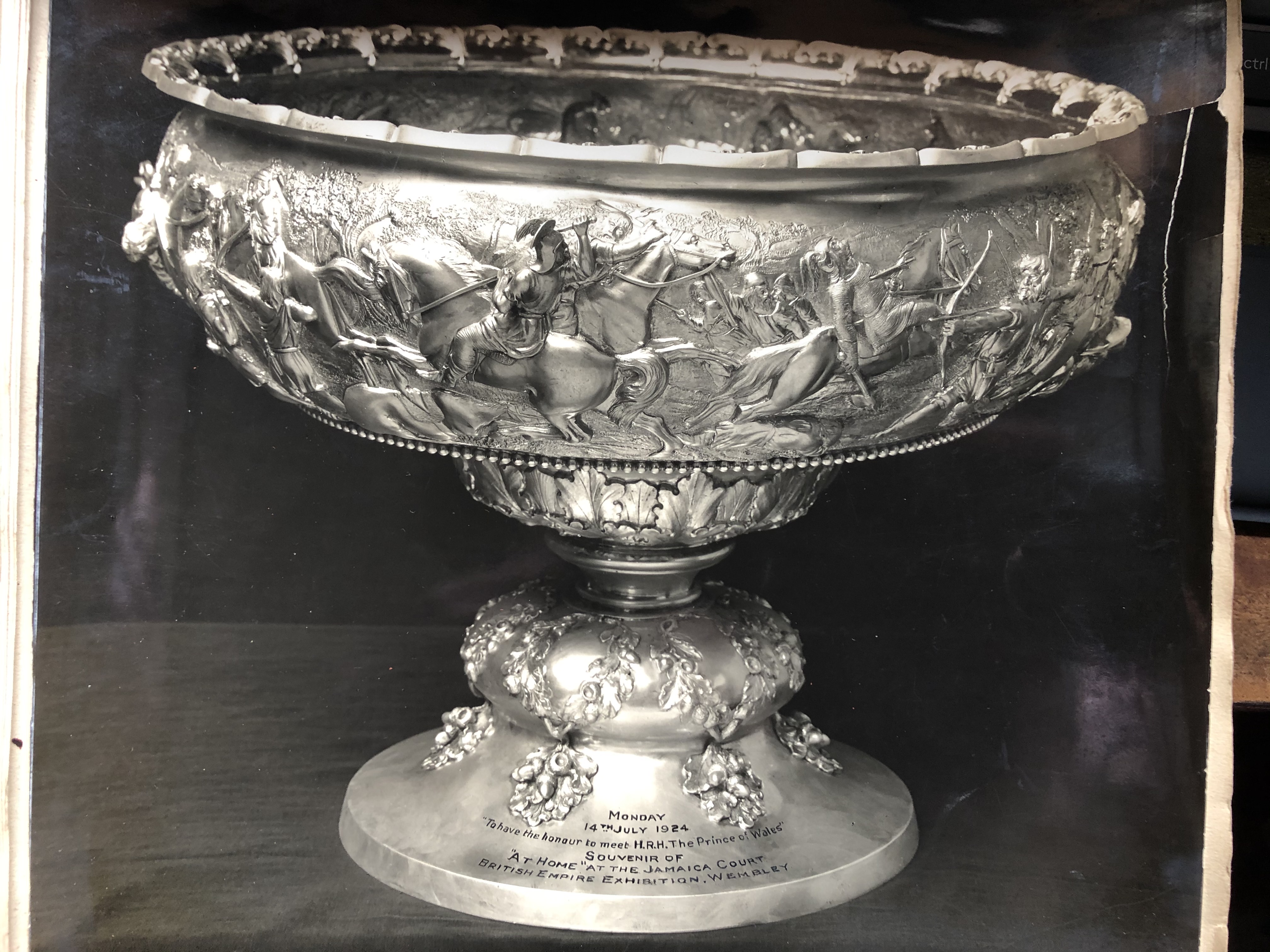
Some of the most interesting photographs in the album illustrate pieces of antique silver that have been remounted as presentation pieces by Jay, Richard Attenborough & Co in the 1920s and 1930s.  This silver punch bowl dating from 1870 has been remounted for presentation in 1924.  There is a long description of the object in the album; ‘Silver Punch Bowl, weighing 144 ounces, standing 14 inches high, and measuring 18 inches across. It is entirely wrought and chased by hand, and bears the Victorian Hall mark for the year 1870. The body of the bowl is decorated with repousse work in high relief of figures of horsemen and footmen in armour, symbolising battle scenes from early English history. The pedestal foot is ornamented with a series of wreathed designs of oak leaves and acorns; the whole forming a remarkable and unique specimen of the silversmith’s art. It was originally on [sic] the collection of the late Viscount Chaplin, who was a great patron of the turf, and a thorough sportsman, also a political associate of the Rt. Hon. Joseph Chamberlain. The inscription engraved on the foot is as follows:- Monday, 14th July, 1924 ‘To have the honour to meet H.R.H. The Prince of Wales’ Souvenir of ‘At Home’ at the Jamaica Court. BRITISH EMPIRE EXHIBITION, WEMBLEY.’

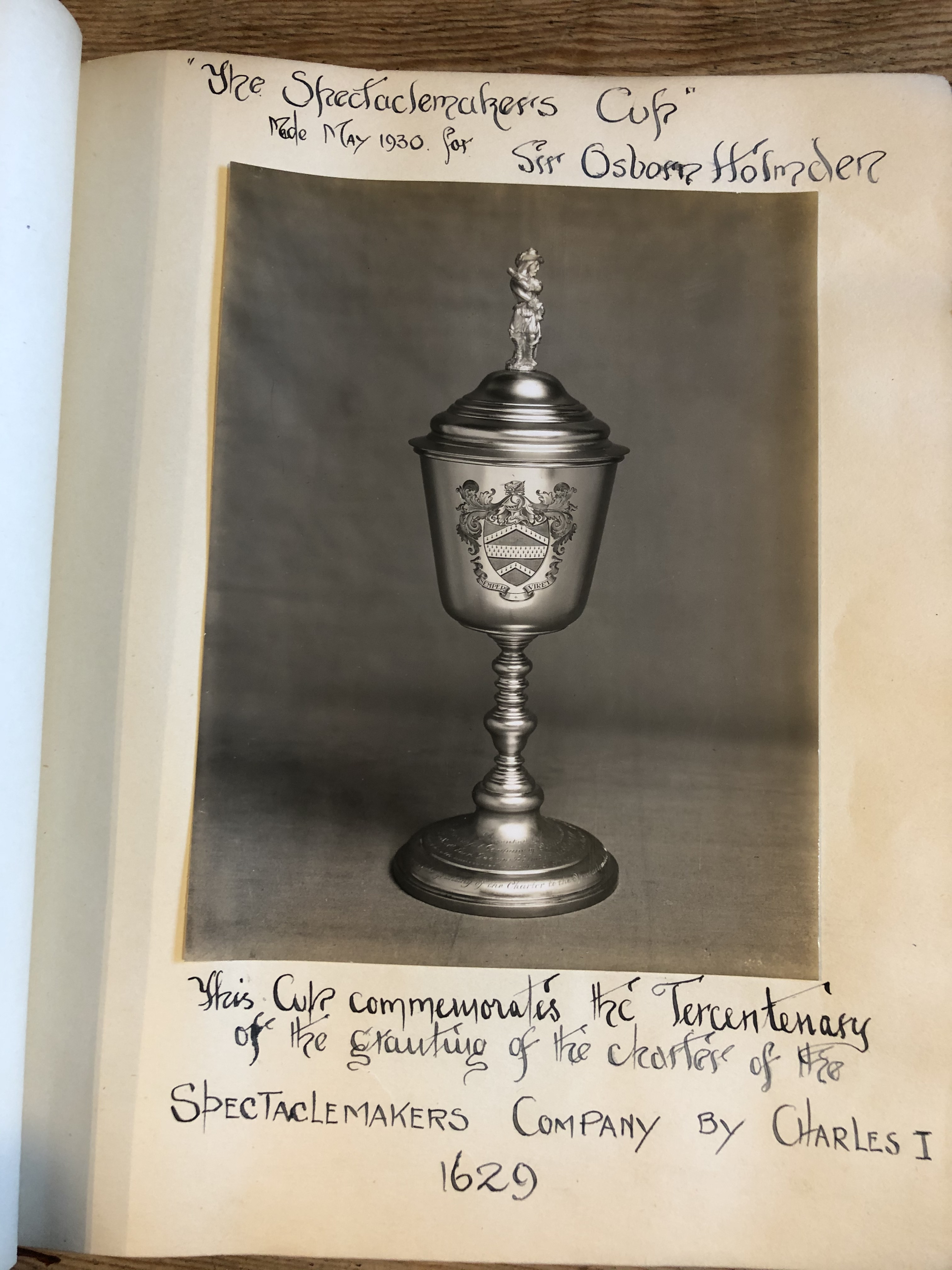
The album also contains dozens of photographs of commissions for presentation cups and plate that the firm created in the early and mid 20th century. Here, for example, is ‘The Spectaclemakers Cup’, made to commemorate the tercentenary of the granting of the Royal Charter by Charles I in 1629; ‘made in May 1930 for Sir Osborn Holmden’ – who was made Master of the Worshipful Company of Spectaclemakers in 1928.

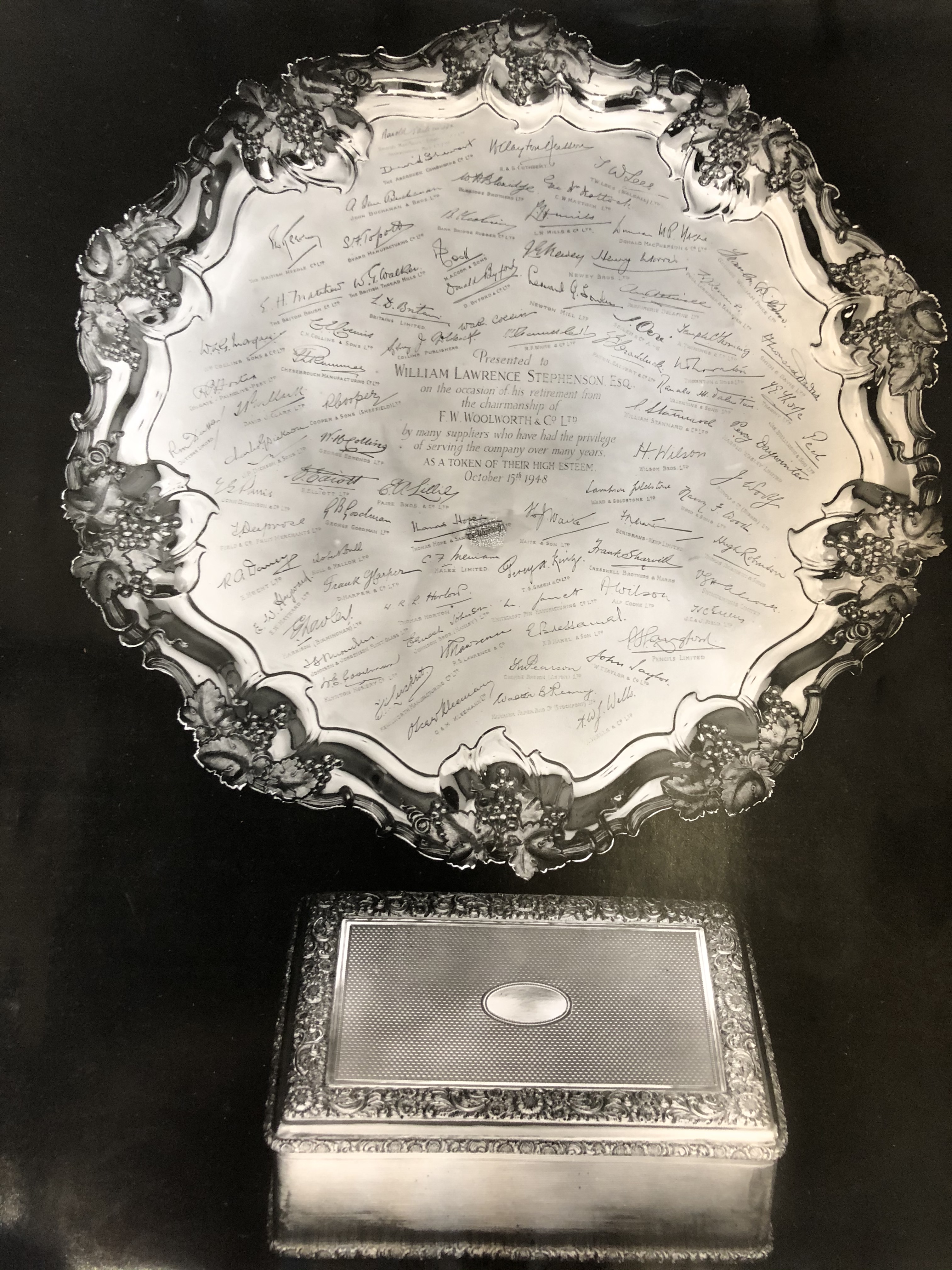
The wide range of commissions for silver that the firm undertook is illustrated by these two further examples – a large silver presentation salver, made as a gift to William Lawrence Stephenson Esq. on his retirement as chairman of F.W. Woolworth & Co. Ltd. in 1948.

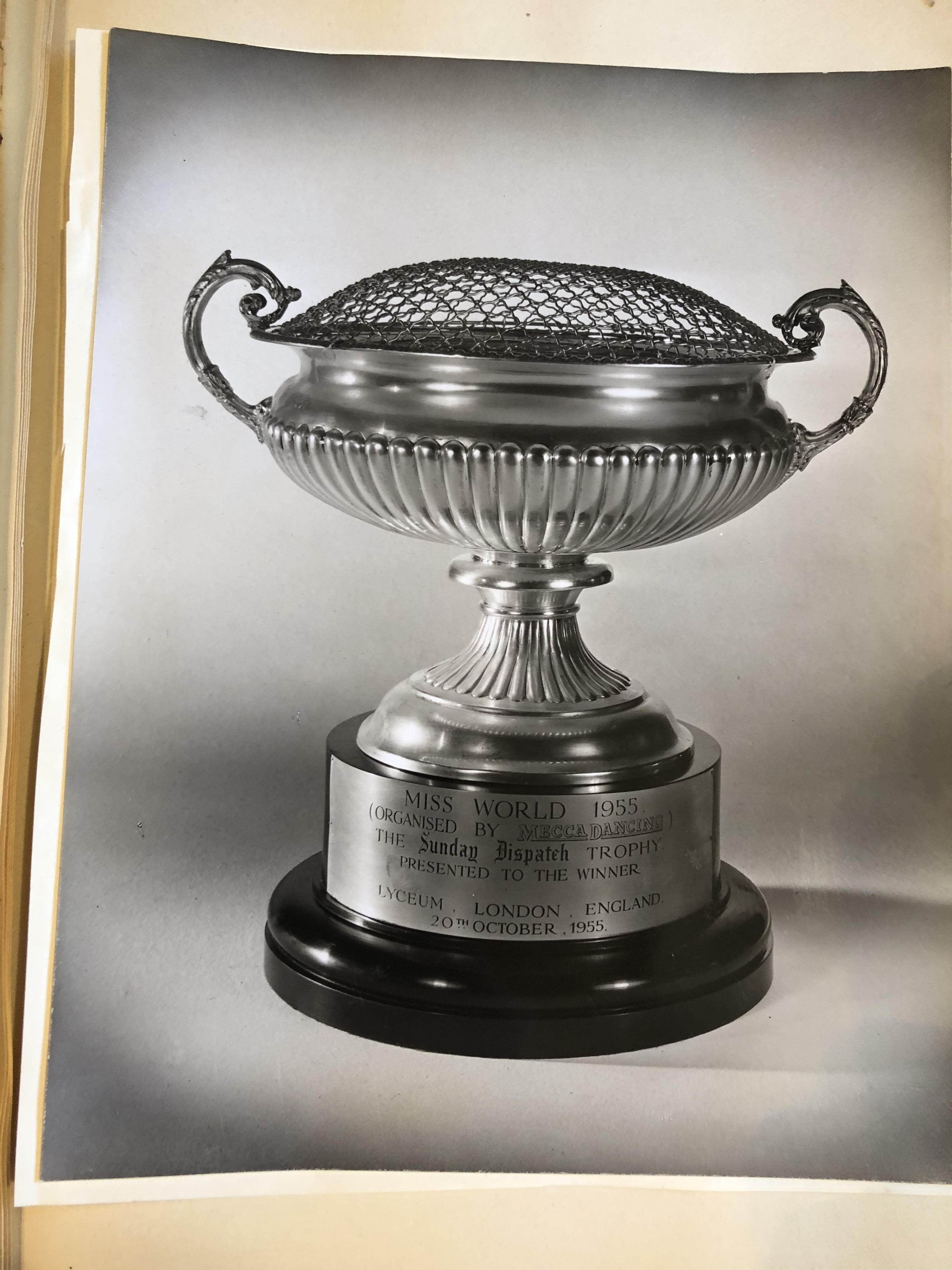
And the winner’s trophy for the Miss World Competition in 1955, which that year was held in London.

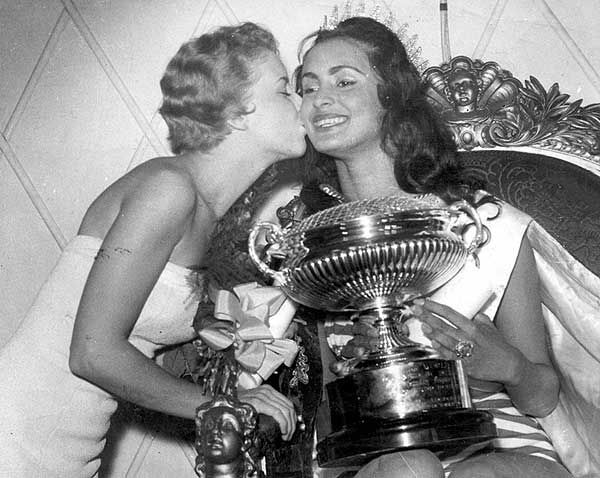
That year, the fifth edition of the now highly contentious and outdated competition, Miss Venezuela, Susanna Duijm, won the competition; here she is, holding the trophy made by Jay, Richard Attenborough & Co Ltd.

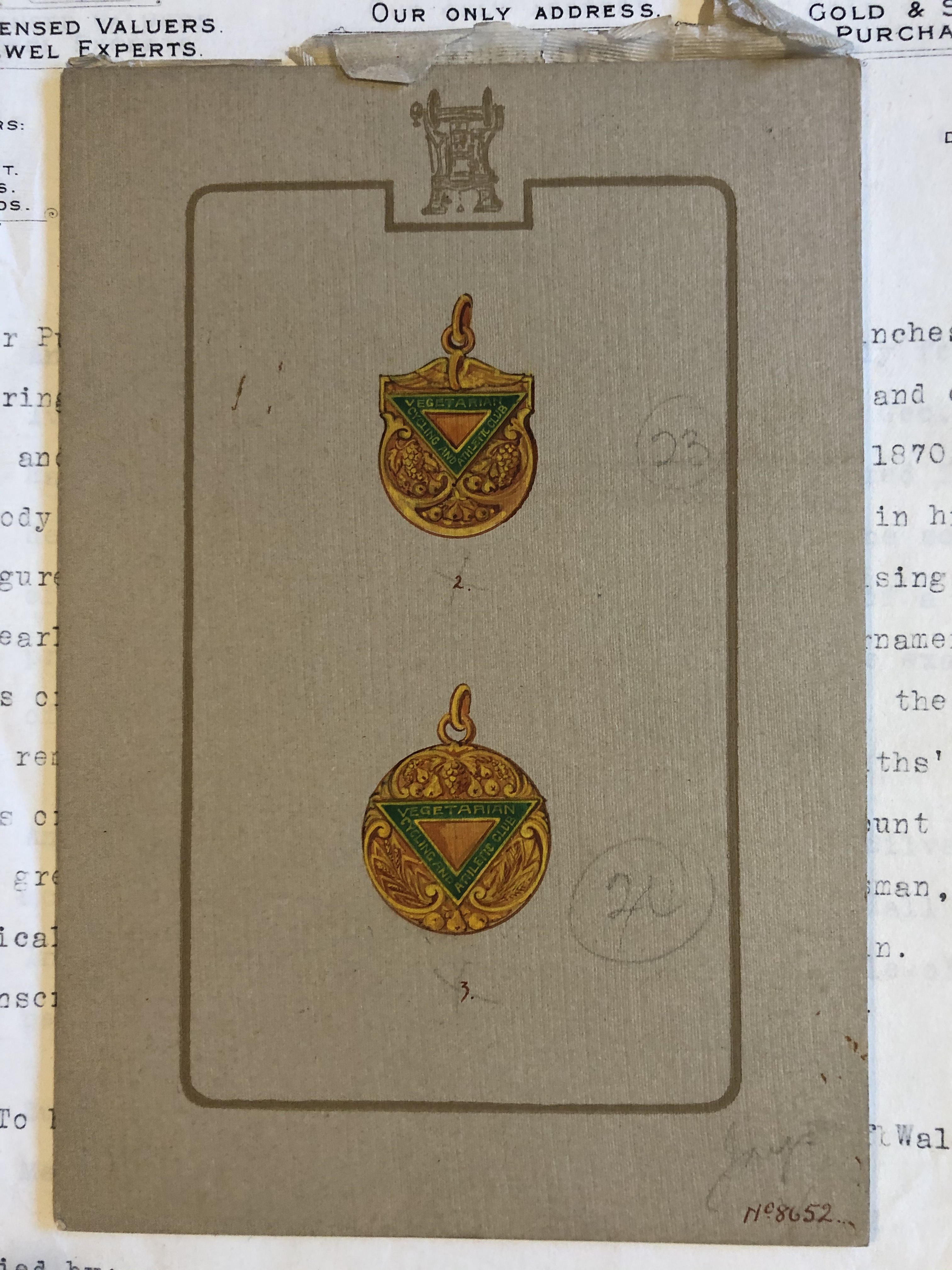
As well as the photographs of modern and antique silver, the album also contains a small number of fascinating watercolour designs for cups and medals, including these beautiful watercolours for designs for a medal for the Vegetarian Cycling and Athletic Club, dating from the 1930s.  The Club was established in 1888 and is still going.

The Attenborough album is an amazing document, one that clearly demonstrates how the practices of antique dealing, and those of contemporary design, have been in continuous flux.  The album will be making its way to the Special Collections at the Brotherton Library at the University of Leeds in due course!

Mark
May 11, 2020

Antique Dealer Research Project Newsletter – Spring 2020

Hello all friends and colleagues,

I hope you are all staying safe and well and everyone in your respective families are all OK and well too.  We thought, in these very challenging times, that you might like to hear about all the things that the antique dealers research project has been involved in over the past few months – and to hear about our future plans in the Post-Covid-19 world (not much detail on that front at present I’m afraid…but do keep an eye on the antique dealer research project blog for news, as and when things start to settle down).  But anyway, we have developed a new initiative – our Antique Dealer Research Project Newsletter – the first of which is attached here – Newsletter No.1 – ADRP Issue 01 HiRes FINAL (1)

We do hope that you enjoy reading the News – and hope that you remain safe and well.

Very best wishes

Stay Safe

Mark
April 20, 2020

Lockdown Quiz – Answers!

Looks like the Lockdown Quiz was rather too daunting and appears to have defeated everyone! We didn’t get one completed or even semi completed response to the quiz. The Christie’s Christmas Quiz from 1978 was indeed a fiendish beast, and if I’m honest, I don’t think, even with the help of Google it was possible to answer many of the questions.  There certainly were some really perplexing questions; who knew, for example that Augustus John and King George V were the only British Army Officers that were allowed to keep their beards in World War One (Question 23)? Or the answer to question 84 – ‘If James Yates is 5338, who is 2341’?….the numbers are pewterers numbers, so, obviously, 2341 is Robert Hitchman!….of course!…

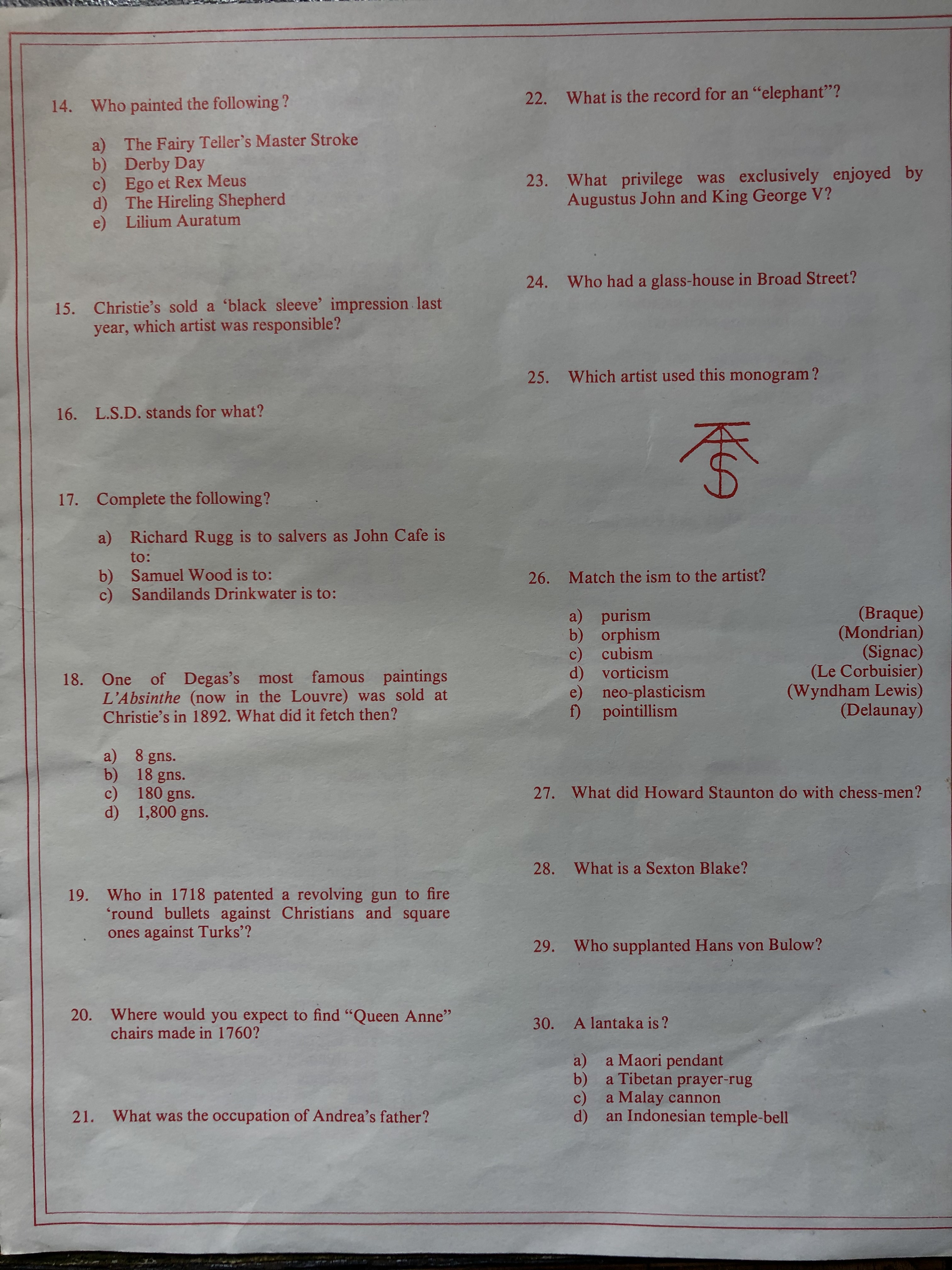
There were some rather standard empirical art history questions, which I guess many people would be able to answer quite easily – Question 26, for example, which asked to match up the ‘ism’ to the artist; or question 14, which asked to name the artist who painted particular paintings – such questions seemed pretty easy to deal with, especially with the help of Google – but many other questions seemed to be rather obtuse – I particularly liked question 16 – ‘L.S.D. stands for what?’….no, it was not acid (Lysergic Acid Diethylamide), but ‘Librae. Solidi. Denarii.’

Some of the questions were too obviously time specific – question 22, for example ‘What is the record for an ‘elephant’ – one needed to know that an ‘elephant’ is a folio size, and that the record at auction in 1978 was £216,393; or question 61, ‘Which proved more expensive: vultures, bantam cocks or cocatoos’ – (they are all birds modelled by the Meissen porcelain factory, and hence, it’s Vultures….of course!).

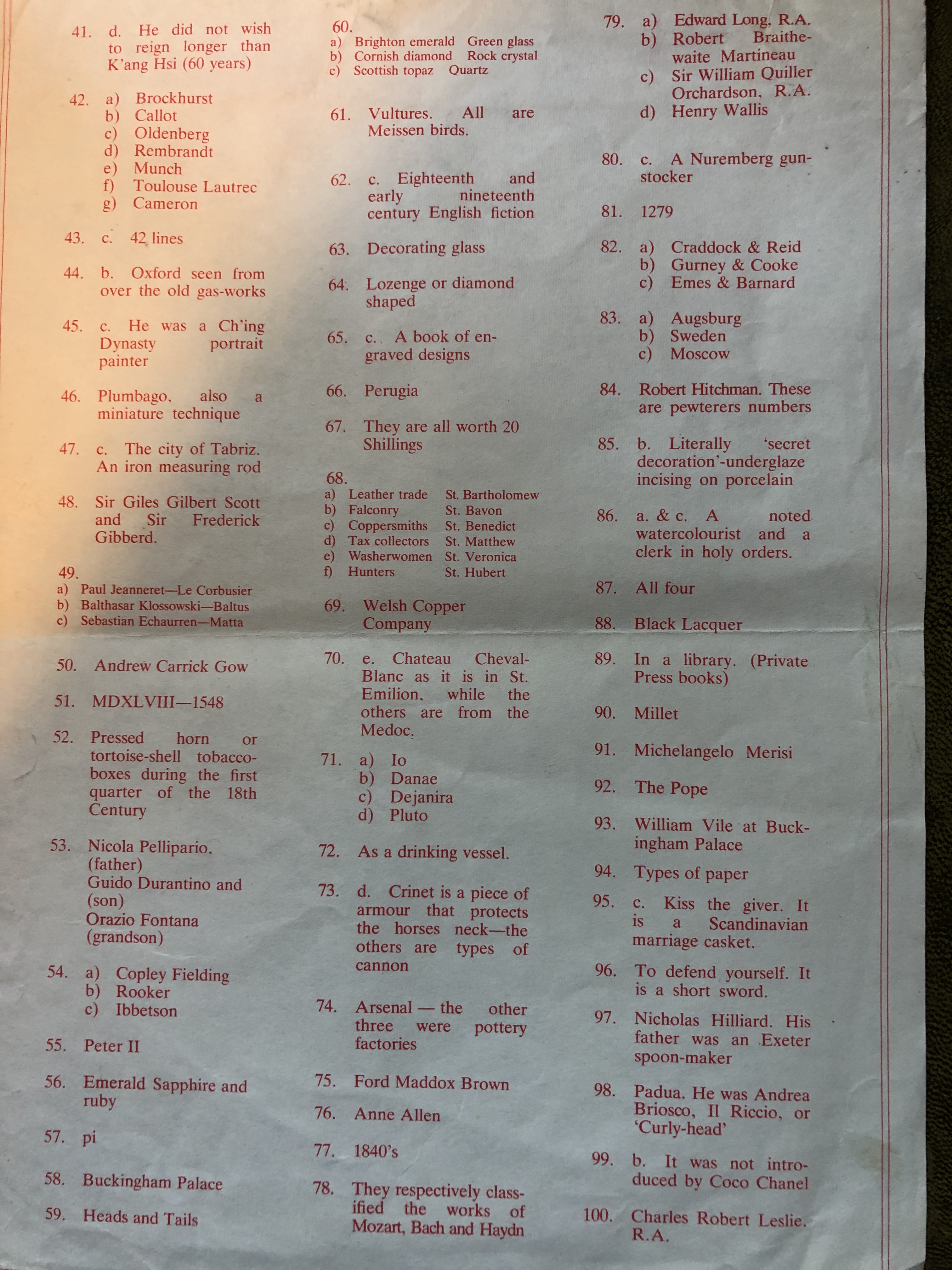
Anyway, I know you will all be waiting to see the answers to the quiz, to see how you did – so here are the answers!….Hope you did well, even if you didn’t submit your answers for the prize!

Answers 1-40:

Answers 41-100:

They were really hard, weren’t they!

Mark
April 13, 2020

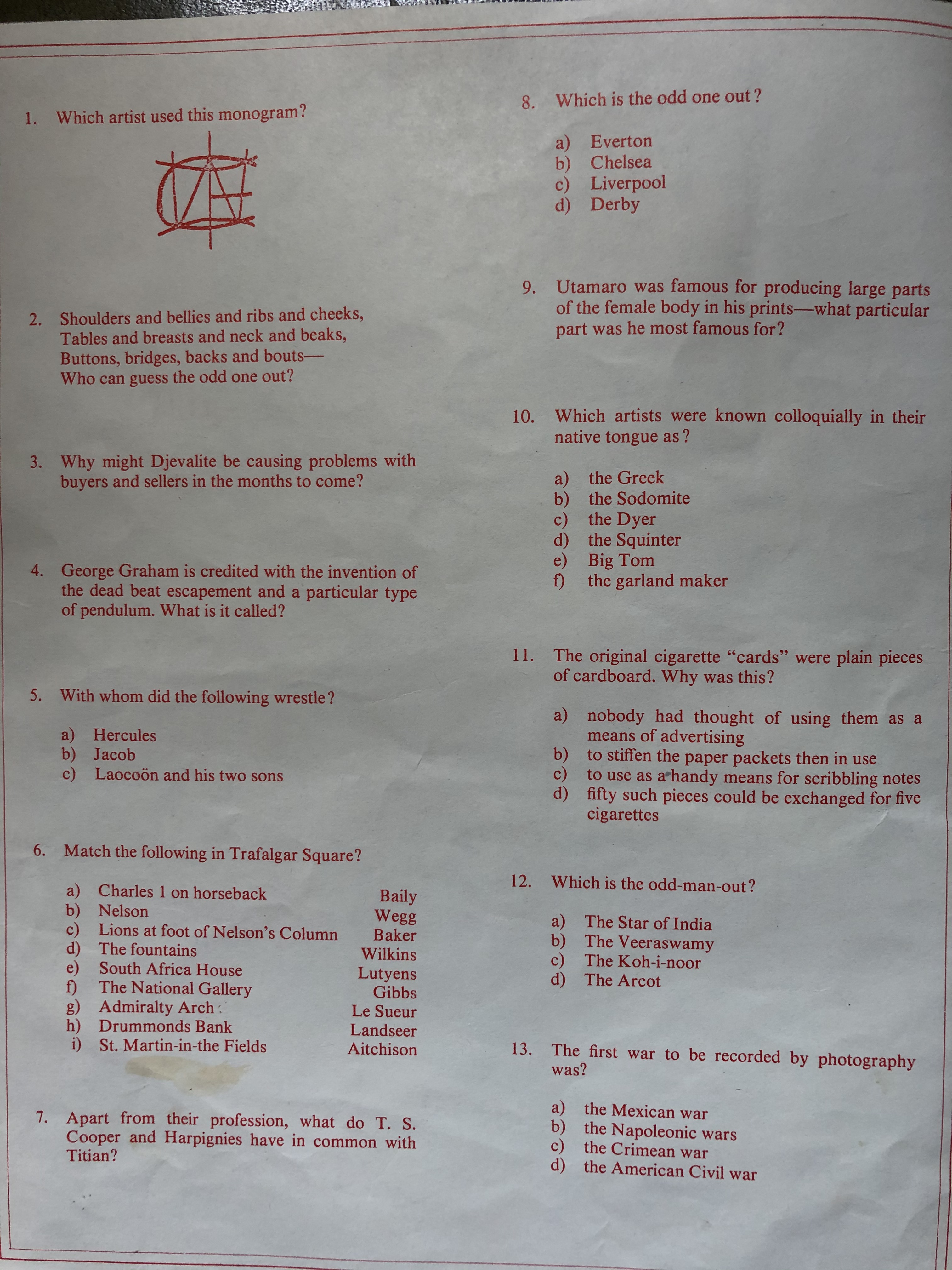
Lockdown Art and Antiques Quiz – Christie’s Christmas Quiz 1978

In these challenging days of ‘Lockdown’ we all need distractions – so how about an art history and antique collecting quiz, from back in the day – from 1978 to be precise, and a fiendishly difficult one too!  The Christie’s (auctioneers) ‘Christmas Quiz 1978’, which is a real mind boggler!

1978 – think Space Invaders, think Grease and Saturday Night Fever at the cinema, Charlie’s Angels and Love Boat on TV, boogie woogie disco clothes, and public services strikes in the UK – so what on earth was the state of knowledge in the art and antique markets in Britain at the time – well, exceptionally wide and very extensive if we go by the standard of the questions in the Christie’s 1978 Quiz!……here’s just one example to perplex you!…Question 33 – ‘What do Bawbee, Merk and Plack have in common?’….what on earth?…..and there are much more difficult questions!
The quiz has 100 questions, all related to art, antiques and collecting, with a few questions on wine too (as one might expect in a cultural quiz!).

There’s a prize for the winner – a print copy of the recently published SOLD! Great British Antiques Story exhibition catalogue will be posted to the winner (anywhere in the world!) – you have ONE WEEK (so the quiz deadline is Monday 20th April – 12.00pm UK time) to complete the quiz (I’d be very surprised if anyone managed to get all 100 questions correct!).  Email your answers to the project email address:

antiquedealers@leeds.ac.uk

The winner will be announced here on the project blog on Monday 20th April at 5.00pm – GOOD LUCK! – I have all of the answers to the quiz of course and will publish them on here on Monday 20th April – I’m guessing people will try to google some of the answers, but I’d be surprised if all of the questions can be googled!

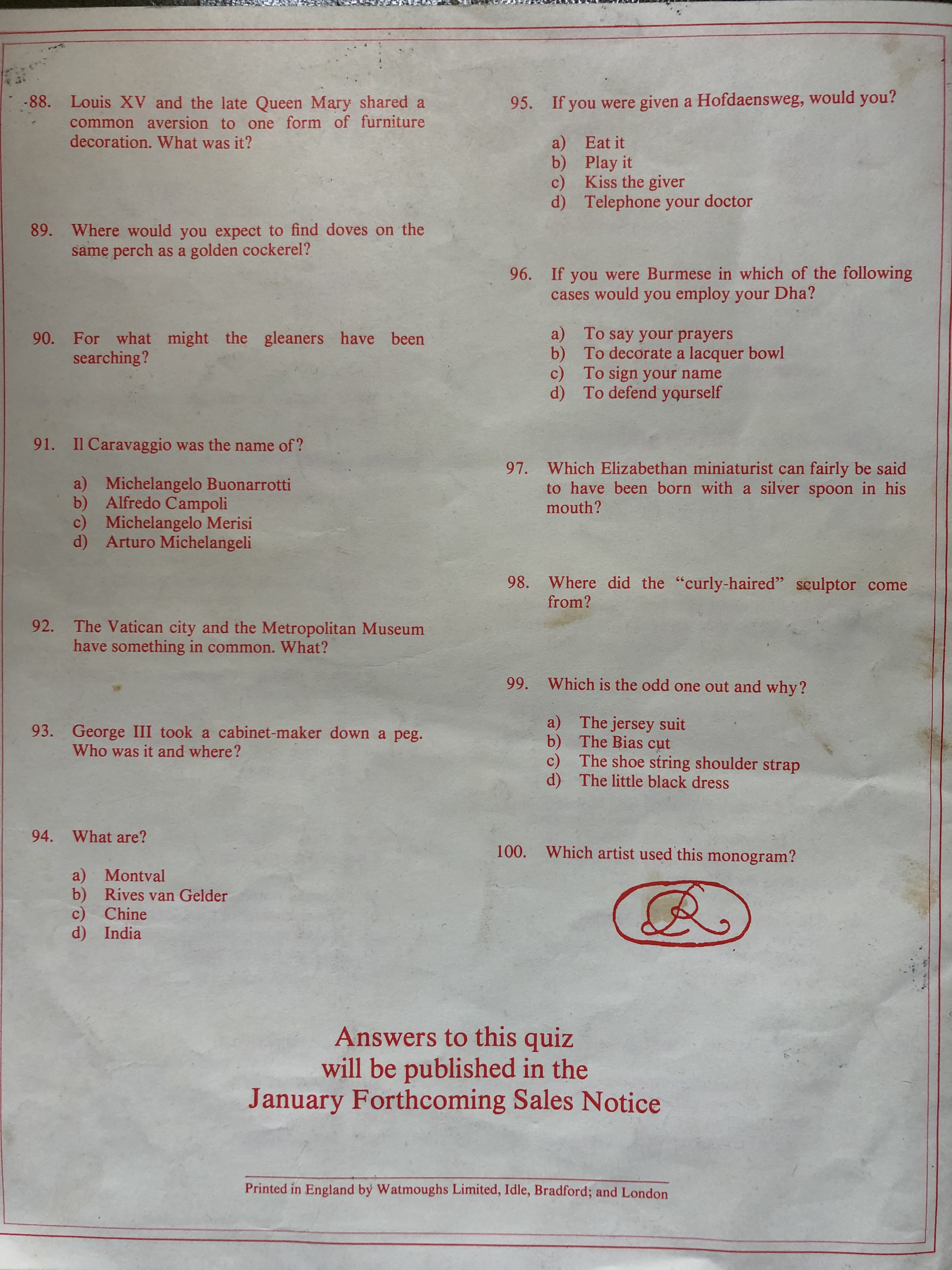
Anyway, here you go…here’s all the questions, in each of the pages from the 1978 quiz

Questions 1-13


Questions 14-30

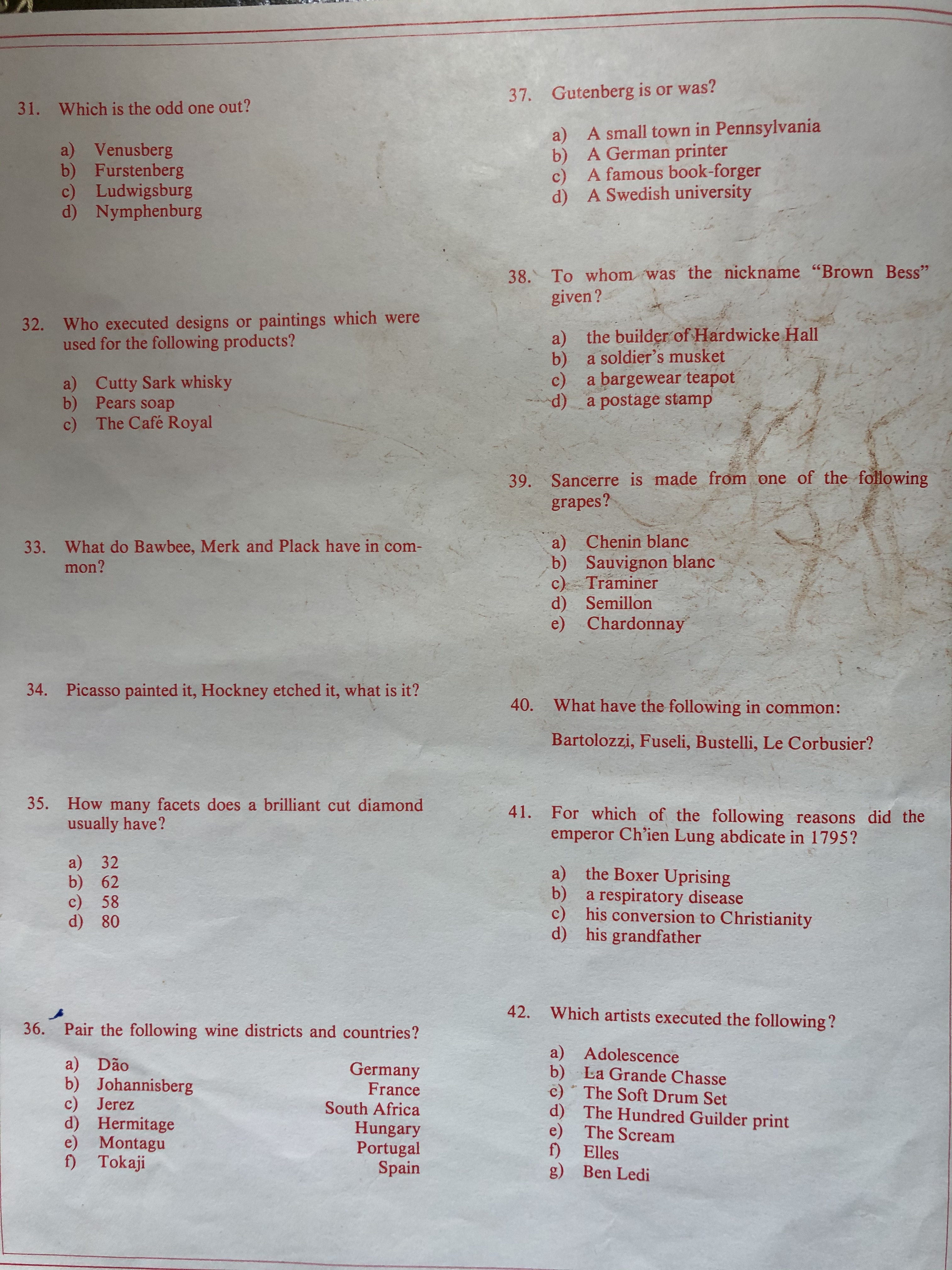
Questions 31-42

Questions 43-57

Questions 58-72

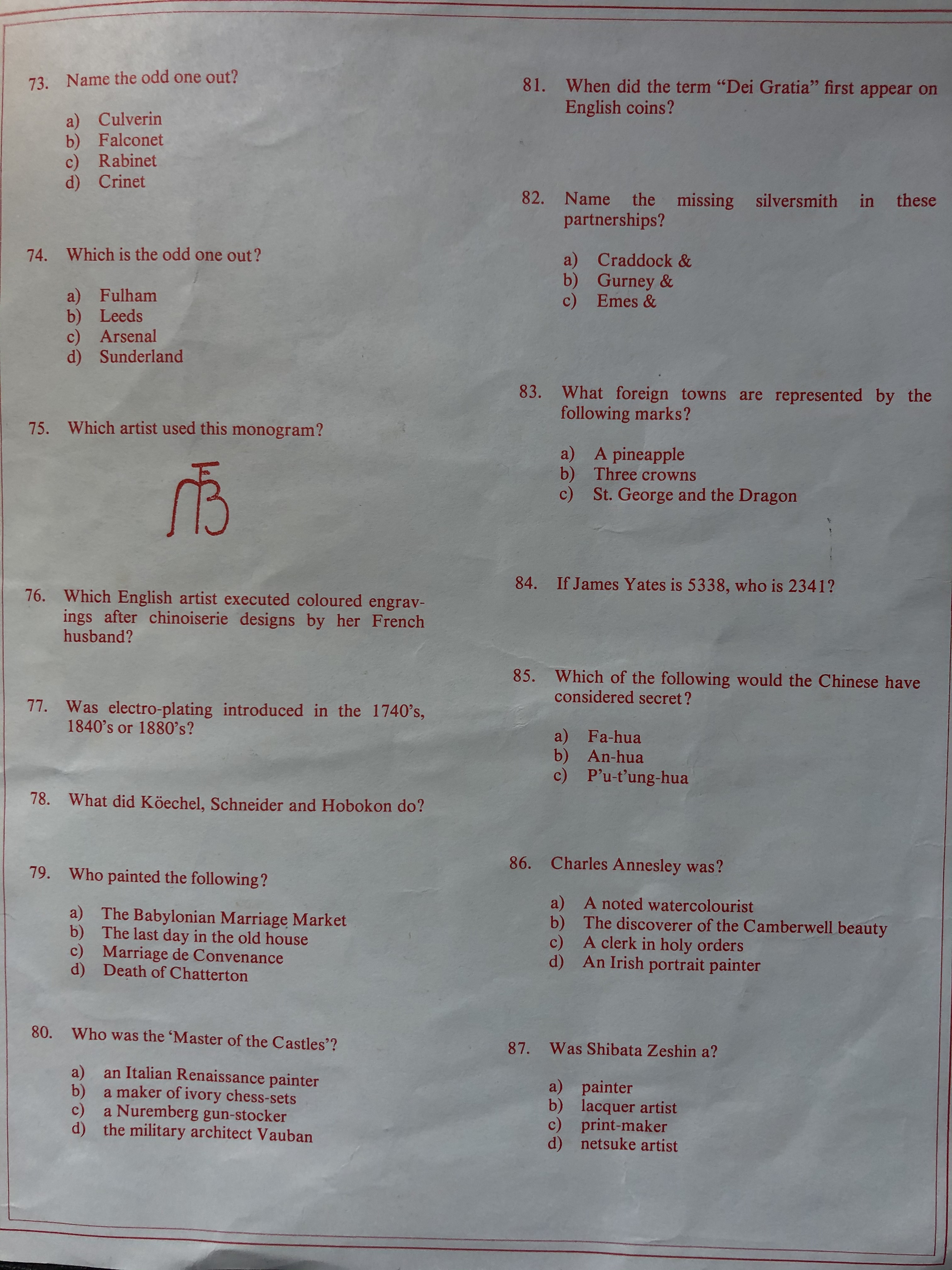
Questions 73-87

Questions 88-100

GOOD LUCK!

Mark


April 5, 2020

SOLD! Exhibition Catalogue

The SOLD! exhibition catalogue is now published –

and thanks to the Paul Mellon Centre for Studies in British Art, and the AHRC (Arts & Humanities Research Council) we are able to make the digital E-Version of the SOLD! catalogue free for everyone – you can download the PDF version (9Mb at 72dpi) – here’s the PDF below; Enjoy!

SOLD Catalogue – WEB 72dpi revised

March 8, 2020

Quinneys – costumes

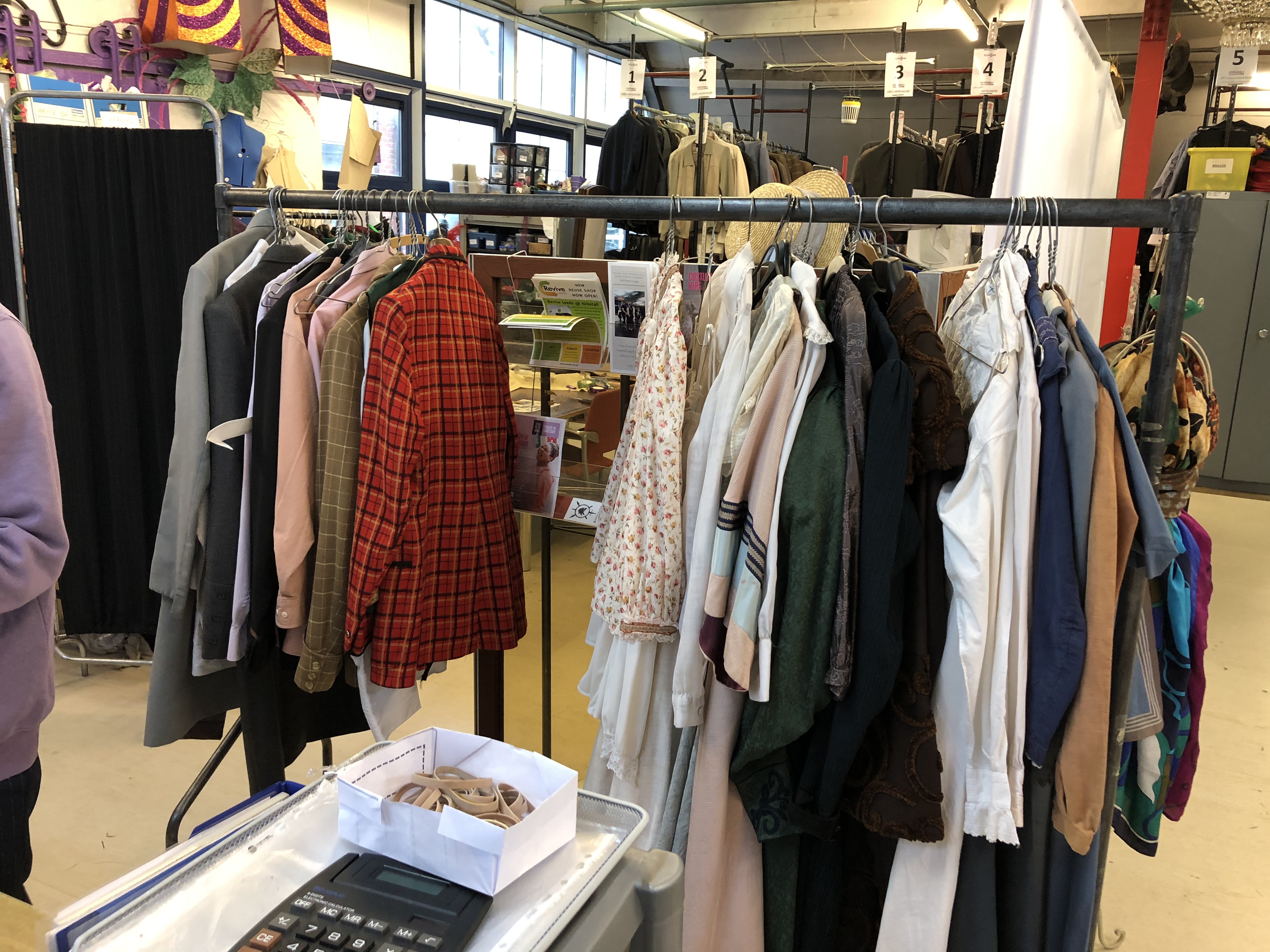
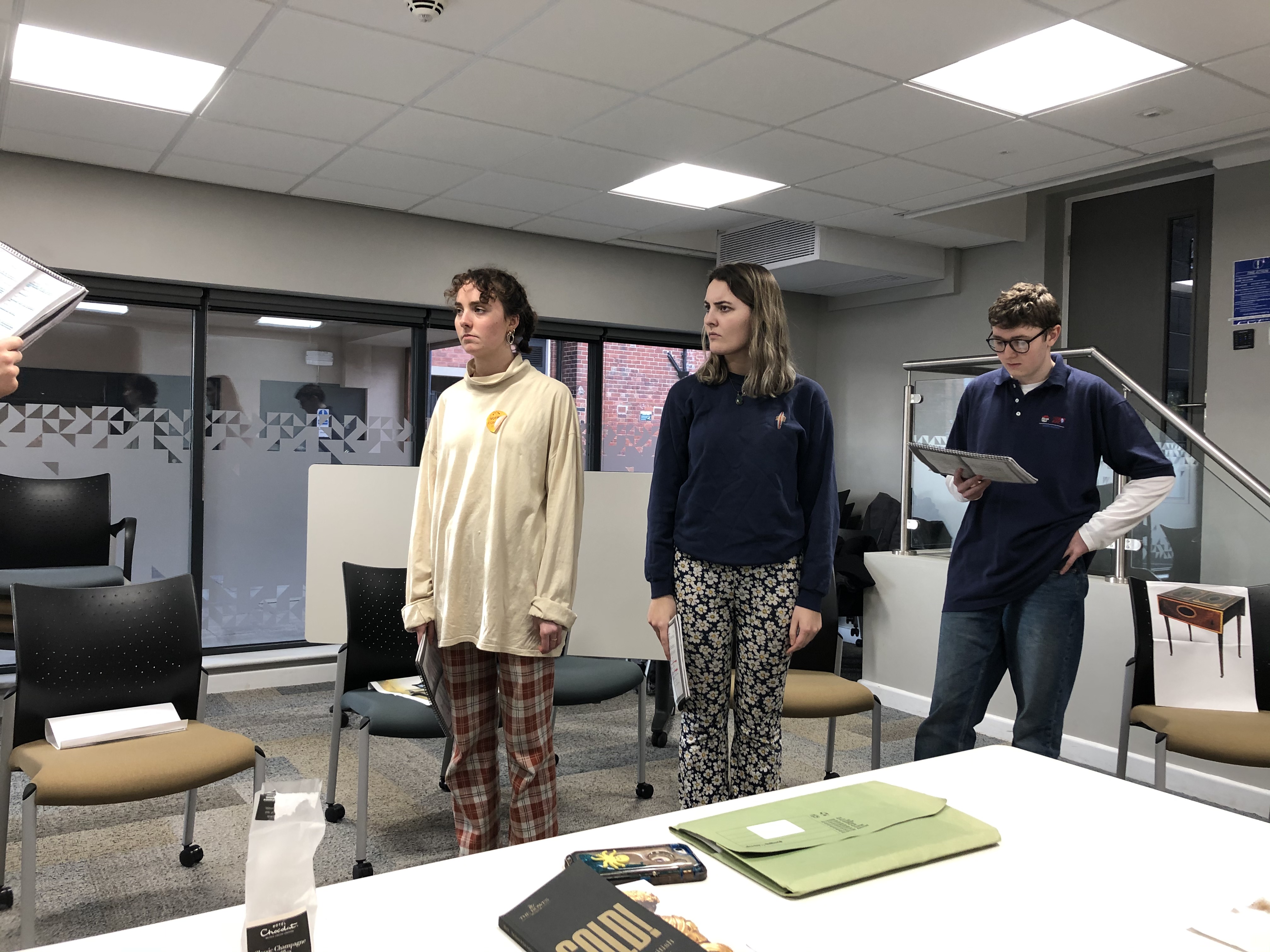
Our progress on re-staging our performance of Quinneys is coming along well; yesterday (a Saturday no less!) India Walton and I went to the Leeds Playhouse Costume Hire stores to choose the costumes for all the characters in the play – India is playing the part of ‘Mable Dredge’, Quinney’s typist, who in the play is in the triangle of love between James (Quinney’s foreman – played by Fergus Johnston) and Posy (Quinney’s daugther – played by Annabel Marlow) – here, (below) is India (left), with Annabel (centre) and Fergus (right) in rehearsals earlier in the week.

India, Annabel and Fergus in rehearsals for Quinneys.

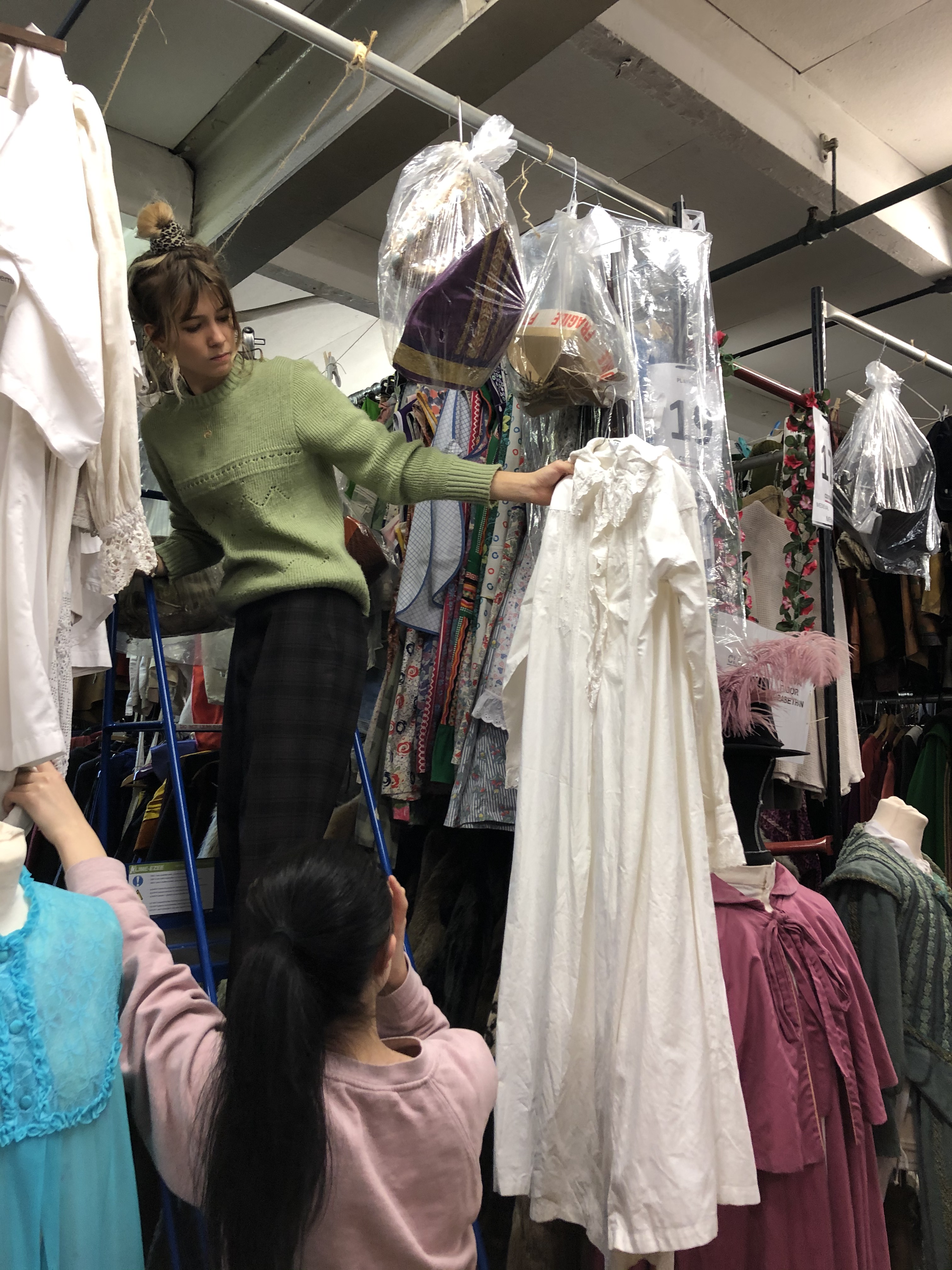
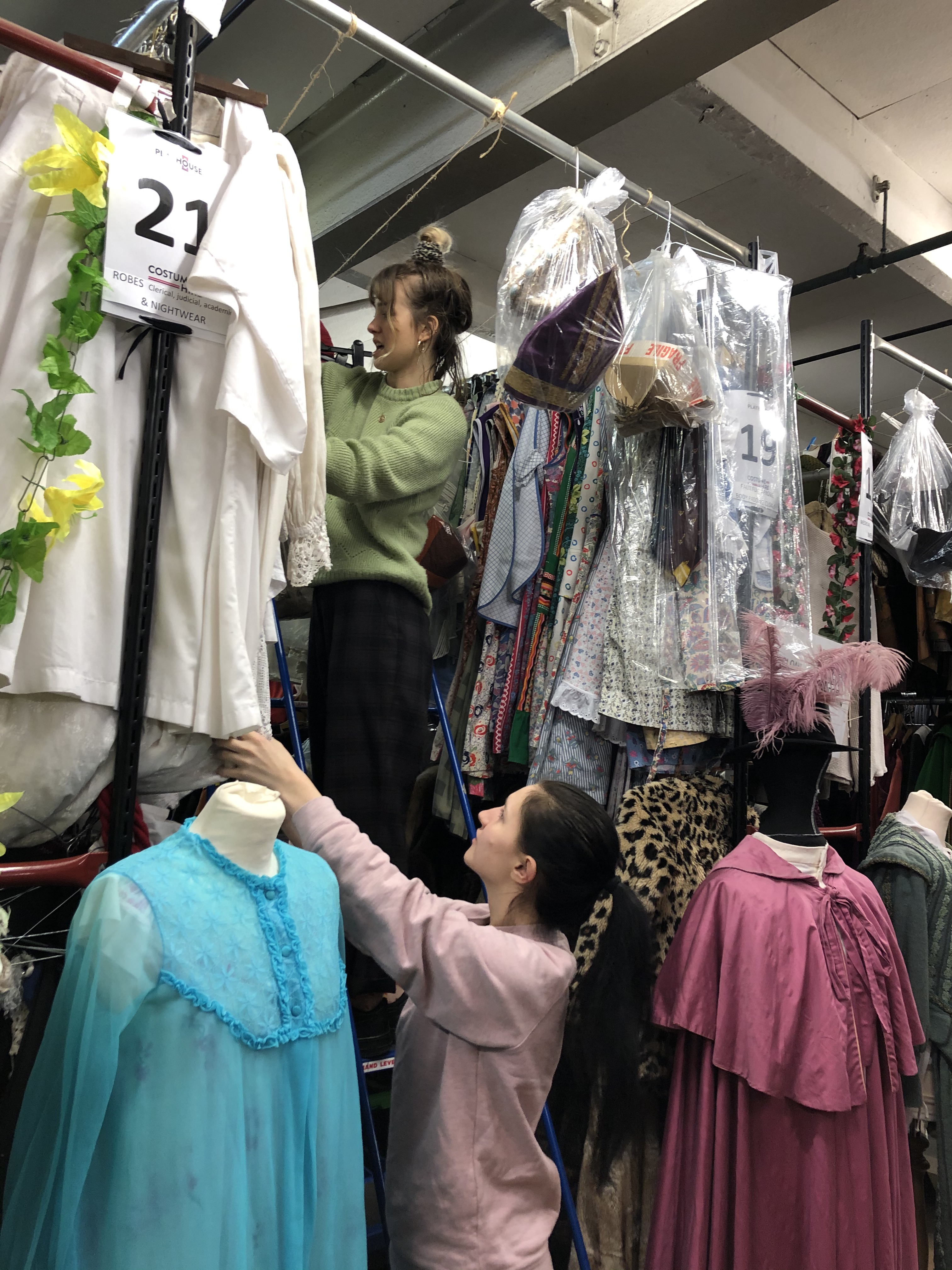
India and I spent all day in the costume store – it was exhausting (10.15am til 4.00pm!) but great fun! And we managed to find costumes for every character in the play.  Here’s India, choosing a nightdress for ‘Mable Dredge’, with Steff, from the costume hire, who was such a fantastic help all day! All the costume we needed dates from the Edwardian period (the play is set in 1914), and there are brilliant resources at the Leeds Playhouse Costume Hire.

India and Steff and Leeds Playhouse Costume Hire

India and Steff and Leeds Playhouse Costume Hire

We hope that the actors (and George Rodosthenous, our theater director for the performance of Quinneys) all approve of the costumes that India and I chose.

We’ve made the characters of the American millionaire collectors, ‘Cyrus P. Hunsaker’ and ‘Dupont Jordan’ (played by Stephenson Catney and Jake Pursell, respectively) rather bold, brash and ostentatious……with a brightly coloured jacket in red, yellow and black check pattern, and a similar jacket in brown and yellow checks – they will look out-rage-ous in the play! – especially as ‘Cyrus’ accepts a large ‘cheque’ (a ‘check in American parlance) from Mr Quinney at one point in the play….

For ‘Quinney’ himself (played by Samuel Parmenter) we decided he should be very smartly and expensively dressed, but rather more soberly – so we put him in a light grey morning suit – a dapper chap, but with a restrained, serious personality. For Mrs Susan Quinney (played by Hannah Rooney) we went for two Edwardian dresses, both in an elegant green – one with fabulous black embroidery to the sleeves.

And for ‘Posy’ (Quinney’s daugther, played by Annabel Marlow) we found a light and delicate pale blue dress, together with some some Edwardian blouses in white, with small red flowers, and a cream-coloured long flowing Edwardian skirt. We also found suitable dresses for ‘Mable Dredge’ – slightly more plain, given Mable’s status as Quinney’s typist, but still very elegant – (India enjoyed choosing her costume!)…. And finally we found a very swish black jacket with black velvet trousers for ‘Sam Tomlin’ the smart (and smarmy) Bond Street antique dealer, (played by Morgan Buswell), and for ‘James Miggott’ (Quinney’s foreman…played by Fergus Johnston) we found a suitable ‘workman’s’ outfit, but one that still retains a degree of Edwardian elegance….

Here are all the costume’s on the rail at Leeds Playhouse Costume Hire –

Quinneys play costume at Leeds Playhouse Costume Hire.

We still need a few Edwardian hats and accessories, but the costume for the performance is all coming together well – I’m sure that the actors will thoroughly enjoy their rehearsals now that we have costumes – and that their performances will become even more authentic and ’embodied’!

Mark


March 4, 2020

More Quinneys Rehearsals

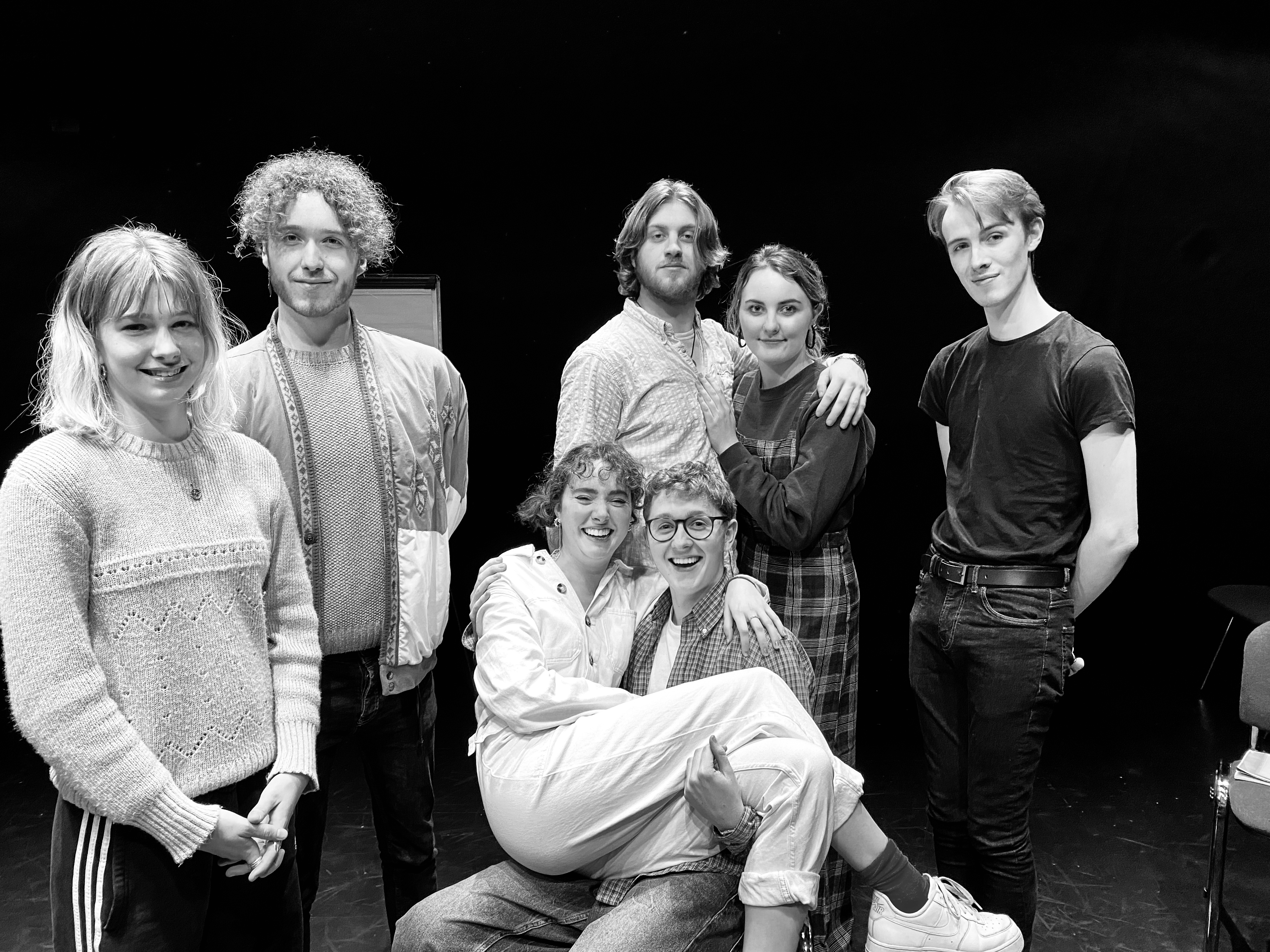
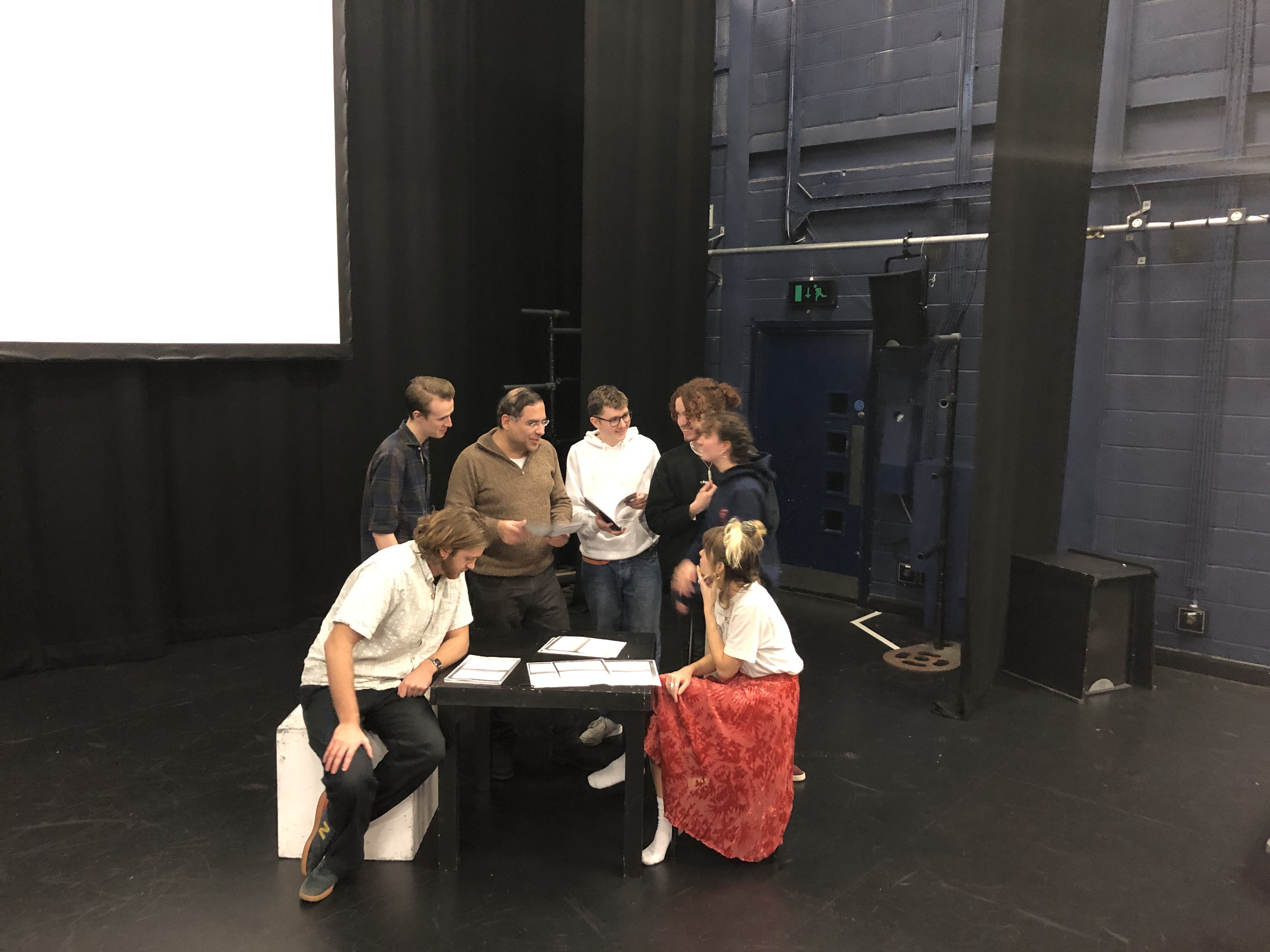
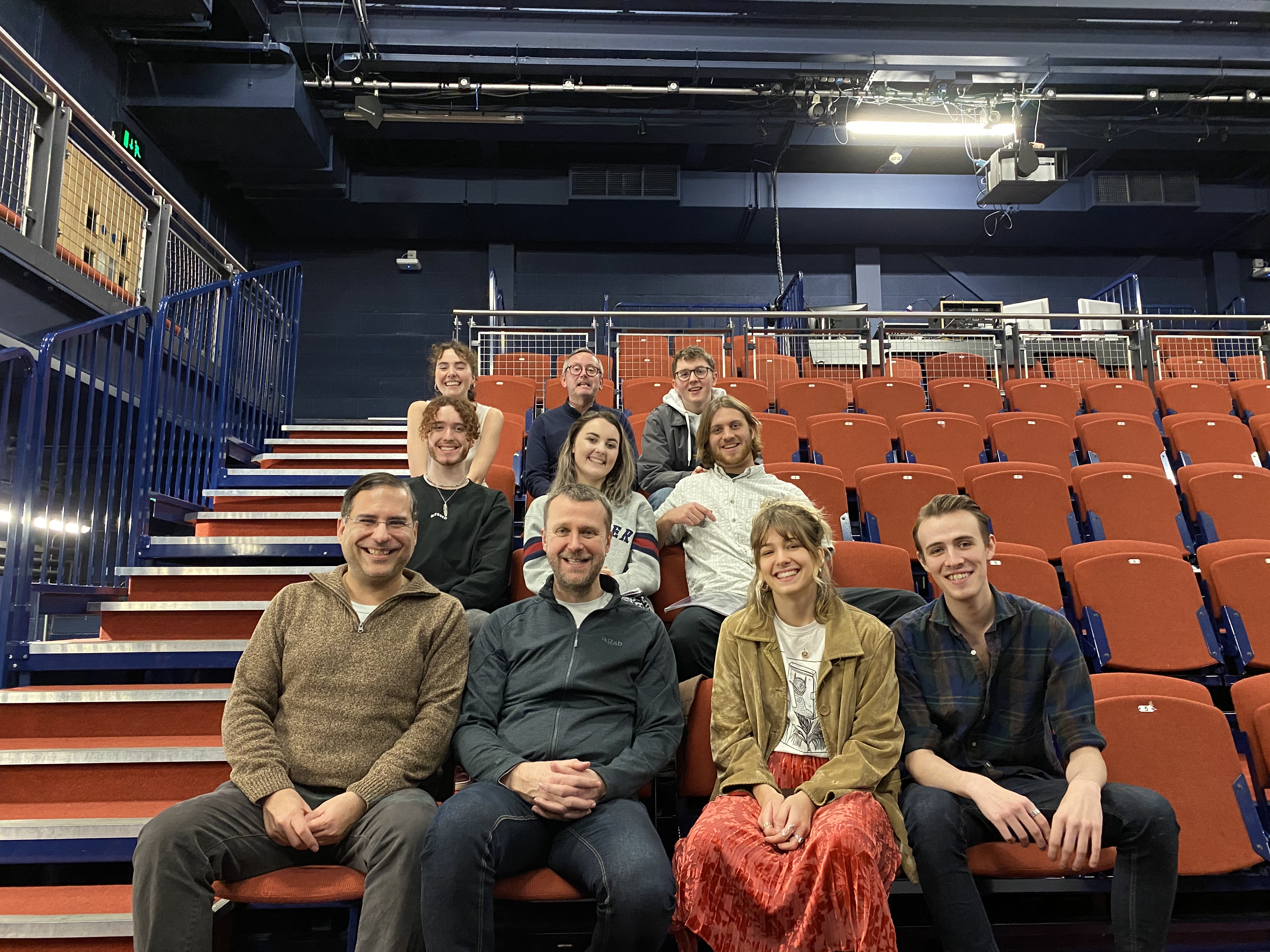
Our rehearsals for the performance of Quinneys are continuing apace – (the play is to be staged at The Witham, Barnard Castle, on Saturday 28th March – to book tickets, click to the weblink to The Witham here).  George Rodosthenous, (Director of the theatre and performance BA/MA programmes at the University of Leeds), and the director of the play, has been ramping up the number of rehearsals over the last two weeks, as the student actors begin to inhabit their characters in ever increasing degrees of authenticity!  Here (below) is one of George’s professional black and white photographs of (almost) the full cast of Quinneys (only Jake, who has recently joined the cast to play the part of Dupont Jordan, is absent…but you can see Jake further in this blog post, below) – in the photo below are, left to right, India (Mable Dredge, Quinney’s typist), Stephenson (Cyrus P. Hunsaker, American millionaire collector), Annabel (Posy, Quinney’s daughter) on Fergus’s (James, Quinney’s foreman) knee; with Samuel (Quinney) and Hannah (Mrs Susan Quinney) behind, and Morgan (Sam Tomlin, fellow antique dealer) to the right.

The cast of Quinneys in rehearsals at the University of Leeds.

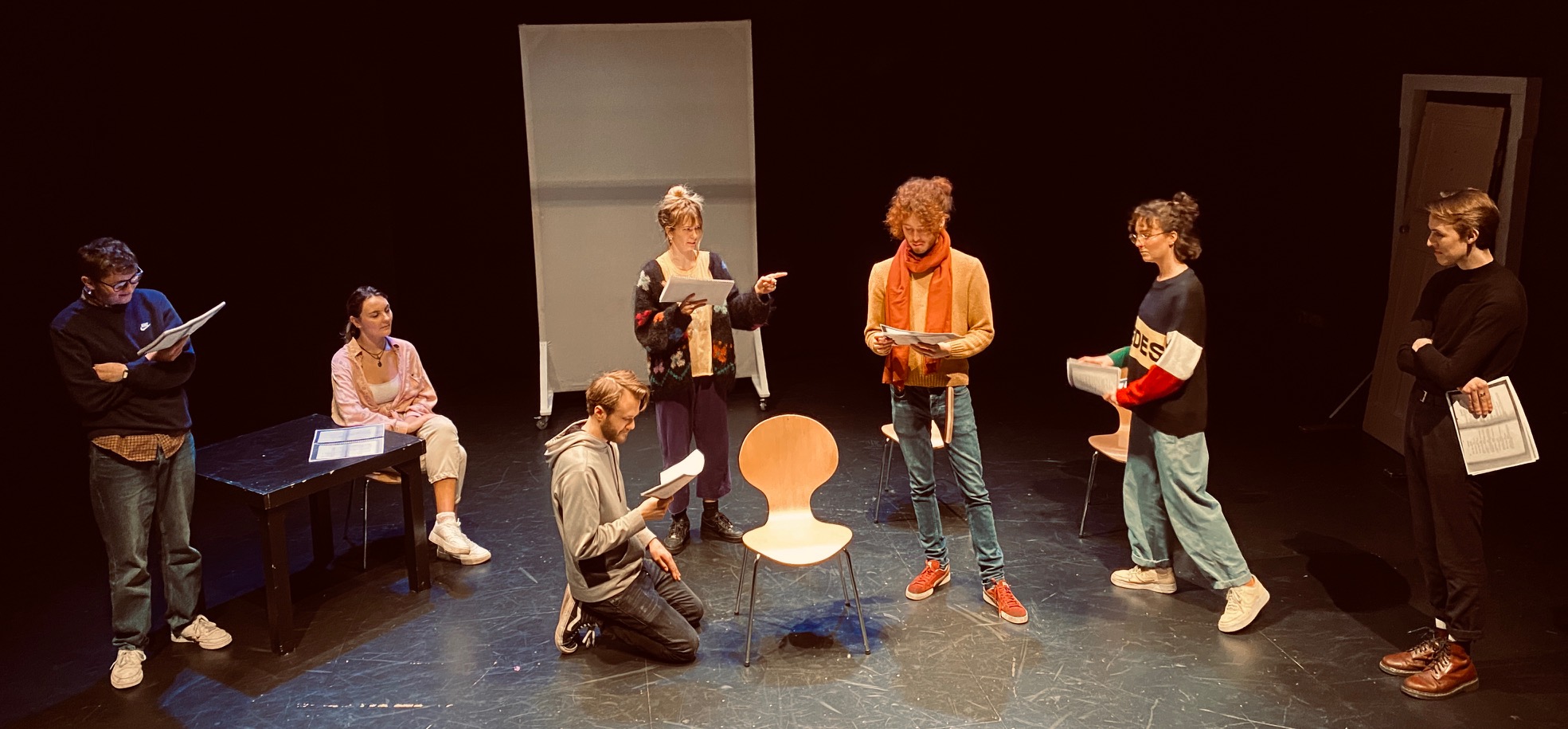
And here’s the cast in rehearsals again, this time without Samuel (Quinney) but with Jake Pursell (playing the role of the American millionaire collector, Dupont Jordan) in the centre, on his knees examining a chair – Jake is an MA student, and has immediately immersed himself in the role…being from Texas, USA, himself!

The cast of Quinneys – without Samuel (Quinney), but with Jake (Dupont Jordan).

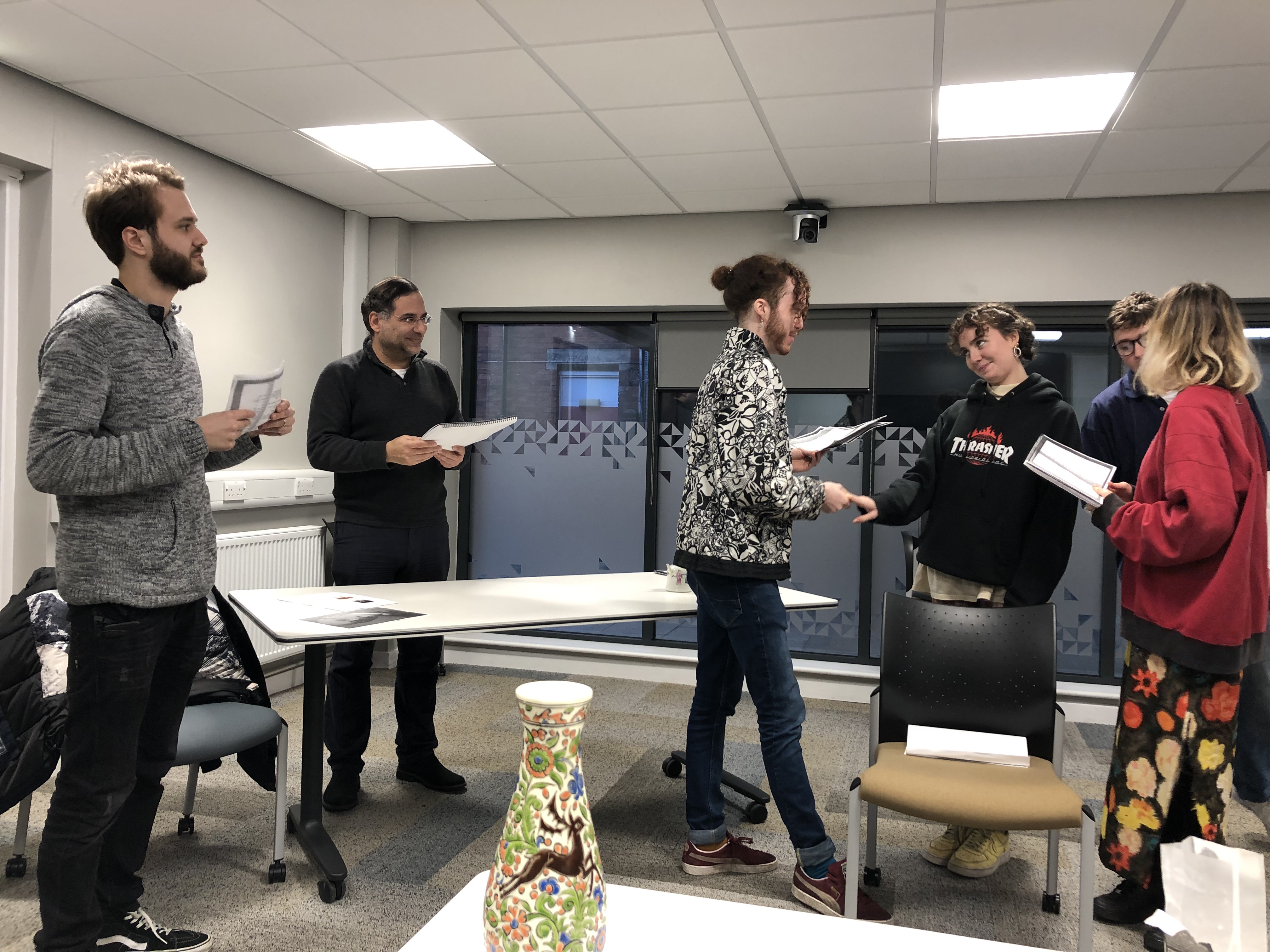
In the photograph (below) Jake (Dupont) and Stephenson (as Cyrus P. Hunsaker, another American collector in the play), greet Annabel (Posy), with India (Mable) and Fergus (James) to the right – and George, directing the play (but here playing Quinney). In the foreground is an inanimate ‘actor’, (a reproduction ‘Persian’ vase) taking the part of the rare ‘Kang Hsi, mirror-black bottle’ that also stars in the play.

Jake, George, Stephenson, Annabel, Fergus and India in Quinneys rehearsals

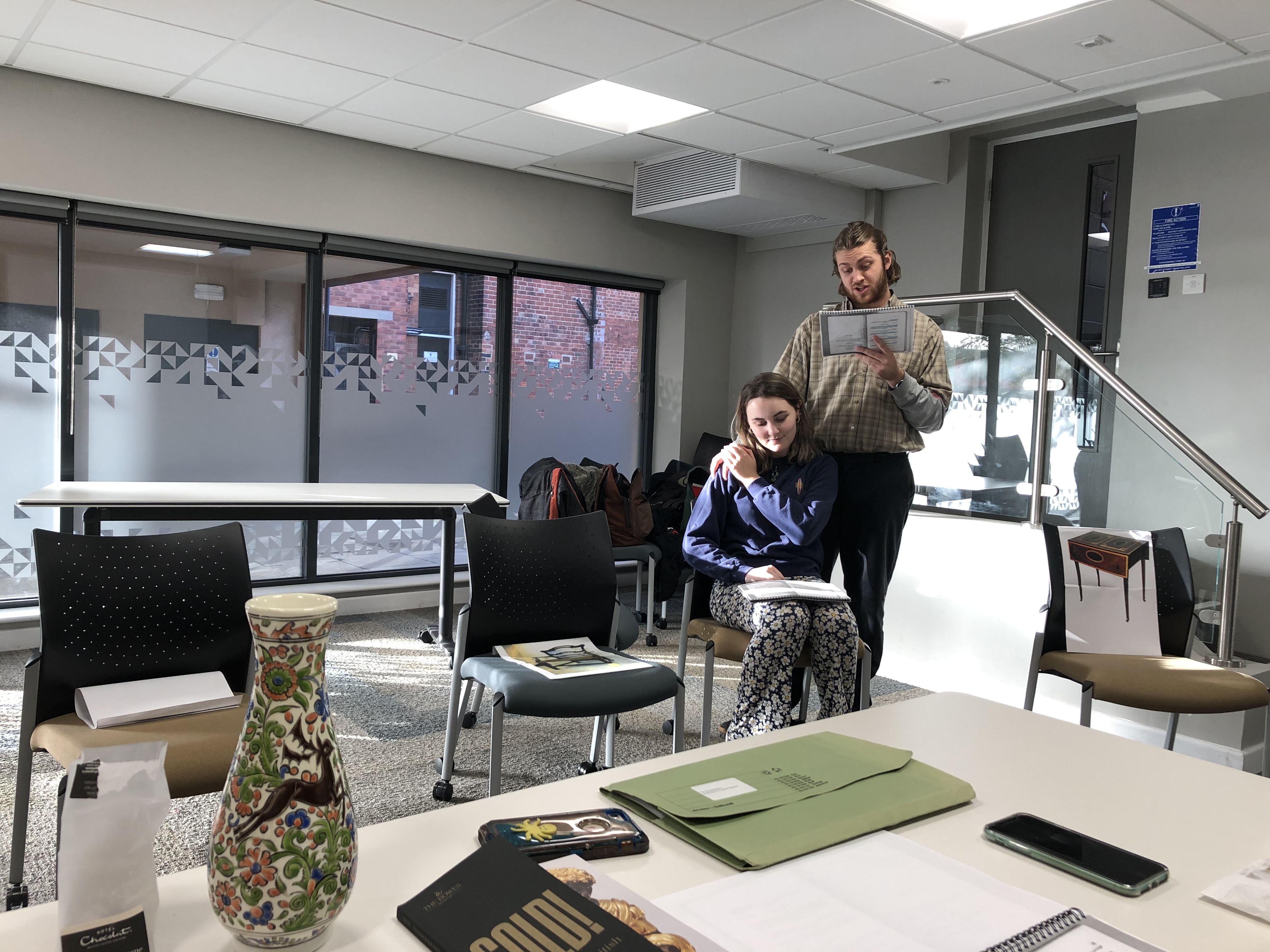
Indeed, in this week’s rehearsals we used some stand-in props for the real antiques that we will be using as part of the set for the play. In the 1910 and 1920s, when Quinneys was first performed, several leading antique dealers, such as Moss Harris and Walter Thornton-Smith, provided appropriate antiques for the set – and for our performance at The Witham, we have been lucky that several antique dealers, and also the Bowes Museum itself, have agreed to loan antiques for the play.  For rehearsals of course, we need ‘stand-ins’, and in the photograph (below), Samuel (Quinney) and Stephenson (Hunsaker) discuss a rare Charles II walnut armchair (which will be on loan from the Bowes Museum) using a large blown-up photograph (fixed to the cream seminar room chair, between them) of the very chair that will be in the performance!

Samuel (Quinney) and Stephenson (Hunsaker) discuss an ‘antique’ chair in rehearsals for Quinneys.

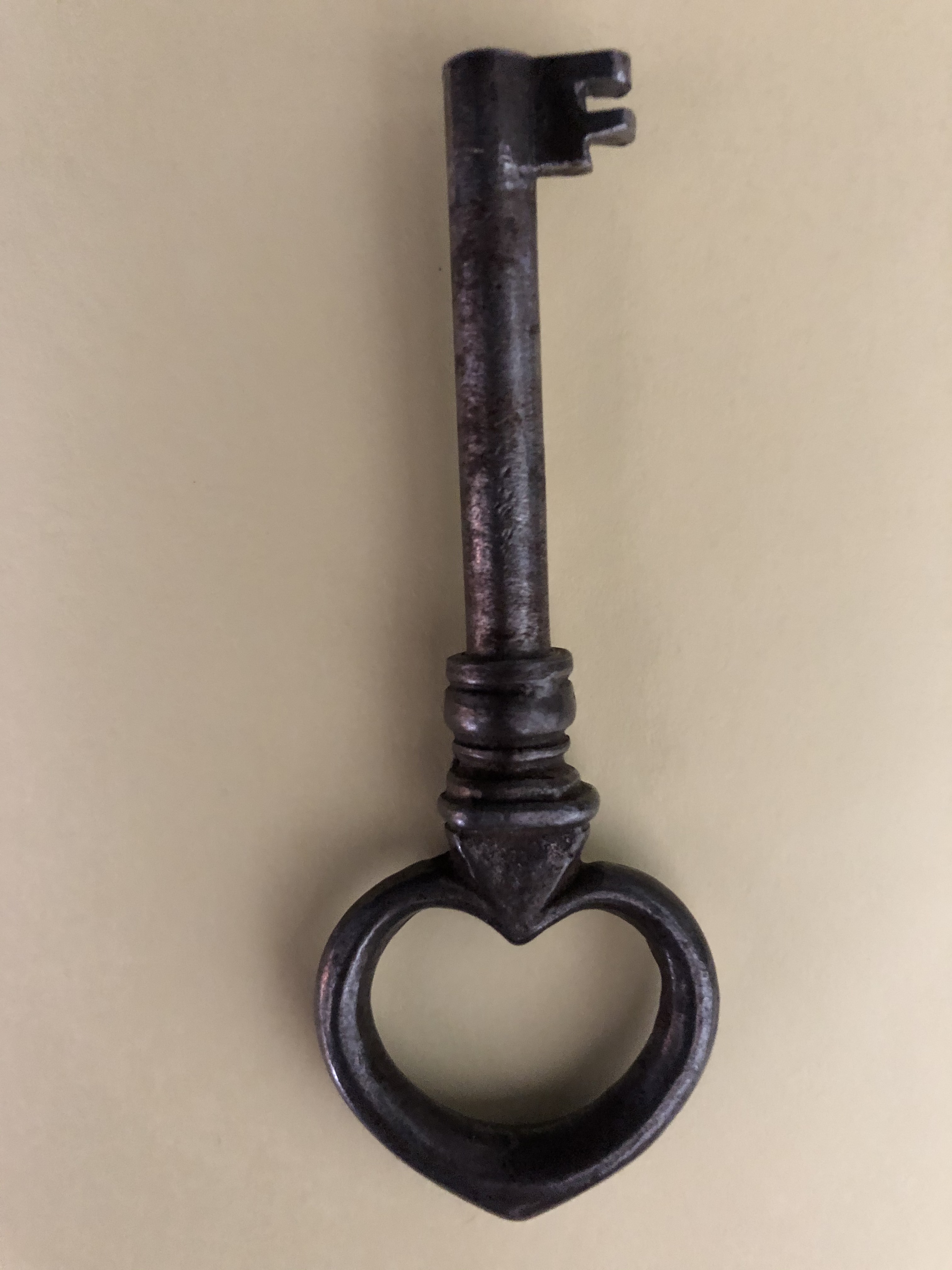
We did manage to use one real antique in the rehearsals – a 19th century key, one that Posy places in the Kang Hsi ‘mirror black, bottle’ and which opens an antique lacquer cabinet that is one of the stars of the show (in terms of inanimate objects at least) and into which she has placed a love letter to James – and here’s the very key – appropriately, given that it is the key that opens a cabinet into which a love letter rests, shaped like a ‘heart’!

The key to Posy’s Heart – from Quinneys!

One of the aspects of the performance that we will be debating and discussing in the proposed workshop on Sunday 29th March – the day following the re-staging of Quinneys – is the complexity of the idea of ‘authenticity’ in a workshop titled ‘Dealing with Authenticity’ and led by our colleague Professor Jonathan Pitches (Professor of Performance at the University of Leeds) – so having the actors working with ‘fake’ antiques, and then working with the genuine thing, will be something we might ruminate upon; as well, of course, as what it means to embody, to become, a character in a play as part of a performance.

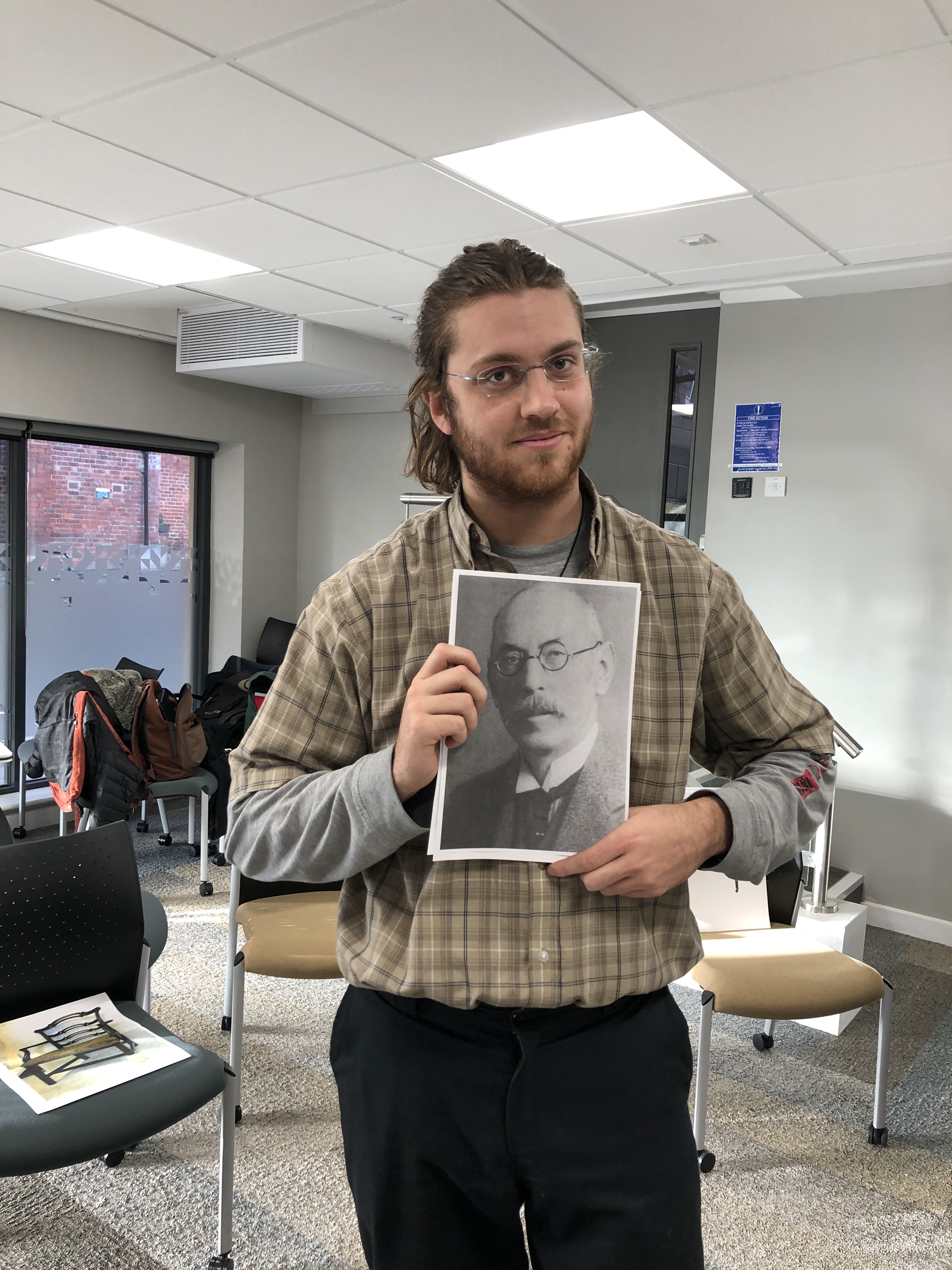
Indeed, what is especially interesting (for me) is that the fictional character of the antique dealer Joseph Quinney is actually based on a real life antique dealer, called Thomas Rohan, who was trading in Bournemouth and Southampton at the time that Horace Vachell composed his play (and associated novel) – and, as if to reinforce the point, here is Samuel, holding a photocopy of a photograph of Thomas Rohan, of about 1920 – Samuel becoming Thomas Rohan, becoming Joseph Quinney!

Samuel, as Quinney, as Rohan.

And here’s a few more photographs of the student actors in rehearsals – they are all fantastic actors and are performing brilliantly – you will miss something special if you don’t get to see the play!….seats are going fast, so do book before they all go!

Hannah (Mrs Susan Quinney) and Samuel (Quinney) in rehearsal.

Annabel (Posy), Hannah (Mrs Quinney) and Fergus (James) in rehearsals for Quinneys.

India (Mable), Annabel (Posy) and Fergus (James) in rehearsals for Quinneys.

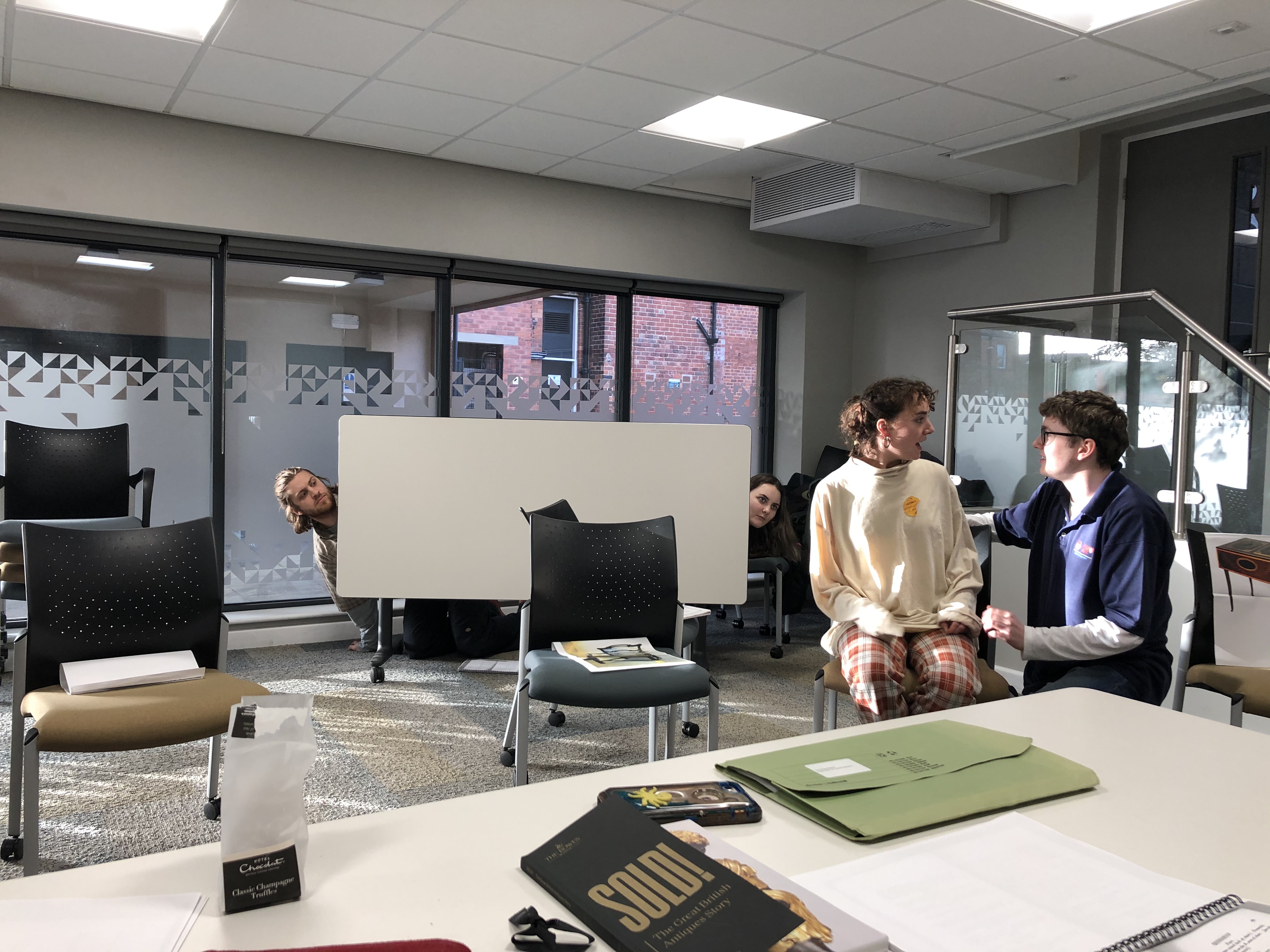
And finally, an amusing shot, from an amusing scene in the play, with Annabel (Posy) and Fergus (James) in foreground, with Samuel (Quinney) and Hannah (Mrs Quinney) in the background, sneaking a look at the two young lovers – (in the play, the whiteboard will be an 18th century  Chinese lacquer screen…..we hope!)

Mark

Annabel (Posy) and Fergus (James), with Samuel (Quinney) and Hannah (Mrs Quinney) in the background – rehearsals for Quinneys.


February 9, 2020

Quinneys Rehearsals

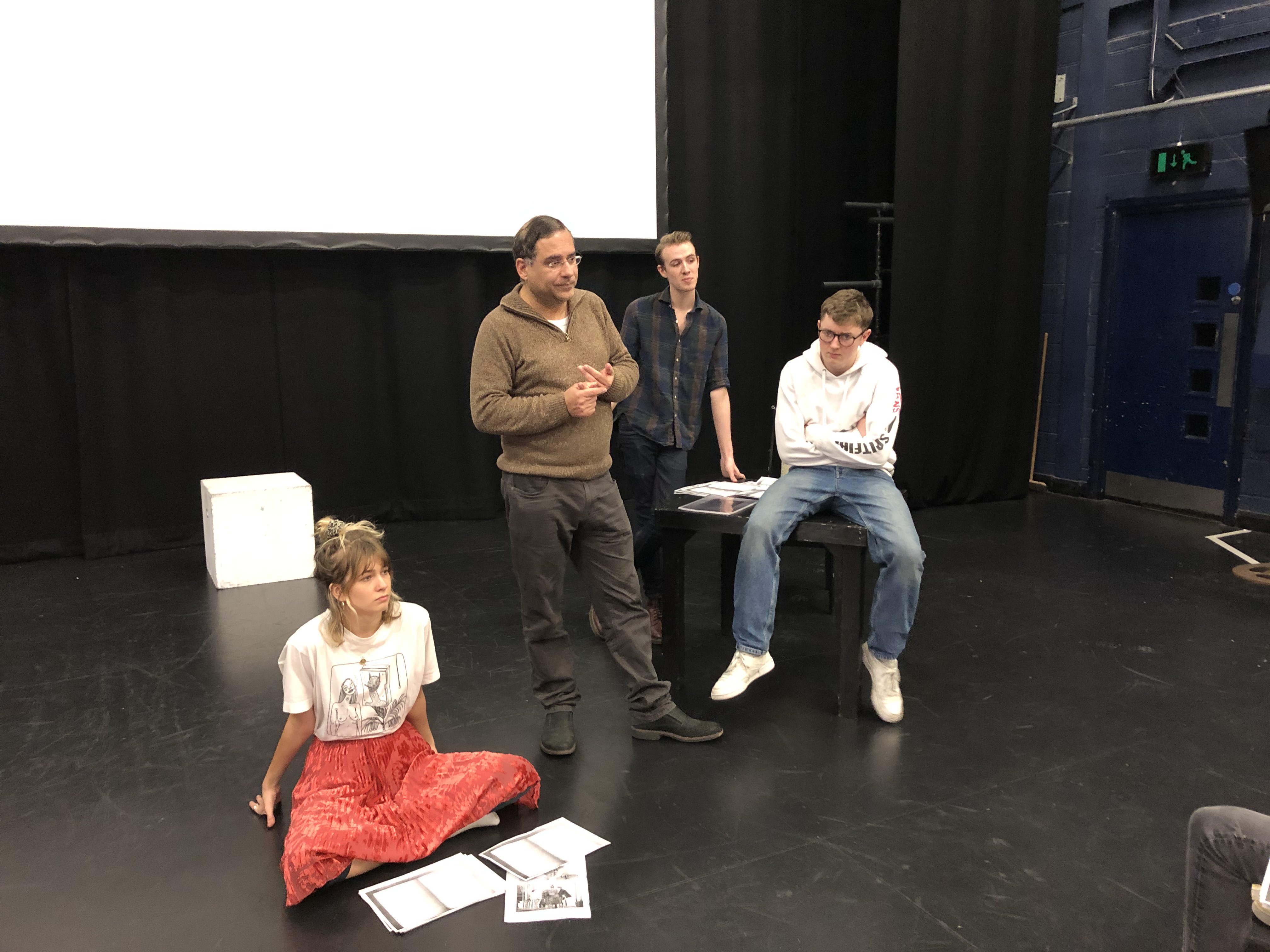
Our rehearsals for the play Quinneys continue apace – with Dr George Rodosthenous leading the direction of the performances.  This week George assembled the whole team, including Professor Jonathan Pitches, who is taking the lead on the ‘Dealing with Authenticity’ workshop which takes place at The Bowes Museum on the day following the restaging of Quinneys at the Witham in Barnard Castle.  Here’s the whole team at the rehearsals –

The Quinneys team – back (Annabel, Mark, Fergus), middle (Stephenson, Hannah, Samuel), Front (George, Jonathan, India, Morgan).

George (centre) directing India (sitting) and Morgan (back) and Fergus (right) in rehearsals for Quinneys.

George had the cast reading sections of the play, revealing insights into the characterisations, and drawing out some great performances from the actors.

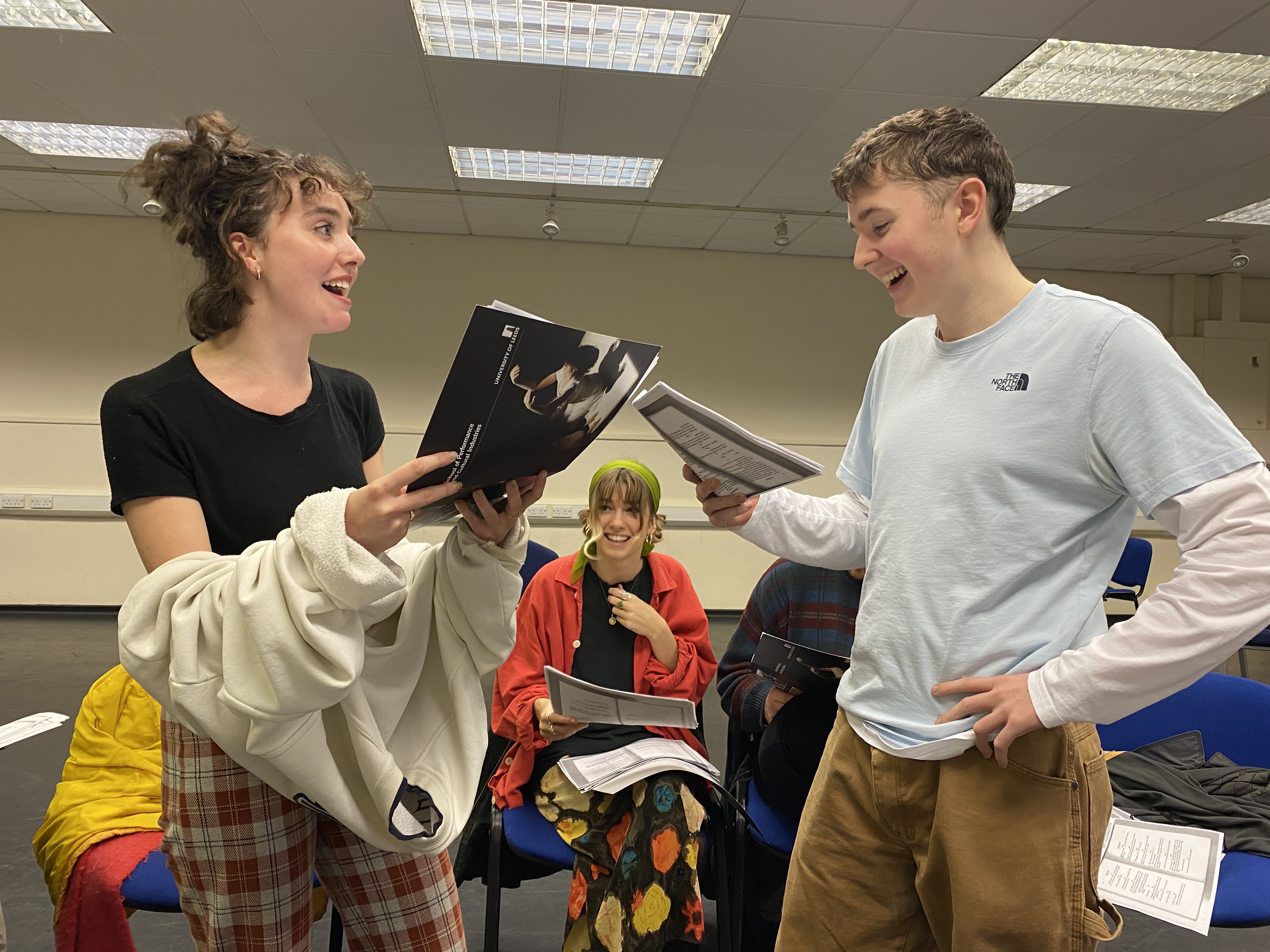
Annabel and Fergus reading for ‘Posy’ and ‘James’.

Here’s (left) Annabel and Fergus taking on the character of ‘Posy’ (Quinneys’ daughter) and ‘James Miggot’ (Quinney’s workshop foreman).  And (right), George, directing India (seated), playing ‘Mable Dredge’ (Quinney’s typist), and Morgan (background) playing ‘Cyrus P. Hunsaker’ the American millionaire collector, with Fergus as ‘James’.

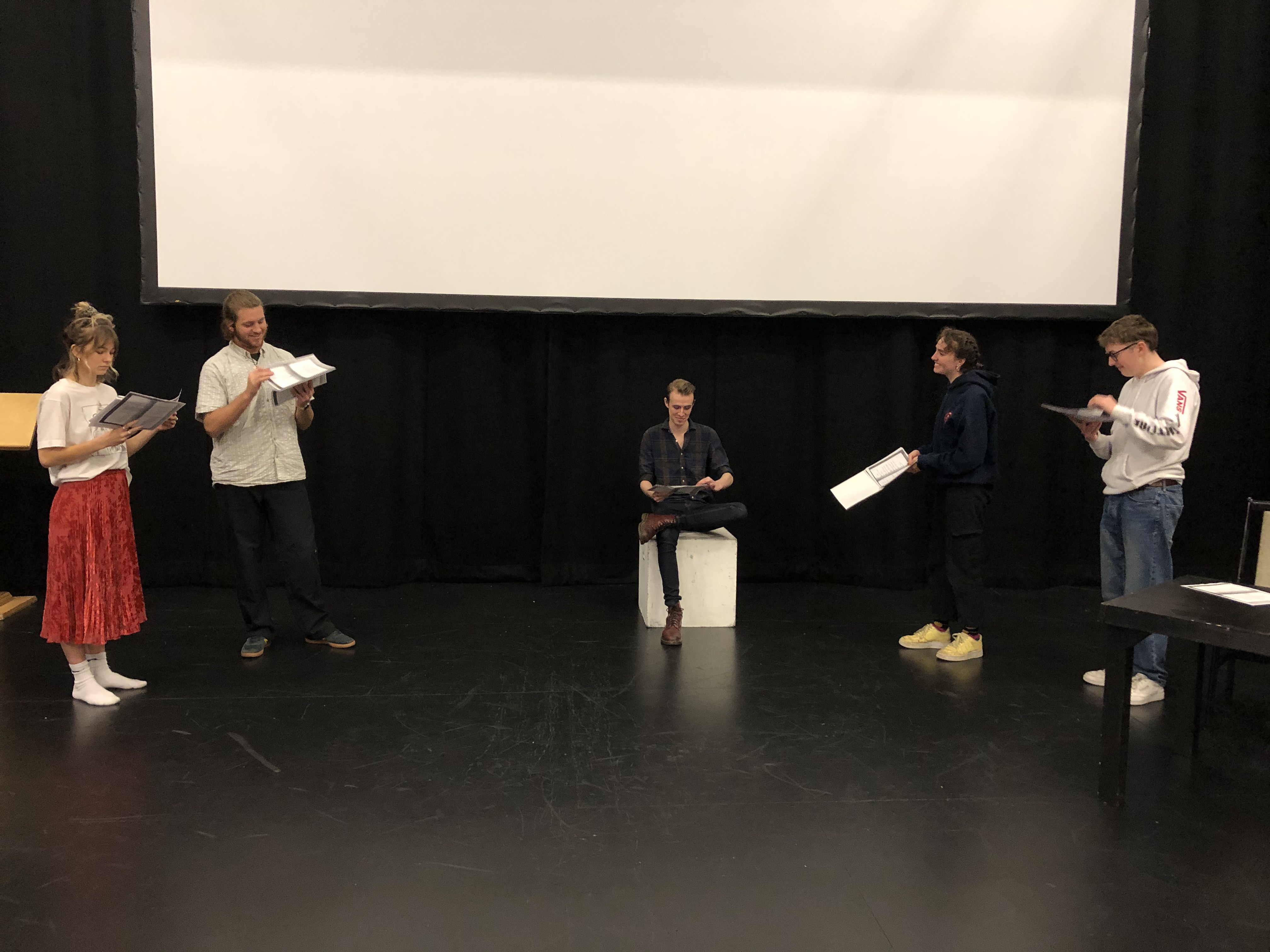
And another few photos of the cast getting into character – with (left to right) India, Samuel (as the eponymous Joseph Quinney), Morgan, Annabel and Fergus, rehearsing a scene set in ‘Quinney’s sanctuary’ – Quinney’s collector’s paradise, full of extraordinary antiques.

Quinneys actors – (left to right) India, Samuel, Morgan, Annabel, Fergus.

We are working with The Bowes Museum and local antique dealers in Barnard Castle to source the antiques for the stage set.  In 1915, when the play was first performed, several well-known London antique dealers loaned antiques for the set, including Walter and Ernest Thornton-Smith, who, co-incidently (or maybe not) traded in Soho Square, London, which was also the fictional location of Quinney’s  antique  shop in the novel ‘Quinneys’ (1915).  Indeed, one of the aspects we are thinking through in the restaging of Quinneys is the notion of authenticity – Jonathan Pitches will be working with the actors, reflecting on authenticity of performance and authenticity of character in acting, alongside me (Mark) working on authenticity of objects (antiques) and authenticity of identity (of antique dealers), in the ‘Dealing with Authenticity’ workshop on the day following the performance at The Bowes Museum.

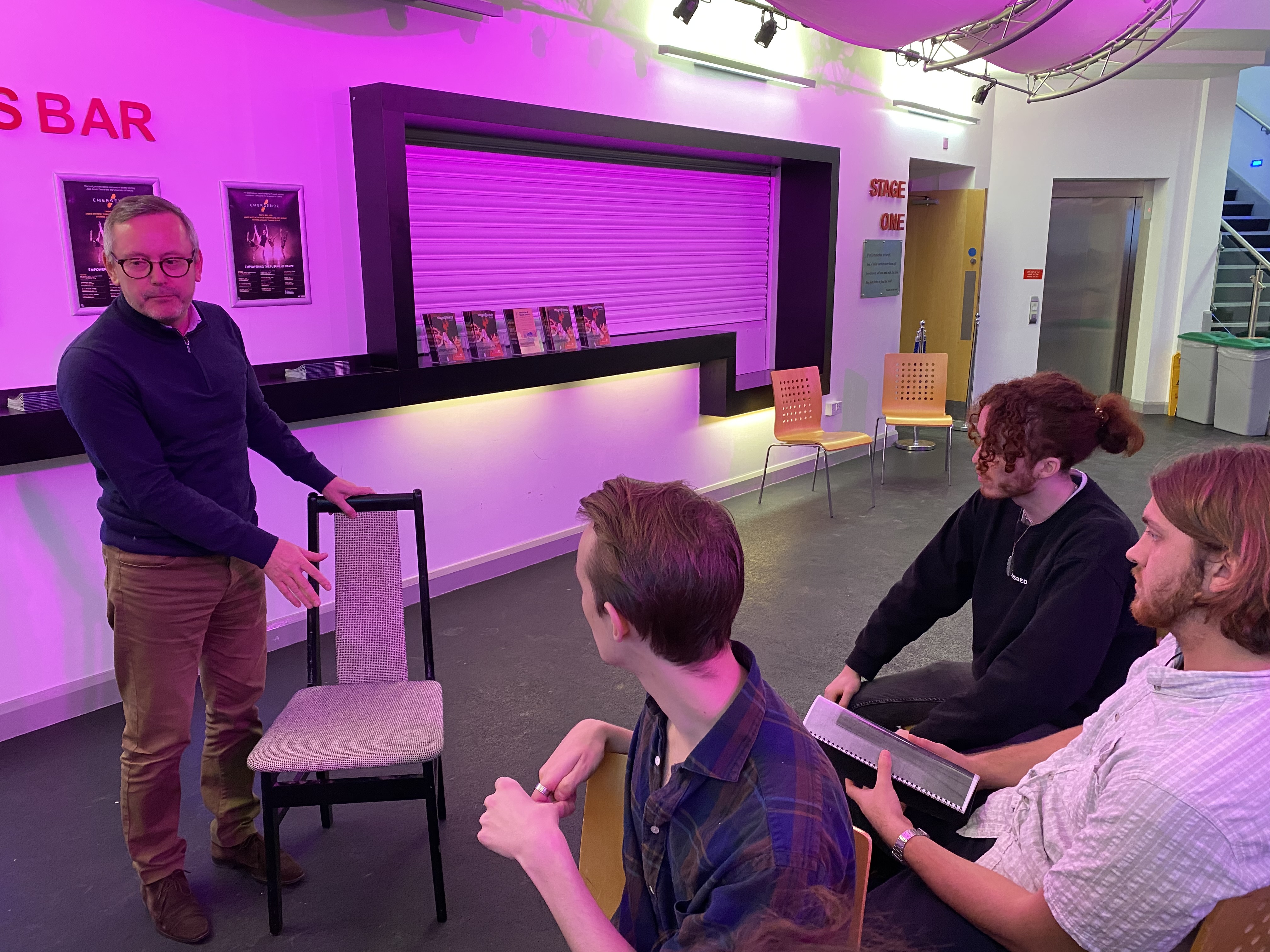
To that end, George got me to work with an imaginary ‘antique chair’, examining it as if I were an antique dealer, for the student actors – (that’s as much acting as I am going to do!) –

Mark, explaining how an antique dealer examines an ‘antique’ chair……

Hannah, another of the student actors, also joined in the rehearsals, playing the part of Susan Quinney, Quinney’s wife – here’s Annabel (left) as ‘Posy’, with Hannah (right) as ‘Susan’, reading from a scene in Act 1.

Annabel (left) and Hannah (right) rehearsing for Quinneys.

George and the actors are certainly creating a fantastic atmosphere, and I am sure that when Quinneys is eventually performed on Saturday 28th March at The Witham, is will be a brilliant production!  Here’s a final few photos of George and the team.

George (centre) with the student actors at the rehearsals for Quinneys.

And a final, much more professional photograph, of Stephenson, India and Samuel (back row), with Annabel and Fergus (front).

part of the cast for Quinneys – Stephenson, India, Samuel (back) with Annabel and Fergus (front)

Don’t forget to book your tickets for Quinneys – you can book your seat HERE

Mark

Home Subjects

a working group dedicated to the display of art in the private interior, c. 1715-1914

The Period Room: Museum, Material, Experience

An International Conference hosted by The Bowes Museum and The University of Leeds

H. Blairman & Sons Ltd

A research project investigating the history of the antiques trade in Britain in the 19th & 20th centuries

Museum Studies Now?

'Museum Studies Now?' is an event which aims to discuss and debate museum and heritage studies education provision.

The Burlington Magazine Index Blog

art writing * art works * art market

East India Company at Home, 1757-1857

A research project investigating the history of the antiques trade in Britain in the 19th & 20th centuries