Archive for ‘Uncategorized’

November 12, 2014

The Generosity of Dealers!

We had another very generous donation of archive material to the antique dealer project! Thank you so much to John Smith, formerly of Regency House Antiques, Walton-on-the-Hill, Surrey, for donating a cache of several hundred B&W photographs of antique furniture – just some of the previous stock of Regency House Antiques.  The photographs (taken by Raymond Forte) date from the 1960s-1980s, and John tells us that they were used for advertisements in publications such as Country Life.

P1000099

Photographs of the stock of antique furniture from Regency House Antiques (1960s-1980s)

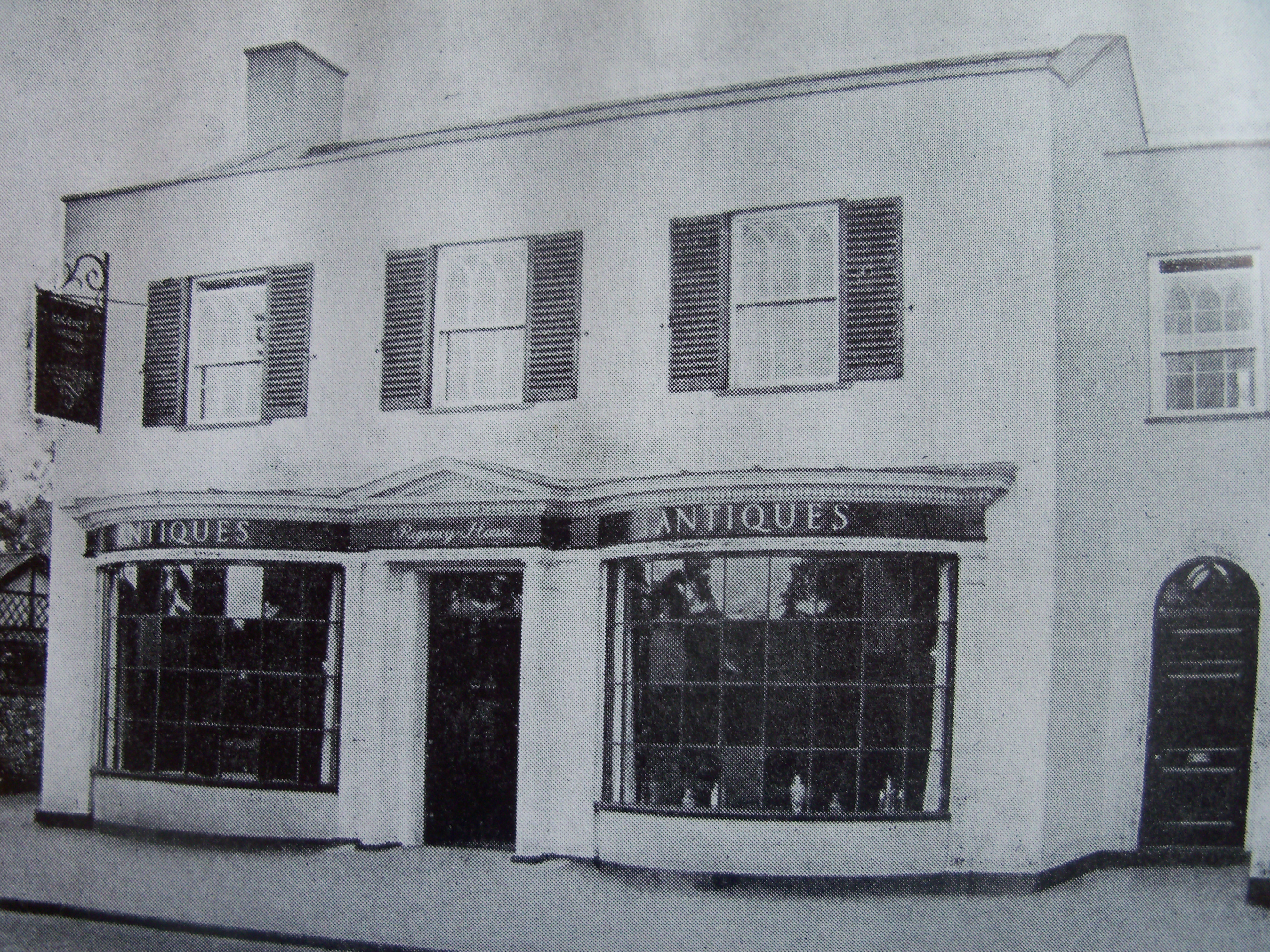
In our own (growing) database of images of antique shop (exteriors and interiors) we discovered we had an image of the shopfront of Regency Antiques, dating from c.1960 – here:

Regency House Antiques Walton on the Thames AYB 1961

Regency House Antiques, Walton on the Thames, c.1960.


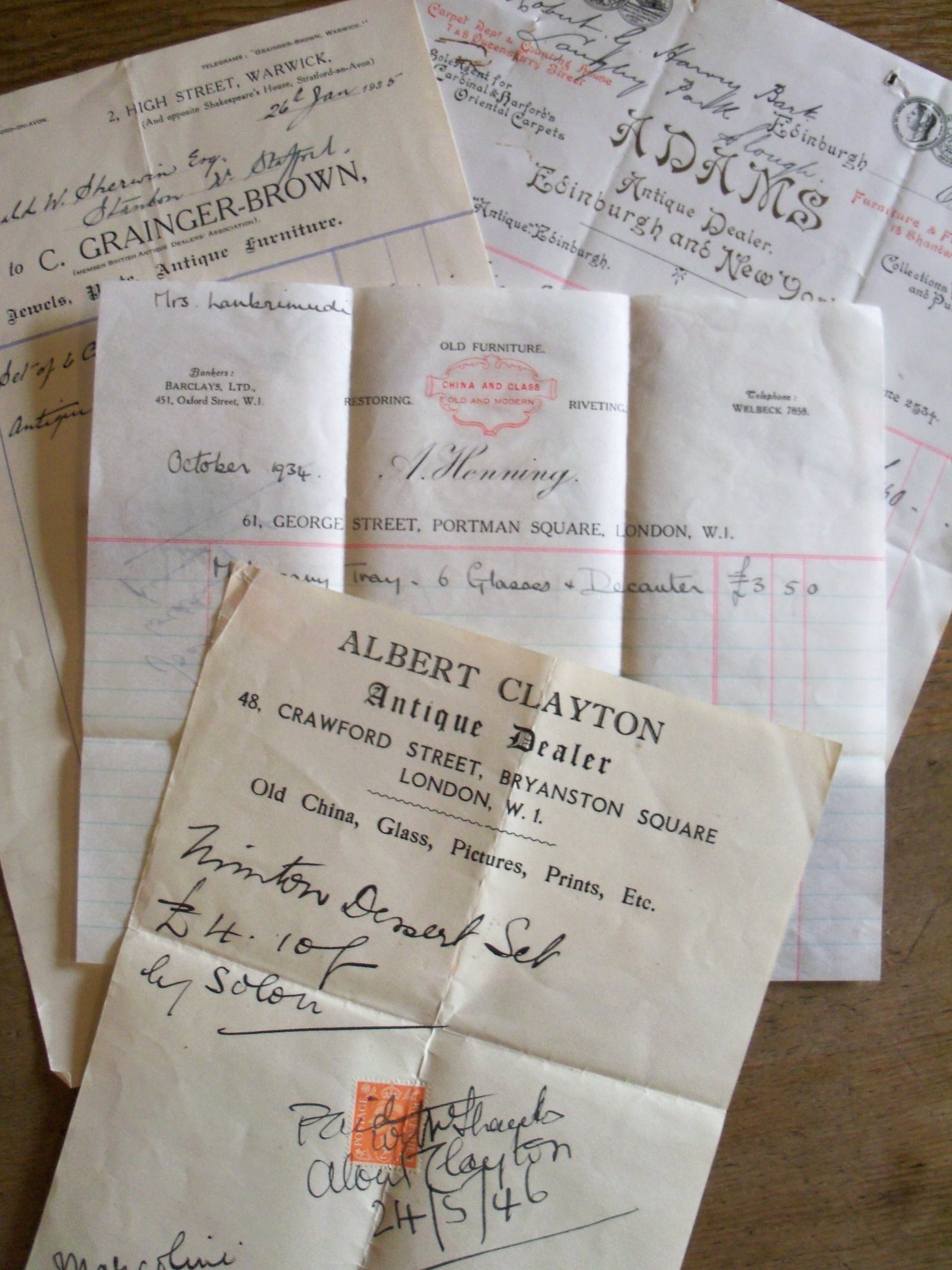
John also tells us that Regency House Antiques was founded by a stockbroker called Sketchley in the mid 1960s, in a purpose-built building, which had its own restoration workshop, employing 3 people – the business was acquired by John Smith in 1975, but was closed in the early 1980s.  John also owned the antique business named ‘A. Henning’ (and, curiously, I already had a copy of an invoice from A. Henning!) – see below…

dealer invoices

dealer invoices

Henning was established in 1922 by John Smith’s step-grandfather, and John inherited the business in 1974. The invoice (above, middle) is dated October 1934, when Henning was located at 61 George Street, London, and traded in ‘Old Furniture’, and ‘China and Glass, Old and Modern’ – the invoice was for a ‘Mahogany tray, 6 glasses + Decanter’, for £3.5.0.

Thank you John for so generously donating the photographs to the research project.

Mark


November 6, 2014

The Architecture of the Trade – The Export Trade

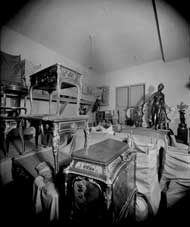
Further to the blog posts on the architecture of the antique trade we’ve been doing some work on the development (and decline) of the trade in importing and exporting antique furniture (often called ‘shipping goods’).  The ‘wholesale’ import and export trade in antiques has a long history – one could, if one adopted certain classificatory frameworks, suggest that such activities began to emerge in the opening decades of the 19th century – there were certainly dealers shipping ‘containers’ of antiques and curiosities between the Continent and Britain just after the Napoleonic Wars, and those import-export activities continued into the early 20th century as part of the transatlantic (UK-USA) trade – the now relatively well-known photograph of Duveen’s ‘storeroom’  is a testament to those practices.

Duveen_storeroom

Duveen’s storeroom, c.1920

But at far as the present project is concerned this particular segment of the trade appears to have taken on a particular form in the decade after World War II.  By the 1960s a specific form of ‘import-export dealer’ emerged – often known as ‘a shipper’- and a certain kind of classification of antique objects, called ‘shipping goods’, also developed as a specific category of antiques.  These ‘trade only’ import and export dealerships often seem to have chosen specific locations and occupied specific building types – they were/are often located on the edge of cities or towns, near major driving routes, sometimes on ‘industrial’ estates; or often could be seen to be occupying redundant barns on farmsteads. They are still a familiar sight today of course.

Alongside the emergence of the ‘shipping dealer’ there developed a whole range of shipping firms, such as Fenton & Co., Gander and White, and Michael Davis – which in the 1970s had offices in London, Los Angeles, New York, Paris, Melbourne and Johannesburg – indicative of the main trading locations for shipping antiques at the time – now I think China may be top of the list!

Evidence from sources in the 1950s-1970s highlights that the import-export trade can provide fascinating evidence for a number of conceptual notions central to the ‘antique trade’ – one is the shifting definition of ‘antiques’ themselves. In the 1970s for example, in terms of import duties that have been payable on such kinds of objects, certain countries defined antiques as being over 100 years old; such objects would be exempt from any import duty. Some countries had different classifications – in the USA in the 1970s, for example, an ‘antique’ was, according to tax law at least, an object made ‘prior to 1830’ (the notional date of the development of the ‘machine age’). At the same time in the UK, the Board of Trade definition of an ‘antique’ was an object that was over 75 years old.  The age of an ‘antique’ has been constantly in flux of course, but it’s interesting that even if one takes something as ‘solid’ as tax law, one will still see variations in the classifying principles!…

Further evidence from some short articles on ‘Exporting Antiques’ in the Antiques Yearbook (1950) and a summary of export figures published in Antique Finder magazine (1976) there seems to have been an expansion of the export trade between the 1960s and the 1970s.  In 1962 the UK export figures were c.£5 million, rising to £68.5 million in 1975; Import figures from the UK illustrate a similar pattern (in 1962 the UK imported £4 million of antiques, and in 1975 the figures was £33.8 million).  The countries the UK exported antiques to also provide a fascinating picture of the global markets in the 1960s and 1970s. Here’s some figures for 1976:

USA £13.4 million

(West) Germany £7.1 million

Japan £2.2 million

Canada £1.3 million

Netherlands £4.4 million

Australia £3.1 million

Belgium £4.0 million

France £4.3 million

Kuwait/Dubai/Abu Dhabi £0.01 million

I imagine the figures today would be relatively familiar in terms of countries….with more activity in the Middle East; and the absence of China (so important today) in the 1976 figures is very significant of course.

What is also of interest in the market conditions for antiques in the 1970s was the economic crisis of the early-to-mid 1970s (the oil crisis) – the commentary from the Antique Finder suggested that the top of the market (the top 5%) had ‘felt the pinch in 1975’ but that the rest of the trade (95%) had ‘continued to move forward’ – the 1974/75 depression in world industrial prosperity had impacted most on higher wealth purchasing power. In today’s economy, the economic depression of 2007-08, seems to have had limited effect on the top 5% of wealthy collectors.

Mark


November 2, 2014

Some surprising sources for antiques

One of the more interesting side effects of the constant fluctuations in taste and fashion in relation to the antiques trade is the emergence (and subsequent disappearance) of antiques departments in some slightly unexpected places.

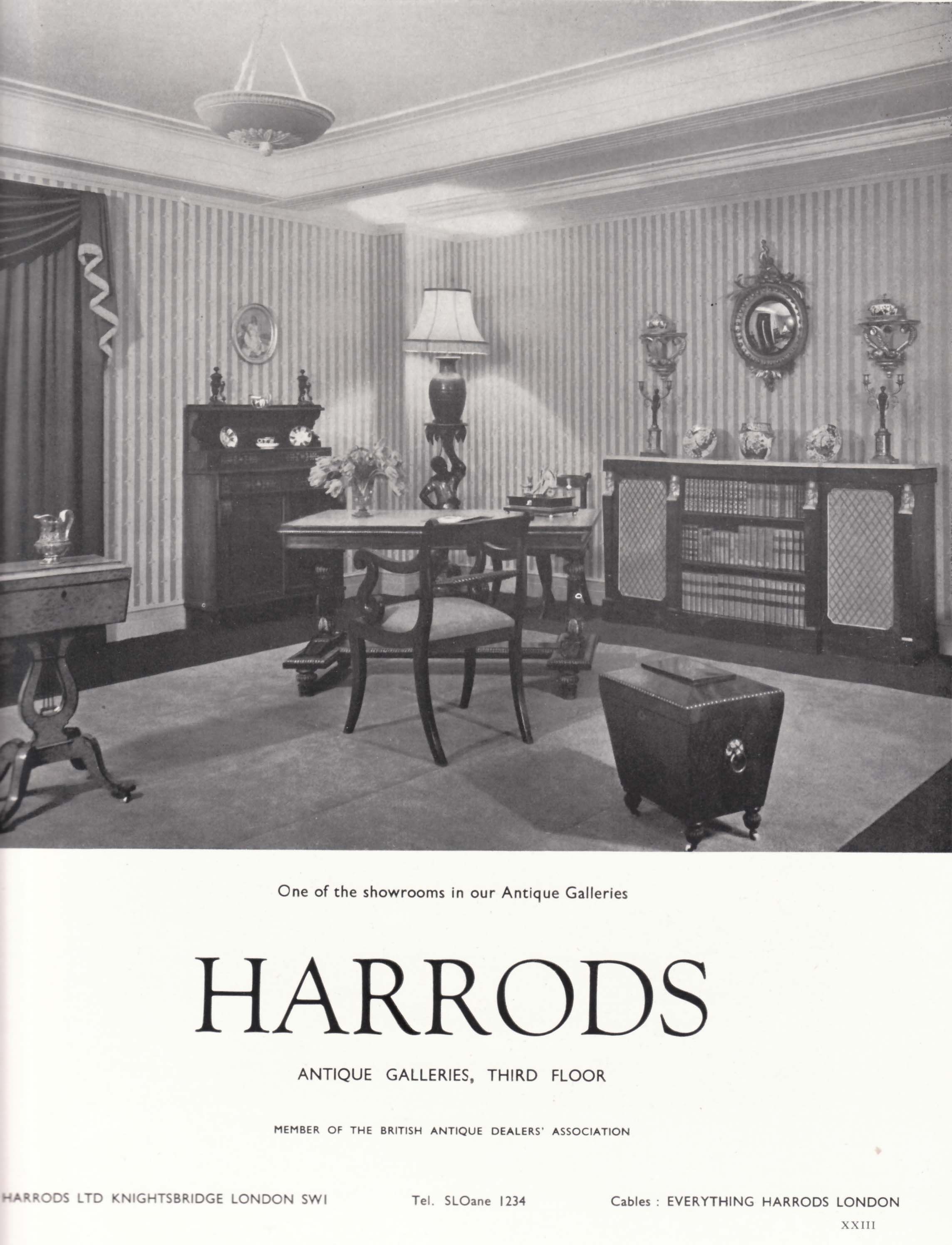
Those of you who have been collectors/connoisseurs/enthusiasts for some time will not need to be told that Asprey and Harrods were once very serious players on the London antiques scene. Both firms were members of the BADA (British Antiques Dealers Association) and exhibited at the celebrated Grosvenor House fair every year. They carried extensive stocks of furniture, textiles, silver, jewellery and porcelain etc. and traded at the very top of the market. Both firms had always been associated with luxury goods of course but neither were founded as antiques dealerships as such. Harrods does still have a small antiques section in its store but, as this image from 1951 shows, at one stage the department was very extensive indeed.

Harrods 1951

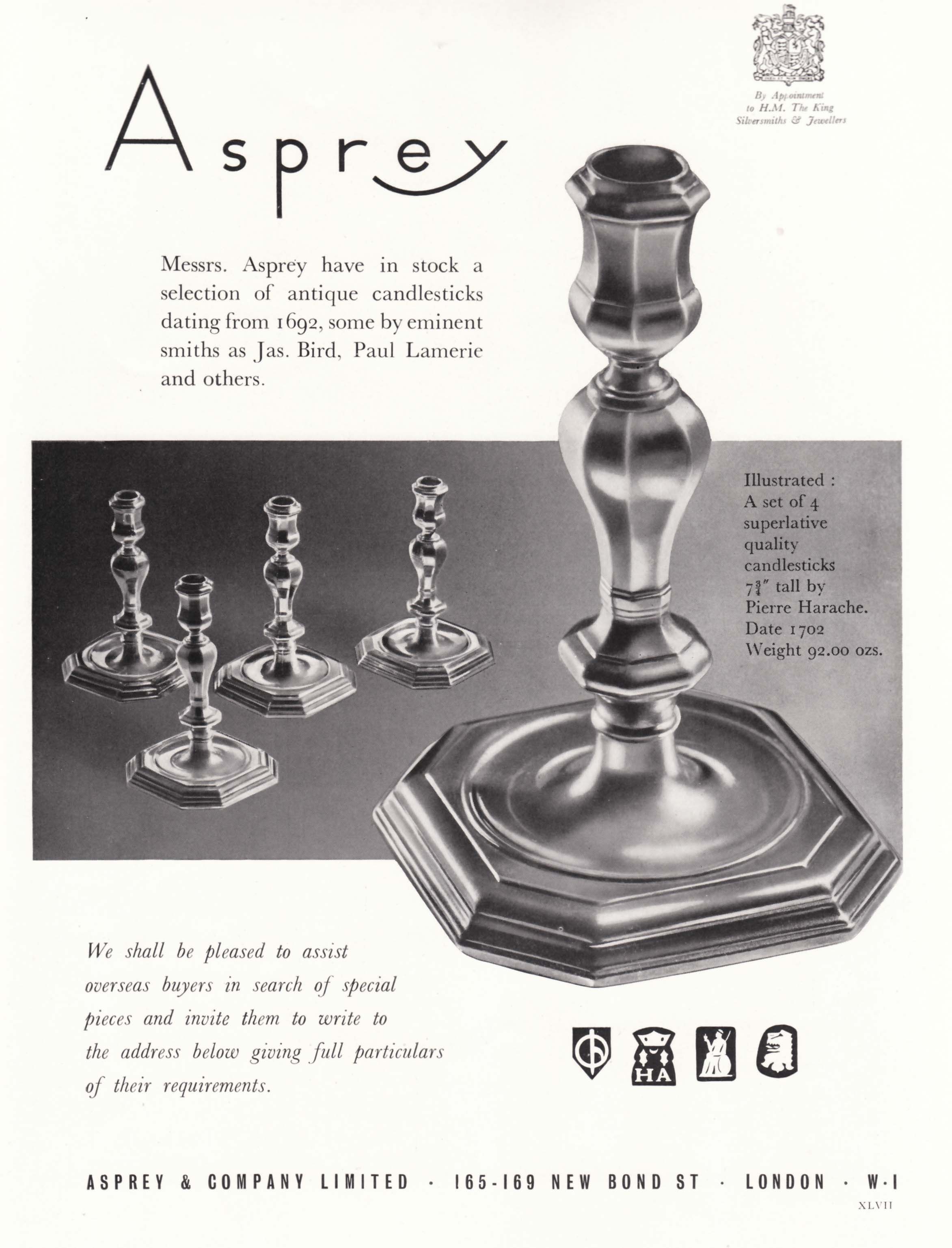
Asprey’s antiques department was the starting point for many celebrated dealers including silver specialist, and Antiques Roadshow expert, Alastair Dickenson who worked there between 1983 and 1996. Sadly the department is no longer operational though the firm does still retail antiquarian books. The image below is from an advert published in 1951.

Asprey 1951

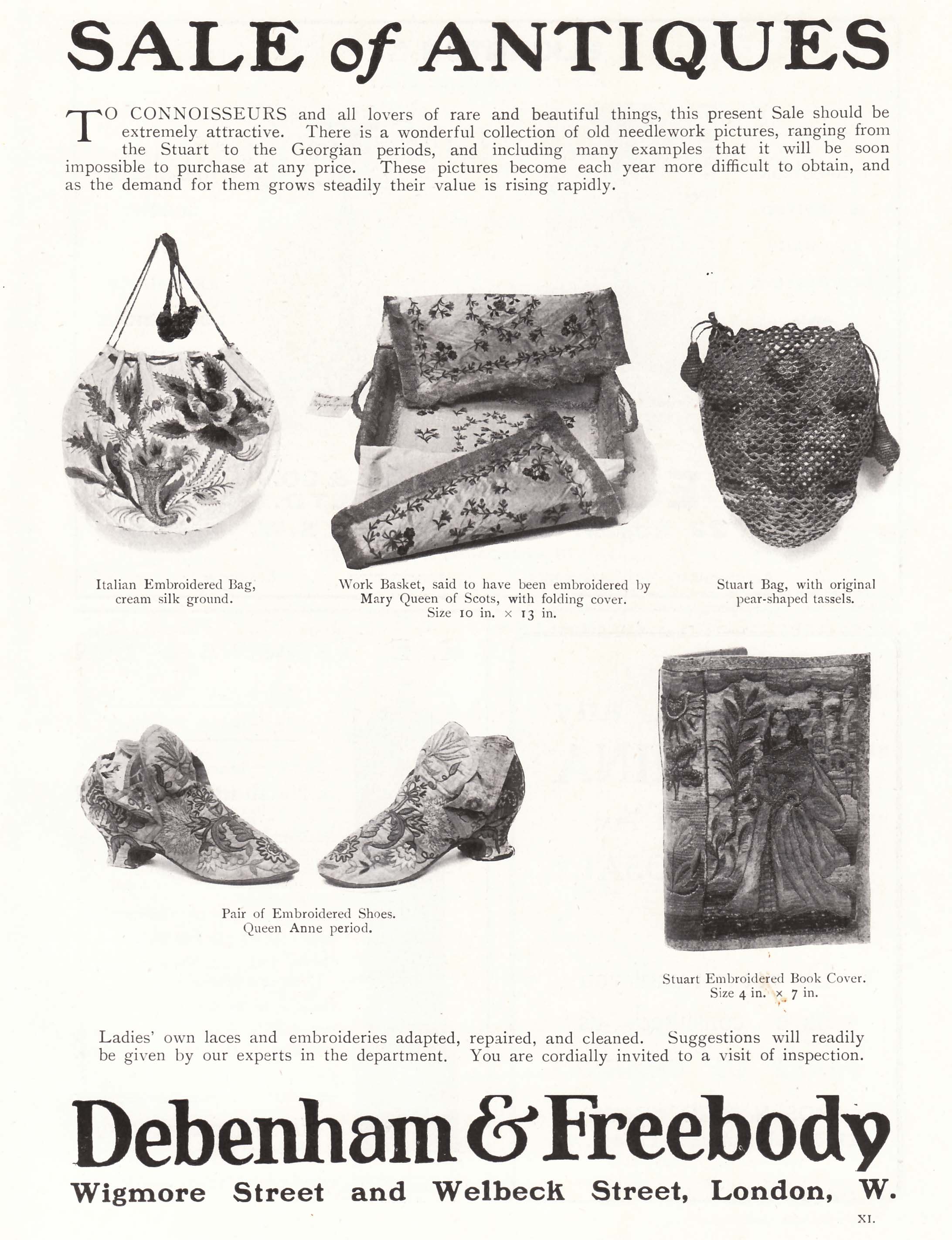
More surprising still are the following two firms that also had antiques departments in the past. Firstly Debenham and Freebody (yes, that Debenham’s). I bow to the greater experience of others but until I saw this advert from the Connoisseur in 1916 I had no idea that they had ever sold antiques. The advert below suggests that the antiques department was limited to textiles but what textiles! Some incredible examples of needlework including one piece possibly worked by Mary, Queen of Scots. Debenham’s flagship store straddling Wigmore Street and Oxford Street is still in place of course but unfortunately the collection of needlework is not.

Debenhams 1916

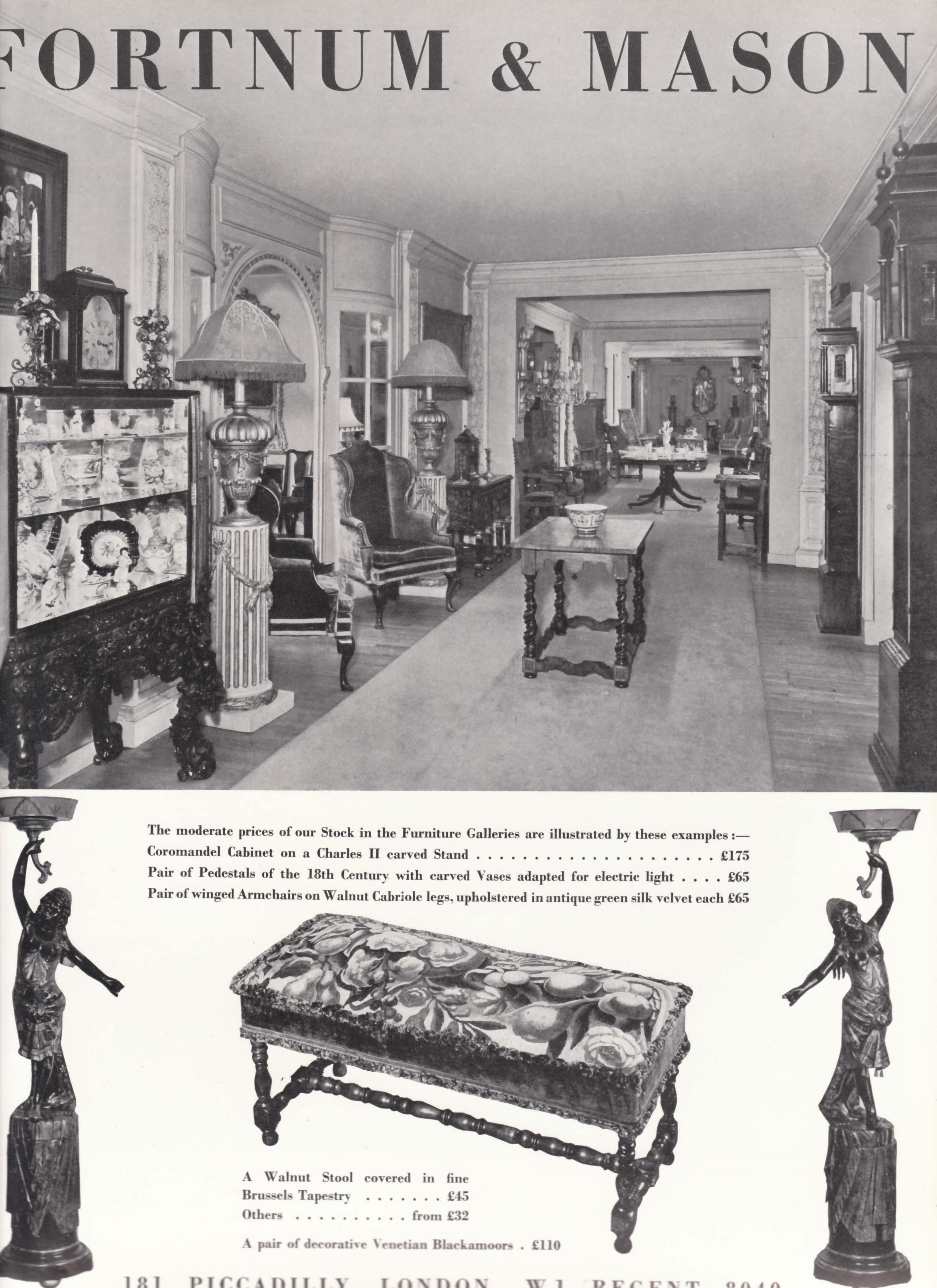
Finally we come to one of the country’s most prestigious retailers but one that I certainly wouldn’t associate with antiques. Fortnum and Mason has long been a foodie’s destination but, apparently, in the post-war period (this advert is from 1951 once again) you could also expect to see a fine selection of antiques. What I find particularly interesting about this advert is that the firm is taking a noticeably different approach to those illustrated above by concentrating on “moderate prices” as the primary selling point. That having been said, the beautifully laid-out gallery setting certainly leaves the viewer in no doubt that, however “moderate” the prices may have been, there are objects of real quality on sale here.

Forthum and Mason 1951

Who knows, perhaps during the next antiques boom we’ll witness the birth of the IKEA or Tesco fine antiques department…

Chris Coles,

Project volunteer.

October 26, 2014

Tourism and the Interwar Antique Shop

* Guest Post by Heidi Egginton, University of Cambridge *

As Mark very kindly said in his previous post, I am currently doing a PhD on amateur antique and curiosity collecting in Britain from the 1870s to the 1930s. In the course of my research I’ve become a bit obsessed with looking for old postcards and other bits and pieces relating to antique shops and collections, and when I came across some intriguing postcards apparently designed by two antique dealers themselves – Mr. F. G. Halliday of Fore Street, Taunton, and G. A. Parkhurst of Crawley – I decided to find out more…

During the early twentieth century, the new antique shops springing up in towns and villages all over England seemed to be instantly recognisable to amateur collectors and lovers of the antique – they tended to inhabit old, crooked buildings and played on their historical associations. This could mean simply affixing ‘Ye Olde’ to the name of the shop, though in some instances, the building itself was even promoted as a tourist attraction in collectors’ magazines, and through the use of promotional postcards. Many shops included cafés, and were evidently intended to cater for day-trippers and motorists.
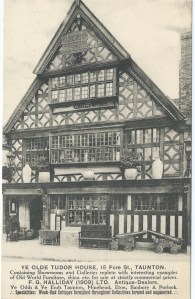
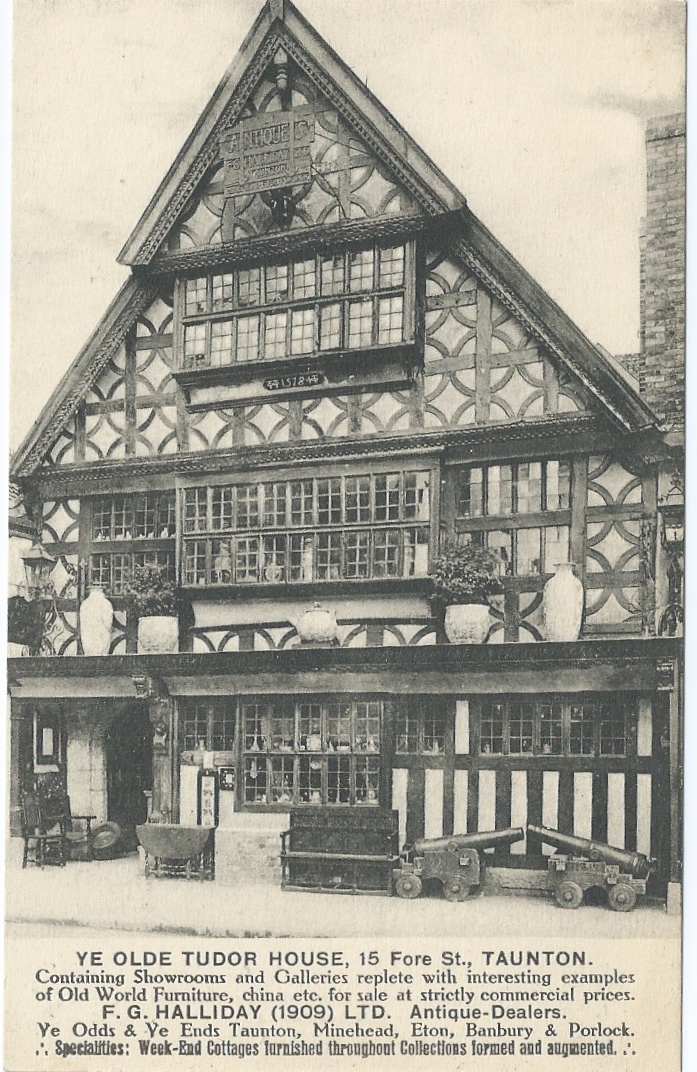
F. G. Halliday, 'Ye Olde Tudor House'

One of a series of phototype postcards printed by Raphael Tuck & Sons to advertise F. G. Halliday’s ‘Ye Olde Tudor House’, Taunton (c. 1920s)

These two dealers, like many of their contemporaries, made much of their shops’ romantic (and probably spurious) connections with illustrious visitors. [1] Halliday portrayed his ‘Tudor House’ – now acknowledged as one of the oldest surviving domestic dwellings in Taunton – as being ‘rich in historical interest from its association with the notorious Judge Jeffreys and other celebrities’. [2] Parkhurst maintained that, in his shop’s previous life as an inn on the road to Brighton, ‘many noted personages’ had undoubtedly stayed there on their progress to and from London, ‘including Anne Boleyn, Queen Elizabeth and Queen Anne’.
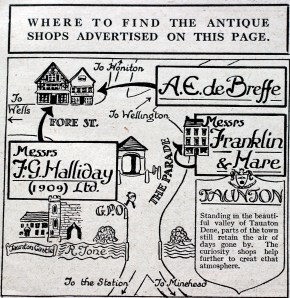
IMG_5029

Map showing location of antique shops and Taunton Castle, in ‘The Quest of the Antique at Taunton’, The Bazaar: Our Saturday Issue for Collectors and Connoisseurs (8th October 1927)

One of the main attractions of these shops, however – perhaps even more so than the antiques and curios offered for sale – were their original architectural and interior features. In the summer of 1914, the newly-opened ‘Hatfield Gallery of Antiques, Ltd.’ placed an advertisement in the Connoisseur proclaiming that the firm had been established in Goodrich House, a ‘fine specimen of English domestic architecture’ with ‘25 spacious rooms, many fitted with rare Adam mantelpieces’. ‘The furniture and other antiques for sale, instead of being huddled together, as is generally the case in a shop, are judiciously placed about the various rooms as in a private house, and purchasers thereby are best able to judge how they would look in their own homes’. All of this was described as ‘in itself well worth a visit’, as there was much to ‘interest the antiquarian or artist’. This firm even employed its own ‘Curator’, a Mr. Horace Hall, who had previously worked in ‘the Antique Department of Harrods’ Stores’ [3]
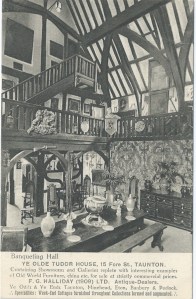
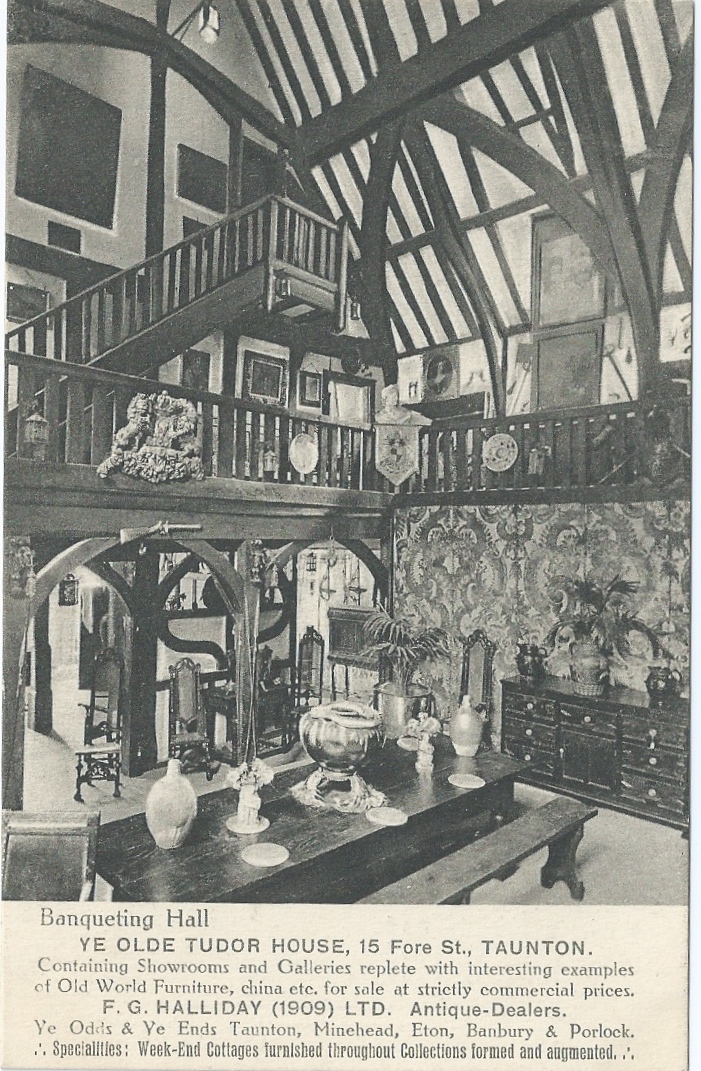
Ye Olde Tudor House, Taunton postcard

The impressive ‘Banqueting Hall’, with a first-floor balcony, inside the Tudor House (c. 1920s)

In the following decade, Halliday and Parkhurst were suggesting that their shops could be visited as part of a day out in the countryside or market town, almost in the same way as historic houses. On his postcard, Halliday called his shop a ‘fine’ specimen of ‘Tudor architecture’ and ‘a striking example of the old world town of Taunton’; still of ‘undoubted antiquity’. Inside the shop, as well as some ‘well-preserved old timbering and some excellent panelling’, several rooms contained ‘examples of Adam work’ from the end of the eighteenth century. The Bazaar, Exchange and Mart’s special Saturday issue for antique collectors described the Tudor House in October 1927 as being full of ‘splendid “period” rooms where each piece has its place, and the galleries have the air and appearance of a particularly “intimate” museum’. [4]
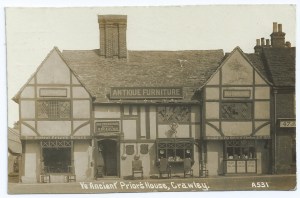
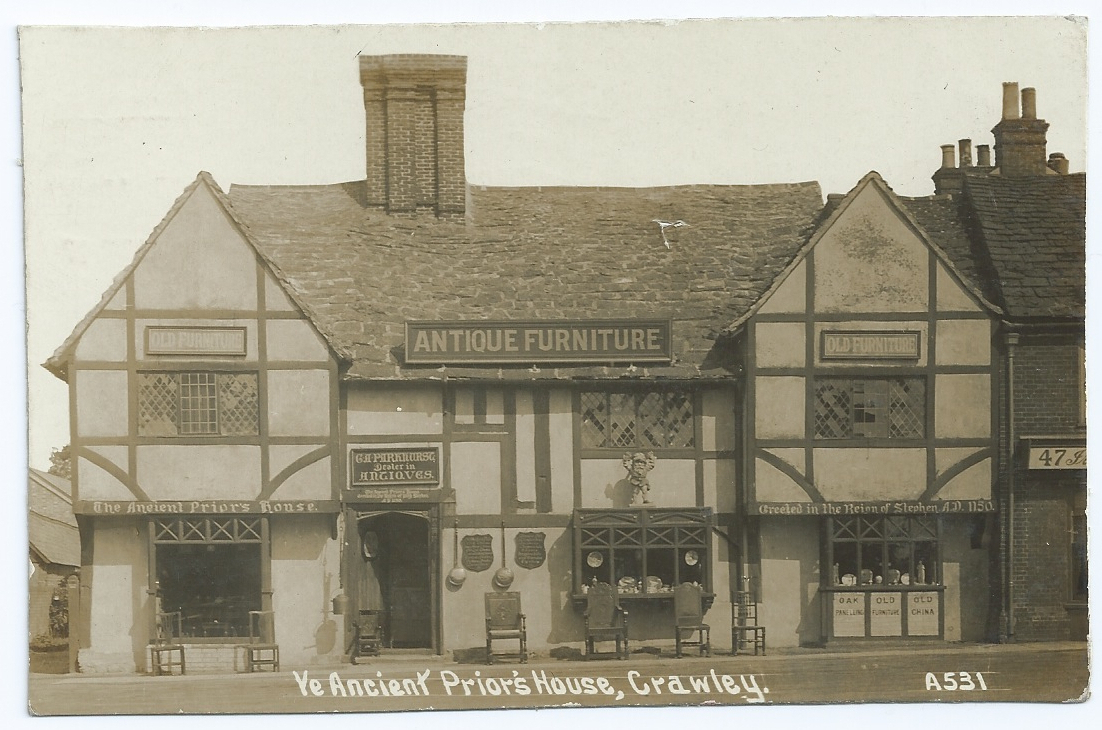
Ye Ancient Prior's House, Crawley

Souvenir postcard showing exterior of G.A. Parkhurst’s ‘Ye Ancient Prior’s House’ (postmarked 4th January 1917)

On the first floor of the ‘Ancient Prior’s House’, which dated from ‘1150’, Parkhurst said that he had found ‘two secret chambers’ – no doubt once used by ‘highwaymen, who were the terror of the road in the old days’. Although he insisted, rather sheepishly, that he had most definitely not attempted to ‘verify’ the rumour that his cellars contained the entrance to ‘a secret underground passage leading into the Church’, he had also found ‘several old smuggling chambers’ underneath his front room.
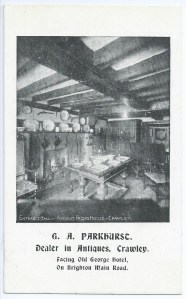
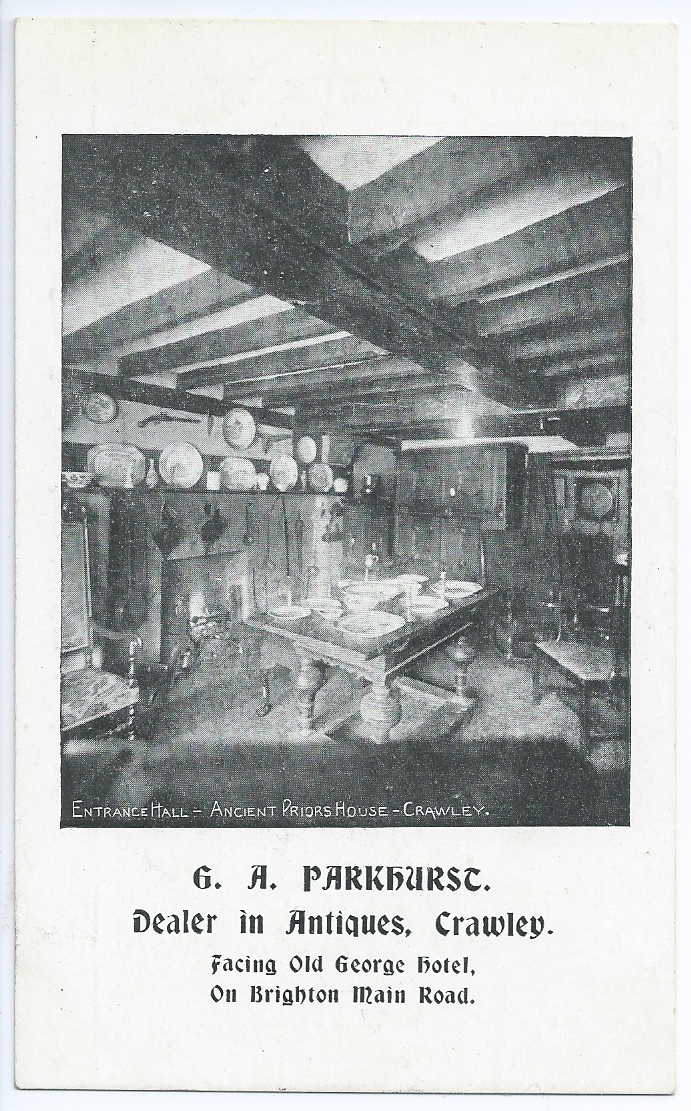
G. A. Parkhurst postcard

Promotional postcard showing the ‘Entrance Hall’ to Parkhurst’s shop (c. 1910s)

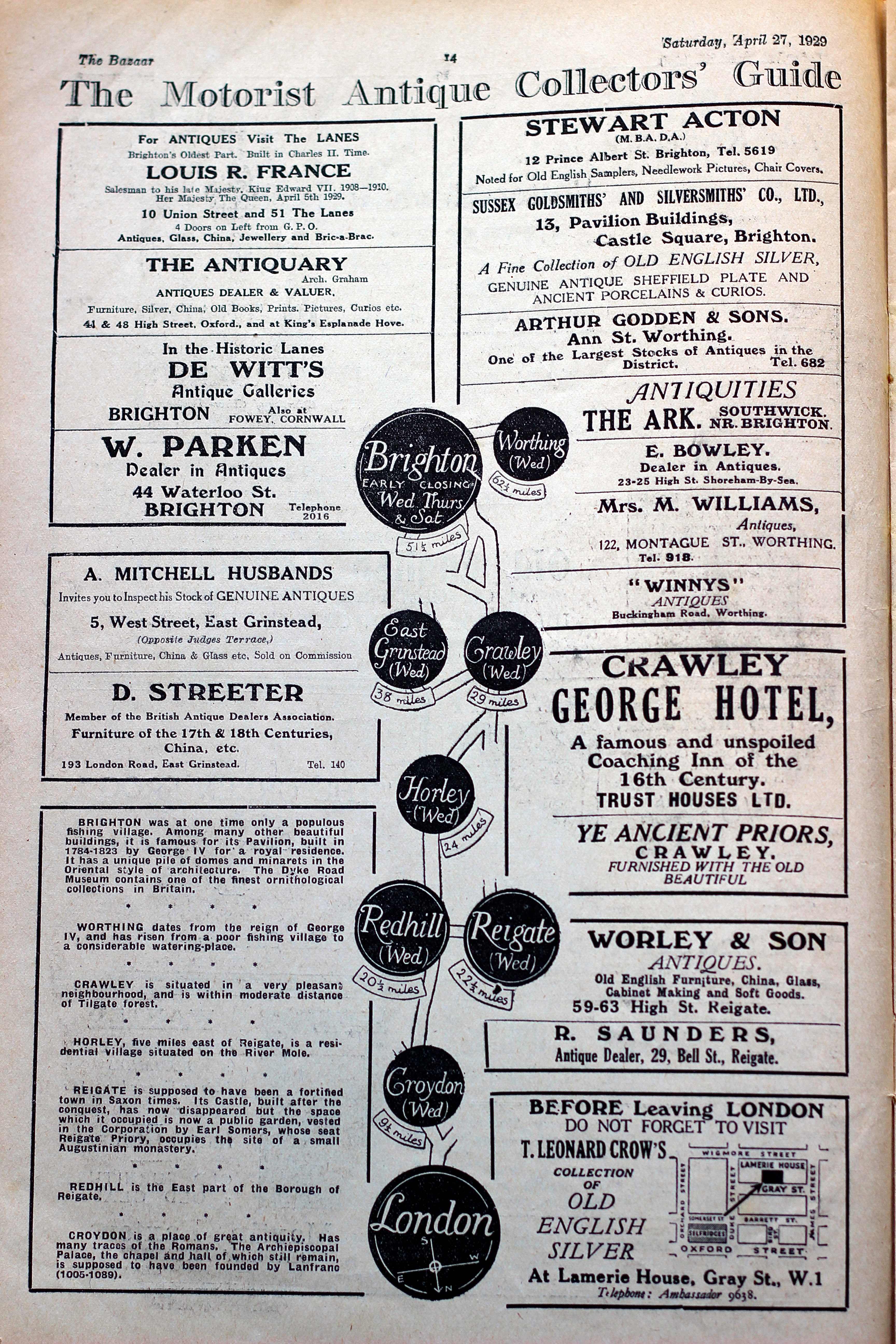
G. A. Parkhurst died in 1920 and the shop briefly passed to a ‘J. Wyndham Parkhurst’, probably a relation. Some antiques were later transferred to ‘The Carlton Galleries’ in Tunbridge Wells, which dealt in ‘Authentic Antique Furniture’ as well as offering decoration services for period and modern room schemes. [5] By the end of the 1920s, the shop itself had been converted back into an inn, ‘furnished with the old beautiful’, by Trust Houses Ltd., a company who ran a number of “old English” hotels and historic public houses.
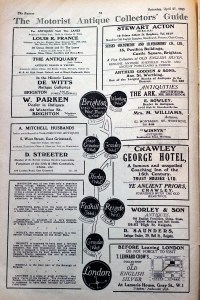
IMG_5028

‘The Motorist Antique Collectors’ Guide’, showing the locations and opening times of antique shops and other attractions between Brighton and London in The Bazaar: The Popular Weekly for Connoisseurs and Collectors (27th April 1929)

Halliday moved out of the Tudor House and into another shop in 1946, at which point it became a restaurant; its new owners assured a local newspaper that they would retain the interior’s original features. [6]


Heidi


[1] Deborah Cohen, Household Gods: The British and their Possessions (New Haven and London: Yale University Press, 2006), pp. 152-53.

[2] R. J. E. Bush, ‘The Tudor Tavern, Fore Street, Taunton’, Somerset Archaeology and Natural History, 119 (1975), pp. 15-21.

[3] Advertisement: ‘Now Open: Visit Historical Hatfield and The Hatfield Gallery of Antiques, Ltd., Founded to Encourage the Collecting of Genuine Antiques’, Connoisseur (May 1914), p. xxvi. For Harrods’ antique department, see: Julia Petrov, ‘“The habit of their age”: English Genre Painters, Dress Collecting, and Museums, 1910-1914’, Journal of the History of Collections, 20 (2008), p. 241.

[4] ‘The Quest of the Antique at Taunton’, The Bazaar, Exchange and Mart, 9 October 1927, p. 380.

[5] Advertisement: ‘The Carlton Galleries’, Kent & Sussex Courier, 28 February 1936, p. 11.

[6] ‘A Historic Tudor House: No. 15, Fore Street, Taunton, To Change Hands’, Somerset County Herald, 26 January 1946, p. 3.

October 19, 2014

The generosity of scholars!

I had the great pleasure of meeting Heidi Egginton this week whilst I was in London – Heidi is an emerging scholar, just completing a PhD at the University of Cambridge under the supervision of Professor Peter Mandler. Heidi’s PhD looks at the craze for collecting old furniture, bric-à-brac, and curiosities during the late-nineteenth and early-twentieth centuries. She is especially interested in the ways in which a taste for historic furnishings, and knowledge of the decorative arts and craftsmanship, circulated among a popular audience after the 1900s. Of course, there are many intersections that resonate with the Antique Dealer Project, and it was fascinating to hear how her research is progressing – and,  with such a wonderfully generous gesture, Heidi sent us some information on some early 20th century dealers she has been discovering – including sending us a massive spreadsheet with over 200 dealer names and locations from the Shrewsbury trade directories (c.1900-1940)….amazingly generous!…Thank you Heidi!

Heidi has also very kindly agreed to post some blog entries for the project, based on some research she has undertaken – so what this space for Heidi’s blog posts – we have quite a community of interest developing around the Antique Dealer project!

Mark


October 12, 2014

Alfred Bullard Inc.,- further reflections on changing practices

The recent shifts in the taste for ‘antique furniture’ continue to impact on the changing landscape, and practices, of the trade in antique furniture – of a particular type anyway….the ‘new antiques’ such as Danish Designer furniture continues to thrive…illustrative of the shift to the contemporary that is the driver for the market at present.  The announcement of the auction sale by Stair, Auctioneers and Appraisers in the USA of the ‘Collection and Inventory’ of Alfred Bullard Inc., in their auction on 25th & 26th October 2014, draws further attention to the significance of these shifts in taste.

Bullard-London-Shop-Interior-1

Alfred Bullard shop interior, c.1930.

Bullard are just one of a number of antique furniture dealers that have either changed their patterns of trading, downsized, or ceased trading altogether in the last 10 years or so – and, as you may know, part of the catalyst for the current investigation of the history of the antique trade is to track, assess and critically analysis this shift.

Alfred Bullard may be an American firm of antique dealers (and therefore seemingly outside the remit of the present research project), but they were originally established in Britain in the 1920s (and therefore part of the ‘cultural geography of the British trade). They have been trading in 18th and early 19th century English Furniture since the 1950s in Philadelphia, USA. According to our research Bullard was established in Newport Pagnell, Wales by the early 1920s, before moving to premises off Park Lane in London by 1925. They already had a branch in Philadelphia USA by 1950, and consolidated both the UK and USA operations in Philadelphia by 1965.  The firm is a testament to the importance of the transatlantic antiques trade throughout the 20th century and were one of a number of dealers operating at the very top of the trade in antiques in the period.

We should say that whilst the shop of Bullard Inc., may disappear from the high street, the firm itself will continue through Bill Bertolet, who will now continue to act as ‘advisor’ to clients – but the shift in practice is also a further testament to the changing panorama of the antique trade in the late 20th and early 21st century.

Mark

October 5, 2014

The London trade in microcosm-the changing face of Mount Street

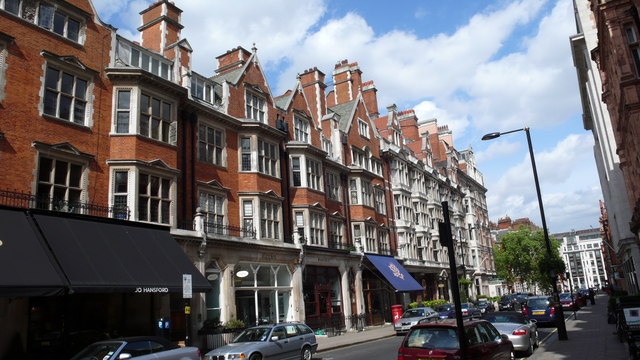
Mount Street in more recent times. The architecture remains but the focus of the street has changed forever.

Mount Street in more recent times. The architecture remains but the focus of the street has changed forever.

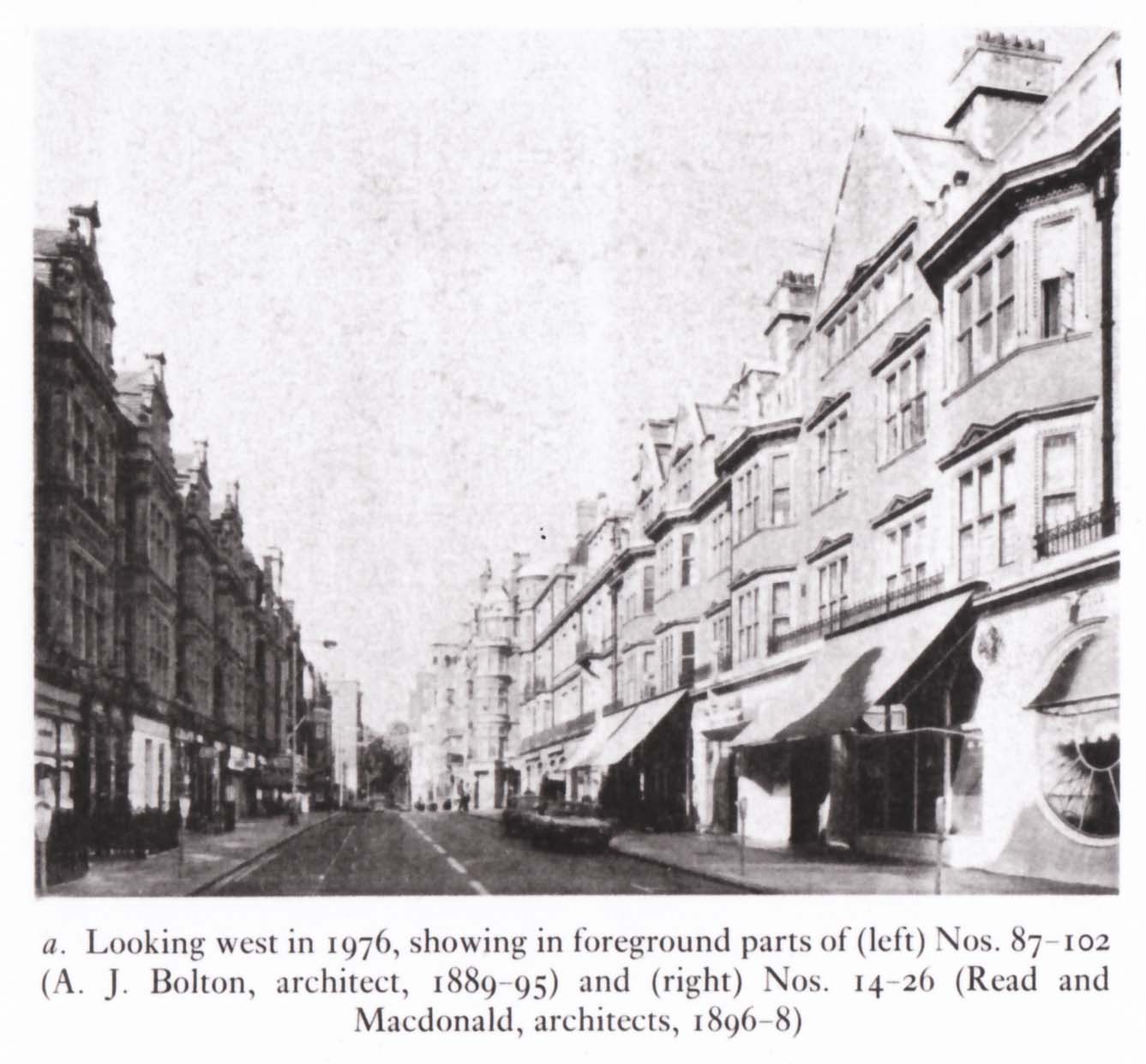
You'll have to take my word for it as this is the best image I can find, but most of the shops here, pictured in 1976, are antique dealers.

You’ll have to take my word for it as this is the best image I can find, but most of the shops here, pictured in 1976, are antique dealers.

Located off of Berkeley Square and between Grosvenor Square and Piccadilly, Mount Street is an idyllic location that has long been described as the heart of what estate agent Peter Wetherell still describes as the Mayfair village. Looking at the immaculate rows of late Victorian shop fronts, now largely filled with fashion retailers, clothiers and the like it is easy to forget that this one street alone used to provide the addresses of an extraordinarily high number of dealers at the Grosvenor House Fair.

Nowadays the exceptional general dealer Kenneth Neame and the Asian art specialist A J Speelman remain the only dealers with ground floor shop fronts in the street (though others do operate by appointment from 1st floor premises) but in the past the street was visited by every serious wealthy collector as a matter of course. As the project continues and more data is gathered then a more complete picture of the sheer numbers of dealers in the street will emerge but my own list comprises the following:

Barling of Mount Street (Oriental art)

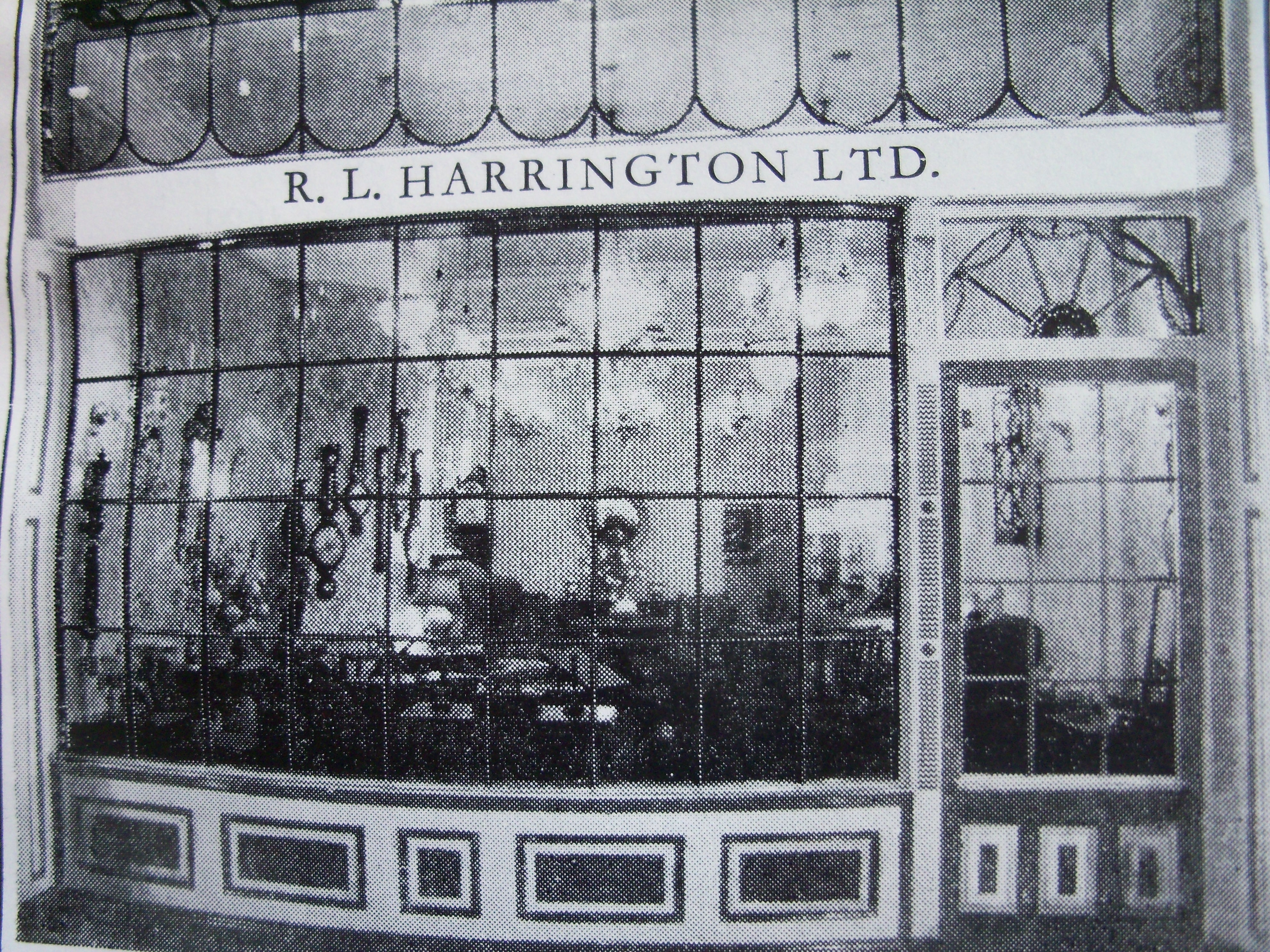
R L Harrington (English furniture and related objects)

The dealer R L Harrington at 120-121 Mount Street in 1961

The dealer R L Harrington at 120-121 Mount Street in 1961

John Keil (English furniture dealer with premises in Knightsbridge and, in times past, Bristol and Bath)

Stanley J Pratt (antique fireplaces and accessories)

Trevor (English furniture)

Stair and Co (one of the pre-eminent English furniture dealers-see Mark’s earlier post)

Pelham Galleries (English and French furniture plus Chinoiserie decoration)

H Blairman and Sons (Regency and later furniture and decorative arts)

John Sparks (Oriental art)

Mansour Heskia (rugs and carpets)

Alistair Sampson (early English pottery and country furniture)

Mount Street Galleries (still exists but different scope-the emphasis has switched from furniture to contemporary art)

Patrick Jefferson (English furniture and associated objects)

Walter Waddingham (English furniture)

Gerard Hawthorn (Oriental art)

Marks Antiques(Antique silver and Faberge)

Bruford (jewellery and silver)

Quite a selection I’m sure you’ll agree.

Hopefully the images give something of a flavour of this remarkable street but if you were lucky enough to see the area in its antiques heyday and have images to share then please get in touch.

Nowadays the largest concentrations of dealers in London are in Kensington Church Street, Portobello Road and the Fulham Road. With South Audley Street (at the end of Mount Street and another traditional heartland of the trade) also beginning to attract  fashion brands the Mayfair trade will never quite be the same again. My advice would be to visit whilst you still can, even if just to window shop. There are still some remarkable pieces to see here and who knows-you may be a part of the trade’s fight back against the multinational giants.

Chris Coles,

Project volunteer.

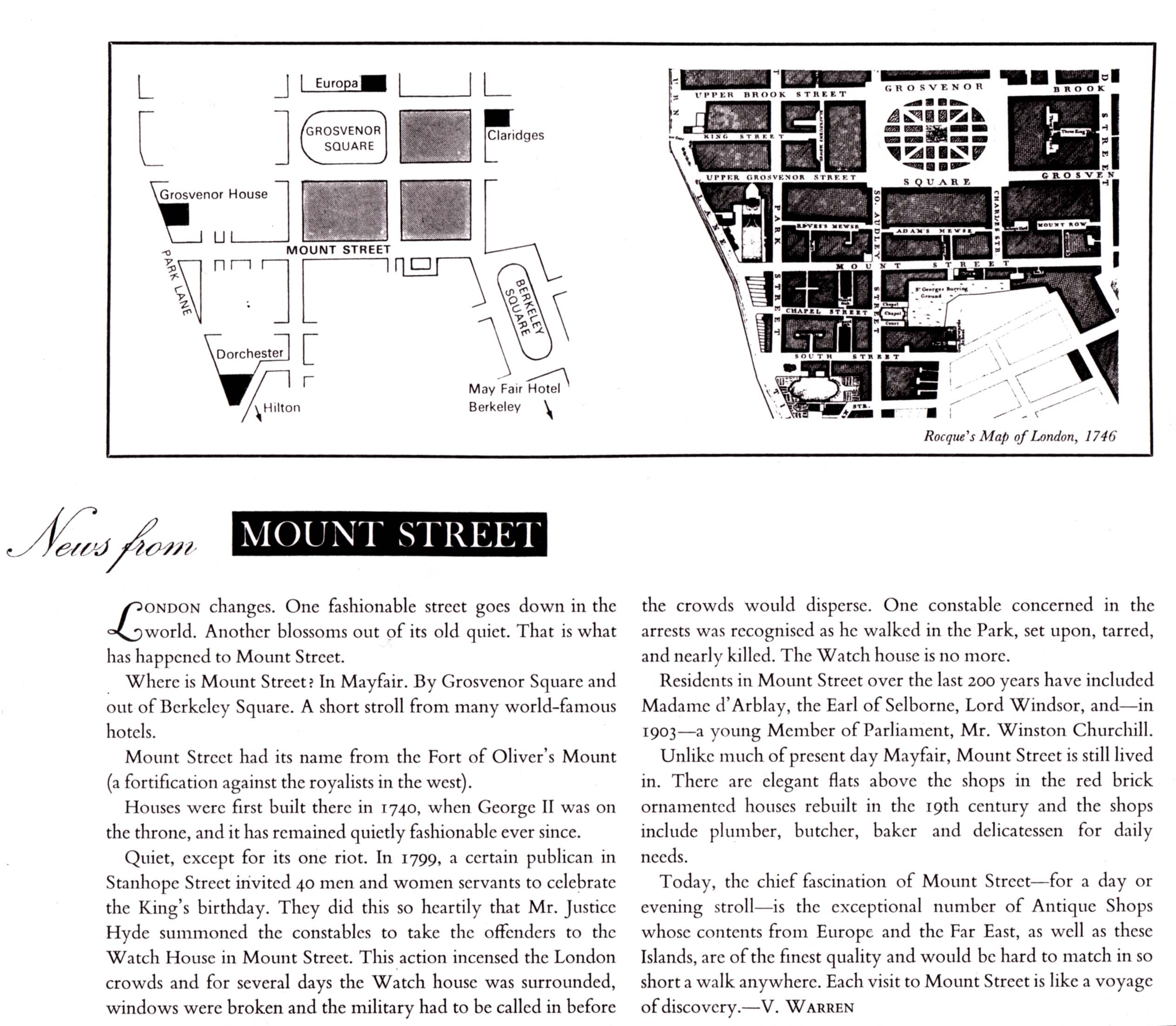
The last paragraph says it all. An undated entry for the street kept in the Westminster Archive.

The last paragraph says it all. An undated entry for the street kept in the Westminster Archive.

September 28, 2014

Oral History Interview – Jerome Phillips

We interviewed Jerome Phillips earlier this month – of the well-known dealers ‘Phillips of Hitchin’, established in the 1880s, and still trading from the same address at the Manor House in Hitchin.  Jerome, photographed below is sitting in the main entrance hall at the Manor House.  P1000018

The firm of Phillips of Hitchin was begun by Jerome’s grandfather, F.W. Phillips in c.1884, and Jerome told us about the history of the business, and his experiences since he joined the firm in the early 1960s.  The interview with Jerome will form part of the oral history archive of the antique trade and will be available via the project websites later this year, so keep your eye on the developments as the project progresses.

Mark

August 21, 2014

The Architecture of the Trade – antique, second-hand, and reproduction furniture

A longer than usual Blog entry – but the issues are complex! – I recently visited Tyne & Wear archives (at the Discovery Museum in Newcastle) to have a look at the archive of an antique dealer named Robertson, trading in Newcastle in the 1960s and 1970s. Unfortunately we couldn’t find the archive! I did have a reference (1556) from the National Archives site (honest!) and it suggested that the archive was in Newcastle, but there’s no record of it at T&W archives – more digging is needed.

Anyway, I didn’t waste the day, I had a look at the archive of George Hobbs Limited, which dates from c.1921 up to 1967. Investigating the Hobbs archive has directed attention again to key issues we are dealing with in the research for the project – we’ve had endless discussions about this! And that is who/what we include in our ‘cultural geography’ of the antique trade. The main point here is that any history of the antique trade needs to address both the mutability of the term ‘antique’ (more on that in a future blog entry), and the hybridity of antique trade itself. Historically the ‘Antique Trade’ has involved a complex overlapping of practices and initiatives. Hobbs is a good case in point.

George Hobbs is not listed under ‘antique dealers’ in the trade directories in the period 1920s-1950s, but is firmly categorised under ‘Furniture Dealers’  or ‘Furniture Brokers’- in the period in question this would normally indicate that Hobbs was a ‘second-hand’ furniture dealer.  You’ll already see a key point here…when does ‘second-hand’ furniture become ‘antique’ – the notion is too complex to deal with here in a short blog entry, but it’s worth holding that thought for now.

What is interesting about the Hobbs archive though is how it illustrates how ‘trade directory’ classifications are themselves a meta-classificatory form, one that smooths out, elides and indeed often obscures the complex nature of antique trade.  The stock books of Hobbs clearly demonstrate this (to me anyway!) –  the early stock books of the firm (dating from 1930s) clearly show that the majority of the furniture that they sold was described as ‘antique’ – here’s a few examples:

‘Old Chippendale armchair’ which was listed as valued at £1.0.0. [this is pre-decimal currency] in January 1939. Again, there’s not space here to deal with the semantic field but it’s worth noting the descriptive term ‘Old’….

‘Antique Mah[ogany] Bow Chest’, which was bought for £7.0.0. [this is pre-decimal currency) in August 1944, and sold for £29.10.0 [they did quite well out of this transaction!] in September 1945.

‘Antique Mahogany DL [drop leaf] table’ which was bought at the auction house of Anderson & Garland in September 1944 for £3.5.0. and following some restoration costing £3.19.0, was sold in January 1945 for £22.0.0.

There are many more examples in the stock books in the 1930s and mid 1940s of the sales of ‘antique furniture’, alongside quite obvious ‘second-hand’ and household furniture – things such as ‘4ft Hair Mattress’ bought for £5.10.0. in May 1945, and sold later that same month for £8.5.0. What is striking is that by the early 1950s the stock books clearly indicate that the selling of ‘antique’ furniture by Hobbs was much less common and second-hand furniture seems to have become much more the main trading activity of the firm. There may, of course, be some very specific reasons for the gradual change in the trading activities, but the point is that all the while that Hobbs was selling ‘antiques’ the firm remained in the trade directories at least, as ‘furniture brokers’.

Searching for ‘Hobbs’ in the trade directories in the archives at the Discovery Museum also illustrates a, by now, familiar pattern of practices that form, morph into, the ‘antique trade’ (if you’ve read my Dictionary of 19th Century Antique & Curiosity Dealers (2009/2011) you’ll read about this formation – (sorry for the plug there…I still have some copies btw if you’re interested!…).

Anyway, the firm of ‘George Hobbs Limited’ was incorporated in 1925 (as ‘Cabinet Makers and House Furnishers’…yet another practice!) – they appear to begin with ‘James Hobbs’ listed as ‘Chair Manufacturer’ at 14 Pilgrim Street, Newcastle, in trade directories in 1874; James Hobbs is then listed as ‘Cabinetmaker’ in 1886, before a listing as ‘Furniture Broker’ in 1889, when his son, George Hobbs, was also listed at 88 Pilgrim Street, as ‘Furniture Dealer’.  George Hobbs continues to be listed in the trade directories in the early 1900s to the 1920s as ‘Furniture Broker’.

This ‘problem’ in terms of classification is helpful though, as it directs attention to the complex nature of the history of the antique trade. Indeed, here’s another example to reinforce (and complicate) the point – it’s also an opportunity to show some photographs of another archive that I recently acquired, and that will be a useful resource for the research project of course!

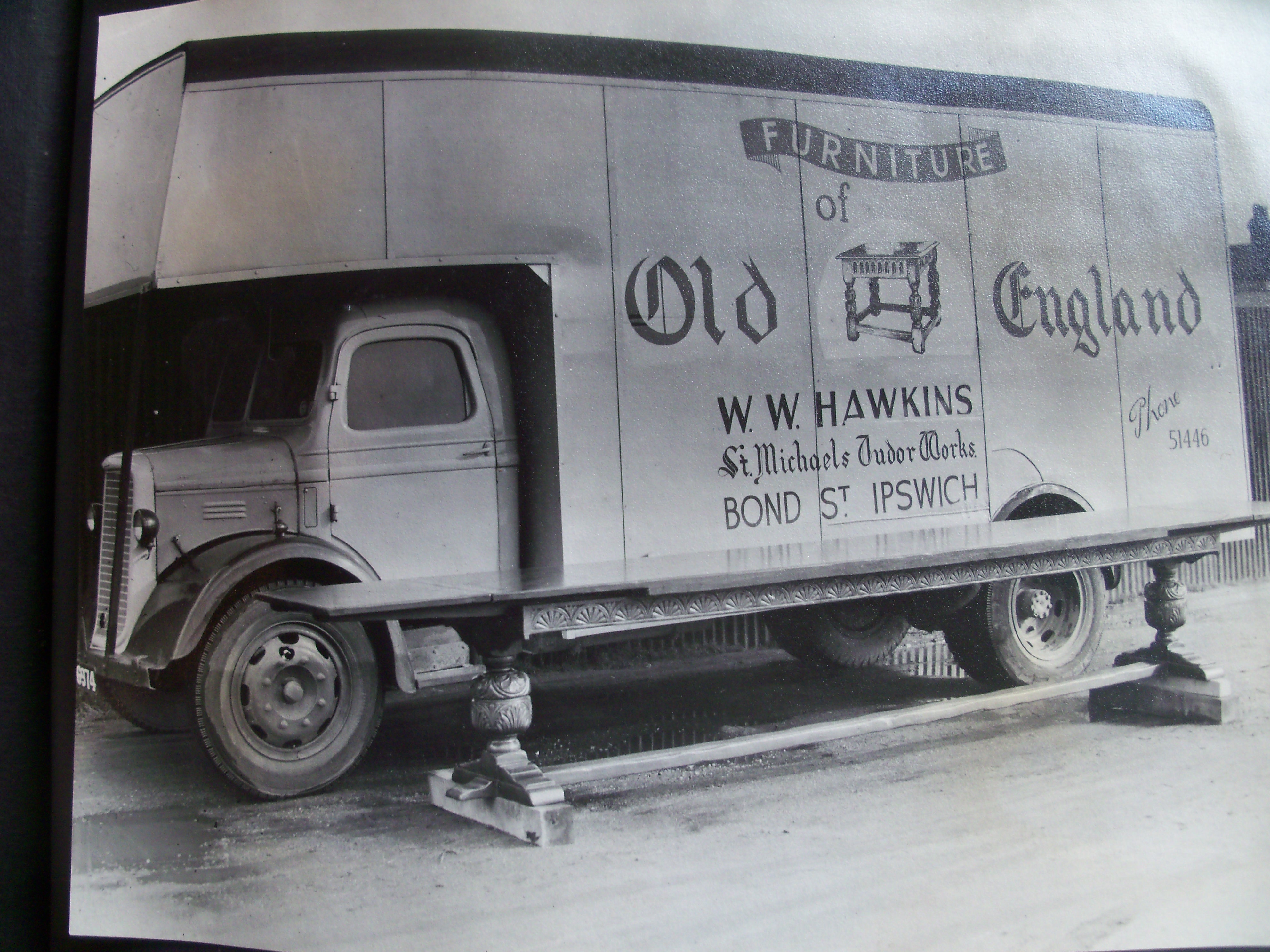
The archive is from the firm of W.W. Hawkins, St. Michaels Tudor Works, Bond Street, Ipswich, Suffolk, and is composed of a number of albums of photographs and working drawings of furniture designs, and dates from c.1917 to to c.1960. Hawkins supplied ‘handmade, hand-carved’ reproduction furniture – the ‘Furniture of Old England’ as the livery on their vans indicated:

100_3732

W.W. Hawkins delivery van, c.1950.

100_3733

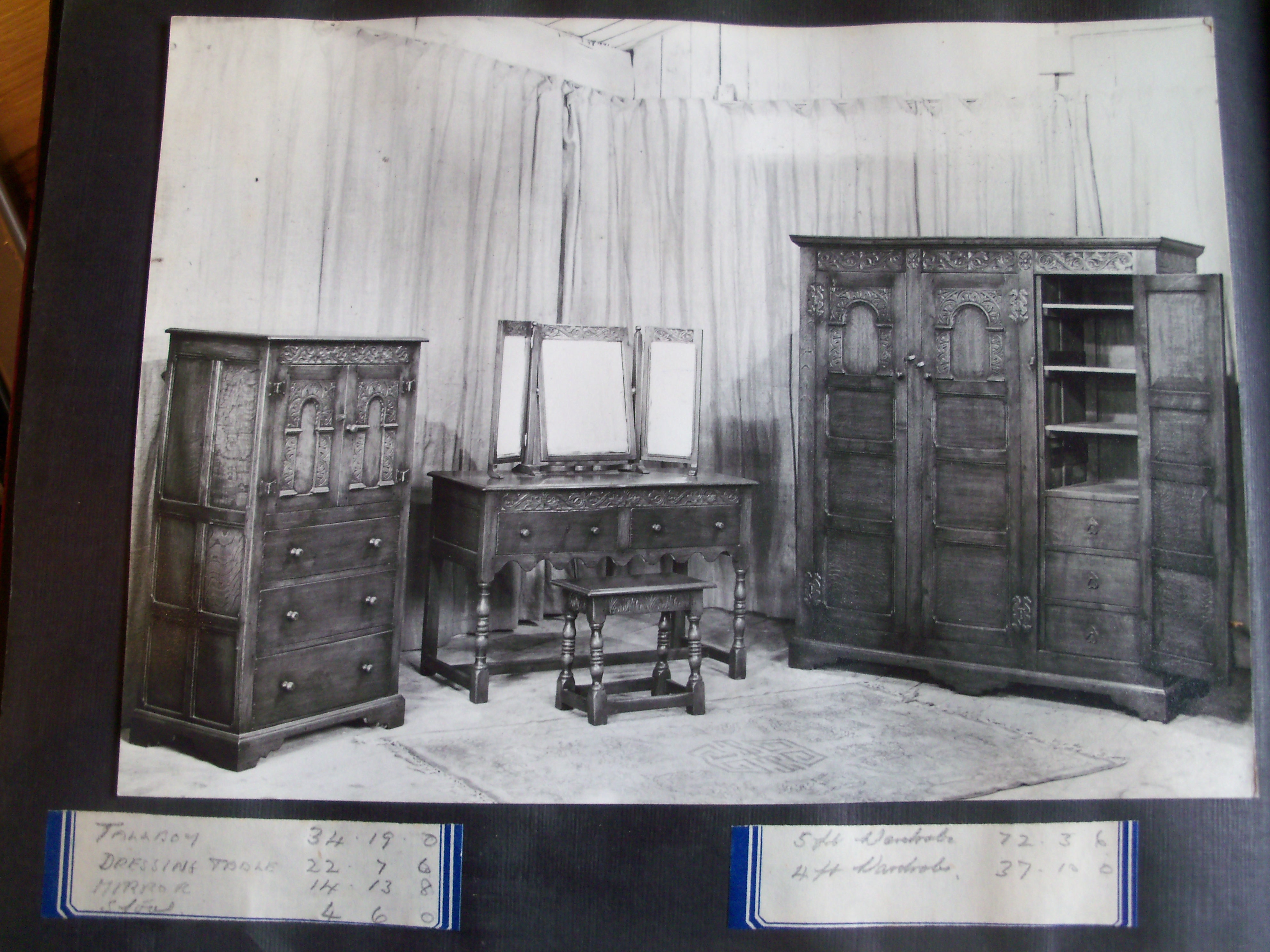
Reproduction furniture made by W.W. Hawkins c.1950.

And here’s an example of the kind of oak furniture (sometimes described as ‘Jacobethan’) – for those that are interested, the descriptions, left to right, are: ‘Tallboy, £34.19.0; Dressing Table £22.7.0.; Mirror £14.13.0. Stool £4.6.0.; 5ft Wardrobe £72.3.6.; 4ft Wardrobe £37.10.0.’

100_3730

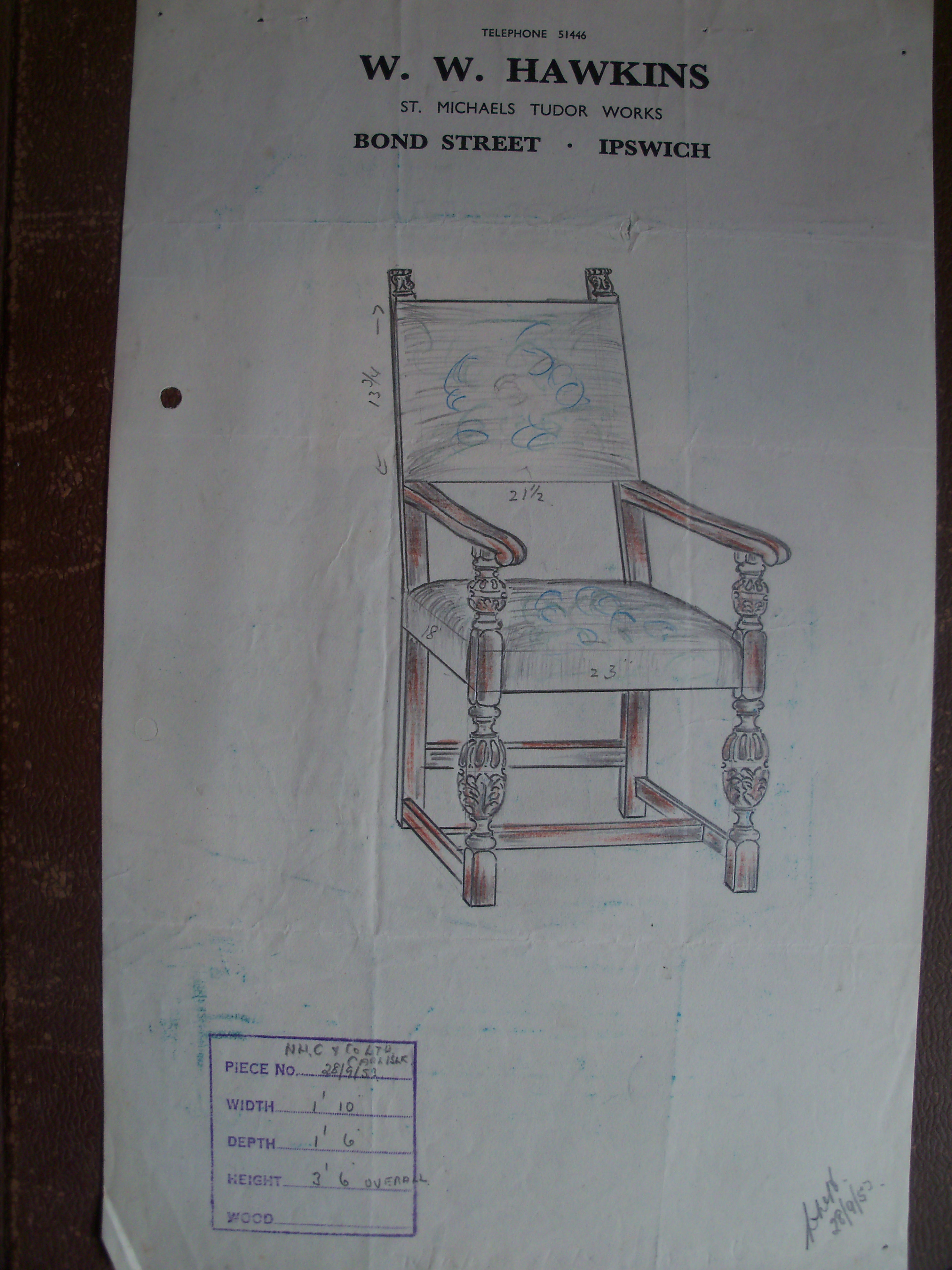
Design for a chair: W.W. Hawkins – design dated 1953.

Here’s also a design for a late 17th century style armchair. The archive is a fascinating insight into the fashion for reproduction antique furniture in the period.

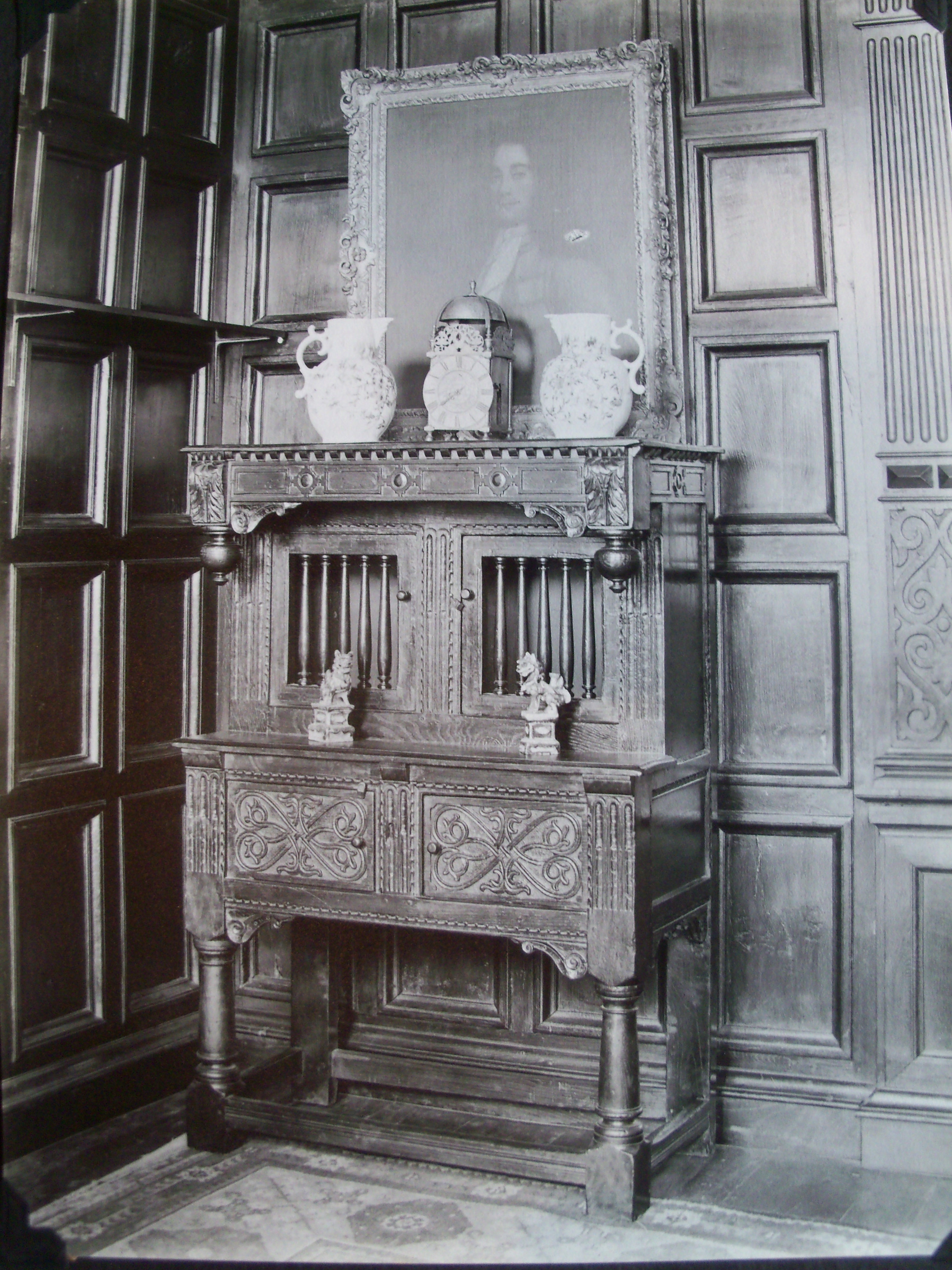
I can’t categorically say that Hawkins sold ‘antique’ furniture as well as manufacturing reproduction antique furniture, but one of the photograph albums certainly appears to have illustrations of genuine antique furniture – they may have been models for the craftsworkers at Hawkins of course – this example (below) is one of a number of pieces in an album dated c.1917-1927 that appear to be genuine examples.

100_3734


But even if Hawkins did not actually retail antique furniture there are plenty of examples of ‘antique furniture manufacturer’s’ also selling genuine antique furniture alongside the practice of furniture making, and, as I’ve suggested above, this was a practice through which the ‘antique trade’ as we now understand it, emerged. There are many other hybrid forms of course, ‘Interior Decorators’ is just one that automatically comes to mind, and part of the objectives of the present research project is to ‘unpack’ (as we say in academia!) these complex practices….

Mark

August 16, 2014

Frank Partridge & Sons – donation of materials

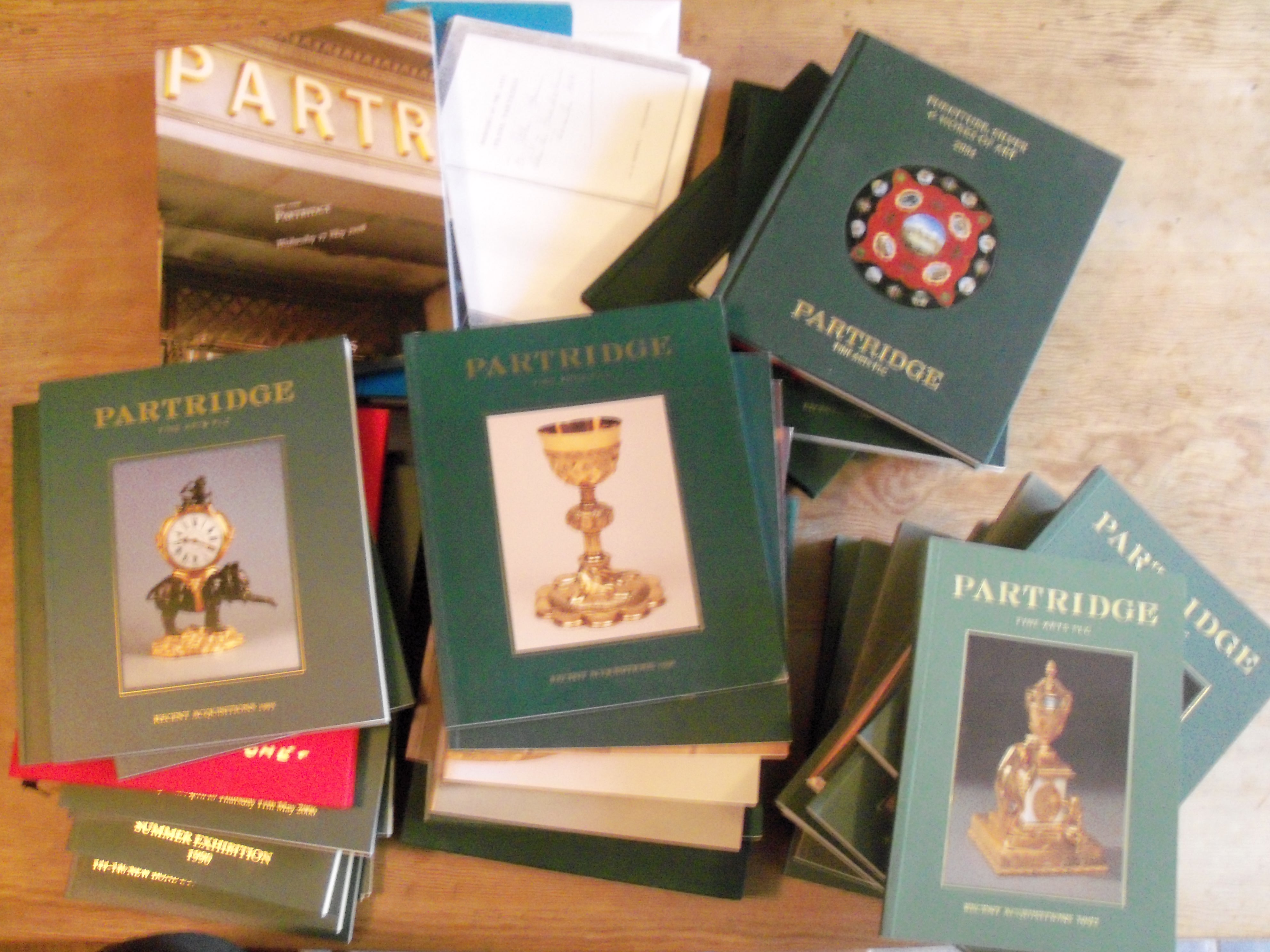
The antique trade continues to be exceptionally generous to the research project – Anthony Smith, formerly with the well-known dealers Frank Partridge & Sons (Partridge Fine Arts) serving as accountant, company secretary and finance director for almost 28 years, very kindly donated a whole stack of Partridge catalogues (1974-2007) to the project – as well as other ephemera, including a photocopy of Memoirs of the late Frank Partridge (published in 1961) and a copy of the prospectus issued at the time of the company’s flotation on the Stock Market in 1989.

100_3726


These materials are a fantastic resource for the project, so we owe a big thank you to Anthony!

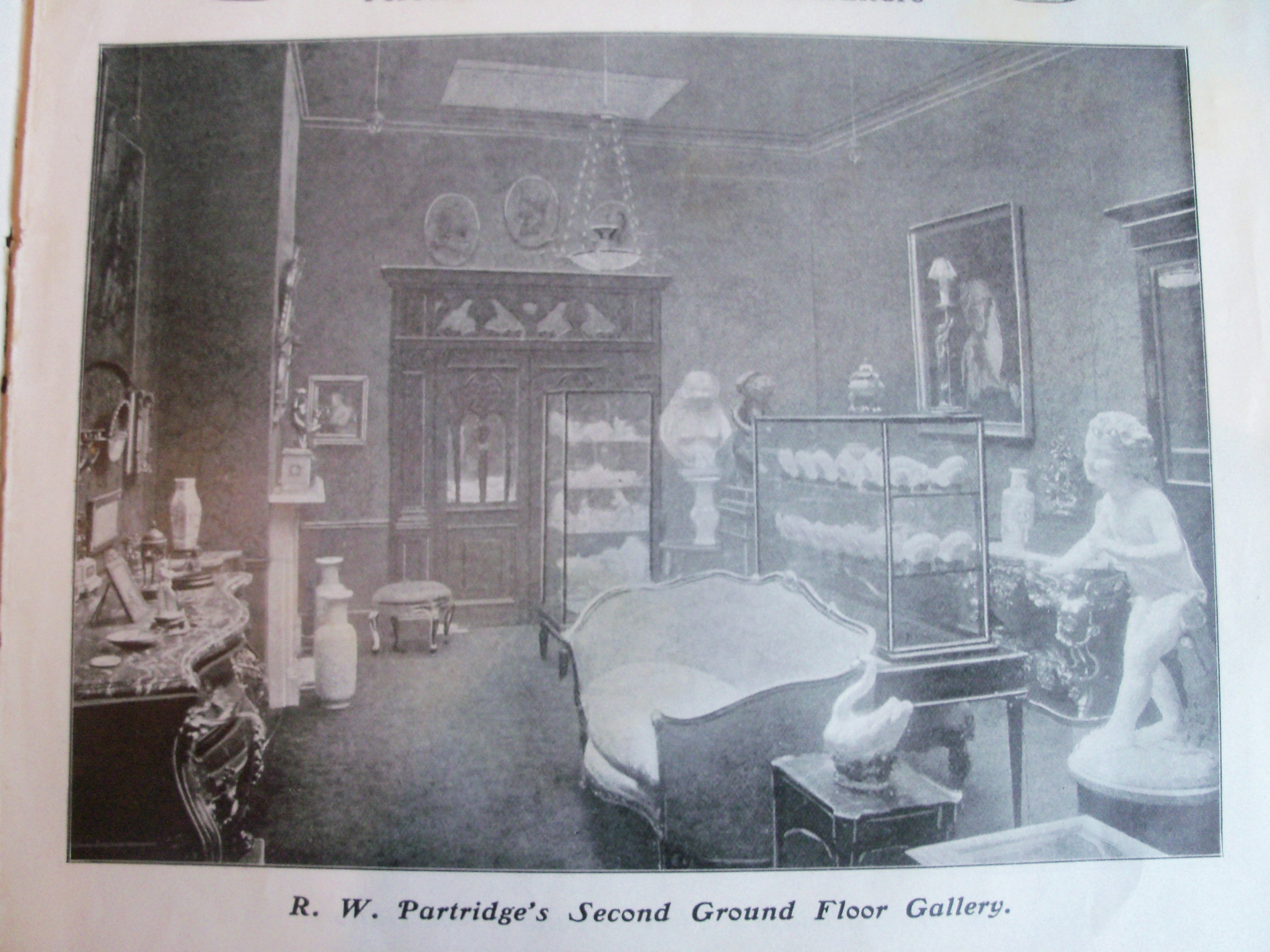
One of the interesting aspects that have emerged in the initial investigation of the catalogues is the presentation of the Partridge business in the early and late 20th century. This follows on from some of the earlier posts on the Antique Dealer project blog (see entries on images of dealer shops) – here, again, is the photograph of the shop of ‘R.W. Partridge’ in 1914 – R.W. Partridge, was Robert Partridge, the elder brother of Frank Partridge, who established his antique business in the 1890s, prior to Frank opening his own shop in King Street, St James’s, in London in 1900.


Partridge second floor gallery

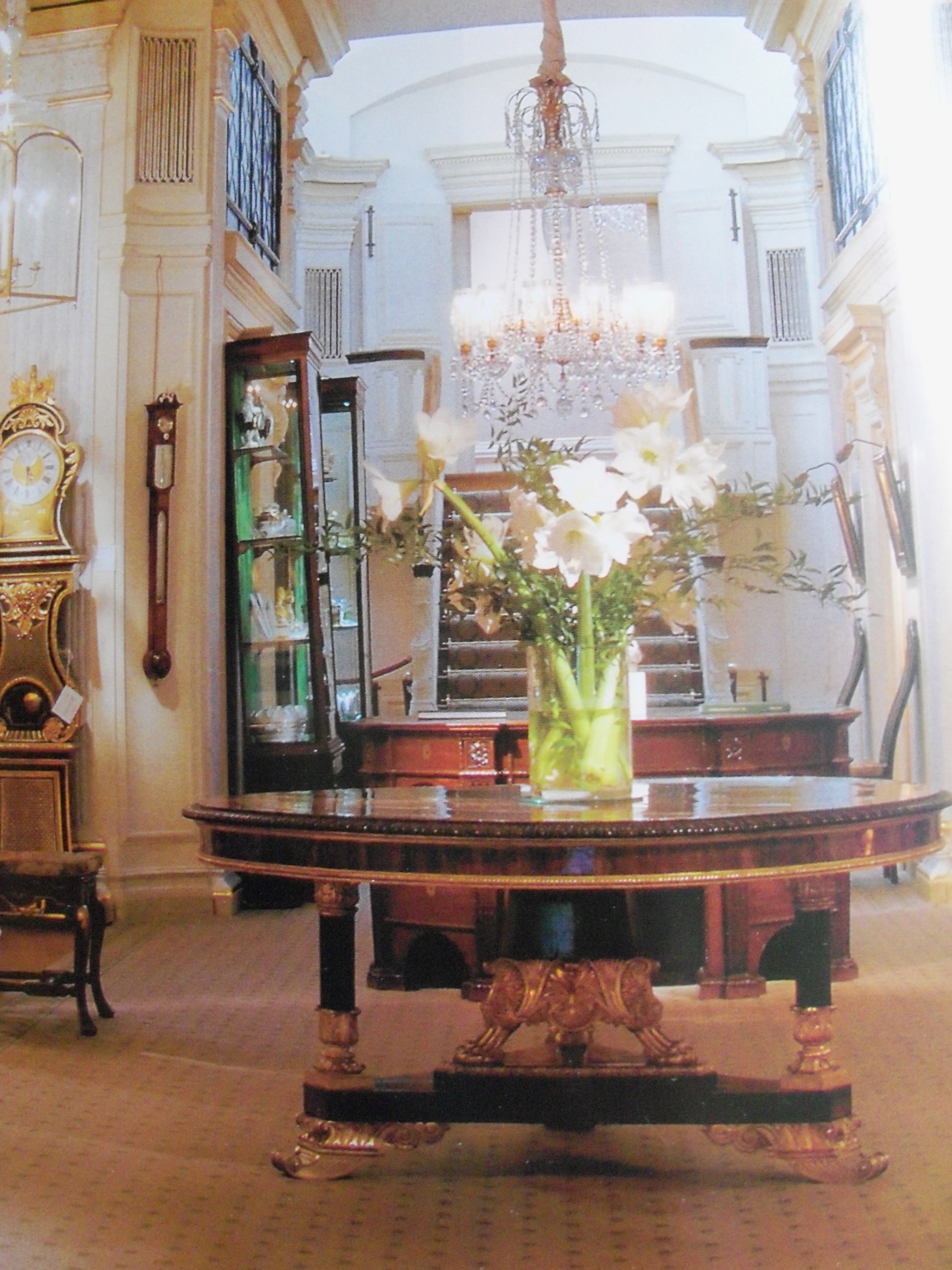
Robert’s shop, in the early 20th century, one can see, is arranged in much the same way as that of the more recent displays at Frank Partridge – here is an image of the antique business of Frank Partridge & Sons (then called Partridge Fine Arts) in c.2007 – perhaps Robert’s is a little more packed with material, but the general arrangement is similar at least…


100_3729100_3728

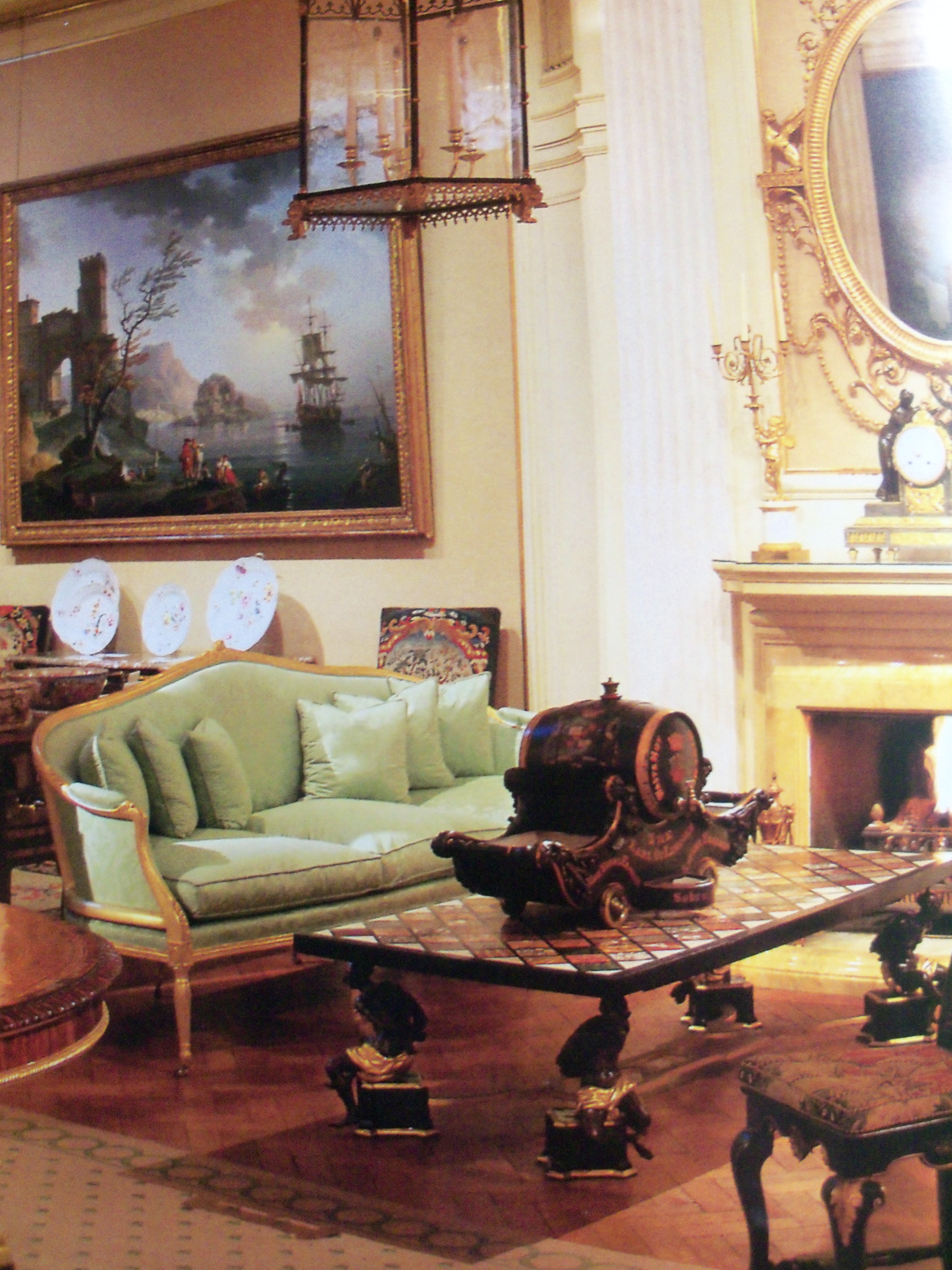
And below that image is a further photograph of Partridge’s galleries in the same brochure of c.2007, this time with a showroom arranged as a room setting. This is a subtle marketing technique, and one wonders when this kind of display was adopted by the antique trade?….perhaps it crossed from house furnishers? Perhaps from museum displays? But either way, there’s a distinctive marketing narrative being set up here….a subtle projected imagining.

There’s much more to say about these arrangements of objects….objects on the syntagmatic plain…the arrangement of objects in real space….they tell a story, and the project will be investigating these dynamics over the next few years…

Mark

Home Subjects

a working group dedicated to the display of art in the private interior, c. 1715-1914

The Period Room: Museum, Material, Experience

An International Conference hosted by The Bowes Museum and The University of Leeds

H. Blairman & Sons Ltd

A research project investigating the history of the antiques trade in Britain in the 19th & 20th centuries

Museum Studies Now?

'Museum Studies Now?' is an event which aims to discuss and debate museum and heritage studies education provision.

The Burlington Magazine Index Blog

art writing * art works * art market

East India Company at Home, 1757-1857

A research project investigating the history of the antiques trade in Britain in the 19th & 20th centuries