Here’s some more behind the scenes ‘gossip’ on the making of the Year of the Dealer films – this time the John Bell of Aberdeen film at The Bowes Museum – you can watch the final version of the film HERE. You can also read a little more about John Bell of Aberdeen in an earlier post on the research blog – ‘Antique Shops Then & Now‘.
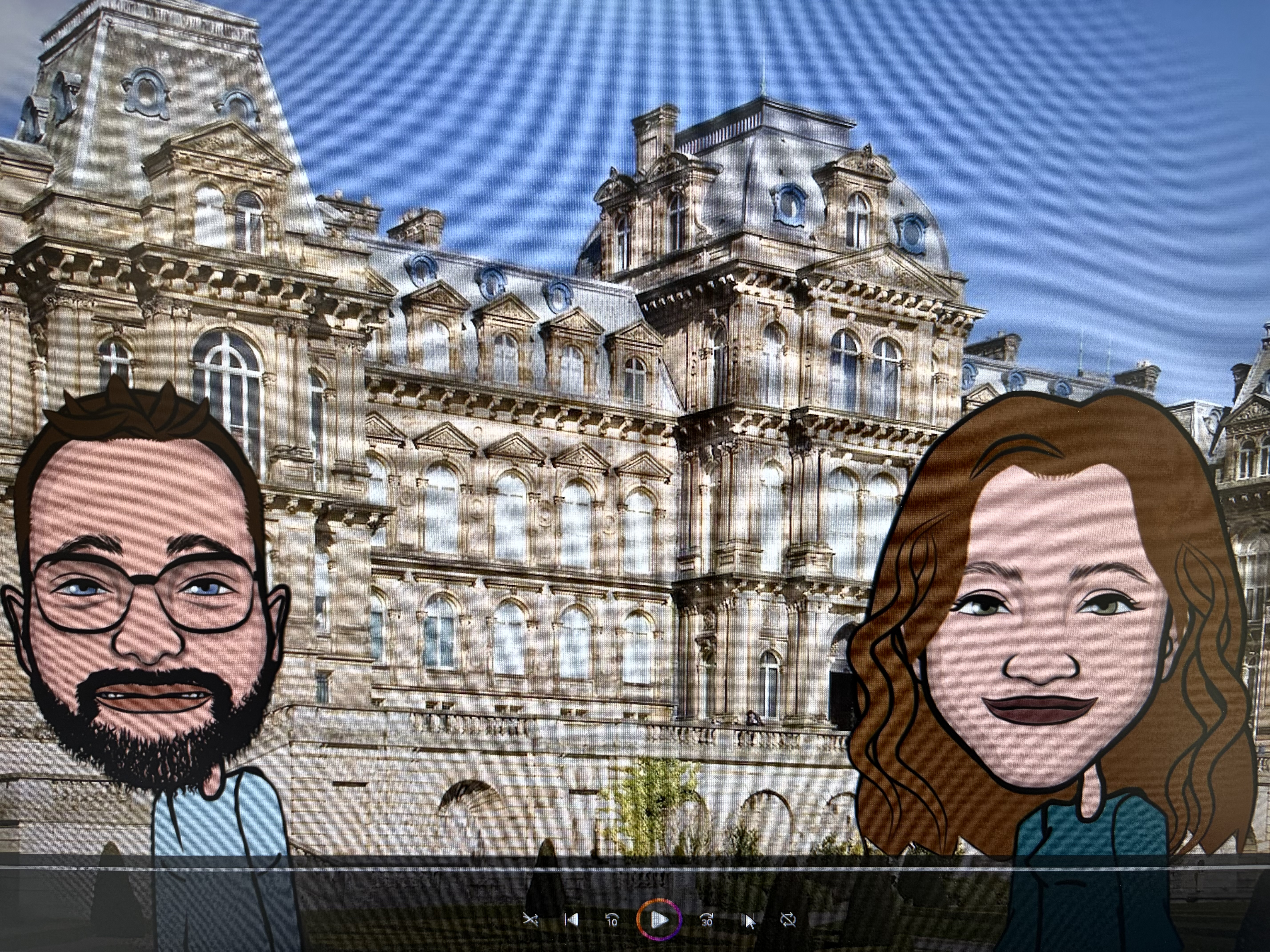
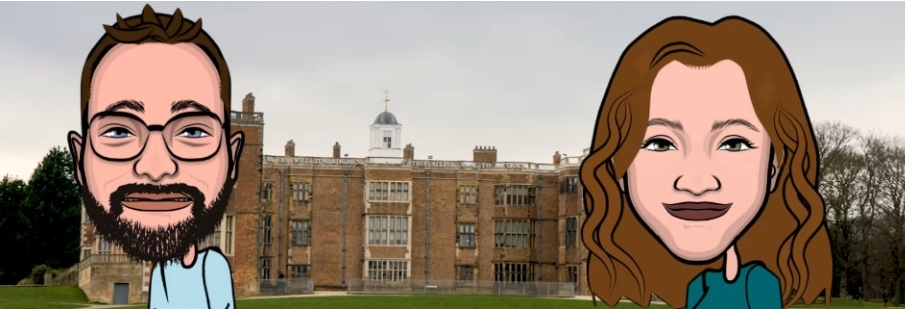
One thing we were still working on in the early drafts for the John Bell film was how the avatars would look and sound – we eventually ended up with two avatars that we thought represented Mark and Mo relatively well in all five sets of films (see below – the final avatars with The Bowes Museum in the background).
Final avatars for the Year of the Dealer films. Image, Antique Dealer Research Project, University of Leeds.
A Big Reveal (for those that do not already know this of course) is that the Mark avatar voice is me of course (Mark); the Mo avatar voice is actually my lovely wife Mo! We had considered hiring other people (or indeed some professional actors) to be the voices of Mark and Mo but the work required was impossible to fit into a defined time period and needed to be spread over many months to accommodate various edits etc., so it was extremely difficult to cost it for an external supplier and very hard to work up a firm schedule.
One extra complication of this was that any edits and new lines of audio (of which there were many) had to be recorded in exactly the same environment and conditions to match in with the existing audio. We could not afford to record the audio in a Sound Studio – we actually recorded the audio at home in my then home office – or ‘bedroom 3’ as it was! This brought up many challenges – we had, for example, some very loud Wood Pigeons in the garden and often had to wait for sound breaks in their cooing before pressing ‘record’ on the audio recorders!
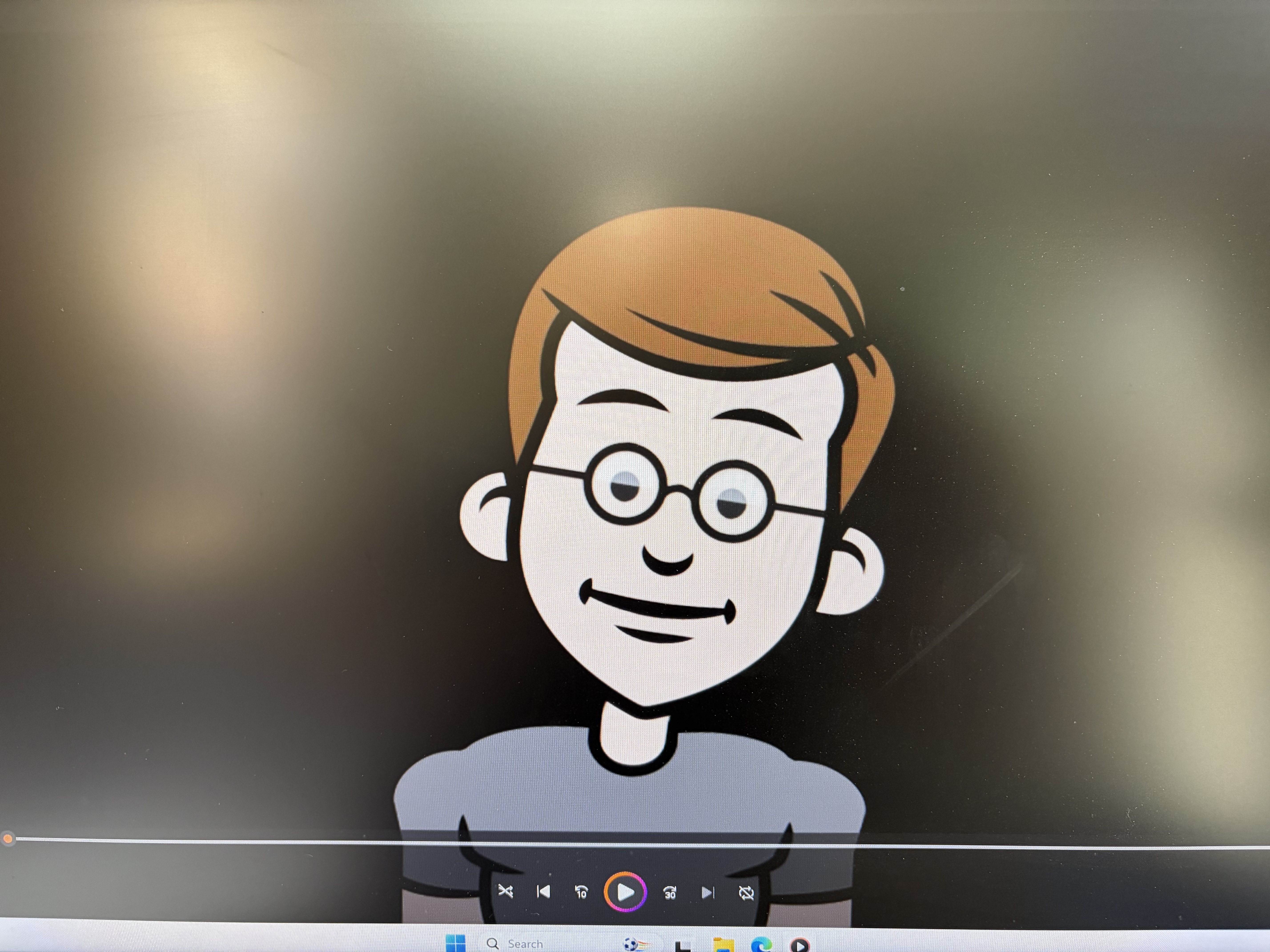
The early drafts of the visual material for the avatars that Patrick Bannon (our brilliant film-maker) worked on were often quite something! Here’s one of the early drafts of the Mark avatar (see below). We thought this looked a bit too cartoon-like (and a bit too young!).
First attempt at Marks’ avatar, Year of the Dealer films. Image, Antique Dealer Research Project, University of Leeds.
And here’s a similar early draft of the Mo avatar (see below) – which we also thought looked a bit too cartoon-like (we were also not sure why Mo’s early avatars were stuck in a forest either!)
First attempt at Mo’s avatar, Year of the Dealer films. Image, Antique Dealer Research Project, University of Leeds.
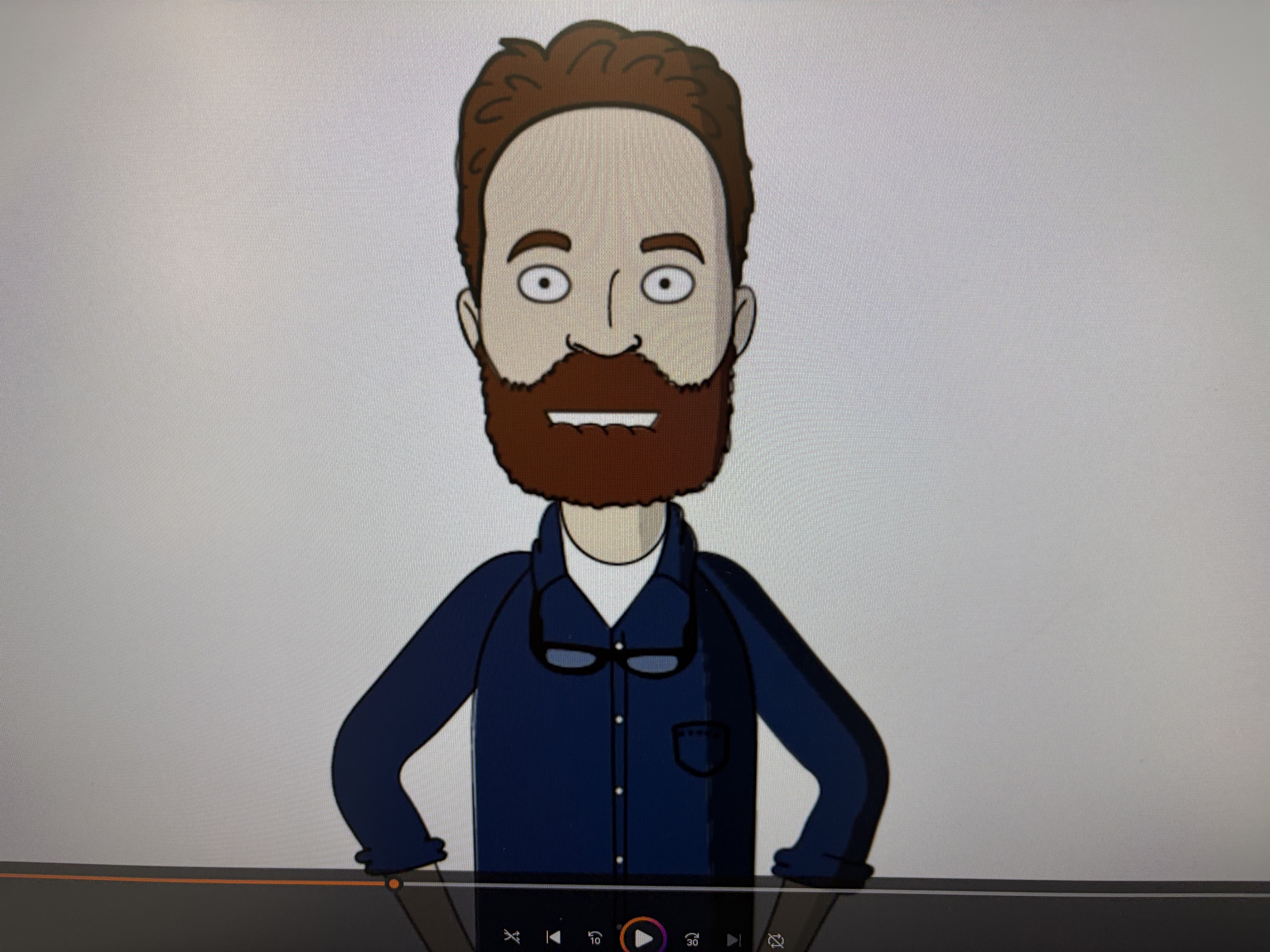
Patrick sent us various other ideas before we eventually settled on the final versions of the avatars – here’s a couple more versions (see below) – this one is getting a bit closer to the finished version of the Mark avatar, but still looked a bit too stern…..and perhaps a bit too much like a ‘psycho-killer’!
Another attempt at Mark’s avatar, Year of the Dealer films. Image, Antique Dealer Research Project, University of Leeds.
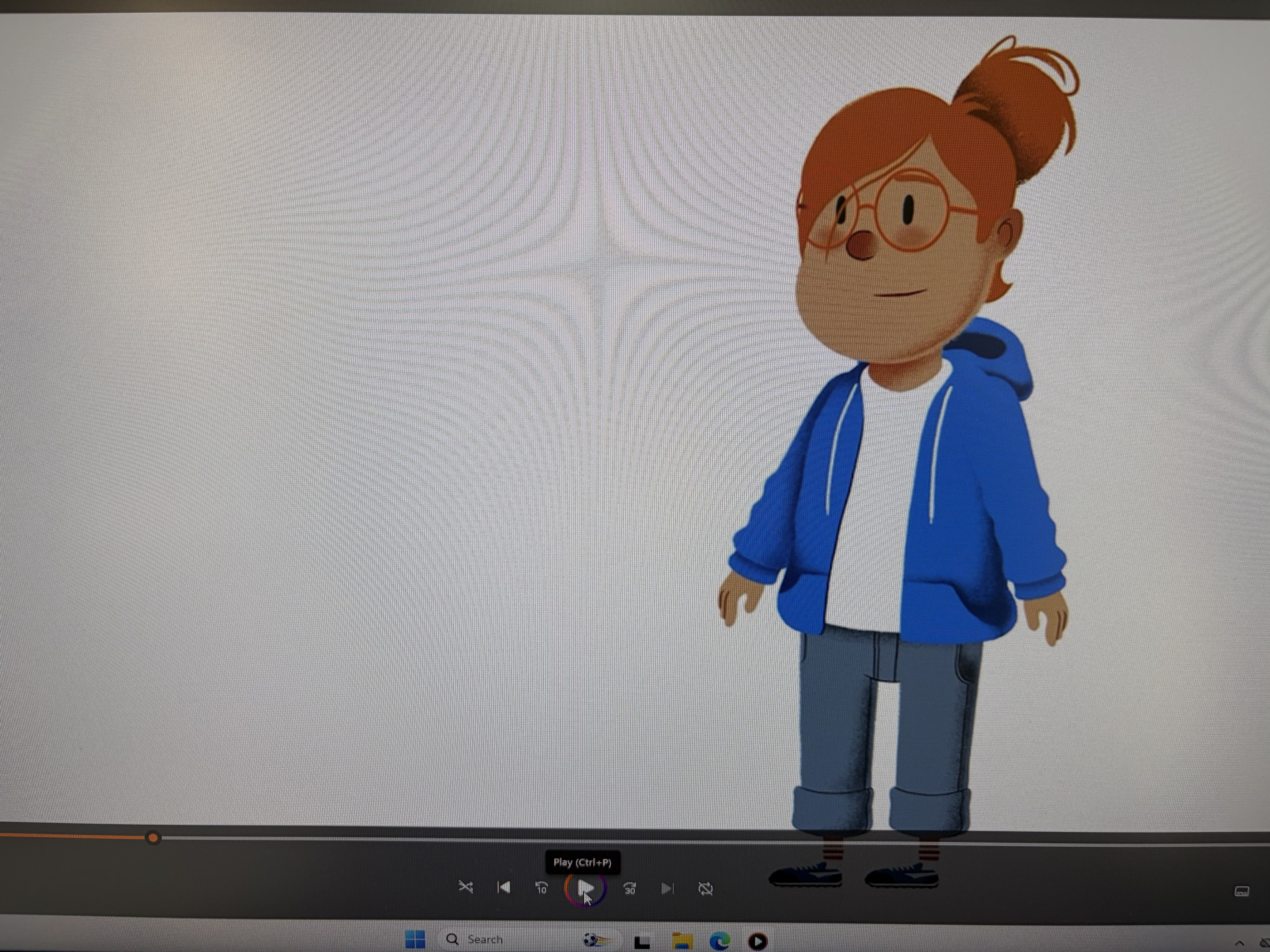
And another early version of the Mo avatar (see below) – which we thought maybe made the Mo avatar look a bit too ‘Gen Z’ .
Another attempt at Mo’s avatar, Year of the Dealer films. Image, Antique Dealer Research Project, University of Leeds.
As you might appreciate there was an awful lot of work in creating and producing the films and a lot of decisions to be made; we would like to thank Patrick again for all his hard work (and patience!) on various drafts, iterations and edits.
Look out for next week’s blog for another ‘Behind the Scenes of the Year of the Dealer’.
Here’s more on our Behind the Scenes of the Year of the Dealer theme with some behind the scenes ‘gossip’ on the making of the digital film trail for S.J. Phillips, the world famous antique silver dealers, at Preston Park Museum, Stockton-on-Tees – here’s the finished film on the YoD website.
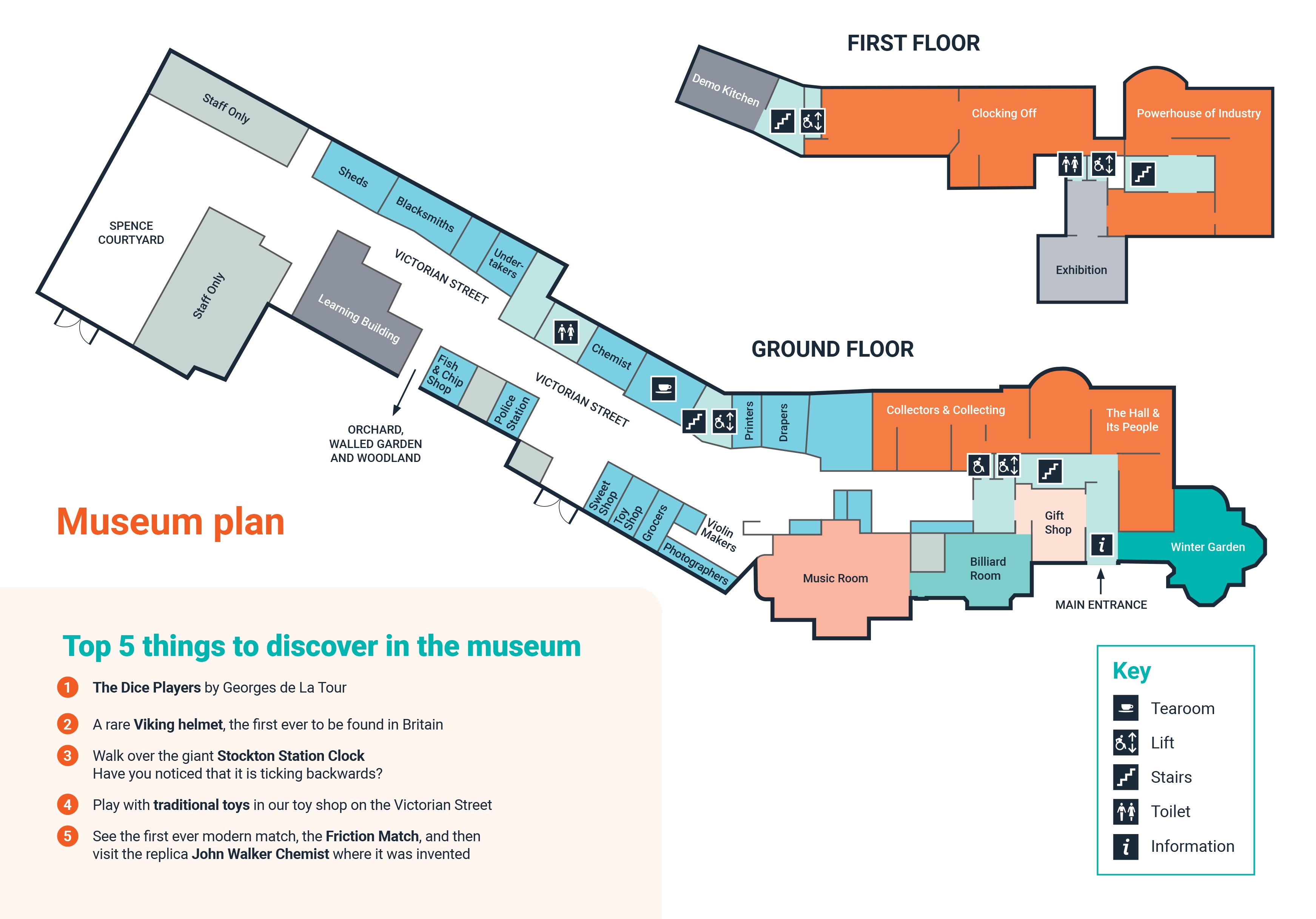
The films we made at Preston Park Museum were amongst the most complicated of all five museum digital film trails. Mainly because the Year of the Dealer project took so long to complete that by the time we launched all the films in June 2026 Preston Park Museum had undergone a major refurbishment of its displays. As a consequence, six of the ten objects we focused on in the films had been moved to museum storage and were no longer on display. This meant that we couldn’t use floorplans to locate the objects for viewers that wished to go to see the objects in real life at the museums (as we did in the other four museums) – you may have noticed that there are no floorplans in the Preston Park Museum digital film trails?
Preston Park Museum floor plan prior to major refurbishment. Image, Preston Park Museum.
As a result of the refurbishment at Preston Park Museum we also decided we should only use the photographs we took of the interior displays at Preston Park prior to refurbishment in a very limited way so as not to confuse the viewers watching the films, (and any subsequent museum visitors).
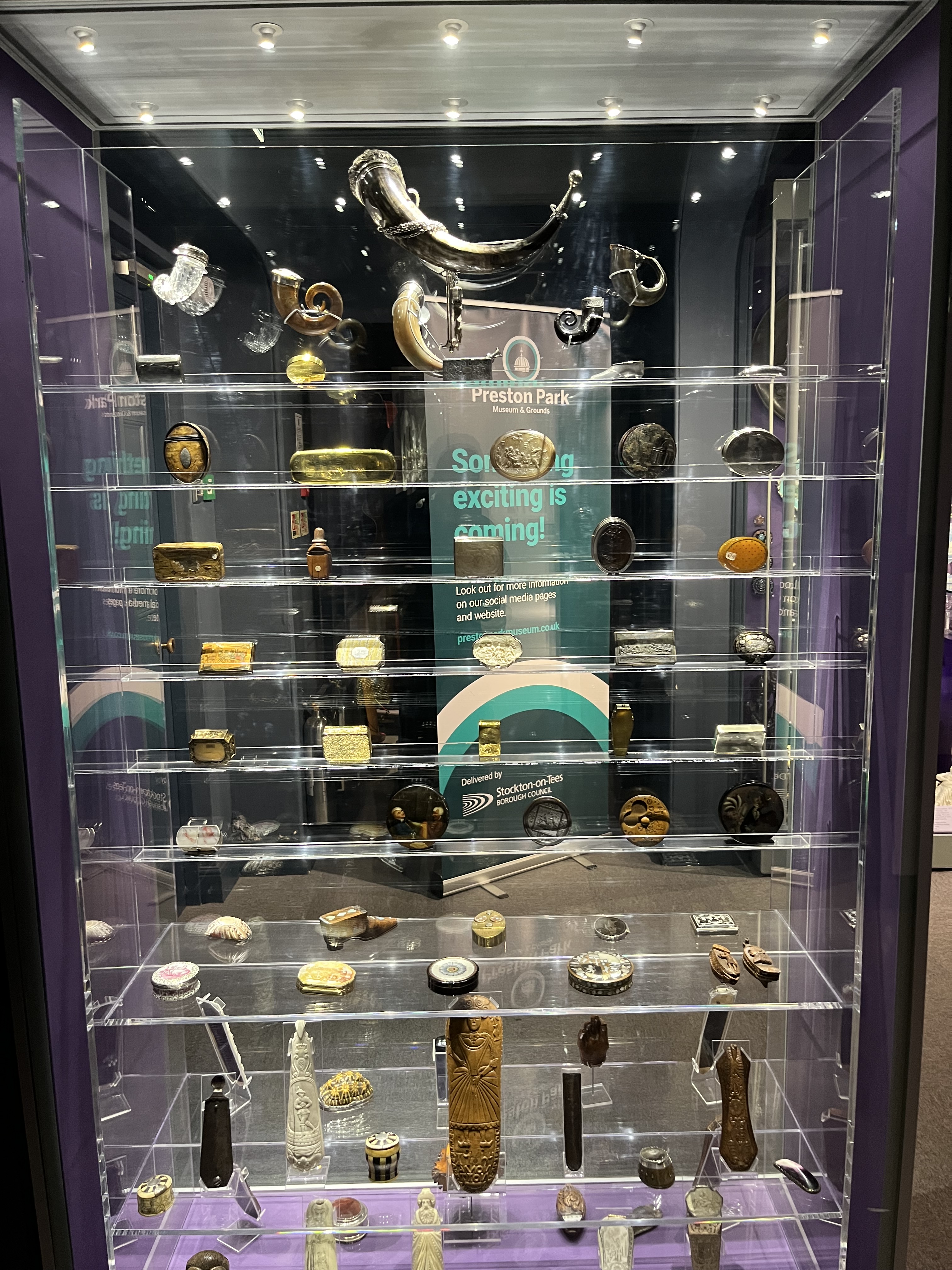
Display at Preston Park Museum, now no longer in the galleries at the museum. Image, Year of the Dealer project and Preston Park Museum 2026
This photograph (above) for example, was initially going to feature prominently in the main introductory film for Preston Park Museum, as well as in the S. J. Phillips and Law, Foulsham & Cole films, but we felt we couldn’t really highlight the image as much as we initially planned, due to the display being remodelled during the Preston Park Museum refurbishment.
The photograph shows the silver powder flask highlighted in the S. J. Phillips film (top middle) as well as the small 18th century snuff box featured in the Law, Foulsham & Cole film at Preston Park Museum (righthand side, 3rd row down, the yellow coloured oval box) – both objects are now in storage at Preston Park Museum along with the majority of the other objects on display in the glass case and we only used close-up versions of the photograph in the S.J. Phillips and Law, Foulsham & Cole films.
This small detail is hardly noticeable in the actual films of course, but it reminded us a lot about how long the project took to complete and how complicated projects can be – but also how important it is to be flexible when working with partners!
Whilst our ‘Behind the Scenes of the Year of the Dealer’ posts are ongoing for the next 12 months we thought the blog also needs to continue to post our research updates on the antique dealer research project. So, this blog post focuses on one of our usual themes of stories and information from the antique dealer archives. This time it’s the famous dealer in antique oak furniture and related objects, S.W. Wolsey (1895-1980).
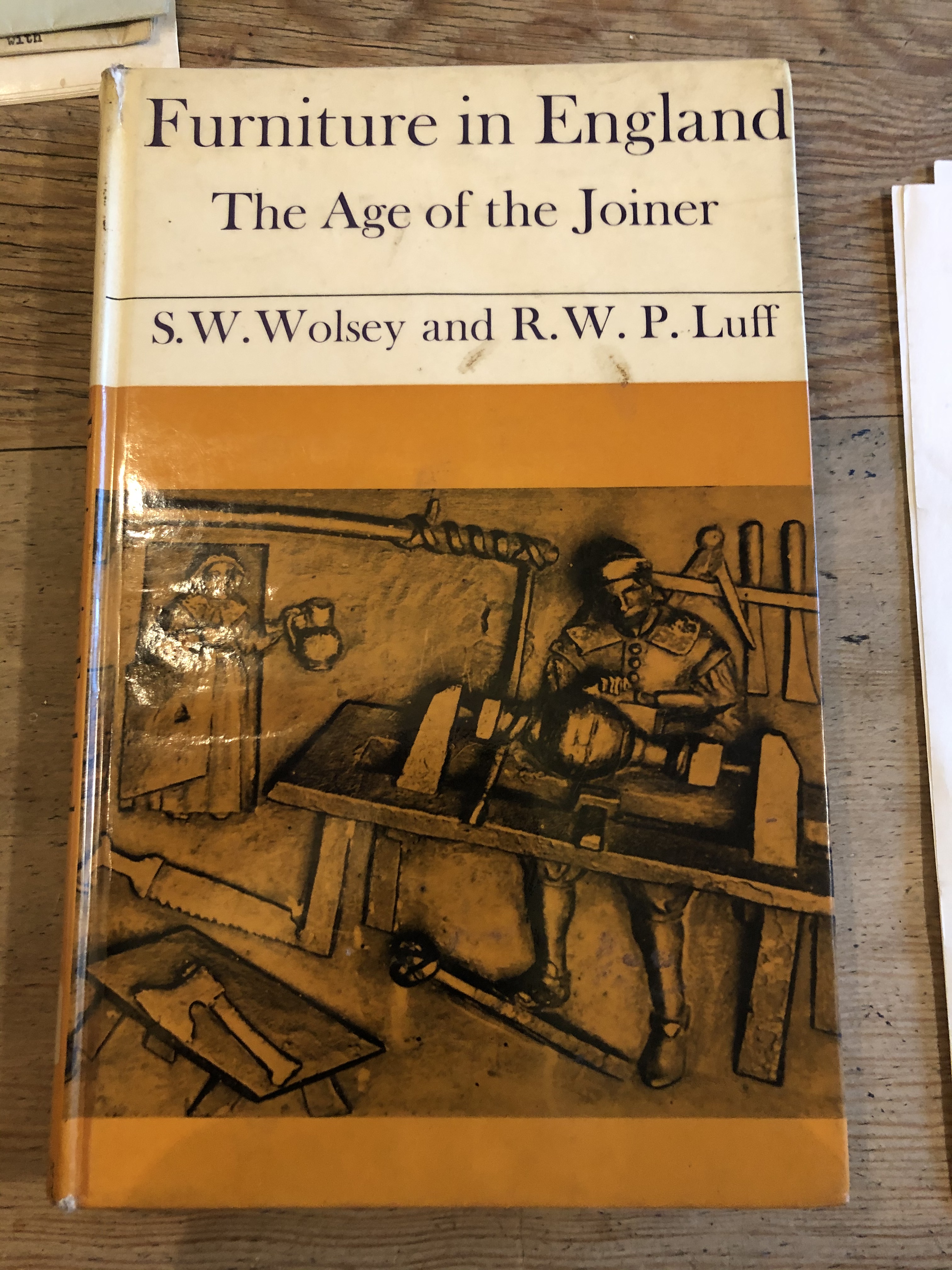
We were recently very fortunate to receive a donation of a large number of albums of photographs (of antique oak furniture and objects) that formed the stock of S.W. Wolsey. The albums were kindly donated to the project by Richard Marshall, who recently administered the Estate of the Luff family – thanks again to Richard! Peter Luff was a great friend of Sam Wolsey – Luff and Wolsey wrote a well-known book, Furniture in England: The Age of the Joiner (Arthur Barker Ltd., London, 1968). Indeed, several photographs in the Wolsey archive photograph albums donated by Richard Marshall were also used in the Furniture in England book.
Furniture in England, The Age of the Joiner – S.W. Wolsey & R.W.P. Luff (1968). Image, Antique Dealer Research Project, University of Leeds.
We have posted on S.W. Wolsey on the research blog before (see blog post S.W. Wolsey and Peter Luff 31st December 2020), but just to remind readers, Samuel Wilfred Wolsey was one of the leading dealers in antique oak furniture in the middle decades of the 20th century; the photograph albums contain images of some of the most important oak furniture that passed through the firm of S.W. Wolsey, many of which are now in prominent public museums.
There are scores of objects to highlight in the photograph albums but one example stands out as particularly interesting – especially as it has a long history going back to the start of the ‘modern’ antique trade in the opening decades of the 19th century (see my book The Emergence of the Antique and Curiosity Dealer 1815-1850: the commodification of historical objects (Routledge, 2020), pp.61-72, if you are interested to read more about this.
The object in question is the ‘Lovely Hall’ bed – a 16th century four-post bed that was first illustrated in Samuel Rush Meyrick and Henry Shaw, Specimens of Ancient Furniture (1836) – (see below).
S.W. Wolsey advertisement for the sale of the ‘Lovely Hall’ bed, June 1961. Photograph, Antique Dealer Research Project, University of Leeds.
In Specimens of Ancient Furniture (1836) the bed was described by Samuel Rush Meyrick as ‘Bedsted of the Time of Henry the Eight, in the possession of the Rev. Wm. Allen, Lovely Hall, near Blackburn.’ Meyrick’s description continues – ‘This interesting example, which unfortunately has lost its true cornice, no doubt highly enriched, was observed by Mr. Allen in the course of his professional duties, in administering to a dying parishioner the last consolations of religion, and purchased by him after the decease of the sick person from his heir.’ (Specimens, (1836), p.39).
Lovely Hall, Salesbury, near to Blackburn in Lancashire, dates from c.1600 and was owned by the Starkie family from the 1750s until the 1960s, so perhaps Rev. Allen rented the hall from the Starkie family. The bed was transferred to Holme Cliviger Hall, near Burnley, also in Lancashire, sometime after the 1830s, becoming property of the Whittaker family who owned Holme Hall.
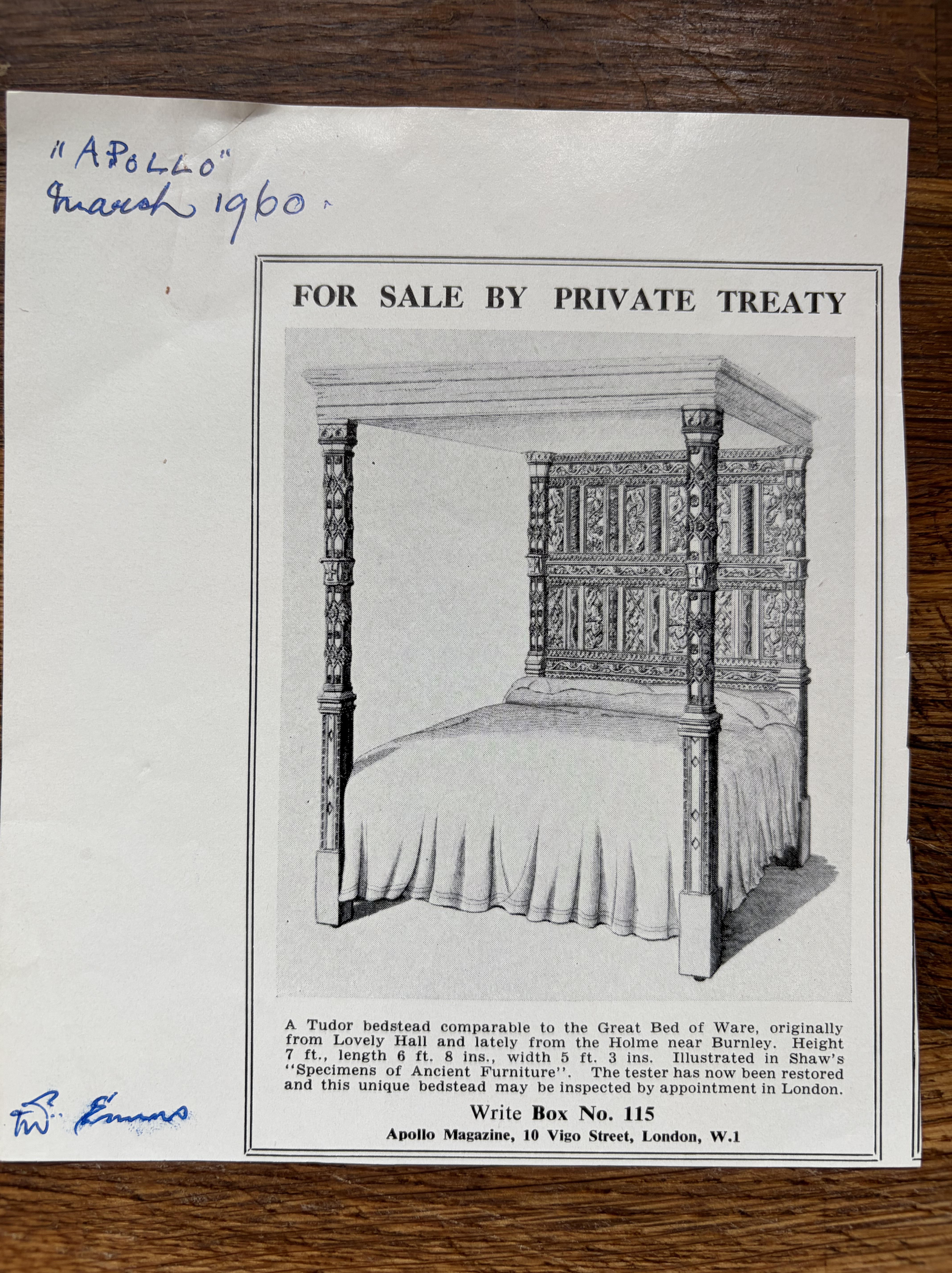
Despite the bed being illustrated in Specimens in 1836 it seems to have been unrecorded again until it appeared on the market in 1960, when it was acquired by S.W. Wolsey. According to some notes by S.W. Wolsey associated with the S.W. Wolsey photograph albums, Wolsey acquired the bed from direct decedents of the Whittaker family. This may be true, but the Whittaker’s sold Holme Hall in 1950 and Wolsey bought the bed from a private collector then living in Putney in South West London (who was not called Whittaker, but may indeed have been a member of the family). The collector had advertised the bed ‘For Sale’ in Apollo magazine in March 1960 (see below) mentioning that the bed was ‘lately from the Holme near Burnley’.
Advert for the sale of the bed, Apollo, March 1960. Image, Antique Dealers Research Project, University of Leeds.
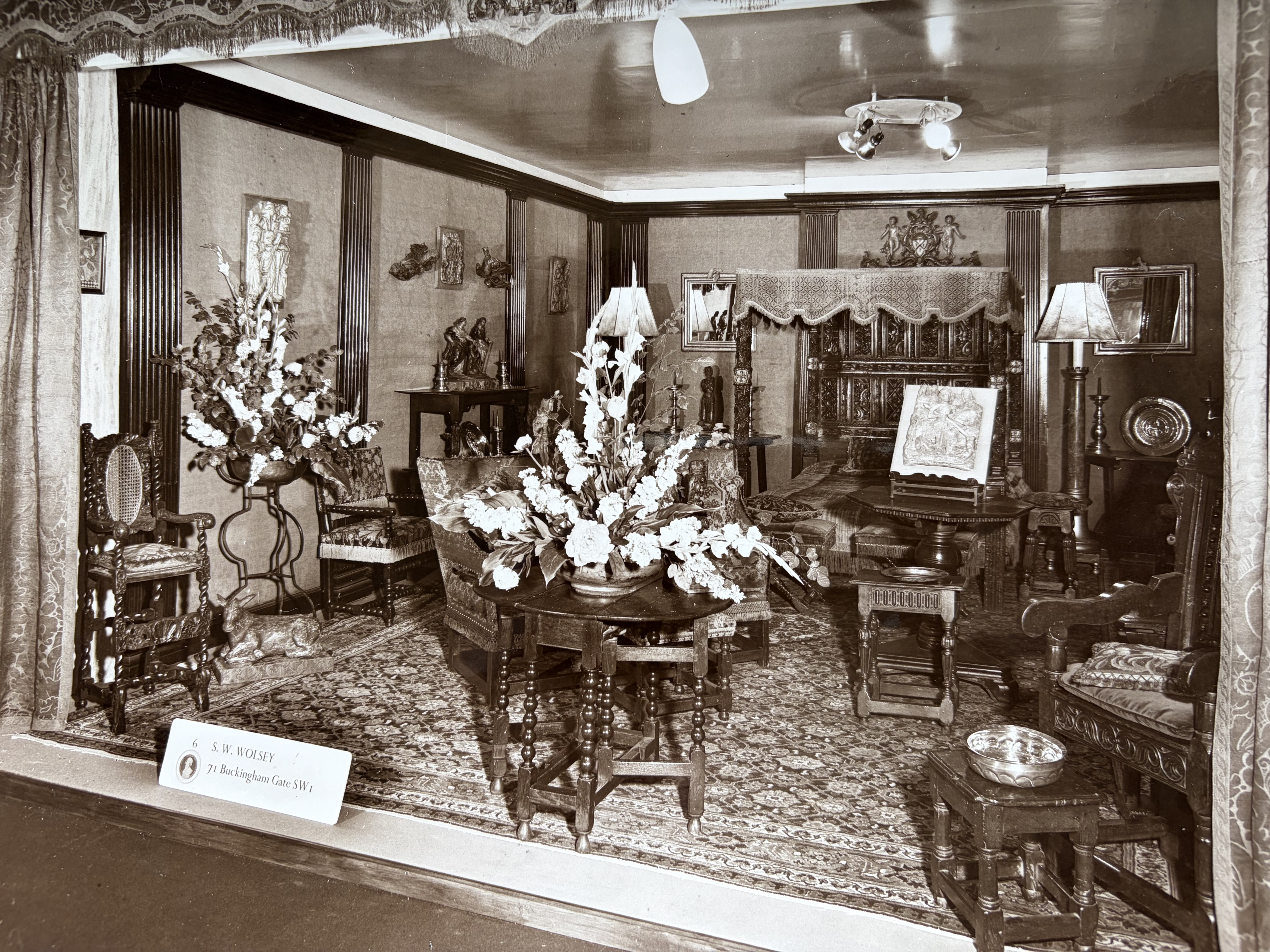
Wolsey displayed his important purchase as a key centrepiece on his stand at the Grosvenor House Antique Dealers Fair in London in June 1961 (see below).
S.W. Wolsey stand at the Grosvenor House Antiques Fair 1961. S.W. Wolsey photograph albums.S.W. Wolsey stand at the Grosvenor House Antiques Fair 1961. S.W. Wolsey photograph albums.
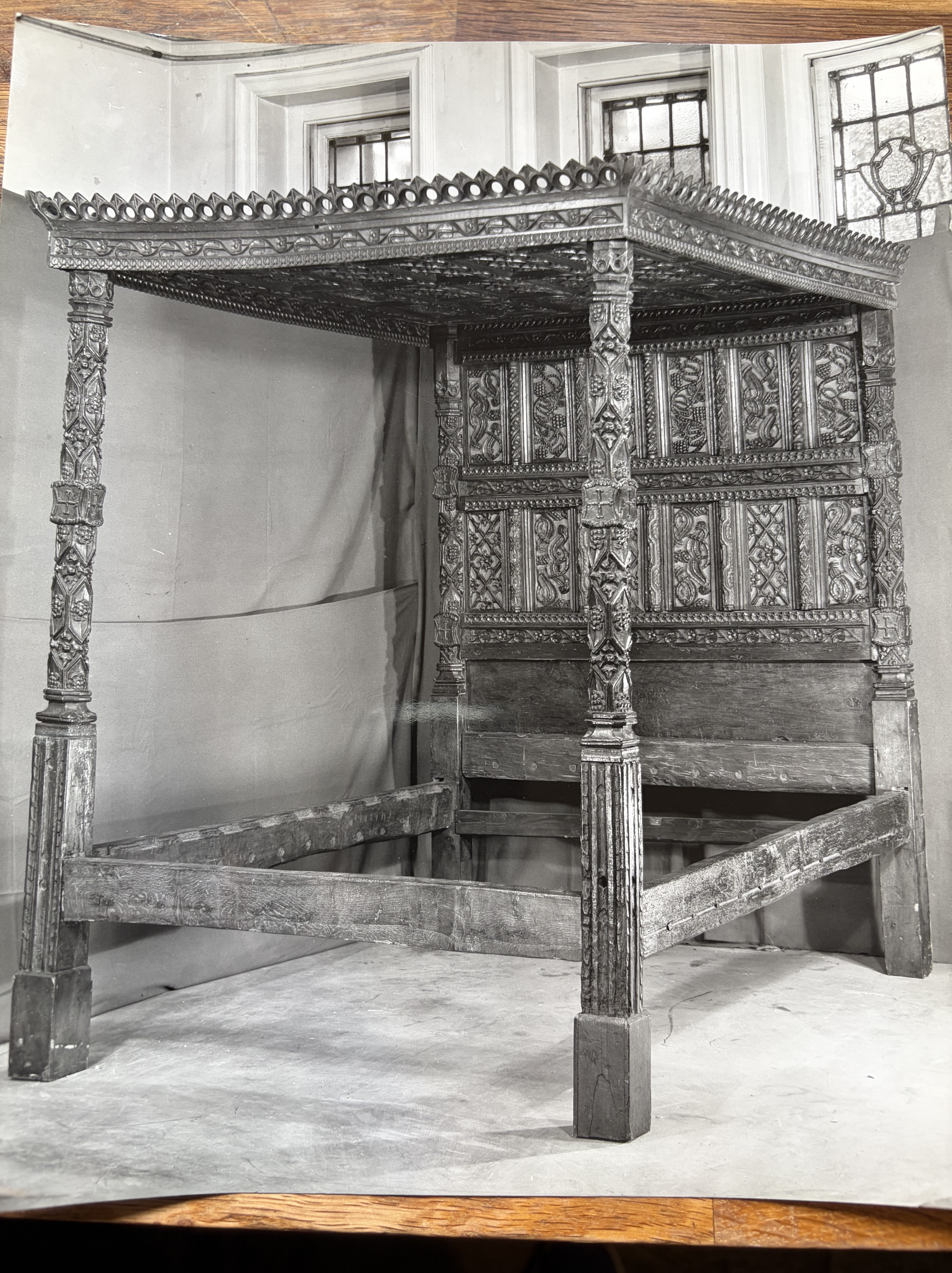
The S.W. Wolsey photograph albums also have several photographs of the bed and details of the frame and carvings, including a photograph of the bed fully assembled in Wolsey’s shop in Buckingham Gate, London (see below).
The bed fully assembled in S.W. Wolsey shop at Buckingham Gate, London. S.W. Wolsey photograph albums.
Henry Shaw’s illustration of the bed in Specimens (1836) shows it with a plain cornice. As mentioned, Meyrick’s commentary on the bed highlighted that it had ‘lost its true cornice’ by the 1830s. This was something that S.W. Wolsey also speculated upon in his notes associated with the photograph albums – writing ‘It appears that, following the publication of the Shaw book in 1836, an elaborate and expensive ‘Gothic’ canopy was made for the bed no doubt under the influence of a book by A. Welby Pugin…’ (perhaps Wolsey meant Gothic Furniture in the style of the 15th century designed and etched by A.N.W. Pugin (London, 1835).
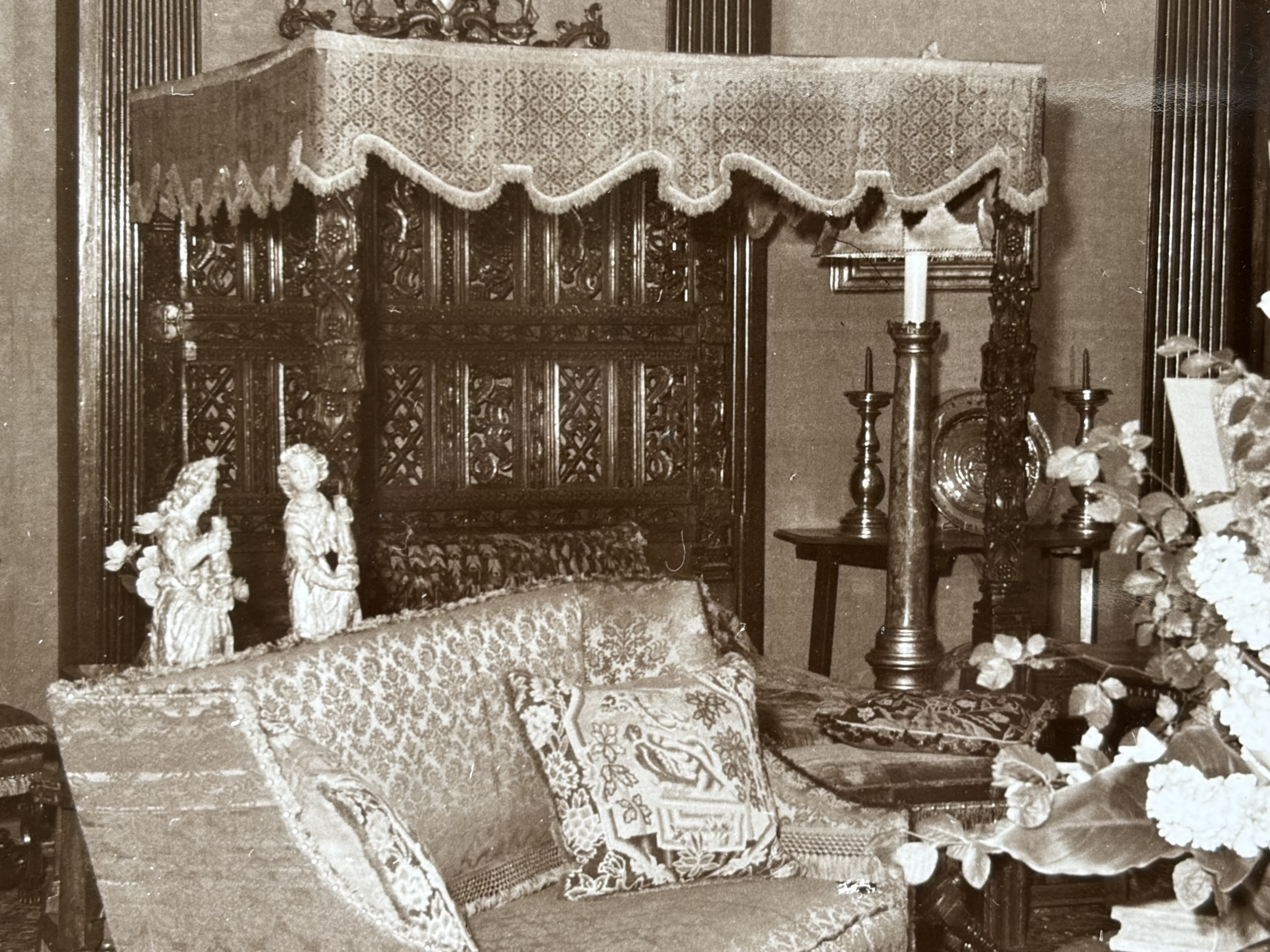
The advertisement of the bed for sale states ‘the tester [canopy/cornice] has now been restored’ but does not indicate how old the restoration might be; it’s probable that the tester was replaced in the 19th century as Wolsey suggests. The Wolsey photographs include some wonderful detailed images of the tester (see below), which as we know is a 19th century copy in the 16th century style; and the headboard (see below) which dates from the 16th century.
Bed tester (canopy) (19th century). S.W. Wolsey photograph albums.Bed head (16th century). S.W. Wolsey photograph albums.
It’s interesting that in Wolsey’s display of the bed at the Grosvenor House Antiques Fair (1961), he chose to cover the canopy with a textile hanging – perhaps a compromise to appease the Grosvenor House Antiques Fair vetting committee?
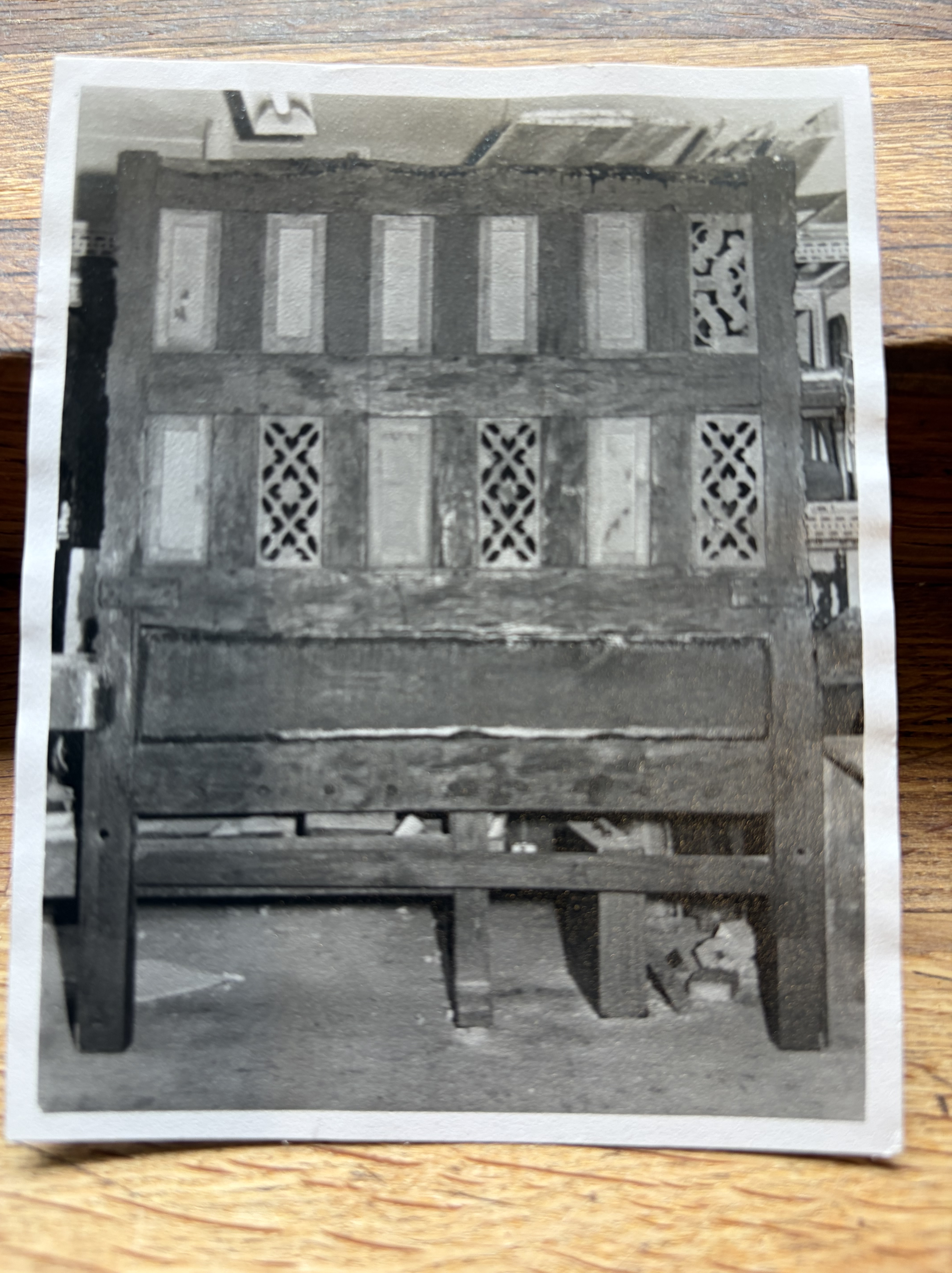
The photographs associated with the bed in the Wolsey photograph albums also include some absolutely fascinating images of the rear of the headboard (see below), which seem to have been taken in a storeroom (perhaps at Wolsey’s shop?). They seem to show various old repairs to the headboard – just as one might expect given that the bed is over 400 years old.
Back of the headboard for the bed. Photograph from the S.W. Wolsey photograph albums.
These important photograph albums will be making their way to the Brotherton Library at the University of Leeds in due course. But the key question (for me at least) is where this very famous bed is today? If anyone knows, do send me a note!
Here’s more behind the scenes ‘gossip’ on the Year of the Dealer films – this time the Charles Duveen (C. J. Charles) film at Lady Lever Art Gallery – you can see the film here
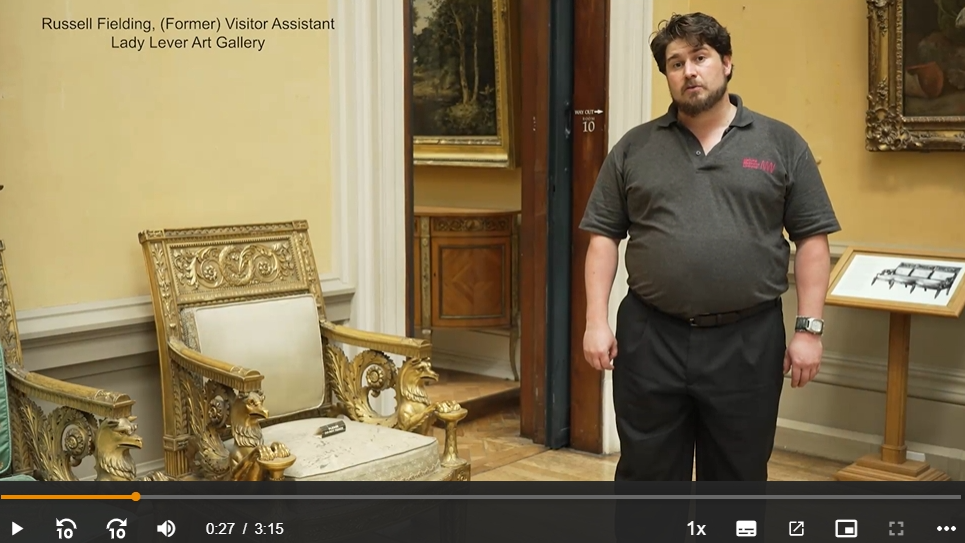
We were fortunate in this film that Russell Fielding, one of the visitor assistants at Lady Lever Art Gallery who introduced the suite of antique Italian furniture, was also an enthusiastic amateur actor – his enunciation in his introduction to the suite is fantastic! Russell sadly is no longer working at Lady Lever Art Gallery – perhaps he is treading the boards somewhere?
Screenshot from The Year of the Dealer film at Lady Lever Art Gallery with Russell Fielding. Year of the Dealer project, University of Leeds.
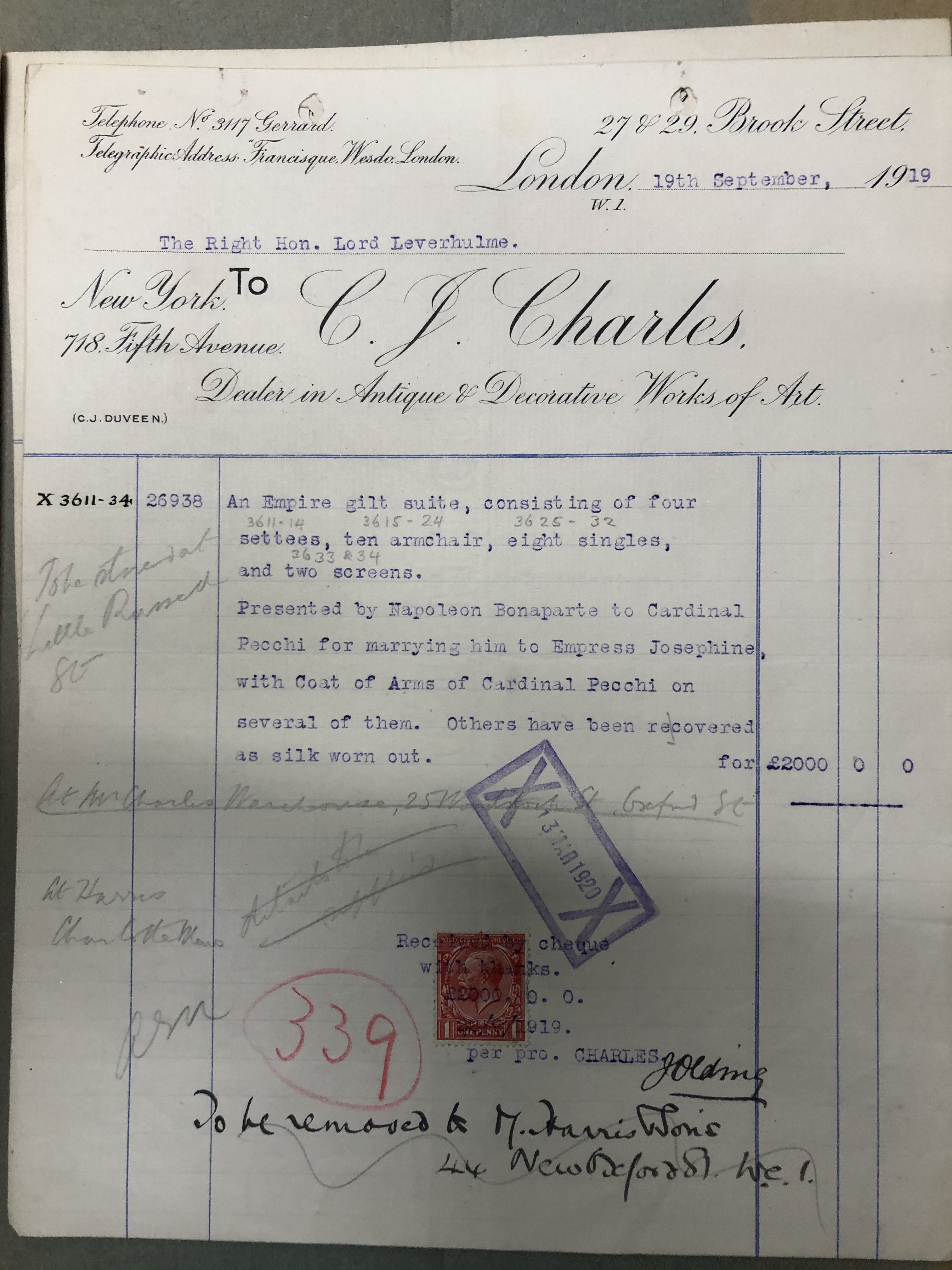
There were numerous edits to the script for the Charles Duveen film at Lady Lever Art Gallery – we had to cut some sections to keep to our sub-4 minute rule. So a section (lasting about 35 seconds) telling the story about the early history of the Duveen dynasty of antique dealers (the family is of Dutch Jewish extraction, but started out in Britain in Hull of the east coast of England in the 1840s) was cut. As was a short section (about 40 seconds) on the significance of the close relationships between collectors and networks of antique dealers – this was illustrated in the image of C. J. Charles’ invoice for the suite of Italian furniture (see below – the image of the invoice was actually included in the film).
Invoice from C.J. Charles for suite of Italian furniture to Lord Leverhulme, 19th Sept 1919. Courtesy of Lady Lever Art Gallery archives.
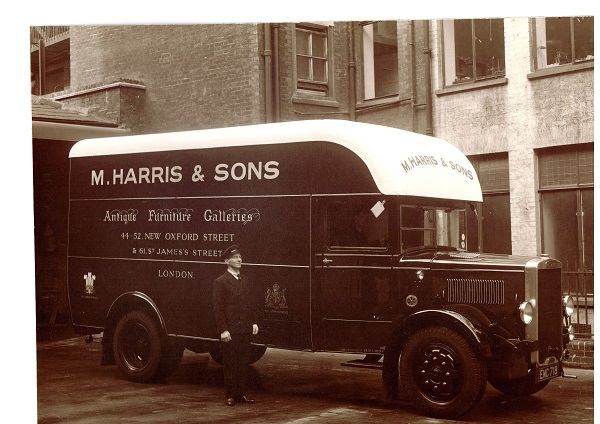
The handwritten notes on the invoice illustrate the tightly grouped network of London antique dealers that Lord Leverhulme used as key suppliers for his antique collecting activities. Moss Harris & Sons were one of Leverhulme’s most trusted antique dealers and Leverhulme regularly acquired antiques from Moss Harris’ Oxford Street shop. One of the the handwritten pencil notes on the invoice indicate that the suite acquired from C. Charles was located at ‘Mr. Charles’ warehouse, 25 Woodstock Street, Oxford Street‘ (which was just off Oxford Street and New Bond Street near to Charles’ shop in Brook Street). Another note (in pen) states ‘To be removed to M. Harris & Sons 44 New Oxford Street WC1‘. A shipment by Moss Harris’s van (see below) would be the most efficient way of getting antiques from various London antique dealers to Leverhulme’s various houses.
M. Harris & Sons delivery van, c.1935. Photograph courtesy of John Hill.
Unfortunately, we could not fit either of these fascinating details into the script and audio for the C. Charles film at Lady Lever Art Gallery, but we did get this lovely image of M. Harris van in one of the films focused on M. Harris & Sons at Lady Lever Art Gallery though!
See next week for more Behind the Scenes of the Year of the Dealer
Here’s some more behind the scenes ‘gossip’ from The Year of the Dealer – this one is on the making of the digital film trail at Temple Newsam for H. Blairman & Sons sale of the famous library desk made in c.1770 by Thomas Chippendale for Harewood House – here’s the finished film on the YoD website
This was quite a complicated film to make as we had to go to London to create a filmed interview with Martin Levy (current owner/director of H. Blairman & Sons) for the Temple Newsam film; we also used extracts from the interview with Martin in the other H. Blairman & Sons films for Bowes Museum and V&A.
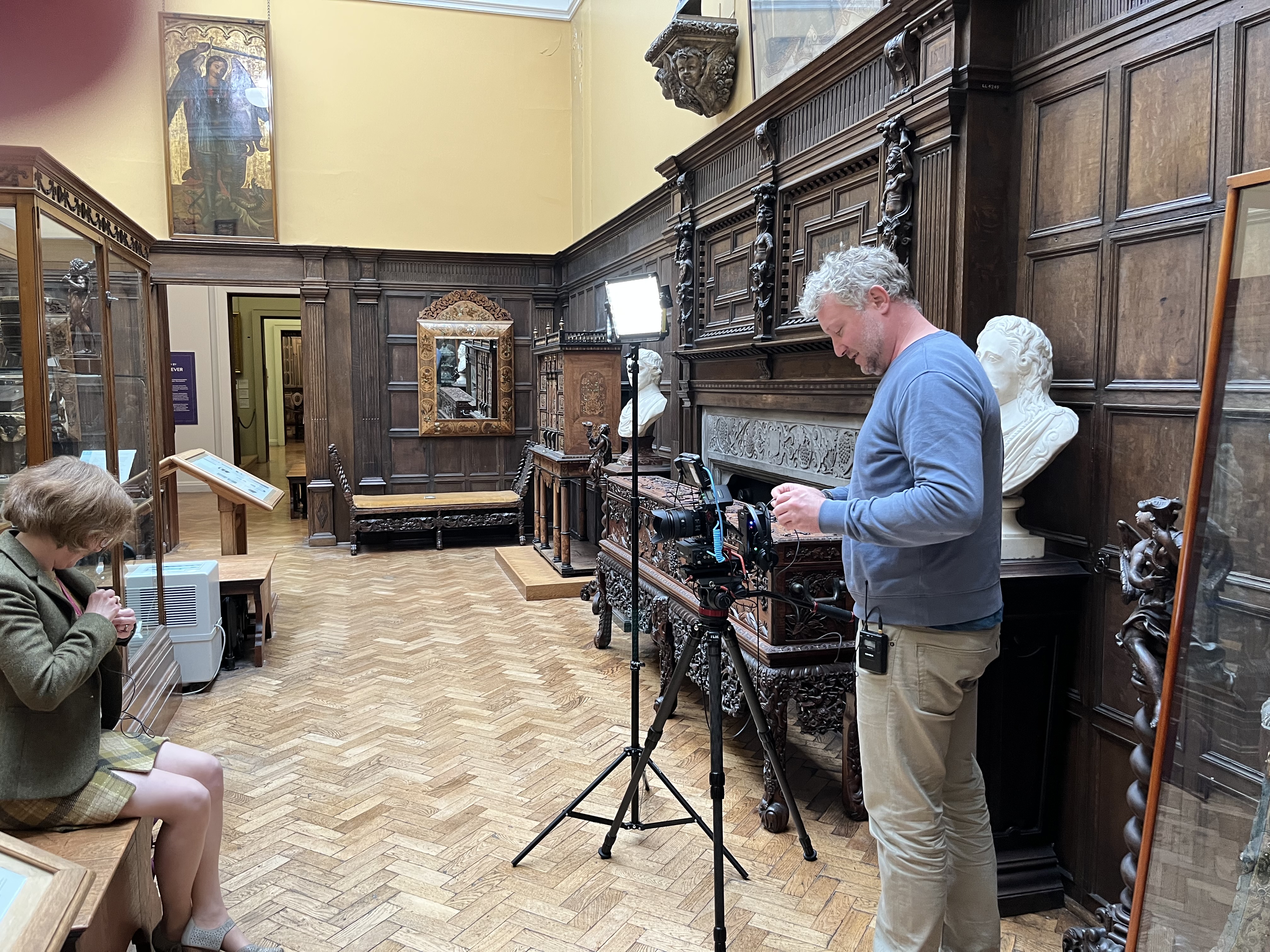
We spent quite a lot of time at Temple Newsam working with the amazing front of house team and Adam Toole, curator, Temple Newsam and Decorative Art, making the introductory pieces to camera and photographing the desk etc. It was a lot of work, but we had a lot of fun too.
Viewers may notice when you watch all the films there is a repetitive rhythm to the piece to camera that introduces each of the museum objects – we wanted ‘antique’ and ‘antique dealer’ to be constant phrases in all the introductory pieces in all the films to emphasize these key ideas throughout the project. But this ‘script’ was often surprisingly easy to trip up on – here’s Adrian Thompson, one of the visitor assistants at Temple Newsam, trying to nail his introduction to the Harewood House library desk – Adrian very generously agreed to let us all see one of his (multiple) attempts!…many thanks to Adrian for allowing us to show this.
Adrian Thompson, Visitor Assistant at Temple Newsam, introduces the Harewood House library desk.
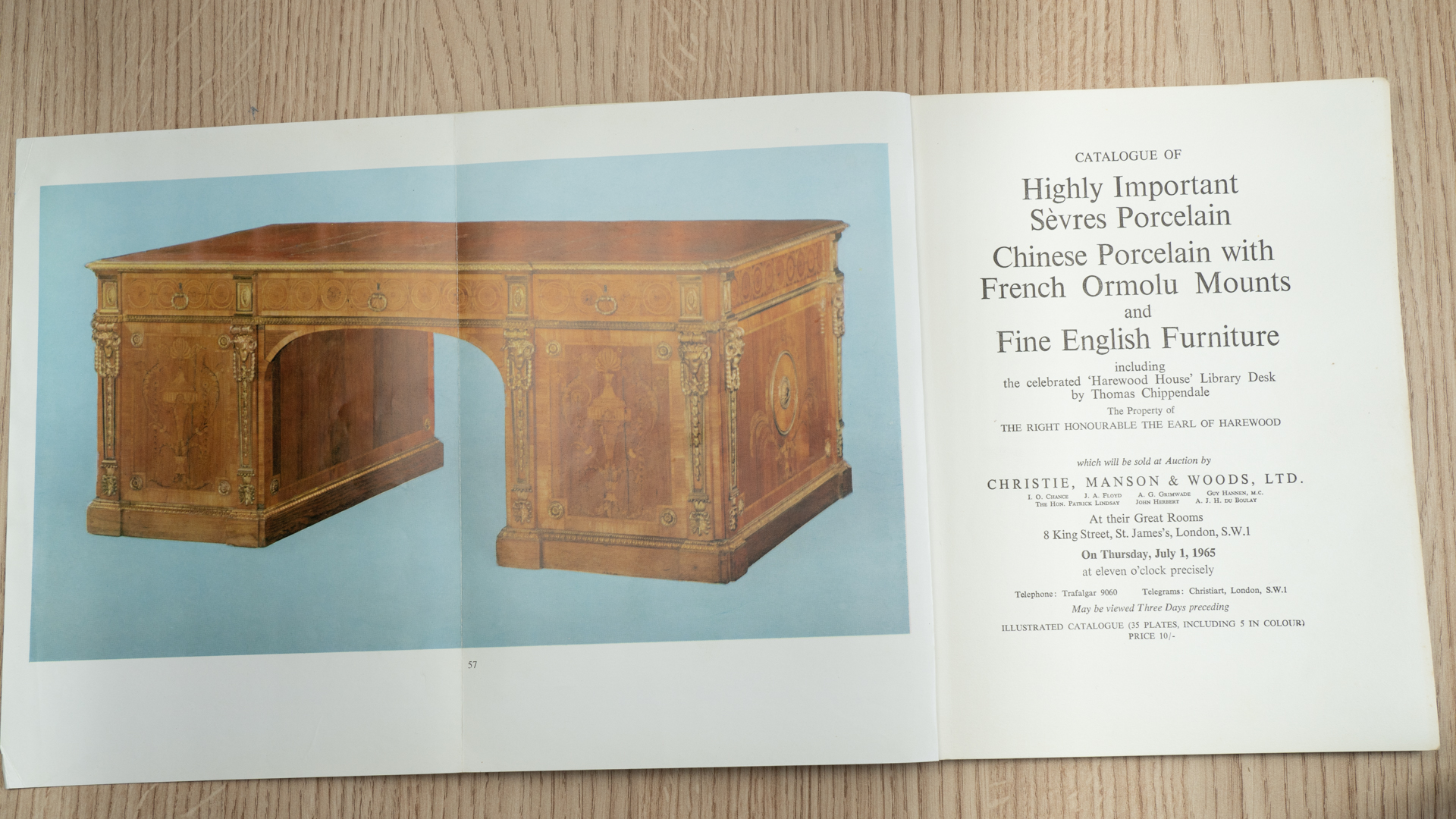
Like in many of the other films, there were numerous images/photographs that we could have used in creating the films but we could not really find the space in the time limits we had placed on the length of the films. In the Temple Newsam H. Blairman & Sons film we had photographs of the various reports on the sale of the desk in national and local newspapers (the sale of the desk featured in reports in The Guardian (Sept 1965) and thee Yorkshire Post (Nov 1965) and several others), but could not find space for the images. We also thought about including a few images of the Christie’s auction catalogue (1st July 1965) – (see below) but could not find space for this in the film without the images appearing and disappearing too rapidly. The catalogue is interesting though, as it highlights the importance of the desk – it had a colour photo fold out of the desk as the frontispiece.
Christie’s auction catalogue, 1st July 1965. Image, Antique Dealers Research Project, University of Leeds.
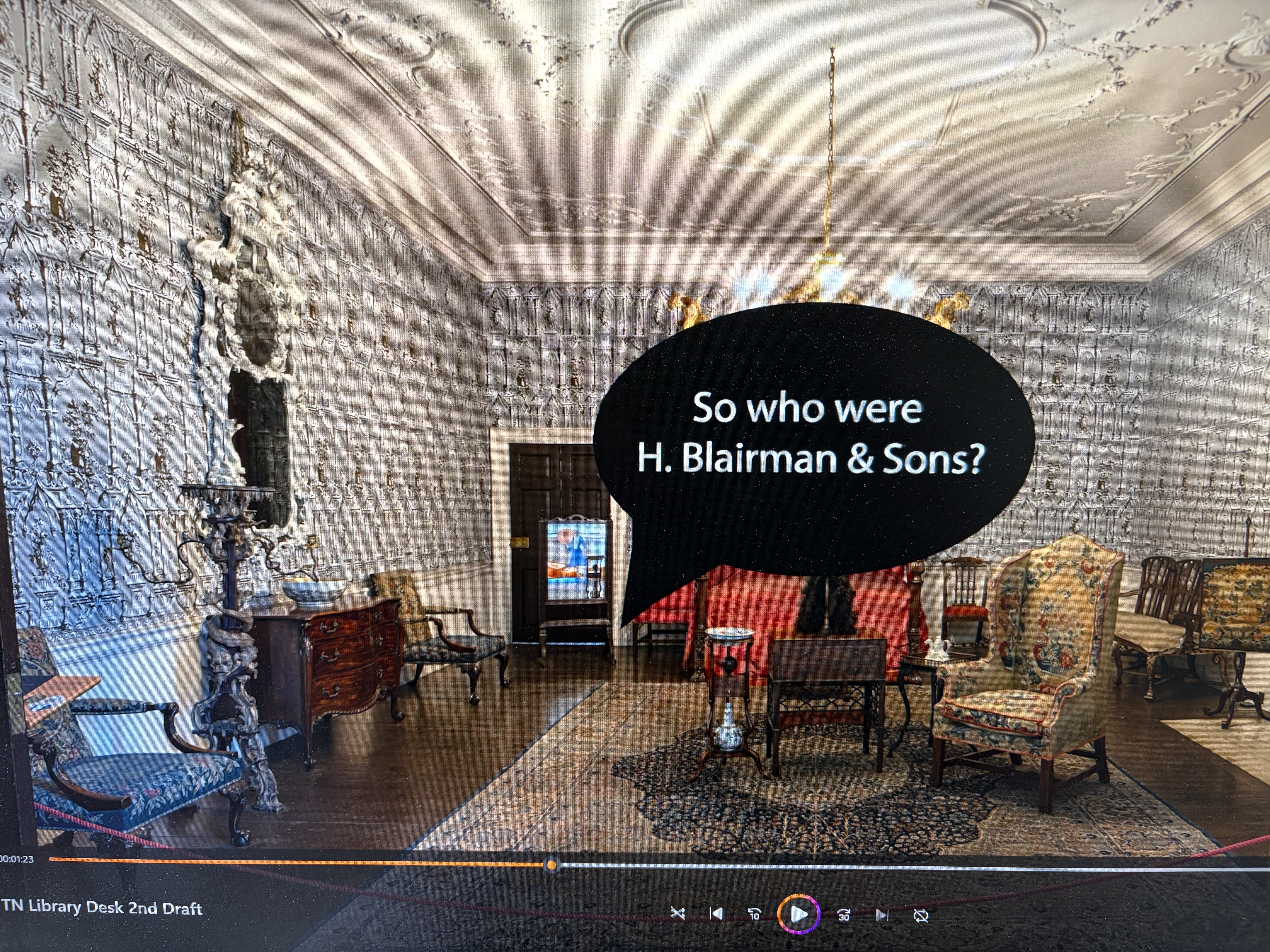
There were some other ideas we tested in the drafts for the film – one of which was that we might include speech bubbles to coincide with the avatar’s audio (see below – this is what the Mo avatar says in the script). This looked so bad though, so we decided to drop it; plus all the films have hard of hearing subtitles embedded as part of the software which viewers can turn on if they need to.
One of the other things that we noticed in the early drafts of the Temple Newsam YoD film was that in the first drafts of this shot (above) of the ‘Gothic Room’ at Temple Newsam viewers could see Patrick (the film maker) taking the film reflected in the cheval mirror at the back of the room on the left side – we could not film this all over again as it would mean having to book time to go to Temple Newsam again…so Patrick rather cleverly cut and pasted a reflection of what could be seem in the mirror if we were not there into this section of the film…..the devil is in the detail!
We’ll have another Behind the Scenes of the Year of the Dealer next week.
Our first in this new series of Behind the Scenes of the Year of the Dealer is on one of the films at the V&A South Kensington – Frank Partridge & Sons and The Great Bed of Ware – here’s the film
This film is about average in terms of the length of all the YoD films at films at 3 minutes 40 seconds, but it was planned to be a bit longer at nearly 5 minutes. This was too long for a trail; we thought that about 4 minutes was the longest we should make the films – this was to factor in that some viewers may watch the films on their phone in front of the object in the museum – so we cut quite a lot of information about the more recent history of Frank Partridge & Sons out of the film and moved that information to the Frank Partridge films at The Bowes Museum, Preston Park Museum, Temple Newsam, and Lady Lever Art Gallery (Partridge is the only dealer represented in all 5 museum film trails). We edited the script to reduce the running time of the V&A Partridge film; there were also too many images as well, which meant they appeared and disappeared on screen too rapidly, so we removed some of the images to allow the images that remained a little more time on screen.
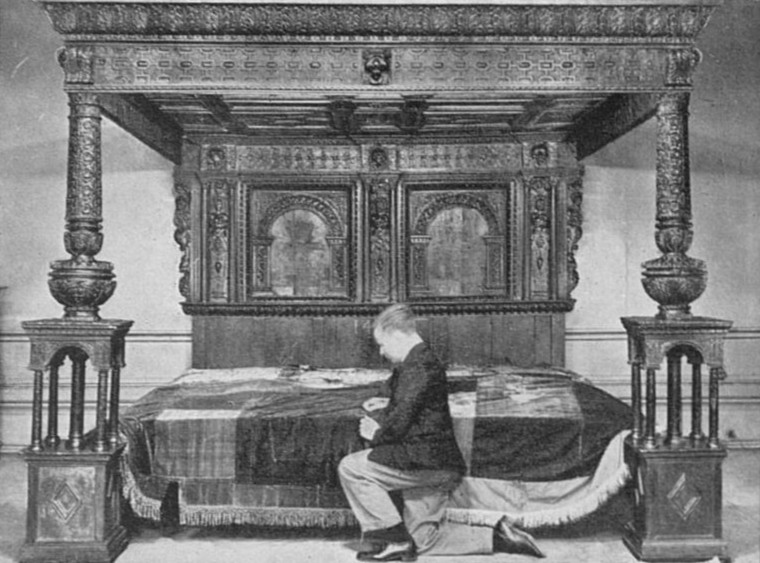
One of the images we removed was this photograph of the Great Bed of Ware at Frank Partridge’s shop at 26 King Street, St. James’s in London in 1931 (see below). The photograph shows a man kneeling in front of the bed – perhaps this is Frank Partridge, but we couldn’t be sure and as we had other images of the bed in Partridge’s shop we included those instead.
The Great Bed of Ware at Frank Partridge’s antique shop in London in 1931. Image from The Sphere, July 25th 1931.
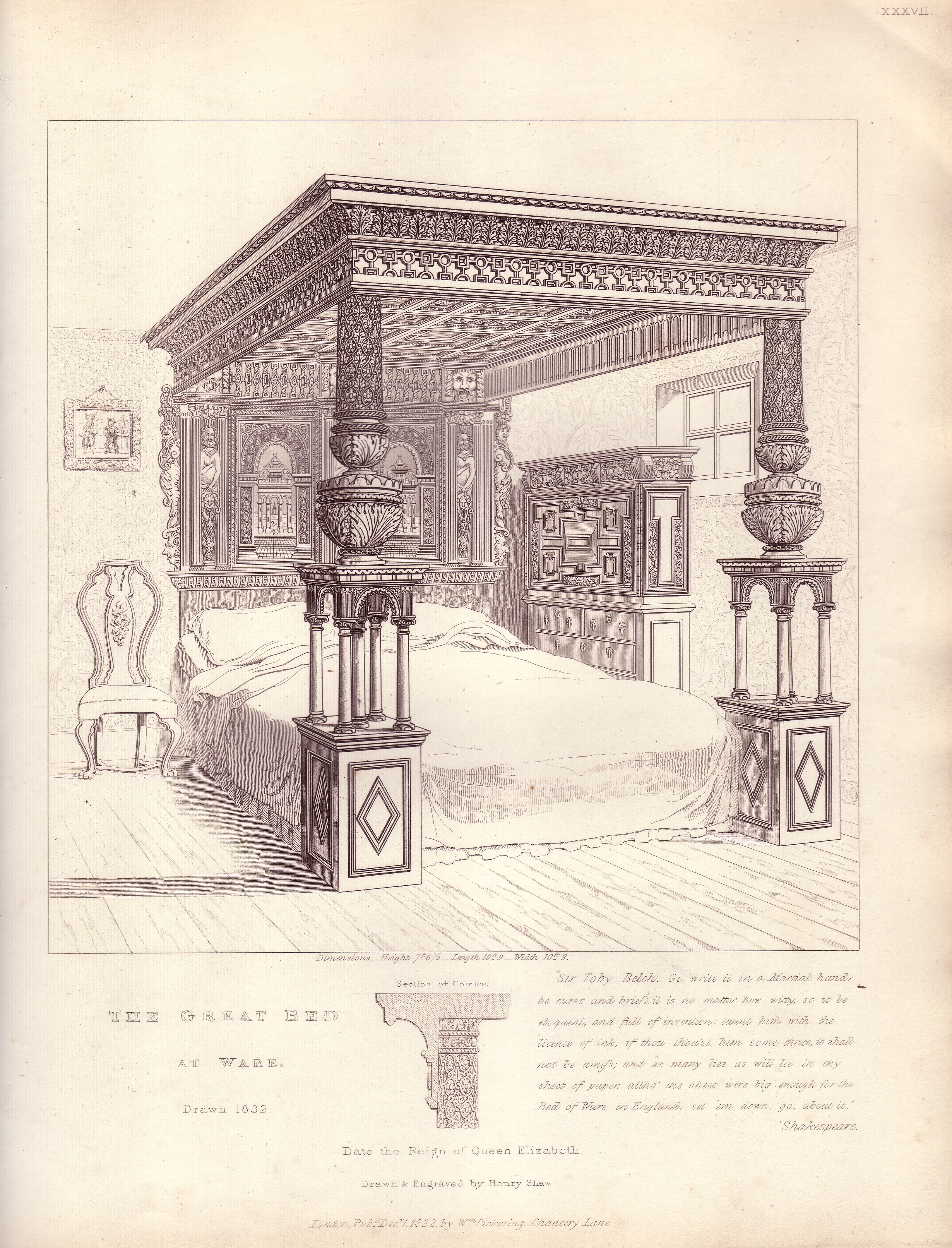
We also wondered about telling more of the story about the Great Bed of Ware – it has a long history, including being illustrated in Samuel Meyrick and Henry Shaw Specimens of Ancient Furniture (1836) (see below), one of the earliest depictions of the bed. But we really wanted to focus on the dealer, Frank Partridge, so decided not to include a more fulsome history of the bed. Such information is more commonly highlighted when the Great Bed of Ware is discussed anyway, and is available at the V&A and elsewhere.
The Great Bed of Ware, Samuel Meyrick and Henry Shaw, Specimens of Ancient Furniture (1836), plate 37.
One of the other changes we made was the representation of the house (the equivalent of the price of the antique to the price of a house at the time the antique was acquired by the museum is the common theme throughout all the YoD films) – we didn’t like the first attempt…the house looked too modern and a bit too ‘American’ (see below) (not that we have anything against Americans!), so we swapped the image for the more appropriate looking 1930s house (the bed was sold to the V&A in 1931) in the final version of the Frank Partridge & Sons digital film trial. We also decided that all the images of houses in the films should be images of houses dating from around the time that the dealer sold the object (the antique) to the respective museum, rather than this generic house image (below).
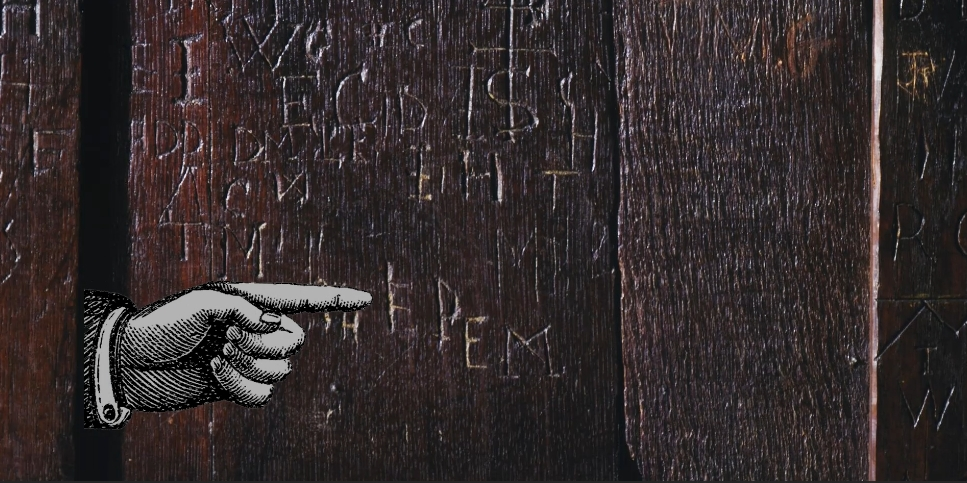
There were several other changes and edits to the film. I think we must have made at least 6 or 7 versions of each of the YoD films before we settled on the final versions – so that’s 50 films x 7…and enormous amount of work! For the V&A Partridge film one thing we debated about for a while was the use of what I called ‘the Monty Python Hand’ as a way of highlighting the carved initials ‘F.P.’ in the frame of the bed (see below).
We tried various ways of highlighting the initials but we quite liked the quirky-ness of the Victorian hand – we used the hand in some of the other YoD films too. Patrick Bannon, who made all the films for us, also voiced the script for the extract from Frank Partridge’s memoirs in the V&A Partridge film – Partridge was originally from Hertfordshire, rather than the Wirral though (where Patrick is from)…so a bit of artistic license (as well as questions of economy) was needed!
See next week for more Behind the Scenes of the Year of the Dealer 2.
As part of the Year of the Dealer digital film trails launch (see previous post), we are going to post some weekly updates for those following and watching the Year of the Dealer films. As you may know, there are 50 antiques highlighted in the Year of the Dealer films, so that’s just under one per week for the full year of the Year of the Dealer.
And so, each week we are going to reveal some of the stories, images, ideas for each of the film- things that never made the ‘cut’ or that we could not include for various reasons – a kind of behind the scenes look at the making of the Year of the Dealer.
In anticipation of that, here is a preliminary to the first of the YoD posts – we show here (below) Patrick Bannon, who is a photographer and film maker in Yorkshire and was the camera man for all the Year of the Dealer films. Here’s Patrick at Lady Lever Art Gallery filming our ‘What is an Antique?’ film with Fiona Slattery Clark, Curator of Decorative Art at National Museums Liverpool.
Patrick Bannon with Fiona Slattery Clark at Lady Lever Art Gallery, Port Sunlight, Wirral, filming the Year of the Dealer, ‘What is an Antique?’ film in 2022. Image, Year of the Dealer project, University of Leeds.
We will still be posting our usual antique dealer research updates on the Blog too of course, but watch out for the next in our behind the scenes of the Year of the Dealer next week!
After many years of invigorating research and work, the digital film trails for the Year of the Dealer project are finally launched today, Thursday 11th June!
As many of our readers will know, The Year of the Dealer is a project that began 4 or 5 years ago, and it’s taken an enormous effort, working with a brilliant team at the University of Leeds and colleagues at our 5 Year of the Dealer collaborating partner museums – The Bowes Museum, Lady Lever Art Gallery, Preston Park Museum, Temple Newsam, and the V&A South Kensington – to finally launch the digital film trails.
You can watch all the films here – on the Year of the Dealer main project website, but also on all five partner museum websites too – we hope you enjoy watching the films – but you can also go and see the antiques highlighted in the films at each of our five partner museums.
Focusing on ten familiar objects at each of the five museums, the films highlight how some of our most prized treasures ended up in collections and reveal their hidden histories as ‘antiques’. Guided by two friendly avatars, Mark and Mo (see below) – with introductions by respective museum directors, curators and collections officers – 50 antiques and over 40 antique dealer histories are explored.
Mark and Mo – the avatar guides in the Year of the Dealer digital film trails. Image, The Year of the Dealer project, University of Leeds.
The films reveal the fascinating stories of the dealers who sold the antiques to the museums – including Edgar Gorer, a leading specialist in antique Chinese porcelain, who sadly perished in the sinking of the Lusitania in 1915; and antique dealer Frank Partridge, who miraculously survived the same disaster.
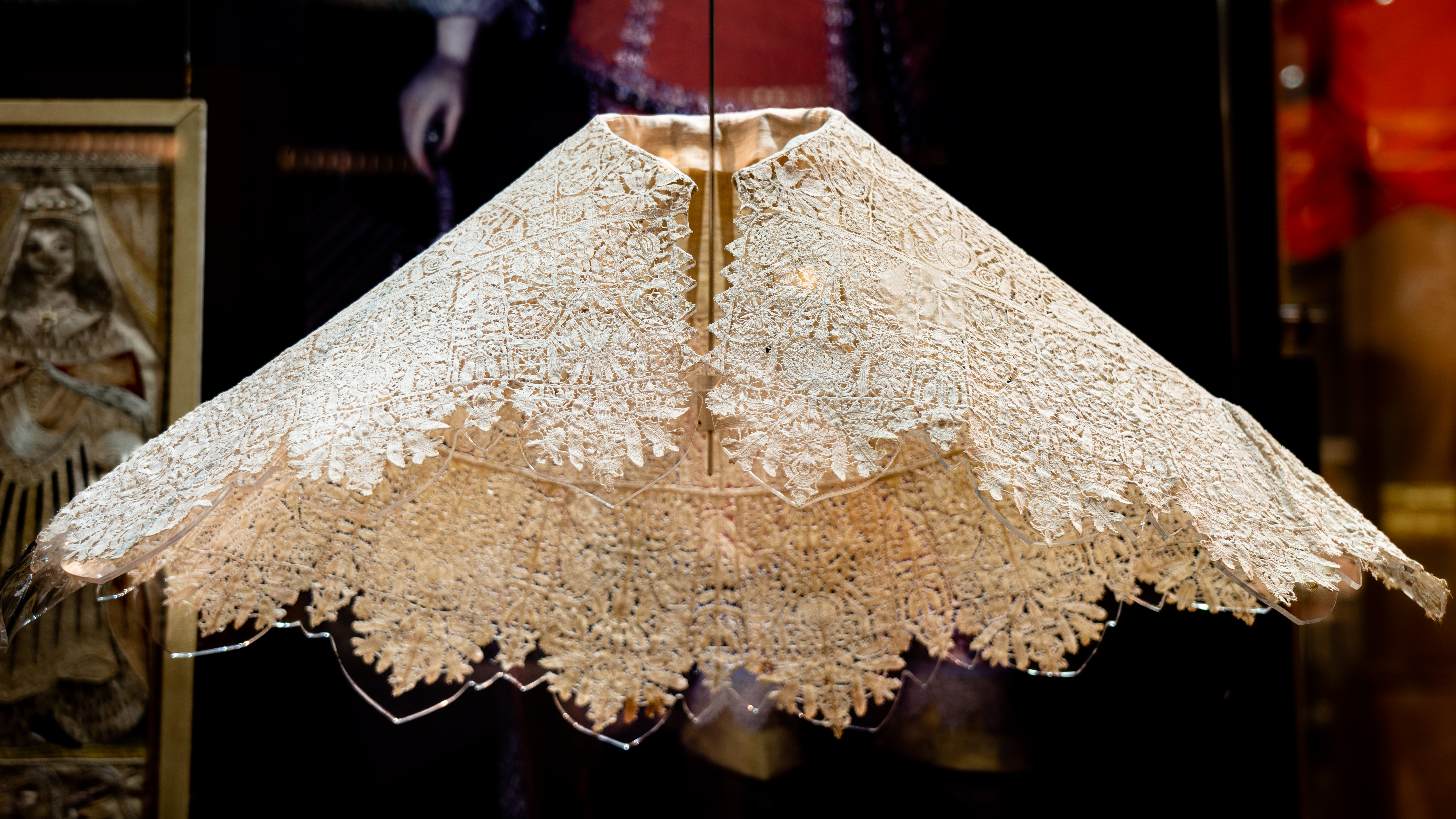
Several films highlight the important role that women have played in the history of antique dealing. One features an antique lace collar on display at The Bowes Museum in Barnard Castle, originally from the collection of Jane Clarke, one of the most prominent antique dealers of the 19th century (see below).
17th century Lace Collar, part of the Year of the Dealer digital film trail at The Bowes Museum, Barnard Castle. Image, The Year of the Dealer Project, University of Leeds & The Bowes Museum.
The Year of the Dealer project draws together several years of research, including museum and dealers’ archives, auction catalogue records and oral history interviews, to bring these previously little-known stories to life.
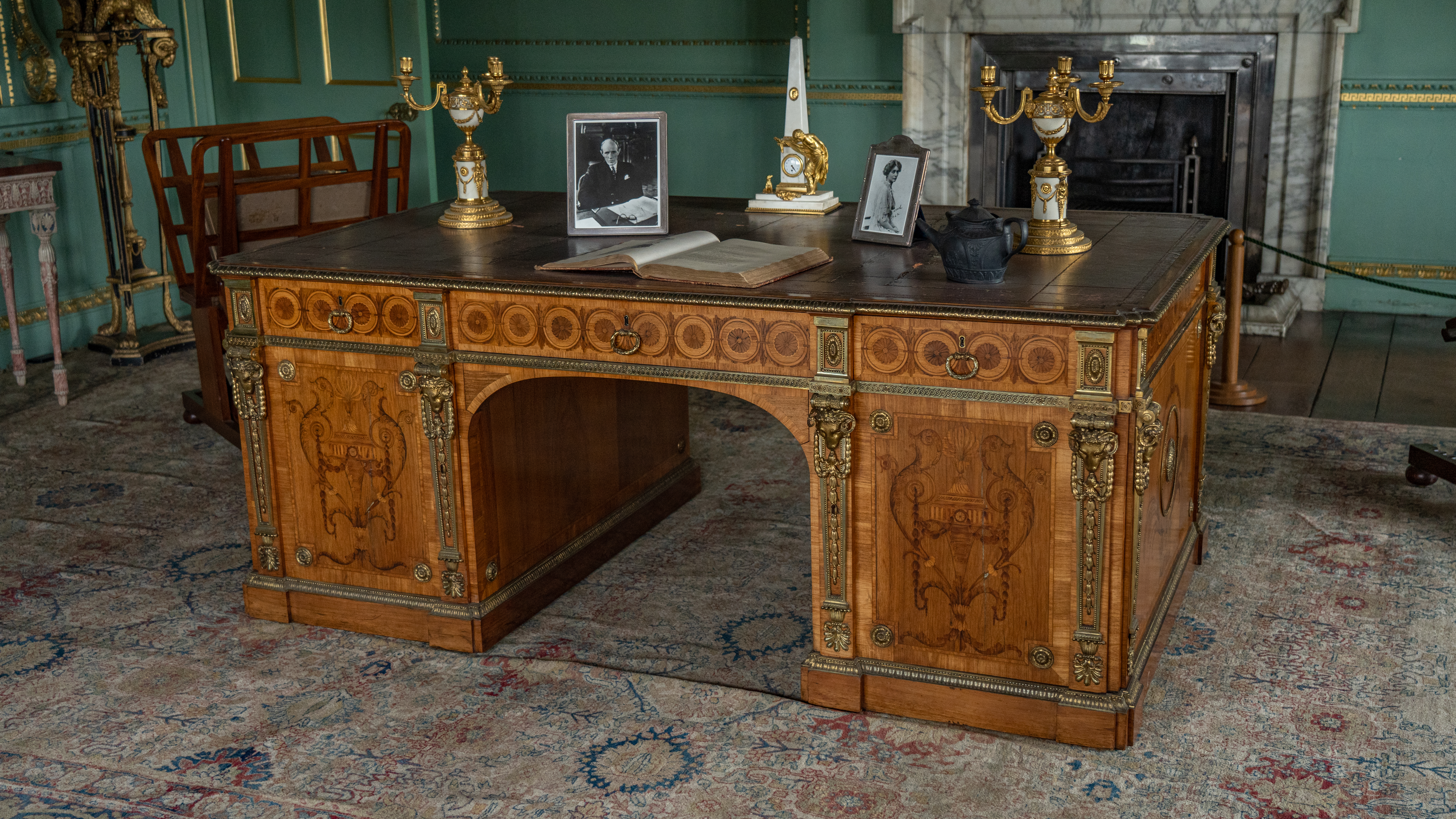
Other antiques in the digital film trails include the important library table, made by Thomas Chippendale in the 1770s for Harewood House in Yorkshire, sold to Temple Newsam, Leeds in 1964 by H. Blairman & Sons for a world record price of 41,000 guineas (see below);
The Harewood Library Desk, c.1770, part of the Year of the Dealer digital film trail at Temple Newsam, Leeds. Image, The Year of the Dealer project, University of Leeds & Temple Newsam, Leeds Museums & Galleries.
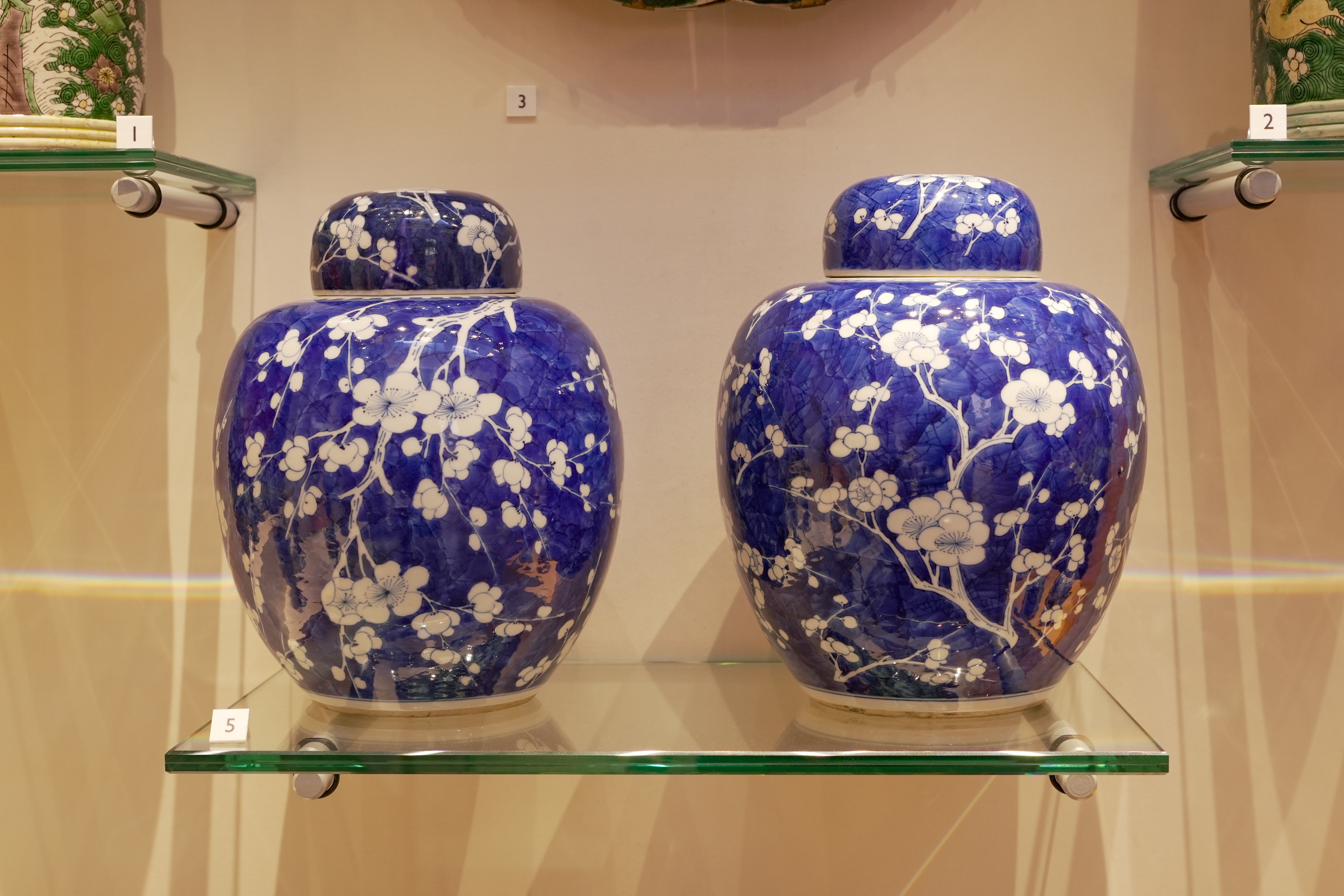
A rare pair of 17th century Chinese ‘Prunus’ pattern jars, sold by the special dealer in Chinese Works of Art Edgar Gorer to the collector William Hesketh Lever in 1911 for the spectacular sum of £6,500 (equivalent to as much as £3.8 million at the time) and now at Lady Lever Art Gallery (see below).
A pair of Chinese 17th century ‘prunus’ jars, part of the Year of the Dealer digital film trail at Lady Lever Art Gallery. Image, The Year of the Dealer project, University of Leeds & Lady Lever Art Gallery, Port Sunlight.
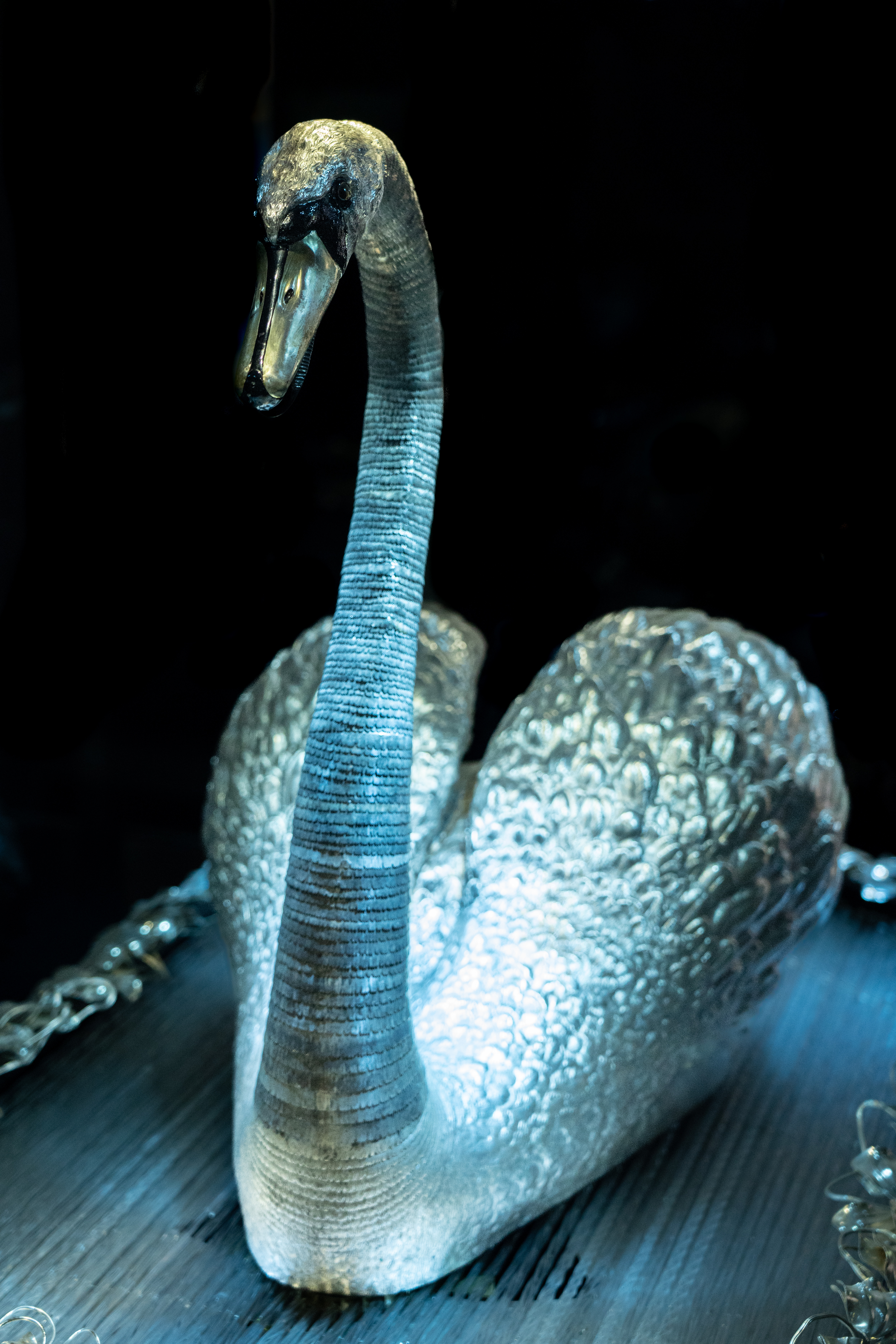
The Bowes Museum’s famous 18th century silver swan automaton, acquired by John and Josephine Bowes from the dealers Briquet and Samper of Paris in 1872 for about £200 (see below).
18th century silver swan automaton, part of the Year of the Dealer digital film trail at The Bowes Museum, Barnard Castle. Image, The Year of the Dealer project, University of Leeds & The Bowes Museum.
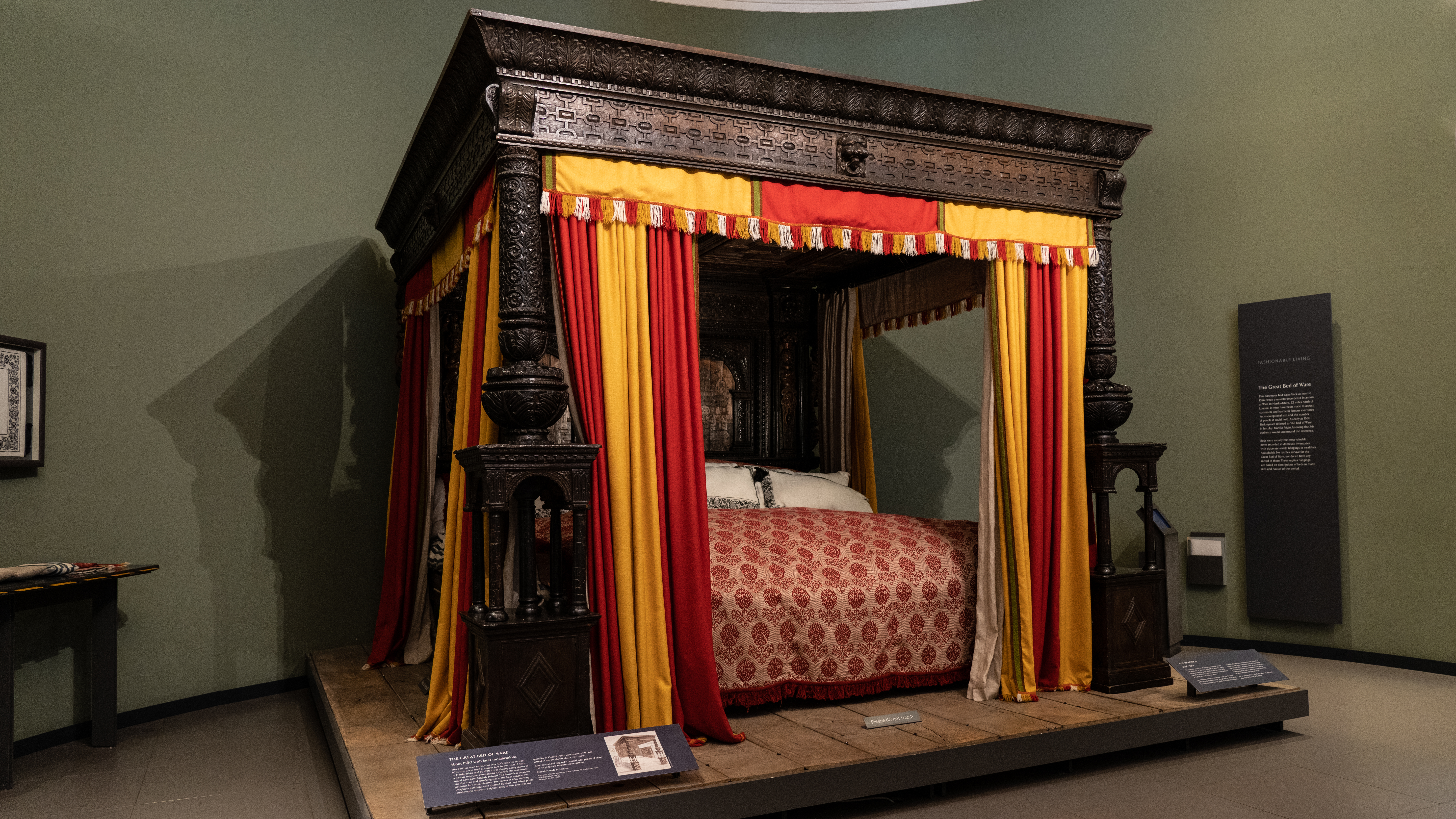
The Great Bed of Ware, sold by the antique dealer Frank Partridge to the V&A Museum in 1931 for £4,060 (see below).
The Great Bed of Ware, part of the Year of the Dealer digital film trail at the V&A South Kensington. Image, The Year of the Dealer project, University of Leeds & V&A South Kensington.
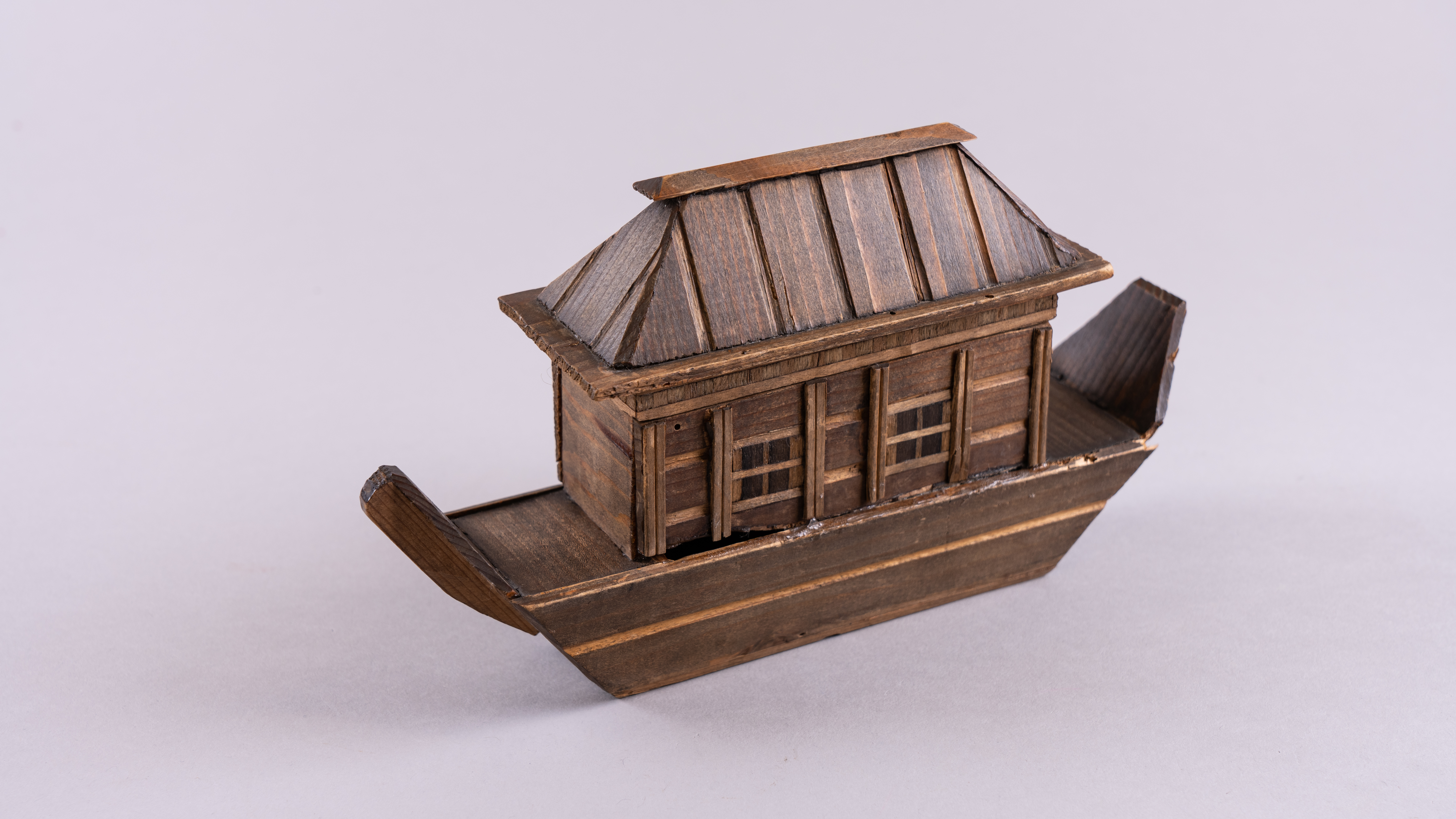
There are also some much more humble objects sold by antique dealers to museums, such as this toy Noah’s Ark c.1900, sold to Preston Park Museum, Stockton, in 1969 by Caedmon Antiques of Whitby for a few pounds (see below).
Toy Noah’s Ark, c.1900, part of the Year of the Dealer digital film trail at Preston Park Museum, Stockton. Image, The Year of the Dealer project, University of Leeds & Preston Park Museum, Stockton.
We hope you enjoy the Year of the Dealer films, and that it will encourage you to think further about the role that antique dealers have played in the development of collections.
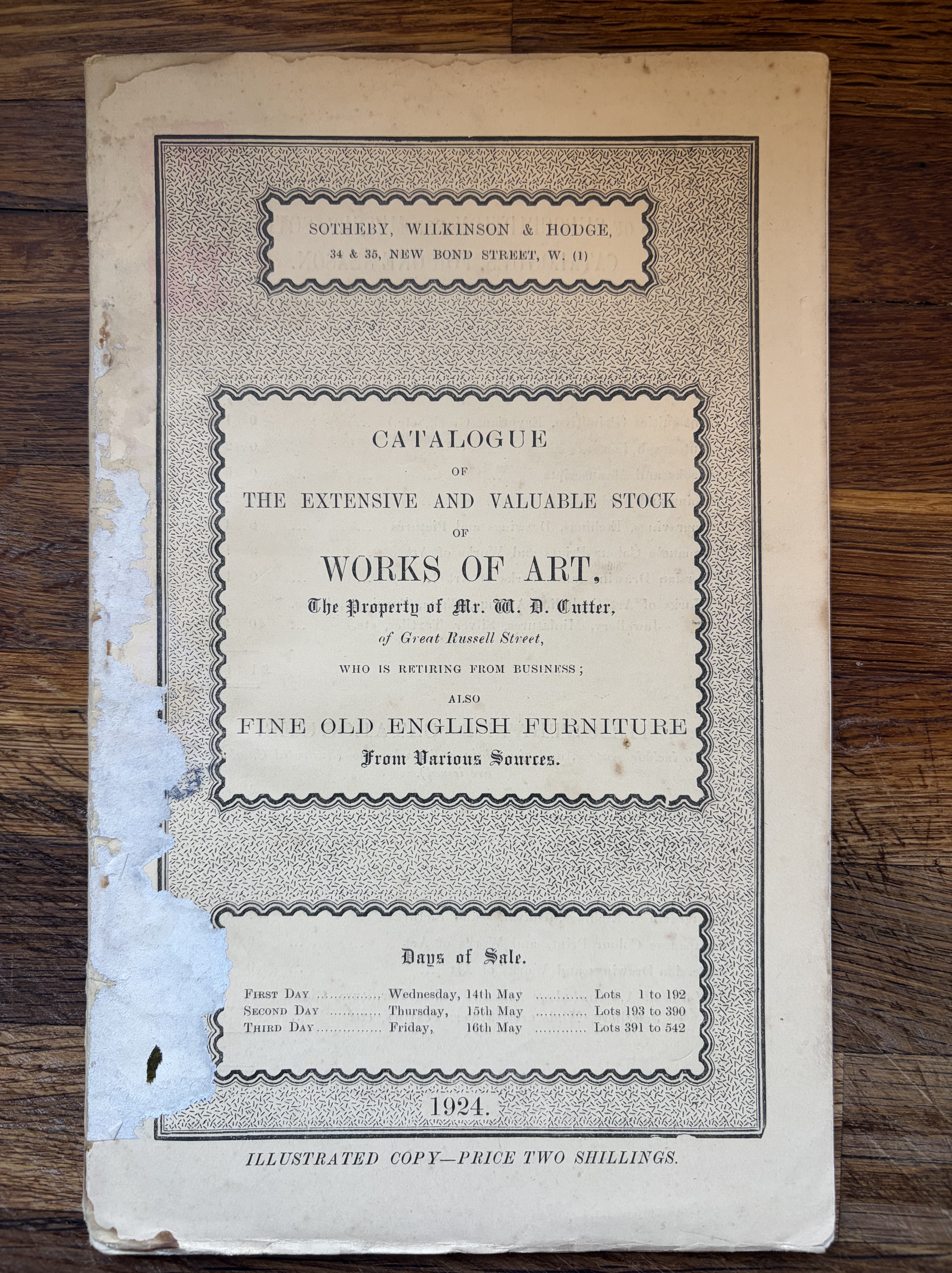
The history of antique dealing is littered with fascinating ephemera – dealer catalogues, invoices, letters, drawings and sketches, stock books, sales books and photograph albums. Some of the most interesting survivals are auction sale catalogues, often generated when a dealer makes changes to a business (sales of surplus stock when moving to different premises for example), or when a dealer retires, or dies. One such catalogue recently joined the collection of antique dealer ephemera that are such important resources for the antique dealer research project.
The catalogue presents ‘The Extensive and Valuable Stock of Works of Art, the property of Mr W.D. Cutter of Great Russell Street, who is retiring from business’ which was was sold over 3 days, 14th -16th May 1924. It gives us a unique insight into the remaining trading stock of an important and well-known (in the late 19th century at least) antique dealer.
Catalogue of the auction sale of the stock of W.D. Cutter; Sotheby, Wilkinson & Hodge, London 1924. Image, Antique Dealer Research Project, University of Leeds.
William Doherty Cutter (c.1848-1929) traded as ‘antique furniture dealer and curiosity dealer’ at 36 Great Russell Street, London in the 1870s, but the business can be traced back to as early as the 1860s, started by William’s father William George Cutter, a ‘picture dealer’ in St. James’s in London – William George Cutter was described as a ‘naturalist’ in the 1871 Census. Cutter’s were well known as suppliers of ‘curiosities’ of natural history and ethnography to the British Museum from the late 1860s to c.1900 – their shop was very close to the British Museum in Great Russell Street. Cutter is mentioned in Provenance: Twelve collectors of ethnographic art in England 1760-1990′ edited by H. Waterfield and J.C.H. King (2006), as well as having a short entry in my Biographical Dictionary of 19th century Antique and Curiosity Dealers (2009). Cutter’s appear to have been a very important antique dealers, now little known of course; they were active at the famous Hamilton Palace auction sale in 1882, buying a small number of Lots, including ‘a large cameo, with three heads in profile’ (Lot 2166) for £7.0.0. William George Cutter’s daughter, Eva A. Cutter (born c.1860) also traded as a dealer in natural history specimens and ethnographic artefacts, selling several objects to the British Museum in the late 1890s. Both of W.D. Cutter’s daughters, Marjorie Doherty (born c.1896) and Eva (born c.1890) also worked for their father in his antique dealing business.
What’s fascinating about the auction catalogue of Cutter’s stock is the sheer range and quality of the antiques he held in stock in 1924. This extends far beyond the natural history and ethnographic specimens that Cutter’s are said to have supplied to the British Museum in the second half of the 19th century. The auction sale had 499 Lots of Cutter’s stock, which ranged from bronzes, ivories, Chinese and European porcelain, silver, clocks, marble and terracotta sculptures, Chinese hardstone carvings and cloisonne, as well as some antique furniture, an array of objet d’art and a small number of paintings.
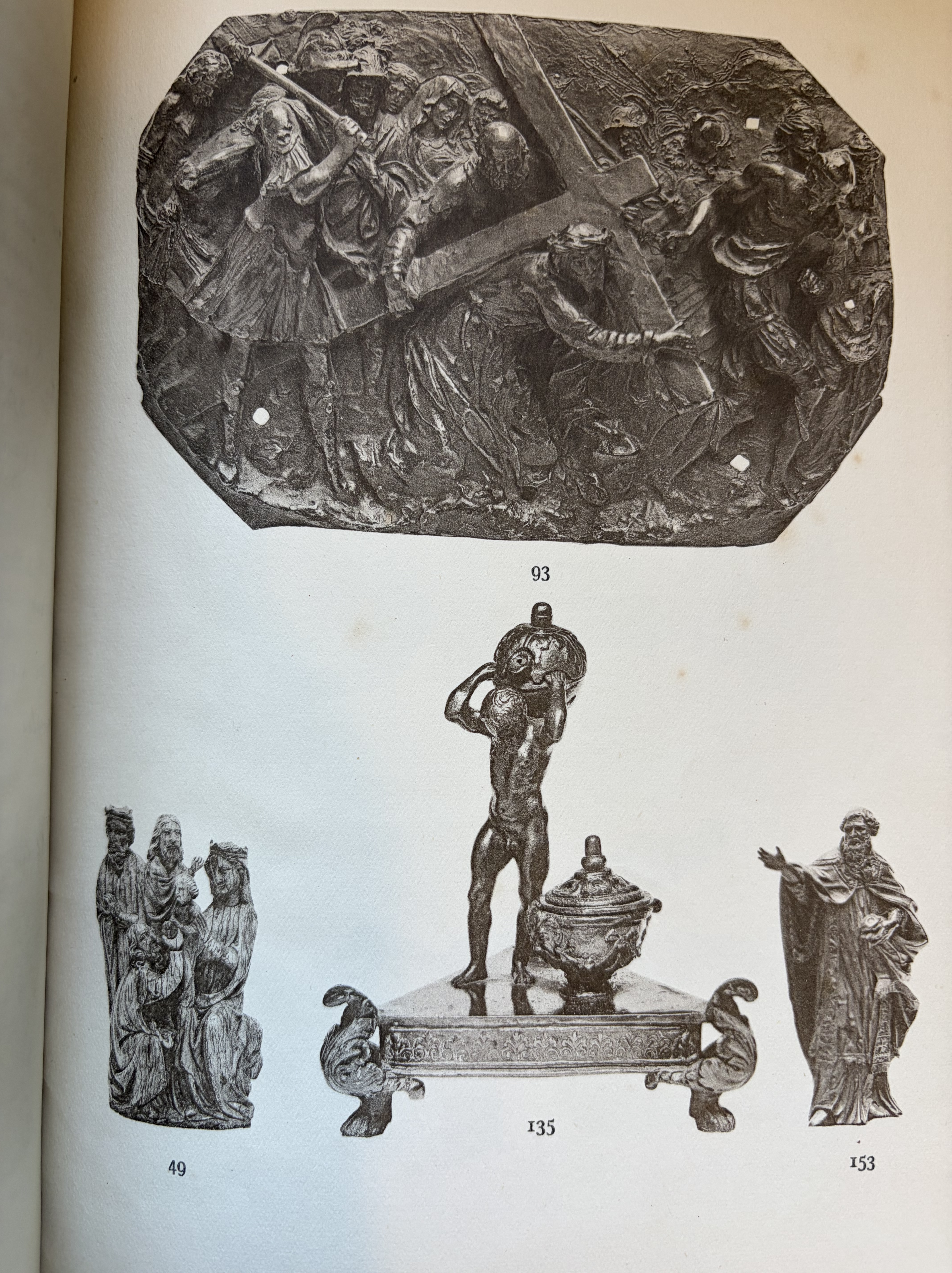
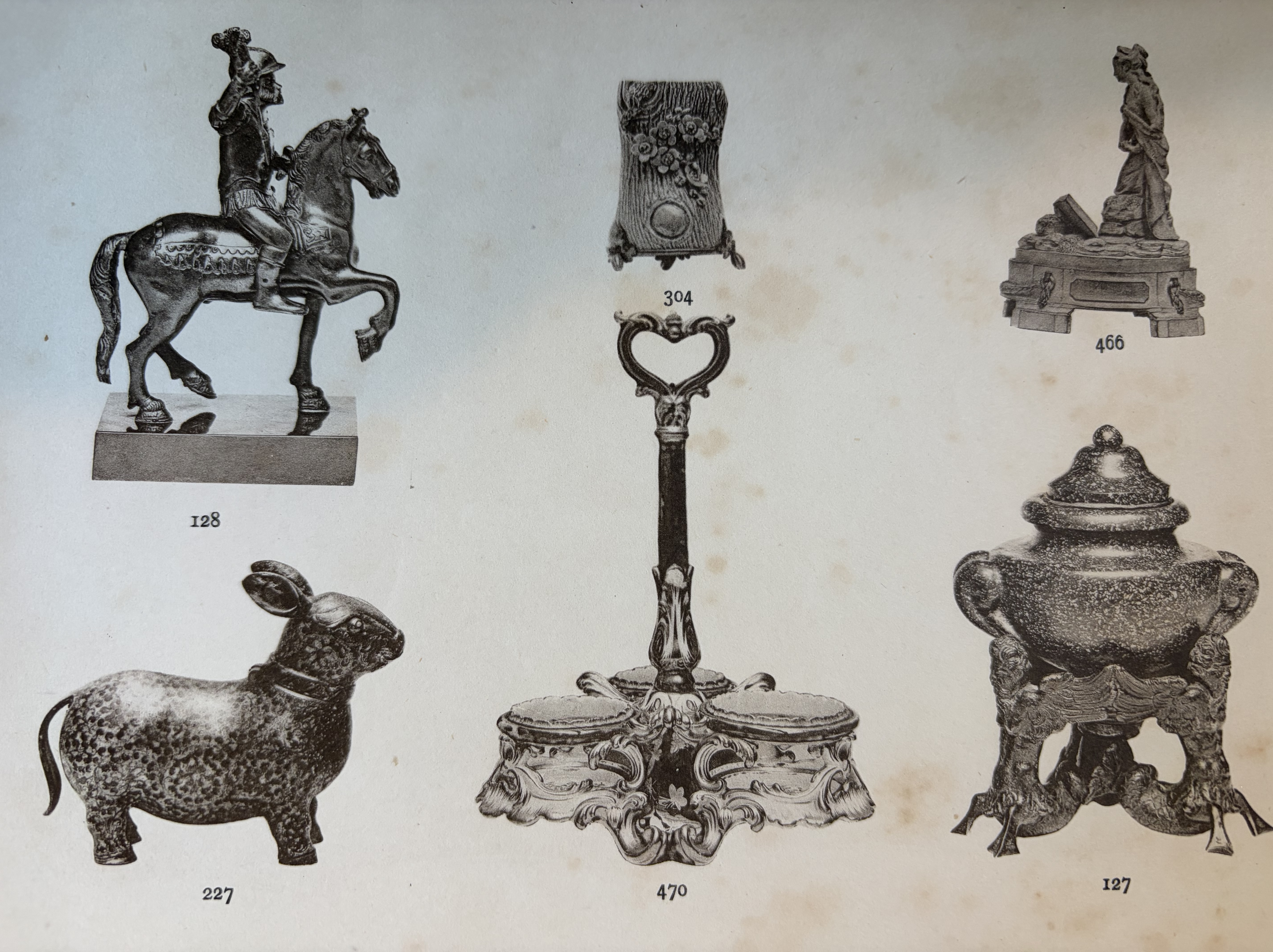
This range of ‘antiques’ is typical of late 19th and early 20th century collecting interests of course, but Cutter seems to have also been something of a specialist in Renaissance bronzes. Lot 135, for example, ‘A FINE INKSTAND, of the school of Riccio…’ (see below, centre – Andrea Briosco, called Riccio, (1470-1532)). The bronze inkstand was sold to ‘Kerin’ for £30 (equivalent to about £13,630, as ‘income value’, according to Measuringworth.com.) Gerald Kerin formed a partnership with the dealer Alfred Spero in 1928 – both Kerin and Spero were dealers based in London specialising in Renaissance bronzes and bought heavily at the Cutter auction sale.
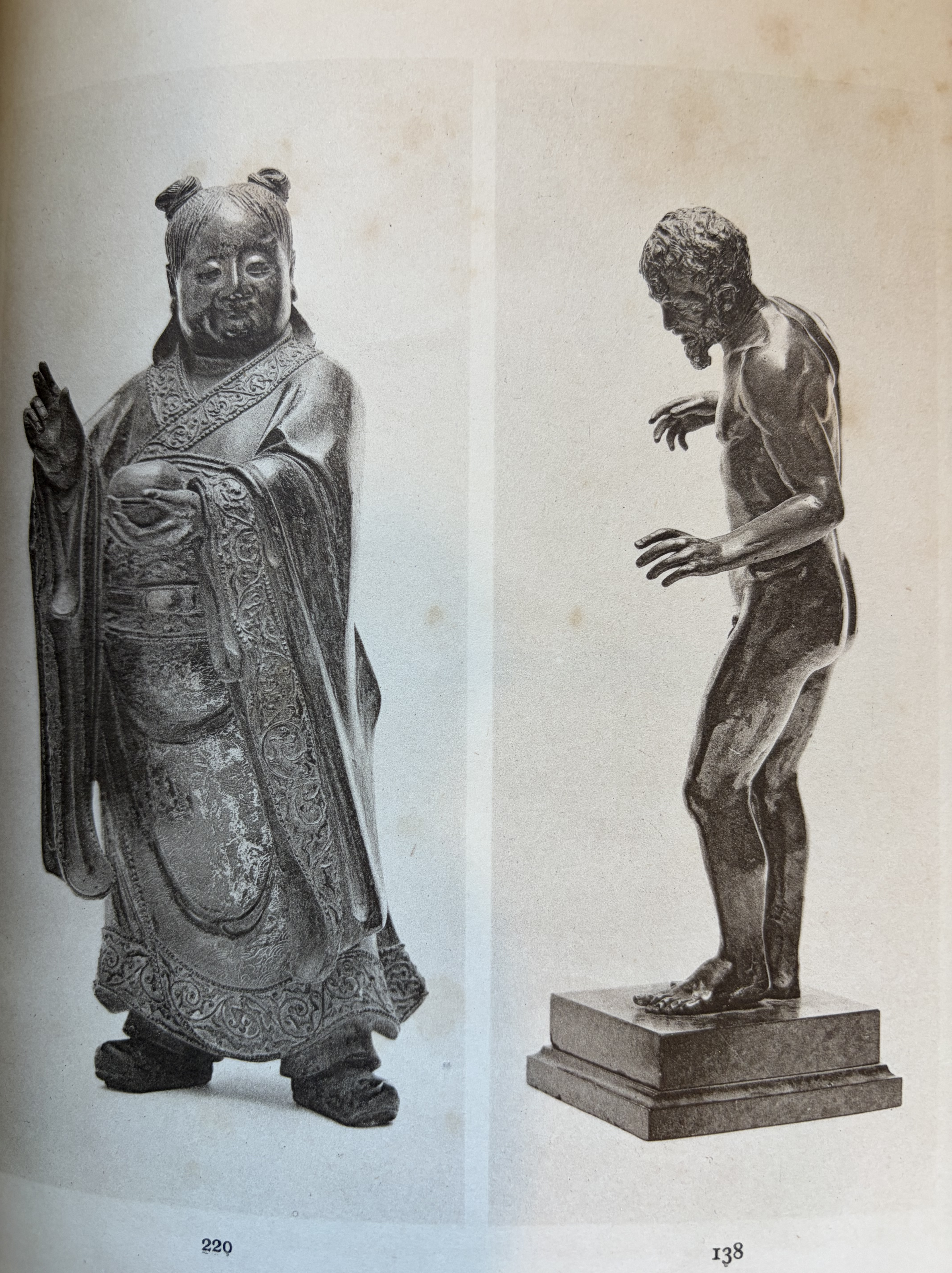
Lot 49 (see below bottom left) ‘A VERY FINE 15th CENTURY IVORY GROUP of ‘The Adoration of the Magi 6 1/2 in.’ was bought by the dealer ‘Garabed’ for £7 & 10 shillings (equivalent to about £3,400). A. Garabed was well-known dealer trading at Pall Mall Safety Deposit, Carlton Street, London at the time. And Lot 153, ‘A VERY FINE FIGURE OF A POPE, in pear-wood, coloured to imitate bronze, full-length in vestments, standing with right arm raised, 6 7/8 in.’,(below bottom right) sold to the dealer ‘Lewis’ for £3 & 10 shillings (equivalent to about £1,590). Lewis could be any number of antique dealers of the Lewis family in the 1920s.
Auction catalogue of the W.D. Cutter sale, May 1924. Photograph, Antique Dealer Research Project, University of Leeds.
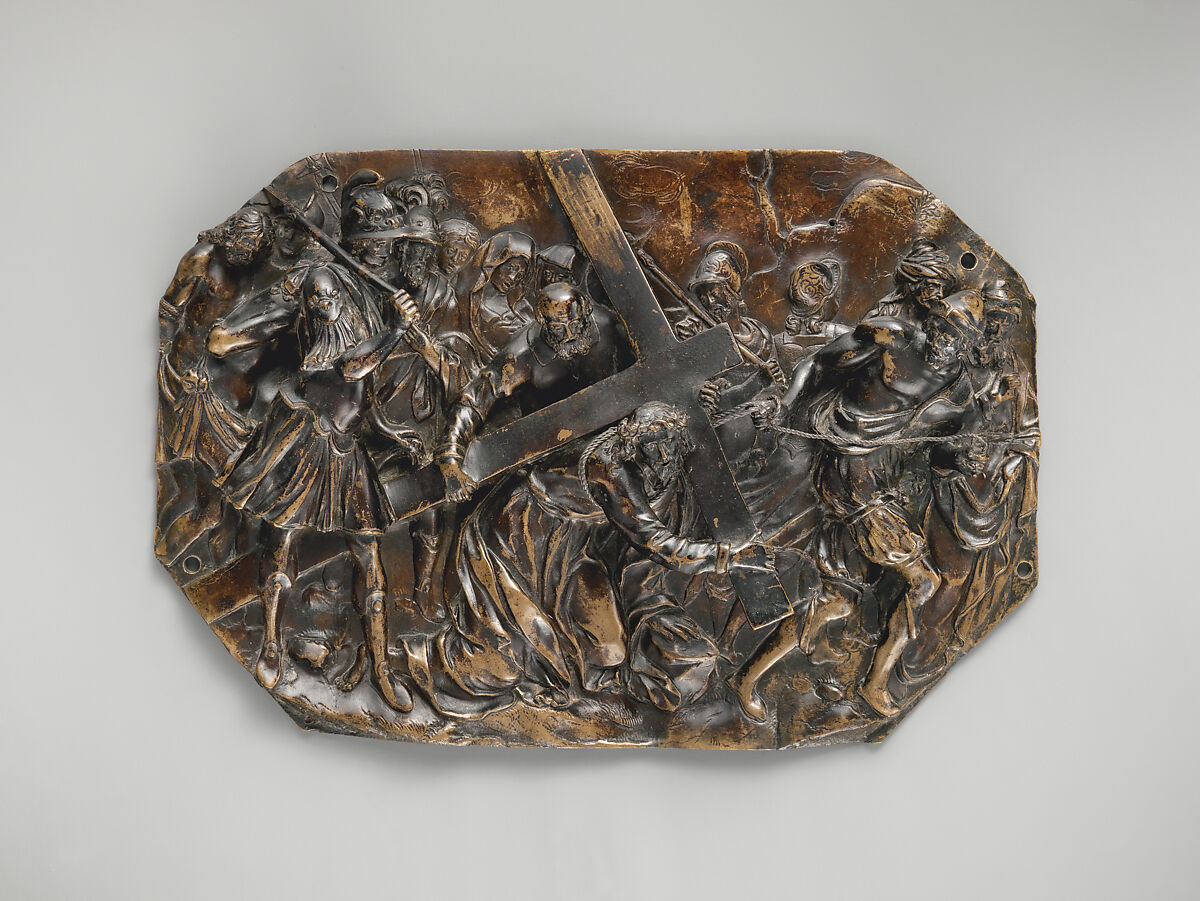
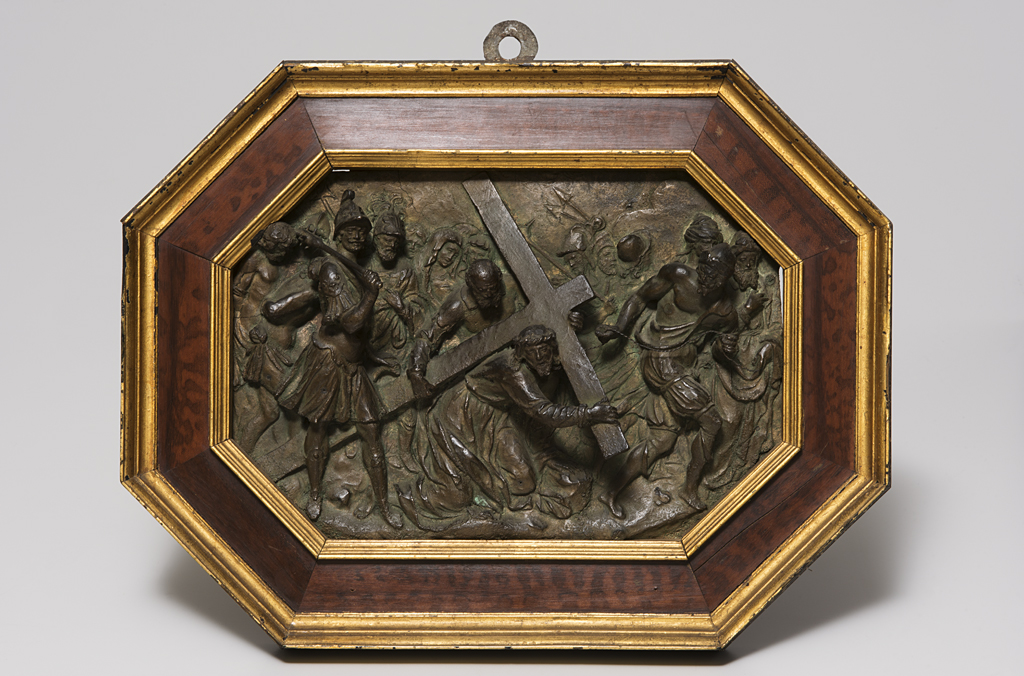
Lot 93,(see above, top middle) ‘A FINE 16th CENTURY PLAQUE of Christ bearing the Cross, a ”cire perdu” casting, with figures in very high relief (up to 1 1/2 in.), oblong, octagonal, 9 1/2 in. by 6 1/2 in.’, was sold to Alfred Spero for £40 (equivalent to £18,170) – the most expensive object sold at the Cutter auction. Alfred Spero was trading from a shop at 33 King Street, St. James’s in London in the 1920s, right next to Christie’s auction rooms.
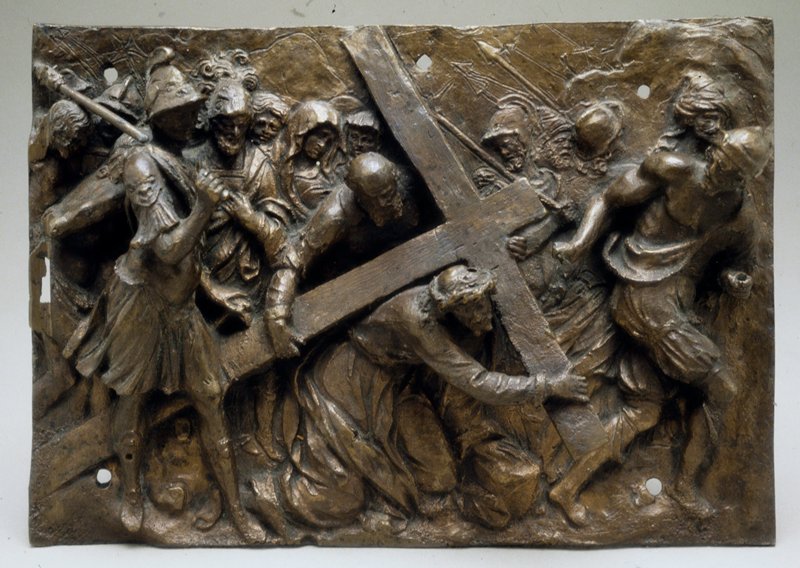
The bronze shown in Cutter’s stock is a well-known casting, previously attributed to Ferdinando Tacca (1619-1686), but is now said to be by Francesco Fanelli (1608-1661). There are three known versions of bronze, in different shapes and sizes, in museum collections in the USA. One version, rectangular in shape, in the collections of The Minneapolis Institute of Art (see below).
Francesco Fanelli (1608-1661), Christ bearing the cross, mid-17th century. Minneapolis Institute of Art, USA, (66.43.1) The Christina N and Swan J. Turnblad Memorial Fund. Image Minneapolis Institute of Art.
Two other versions are octagonal in shape, the same as the example in the Cutter auction. These are in the collections at The Metropolitan Museum of Art in New York and at the Spencer Museum of Art, Kansas, USA (see below).
Francesco Fanelli (1608-1661), Christ bearing the Cross, mid-17th century. Metropolitan Museum of Art, New York, USA. Image, Metropolitan Museum of Art, New York.Francesco Fanelli (1608-1661), Christ bearing the Cross, mid 1600s. Spencer Museum of Art, Kansas. Image copyright Spencer Museum of Art, Kansas, USA.
The Metropolitan Museum of Art and the Spencer Museum of Art examples show different fixing holes and other variations, so cannot be the Cutter example, which raises the possibility that Cutter’s example is a previously unrecorded, and as yet unlocated, example of this famous bronze.
Other examples of Renaissance bronzes in the W.D. Cutter auction sale include Lot 128, ‘AN EARLY EQUESTRIAN FIGURE, in pseudo-classical costume, 8 in.’ (sold again to Kerin, at £3.0.0.) (see below top left).
Auction catalogue of the W.D. Cutter sale, May 1924. Photograph, Antique Dealer Research Project, University of Leeds.
And a bronze sculpture of a man (below, right), Lot 138, ‘A FINE 16th CENTURY FIGURE of a man, with curling hair and beard, standing nude with head turned to right and looking downwards, both arms bent with fingers open 15 1/2 in.’ This was sold for £20.0.0. (to a buyer who’s name is too hard to decipher?).
Auction catalogue of the W.D. Cutter sale, May 1924. Photograph, Antique Dealer Research Project, University of Leeds.
The Cutter auction catalogue is a rare document of the stock of a formerly well-known, but now forgotten, antique dealer, and illustrates the high quality stock that W.D. Cutter held. The catalogue will be joining the range of antique dealer ephemera at the Brotherton Library at the University of Leeds in due course.
One of our occasional guest blog posts – this time another post from our friend Chris Coles. Thanks Chris for such a fascinating blog post! – Mark
One of the real pleasures involved with researching antiques is uncovering some of the stories relating to dealers of the past who might now have slipped into obscurity. The Antique Dealer Research Project map website is always the best place to start of course and so, when I discovered that a piece I was researching had provenance to a firm named Baliol Ltd (not Balliol like the Oxford college) I was intrigued. Here is the link to the Baliol page on the project website https://antiquetrade.leeds.ac.uk/dealerships/37156
The firm advertised in Country Life and Connoisseur but not particularly regularly. They were certainly not amongst the firms who showed stock for sale in every issue and, as such, their importance as a dealership has perhaps been overlooked. This short post is an attempt to rectify this and also a call to those who may have more information about the firm to get in touch and help preserve the name for future generations.
Baliol-what we know so far
All the adverts for the firm that I have been able to locate have come from 1931, which also seems to be the year when the firm came to some prominence. The first reference I have found to the firm is from April 1931, but not in an advert, rather in a reference to a court case. The same text appeared in a vast number of newspapers, syndicated across the UK, but the version transcribed below appeared in the Dundee Courier on the 14th of April 1931. The article reads as follows:
‘FURNITURE ALLEGED TO HAVE BEEN FAKED
Two captains, a widow, furniture which was alleged to have been “faked”, and a cheque for £450 figured in a case at Marlborough Police Court, London, yesterday. The men were Capt. H. J. Newnes, of Royal Crescent, Holland Park, London, and Capt. A Salisbury Devenport, of Marylebone Road, London. The widow was Mrs Stubbs, managing director of Baliol Ltd., Albemarle Street, London.The two men were charged with conspiring together to obtain a cheque for £450 from Baliol Ltd.
It was alleged that Newnes called on Mrs Stubbs and suggested she should see some furniture which Devenport had in store. He is alleged to have said it had been in Devenport’s family for more than 100 years. Mrs Stubbs went and saw a chair and a table, which, it was alleged, Devenport told her were genuine Chippendale. She gave him a cheque for £450, taking the furniture by taxi to her stores. She offered Newnes £10 as commission. The next day, it was stated, Mrs Stubbs had the furniture examined by an expert, who said it was faked. Both men denied the charge, and the hearing was adjourned’.
Both men were found guilty of all charges.
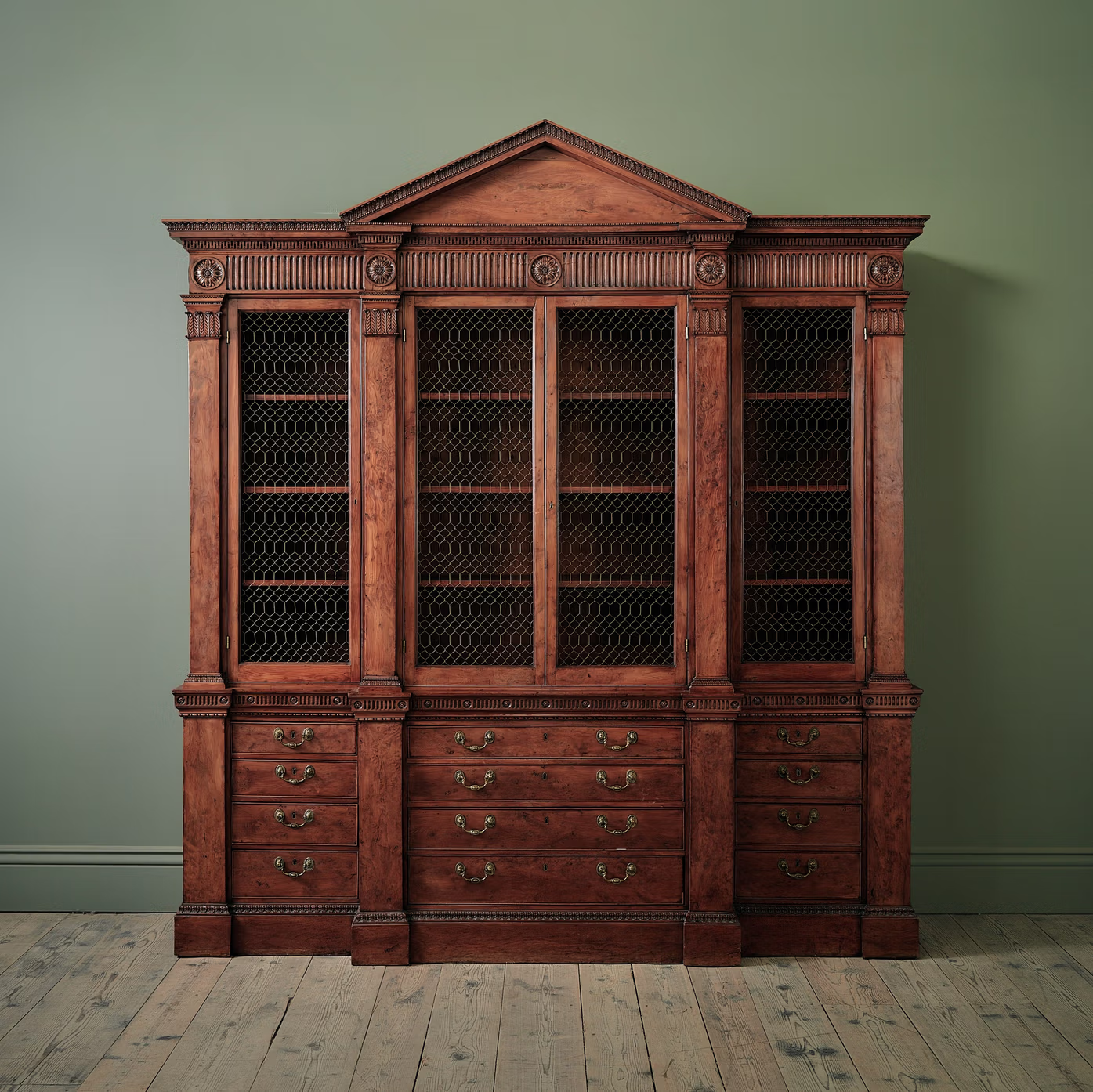
Clearly Mrs Stubbs’ knowledge of antique English furniture was a little deficient in this instance, but the quality of the pieces they dealt in is illustrative of their importance in the history of the antique trade. For example, Country Life (9th of May 1931) carried a write-up about pieces in stock at ‘Messrs Baliol’s of Albemarle Street’ which included ‘a large break-front bookcase…made of yew wood of mellow colour. The centre section of the upper stage is surmounted by a pediment, and this stage is flanked by pilasters with leaf capitals. The cupboard doors are fitted with wire trellis. In the lower stage, which is fitted with drawers, is a fluted and pateraed frieze corresponding to that of the upper stage but narrower’.
This piece, described so beautifully by the author of the article J. De Serre, is highly likely to be a very famous bookcase which was subsequently acquired by Randolph and taken to Grosvenor House in 1937. This piece was latterly in the Simon Sainsbury collection, having passed through the hands of antique dealers Mallett & Sons (twice) and Hotspur Ltd., and is now with Hawker Antiques, part of Jamb Ltd, on the Pimlico Road – see www.jamb.co.uk (see below).
A George III Solid Yew Wood Breakfront Bookcase, c.1775. Image courtesy of Jamb.
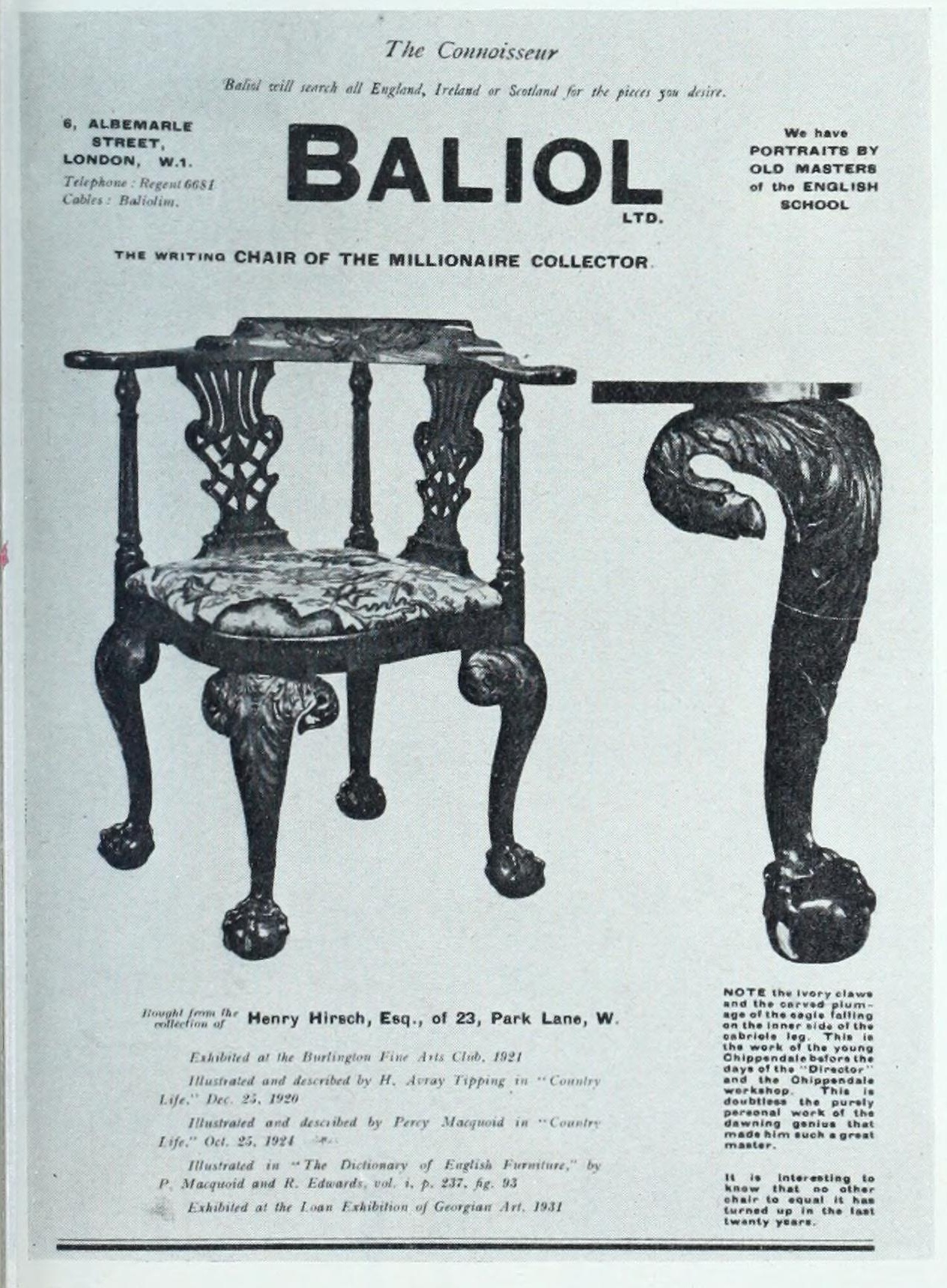
The bookcase would be a jewel in any antique furniture dealer’s stock but it was certainly not the only very fine piece Baliol handled. In 1931 they acquired the famous corner writing chair, immortalised in the Dictionary of English Furniture that had belonged to the famous collector Henry Hirsch and graced his Park Lane mansion. In 1976, Connoisseur ran a feature on adverts of the 1920s and erroneously reprinted the Balliol advert for the chair which had featured in the magazine, presumably in July 1931 (see below). The text of the firm’s advert highlights the Hirsch provenance, using the tag line ‘The writing chair of the millionaire collector Henry Hirsch’. The chair also featured in Christie’s yearbook 1931, having achieved the very high price of £1008 in the Hirsch sale on the 10th of June 1931 (lot 70).
Advertisement for Baliol Ltd., Connoisseur, June 1931, republished in Connoisseur 1976.
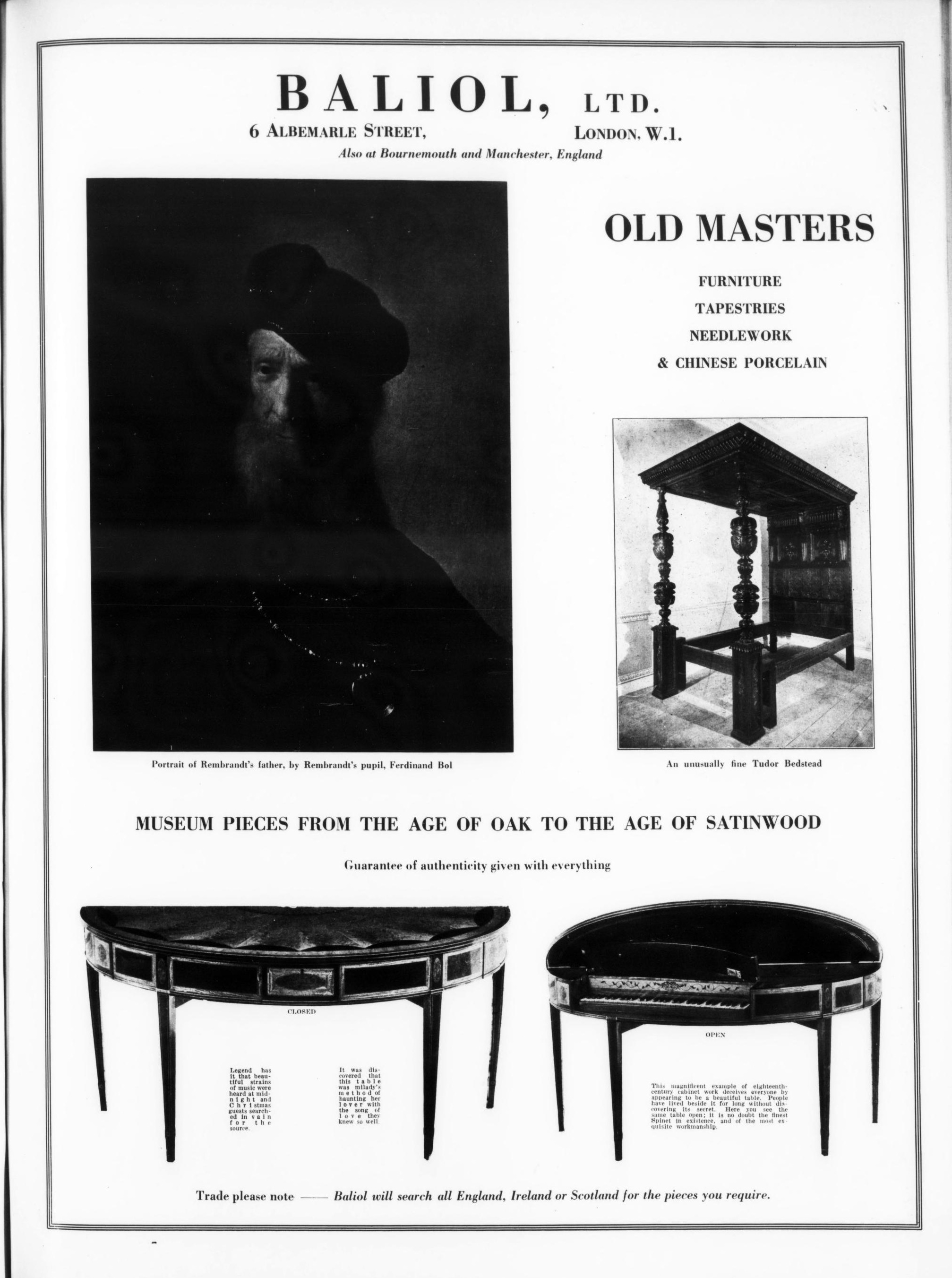
Another advert was placed by Baliol Ltd in The Art Newspaper (16th May 1931) (see below) adds a lot of additional information to our understanding of the firm. It also makes clear that the firm dealt in ‘Old Masters, furniture, tapestries, needlework and Chinese porcelain’ with ‘a guarantee of authenticity given with everything’. With lots of stories about fakes and forgeries circulating in the press, such statements in antique dealer’s adverts were quite common in the period. The firm also appealed to the trade, stating ‘Trade please note – Baliol will search all England, Ireland or Scotland for the pieces you require’.
Advertisement for Baliol Ltd., Art Newspaper 16th May 1931.
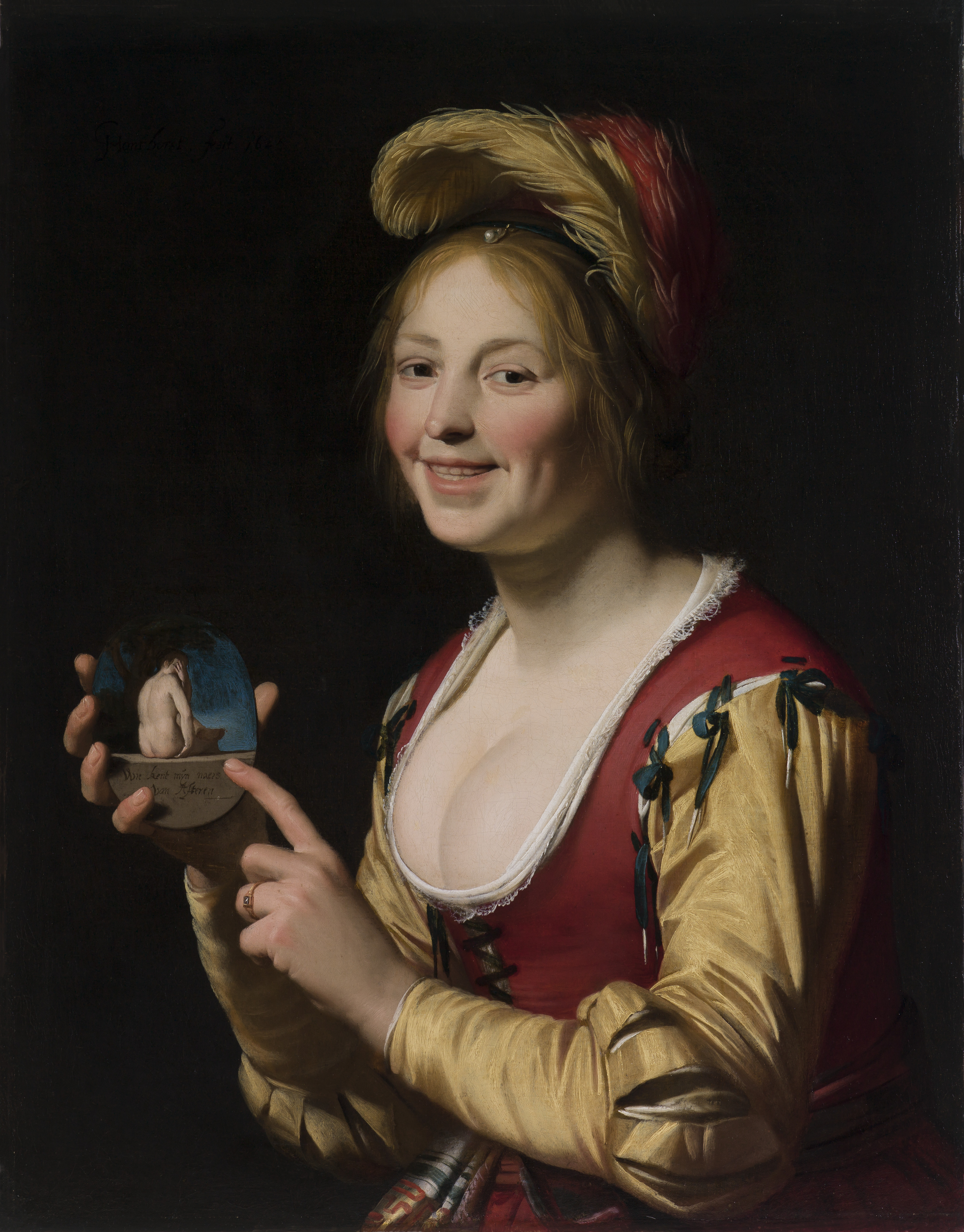
In terms of stock, they showed a Tudor oak bed and a beautiful demilune table piano, the case probably by William Moore of Dublin. This lovely piano was clearly not a quick seller as it was still available when profiled by Country Life on the 1st of August 1931. But it’s clear that Baliol sold ‘Old Master’ paintings alongside antique furniture. They illustrated a painting by Ferdinand Bol (1616-1680); they also had a very fine Dutch painting by Gerrit van Honthorst (1592-1656) in 1931, ‘Smiling Girl, a Courtesan, holding an obscene image’ (1625), which Baliol bought at Christie’s on 3rd July 1931 (lot 85), and is now in the collection of the Saint Louis Art Museum, Saint Louis, Missouri, USA (63.1954).
Gerrit van Honthorst (1592-1656) ‘Smiling Girl, a Courtesan, holding an obscene image’ (1625). St. Louis Art Museum, St. Louis, Missouri, USA. Object No. (63.1954). Image copyright St. Louis Art Museum.
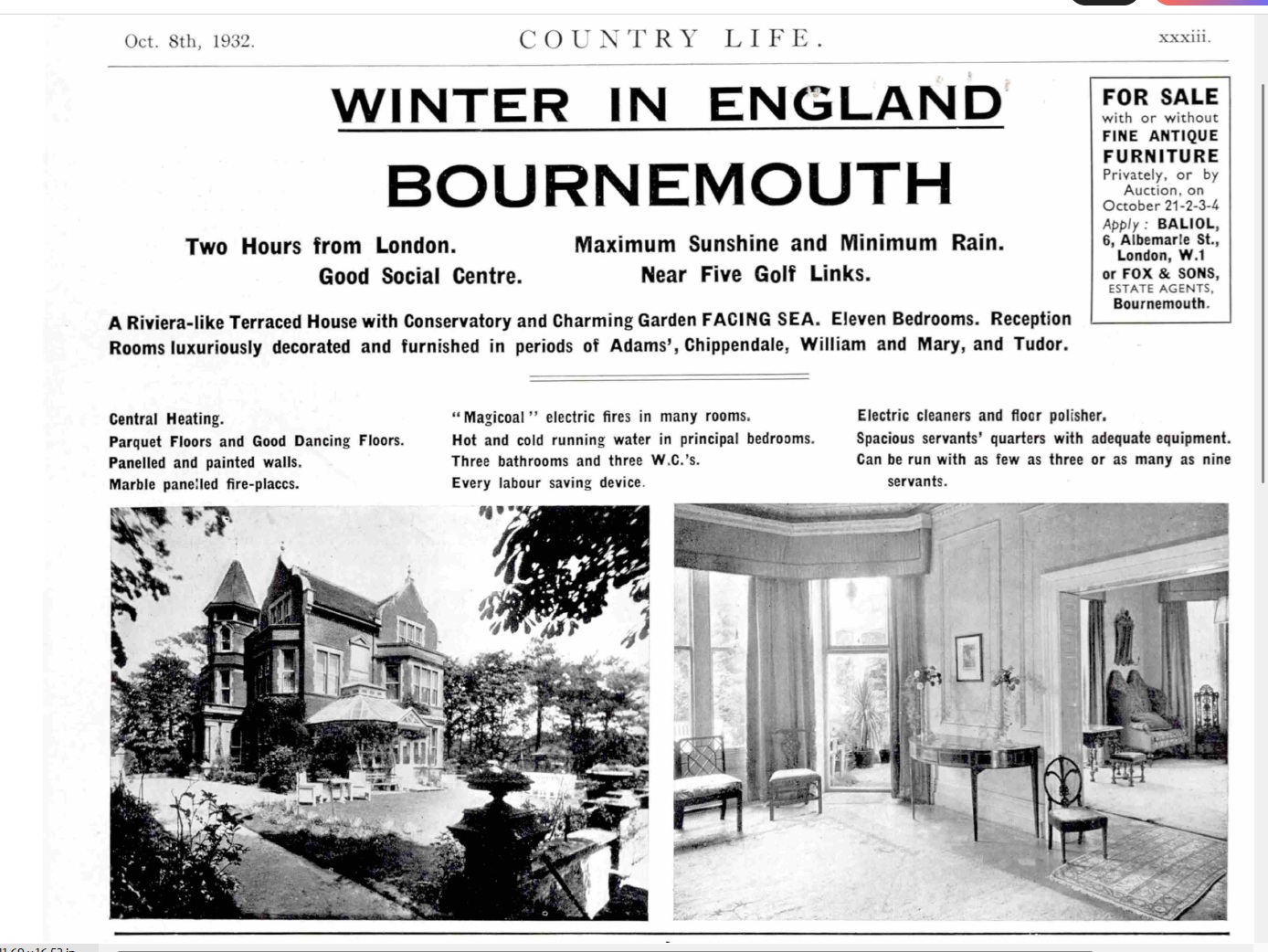
The advert also states that the firm had branches ‘at Bournemouth and Manchester’. I haven’t found any further information about the Manchester premises, but an advert in the property section of Country Life (8th October 1932) sheds fascinating light on the Bournemouth arm of the business.
Baliol Ltd., advertisement, Country Life, 8th October 1932.
The advert shows a detached mansion in Bournemouth which was offered for sale ‘with or without fine antique furniture’. We are told that the ‘Riviera-like terraced house’ has ‘reception rooms luxuriously decorated and furnished in periods of Adams’ (sic), Chippendale, William and Mary and Tudor’. The image of one of the interiors shows some lovely pieces of antique furniture, including a William and Mary settee, a Hepplewhite chair, a cockpen chair and the William Moore-type table piano. Presumably, Baliol realised that having a display property on the English Riviera in the fashionable town of Bournemouth was a perfect way to capture those clients holidaying in the milder climes.
Clearly the firm traded at the very highest level, but seemingly only for a very short period. Where the interesting name for the firm came from is certainly one question I would like answered. I have found the name Baliol being used as the middle name of some important families and wonder whether there was any familial link between any of these and Mrs Stubbs?
Please do get in touch if you have any further information on Baliol Ltd. Post a comment on the Blog or email us at antiquedealers@leeds.ac.uk