Posts tagged ‘The Old Curiosity Shop’

October 30, 2024

Antique Shops in Visual Culture V

As promised in our Blog Post on Antique Shops in Visual Culture IV, we have an update on our theme of paintings of antique shops (see previous Blog Posts on this theme – Antique Shops in Visual Culture I (Blog post 30th July 2023); Antique Shops in Visual Culture II (blog post 30th September 2023); Antique Shops in Visual Culture III (blog post 27th November 2023); Antique Shops in Visual Culture IV (blog post 25th June 2024)

The latest additions to the growing corpus of paintings of antique shops includes our first image of a shop that is not located in Britain (but is by a British artist) – This pencil drawing (see below) by the artist Frank Lewis Emanuel (1865-1948) of an ‘Old Curiosity Shop in Grand Avenue, Dinan’.
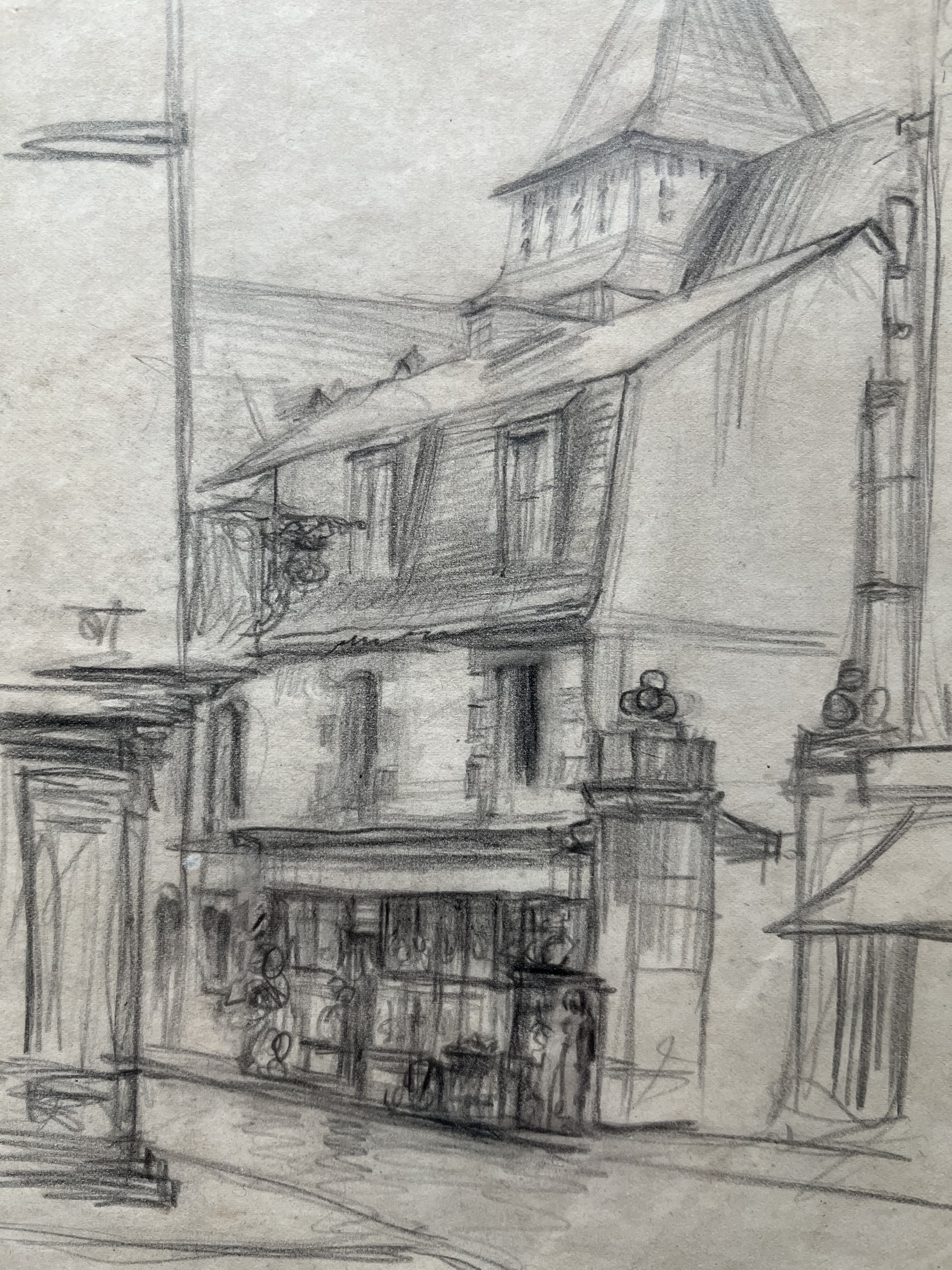
Frank Lewis Emanuel (1865-1948), ‘Old Curiosity Shop in Grand Avenue, Dinan’. Pencil on paper, c.1880-1890. Private Collection.

Emanuel was born in London and studied at the Slade School of Art under the French artist Alphonse Legros (1837-1911); he first exhibited at the Royal Academy in London in the 1880s and at the Paris Salon in 1886. The pencil drawing of the ‘Old Curiosity Shop’ dates from the 1880s or 1890s and records a real antique shop in the town of Dinan in north west France. In this sense it is both an historical document and a work of art.

There is of course a very rich tradition of paintings and drawings of antique & curiosity shops in Europe dating back into the 19th century, especially in France and Italy, 2 key hunting grounds for antique collectors. Emanuel’s drawing of a ‘curiosity shop’ in Dinan is emblematic of the important role that antique and curiosity dealers played in the consumption of the past. Lewis’s drawing also reminds us of the relationship between buying and selling ‘antiques’ and historic urban environments – in the 19th century Dinan still retained much of it’s medieval historic fabric, a castle, city walls and many half-timbered buildings – ideal backdrops for antique and curiosity shops and curio hunters.

This practice of antique shops layered into the historic fabric, and indeed shops occupying historic buildings, is a recurring theme in the history of antique dealing. Here’s another example, this time an antique shop in Italy, a painting by the American artist William Merritt Chase (1849-1916) ‘The Antiquary’s Shop’ (1879).
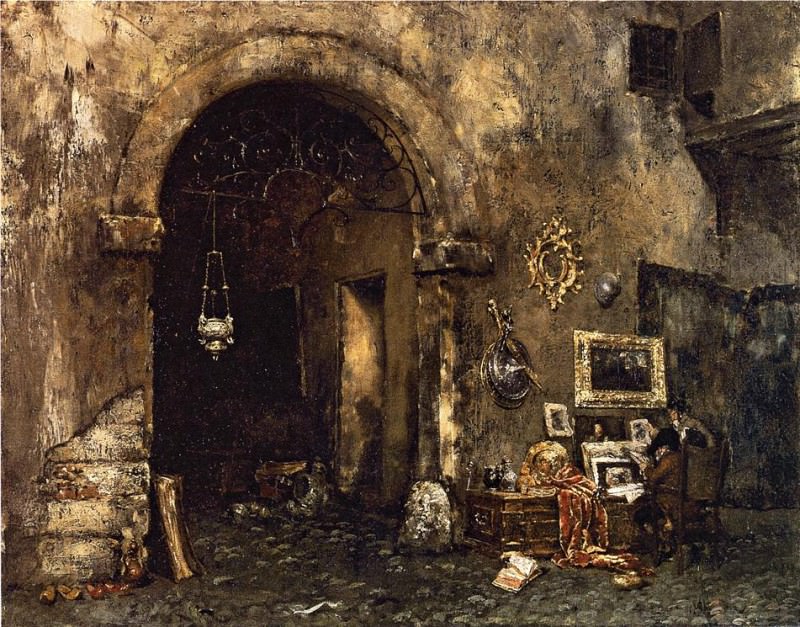
William Merritt Chase (1849-1916), ‘The Antiquary Shop’ (1879), Oil on canvas. Brooklyn Museum, USA. Image copyright Brooklyn Museum USA.

The shop in Chase’s painting was located in Venice, the home of many leading antique dealers in the 19th century. Perhaps the shop that Chase portrayed is that of ‘Mr Zen’, a well-known dealer who had extensive dealings with the art historian and art dealer Otto Mundler (1811-1870) in the 1850s, when Mundler was working as an agent for the National Gallery in London.

But to return to our key focus on antique shops in visual culture in Britain and further additions to the corpus of paintings and drawings of antique shops. Another new addition to the archive of paintings is a contemporary example – emphasizing the point of the enduring interest of antique shops in visual culture. This painting (below) by the artist Deborah Jones (1921-2012) of a ‘curiosity shop’.
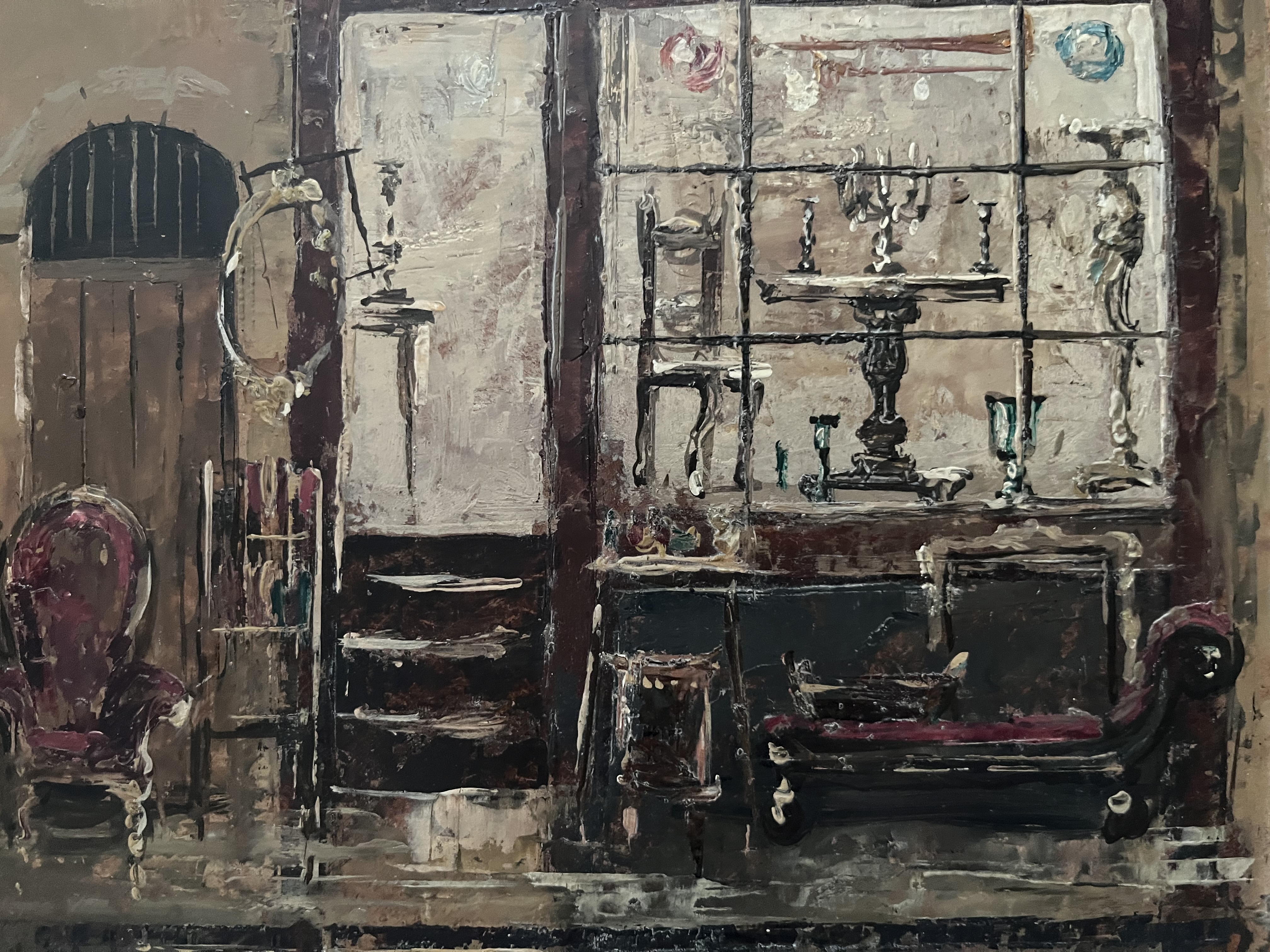
Deborah Jones (1921-2012) ‘Curiosity Shop’. Oil on panel, 1980s. Private Collection.

Jones was born in Wales and worked as a theatre and set-designer for The Royal Opera House, Glyndebourne and the Royal Shakespeare Company in Stratford-upon-Avon. Her artworks tend to reflect this practice and can be a little formulaic (at least for my taste) – see below – Jones’ oil on canvas, ‘Mrs Dabbs Antique Shop’.
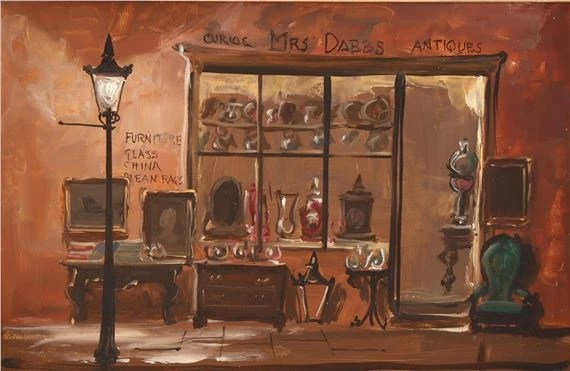
Deborah Jones (1921-2012) ‘Mrs Dabbs Antique Shop’. Oil on canvas, c.1990. Private Collection.

Deborah Jones’ painting of the ‘Curiosity Shop’ (above) by contrast, seems more vibrant, more impressionistic perhaps, and reminded me of some of the earlier traditions in the depictions of ‘curiosity shops’, that started with George Cattermole (1800-1868) and his representation of Charles Dickens’ ‘Old Curiosity Shop’ in 1840 (see below).
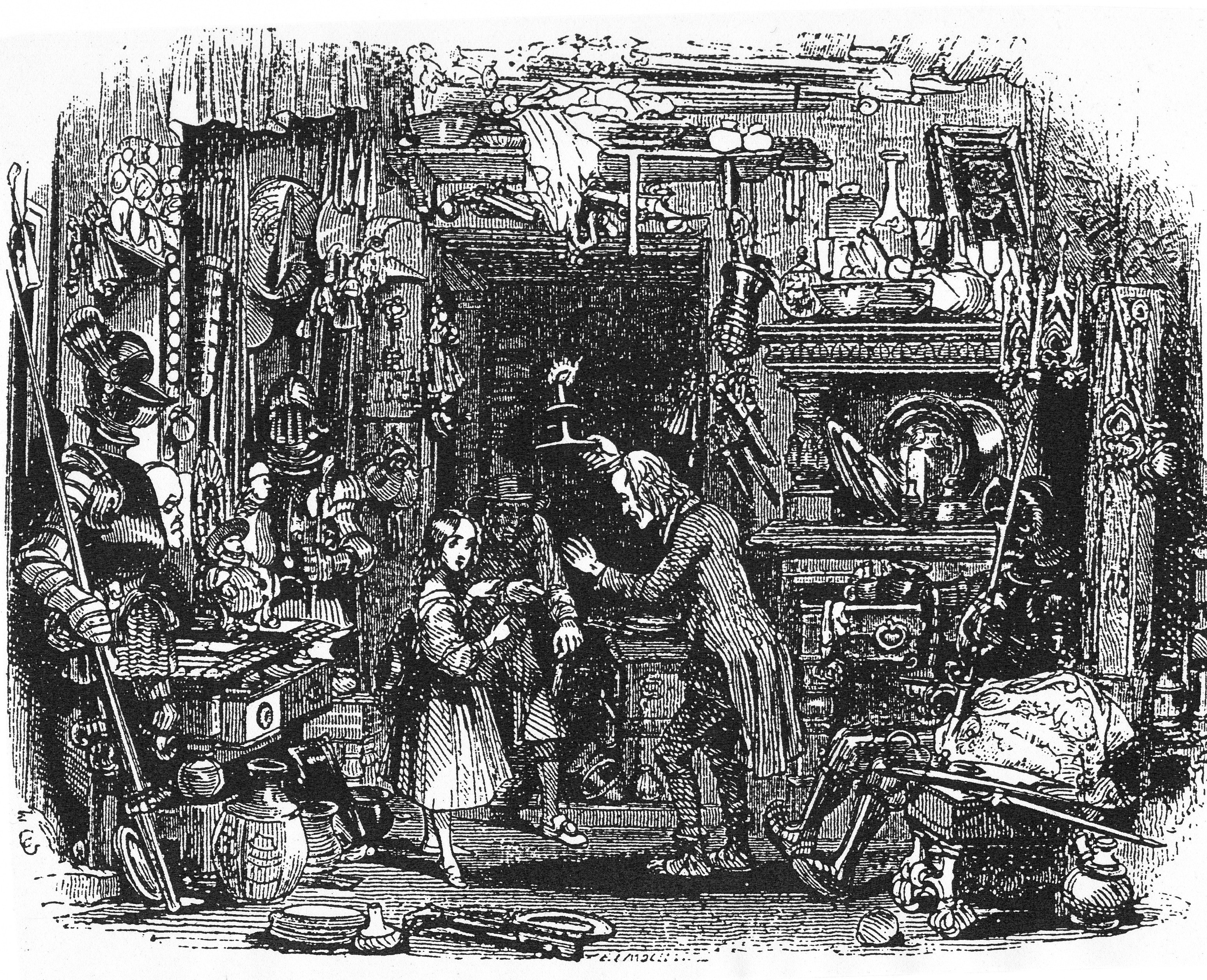
George Cattermole (1800-1868). The Old Curiosity Shop (1840). Wood Engraving. Private Collection.

Hence Jones’s oil on panel was acquired for the project as an interesting contemporary example of the enduring legacy of the antique shop in visual culture.

Mark
December 22, 2017

James Munro’s ‘Old Curiosity Shop’, Inverness c.1910

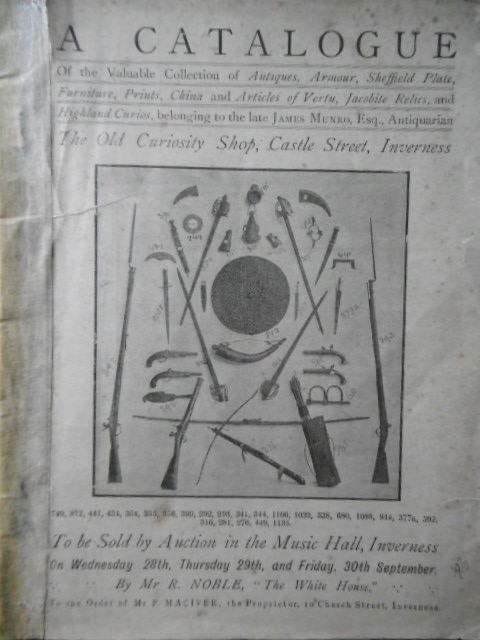
I recently acquired a rare copy of the auction sale catalogue of the collection of antiques of the antique dealer and antiquary James Munro – all part of the growing body of historic antique dealer ephemera we are building at the University of Leeds.  Munro traded from ‘The Old Curiosity Shop’ in Castle Street, Inverness during the period c.1870 to the opening decade of the 20th century.  The catalogue dates from 1910 and includes a wide selection of antique objects that would have been of interest to collectors in the period.  Like many Scottish collectors, Munro appears to have had a particular interest in Scottish antiquarian objects and especially anything associated with the Jacobite Rebellion. Munro is listed in the Trade Directory for Inverness in 1899 as ‘Antiquarian’, at 3 North Church Place, Inverness – I’ve yet to find out when Munro died, but the sale is a posthumous auction, so he certainly died a short time before 1910.

Title page, ‘A Catalogue of the Valuable Collection of Antiques…belonging to James Munro Esq. 1910. Private Collection.

The catalogue contains some fascinating photographs of the stock of objects that would have been on sale in Munro’s shop.  The collection amounts to 1,398 lots at the auction; although it seems this was not the full extent of the collections of Munro.  Indeed, the ‘Introductory Note’ to the catalogue, penned by the ‘auctioneer’ R. Noble, of ‘The White House’ Inverness (who also appears to have been working as a cabinetmaker – (or at least there is an R. Noble listed as ‘cabinetmaker’ at the White House in the 1909 Trade Directory for Inverness) states that a ‘Mr F. Maciver, of the Highland Bazaar, has pleasure in intimating that he has purchased the entire stock belonging to the estate of the late Mr James Munro and he is now issuing this catalogue of the articles to be sold by auction…..(and he) intends to dispose of the remainder by auction on a future date.’ I wonder if there is another catalogue of the other auction, if it took place?

There are some wonderfully interesting objects in the auction sale – lot 377a, for example – ‘AN OLD DIRK with ivory handle inlaid with gold.’ The catalogue states that this dirk was allegedly the same dirk that was used by Alexander Fraser, the ‘Young Master of Lovat (born 1677)’ to kill the piper at ‘the wedding at Teawig’ – a story that at the time had also been rehearsed in the recently published book, The Clan Fraser in Canada by Alex Fraser (1895). The dirk is a little hard to see in the photograph on the title page of the catalogue, but it’s the small dagger, just to the left of the rifle on the right hand side of the photograph (above).

The auction also included ‘A RARE OLD HIGHLAND TARGE, an excellent example of the XVII, Century…’ (lot 812 – and is the small, circular shield in the centre of the photograph of the title page of the auction catalogue – there is a very similar Targe in the National Museum of Scotland and we are checking to see if this might be related to that Targe?)

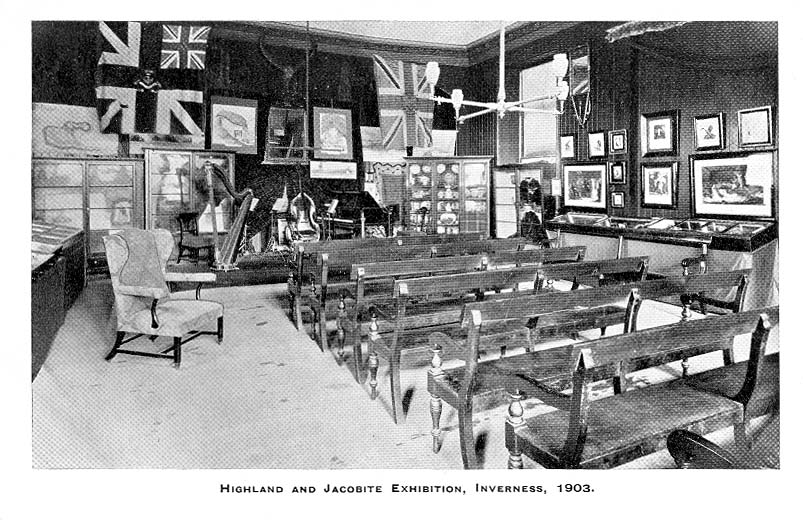
Munro’s collection must have been well-known in Scotland – he had earlier loaned a number of ‘Highland Curios’ and ‘Jacobite Relics’ from his collections to the Highland and Jacobite Exhibition, held at the Inverness Free Library and Science and Art Building in 1903 –  these two photographs of the displays at the 1903 exhibition are from the ‘Exhibitions Study Group‘ website.


The Highland and Jacobite Exhibition took place between 14th July and 20th September 1903 and was one of a number of similar exhibitions that took place throughout the 19th century and into the opening decades of the 20th century throughout Britain.

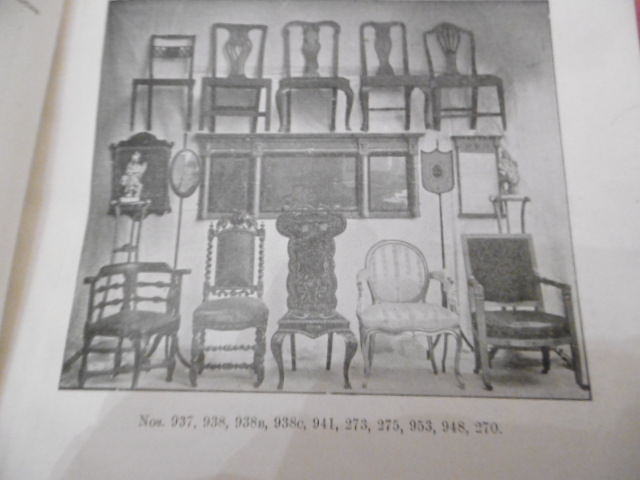
The auction sale of Munro’s ‘Old Curiosity Shop’ took place at the ‘Music Hall, Inverness’ on Wednesday 28th, Thursday 29th and Friday 30th September 1910, and as well as the famous collections of ‘Highland Curios and Jacobite Relics’ also included a wide range of objects that were symptomatic of an antique dealers’ stock at the time – here’s a photograph of a selection of ‘Old Furniture’ as it was described at the time, from the auction catalogue –

A Catalogue of the Valuable Collection of Antiques…James Munro….1910. Private Collection.

The chairs appear to be a selection of 18th and mid 19th century examples, as well as some evidently of more recent date, supplemented by some antique mirrors and pole firescreens. The small corner chair in bottom left is especially interesting – it was described as ‘an Old Laburnum Corner Chair from Orkney, supposed to have belonged to the Bishop of Orkney’ (Lot 937).

Whether the chair actually had this illustrious provenance is, I guess, not really the point – as with many of these ‘relics’, it was the object’s role as ‘story teller’ that was central to their interest to collectors. As the commentary of Mr Noble suggests in the ‘Introductory Note’ to the catalogue – ‘Anyone visiting his Old Curiosity Shop in Castle Street and looking around could not help feeling as if transported back into the times of clan feuds, and even into Druidical and Pictish ages.’

Mark

Home Subjects

a working group dedicated to the display of art in the private interior, c. 1715-1914

The Period Room: Museum, Material, Experience

An International Conference hosted by The Bowes Museum and The University of Leeds

H. Blairman & Sons Ltd

A research project investigating the history of the antiques trade in Britain in the 19th & 20th centuries

Museum Studies Now?

'Museum Studies Now?' is an event which aims to discuss and debate museum and heritage studies education provision.

The Burlington Magazine Index Blog

art writing * art works * art market

East India Company at Home, 1757-1857

A research project investigating the history of the antiques trade in Britain in the 19th & 20th centuries