Our thread on ‘Antique Shops in Visual Culture’ seems to be very popular with readers of the Antique Dealers Research blog, so here’s the third instalment (the last for a little while at least). If you have missed Parts I, & II of this thread, you can catch up in Blog posts July 30th 2023 and September 30th 2023.
Our first image in this third instalment of the ‘antique shop’ in visual culture is by the artist John Watkins Chapman (1832-1903) and dates from about 1880.
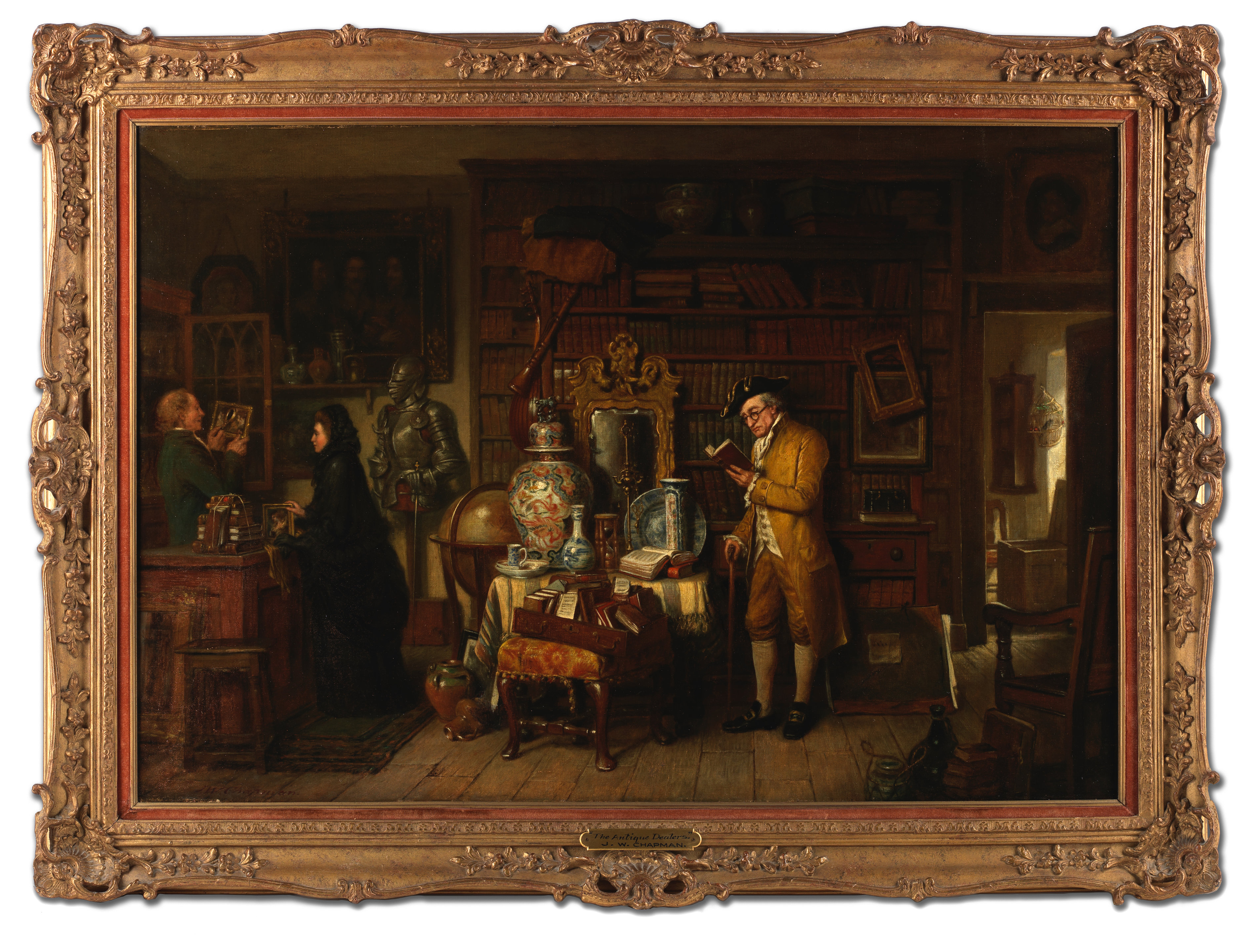
Chapman’s painting, which is quite large, about 2 feet by 3 feet, is typical of his work. In the painting Chapman seems to be rehearsing common visual and literary tropes of the antique and curiosity shop – the shop piled high, cluttered with curious things. Chapman also presents the viewer with a quintessential Victorian sentimental narrative; the woman to the left, dressed in black is evidently a widow and in need of funds. She appears to be trying to sell some small paintings to the antique dealer, who is examining them carefully with his magnifying glass in an act of obvious connoisseurship. I’m not sure what the character reading a book in the centre is supposed to represent; he appears to be dressed, deliberately, in antiquarian style as an 18th century gentleman – perhaps he is a poetic memory of the life of the array of objects surrounding him? The painting was previously sold at auction at Christie’s in London in 1948 but we are pleased to say that it is now part of the collections of the antique dealer research project.
John Watkins Chapman is well-known for his representations of ‘The Old Curiosity Shop’, made famous through Charles Dickens’ story in 1840-41. Chapman painted dozens of examples in the second half of the 19th century. Perhaps Chapman’s most well-known and accomplished painting of this subject is his superbly detailed ‘The Old Curiosity Shop’ (also dating from c.1880), which was sold at Christie’s in 1991 – I think it remains in a private collection in Italy? But one of our readers may know otherwise?

This painting also formed the visual basis for our own contribution to the theme of the antique shop in visual culture, with our recreation of ‘The Old Curiosity Shop’ at the exhibition ‘SOLD! The Great British Antiques Story’ at The Bowes Museum (January to May 2019) – see various blog posts on the Antique Dealers Research blog from December 2018. You can still download a PDF copy of the SOLD! exhibition catalogue (for free!) here https://antiquedealers.leeds.ac.uk/research/sold-the-great-british-antiques-story/

However, whilst both of Chapman’s paintings have a common theme, that of the antique and curiosity shop, Chapman’s representation of ‘The Old Curiosity Shop’ is much more anchored in the narrative of Dickens’ story. ‘Little Nell’ sits front and centre, and one can also see her Grandfather, the curiosity dealer, tucked away at the back of the shop, worrying over his mounting debts, and which will eventually lead to their escape from the shop and ultimately to the death of Little Nell.
What is also interesting about Chapman’s paintings is the representation of curious and antique objects. All of them will, I guess, be representations of real antique objects; some are iconic – the suits of armour in both paintings are emblematic objects of both the (generally) earlier ‘curiosity shop’ and the (generally) later ‘antique shop’. Although it’s clear that the suits of armour are not exactly the same example in each painting. However, the 18th century giltwood mirror (in the centre of ‘The Antique Dealers’, facing outwards; and just to the right, side-on, in ‘The Old Curiosity Shop’) is clearly the same ‘antique’ mirror. Perhaps this was an antique object from Chapman’s own collection?
As I say, Chapman’s visual representation of ‘The Old Curiosity Shop’ draws heavily from the literary description of Charles Dickens. In Dickens’ by now iconic description of ‘The Old Curiosity Shop’, he writes, it was:
”one of those receptacles for old and curious things which seem to crouch in every corner of this town, and hide away their musty treasures from the public eye in jealousy and mistrust. There were suits of mail standing like ghosts in armour, here and there, fantastic carvings brought from monkish cloisters; rusty weapons of various kinds; distorted figures in china, and wood, and iron, and ivory; tapestry. and strange furniture that might have been designed in dreams.” (Dickens, The Old Curiosity Shop (1841) p.3)
As I have written elsewhere, ”Dickens’ interior descriptions of the shop are well known and rehearse the trope of the shop as problematic space, one that is retentive with its knowledge and in which the dis-ordered objects in its interior provided the antithesis to the ordered collections assembled by the collector.” (Westgarth, The Emergence of the Antique & Curiosity Dealer 1815-1850: the commodification of historical objects (2020, p.28).
Two further visual representations of the history of the antique trade in Britain offer both a continued visual tradition (one is an image of a cluttered interior of an antique shop) and a contrast (one is not an image of an interior of an antique shop but of an open air second-hand market stall). This pair of watercolour paintings, (also now part of the collections of the antique dealers research project) date from c.1940s; they are about 12 inches by 8 inches. They are obviously by an amateur hand, but are charmingly naïve in the representations.
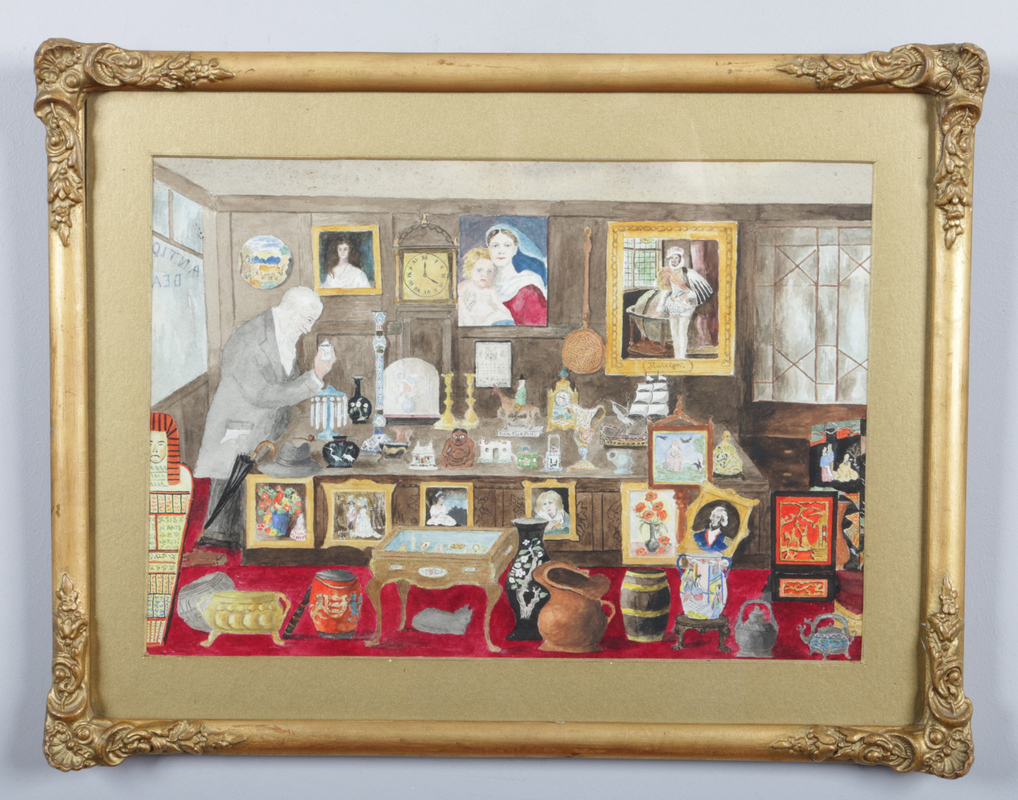

The painting of the antique shop interior (you can just see the remaining letters forming the words ‘Antique Dealer’ in the window), illustrates the wide range of antique objects that one might expect to see in an antique shop in the period. There’s also a clear sense of British nationalism in the choice of items represented – a portrait of Sir Walter Raleigh; a portrait of Horatio Nelson; the various British paintings displayed along the front of the display table. As well as objects from across the world – an Egyptian mummy, Chinese porcelains.
By way of contrast, the street market scene in the other painting illustrates a typical range of objects from second-hand cultures. Old but still usable pots and pans, bags, shoes, alongside the odd piece of broken pottery. As in the other painting, there’s a strong sense of British nationalism; the Second World War was probably taking place, or was a very recent memory, when these paintings were produced. As if to emphasise this, the small painting/photograph? to the right in the street market scene, depicts Charlie Chaplin in the famous American anti-war film ‘The Great Dictator’, which came out in 1940.
The shop behind the central figure is named ‘J. Bodger’ (certainly a fictional name – a ‘bodger’ is a wood-turner, someone who makes chair legs and turned parts of chairs and furniture). ‘J. Bodger’ is named as a ‘furniture dealer’, but seems to be buying and selling all sorts of second-hand material. The relationships between second-hand dealers and antique dealers has always been very close, but here, by the 1940s, there’s a very clear distinction between the two practices, as articulated in the pair of paintings. Indeed, Portobello Market (located in Portobello Road, as the street sign in the painting illustrates), which had developed as an open air market in the late 19th century, became associated with the second-hand trade by the 1920s, and became famously associated with the antiques trade in the 1940s, when these paintings were created.
The 19th century paintings by John Watkins Chapman and the anonymous pair of 20th century paintings of Portobello Road antique and second-hand markets, offer fascinating insights into the visual culture of the antique trade, and it’s rich potential as a research resource for the history of antique dealing.
Mark


 antiquedealersblog