Posts tagged ‘London trade’

July 30, 2023

Antique Shops in Visual Culture I

As readers of the antique dealers Blog will know, we’ve been acquiring antique dealer ephemera for many years now – dealer catalogues, photographs and archives, as part of the on-going research project into the history of the antique trade in Britain. Much of this material, including the extraordinary collection of antique dealer archives, is housed at the Brotherton Library Special Collections at the University of Leeds.

More recently, we’ve been seeking out paintings depicting antique shops – we recently acquired, for example, a naïve painting (oil on canvas, c.1880, signed ‘M. Davis’) of the shop of Mr Deadman at an auction in The Netherlands of all places – ‘Ye Old Beckenham Curio Shoppe’ (see below). The shop depicted in the painting was in High Street, Beckenham in Kent (the building, which appears to be 16th century, was demolished by the 1930s). Frederick William Deadman (either the same dealer or perhaps a relative) was still trading as an antique dealer in the late 1930s – from a shop in Station Road, Freshwater on the Isle of Wight.

M. Davis ‘Ye Old Beckenham Curio Shoppe’, oil on canvas 24 in x 17 in; c.1880. Private Collection.

This painting has been added to our growing collection of paintings of antique shops, all of which demonstrate how important the idea of the antique shop has been in British cultural life. An earlier acquisition, of an equally naïve painting, illustrates this point. The painting, a watercolour, (10.5 in x 15 in, by H. Middleton-Holding, c.1910) of an antique shop in York Street, London, was acquired at auction in Shaftesbury, Dorset in 2019. It’s also a rather naïve work, but is charmingly rendered (see below):

H. Middleton-Holding, ‘York Street, Westminster, London’ watercolour, (10.5 in x 15 in), c.1910. Private Collection.

The artist has copied an engraving of the same scene, much more competently rendered and published in The Daily Chronicle on Tuesday September 27th in either 1904 or 1911, a copy of which is pasted to the backboard of the painting (see below) – (unfortunately, the actual year of the publication is obscured by some brown paper tape). The newspaper article outlines the history of the buildings in York Street, London and their occupiers, including the political philosopher Jeremy Bentham (1748-1832) and the highwayman Dick Turpin (1705-1739).

Backboard of the watercolour by H. Middleton-Holding. Private Collection.

The main shop in the scene, No. 32 York Street, was the location of a well-known female antique dealer, Mrs Amelia Jane Hardingham, who owned several antique shops in York Street (nos. 28-32), and began trading as an antique dealer in about 1900, in Waterloo Road, London. According to the article in The Daily Chronicle no.32 York Street was famous as the home of the artist George Morland (1763-1804) – perhaps that is why H. Middleton-Holding painted the scene again?

Amelia Hardingham’s shop was also captured in a photograph in c.1910 (see below).

A. Hardingham, Dealer in Works of Art, 32 York Street, London, c.1910. Photograph, The Victoria & Albert Museum, copyright V&A Museum.

Amelia Hardingham’s antique shop was swept away when the buildings on York Street were demolished in 1923 to create ‘Petty France’, but the shop front of her shop was saved. It was gifted to the Victoria & Albert Museum by the Army Council (which owned the buildings) as a fine example of a late 18th century shop front. In fact, as those who visited the exhibition, ‘SOLD! The Great British Antiques Story‘ at The Bowes Museum in 2019, may remember we used an image of Amelia Hardingham’s shop front as part of the introductory interpretation at the exhibition. Indeed, when the 18th century shop front was put on display at the V&A in 1924, it was set up as a display reproducing Amelia Hardingham’s antique shop (see below).
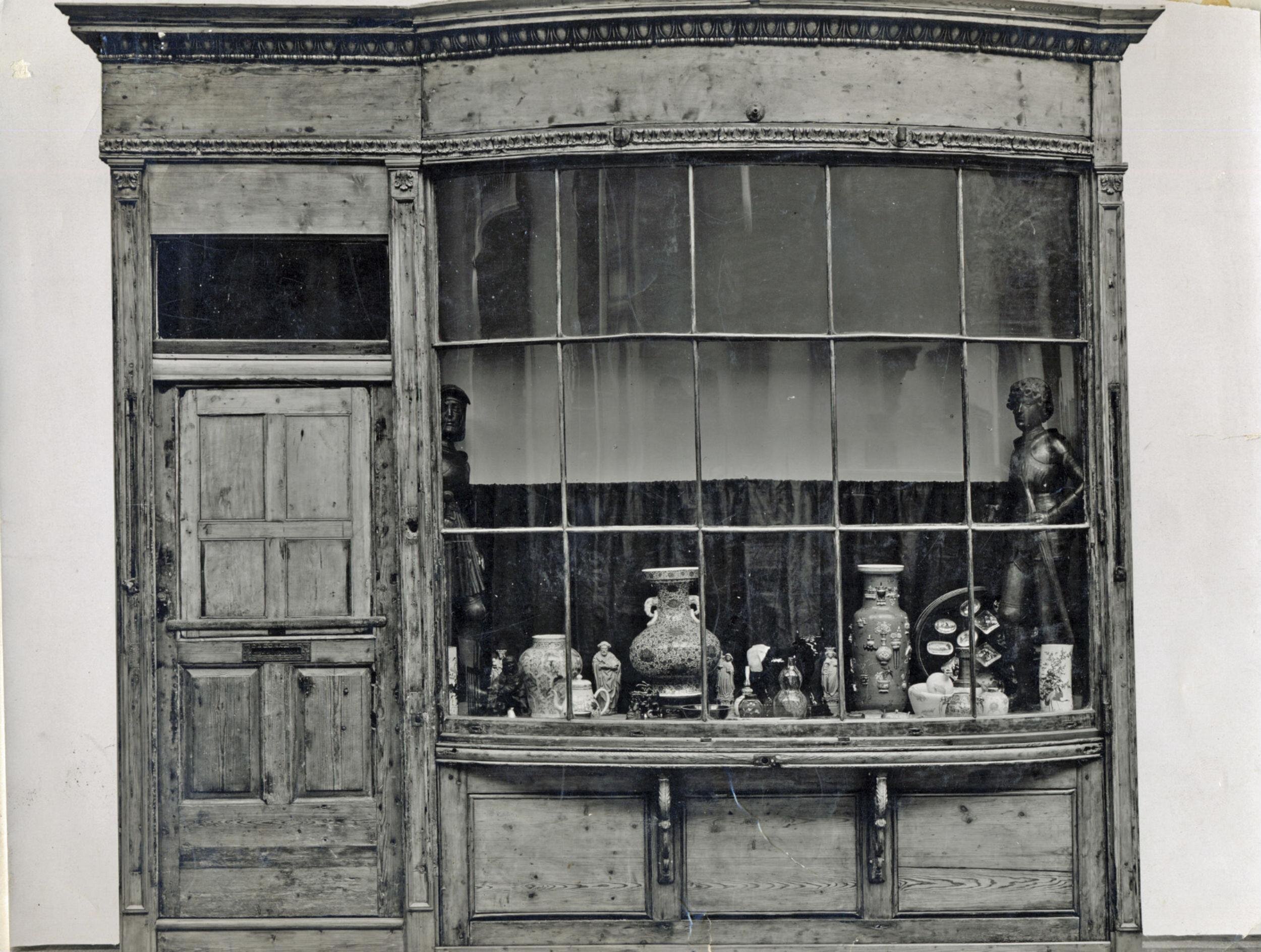
18th century shop front on display at the V&A Museum, 1924 – W.88-1923. Photograph, The Victoria & Albert Museum. Copyright V&A Museum.

The antique shop display at the V&A Museum caused some consternation in the Press at the time, with some commentators questioning if it was appropriate that an antique shop display should be in a museum!
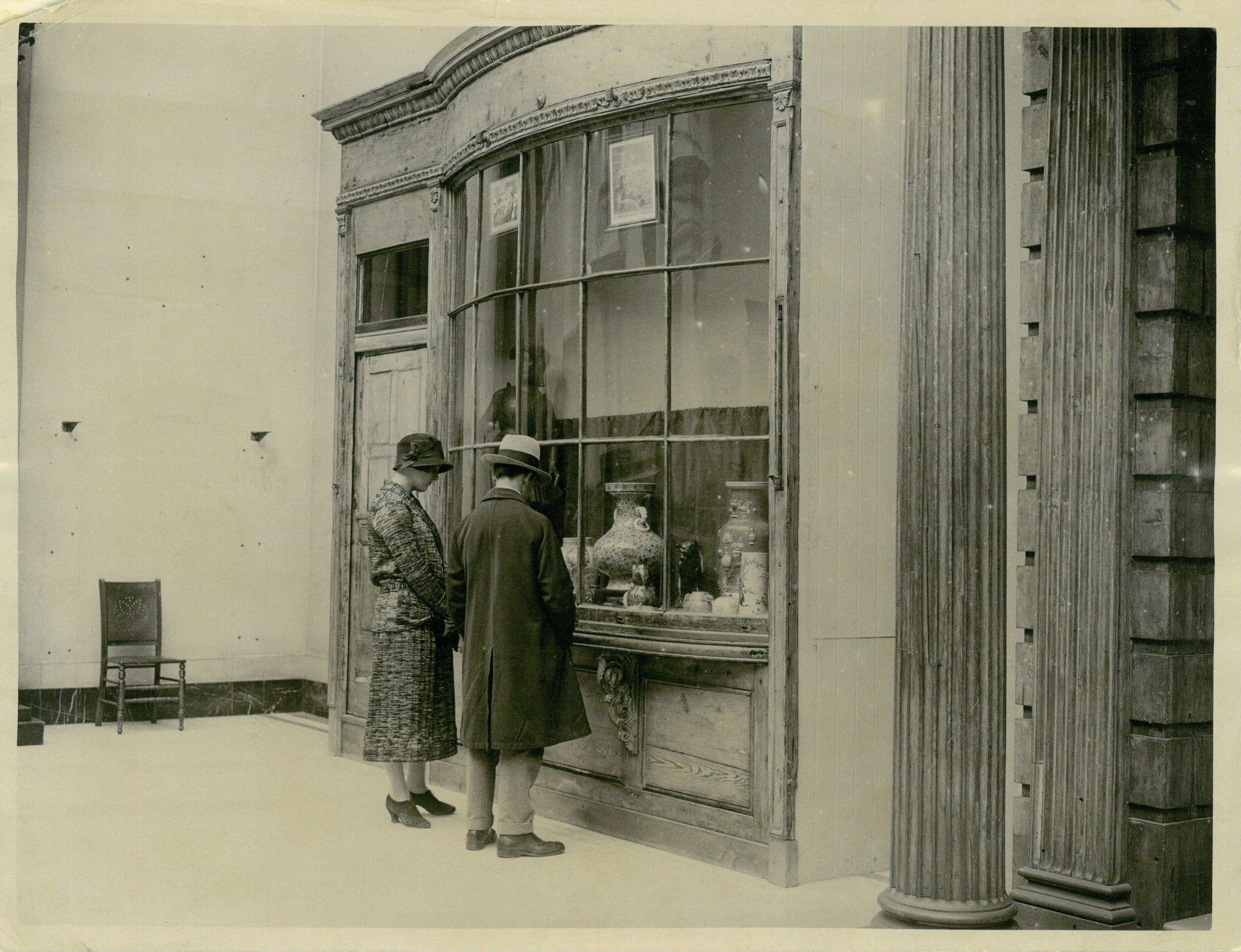
18th century shop front, displayed as an antique shop, at the V&A Museum in 1924. Photograph, The Victoria & Albert Museum. Copyright V&A Museum.

Readers of the Blog may also be interested to hear that women antique dealers (including Amelia Hardingham) are also the focus of some of our ‘Year of the Dealer‘ digital trails – we have ‘women antique dealer’ themes in our Trails at The Victoria & Albert Museum, The Bowes Museum and at Preston Park Museum as part of this project – so do keep your eyes open for our Year of the Dealer Trails public launch in September. As for paintings of representations of antique shops, we have acquired several other paintings over the last few years and will create another Blog post illustrating those in the next few months, so keep you eye on the Blog!

Mark

May 4, 2014

Wartime and the antiques trade

Geoffrey Hill, courtesy of the Hill family

Geoffrey Hill, courtesy of the Hill family

Working through the Kelly’s directories for Essex has revealed a small but rather stable group of dealers plying their trade in the county thus far but, having started work on the directory for 1914 this morning, I started to think about the more unusual links between the trade and the two world wars. Obviously many shops went out of business in this period both as a result of the huge numbers of casualties and the resulting loss of expertise and also the dire economic conditions that resulted from both periods of conflict. However the wartime periods also led to a number of determined young men and women returning from active service and wondering whether the antiques trade might offer them the chance to start afresh in what must have seemed like a brave new world.

Geoffrey Hill joined the RAF reserve forces in late 1938, becoming a full-time pilot in 1939 and serving in 65 squadron throughout the battle of Britain. Whilst flying a mission in February of 1941 he was shot down and forced to abandon his aircraft, leading to his capture by German forces. Mr Hill was sent to Stalag Luft 111. He promptly escaped from the prison camp on three occasions, leading to his imprisonment in Colditz for the rest of the war. Whilst in Colditz, Mr Hill made use of his German language skills and the availability of what was presumably a well-stocked prison library, reading all he could about antiques and antique furniture in particular.

When hostilities ended, Geoffrey Hill, now an MBE due to his bravery during the war, set up in business in London as Jeremy Ltd, soon moving to the Kings Road and, many years later, to Lowndes Street in Belgravia. His hours of study at Colditz had clearly been time well-spent as he soon built up a reputation as one of the world’s leading experts in English and continental furniture and objets d’art, helping to form many major collections in the process. Amongst his many achievements, he served as president of the British Antique Dealers Association and was a long time exhibitor and member of the vetting committees at the Grosvenor House fair. By the time of his death in 1997 his two sons Michael and John had taken over the running of the business and John Hill continues to run the business as a consultancy to this day. It is remarkable to think that, however indirectly, the horrors of the second world war led to the discovery and sale of some of the finest works of art from the 18th and 19th centuries.

For a fuller account of Geoffrey Hill’s wartime career, please see this link

If anyone has other stories about the activities of members of the trade during the wars then please get in touch.


Chris Coles

Volunteer project research assistant


Home Subjects

a working group dedicated to the display of art in the private interior, c. 1715-1914

The Period Room: Museum, Material, Experience

An International Conference hosted by The Bowes Museum and The University of Leeds

H. Blairman & Sons Ltd

A research project investigating the history of the antiques trade in Britain in the 19th & 20th centuries

Museum Studies Now?

'Museum Studies Now?' is an event which aims to discuss and debate museum and heritage studies education provision.

The Burlington Magazine Index Blog

art writing * art works * art market

East India Company at Home, 1757-1857

A research project investigating the history of the antiques trade in Britain in the 19th & 20th centuries