Posts tagged ‘Dealer Advertisements’

November 29, 2025

J. Rochelle Thomas – The Georgian Galleries, London (and New York)

Our friend Chris Coles very kindly sent me a photograph of the antique dealer J. Rochelle Thomas (thank you Chris!), and as it’s quite unusual to have photos of historical antique dealers I thought I’d make a blog post about Rochelle Thomas – as you’ll see, he was a very important dealer, but appears (like most of the important dealers of the past) to have been lost to history! Anyway, here’s the photo from Chris:
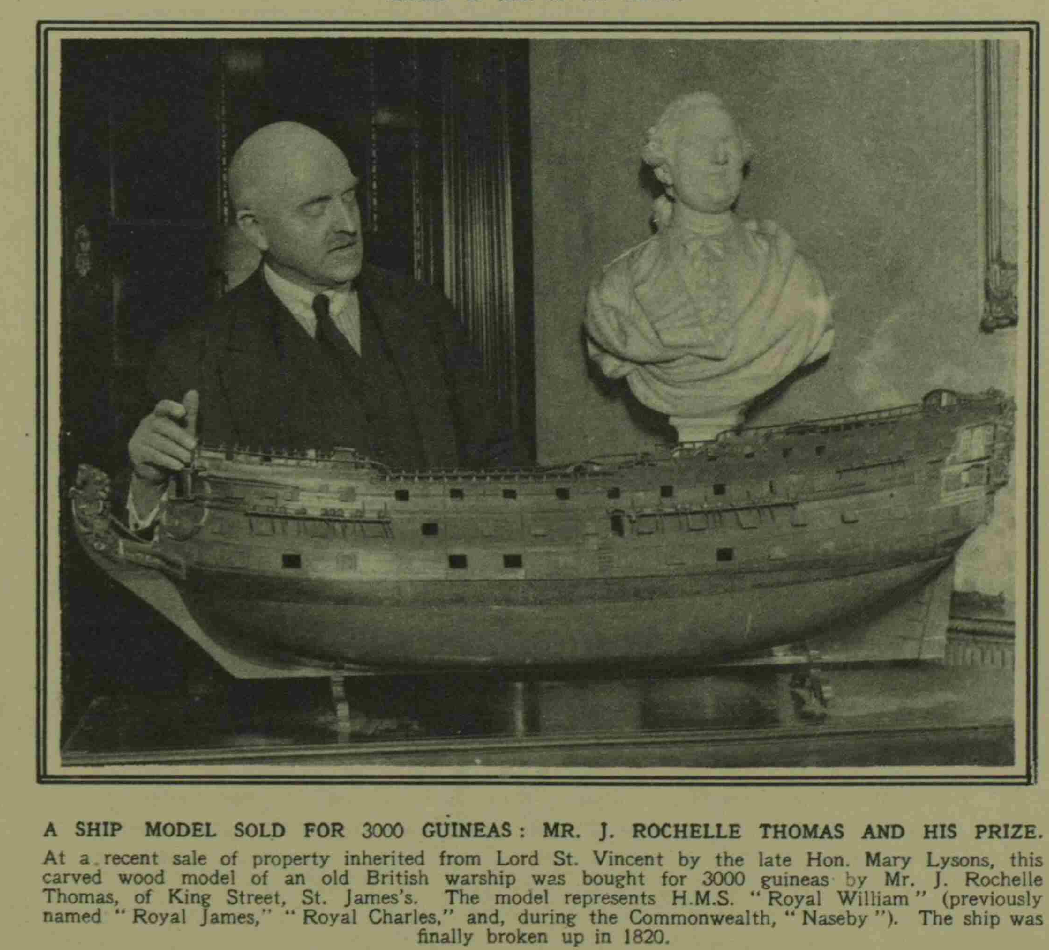
J. Rochelle Thomas with a model ship, from Illustrated London News, April 21st 1928, p.675. Kind thanks to Chris Coles.

The photograph shows Joseph Rochelle Thomas (1865-1938) with a wooden model of the warship ‘Royal William’ (1719) scale 1.48, and made in 1719. As the report states, Rochelle Thomas bought the ship model (I guess in 1928) for 3,000 guineas (£3,150), an enormous sum (hence the newspaper report), which would have been as much as £1.3m at the time – in relative income value – see measuring worth.com The model is now in the National Maritime Museum at Greenwich (not on display); it seems to have been acquired by the museum through the antique dealer J.M. Botibol, who had a well known antique shop in Hanway Street in London in the period. Chris tells me that the ship was advertised as ‘seen by appointment at Mr. Botibol’s shop’. It may be that Rochelle Thomas and Botibol bought the ship model in partnership with one another (this was, and still is, a common practice in the antique trade).
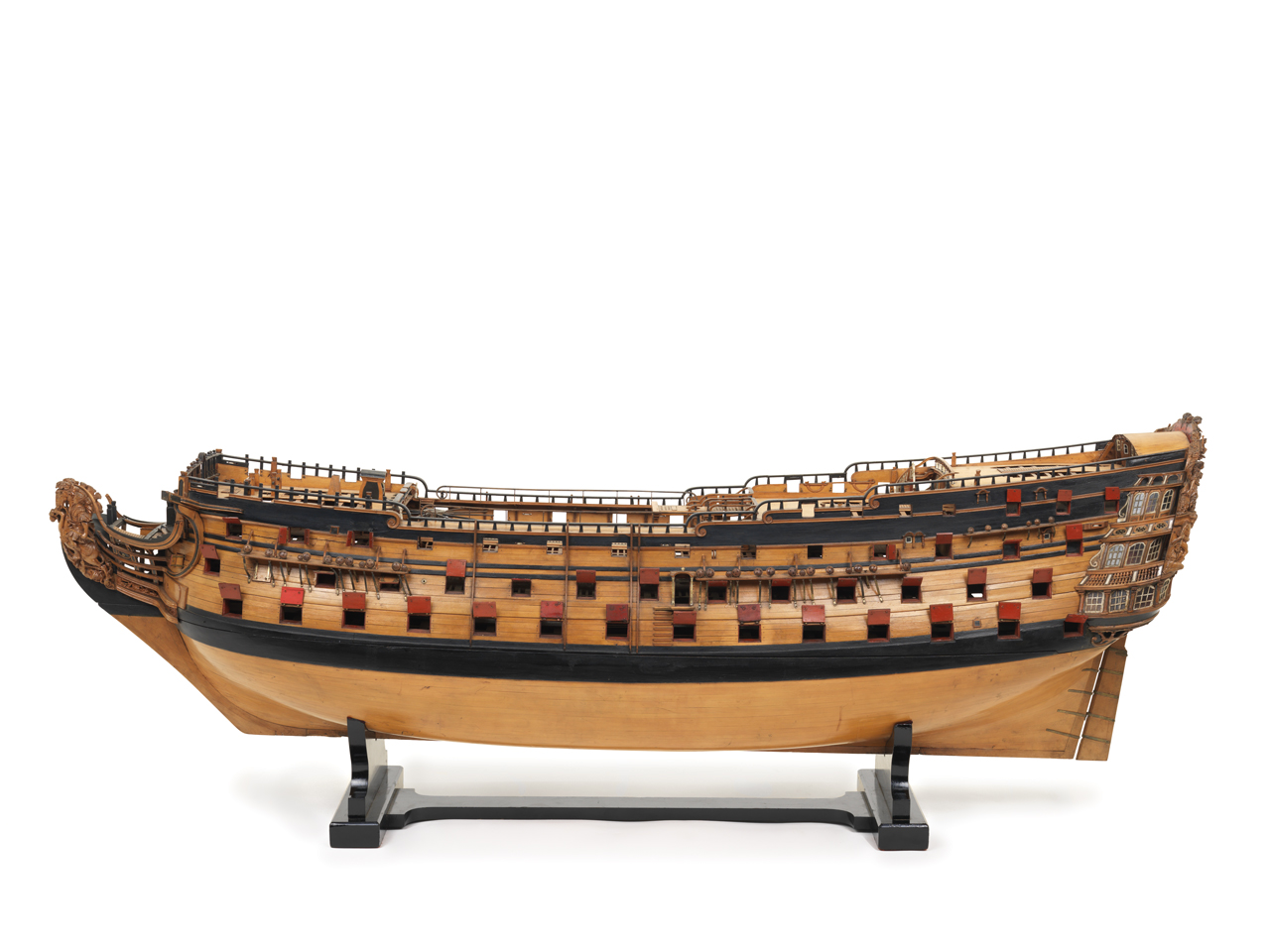
Royal William (1719) wooden ship model 1.48 scale. 440mm x 1365mm x 320mm. National Maritime Museum, Greenwich, London. Image National Maritime Museum, Greenwich.

J. Rochelle Thomas was a very well established antique dealer by the 1920s; the business would later expand to New York selling to many wealthy American collectors, including scores of English antiques to Henry Francis du Pont (1880-1969); du Pont’s collections of American antiques remain at Winterthur Museum in Delaware, USA. Indeed, here’s an image of J. Rochelle Thomas’ London shop from a letter sent to du Pont in 1931, which was right next door to Christie’s King Street auction rooms. The premises occupied by Rochelle Thomas are now part of Christie’s auction rooms.
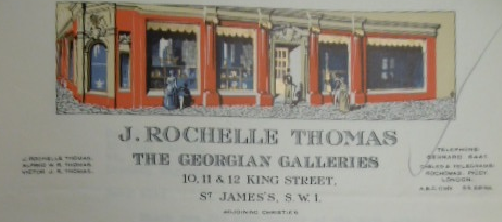
Letterhead, J. Rochelle Thomas, King Street, St. James’s, London, 1931. Photograph Antique Dealers Research Project, University of Leeds.

By this date (the 1930s), the J. Rochelle Thomas business was run by Joseph and his two sons Victor Joseph Rochelle Thomas (1887-1958) and Alfred William Rochelle Thomas (1886-1965). By the early 1950s Rochelle Thomas had opened a shop in New York, at 1166 Second Avenue – our friend Chris Jussel (formerly of Verney & Jussel, leading antique dealers in the USA) and a fount of knowledge about ‘old’ dealers, tells us that J. Rochelle Thomas’ shop in New York was run by Peter Thomas, (Joseph’s grandson), and that it occupied the former warehouse premises of Day, Meyer, Murray & Young; they had no shop window and so, as Chris says, it was an unusual move but the business continued to be a success given Rochelle Thomas’ reputation. Chris remembers visiting the Rochelle Thomas shop in the 1970s, when there were stacks of dinner services all over the floor. By the 1970s Rochelle Thomas opened a branch in Palm Beach, Florida, which, as Chris Jussel tells us, was run by Peter Thomas’ sons (Peter retired to Bermuda in the 1970s); the Palm Beach business traded into the 1980s but sadly Peter’s 2 grandsons died very young and the business closed in the 1980s – as Chris says, the end of a very important dealership. J. Rochelle Thomas sold many antiques to Francis du Pont (and many other American collectors) throughout the 20th century.

The Rochelle Thomas business began in 1859 (they celebrated a centenary year in 1959, according to some of their business letterheads) in Birmingham in the UK. It was started by Henry Thomas, who appears to have been born in about 1815 – the 1861 Census records Henry as aged 48 and working as an ‘ironmonger’ in Birmingham; by 1871 he was working as a ‘cutler’. His son, Joseph Rochelle Thomas (the man in the photograph) was born in 1865 and by the 1890s was described in the Census (1891) as ‘Dealer in Old Bank Notes’; by the 1911 Census Rochelle Thomas was describing himself as ‘Dealer in Pictures, Furniture and Porcelain’, and by 1921 he was ‘Dealer in Works of Art’. His sons, Victor and Alfred, both started working for their father’s antique dealing business from an early age and ran the business following Joseph Rochelle Thomas’ death in 1938. The business was also known as ‘The Georgian Galleries’. J. Rochelle Thomas was elected first President of the British Antique Dealers’ Association in 1918 as well as being a member of several international dealer associations (in Paris, Brussels and New York); so he was a highly respected dealer in the opening decades of the 20th century.

J. Rochelle Thomas appears to have been fascinated by objects that had interesting historical associations – in this sense he was certainly an antiquarian – and often advertised such objects in his sales advertising campaigns in magazines such as Apollo and The Connoisseur. One example (of many!) is an advert for a chair made from the famous (infamous!) mulberry tree wood from Shakespeare’s house in Stratford-on-Avon – if you’re interested in Shakespearian mulberry tree ‘relics’ do have a look at my essay on the subject (see – Mark Westgarth, ‘Well Authenticated Blocks’ in Shakespeare’s Afterlife in the Royal Collections edited by Sally Barnden, Gordon McMullan, Kate Retford and Kirsten Tambling, (Oxford University Press, 2025), pp.103-111)
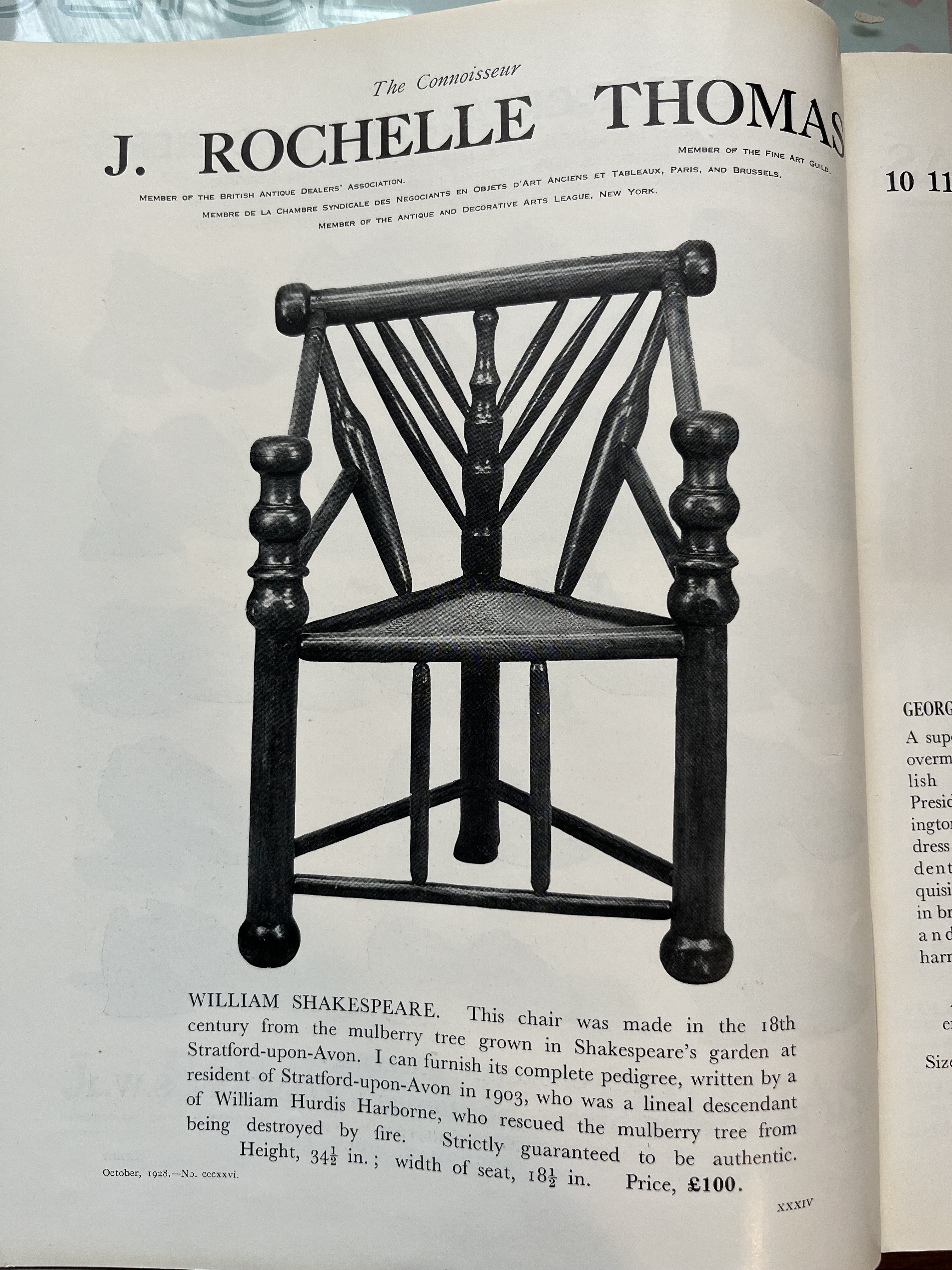
Advertisement for J. Rochelle Thomas, The Connoisseur October 1928. Photograph Antique Dealer Research Project, University of Leeds.

The advert in The Connoisseur October 1928 illustrates an 18th century triangular chair, allegedly made from the wood of the famous mulberry tree – it was priced at £100. Not sure where the chair is now, but if anyone recognises it, do let me know!

Coincidently a while ago I acquired an old sales catalogue produced by J. Rochelle Thomas in 1923 which also contains several items for sale with significant historical associations. The catalogue was issued to facilitate a ‘Clearance Sale’ that Rochelle Thomas undertook in 1923 as part of a refurbishment of his shop in King Street, St. James’s. As the catalogue states, ‘To my customers, as I am about to make extensive alterations to my premises I find it necessary to hold a Clearance Sale of the greater portion of my stock, and I am doing so at 50 per cent. in every case below the original marked prices in order to realise promptly.’ Here’s the cover of the catalogue:
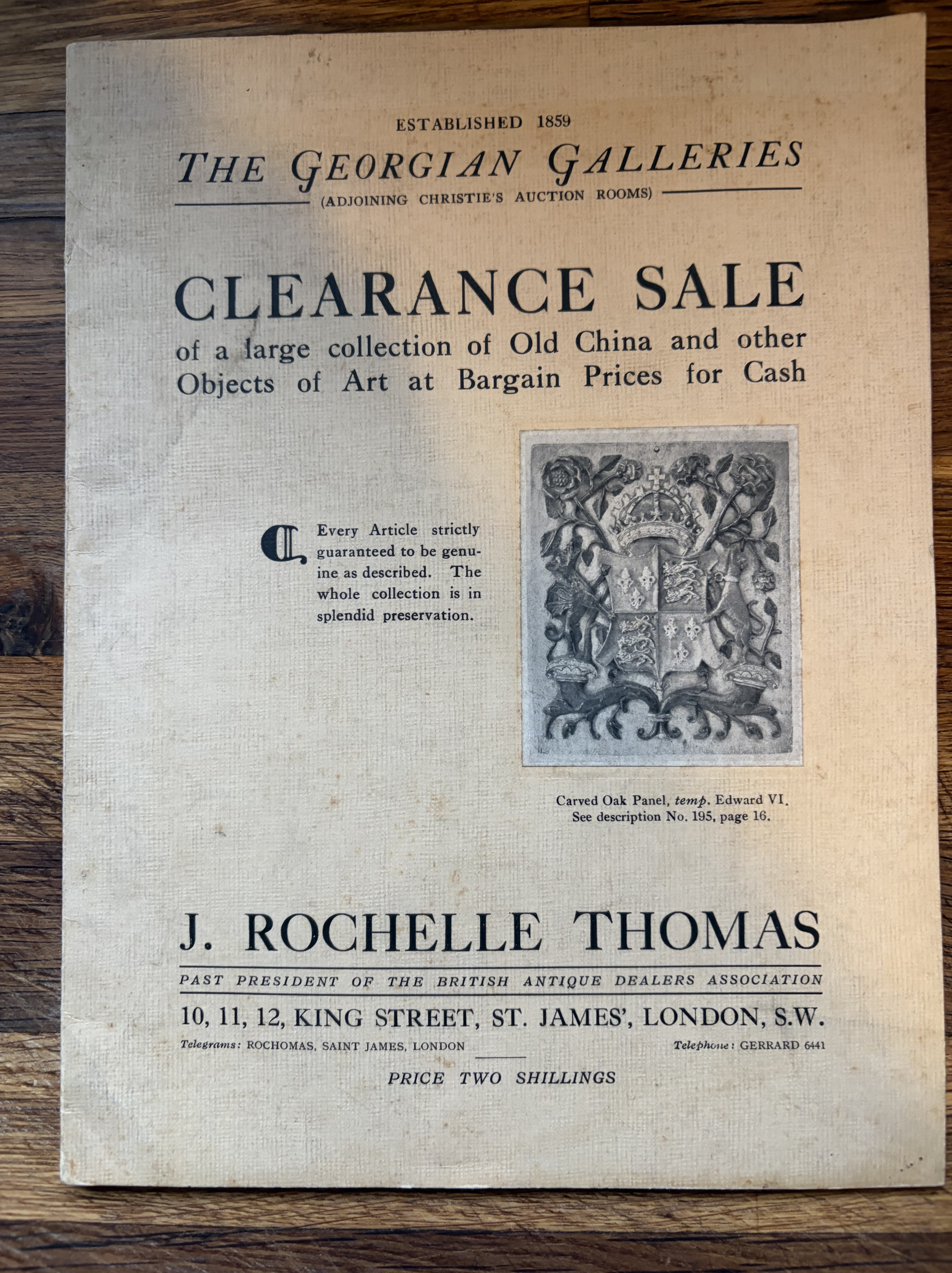
J. Rochelle Thomas sales catalogue, 1923. Photograph Antique Dealers Research Project, University of Leeds.

Sadly the catalogue does not have any photographs of the items for sale except the front cover image of what is described as ‘Carved English Royal Coat of Arms, Period Edward the 6th; fine preservation. A great rarity’ (priced at £37.10.0s, reduced from £75). The catalogue has more than 750 antiques for sale at 50% discount, including some important historical ‘relics’. Item 198 for example (see below) ‘The renowned Shakespearian Relic ‘The Boar’s Head’ at Eastcheap, carved in boxwood and set in two natural tusks’ and priced at £60 (reduced from £120). This was a famous object in the 19th century, having been in several collections, including that of the antiquary Thomas Windus FSA (1778-1854).
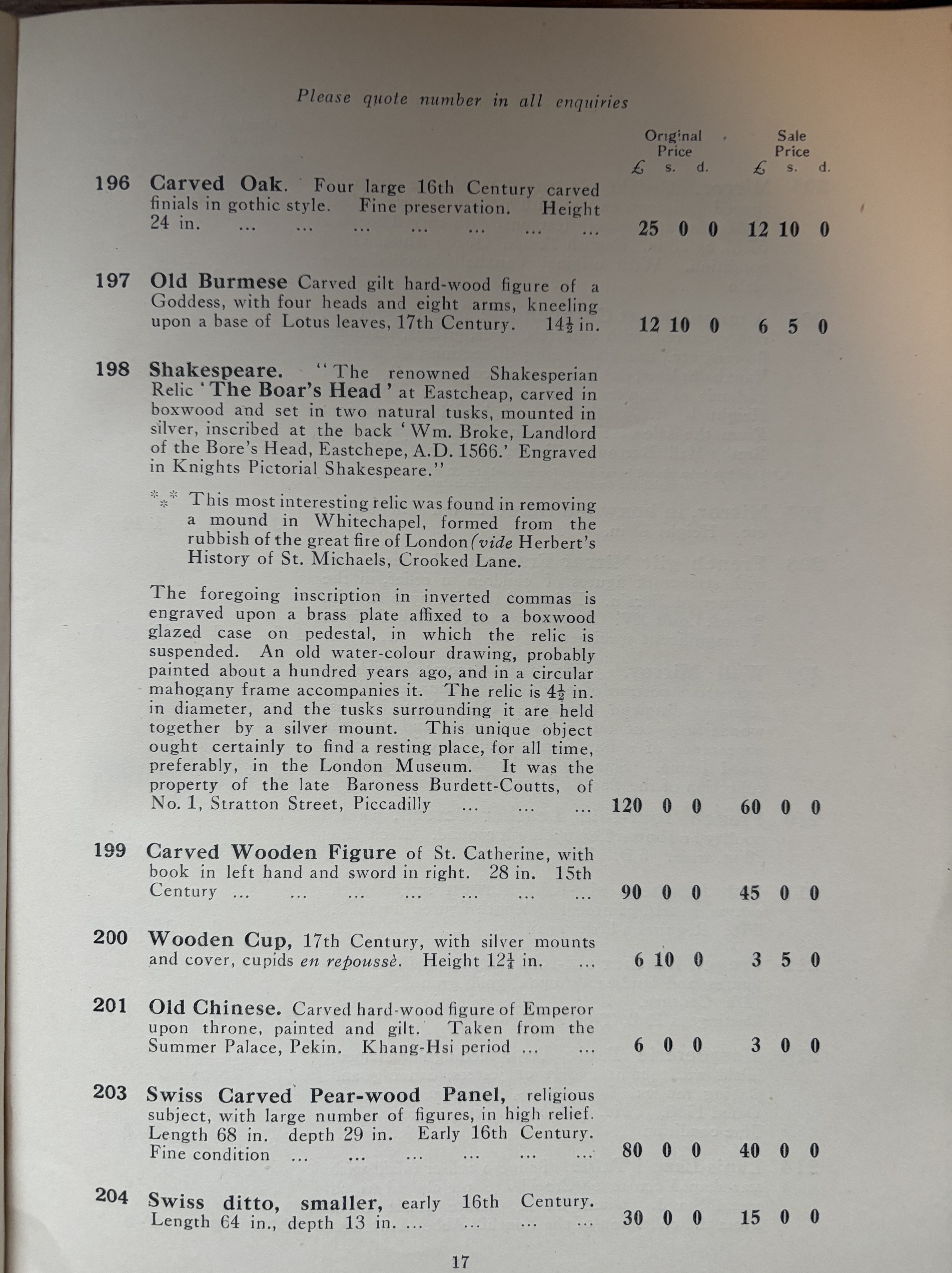
J. Rochelle Thomas sales catalogue, 1923. Photograph Antique Dealers Research Project, University of Leeds.

The ‘Boar’s Head’ was offered for sale at the auction of the collection of Thomas Windus in 1855 where it was reportedly sold for £25 and 4 shillings to the Shakespeare scholar James Halliwell-Phillipps (1820-1889), editor of a lavish Shakespeare Folio edition at the time. It was illustrated in The Pictorial Edition of the Works of Shakespeare edited by Charles Knight (volume 1, 1839-42) – (see below).
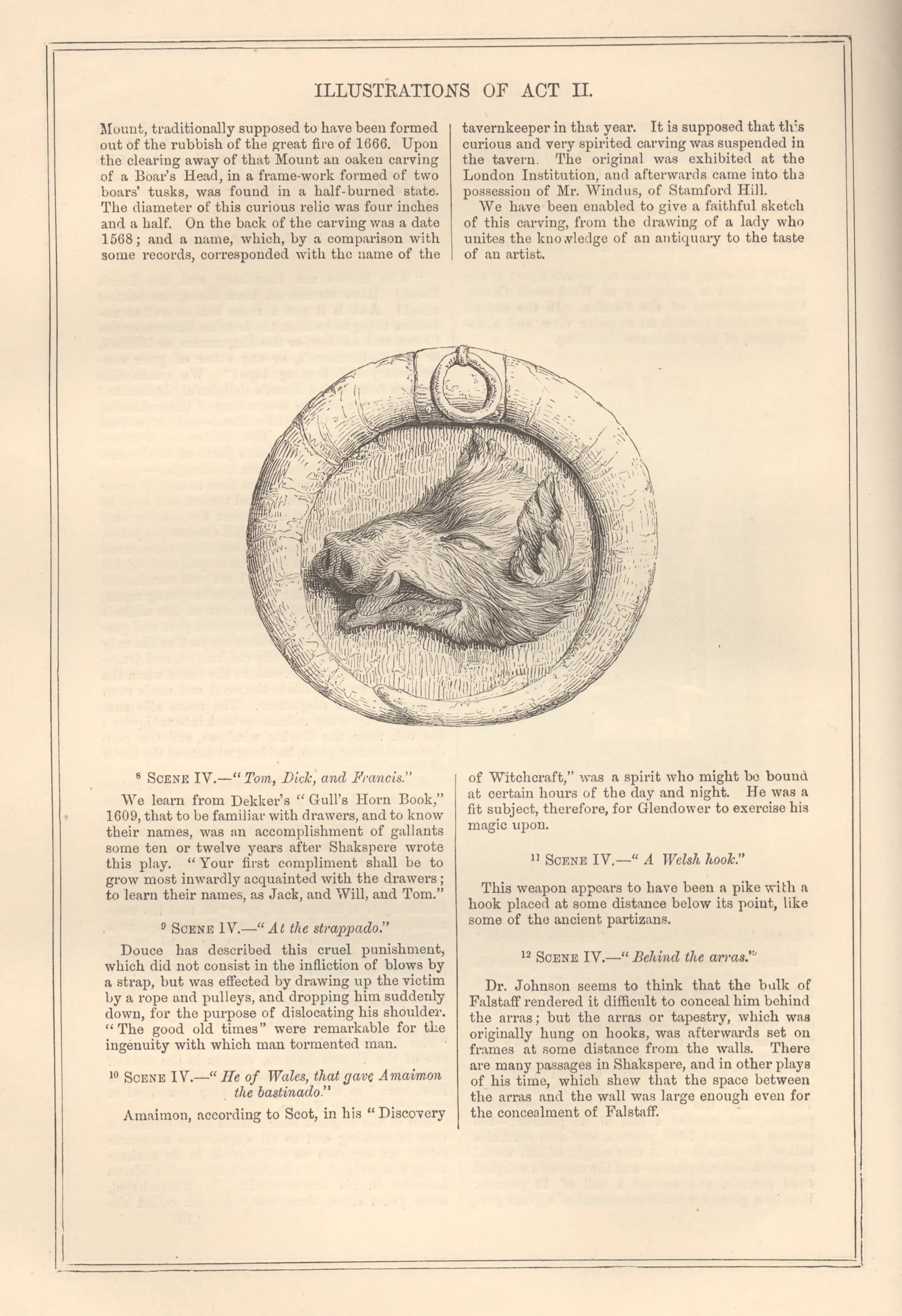
The Pictorial Edition of the Works of Shakespeare edited by Charles Knight (volume 1, 1839-42).

However, the ‘Boar’s Head’ also appeared in the auction of the Windus collection sold by Ansley Windus (Thomas Windus’ son) in 1868, so perhaps it remained unsold at the 1855 auction or was retained by the family. According to the 1923 J. Rochelle Thomas catalogue the ‘Boar’s Head’ was the ‘property of the late Baroness Burdett-Coutts’ (1814-1906); it was offered for sale at £60 (discounted from £120). This important historical object has also subsequently disappeared so if anyone knows where it is, do let me know!

Another object offered for sale in the J. Rochelle Thomas catalogue has been easier to trace – Item 741 – ‘The original carved marble portrait bust, by the great Sculptor Roubilliac, of Jonathan Tyers the proprietor of Vauxhall Gardens. Purchased at Brandon House, Suffolk, from the sale of the effects of Tyers descendants.’ (£50, discounted from £100) – (see below):
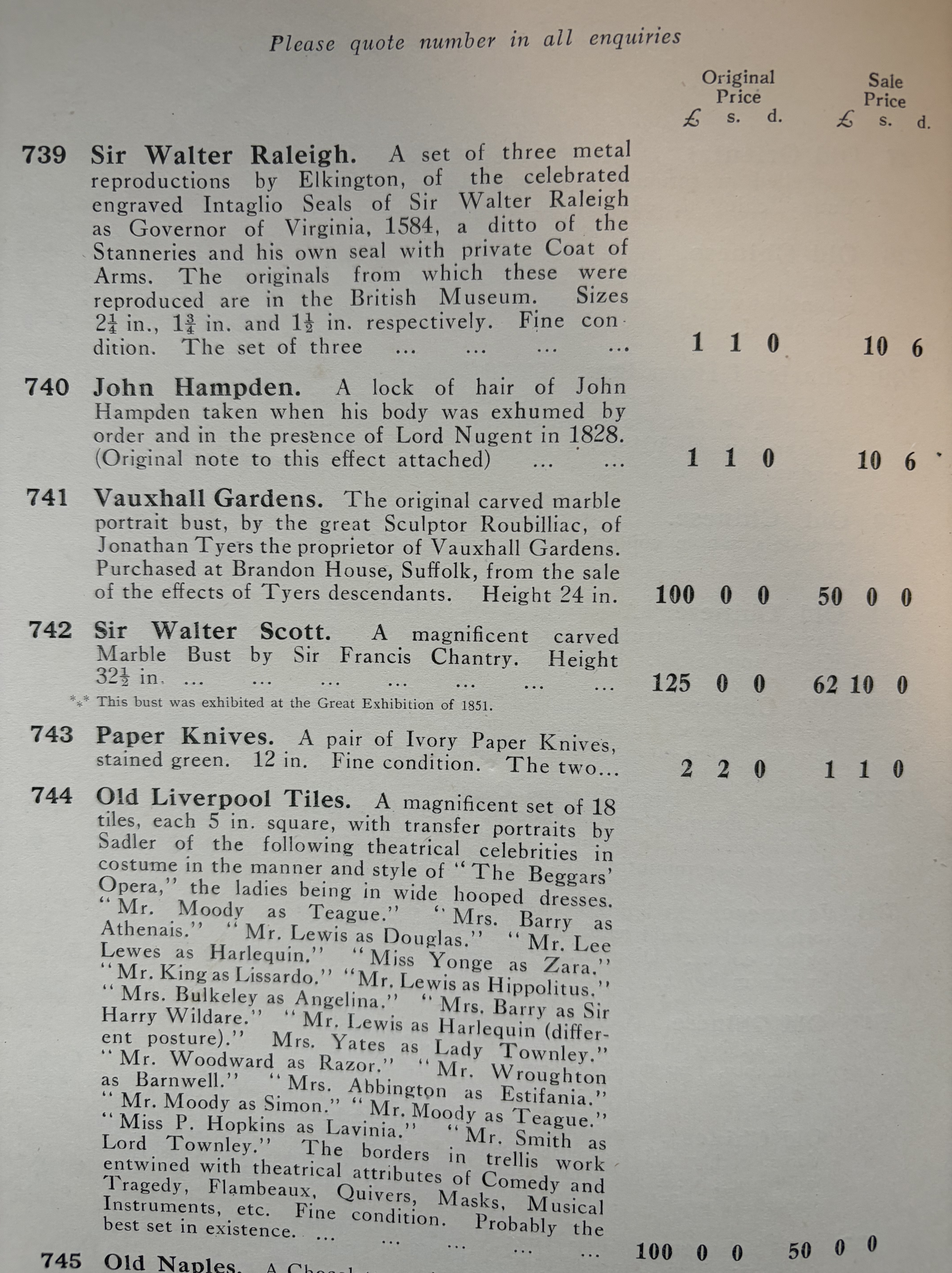
J. Rochelle Thomas sales catalogue, 1923. Photograph Antique Dealers Research Project, University of Leeds.

Here’s the sculpture (thanks to a photograph by David Bridgwater – see his blog HERE):
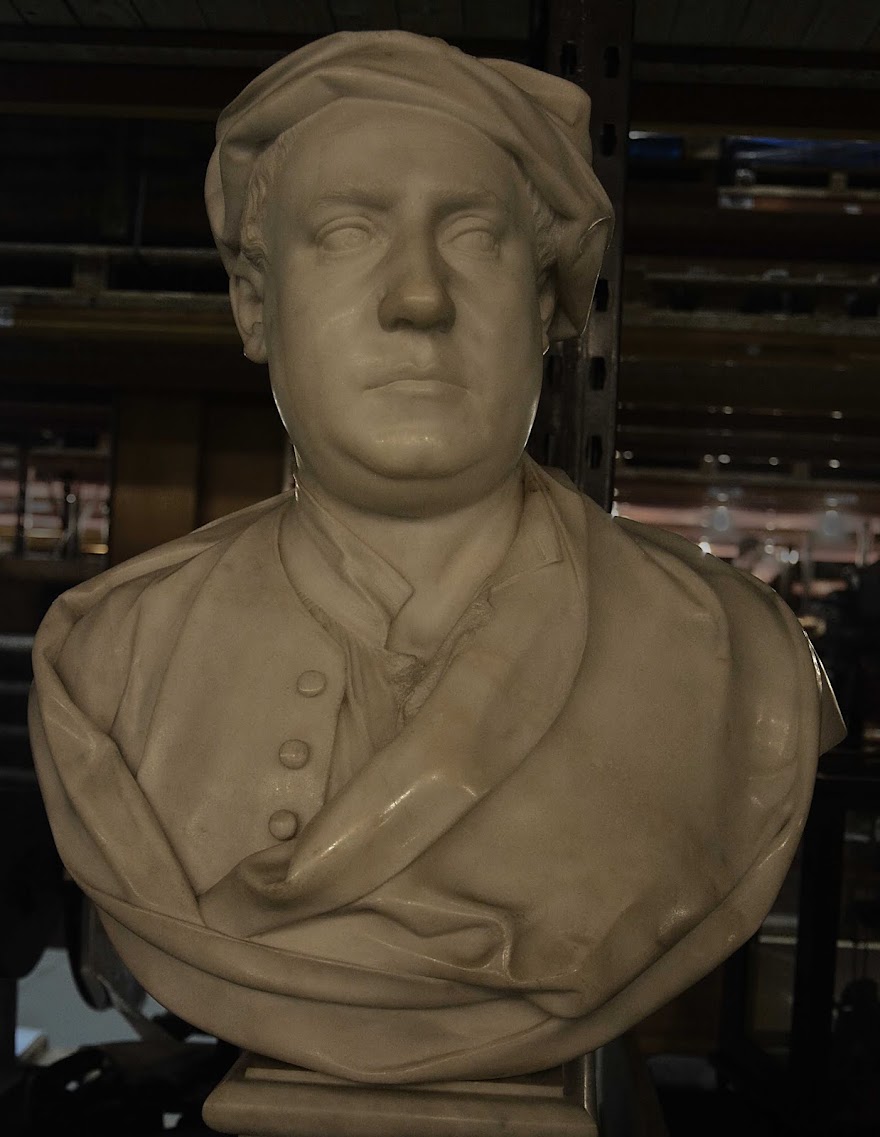
Louis F. Roubiliac (1702-1762) bust of Jonathan Tyers (1702-1767), c.1738. Birmingham Museums. Photograph David Bridgwater.

The marble bust is in the collections of Birmingham Museums, who acquired it in 1956 from the art dealer Frank Sabin. It has an illustrious antique dealer history though. It was acquired (it seems together with a terracotta bust of the same subject) by the well-known Norfolk-based antique dealer Rueben Levine (1865-1927) at the Brandon House auction sale in 1919 (see my blog post on the Levine family of dealers (27th July 2025) HERE. The terracotta bust was sold by G. Levine to the Victoria & Albert Museum in 1927 for £50 and remains in the V&A (see HERE). The marble version of the bust was sold at auction at Sotheby’s in 1927 (24th June 1927, Lot 77), and may have passed through several collections before it was eventually acquired by Birmingham Museums in 1956.

And so, a little photograph of Joseph Rochelle Thomas, kindly sent to us by Chris Coles, opened up a rich seam of research into one of the leading antique dealers of the 20th century – thank you Chris & Chris!

Mark
July 30, 2024

Local and Regional Antique Dealers

The antique dealer research blog has regularly focused on the upper echelons of the British antique trade – dealers such as Frank Partridge & Sons, Phillips of Hitchin, M. Harris & Sons., and etc. This is understandable given the importance of such antique dealers in the history of the antique trade – it’s also an inevitable consequence of the amount of archive material and ephemera that was generated by such firms, and the survival of such evidence. The antique dealer archives held at The Brotherton Library Special Collections are a testament to that – see, for example, the Phillips of Hitchin archives at BLSC

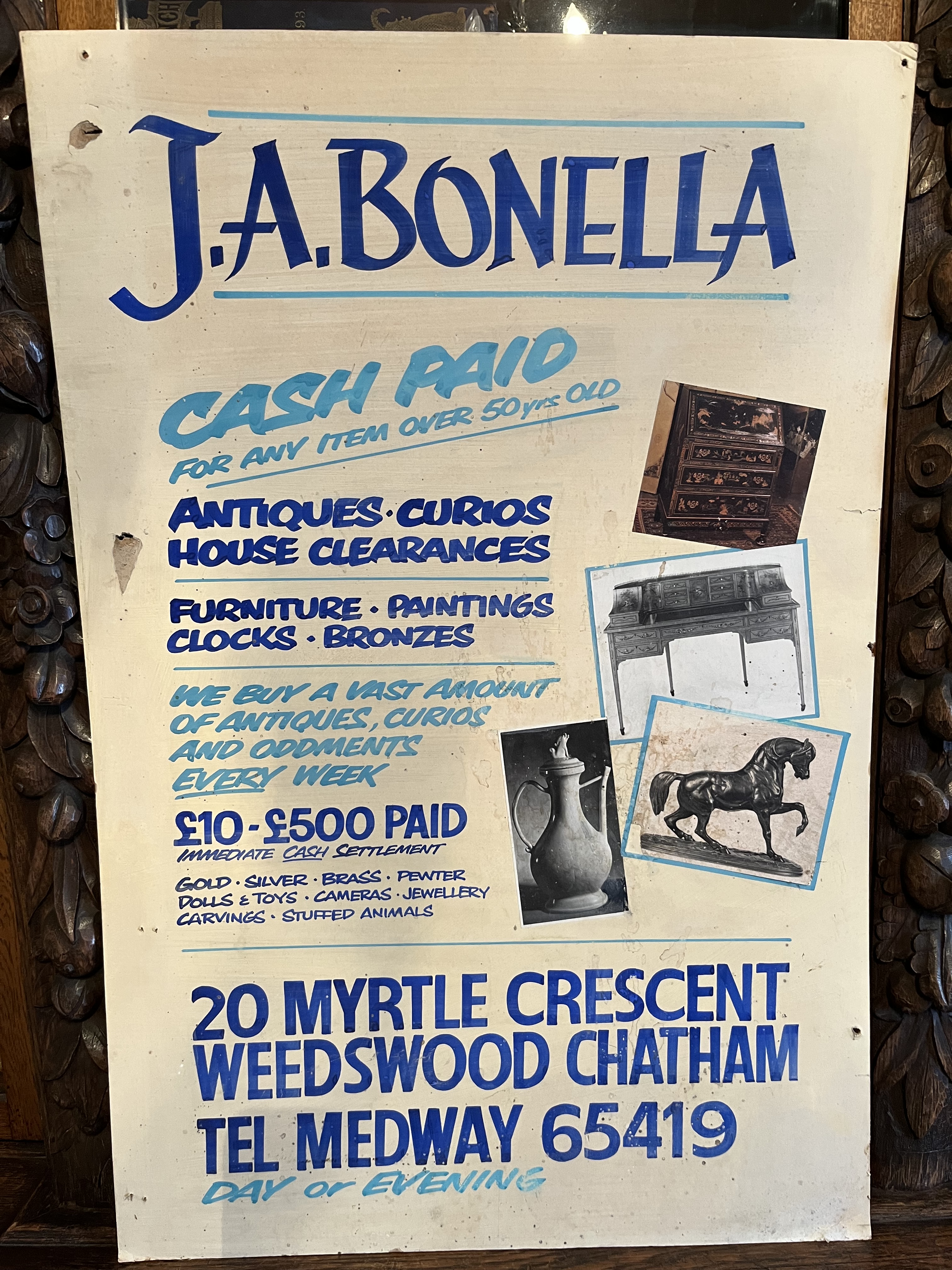
But of course the trade includes a much wider range of participants than those represented by leading London dealers and there has always been an enormous number of smaller scale, local and regional antique dealers that have made up the ecology of the British antiques trade. Ephemera associated with such lower level antique dealing practices are rare (even rarer are the business archives), but some recent additions to the growing archives of ephemera associated with antique dealing gives an insight into these, largely, marginalised histories of the antique trade. Below, for example, is one of 3 cardboard advertising boards recently acquired for the antique dealer research project at the University of Leeds. The adverts were produced by antique dealers operating well below the expensive, museum quality antiques traded by the dealers in New Bond Street in London.

All 3 cardboard advertisements are the same size (20 inches x 30 inches), hand-painted (by a professional sign-writer I would have thought) and date from the early/mid 1970s. They would have been placed in the window of the antique shop, or perhaps in advertising display cases that were quite common in urban and rural areas alike.

Advertising Board, J.A. Bonella, Chatham, 1970s. Photograph, Antique Dealers Research Project, University of Leeds, 2024.

The advertising board (above), produced by J.A. Bonella, tells us a lot about these lower level, but no less culturally significant, antique dealing practices. Jack Alexander Bonella (1938-1987) traded as an antique dealer in the 1970s and 1980s from 20 Myrtle Crescent, Weedswood, Chatham. Myrtle Crescent was not a conventional antique shop, it was a standard domestic house, so Bonella must have had a warehouse or store somewhere. Many antique dealers in the post-WWII era traded from home, (especially country antique dealers), selling to other dealers higher up the ‘food chain’ so it would not have been that unusual. Bonella’s advert also indicates that he will buy ‘any item over 50 years old’ – so not the usual 100 year rule for ‘antiques’. Such practices are aligned much more closely with the second-hand trade, at the margins of the antiques trade proper, and Bonella’s advert usefully reminds us of these structures and practices.

But of course, buying and selling at the margins also offers great opportunities for bargains, particularly in ‘house clearances’, (which Bonella also highlights) where objects can be misunderstood, mis-described or unrecognised. What is also interesting about Bonella’s advertisement are the photographs of antiques pasted onto the advertising board. The photographs appear to have been cut from antique collecting magazines – a colour photograph of an 18th century black lacquer bureau (a very fashionable, and very expensive antique, in the 1970s), a black and white photograph of a late 19th century satinwood and painted ‘Carlton House’ desk; a photograph of a 19th century French bronze horse and an early Chinese porcelain ewer. All objects that antique dealers higher up the ‘food chain’ would buy and sell. The photographs illustrate the kinds of antiques that Bonella hopes he might find, rather than antiques that he would regularly keep in stock.

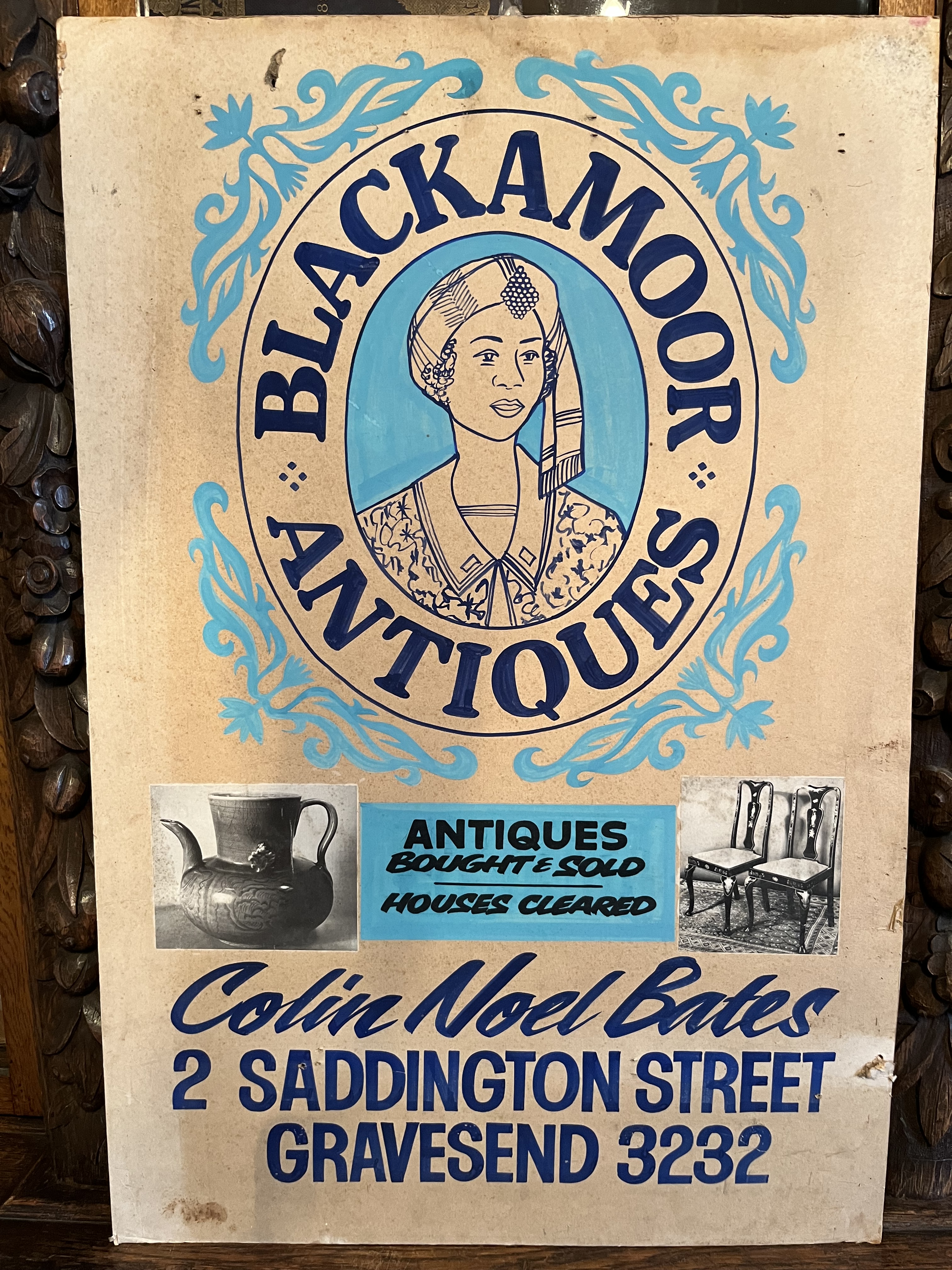
Another of the cardboard adverts has very similar paint colours and may have been produced by the same hand (the antique shops are both in Kent and only 11 miles apart). The advert relates to the antique dealing business of Colin Noel Bates (1932-1985), called ‘Blackamoor Antiques’ – (see below).

Advertising Board, ‘Blackamoor Antiques’, Gravesend, 1970s. Photograph, Antique Dealers Research Project, University of Leeds, 2024.

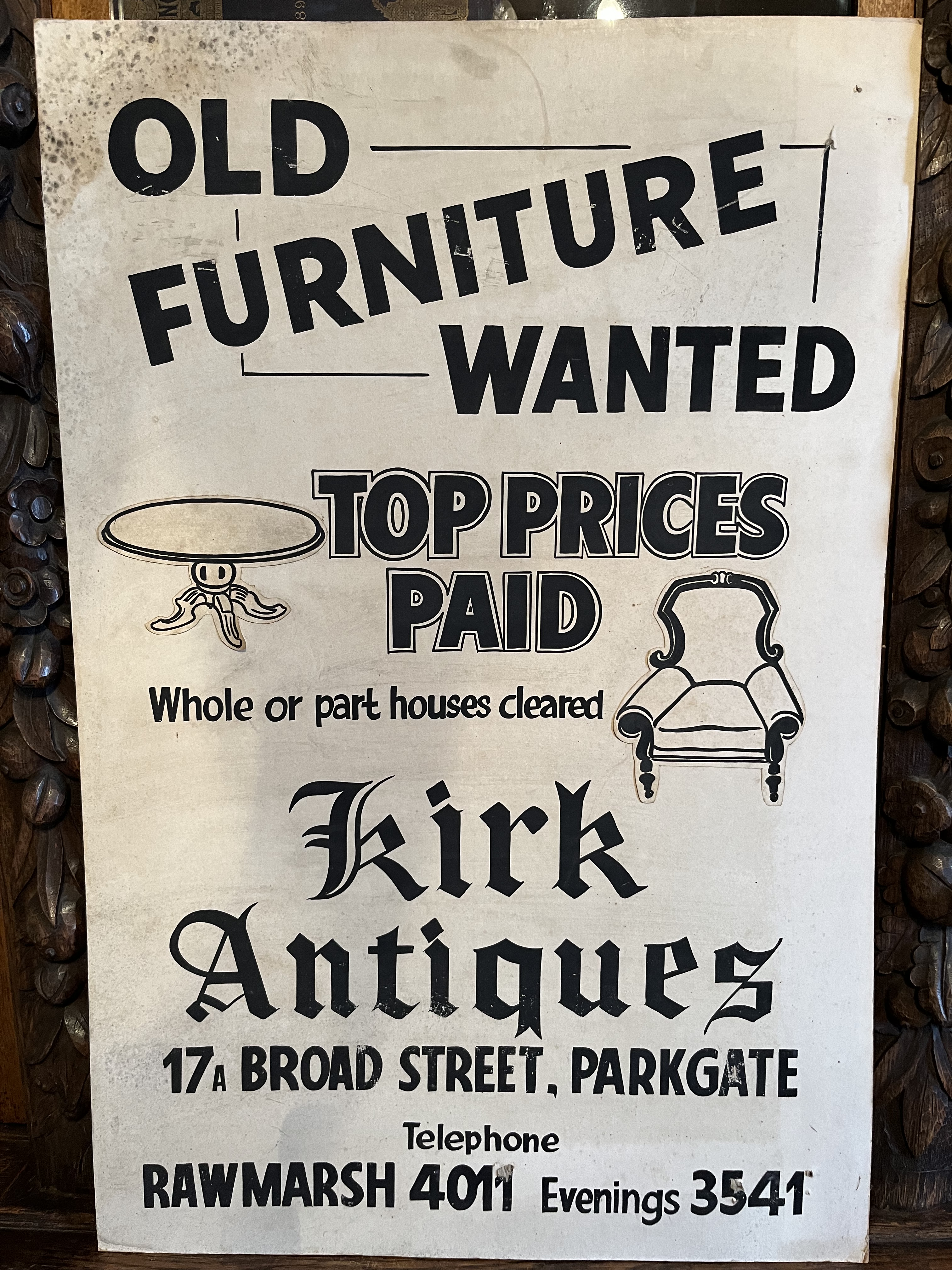
Bates’ advert is a very similar format to Bonella’s; it has photographs cut from contemporary antique collecting magazines and mentions ‘houses cleared’. It also dates from the 1970s. The final cardboard advertisement (see below) is that of Kirk Antiques, who traded in Parkgate, near Rotherham in South Yorkshire.

Advertising Board, ‘Kirk Antiques’, Parkgate, 1970s. Photograph, Antique Dealers Research Project, University of Leeds, 2024.

Kirk Antiques’ advert includes the ambiguous term ‘Old Furniture’, which by the 1970s had lost its cache and the middle-class associations it had in antique collecting and furnishing cultures of the 1920s and 1930s. The illustrations in Kirk’s advert are also in a different format – no longer photographs cut from magazines but hand-drawn illustrations of examples of typical Victorian furniture – furniture that, by the 1970s, may have been more likely to be offered to an antique dealer operating at the margins of the trade.

All 3 cardboard adverts hint towards the inter-dealer trading structure of the antique trade in the 20th century, the so-called pyramid structure, with thousands of dealers at the bottom of the pyramid, buying antiques in local house clearances, filtering their way up through the pyramid structure until they reach their level and are eventually sold to collectors and furnishers. This ‘system’ collapsed in the late 1990s as the internet and the world-wide-web fractured the established ecology of the antique trade, but these 3 cardboard adverts remind us how complex and fragile that ecology was.

Mark

November 12, 2014

The Generosity of Dealers!

We had another very generous donation of archive material to the antique dealer project! Thank you so much to John Smith, formerly of Regency House Antiques, Walton-on-the-Hill, Surrey, for donating a cache of several hundred B&W photographs of antique furniture – just some of the previous stock of Regency House Antiques.  The photographs (taken by Raymond Forte) date from the 1960s-1980s, and John tells us that they were used for advertisements in publications such as Country Life.

P1000099

Photographs of the stock of antique furniture from Regency House Antiques (1960s-1980s)

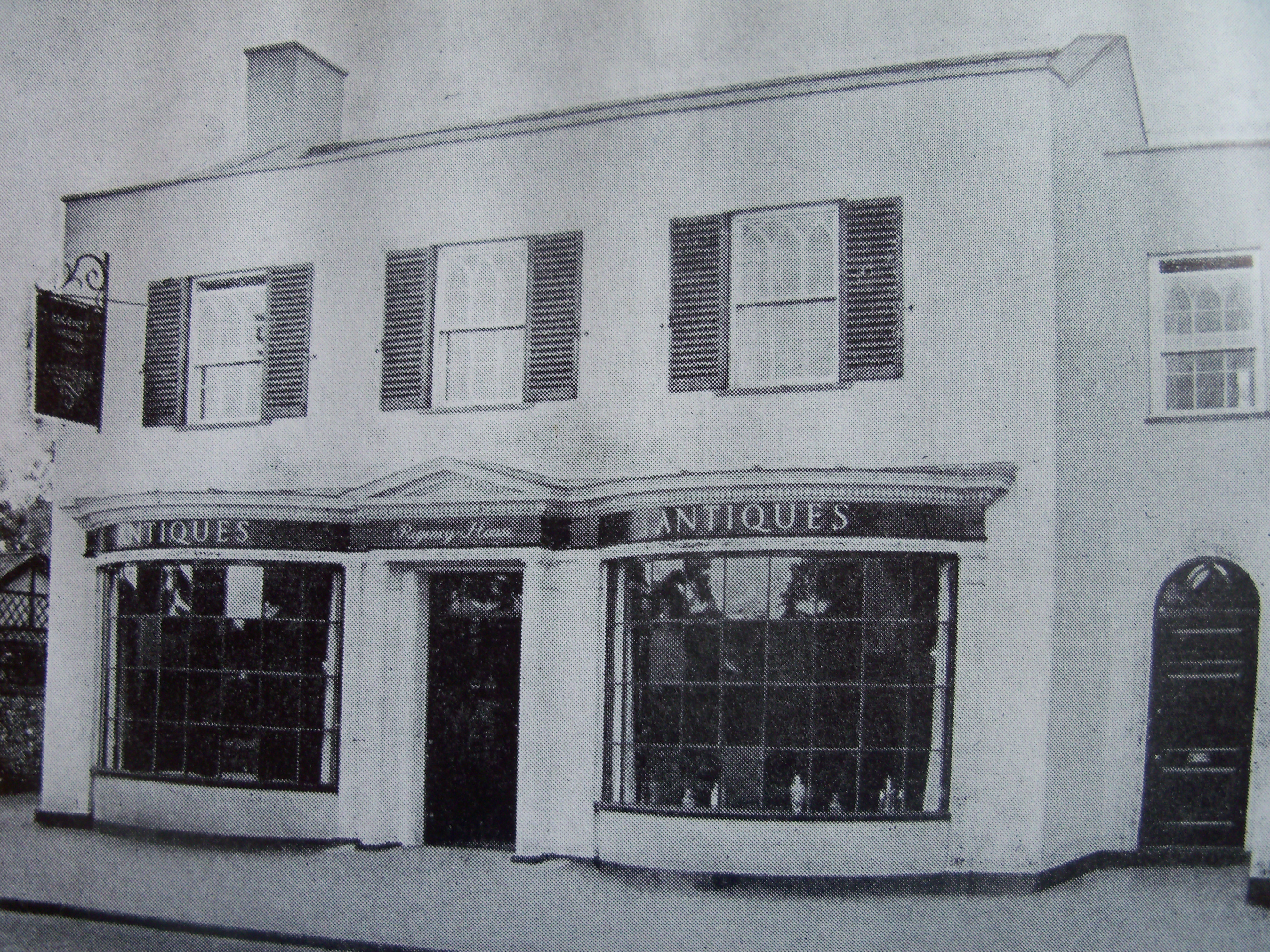
In our own (growing) database of images of antique shop (exteriors and interiors) we discovered we had an image of the shopfront of Regency Antiques, dating from c.1960 – here:

Regency House Antiques Walton on the Thames AYB 1961

Regency House Antiques, Walton on the Thames, c.1960.


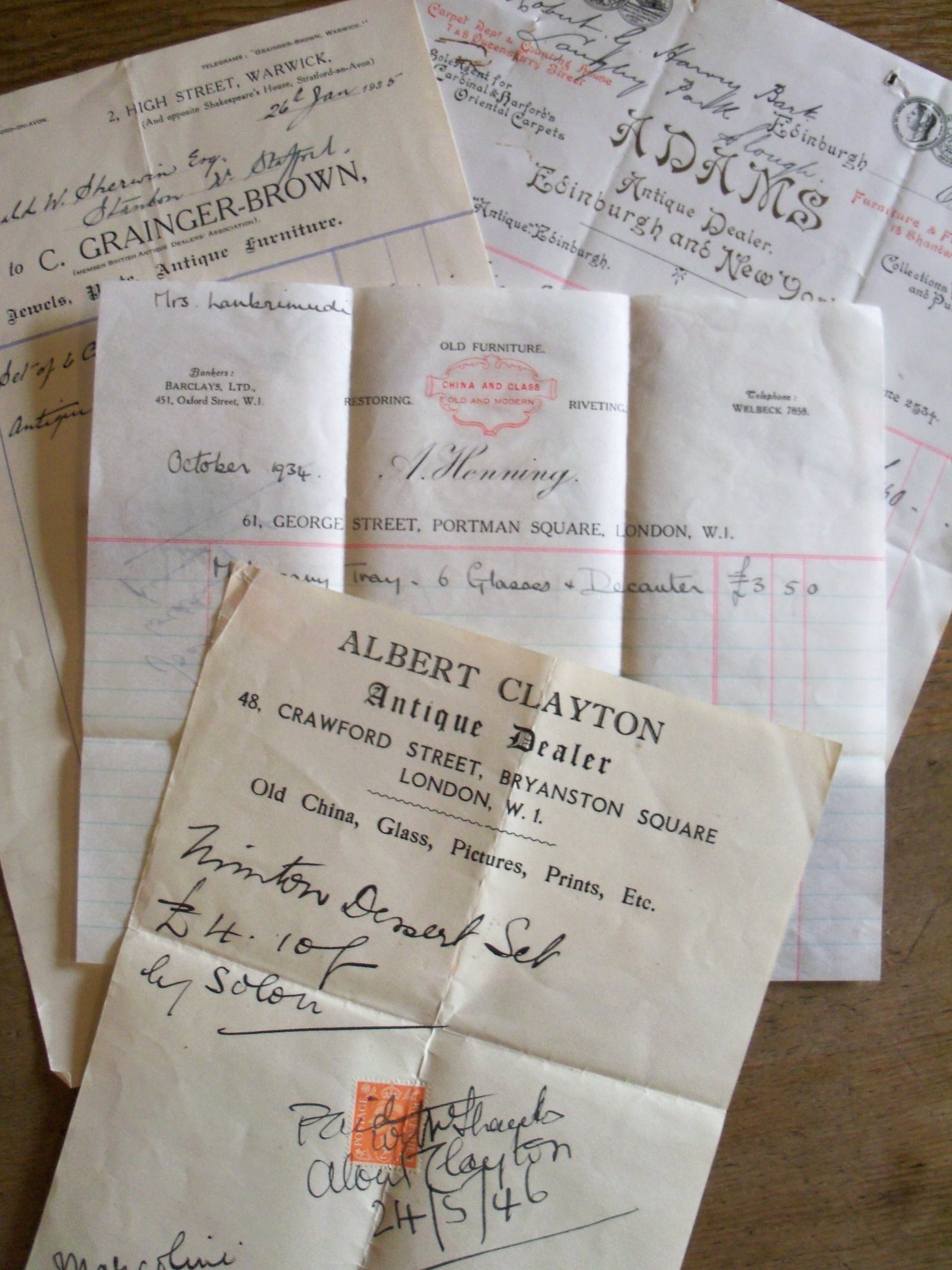
John also tells us that Regency House Antiques was founded by a stockbroker called Sketchley in the mid 1960s, in a purpose-built building, which had its own restoration workshop, employing 3 people – the business was acquired by John Smith in 1975, but was closed in the early 1980s.  John also owned the antique business named ‘A. Henning’ (and, curiously, I already had a copy of an invoice from A. Henning!) – see below…

dealer invoices

dealer invoices

Henning was established in 1922 by John Smith’s step-grandfather, and John inherited the business in 1974. The invoice (above, middle) is dated October 1934, when Henning was located at 61 George Street, London, and traded in ‘Old Furniture’, and ‘China and Glass, Old and Modern’ – the invoice was for a ‘Mahogany tray, 6 glasses + Decanter’, for £3.5.0.

Thank you John for so generously donating the photographs to the research project.

Mark


Home Subjects

a working group dedicated to the display of art in the private interior, c. 1715-1914

The Period Room: Museum, Material, Experience

An International Conference hosted by The Bowes Museum and The University of Leeds

H. Blairman & Sons Ltd

A research project investigating the history of the antiques trade in Britain in the 19th & 20th centuries

Museum Studies Now?

'Museum Studies Now?' is an event which aims to discuss and debate museum and heritage studies education provision.

The Burlington Magazine Index Blog

art writing * art works * art market

East India Company at Home, 1757-1857

A research project investigating the history of the antiques trade in Britain in the 19th & 20th centuries