Posts tagged ‘Bonhams’

October 27, 2025

More Rare Antique Dealer Ephemera

Our collections of antique dealer ephemera continues to grow, with the latest addition a sales brochure/catalogue produced by a dealer previously unknown to us (that in itself is most unusual!). The catalogue is undated (as are many of these dealer catalogues) but seems to have been published sometime in the early 1920s. The previously unknown dealer is ‘The Furniture and Fine Art Depositories Ltd.’, who traded from what appears to be an department store (see previous blog posts on antiques in department stores 31st August 2025; 29th April 2021; 2nd November 2014). The shop was located in Park Street, Upper Street, Islington, London N1 (the location has a long association with antique dealing, especially in the Post Second World War period).
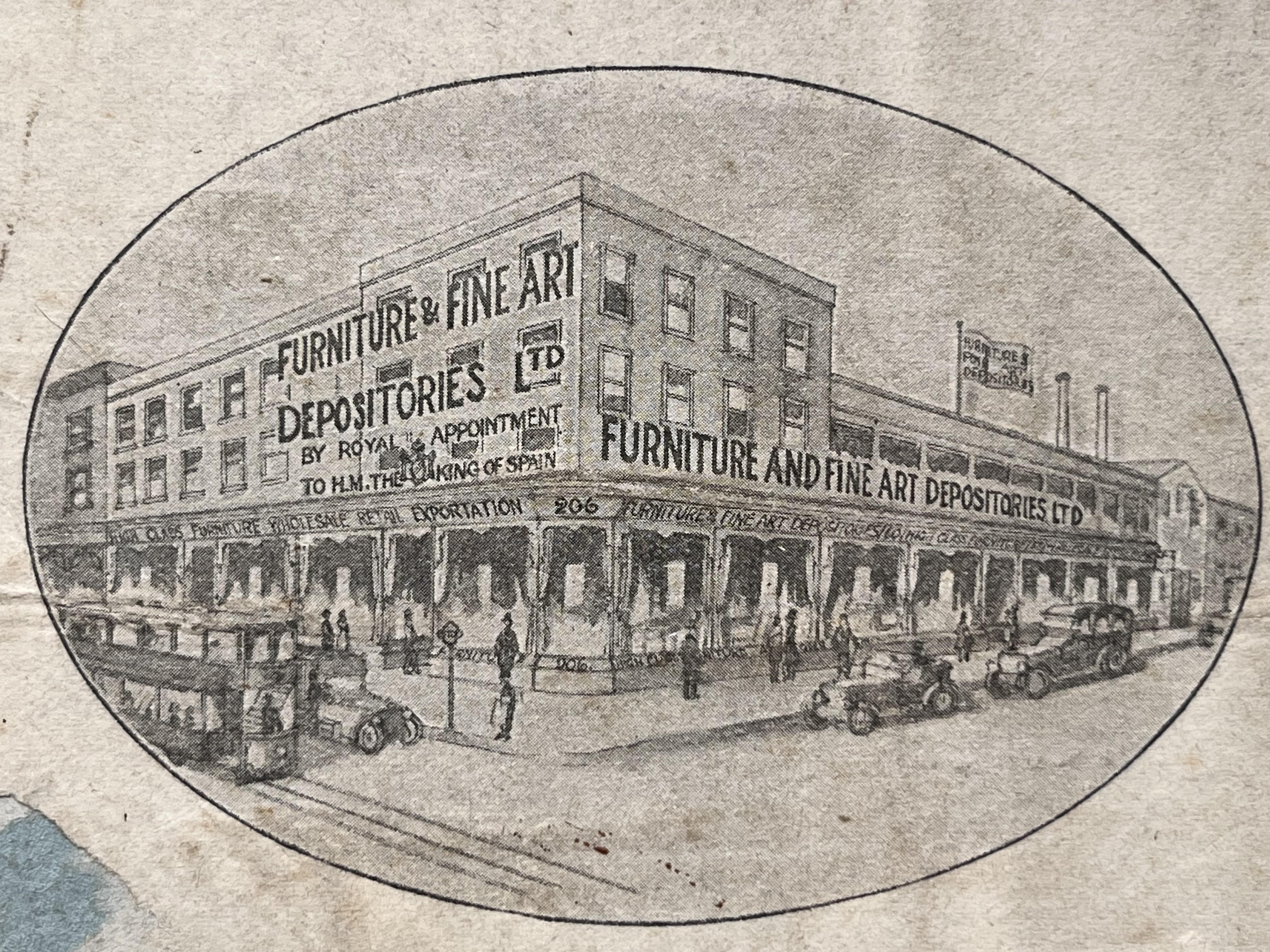
The Furniture and Fine Art Depositories Ltd. Shop in Park Street, Upper Street, Islington, London, c.1920. Photograph Antique Dealers Research Project, University of Leeds.

The business is not listed in any of the usual antique dealer directories, hence they appear to have been under the radar of the project. The business was established in the 1870s and seems to have been primarily involved in making and selling modern furniture (for which they won medals at the Paris Exhibition 1912 and the International Exhibition in Rome in 1912 – see below) and as general house furnishers; they also sold wallpapers, carpets and were contractors for interior decoration. However, the catalogue that the firm produced is very similar to other antique dealer’s catalogues of the period and is full of interesting examples of antique furniture.
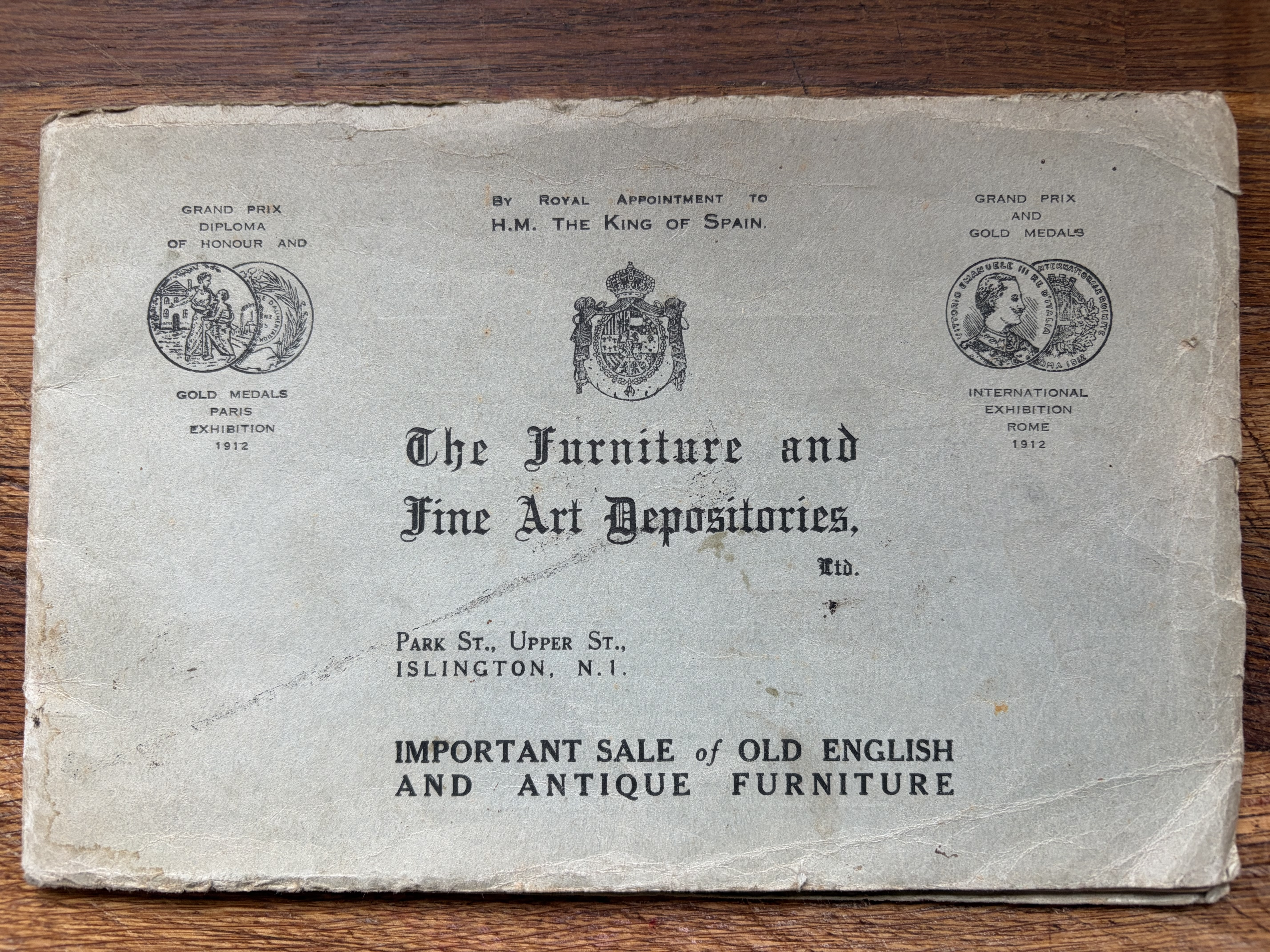
The Furniture and Fine Art Depositories Ltd., sales catalogue, c.1920. Photograph Antique Dealer Research Project University of Leeds.

What appears to be different about The Furniture and Fine Art Depositories Ltd., is their mode of business, which, as they state in the catalogue ‘…is not like that of the ordinary dealer in antiques or the general trader.’ As they elaborate, ‘The greater portion of the goods for disposal by the firm are entrusted to it by private owners, who pay a small commission of ten per cent. on sums for which the articles are sold.’ In the catalogue are dozens of photographs of antique furniture alongside a few pieces of modern reproduction ‘Queen Anne’ furniture, so fashionable at the time. For example, a ‘Chippendale Mahogany Settee’, priced at ‘27.10s.0d’; this was from the ‘the Furness Collection’; and an ‘Old Mahogany Circular Pedestal Table’, priced at ‘£15.0s.0d’ (see below):
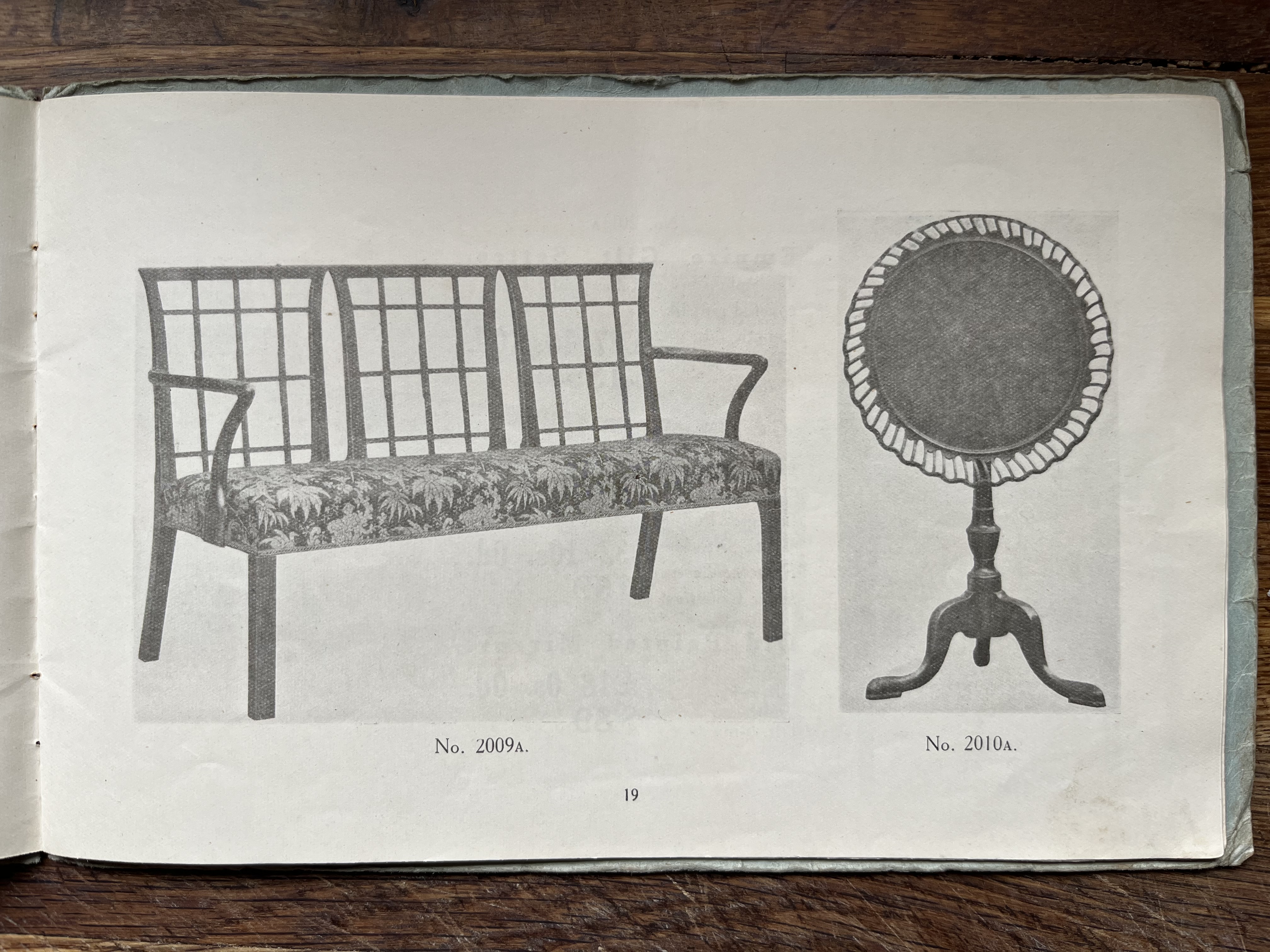
The Furniture and Fine Art Depositories Ltd., sales catalogue, c.1920. Photograph Antique Dealer Research Project University of Leeds.

An ‘Old English Mahogany Tambour Shutter Front Cabinet’ (priced at £12.15s.0d) is listed as from the ‘Earl of Essex Collection, Cassiobury Park’ – the house was sold by the 8th Earl of Essex in 1922 and demolished for its materials in 1927. Incidentally, the famous staircase c.1677-80 from Cassiobury Park (attributed to the carver Edward Pearce) was sold by the antique dealers Edwards & Sons of Regent Street, London to the Metropolitan Museum in New York in 1932 (see here). Also in the photograph (below) is a ‘Charles II Oak Chair’, ‘in excellent preservation’, priced at ‘£17.10s.0d.’
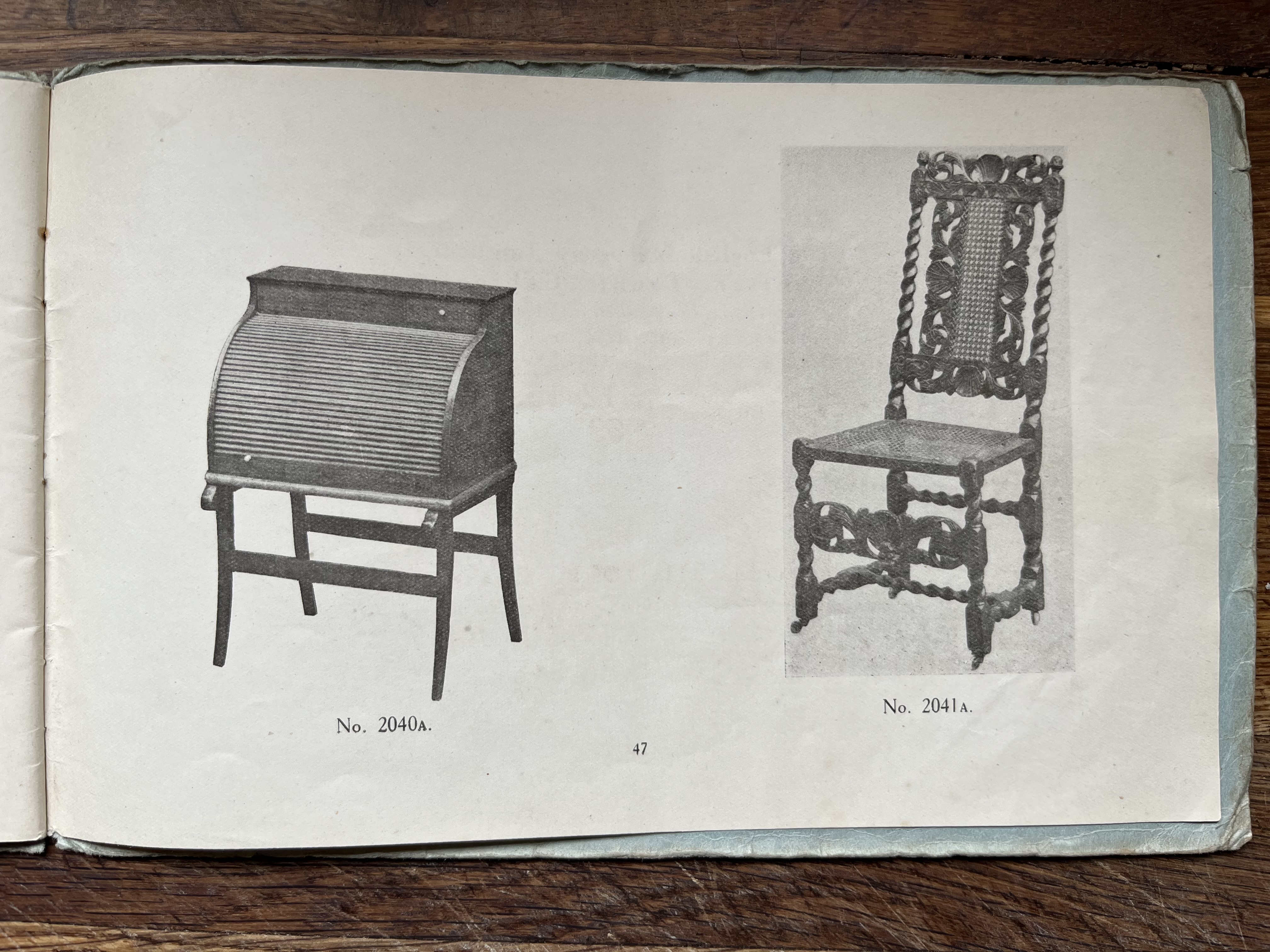
The Furniture and Fine Art Depositories Ltd., sales catalogue, c.1920. Photograph Antique Dealer Research Project University of Leeds.

Many of the antiques illustrated in the catalogue are rather too generic to be able to trace and locate, but I have been able to find one object illustrated in the catalogue – described (erroneously) as a ‘Chippendale Mahogany Side Table. With heavy marble top. Magnificently carved panelled back, supported by four massive carved legs with claw and ball feet’ – priced at £27.10s.0d’.
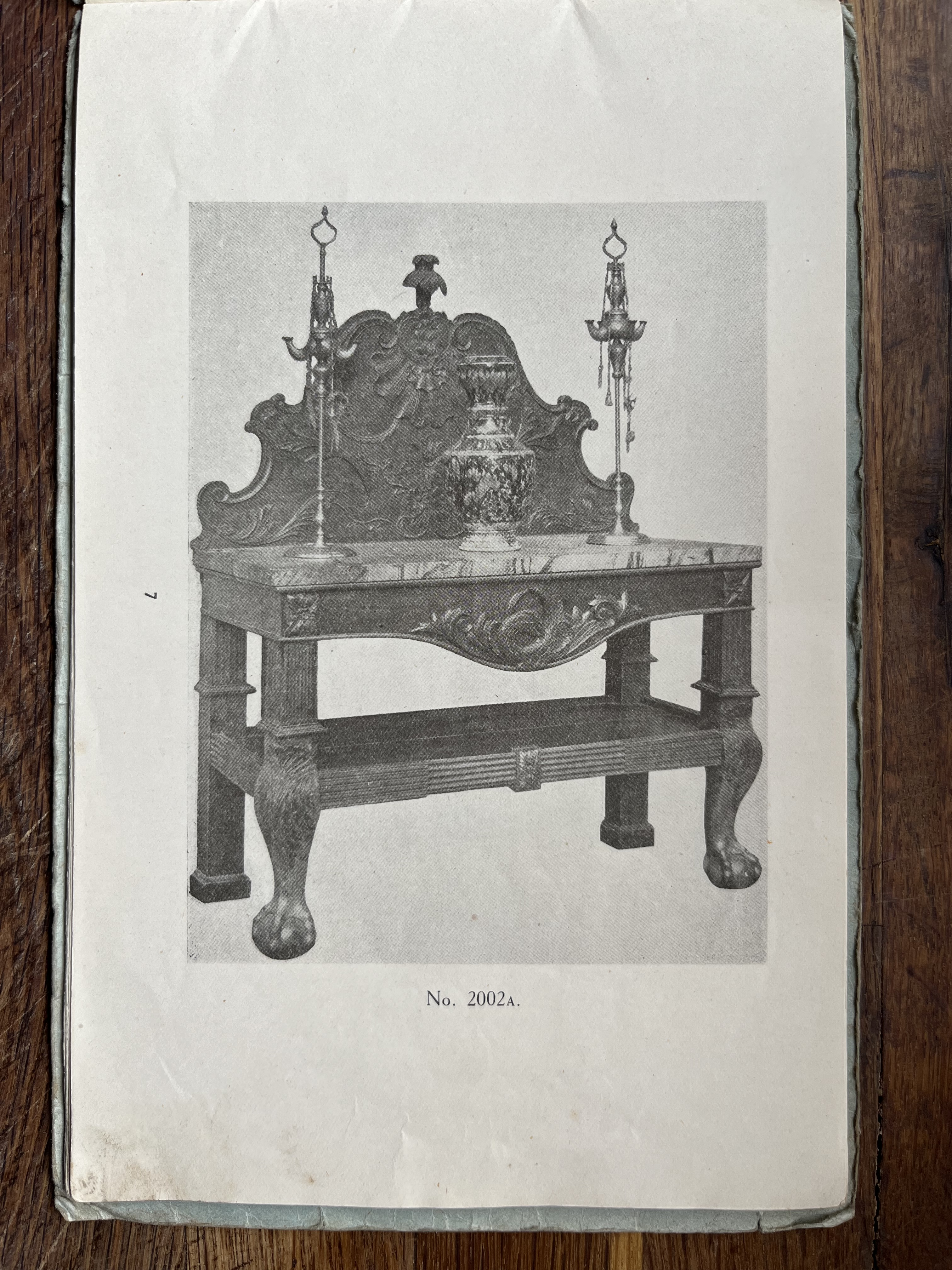
The Furniture and Fine Art Depositories Ltd., sales catalogue, c.1920. Photograph Antique Dealer Research Project University of Leeds.

The table came up for sale at Bonhams in August 2012 – see description here (see below for the Bonhams photograph) described as ‘A Mahogany Two-Tier Pier Table in the George III style’. The table had by 2012 lost its carved back and the marble was broken in two, but it retained an ivorine label for ‘Furniture and Fine Art Depositories Ltd., Park Street, Islington, By Appointment to H. M. The King of Spain’. Bonhams described the table as ‘possibly adapted from a larger 18th century table’; it sold for £275 including buyers premium. It’s worth highlighting that £27.10s.0d was worth about £5,400 (relative income value) in 1920.
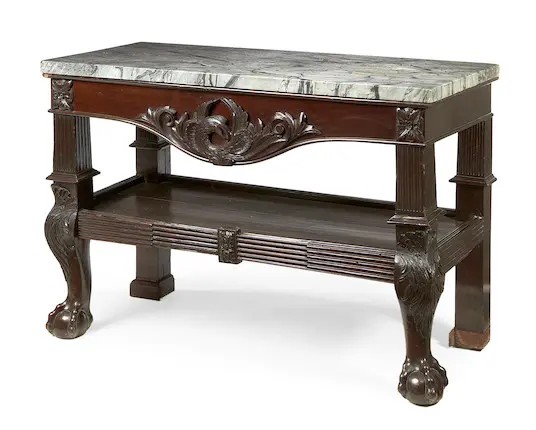
Side Table sold at Bonhams 2012. Photograph copyright Bonhams Auctioneers, 2012.

The Furniture and Fine Art Depositories Ltd., catalogue will be joining all the other antique dealer ephemera in the Brotherton Library, University of Leeds in due course.

Mark
September 24, 2017

New Archive – M. Turpin Antiques

Thanks again to the generosity of our wide community of friends and supporters we have accepted the donation of the partial archive of the well-known antique furniture dealer M. Turpin.  Maurice ‘Dick’ Turpin (1928-2005) established his business in the early 1950s, initially in Old Brompton Road, Knightsbridge, London, before gravitating towards the Mayfair area and settling in Bruton Street by the 1990s – a street which at that date was also the location of R.A. Lee & Sons, whose archive is also now part of the collection of Dealer archives at Leeds.  Indeed, the M. Turpin archive is a great addition to the growing number of antique dealer archives now at the Brotherton Library Special Collections at the University of Leeds.

We have many people to thank for the M. Turpin archive coming to Leeds University – the archive has been very generously donated through the auspices of Bonhams Auctioneers (and special thanks to the help of the Bonhams team at Leeds Office, Jane Winfrey, Jackie Brown, and Simon Mitchell; and Alison Hayes in their London office). The initial donation to Leeds was facilitated by Sally Stratton and Guy Savill, whilst they were at Bomhams London office (and they are now heading up the new auction business The Pedestal). I understand, from Sally, and from our previous project Research Fellow, Elizabeth Jamieson, that the original donation was through Jackie Mann, Maurice’s partner – so there are quite a few people to thank for ensuring that this important archive is saved for future generations of researchers – thank you all!

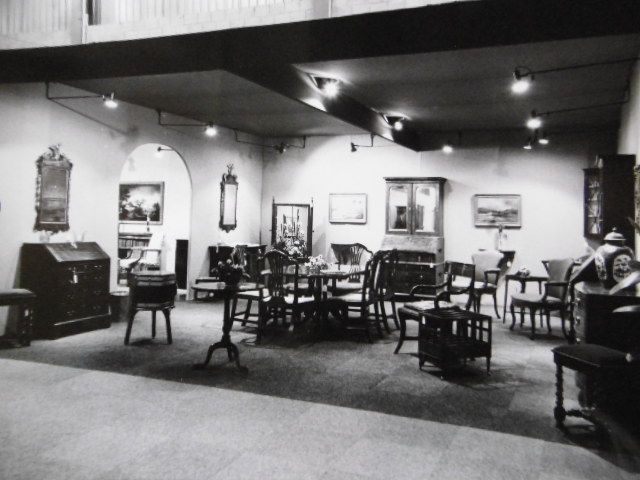
The M. Turpin archive itself mainly consists of a large series of fascinating photographs of stock sold by the firm; there are literally 1000s of B/W and colour photographs. Unfortunately there are no stock book or business records, but that said, the material donated to us gives a fascinating insight into a major antique furniture business over the course of 30+ years of trading.  There are, for example, photographs of the stands that M. Turpin took at various antiques fairs in the period. Here’s a B/W photograph of the stand of M. Turpin at the Maastricht antique fair in 1979.

M. Turpin, Maastricht Antique Fair 1979. Photograph courtesy of the Brotherton Library Special Collections, University of Leeds.

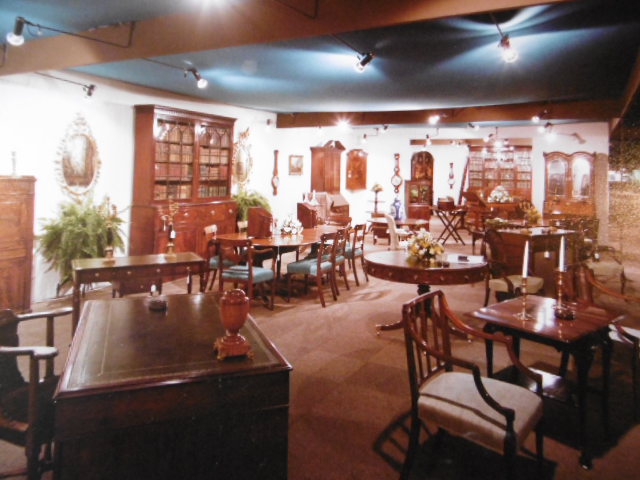
And another photograph, this time in colour, of M. Turpin’s stand at the same fair in 1988 – a much larger stand, with many more objects, indicative of the success of the business no doubt.

M. Turpin, stand at Maastricht Antiques Fair, 1988. Photograph courtesy of the Brotherton Library Special Collections.

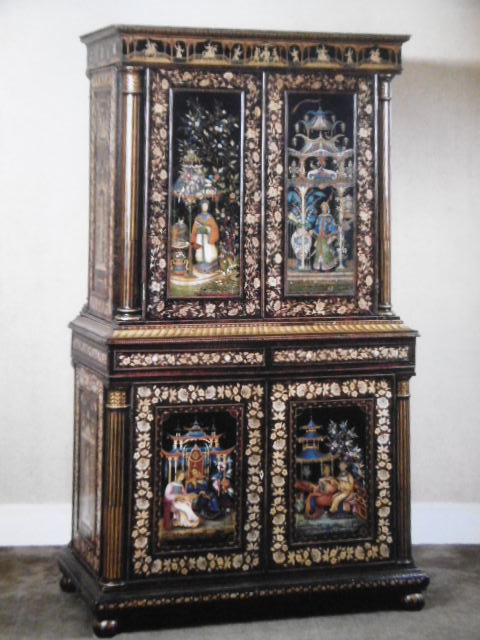
Amongst the many wonderful and historically significant objects that passed through the firm of M. Turpin was this flamboyant Regency period polychrome penwork cabinet – probably well-known to many people.

Regency Penwork Cabinet – M. Turpin archive, Brotherton Library Special Collections, University of Leeds. Original photograph copyright P.J. Gates, London.

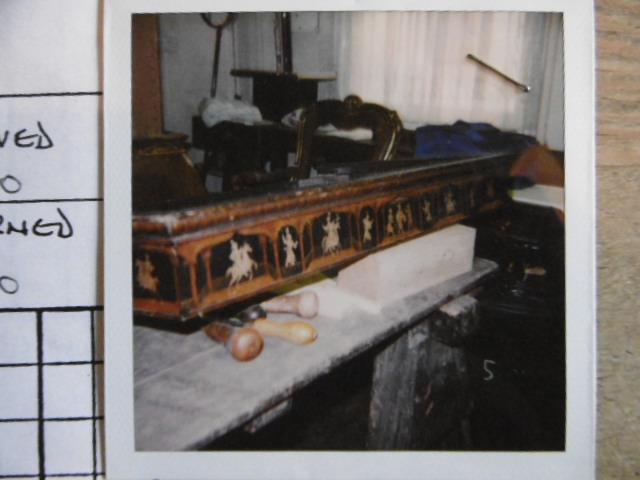
The cabinet was purchased by Maurice Turpin in the 1980s, and seemed to have remained with him until it was sold at the auction sale by Christie’s of the M. Turpin Collection in 2006, after his death – (see Christie’s The Legend of Dick Turpin 9th & 14th March 2006), where it sold for £78,000.  This history is, of course, well known in many circles, but what is perhaps less well known, and revealed in some of the discrete sections in the M. Turpin archive, is the history of the restoration of the cabinet.  The Turpin archive contains a large number of restoration records for a wide range of objects that were either part of stock/collection of M. Turpin, as well as, it seems, records of restorations to many other objects belonging to collectors and dealers.  These make fascinating reading.  The penwork cabinet, for example, appears to have suffered minor damage to the cornice at some stage – here’s a photograph of the record in the archive.

Restoration Record – Penwork Cabinet: M. Turpin Archive, Brotherton Library Special Collections. Photograph copyright Brotherton Library Special Collections.

Restoration Record – Penwork Cabinet. M. Turpin Archive, Brotherton Library Special Collections, University of Leeds. Photograph copyright Brotherton Library Special Collections.

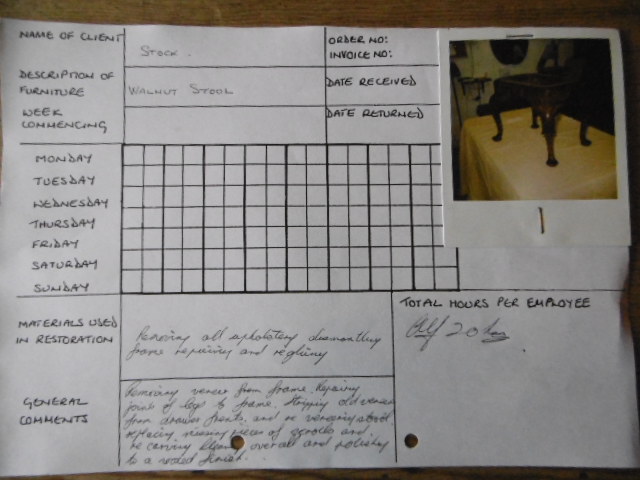
Other restoration records provide valuable insight into the processes of restoration and the changing taste and fashion for the presentation of antique objects – here, for example is the record of the cleaning and minor restoration to an early 18th century walnut stool.

Restoration Record – M. Turpin Archive. Brotherton Library Special Collections, University of Leeds. Photograph copyright Brotherton Library Special Collections.

It is a great pity that the actual business records and stock books for M. Turpin do not survive (unless someone knows where they are?), but this very extensive photographic archive, and the fascinating series of restoration records, will, I’m sure, be invaluable for future research into the history of the antique trade.  The M. Turpin archive will soon be catalogued and made available for research, so keep your eyes on the Brotherton Library Catalogue online.

Mark


May 17, 2017

Generous donation to the Antique Dealer and Art Market Archives

Interest in the antiques dealer and art market archives continues to grow.  The archives, as readers of the blog will probably know, are part of the Centre for the Study of the Art and Antiques Market (CSAAM) here at the University of Leeds, and are deposited in the Brotherton Library Special Collections  You can read about the archives deposited, and promised, to the CSAAM in the archives pages on the CSAAM website – click CSAAM.

The  latest addition, thanks to the extraordinary generosity of the Executors of the estate of late Anthony J. Evans (1954-2008) the well-known scholar and collector of Chinese Ceramics, and Michael Evans the brother of A. J. Evans, is a selection of provenance material, biographical information and related material associated with the collections of Chinese ceramics assembled by Anthony J. Evans. The material has already been catalogued by the team at the Brotherton Library Special Collections (thank you to Karen Sayers, archivist at the BLSC) and is available for consultation – the catalogue record is MS2071 – 1/2/3 – it’s certainly worth a look!

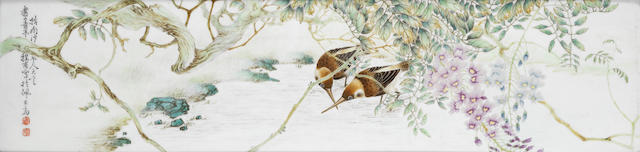
The archive material donated to the university is mainly devoted to the dispersal auction sales of the A.J. Evans collection at Bonhams auctioneers in London in November 2011.  These collections were primarily of Chinese ceramics, something for which Anthony had a special interest and was a world-leading scholar and author. The market for Chinese ceramics is, as many will be aware, very strong in particular areas, but perhaps it’s surprising  (to some…including me!) how valuable some early 20th century Chinese ceramics can be? A.J. Evans certainly had a very good eye!…For example, this Republic Period (1912-1949) plaque achieved £240,000 at the Bonhams sale in 2013 –

Republic Period Chinese polychrome plaque, from the A.J. Evans Collection. Photograph, Bonhams Auctioneers, 2011.

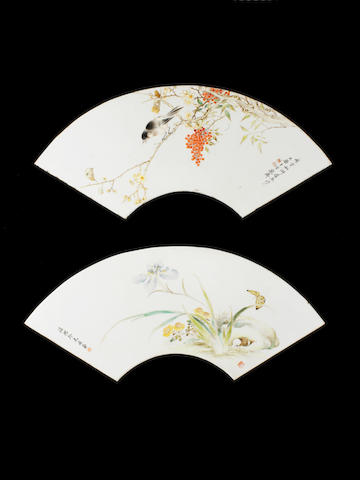
And this rare pair of fan-shaped plaques c.1900-1920, decorated and signed by Pan Taoyu (c.1887-1926) made an even more spectacular £360,000 at the Bonhams auction sale of the A.J. Evans collection.

Rare pair of fan-shaped plaques c.1900-1920 by Pan Taoyu (c.1887-1926) from the A.J. Evans Collection. Photograph, Bonhams Auctioneers, 2011.

I hope this whets your appetite to take a look at the archive information on the A.J. Evans collection; it has been meticulously assembled by Michael Evans and includes all the dealer invoices for the objects that Anthony collected, as well as biographical information and copies of the auction sale catalogues and provenance notes composed by Anthony J. Evans himself – it is an extraordinary resource for future scholars and researchers on the history of the art market, and the history of the taste for collecting Chinese ceramics in particular. Our warm thanks go to the Executors of the Estate of Anthony J. Evans and Michael Evans for donating this fascinating material to the CSAAM and the Brotherton Library Special Collections.


NOTE: (and thank you to Michael Evans and Dominic Jellinek for pointing out the initial error on the first posting of this blog – the A.J. Evans (below) is in fact a different individual from Anthony J. Evans (above) – but it is quite an interesting coincidence that there are 2 collectors of Chinese works of art, both called A.J. Evans, and both collecting in the same period, and both with auctions of their collections around the same time!…)

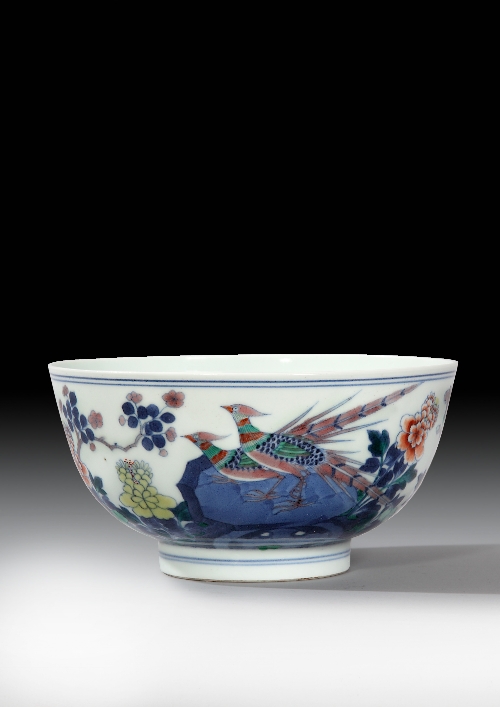
Anyway – this other A.J. Evans was a also celebrated collector of Chinese works of art, a taste he seems to have inherited from his father Frederick Evans, who worked for an Anglo-Chinese mining company in China during the 1920s. Anthony Evans inherited a range of early Chinese ceramics from his father, including this early 18th century polychrome decorated bowl (below), which was sold at one of the auction sales of A.J Evans collection at Canterbury in Kent in 2013, where it realised £235,000.

Early 18th Century Chinese Bowl from the A.J. Evans Collection. Photograph, Canterbury Auctions, Kent, 2013.

Thanks again to Michael and Dominic for pointing out the initial error!

Mark


Home Subjects

a working group dedicated to the display of art in the private interior, c. 1715-1914

The Period Room: Museum, Material, Experience

An International Conference hosted by The Bowes Museum and The University of Leeds

H. Blairman & Sons Ltd

A research project investigating the history of the antiques trade in Britain in the 19th & 20th centuries

Museum Studies Now?

'Museum Studies Now?' is an event which aims to discuss and debate museum and heritage studies education provision.

The Burlington Magazine Index Blog

art writing * art works * art market

East India Company at Home, 1757-1857

A research project investigating the history of the antiques trade in Britain in the 19th & 20th centuries