As promised in our Blog Post on Antique Shops in Visual Culture IV, we have an update on our theme of paintings of antique shops (see previous Blog Posts on this theme – Antique Shops in Visual Culture I (Blog post 30th July 2023); Antique Shops in Visual Culture II (blog post 30th September 2023); Antique Shops in Visual Culture III (blog post 27th November 2023); Antique Shops in Visual Culture IV (blog post 25th June 2024)
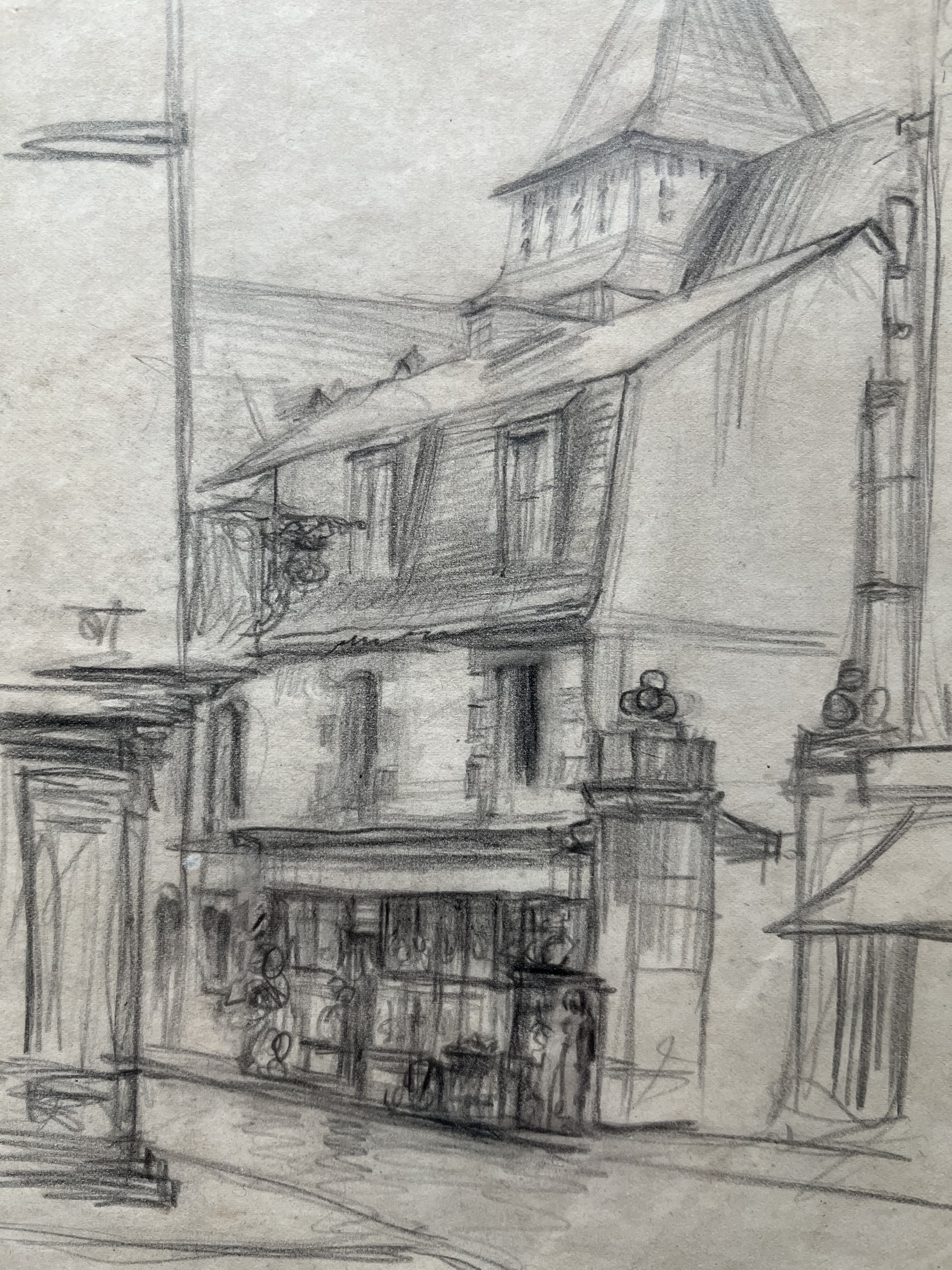
The latest additions to the growing corpus of paintings of antique shops includes our first image of a shop that is not located in Britain (but is by a British artist) – This pencil drawing (see below) by the artist Frank Lewis Emanuel (1865-1948) of an ‘Old Curiosity Shop in Grand Avenue, Dinan’.
Frank Lewis Emanuel (1865-1948), ‘Old Curiosity Shop in Grand Avenue, Dinan’. Pencil on paper, c.1880-1890. Private Collection.
Emanuel was born in London and studied at the Slade School of Art under the French artist Alphonse Legros (1837-1911); he first exhibited at the Royal Academy in London in the 1880s and at the Paris Salon in 1886. The pencil drawing of the ‘Old Curiosity Shop’ dates from the 1880s or 1890s and records a real antique shop in the town of Dinan in north west France. In this sense it is both an historical document and a work of art.
There is of course a very rich tradition of paintings and drawings of antique & curiosity shops in Europe dating back into the 19th century, especially in France and Italy, 2 key hunting grounds for antique collectors. Emanuel’s drawing of a ‘curiosity shop’ in Dinan is emblematic of the important role that antique and curiosity dealers played in the consumption of the past. Lewis’s drawing also reminds us of the relationship between buying and selling ‘antiques’ and historic urban environments – in the 19th century Dinan still retained much of it’s medieval historic fabric, a castle, city walls and many half-timbered buildings – ideal backdrops for antique and curiosity shops and curio hunters.
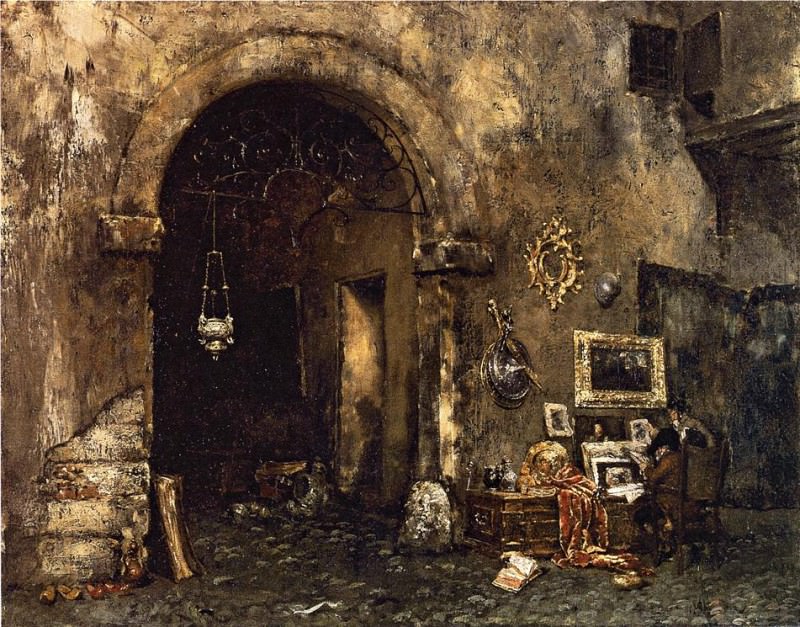
This practice of antique shops layered into the historic fabric, and indeed shops occupying historic buildings, is a recurring theme in the history of antique dealing. Here’s another example, this time an antique shop in Italy, a painting by the American artist William Merritt Chase (1849-1916) ‘The Antiquary’s Shop’ (1879).
William Merritt Chase (1849-1916), ‘The Antiquary Shop’ (1879), Oil on canvas. Brooklyn Museum, USA. Image copyright Brooklyn Museum USA.
The shop in Chase’s painting was located in Venice, the home of many leading antique dealers in the 19th century. Perhaps the shop that Chase portrayed is that of ‘Mr Zen’, a well-known dealer who had extensive dealings with the art historian and art dealer Otto Mundler (1811-1870) in the 1850s, when Mundler was working as an agent for the National Gallery in London.
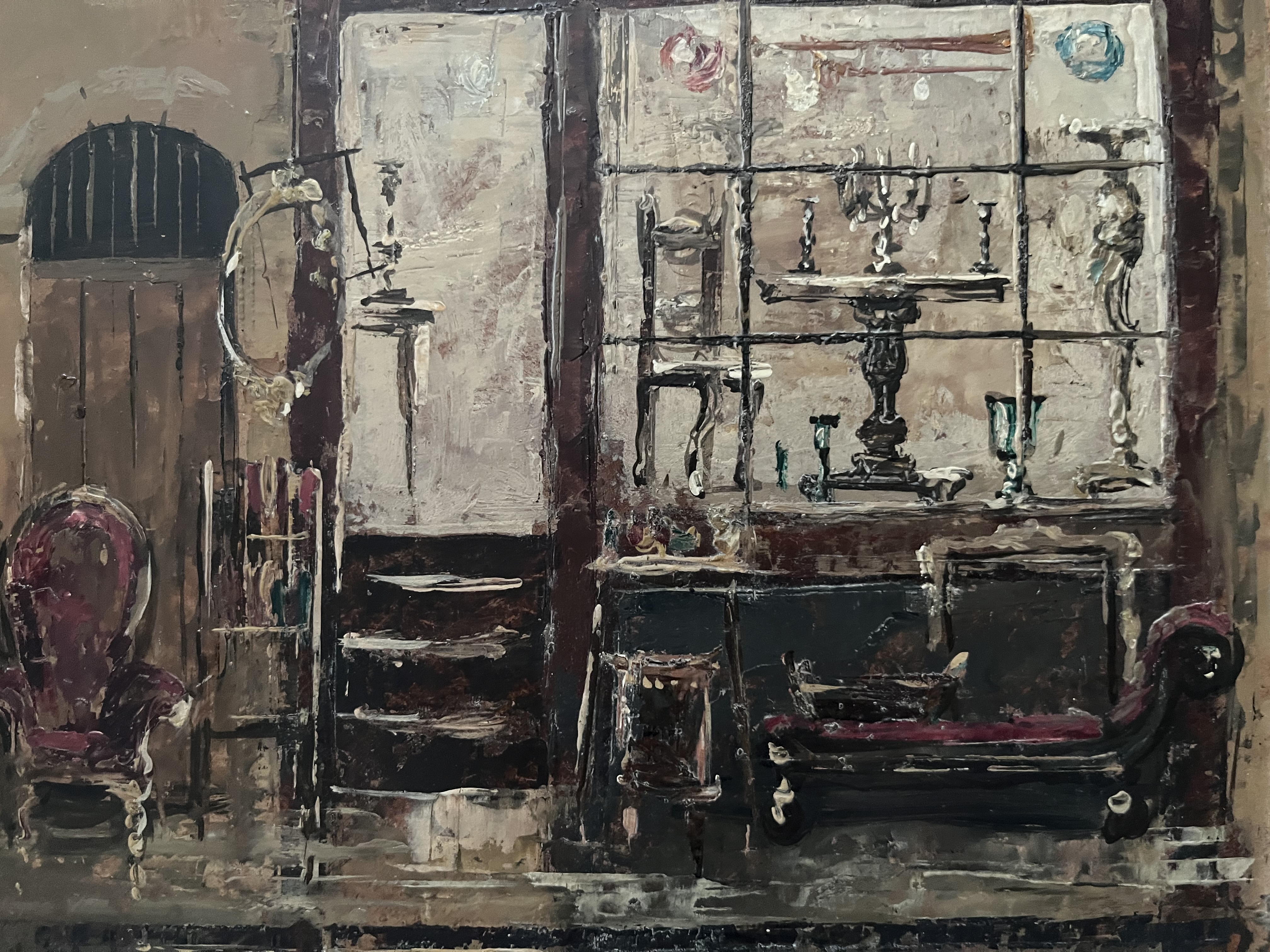
But to return to our key focus on antique shops in visual culture in Britain and further additions to the corpus of paintings and drawings of antique shops. Another new addition to the archive of paintings is a contemporary example – emphasizing the point of the enduring interest of antique shops in visual culture. This painting (below) by the artist Deborah Jones (1921-2012) of a ‘curiosity shop’.
Deborah Jones (1921-2012) ‘Curiosity Shop’. Oil on panel, 1980s. Private Collection.
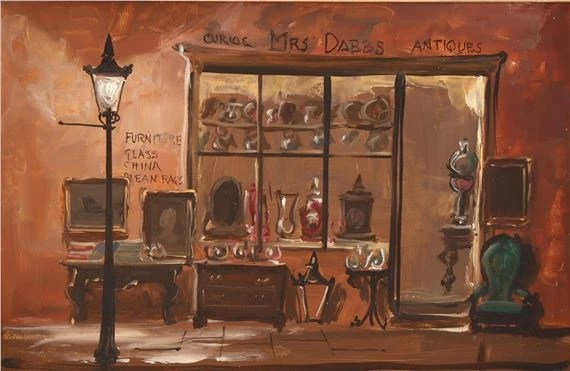
Jones was born in Wales and worked as a theatre and set-designer for The Royal Opera House, Glyndebourne and the Royal Shakespeare Company in Stratford-upon-Avon. Her artworks tend to reflect this practice and can be a little formulaic (at least for my taste) – see below – Jones’ oil on canvas, ‘Mrs Dabbs Antique Shop’.
Deborah Jones (1921-2012) ‘Mrs Dabbs Antique Shop’. Oil on canvas, c.1990. Private Collection.
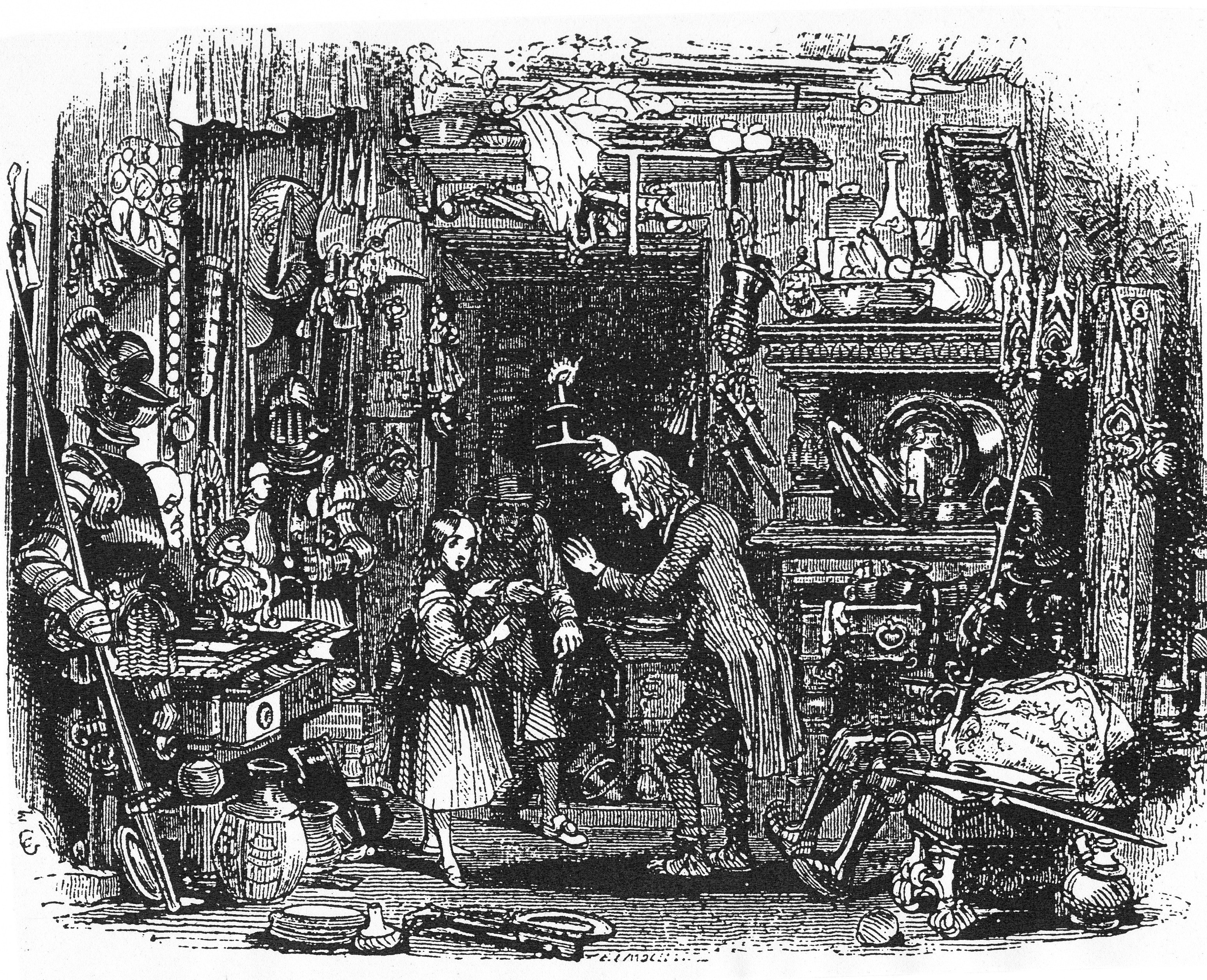
Deborah Jones’ painting of the ‘Curiosity Shop’ (above) by contrast, seems more vibrant, more impressionistic perhaps, and reminded me of some of the earlier traditions in the depictions of ‘curiosity shops’, that started with George Cattermole (1800-1868) and his representation of Charles Dickens’ ‘Old Curiosity Shop’ in 1840 (see below).
George Cattermole (1800-1868). The Old Curiosity Shop (1840). Wood Engraving. Private Collection.
Hence Jones’s oil on panel was acquired for the project as an interesting contemporary example of the enduring legacy of the antique shop in visual culture.
Our collection of paintings of historic antique shops (exteriors and interiors) has had a few additions over the last few months, so I thought I would share a few more of the images and continue the thread of Antique Shops in Visual Culture by adding a 4th post in this theme. You can also follow the theme in earlier blog posts (Antique Shops in Visual Culture I (Blog post 30th July 2023); Antique Shops in Visual Culture II (blog post 30th September 2023); and Antique Shops in Visual Culture III (blog post 27th November 2023).
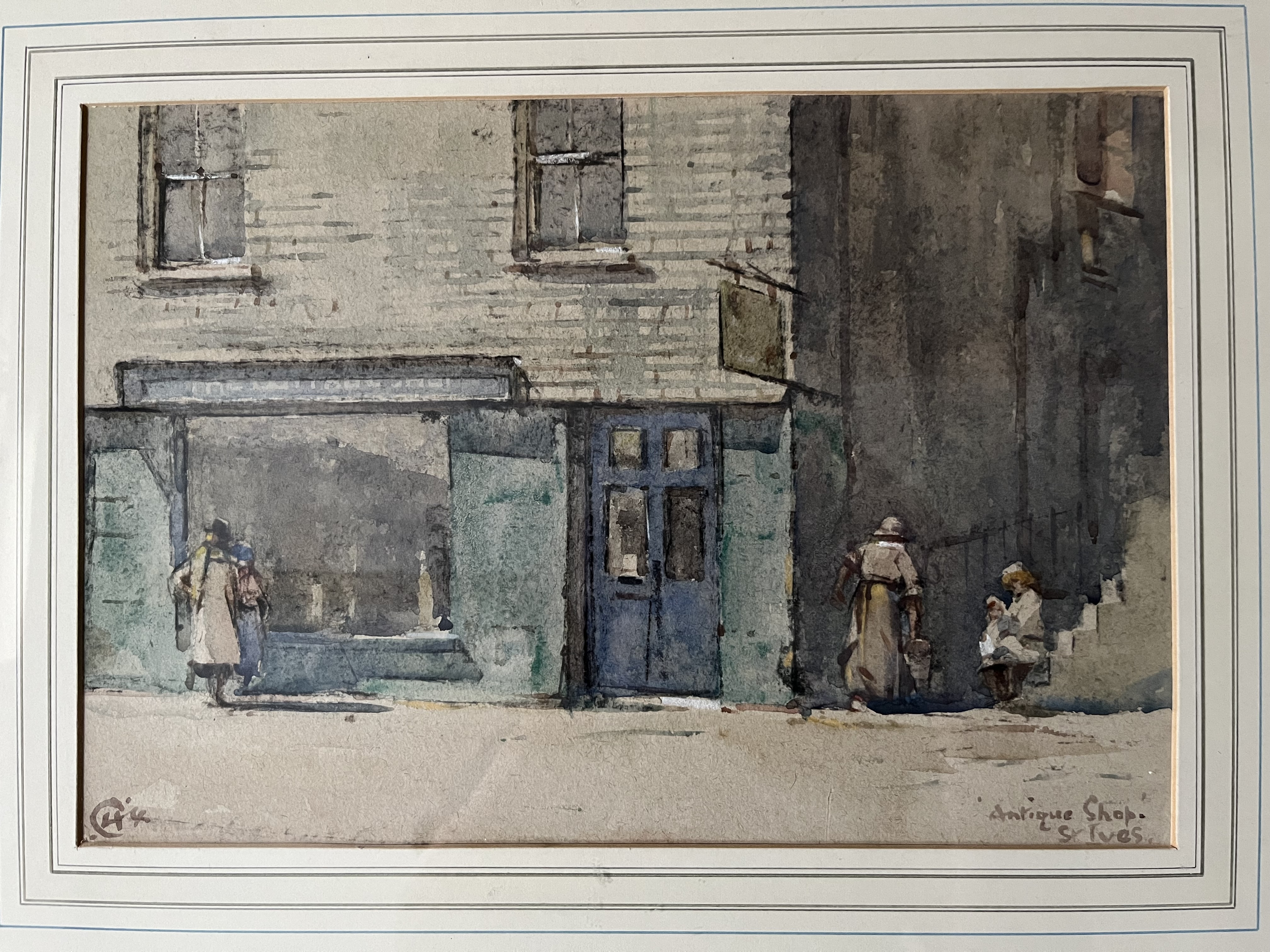
The most recent addition to the archive of paintings of antique shops is this beautifully rendered painting of an antique shop in St. Ives, Cornwall by the artist Cuthbert Crossley (1883-1960) (see below).
Cuthbert Crossley (1883-1960), ‘Antique Shop, St. Ives’ (1944). Private Collection. Photograph, Antique Dealers Research Project, University of Leeds.
I’ve unfortunately not yet been able to identify the actual antique shop, but it’s dated 1944 and at that time there were 12 dealers in St. Ives. The signboard over the shop in the painting just reads ‘The Antique Shop’, but the location looks like it may be near the harbour, perhaps The Wharf, which at the time had the shops of Andrew Glover and The Misses Hugo Habbijam and Marshall; Fore Street (F. Netteinghame; Andrew Armour; Basil Foulds Ltd; Kenneth Foulds); High Street (Charles Jackson), or Tregenna Place (John Vaughan) – you can of course take a look at the antique dealers interactive Map website if you are interested too – see www.antiquetrade.leeds.ac.uk – but if anyone does recognise the building in St. Ives I would be very interested to know.
Crossley was trained at the Halifax School of Art in Yorkshire before the First World War and became a professional painter in the 1920s. He exhibited the painting at the Royal Institute of Painters in Water Colours in Pall Mall, London (I’m guessing in c.1944 – it was priced at £8. 8 shillings at the time). Crossley moved to St. Ives in the 1940s, so I guess he painted the antique shop whilst he was living in St. Ives. The painting certainly has a ‘St. Ives School’ impressionism look about it.
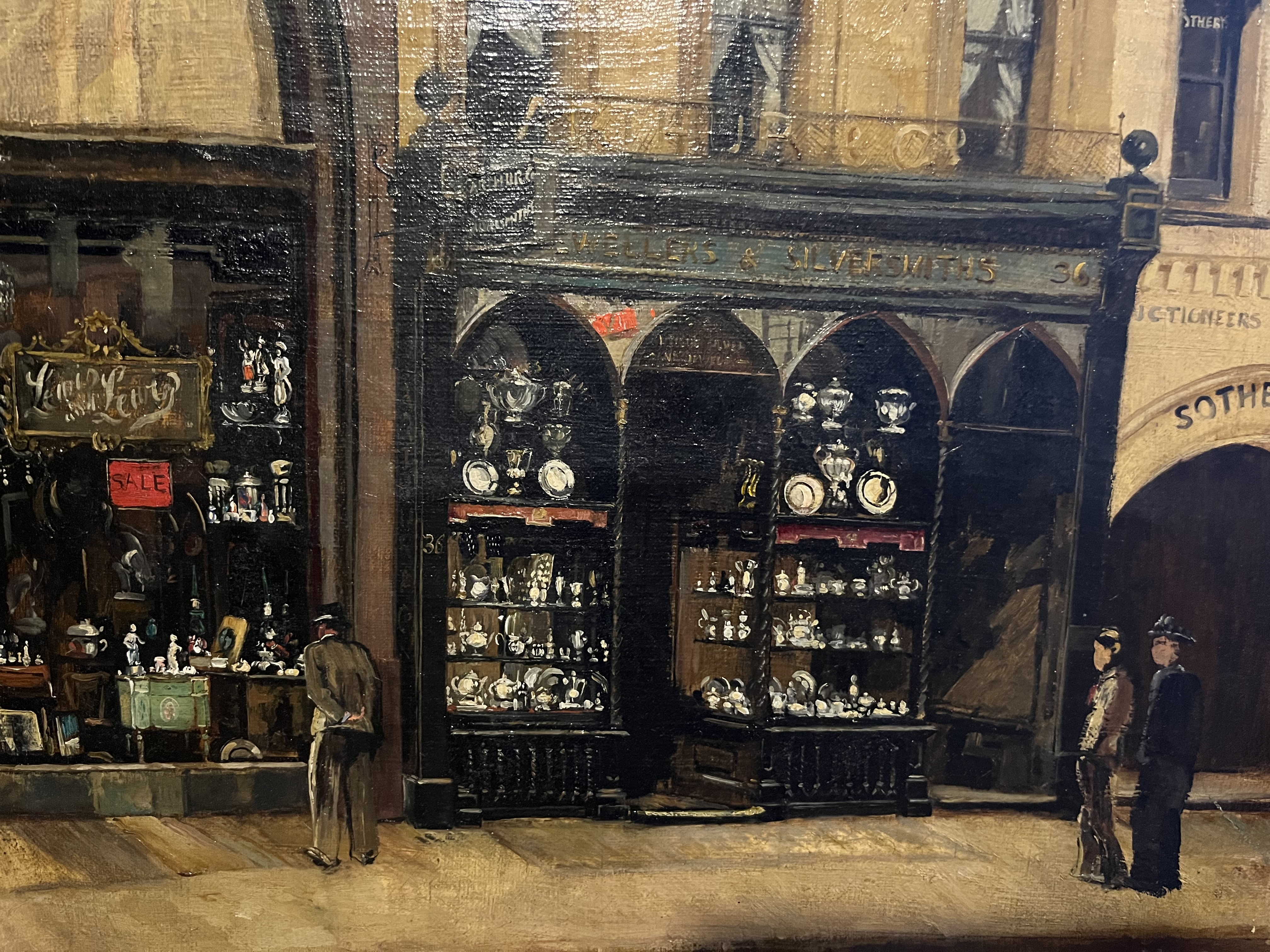
The 1940s and 1950s seem to have been a fruitful period for artists’ paintings of antique shops and one of the most well-known artists for painting antique shops is John Cole (1903-1975). Cole’s painting of the antique shops of Arthur & Co, and Lewis and Lewis in New Bond Street, London (see below) was the subject of the blog post Antique Shops in Visual Culture II (30th September 2023).
John Cole (1903-1975), antique shops in New Bond Street, London, c.1940. Private Collection. Photograph, Antique Dealers Research Project, University of Leeds.
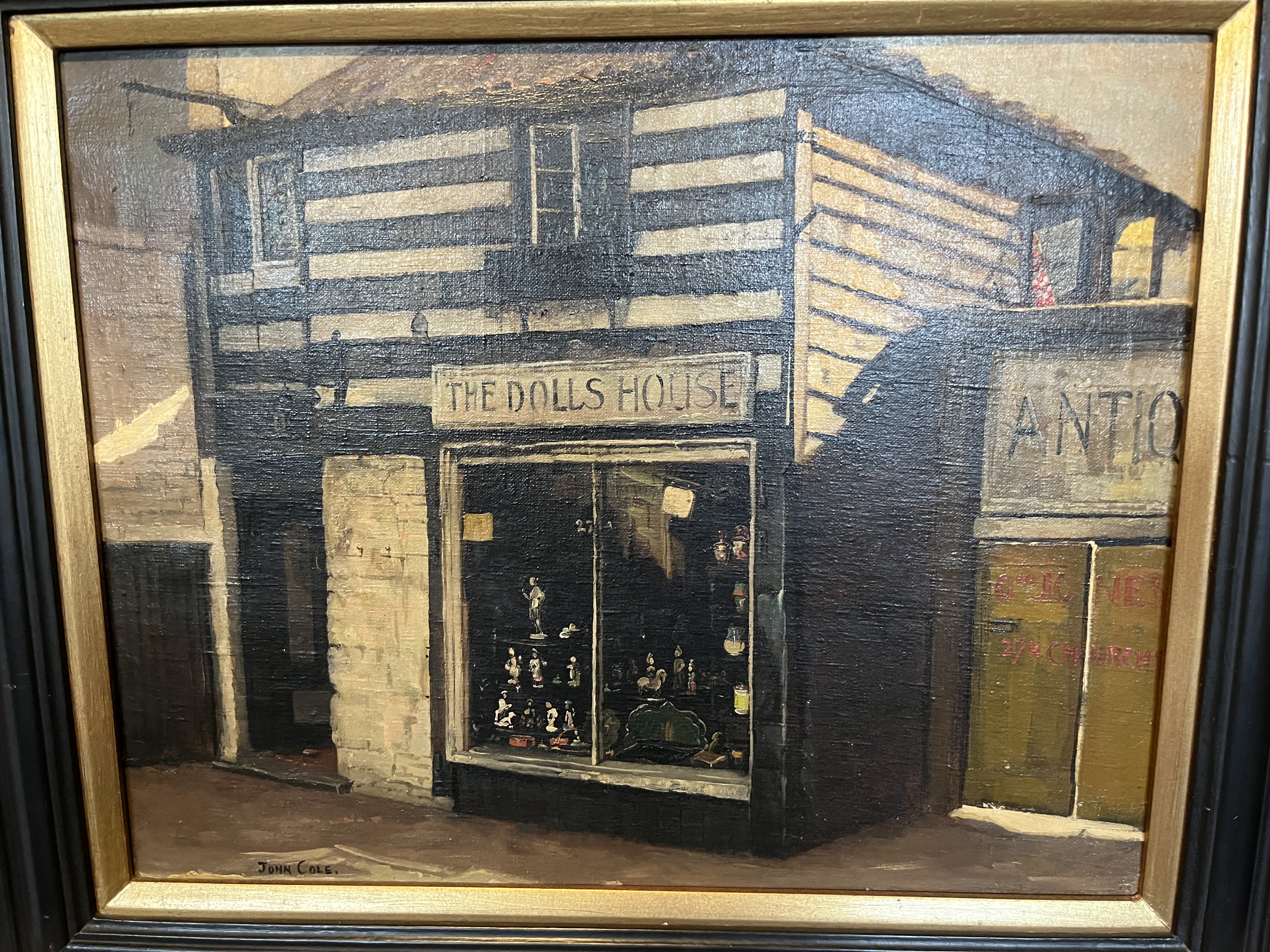
We are fortunate to have recently acquired (thanks to Sarah Colegrave Fine Art) another of Cole’s paintings of antique shops (he painted dozens of antique shops in the 1940s to 1970s). His painting of ‘The Dolls House’ (see below) is a much more well-known image. It was part of the exhibition The Cole Family: painters of the English Landscape 1838-1975, curated by Tim Barringer for Portsmouth City Museums in 1988, when it was then owned by the banking firm Morgan Grenfell. The Dolls House was at 27a Kensington Church Street, London, a very important street for antique shops from the 1920s right up to today (notwithstanding the decline in the number of antique shops in Kensington Church Street from the late 1990s). The Dolls House was owned by the antique dealer William Williams, beginning in the 1920s. Cole’s painting is typical of his style and his practice of recording old shops fronts; as Tim Barringer writes, ‘Through these shop front pictures, Cole achieved for the first time wide publicity and began to gain a public following’ (Tim Barringer, The Cole Family: painters of the English Landscape 1838-1975, (1988), p.175).
John Cole (1903-1975), ‘The Dolls House’, 1940. Private Collection. Photograph Antique Dealers Research Project, University of Leeds.
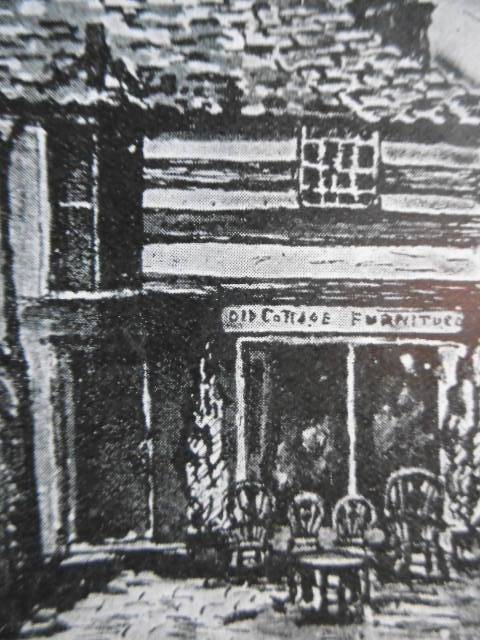
We have another image of The Dolls House, a pencil drawing from 1927. The drawing depicts the same black & white painted shingles to the front of the shop, but the signboard over the front states ‘Old Cottage Furniture’, which was a very popular description in the period for what we now describe as Regional Furniture. There are a few antique ‘Windsor Chairs’ outside the shop, for sale on the pavement.
The Dolls House, Kensington Church Street, London, 1927, pencil drawing. Photograph Antique Dealers Research Project, University of Leeds.
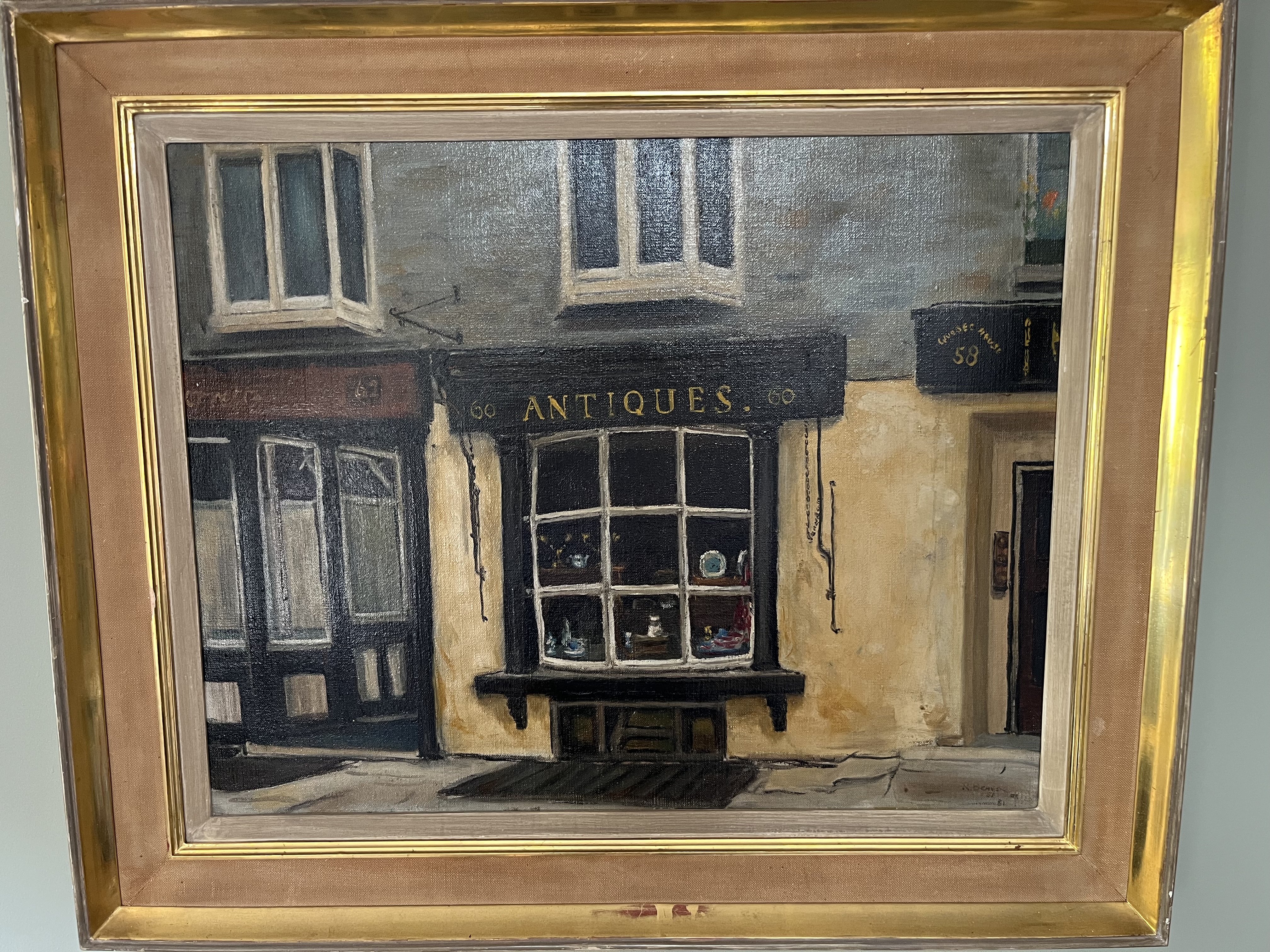
Another painting of an antique shop recently added to the archive of paintings is also from the same period as the paintings produced by John Cole. A painting titled ‘The Antique Shop’ by Robert Atwood Beaver (1906-1975), whose dates align almost precisely with those of John Cole (1903-1975); indeed his painting seems to owe a lot to Cole’s aesthetic as well. Beaver was an anaesthetist (he invented the famous ‘Beaver Respirator’) and a talented amateur painter. The painting is undated but seems to date to the 1950s; it’s not known which antique shop is depicted in Beaver’s painting, but it is known that he painted in and around London, although the particular shop depicted seems to be a country antique shop; perhaps a shop on the Isle of Wight, to which Beaver retired.
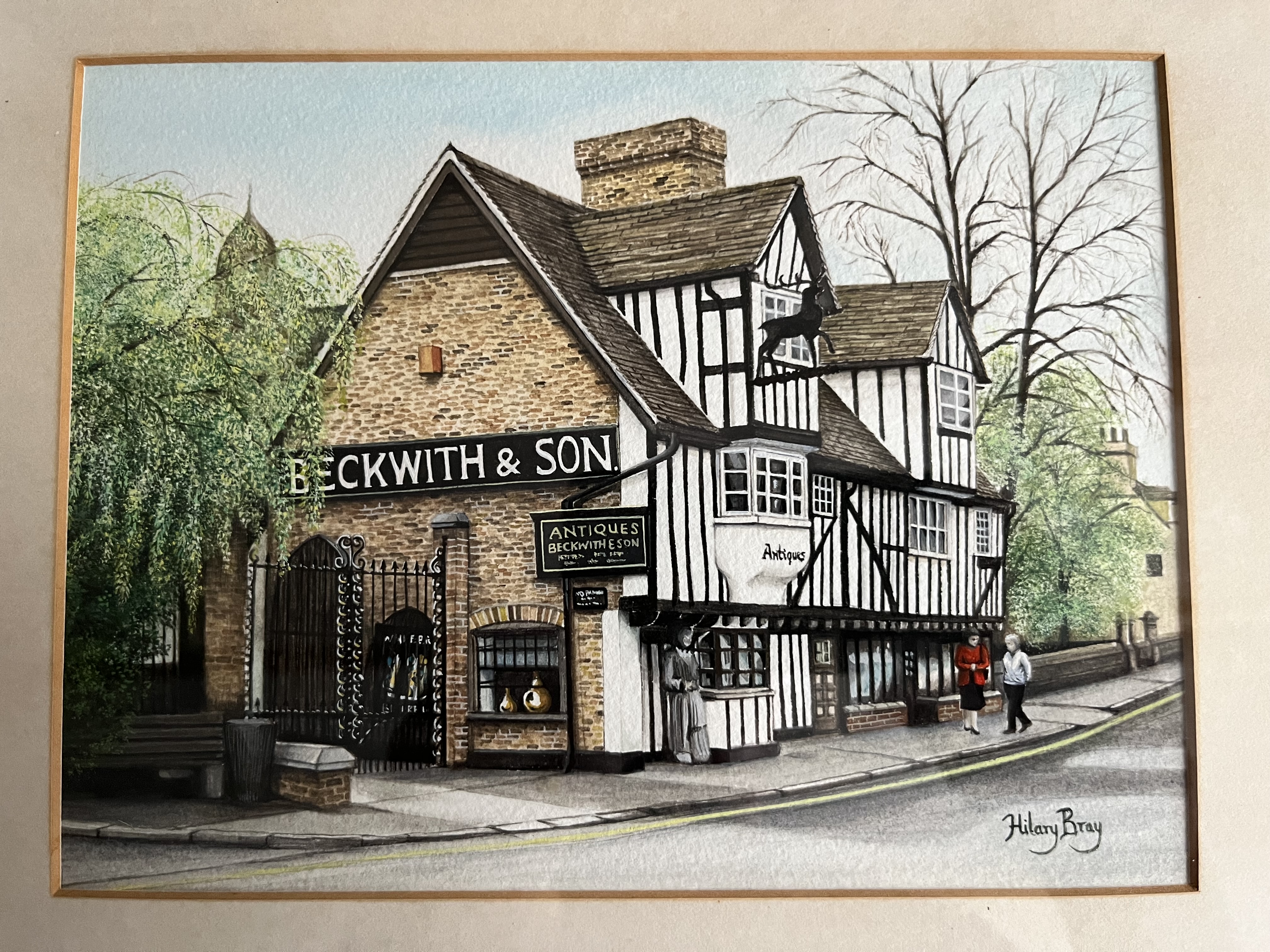
One of the key objectives of gathering an archive of paintings of antique shops is to consider the significance of the presence of the antique shop in British cultural life. Some of the paintings are fascinating, evocative artist’s impressions (like the Crossley and the Cole paintings), but some are more of what one might call ‘documents’. Our last painting of an antique shop in this Blog Post fits to that category I think. It is a work by the artist Hilary Bray, undated but probably 1980s (see below). It’s a competent work, but perhaps lacks the feeling present in the other paintings of antique shops? Nonetheless, the painting depicts a very famous antique dealing business, and perhaps amongst the longest -lived businesses in Britain.
Hilary Bray, ‘Beckwith & Son antique shop, Hertford, 1980s. Photograph Antique Dealer Research Project, University of Leeds.
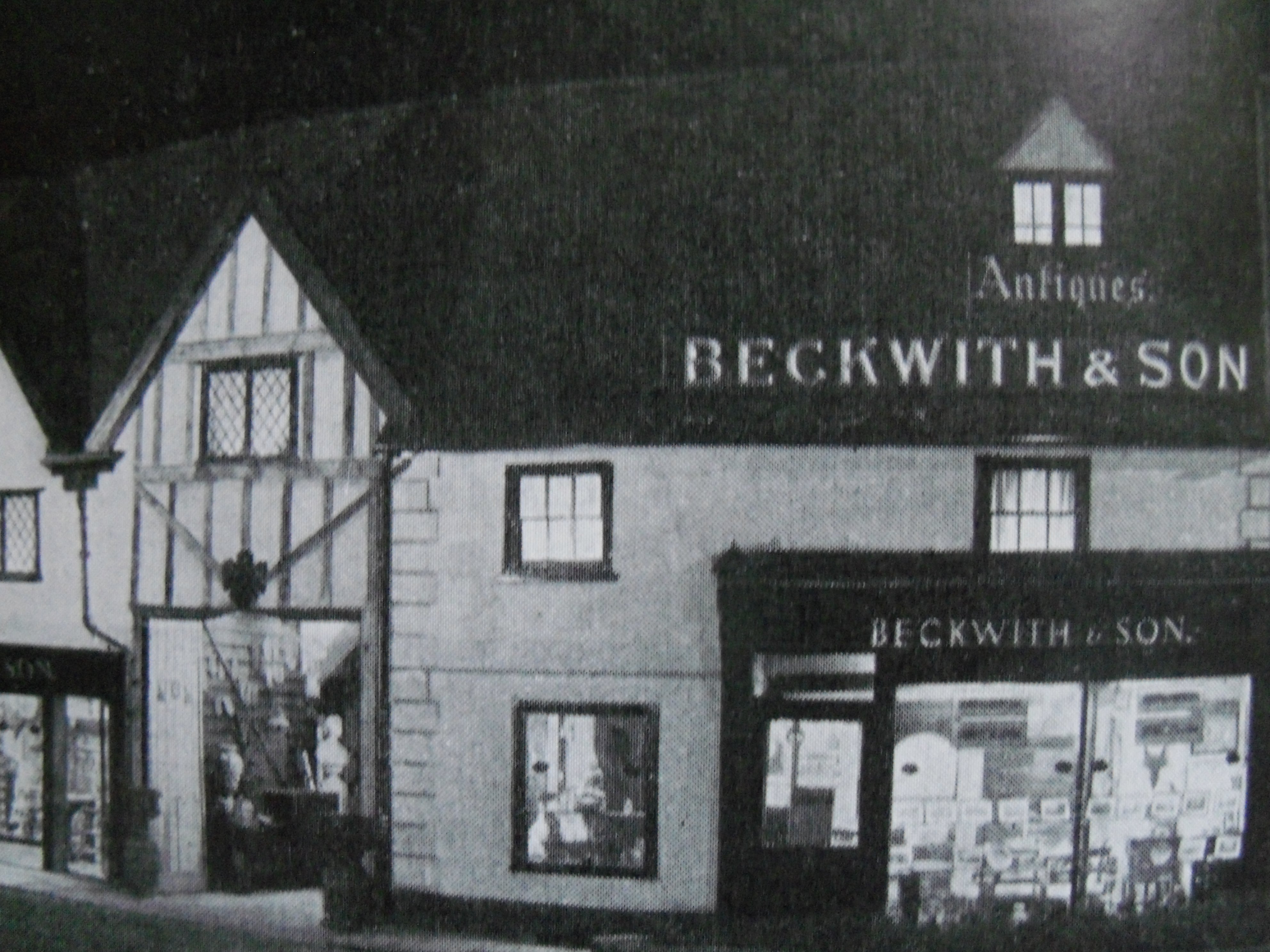
The shop is that of Beckwith & Sons, Old Cross in Hertford, who, according to their own publicity, trace their business back into the 18th century, to the Royal Cabinetmaker Samuel Beckwith (1740-1804). When the business became antique dealers is not known, but it’s likely to have been sometime towards the end of the 19th century. By the 1940s Beckwith & Son was owned by the antique dealer A. Knight Loveday. We have several photographs of the shop of Beckwith & Son at Old Cross in Hertford; this photograph (below), from 1963, seems to depict the shop from a different angle, or perhaps another premises they had in Old Cross, Hertford?
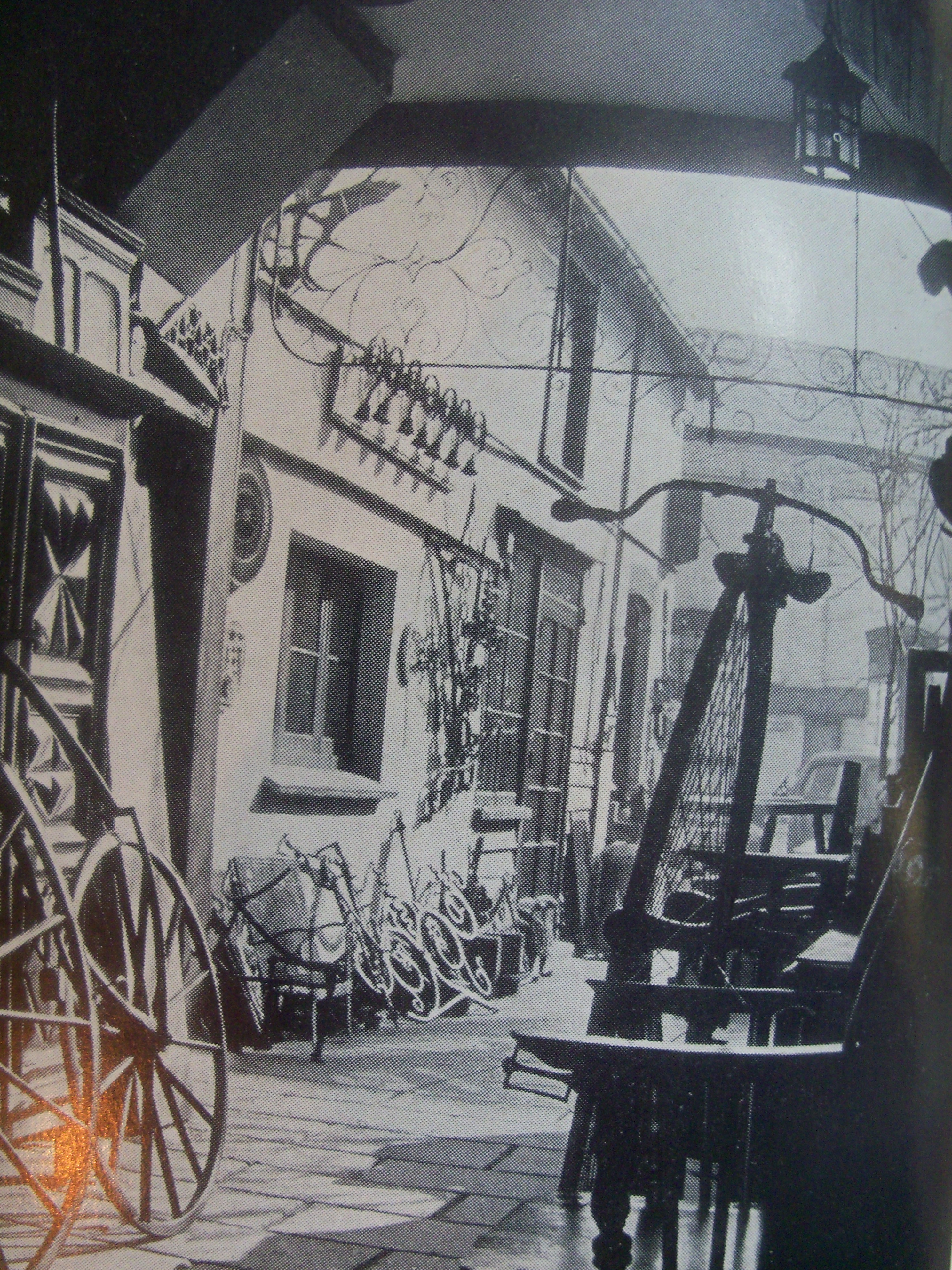
And below, this very evocative photograph (from 1957) of the passage leading to one of the entrances to the Beckwith & Son’s antique shop exemplifies the visual trope of the antique shop as a place for treasure hunters.
We have few more paintings of antique shops, and no doubt will acquire more still, so keep your eye of the antique dealers blog for ‘Antique Shops in Visual Culture V’ at some stage this year.
Our thread on ‘Antique Shops in Visual Culture’ seems to be very popular with readers of the Antique Dealers Research blog, so here’s the third instalment (the last for a little while at least). If you have missed Parts I, & II of this thread, you can catch up in Blog posts July 30th 2023 and September 30th 2023.
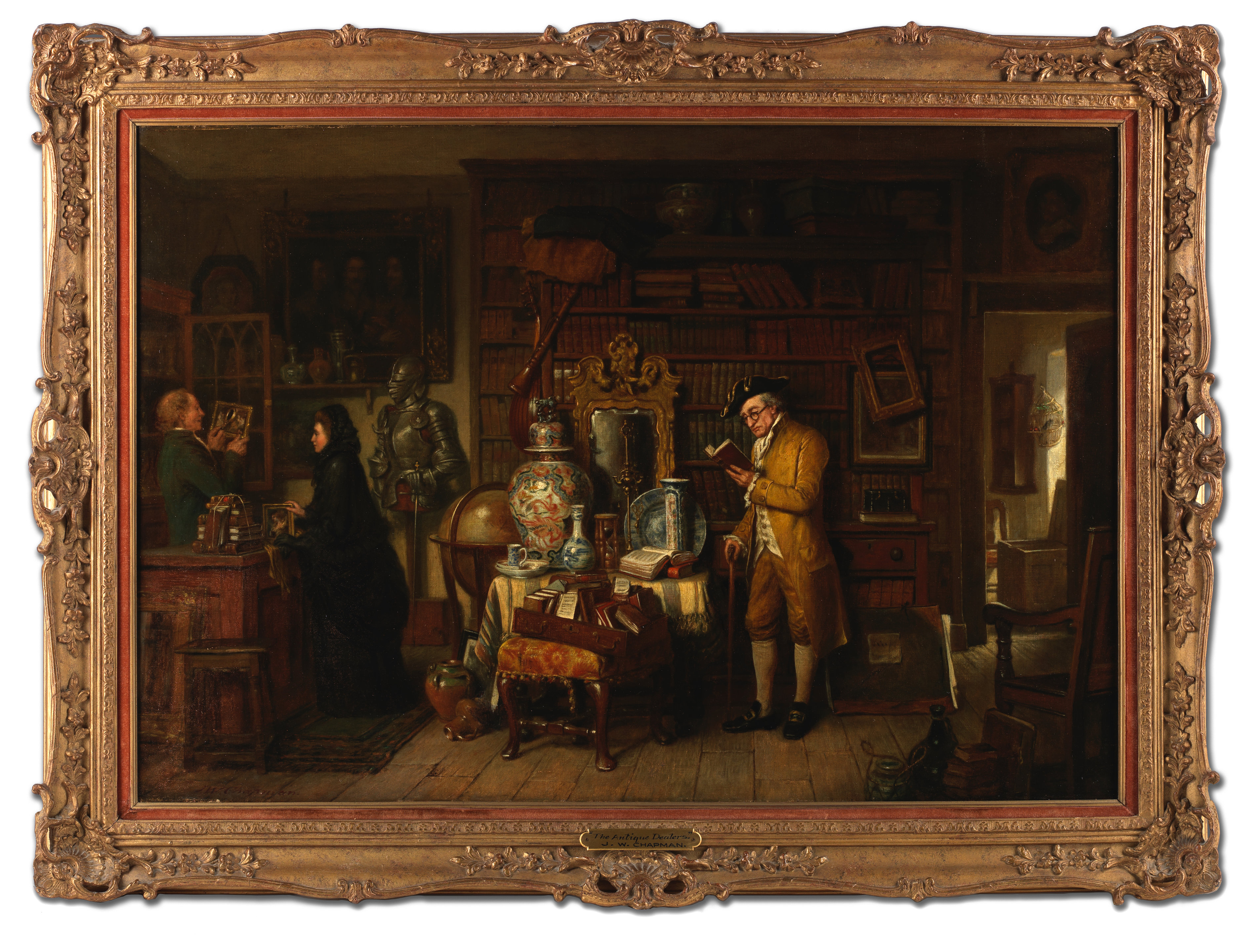
Our first image in this third instalment of the ‘antique shop’ in visual culture is by the artist John Watkins Chapman (1832-1903) and dates from about 1880.
John Watkins Chapman (1832-1903), ‘The Antique Dealers’, c.1880. Oil on canvas. Private collection. Photograph Antique Dealers Research Project, University of Leeds.
Chapman’s painting, which is quite large, about 2 feet by 3 feet, is typical of his work. In the painting Chapman seems to be rehearsing common visual and literary tropes of the antique and curiosity shop – the shop piled high, cluttered with curious things. Chapman also presents the viewer with a quintessential Victorian sentimental narrative; the woman to the left, dressed in black is evidently a widow and in need of funds. She appears to be trying to sell some small paintings to the antique dealer, who is examining them carefully with his magnifying glass in an act of obvious connoisseurship. I’m not sure what the character reading a book in the centre is supposed to represent; he appears to be dressed, deliberately, in antiquarian style as an 18th century gentleman – perhaps he is a poetic memory of the life of the array of objects surrounding him? The painting was previously sold at auction at Christie’s in London in 1948 but we are pleased to say that it is now part of the collections of the antique dealer research project.
John Watkins Chapman is well-known for his representations of ‘The Old Curiosity Shop’, made famous through Charles Dickens’ story in 1840-41. Chapman painted dozens of examples in the second half of the 19th century. Perhaps Chapman’s most well-known and accomplished painting of this subject is his superbly detailed ‘The Old Curiosity Shop’ (also dating from c.1880), which was sold at Christie’s in 1991 – I think it remains in a private collection in Italy? But one of our readers may know otherwise?
This painting also formed the visual basis for our own contribution to the theme of the antique shop in visual culture, with our recreation of ‘The Old Curiosity Shop’ at the exhibition ‘SOLD! The Great British Antiques Story’ at The Bowes Museum (January to May 2019) – see various blog posts on the Antique Dealers Research blog from December 2018. You can still download a PDF copy of the SOLD! exhibition catalogue (for free!) here https://antiquedealers.leeds.ac.uk/research/sold-the-great-british-antiques-story/
SOLD! The Great British Antiques Story, exhibition install of ‘The Old Curiosity Shop’. The Bowes Museum, Jan-May 2019. Photograph, Antique Dealers Research Project, University of Leeds.
However, whilst both of Chapman’s paintings have a common theme, that of the antique and curiosity shop, Chapman’s representation of ‘The Old Curiosity Shop’ is much more anchored in the narrative of Dickens’ story. ‘Little Nell’ sits front and centre, and one can also see her Grandfather, the curiosity dealer, tucked away at the back of the shop, worrying over his mounting debts, and which will eventually lead to their escape from the shop and ultimately to the death of Little Nell.
What is also interesting about Chapman’s paintings is the representation of curious and antique objects. All of them will, I guess, be representations of real antique objects; some are iconic – the suits of armour in both paintings are emblematic objects of both the (generally) earlier ‘curiosity shop’ and the (generally) later ‘antique shop’. Although it’s clear that the suits of armour are not exactly the same example in each painting. However, the 18th century giltwood mirror (in the centre of ‘The Antique Dealers’, facing outwards; and just to the right, side-on, in ‘The Old Curiosity Shop’) is clearly the same ‘antique’ mirror. Perhaps this was an antique object from Chapman’s own collection?
As I say, Chapman’s visual representation of ‘The Old Curiosity Shop’ draws heavily from the literary description of Charles Dickens. In Dickens’ by now iconic description of ‘The Old Curiosity Shop’, he writes, it was:
”one of those receptacles for old and curious things which seem to crouch in every corner of this town, and hide away their musty treasures from the public eye in jealousy and mistrust. There were suits of mail standing like ghosts in armour, here and there, fantastic carvings brought from monkish cloisters; rusty weapons of various kinds; distorted figures in china, and wood, and iron, and ivory; tapestry. and strange furniture that might have been designed in dreams.” (Dickens, The Old Curiosity Shop (1841) p.3)
As I have written elsewhere, ”Dickens’ interior descriptions of the shop are well known and rehearse the trope of the shop as problematic space, one that is retentive with its knowledge and in which the dis-ordered objects in its interior provided the antithesis to the ordered collections assembled by the collector.” (Westgarth, The Emergence of the Antique & Curiosity Dealer 1815-1850: the commodification of historical objects (2020, p.28).
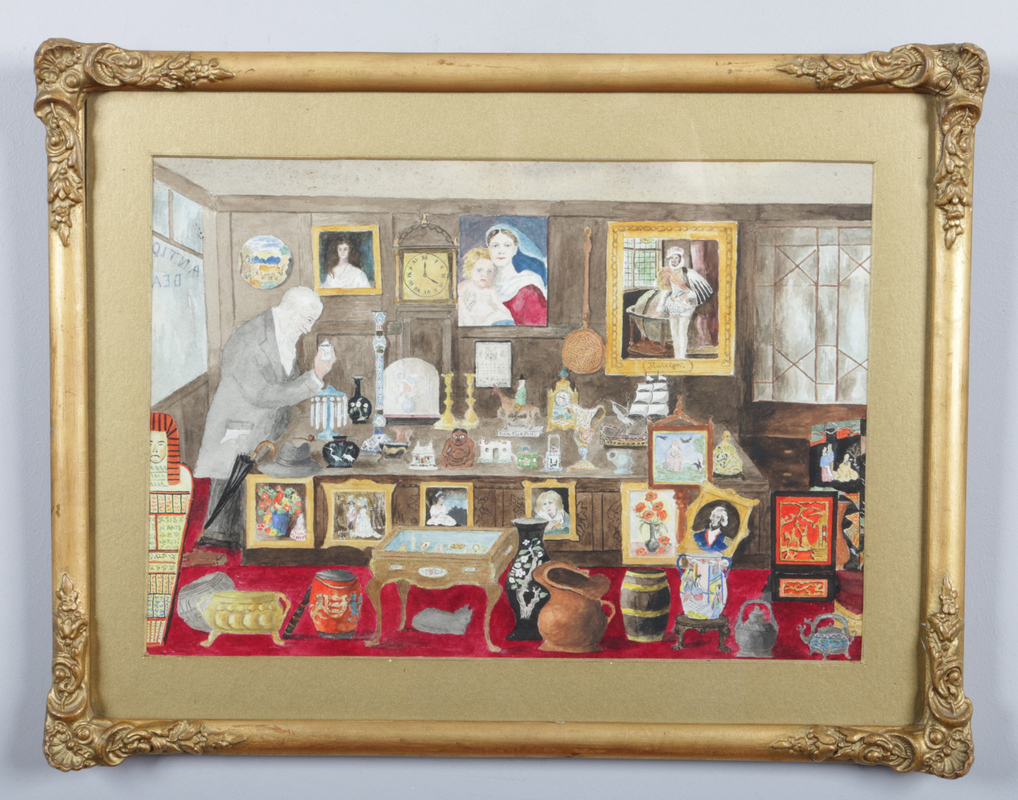
Two further visual representations of the history of the antique trade in Britain offer both a continued visual tradition (one is an image of a cluttered interior of an antique shop) and a contrast (one is not an image of an interior of an antique shop but of an open air second-hand market stall). This pair of watercolour paintings, (also now part of the collections of the antique dealers research project) date from c.1940s; they are about 12 inches by 8 inches. They are obviously by an amateur hand, but are charmingly naïve in the representations.
Anon. ‘An interior of an antique shop’, c.1940s. Watercolour. Photograph Antique Dealer Research Project, University of Leeds.Anon. ‘A view of Portobello Road market’, c.1940s. Watercolour. Photograph Antique Dealers Research Project, University of Leeds.
The painting of the antique shop interior (you can just see the remaining letters forming the words ‘Antique Dealer’ in the window), illustrates the wide range of antique objects that one might expect to see in an antique shop in the period. There’s also a clear sense of British nationalism in the choice of items represented – a portrait of Sir Walter Raleigh; a portrait of Horatio Nelson; the various British paintings displayed along the front of the display table. As well as objects from across the world – an Egyptian mummy, Chinese porcelains.
By way of contrast, the street market scene in the other painting illustrates a typical range of objects from second-hand cultures. Old but still usable pots and pans, bags, shoes, alongside the odd piece of broken pottery. As in the other painting, there’s a strong sense of British nationalism; the Second World War was probably taking place, or was a very recent memory, when these paintings were produced. As if to emphasise this, the small painting/photograph? to the right in the street market scene, depicts Charlie Chaplin in the famous American anti-war film ‘The Great Dictator’, which came out in 1940.
The shop behind the central figure is named ‘J. Bodger’ (certainly a fictional name – a ‘bodger’ is a wood-turner, someone who makes chair legs and turned parts of chairs and furniture). ‘J. Bodger’ is named as a ‘furniture dealer’, but seems to be buying and selling all sorts of second-hand material. The relationships between second-hand dealers and antique dealers has always been very close, but here, by the 1940s, there’s a very clear distinction between the two practices, as articulated in the pair of paintings. Indeed, Portobello Market (located in Portobello Road, as the street sign in the painting illustrates), which had developed as an open air market in the late 19th century, became associated with the second-hand trade by the 1920s, and became famously associated with the antiques trade in the 1940s, when these paintings were created.
The 19th century paintings by John Watkins Chapman and the anonymous pair of 20th century paintings of Portobello Road antique and second-hand markets, offer fascinating insights into the visual culture of the antique trade, and it’s rich potential as a research resource for the history of antique dealing.



 antiquedealersblog