Posts tagged ‘19th century antique dealers’

June 30, 2023

Early 19th Century Antique & Curiosity Dealers

The history of antique dealing (in it’s modern form at least) can be traced to the opening decades of the 19th century, and as part of the research project on the history of antique dealing we occasionally come across material dating from this very early period. There are examples of very rare sales catalogues produced by some of these early dealers – those that made it to the SOLD! exhibition at The Bowes Museum back in 2019 may remember we had on display some key examples of this rare material – a catalogue produced by the curiosity dealer and bookseller Horatio Rodd, who traded from Great Newport Street in London in the 1830s and 1840s, on loan from the collections at The National Art Library at the Victoria & Albert Museum.

Catalogue produced by Horatio Rodd, London 1842. National Art Library, V&A Museum; NAL:II.RC.L.32 Copyright The V&A Museum.

We have not managed to discover any early 19th century dealer catalogues (we are looking though!), but what did appear last week was an early 19th century copper trade token (26mm diameter) produced in 1839 by the well-known ‘curiosity dealer’ William Till (d.1844). Such tokens were produced from the late 18th century as a result of the coin shortages in Britain, but many traders continued to produce tokens as a form of advertising, as well as continuing to be used for payment for goods etc throughout the 19th century.
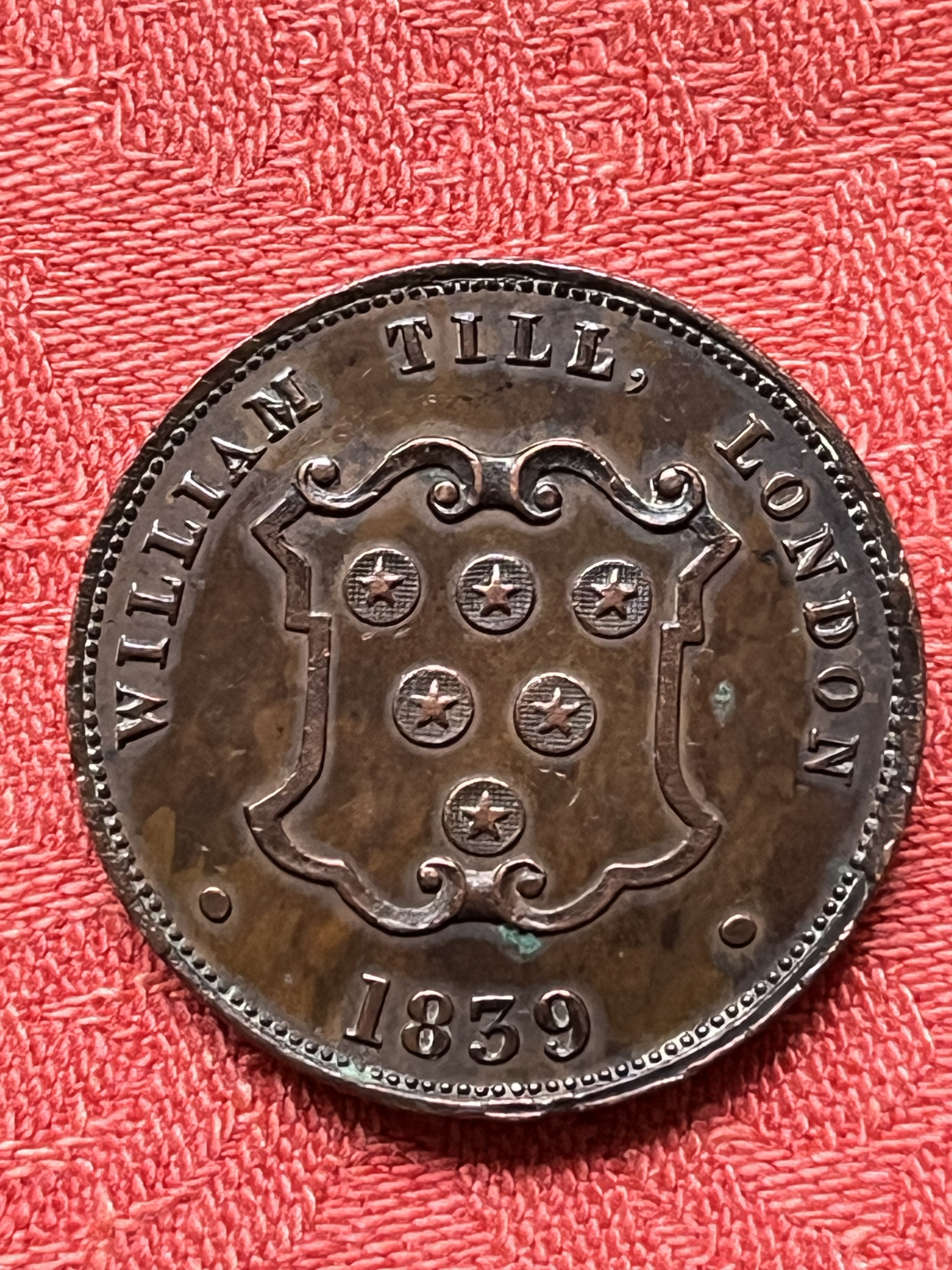
Trade Token, William Till, 1839. Photograph, Antique Dealers Research Project, University of Leeds.

I’m guessing that Till produced this token to advertise his business, and for collectors of modern coins, but perhaps it could also have been used to buy things from Till’s shop. Till was perhaps one of the most famous dealers in ‘ancient & modern coins’ in the period; he is recorded as ‘curiosity dealer’ at 17 Great Russell Street, London by 1832, and wrote an important work on ancient coins, An Essay on the Roman Denarius published in 1838. He was also one of the first members of the Numismatic Society, founded in 1836. Below is the verso of Till’s token, indicating his business as a ‘Dealer in ancient & modern coins, medals and antiques etc’.

Trade Token, William Till, 1839. Photograph, Antique Dealers Research Project, University of Leeds.

Till produced several versions of his token during the 1830s – in the above example he has included an emblem which seems to mirror the Arms of the Medici family, the enormously wealthy family based in Florence in the 15th and 16th centuries, founders of the Medici bank; the 6 balls in the cartouche in Till’s medal mimic the 6 balls in the Medici crest – Till seems to use it as a visual pun.

Curiously, a few years ago we also found another copper trade token produced by a ‘curiosity dealer’. This one produced by the dealer Robert Heslop, who traded from 62 Whitecross Street, London during the 1820s and 1830s. Heslop’s token, (also 26mm diameter), is said to very rare and to date from c.1795; it shows the famous 17th century contortionist Joseph Clarke, said to be the most extraordinary ‘posture master’, beneath the words ‘CAN YOU DO SO’.
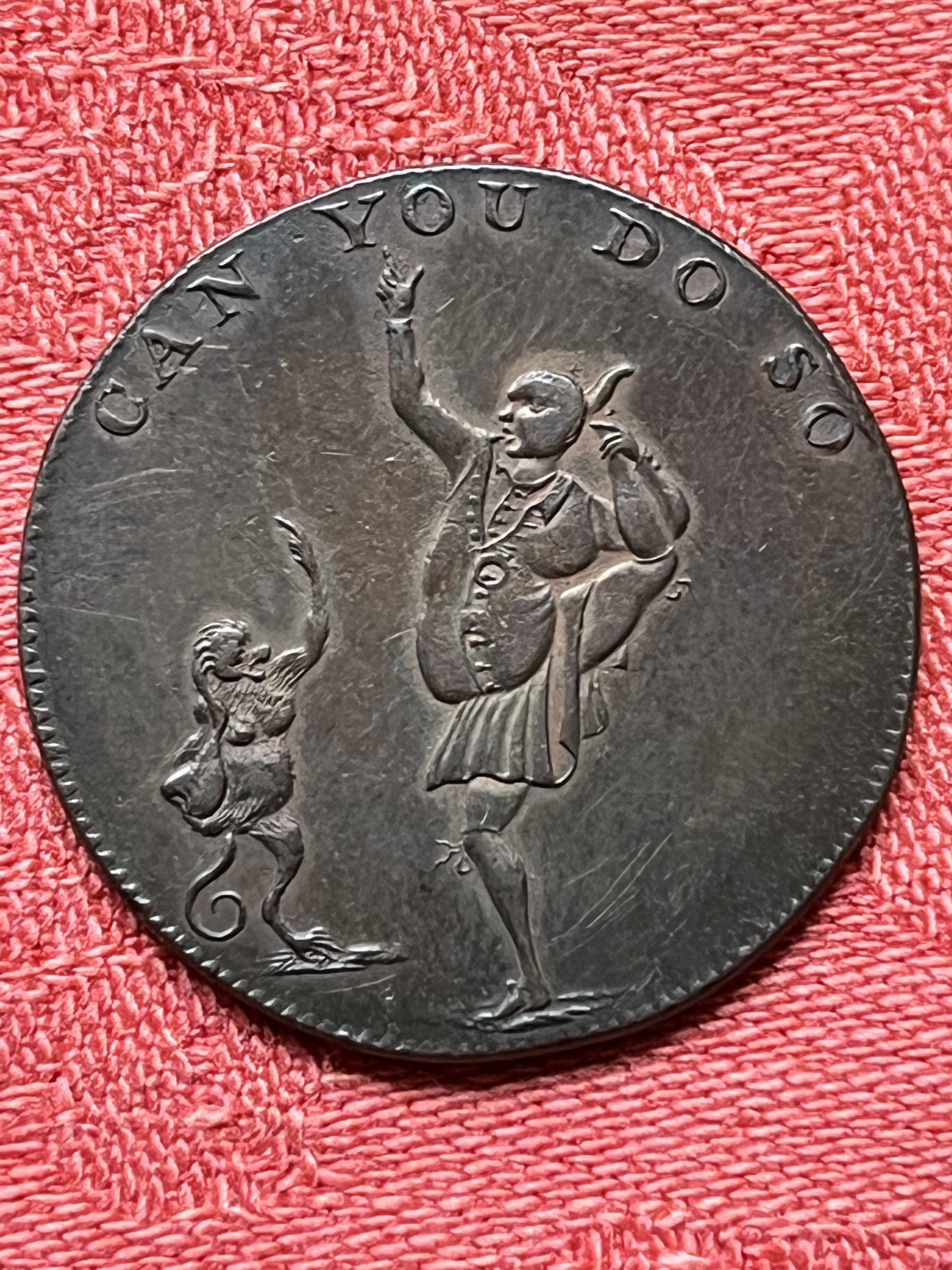
Trade Token, Robert Heslop, c.1795 Photograph, Antique Dealers Research Project, University of Leeds.

The verso of Heslop’s token gives his address at 86 Chiswell Street, London and, like that of William Till, highlights Heslop’s trade – this time as a dealer in ‘Natural Curiosities, Paintings, Coins..’ and supplying ‘colours for artists’. It was very common for ‘curiosity dealers’ in the period to be involved overlapping markets and practices.
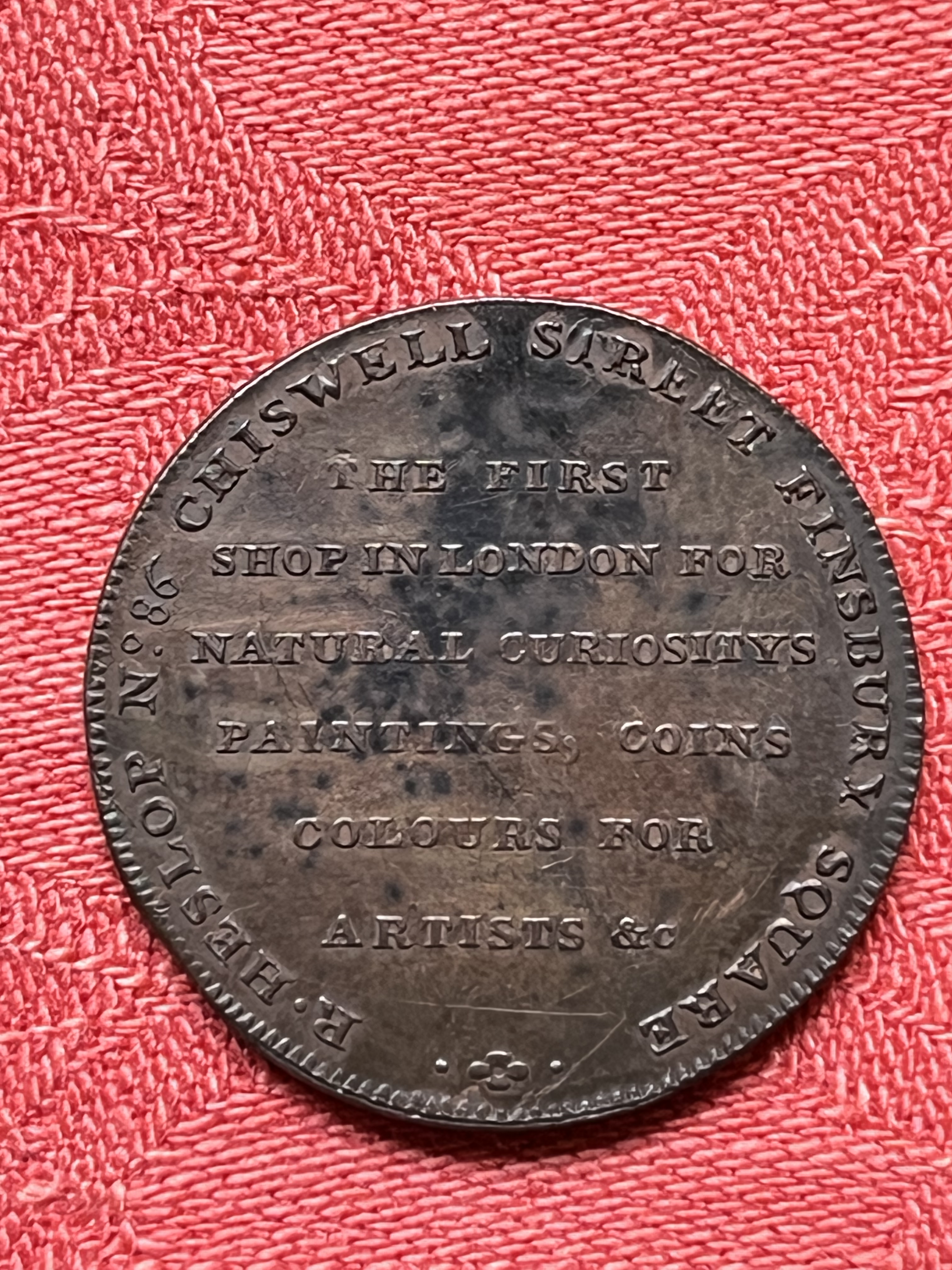
Trade Token, Robert Heslop, c.1795. Photograph, Antique Dealers Research Project, University of Leeds

Heslop’s token was also on display at the SOLD! exhibition at The Bowes Museum. And if you are interested in 19th century antique & curiosity dealers, you can find out more about them in my Biographical Dictionary of 19th Century Antique & Curiosity Dealers – it’s available FREE online at White Rose Depository.

Mark
October 31, 2020

19th Century Antique Dealers – Robert Pratt (1823-1889)

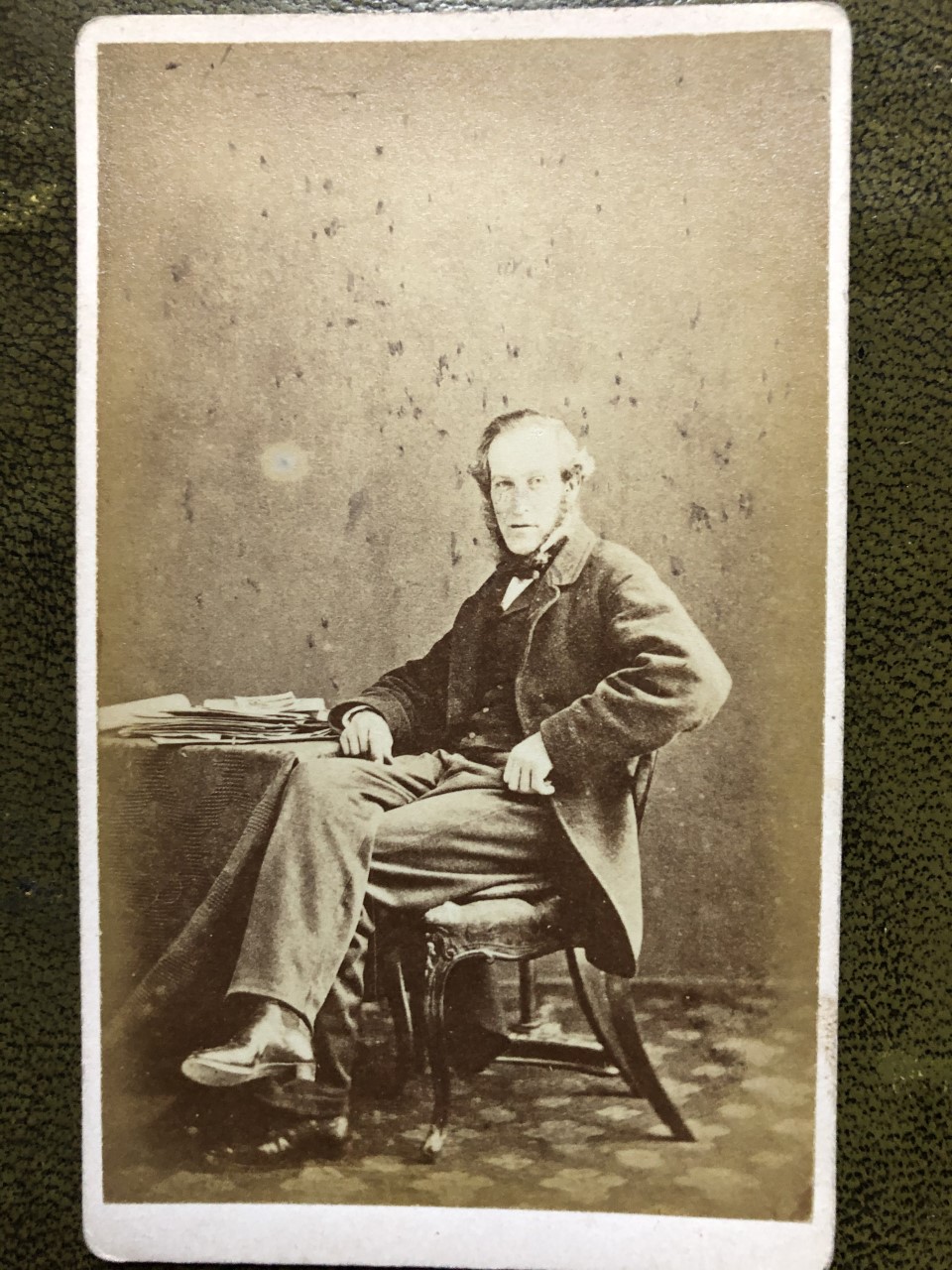
A recent acquisition to the growing archive of antique dealer related ephemera is this rare 19th century carte de visite, dating from the 1860s I think, and featuring the ‘Antique Furniture Dealer’ Robert Pratt (1823-1889), who traded from High Street, Guildford from the 1850s until the 1880s.

Carte de Visite, c.1860s, featuring Robert Pratt (1823-1889). Private Collection.

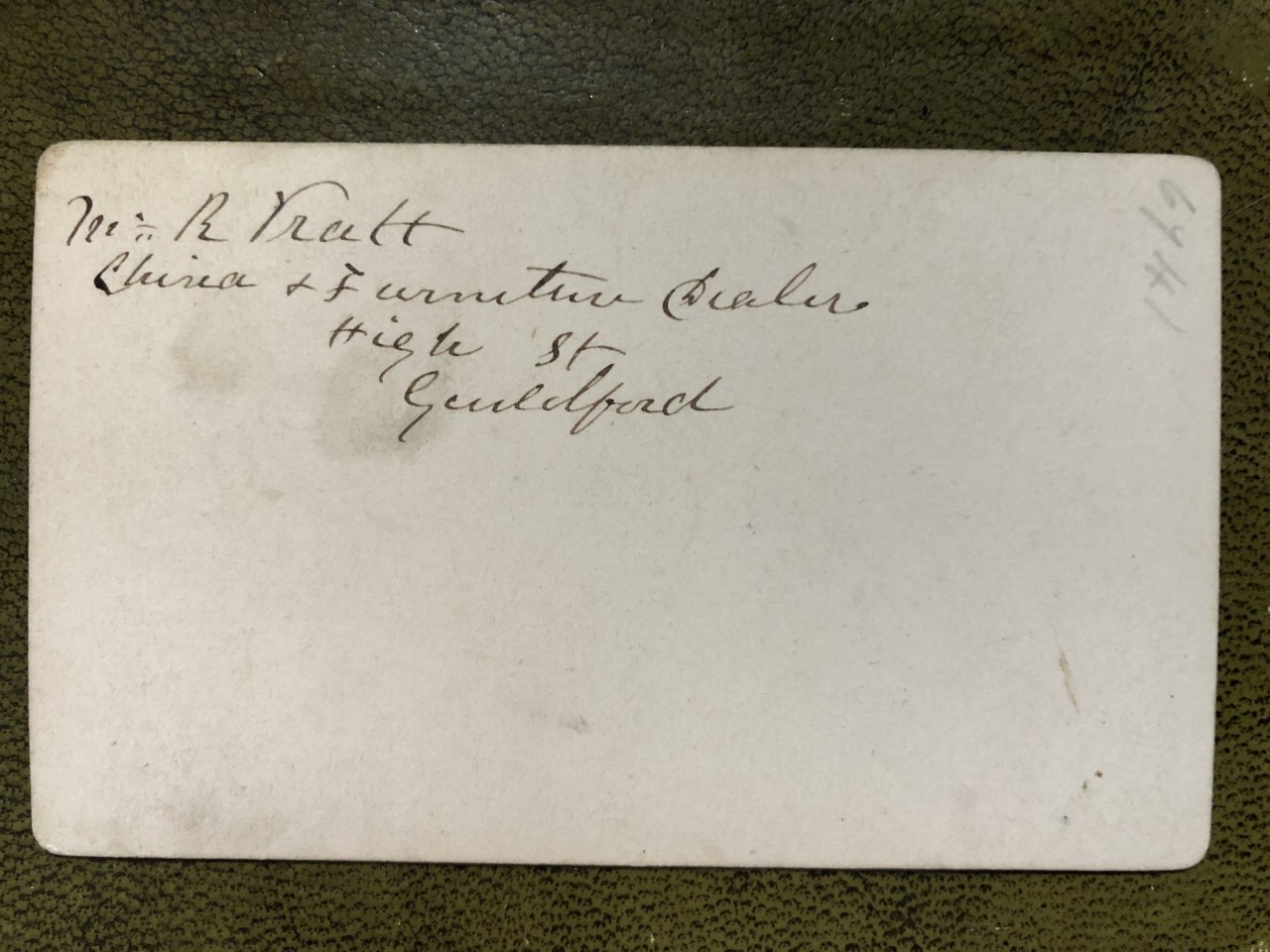
It’s very rare to have an actual image of a 19th century antique dealer, so this was a very exciting find – the card is quite small, just 62mm wide by 104mm long; the verso of the photograph is inscribed in pen in a contemporary hand, ‘Mr R Pratt China & Furniture Dealer High St Guildford’ –

Carte de Visite, c.1860s, featuring Robert Pratt (1823-1889), verso with inscription. Private Collection.

Robert Pratt is listed in the Guildford Trade Directories, at 12 High Street, Guildford in 1855, as ‘furniture broker’, which suggests he was involved in the second-hand trade at the time, perhaps specialising in furniture, as it appears he was trained as a cabinetmaker – the Census for 1851 records Robert Pratt as ‘cabinetmaker and journeyman’.  Pratt was also listed as ‘cabinetmaker’ in the Guildford Trade Directories in 1878, and had by then moved the business to 147 and 148 High Street, Guildford.  However, in 1878 Pratt is also listed as ‘Antique Furniture Dealer’ at 147 and 148 High Street, Guildford in the Surrey Trade Directory.  The inscription on the verso of the photograph, ‘China and Furniture Dealer’ was a common classification and description used throughout the 19th century, especially in the period 1820s to 1870s, for what we would now call ‘antique dealers’, although as you can see from the variety of classifications in the Trade Directories, the descriptions of trades encompassed a range of overlapping practices.

Census records for 1861 indicate that Robert Pratt (who had a recorded age of 37 – although he was actually born, according to the birth and baptism records, on February 21st 1823) – census records for age are often slightly inaccurate due the the method of recording, which was rounded down to the nearest 5 years for people over the age of 15.  Pratt was at the time married to Mary (recorded age 31) and had 4 children – Mary (aged 9), Robert (aged 6) Anne (aged 5), and Susan (aged 3), all ‘scholars’ (i.e. at school); he was recorded as a ‘cabinetmaker and broker’ employing ‘5 men and 1 woman’ – by the 1881 census Robert Pratt was employing ‘8 men and 4 boys’, so he seems to have been quite a successful businessman.  His wife, Mary, appears to have died sometime in the 1860s, as by the 1871 Census Robert is recorded as a widower, and by that date Robert and Mary had 2 further children, Alice (aged 8) and Fanny (aged 5).

Pratt’s father, James Pratt, was a ‘bookbinder’, according to the birth and baptism record. Robert died on 18th April 1889 in Guildford, leaving £1,293.4s.6d – a fairly wealthy man considering that the ‘relative income value’ of that sum was about £1,018,000.00 in today’s terms (according to measuring worth.com)

I had wondered if Robert Pratt was any relation to the well-known antique dealers Charles James Pratt, who were trading in fashionable Brompton Road, London from the early 1900s until at least the 1960s – see the entry from C.J. Pratt & Sons in the antique dealers interactive map website – Antique Dealers Map – but it seems that there was direct no relationship between the families – at least none that I have managed to discover as yet.  And Robert Pratt also does not seem to be directly related to the illustrious 19th century ‘antique dealers’ Samuel and Henry Pratt, who traded in Bond Street, London during the 1830s and 1840s.

Anyway, this lovely little carte de visite is a fascinating survival in the history of the antique trade in Britain – if you know of any other photographs of 19th century ‘antique dealers’ I would be very interested to hear about them.

Mark

Home Subjects

a working group dedicated to the display of art in the private interior, c. 1715-1914

The Period Room: Museum, Material, Experience

An International Conference hosted by The Bowes Museum and The University of Leeds

H. Blairman & Sons Ltd

A research project investigating the history of the antiques trade in Britain in the 19th & 20th centuries

Museum Studies Now?

'Museum Studies Now?' is an event which aims to discuss and debate museum and heritage studies education provision.

The Burlington Magazine Index Blog

art writing * art works * art market

East India Company at Home, 1757-1857

A research project investigating the history of the antiques trade in Britain in the 19th & 20th centuries