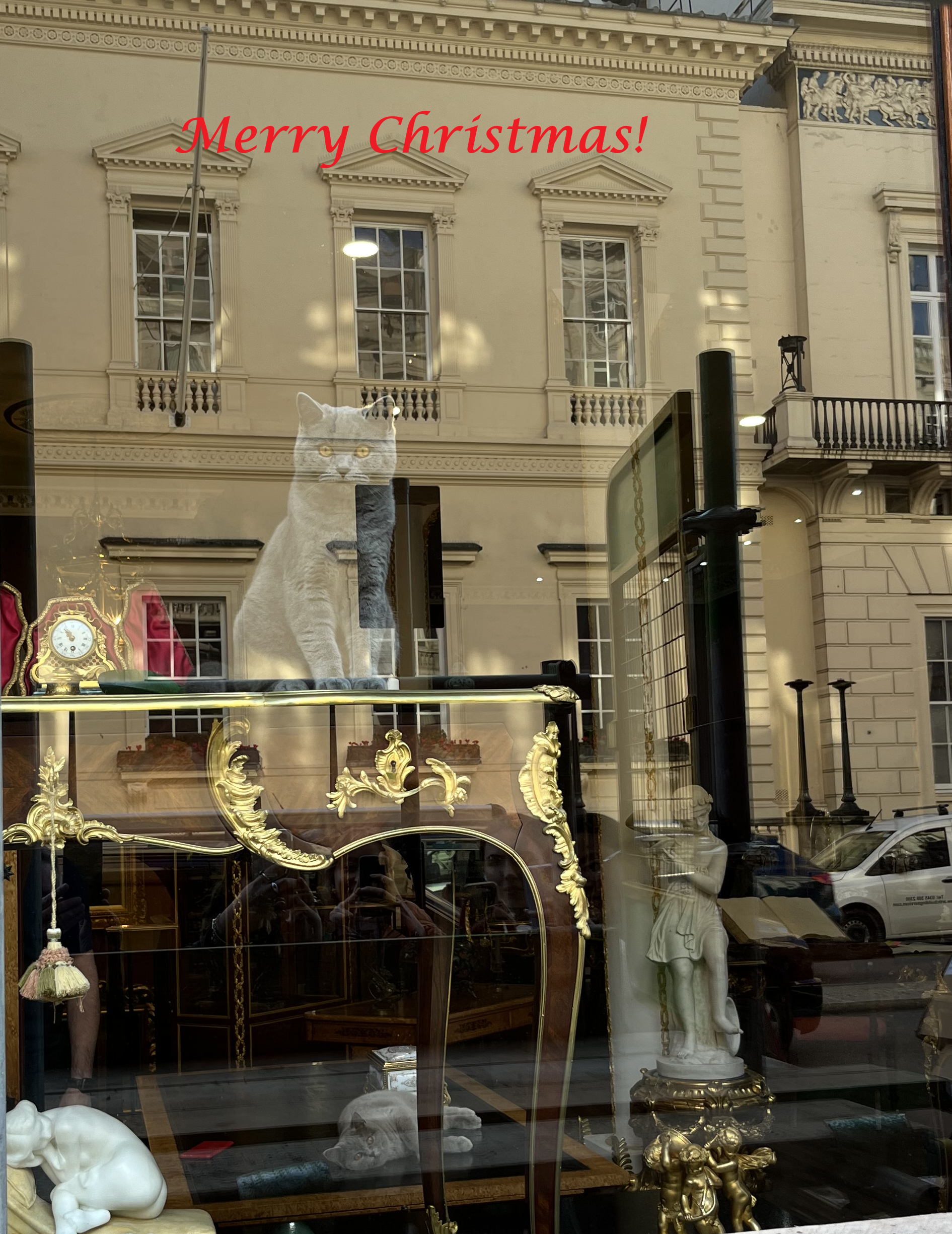
Merry Christmas to everyone, and we wish you all a very Happy and Healthy New Year! Thank you to everyone who reads the Antique Dealer Research Blog – we will have lots of new blog posts in 2025. In the meantime we hope you have a very relaxing Christmas break.
Mark
Cats in an antique shop window, Pall Mall, London.
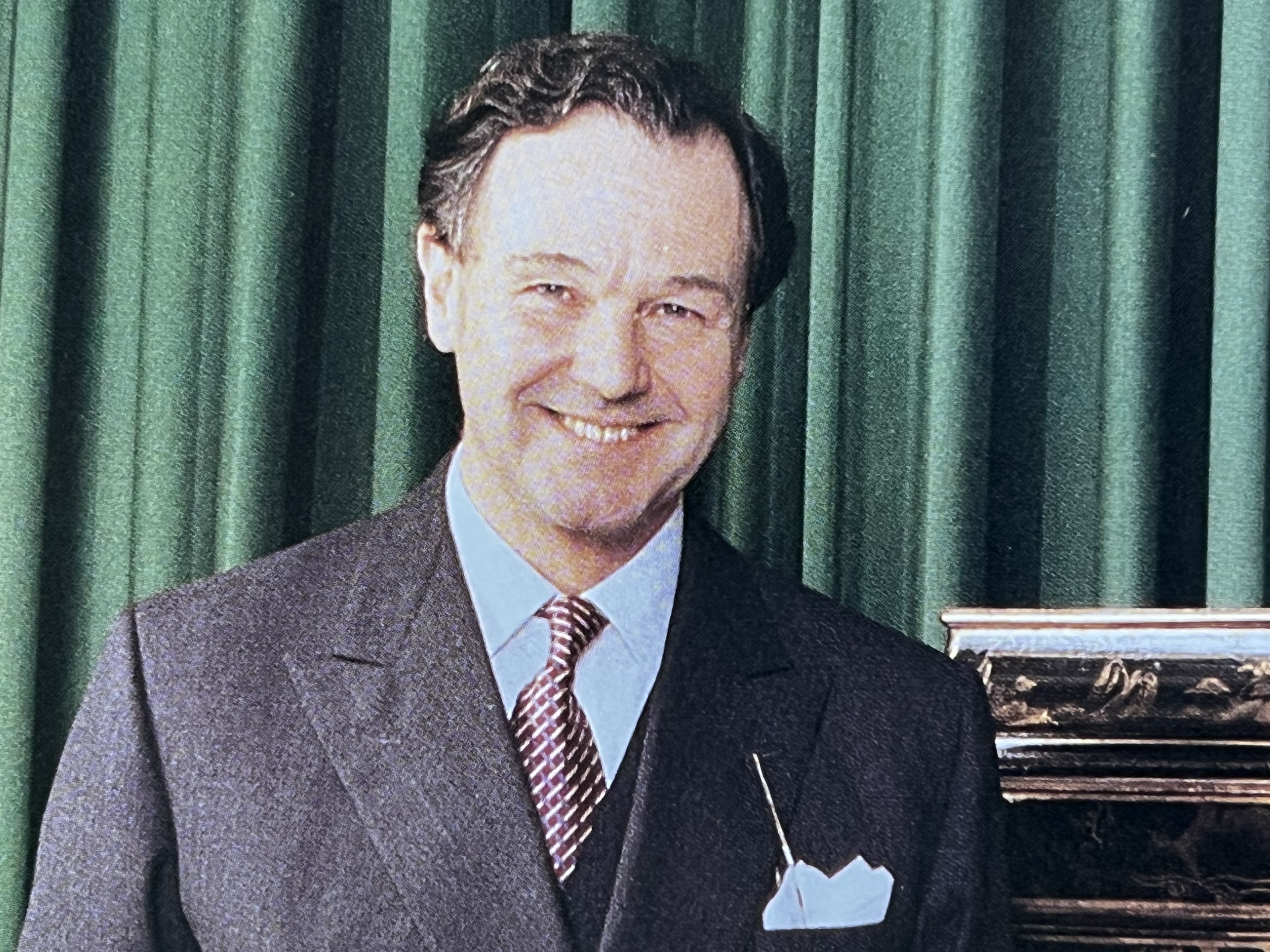
It is with very great sadness that we heard that Robin Kern sadly passed away on 2nd November. We have our own reflections on Robin and on the antique dealing business of Hotspur further below, but Chris Coles, who undertook our oral history interview with Robin back in 2016, has also composed a personal tribute to Robin.
Robin Kern, of Hotspur Limited, in 1999. Photograph courtesy of Robin Kern.
A Personal Tribute to Robin Kernfrom Chris Coles
Mark has very kindly allowed me to write a few words about Robin Kern. I first met Robin whilst still working at the British Museum. I had fortuitously seen an advert in the Antiques Trade Gazette that Mark had placed, asking for volunteers for the Antique Dealers Project. Thankfully I applied and was accepted and Mark very kindly allowed me to conduct some of the oral history interviews. One of those interviews was with Robin Kern at his beautiful home in Notting Hill. I had previously met Robin some years before at his premises in Kinnerton Mews, having already closed the Lowndes Street shop. I had actually visited him as a result of a visitor to my department at the BM who had told me that she was researching dummy boards. I knew that Robin had a pair in stock at that time and suggested that she went to see him. She emailed me afterwards to say how well she had been treated and that I should go and see him myself and I did. This bringing together of academics and researchers and members of the trade was entirely typical of the way that Robin conducted himself and it was no surprise at all that some of his best friends, and greatest clients, included the likes of Christopher Gilbert buying for Temple Newsam and Sir Nicholas Goodison the expert on Matthew Boulton and barometers. As John Hill said so perfectly in his eulogy at Robin’s funeral
‘He was a gifted mentor, using his passion for diplomacy and his velvet touch……Robin and Brian built a strong bond of friendship and trust between like-minded souls and Hotspur was to feel a bit like a private members club’.
When I interviewed Robin for the project he spoke with understandable pride about some of the many famous private collections he had helped to form such as those for the McAlpine family, Jon Gerstenfeld, Fred Krehbiel and Jon Bryan. It is no exaggeration to say that Hotspur took the marketing of purely English furniture and works of art to a new level amongst the trade and virtually every great collection of such pieces will include something that passed through the firm’s hands at one stage or another.
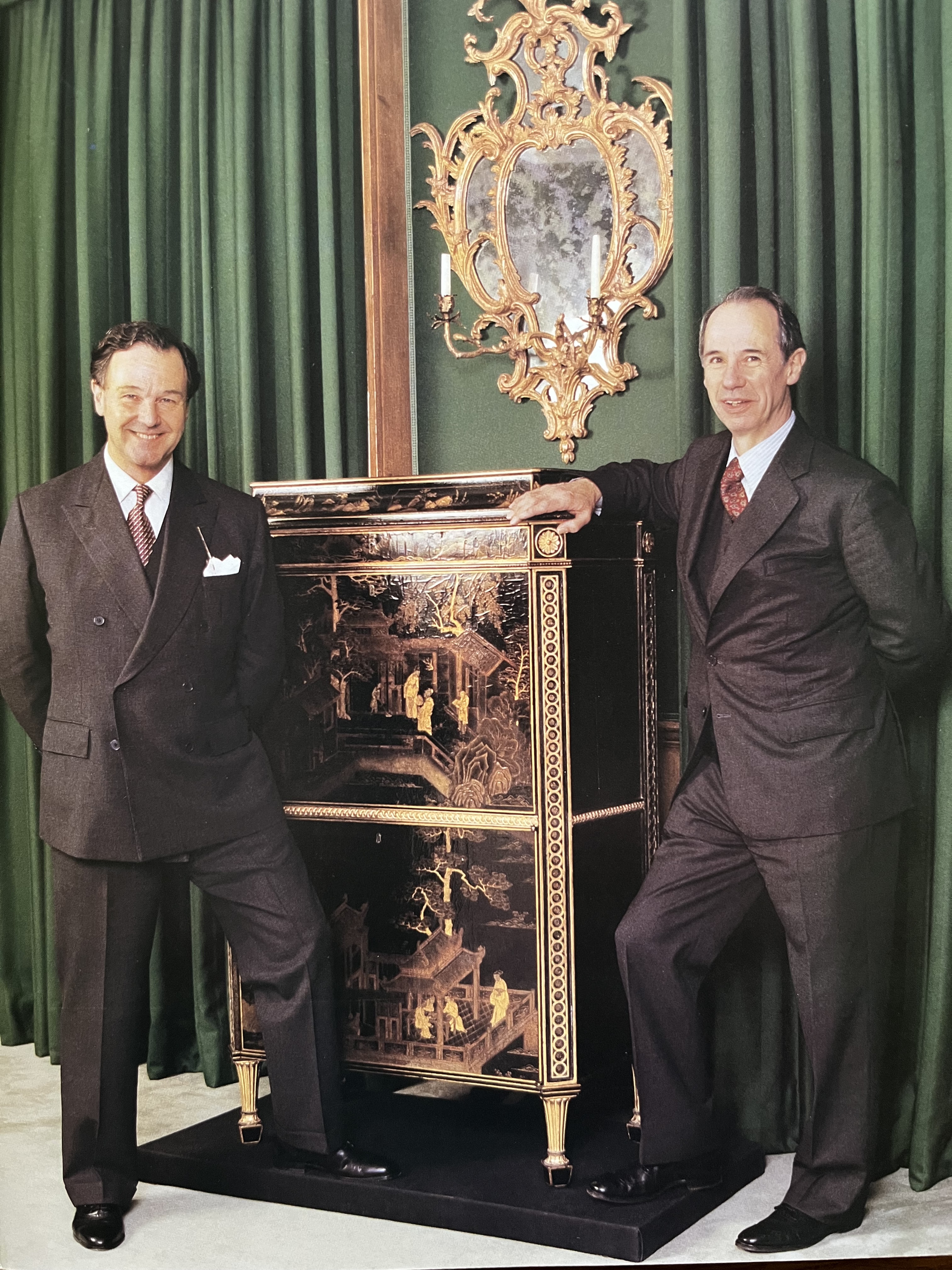
When conducting the oral history interviews, it was always our policy to get a photograph of the interviewee for use in the relevant section on the website. Robin was insistent that we use the image of him and his brother Brian with the Chippendale lacquer secretaire, now at Temple Newsam (see photograph below), that featured in the Hotspur anniversary book. He didn’t want anyone to be under the impression that the firm’s success was down to him alone and wanted Brian, who had already tragically passed away by that time, to get his full share of the credit. The two brothers took over running the firm in the most difficult of circumstances, both of their parents having been killed in a tragic car crash. Under the brothers’ stewardship, however, the firm flourished and moved on to the next level and the respect and affection for Robin was obvious from the remarkable turnout for his funeral which was attended by almost everyone involved in the current high end furniture trade and plenty in other branches of the antiques trade as well.
Robin’s generosity towards the Antique Dealers Project was cemented by his decision to give all of the remaining copies of the Hotspur anniversary book to Mark for use as university prizes and this, again, was typical of his outlook in life, always trying to help others and never hinder.
All of us involved in the furniture trade in Britain and America owe a huge debt of gratitude to Robin for raising the profile and standard of dealing in our area and for his personal kindness and generosity. He was a titan of the trade who will be sadly missed and I send my condolences to his widow Odile, herself also a great dealer, and the rest of the Kern family.
Robin Kern (1938-2024) – Thank you Chris for your contribution to the Antique Dealers Research Blog. Robin’s obituary was also published in the Antiques Trade Gazette (ATG 23rd November 2024), p.79 (composed by his friend, Simon Phillips of Ronald Phillips Limited, London). Below are my own reflections on Robin and the significance of the antique dealers’ Hotspur Limited.
Robin Kern with his brother Brian at Hotspur with the black lacquer secretaire from Harewood House, Yorkshire, sold to Temple Newsam, Leeds, in 1999. Photograph, Robin Kern.
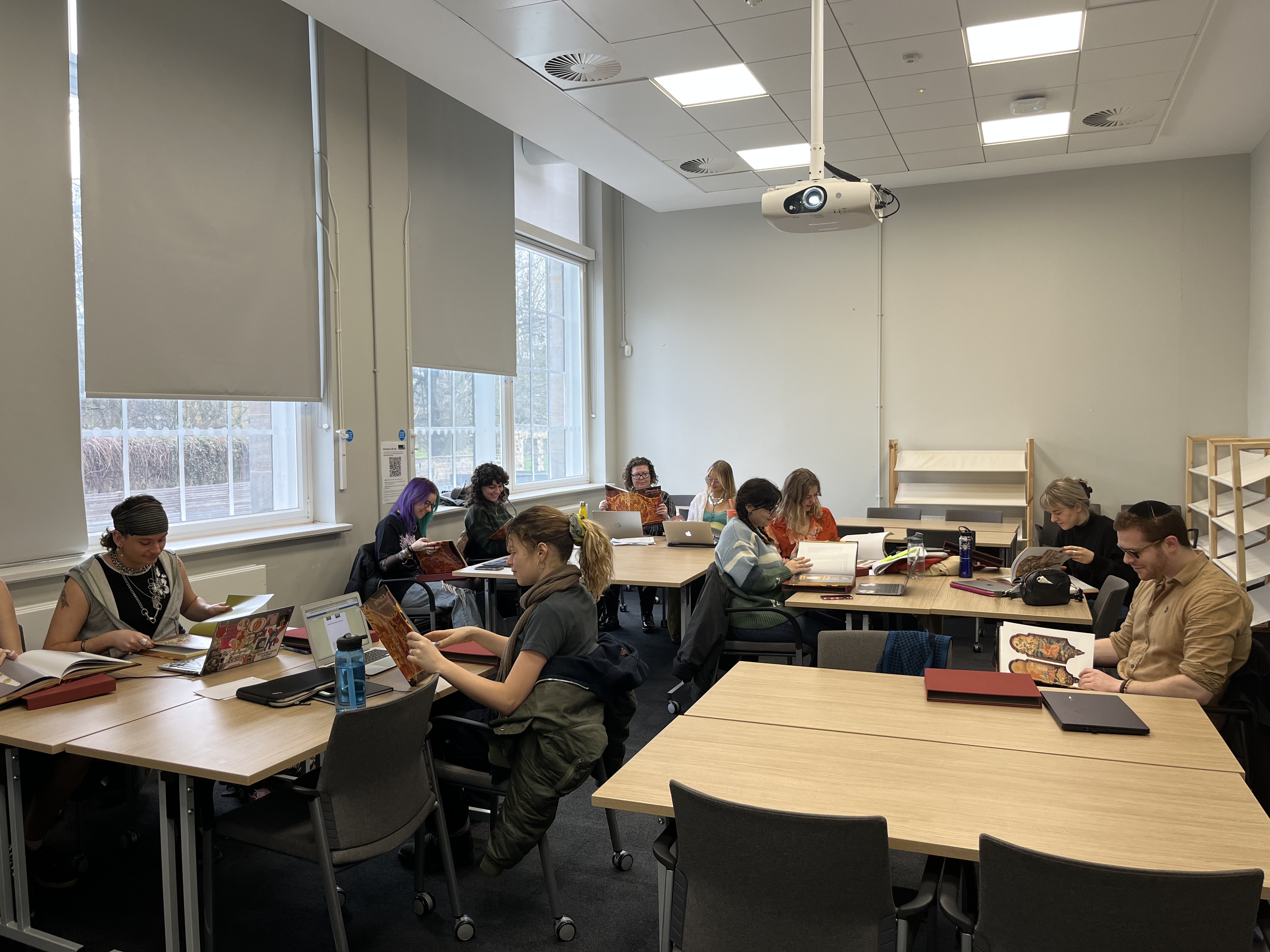
I remember meeting Robin in London at his store in Chelsea, back in 2018. I had driven down from Leeds to collect a very large pile of copies of the book published to celebrate the 80th anniversary of the founding of Hotspur (2004) Hotspur: Eighty Years of Antiques Dealing which, with typical generosity (as Chris mentioned above) Robin had given to the Antique Dealer Research Project to distribute to students enrolled on the module I teach at the University of Leeds (called ‘Antique Dealers: the market for ‘decorative art’ from curiosities to retro’). It is a 3rd year undergraduate module, the focus of which I believe is unique in UK universities, and which I’ve been running for almost 10 years now. Robin give us dozens and dozens of spare copies of the Hotspur book, which I distribute each year to eager students studying the history of antique dealing. Here’s a photograph of the undergraduate students enjoying the book from 2023 (and which I also would send to Robin as evidence of the real impact of his generosity!)
BA students with copies of ‘Hotspur’ in 2023. Photograph, University of Leeds.
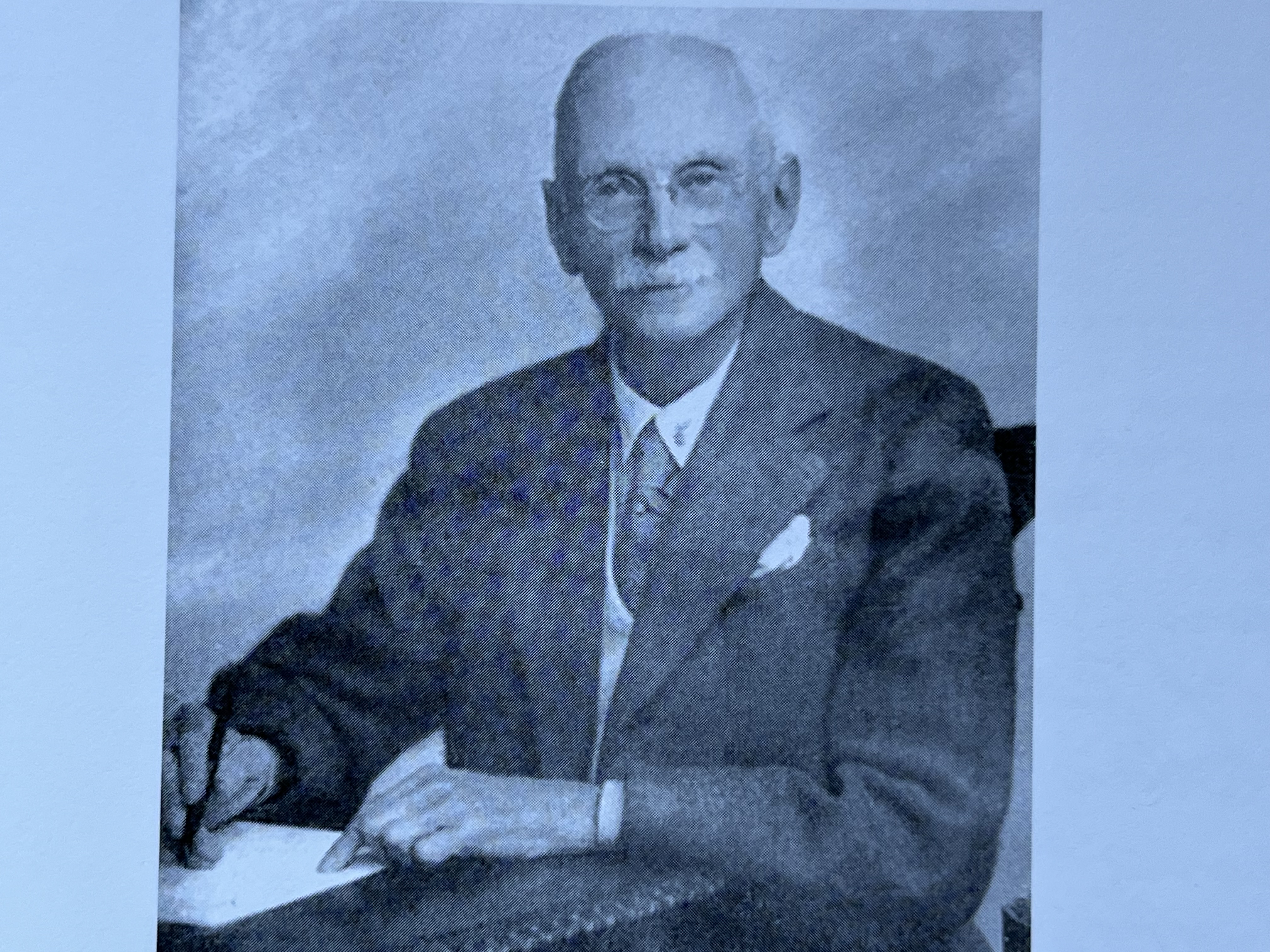
The antique dealing business, Hotspur Limited, was founded by Robin’s grandfather, Frederick Kern (see below) together with Robin’s father, Robert (Rob) Kern (see below) in 1924. Frederick had been a director of the London branch of the decorators and antique dealers Carlhain and Beaumartz, as Nicholas Goodison described in the history of Hotspur, ‘[Frederick] was with the firm for twenty years until it closed in 1914, and was then briefly in business at 27 Soho Square as a director of Monday, Kern and Herbert, where he was in charge of the ‘Antique Department and Reproductions” (Goodison & Kern, Hotspur: eighty years of antiques dealing (Two Associates, London, 2004), p.19.
Frederick Kern (1868-1958) in c.1955. Photograph, Robin Kern.Robert Kern in 1974. Photograph Robin Kern.
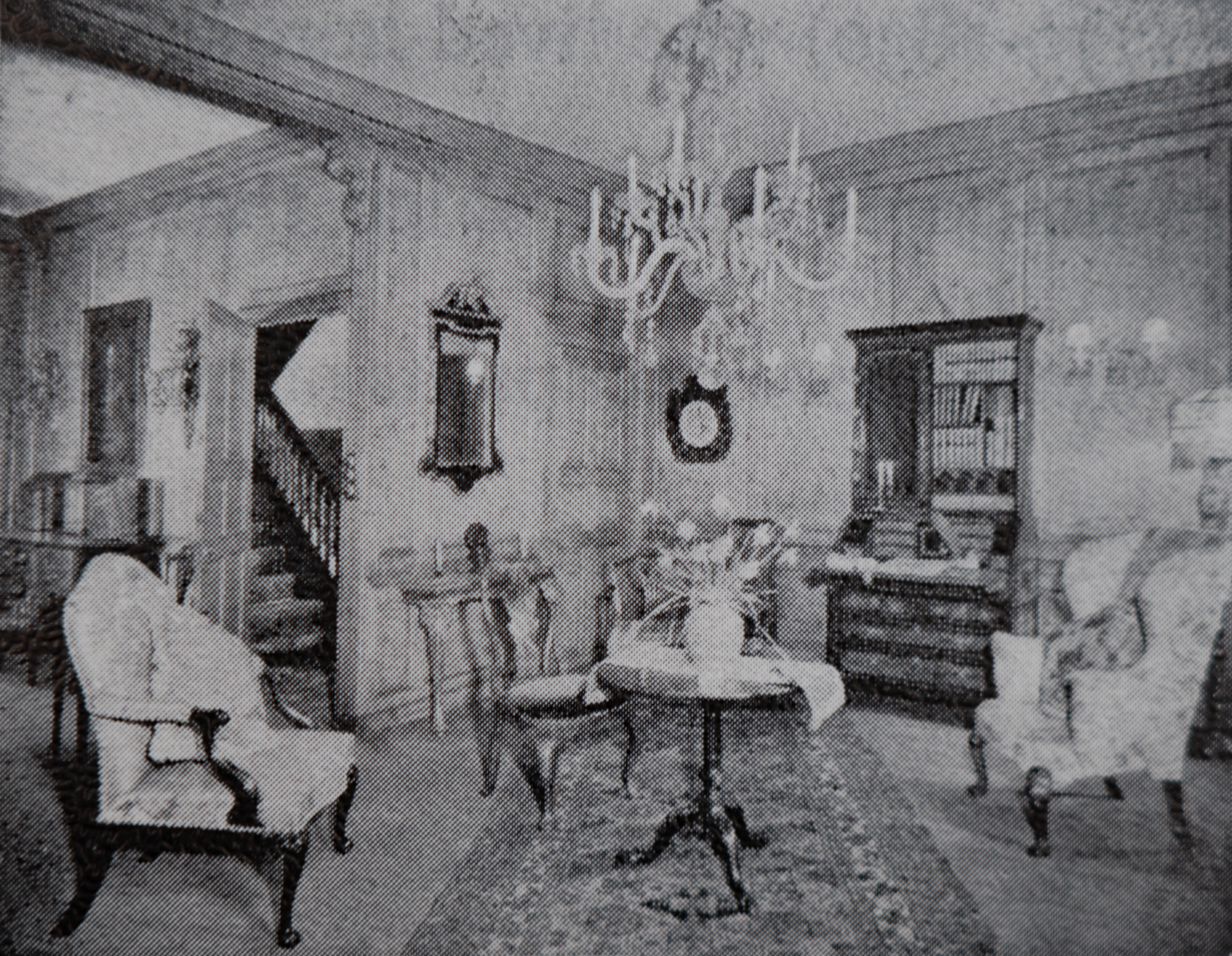
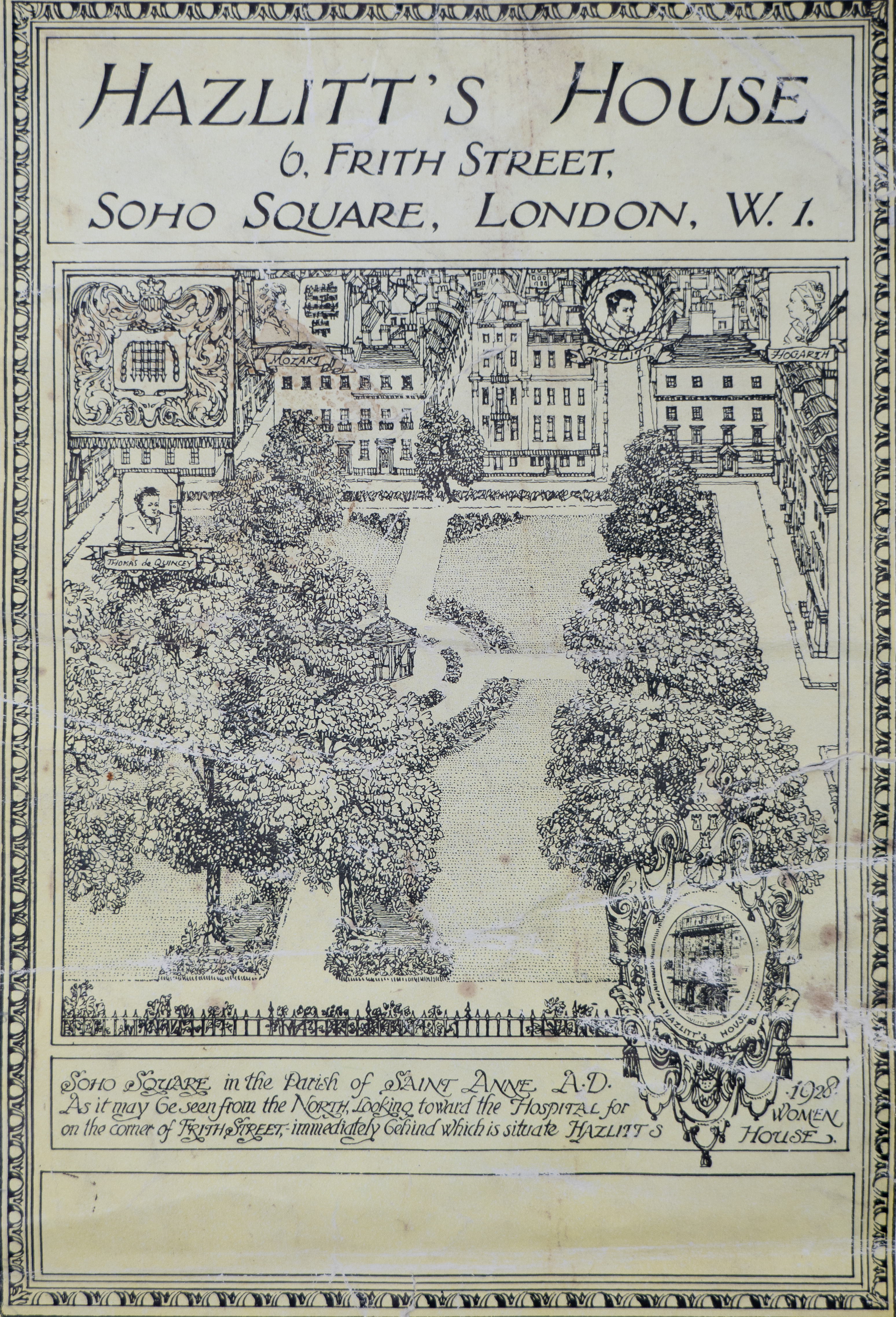
Hotspur’s first antique shop was at 16 Buckingham Palace Road in London, before moving to 6 Frith Street, near Soho Square in London by the late 1920s. The building in Frith Street occupied by Hotspur Ltd was formerly the home of the writer William Hazlitt (1778-1830) and the interiors were perfect for displays of English antique furniture that Hotspur were famous for buying and selling.
Hotspur Limited, 6 Frith Street, London, interior. Photograph, Robin Kern.Sales brochure produced by Hotspur in 1928. Photograph, Antique Dealer Research Project University of Leeds.
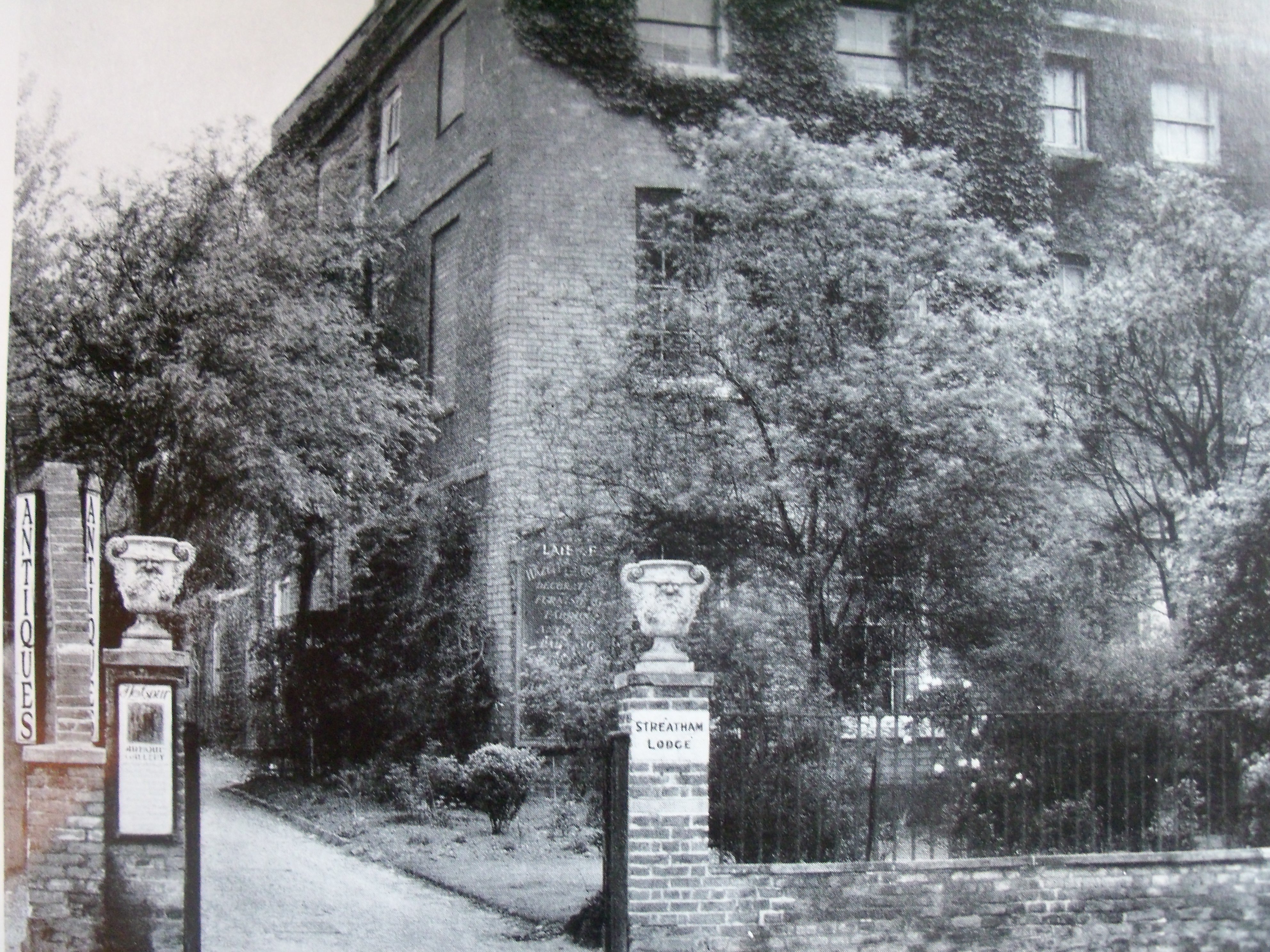
In 1939, to avoid bombing during the Second World War, Hotspur relocated to Streatham Lodge, Richmond, a rather grand 17th century house, again with period rooms ideal for the display of English antique furniture.
Streatham Lodge, the business location of Hotspur from 1939 to 1951. Photograph, Robin Kern.
In 1951 Frederick and Rob Kern moved Hotspur back to central London, to 14 Lowndes Street, a very smart street near Belgrave Square, and in 1956 Robin joined his father in the business, followed by his younger brother Brian in 1963. Robin and Brian’s father and mother, Rob and Betty, were tragically killed in a road accident in 1977. Brian retired from the business in 1999, but Robin continued, finally closing the doors in 2008.
Hotspur were one of the leading dealers in the highest quality antique furniture, especially English furniture of the ‘classic’ period 1680-1830. As Chris mentions (above) they helped build many of the most important collections of antique furniture in the mid-to-late-20th century in both the UK and the USA. Hotspur were also central to building of the antique furniture collection of Noel Terry (1899-1979), which remain on display at Fairfax House in York
Our memories of Robin are of a highly principled and exceptionally generous person. We are privileged to have included Robin and Hotspur as part of the Antique Dealers Research Project at the University of Leeds. Indeed, we are working quickly to make the oral history interview that we undertook with Robin and Chris Coles available to listeners (we are just sorting out the images so we can make that interview live on the project website). You may also be interested to hear that Hotspur are one of the antique dealers that are highlighted as part of the Year of the Dealer digital trails – the sale of the Harewood House secretaire (and the story of Hotspur), shown above, is one of the 10 objects in the digital trail at Temple Newsam, Leeds. We hope to have news of the launch of the Year of the Dealer trails in January, so do keep you eye on the Blog.
But before that, we send our sincerest condolences and best wishes to Robin’s family and friends.
As promised in our Blog Post on Antique Shops in Visual Culture IV, we have an update on our theme of paintings of antique shops (see previous Blog Posts on this theme – Antique Shops in Visual Culture I (Blog post 30th July 2023); Antique Shops in Visual Culture II (blog post 30th September 2023); Antique Shops in Visual Culture III (blog post 27th November 2023); Antique Shops in Visual Culture IV (blog post 25th June 2024)
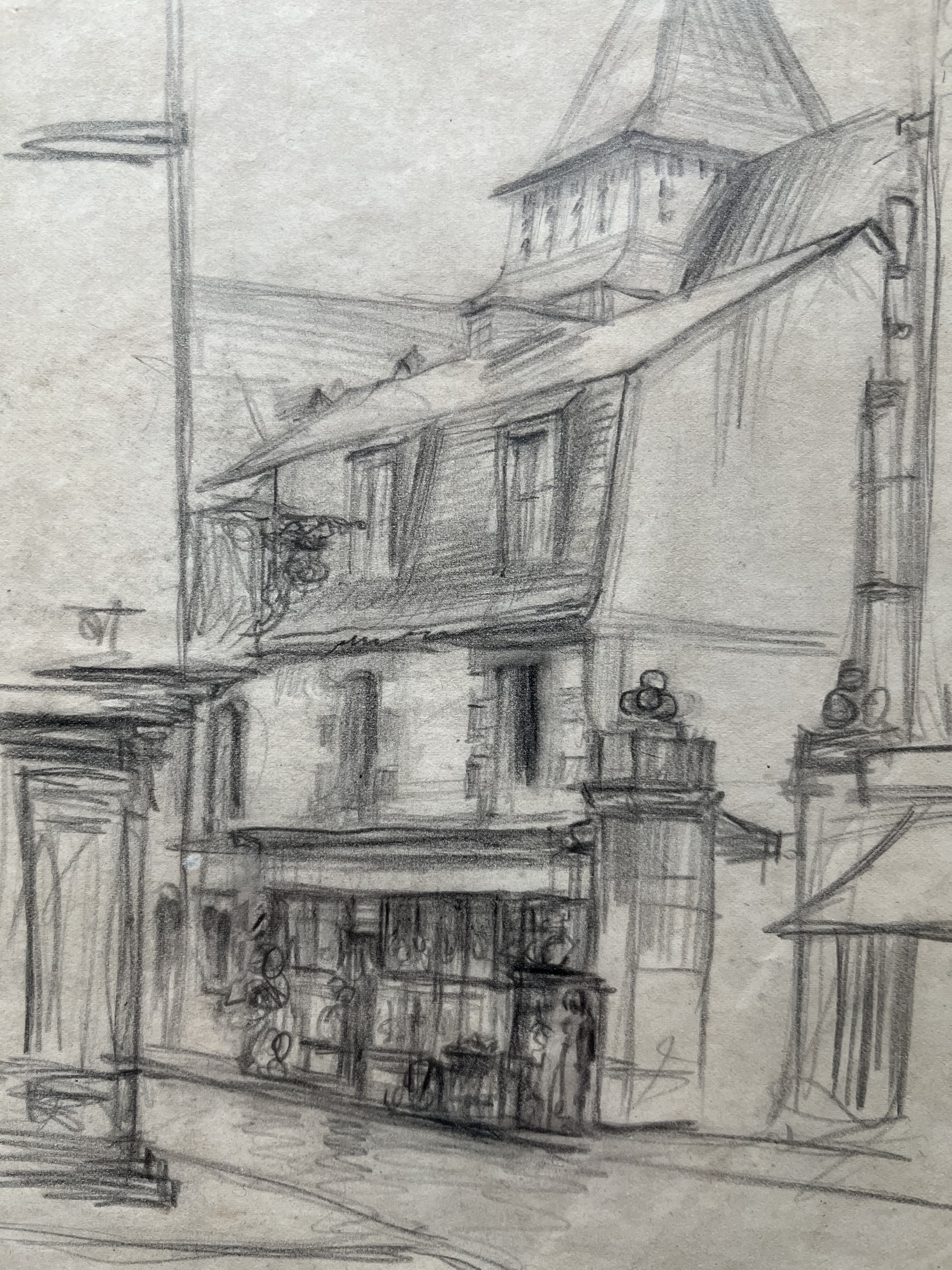
The latest additions to the growing corpus of paintings of antique shops includes our first image of a shop that is not located in Britain (but is by a British artist) – This pencil drawing (see below) by the artist Frank Lewis Emanuel (1865-1948) of an ‘Old Curiosity Shop in Grand Avenue, Dinan’.
Frank Lewis Emanuel (1865-1948), ‘Old Curiosity Shop in Grand Avenue, Dinan’. Pencil on paper, c.1880-1890. Private Collection.
Emanuel was born in London and studied at the Slade School of Art under the French artist Alphonse Legros (1837-1911); he first exhibited at the Royal Academy in London in the 1880s and at the Paris Salon in 1886. The pencil drawing of the ‘Old Curiosity Shop’ dates from the 1880s or 1890s and records a real antique shop in the town of Dinan in north west France. In this sense it is both an historical document and a work of art.
There is of course a very rich tradition of paintings and drawings of antique & curiosity shops in Europe dating back into the 19th century, especially in France and Italy, 2 key hunting grounds for antique collectors. Emanuel’s drawing of a ‘curiosity shop’ in Dinan is emblematic of the important role that antique and curiosity dealers played in the consumption of the past. Lewis’s drawing also reminds us of the relationship between buying and selling ‘antiques’ and historic urban environments – in the 19th century Dinan still retained much of it’s medieval historic fabric, a castle, city walls and many half-timbered buildings – ideal backdrops for antique and curiosity shops and curio hunters.
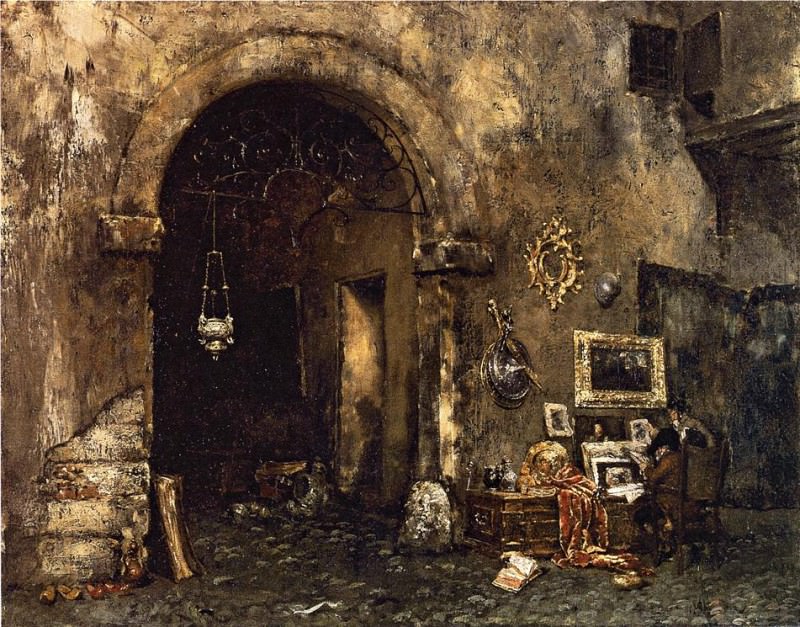
This practice of antique shops layered into the historic fabric, and indeed shops occupying historic buildings, is a recurring theme in the history of antique dealing. Here’s another example, this time an antique shop in Italy, a painting by the American artist William Merritt Chase (1849-1916) ‘The Antiquary’s Shop’ (1879).
William Merritt Chase (1849-1916), ‘The Antiquary Shop’ (1879), Oil on canvas. Brooklyn Museum, USA. Image copyright Brooklyn Museum USA.
The shop in Chase’s painting was located in Venice, the home of many leading antique dealers in the 19th century. Perhaps the shop that Chase portrayed is that of ‘Mr Zen’, a well-known dealer who had extensive dealings with the art historian and art dealer Otto Mundler (1811-1870) in the 1850s, when Mundler was working as an agent for the National Gallery in London.
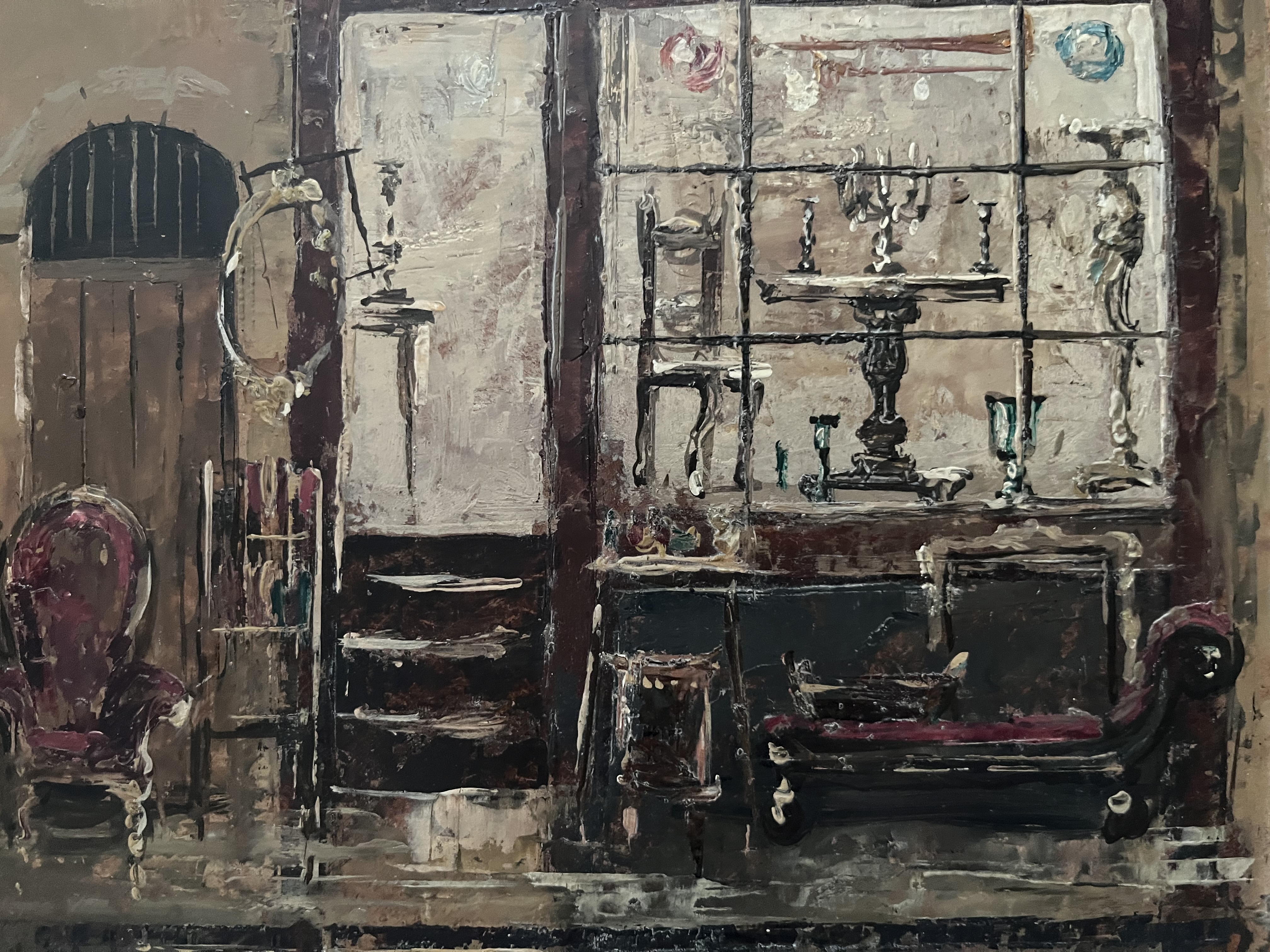
But to return to our key focus on antique shops in visual culture in Britain and further additions to the corpus of paintings and drawings of antique shops. Another new addition to the archive of paintings is a contemporary example – emphasizing the point of the enduring interest of antique shops in visual culture. This painting (below) by the artist Deborah Jones (1921-2012) of a ‘curiosity shop’.
Deborah Jones (1921-2012) ‘Curiosity Shop’. Oil on panel, 1980s. Private Collection.
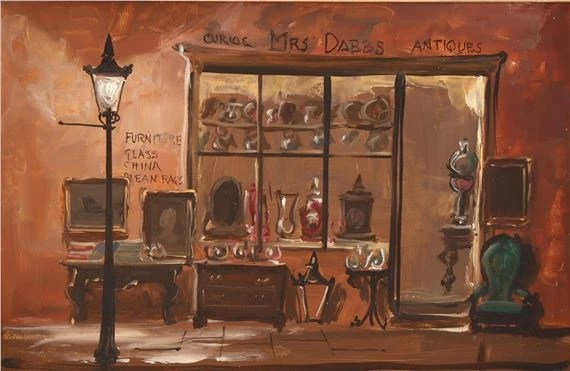
Jones was born in Wales and worked as a theatre and set-designer for The Royal Opera House, Glyndebourne and the Royal Shakespeare Company in Stratford-upon-Avon. Her artworks tend to reflect this practice and can be a little formulaic (at least for my taste) – see below – Jones’ oil on canvas, ‘Mrs Dabbs Antique Shop’.
Deborah Jones (1921-2012) ‘Mrs Dabbs Antique Shop’. Oil on canvas, c.1990. Private Collection.
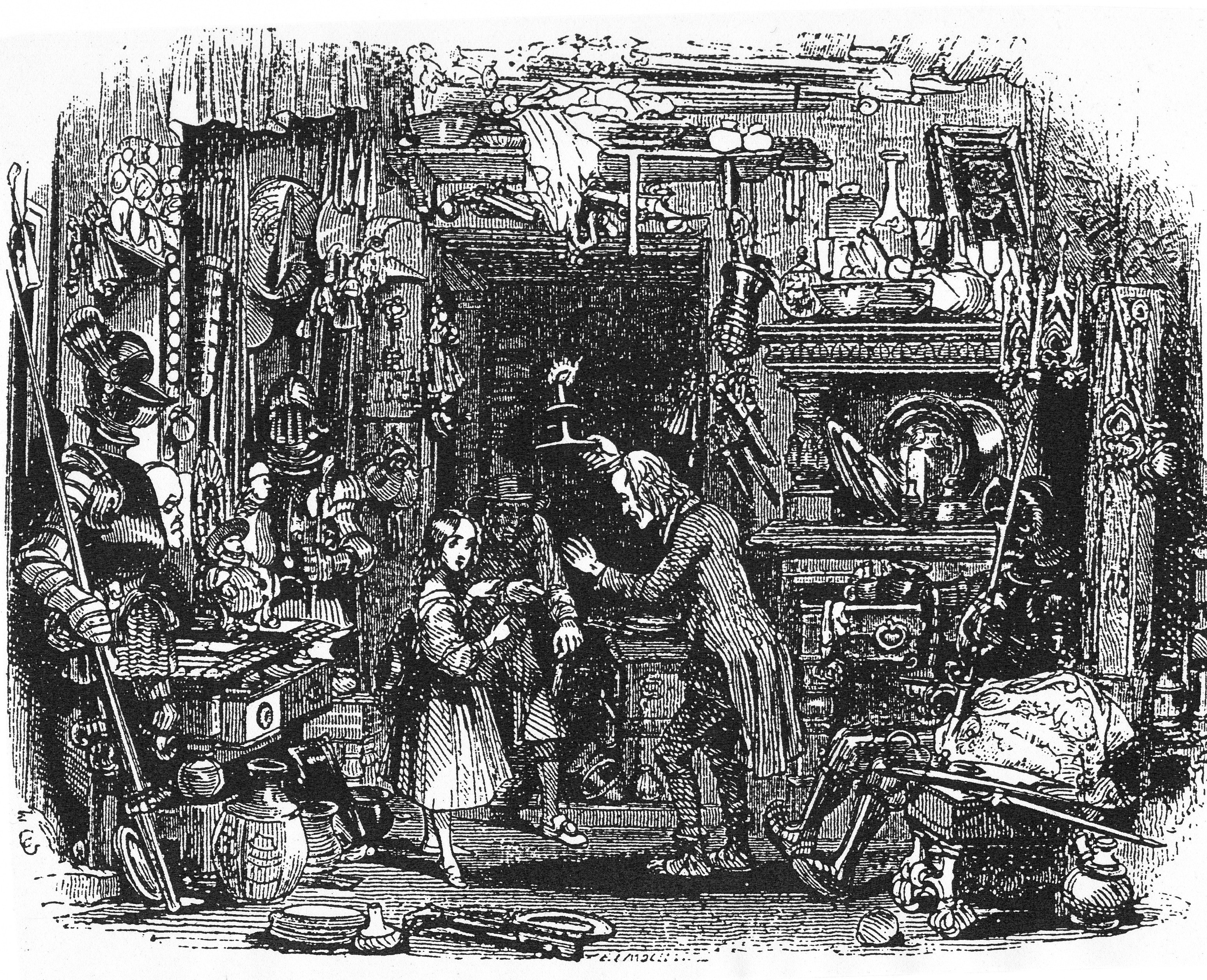
Deborah Jones’ painting of the ‘Curiosity Shop’ (above) by contrast, seems more vibrant, more impressionistic perhaps, and reminded me of some of the earlier traditions in the depictions of ‘curiosity shops’, that started with George Cattermole (1800-1868) and his representation of Charles Dickens’ ‘Old Curiosity Shop’ in 1840 (see below).
George Cattermole (1800-1868). The Old Curiosity Shop (1840). Wood Engraving. Private Collection.
Hence Jones’s oil on panel was acquired for the project as an interesting contemporary example of the enduring legacy of the antique shop in visual culture.
The antique dealer research blog has regularly focused on the upper echelons of the British antique trade – dealers such as Frank Partridge & Sons, Phillips of Hitchin, M. Harris & Sons., and etc. This is understandable given the importance of such antique dealers in the history of the antique trade – it’s also an inevitable consequence of the amount of archive material and ephemera that was generated by such firms, and the survival of such evidence. The antique dealer archives held at The Brotherton Library Special Collections are a testament to that – see, for example, the Phillips of Hitchin archives at BLSC
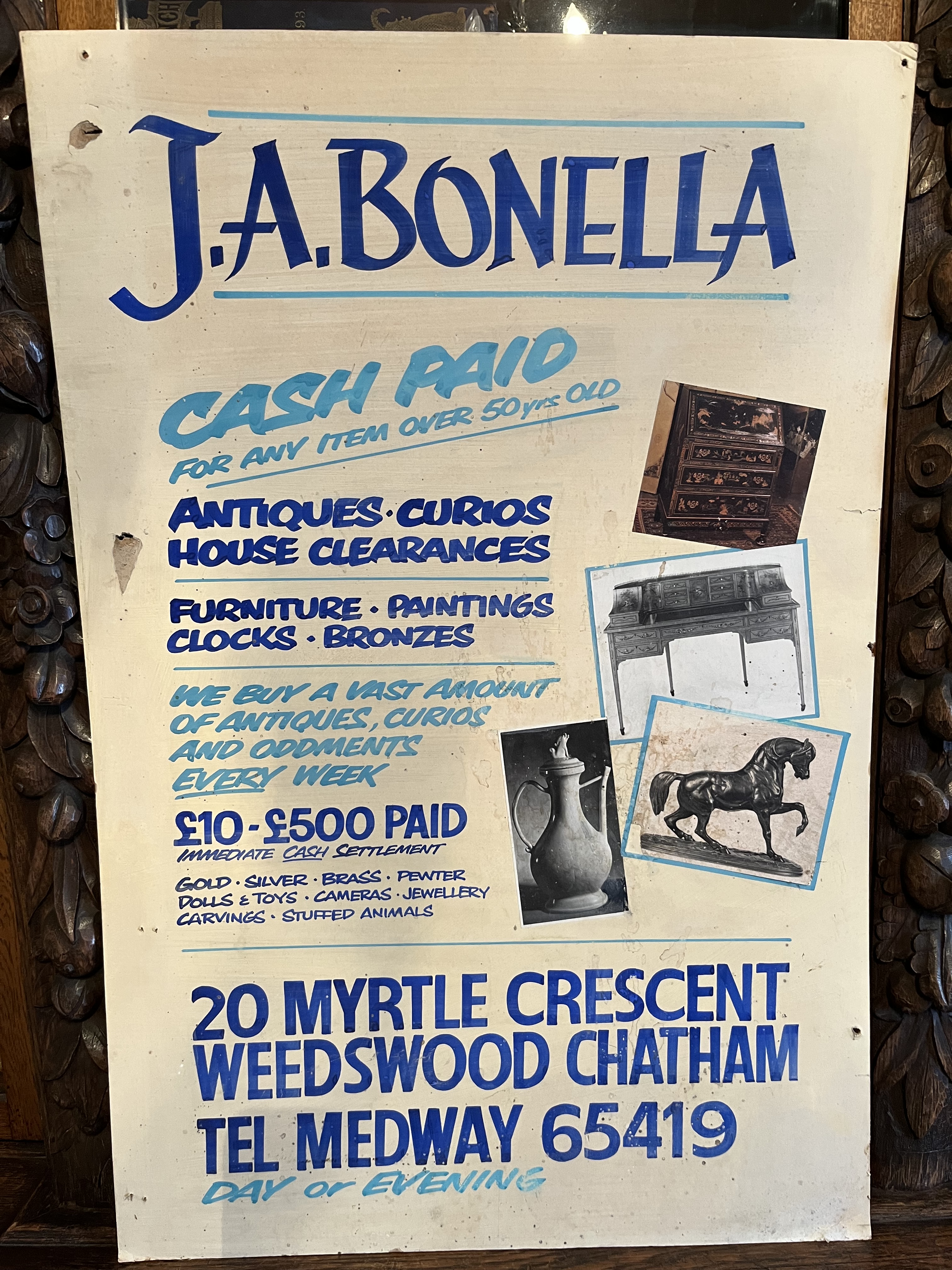
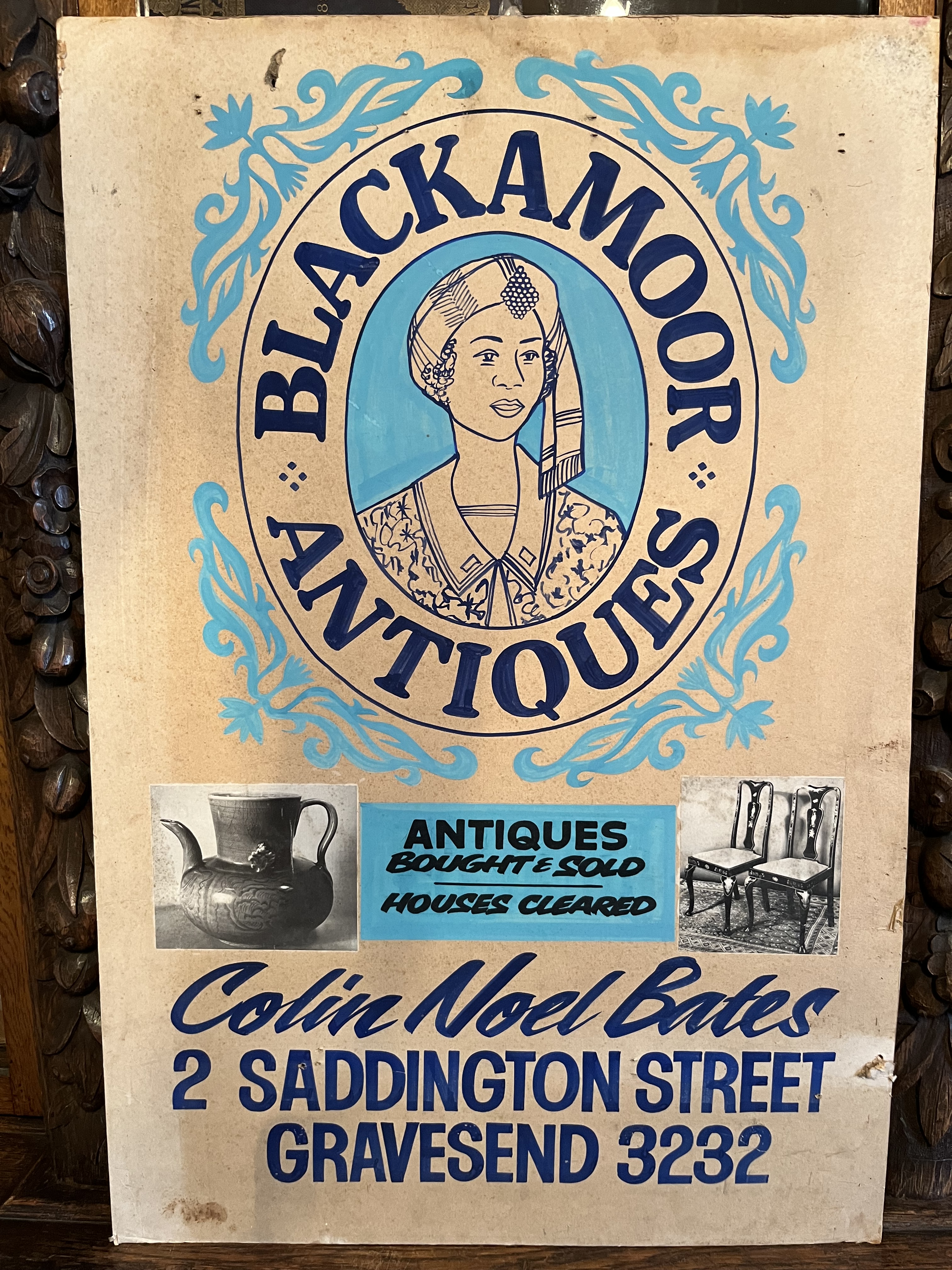
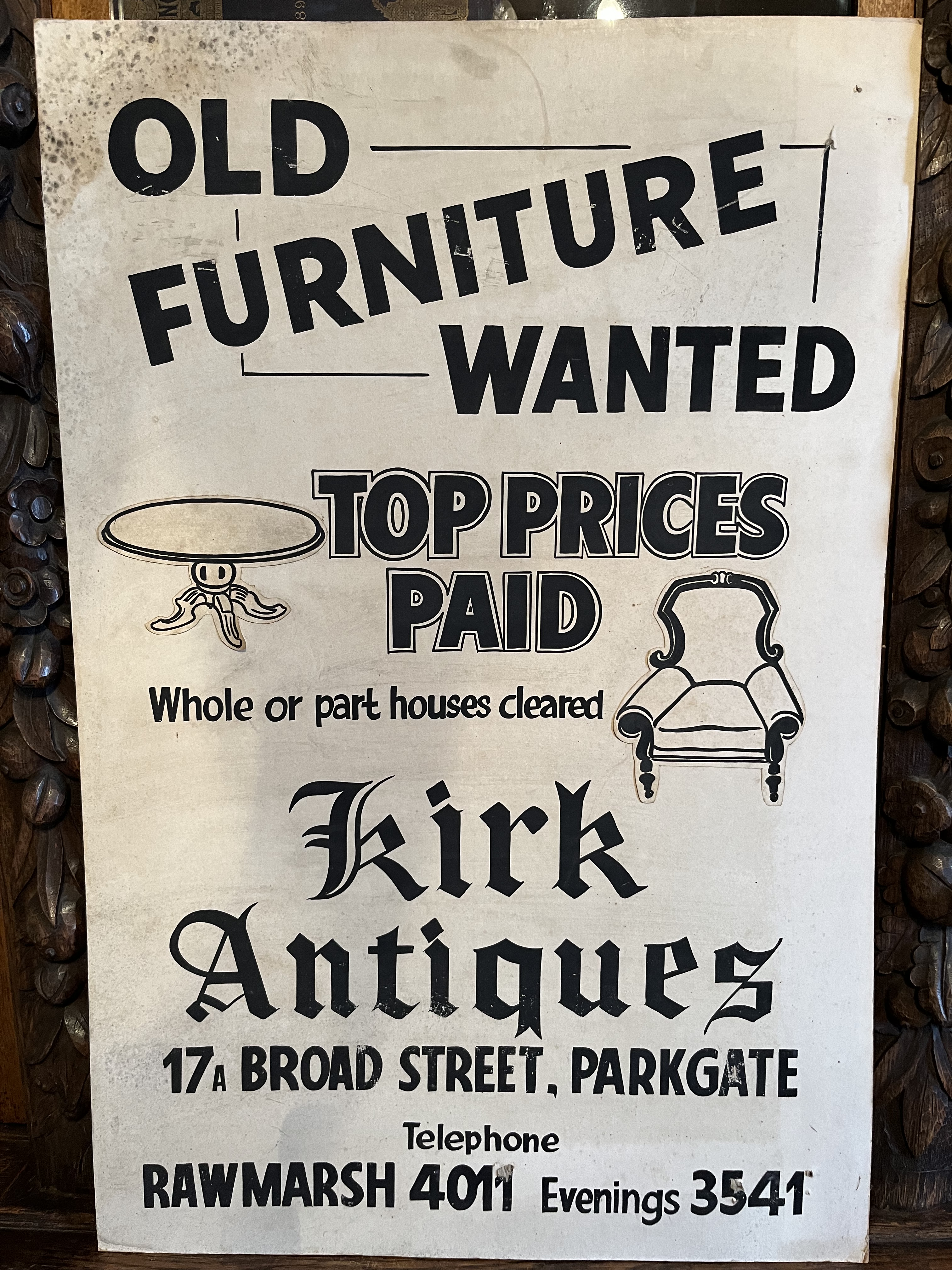
But of course the trade includes a much wider range of participants than those represented by leading London dealers and there has always been an enormous number of smaller scale, local and regional antique dealers that have made up the ecology of the British antiques trade. Ephemera associated with such lower level antique dealing practices are rare (even rarer are the business archives), but some recent additions to the growing archives of ephemera associated with antique dealing gives an insight into these, largely, marginalised histories of the antique trade. Below, for example, is one of 3 cardboard advertising boards recently acquired for the antique dealer research project at the University of Leeds. The adverts were produced by antique dealers operating well below the expensive, museum quality antiques traded by the dealers in New Bond Street in London.
All 3 cardboard advertisements are the same size (20 inches x 30 inches), hand-painted (by a professional sign-writer I would have thought) and date from the early/mid 1970s. They would have been placed in the window of the antique shop, or perhaps in advertising display cases that were quite common in urban and rural areas alike.
Advertising Board, J.A. Bonella, Chatham, 1970s. Photograph, Antique Dealers Research Project, University of Leeds, 2024.
The advertising board (above), produced by J.A. Bonella, tells us a lot about these lower level, but no less culturally significant, antique dealing practices. Jack Alexander Bonella (1938-1987) traded as an antique dealer in the 1970s and 1980s from 20 Myrtle Crescent, Weedswood, Chatham. Myrtle Crescent was not a conventional antique shop, it was a standard domestic house, so Bonella must have had a warehouse or store somewhere. Many antique dealers in the post-WWII era traded from home, (especially country antique dealers), selling to other dealers higher up the ‘food chain’ so it would not have been that unusual. Bonella’s advert also indicates that he will buy ‘any item over 50 years old’ – so not the usual 100 year rule for ‘antiques’. Such practices are aligned much more closely with the second-hand trade, at the margins of the antiques trade proper, and Bonella’s advert usefully reminds us of these structures and practices.
But of course, buying and selling at the margins also offers great opportunities for bargains, particularly in ‘house clearances’, (which Bonella also highlights) where objects can be misunderstood, mis-described or unrecognised. What is also interesting about Bonella’s advertisement are the photographs of antiques pasted onto the advertising board. The photographs appear to have been cut from antique collecting magazines – a colour photograph of an 18th century black lacquer bureau (a very fashionable, and very expensive antique, in the 1970s), a black and white photograph of a late 19th century satinwood and painted ‘Carlton House’ desk; a photograph of a 19th century French bronze horse and an early Chinese porcelain ewer. All objects that antique dealers higher up the ‘food chain’ would buy and sell. The photographs illustrate the kinds of antiques that Bonella hopes he might find, rather than antiques that he would regularly keep in stock.
Another of the cardboard adverts has very similar paint colours and may have been produced by the same hand (the antique shops are both in Kent and only 11 miles apart). The advert relates to the antique dealing business of Colin Noel Bates (1932-1985), called ‘Blackamoor Antiques’ – (see below).
Advertising Board, ‘Blackamoor Antiques’, Gravesend, 1970s. Photograph, Antique Dealers Research Project, University of Leeds, 2024.
Bates’ advert is a very similar format to Bonella’s; it has photographs cut from contemporary antique collecting magazines and mentions ‘houses cleared’. It also dates from the 1970s. The final cardboard advertisement (see below) is that of Kirk Antiques, who traded in Parkgate, near Rotherham in South Yorkshire.
Advertising Board, ‘Kirk Antiques’, Parkgate, 1970s. Photograph, Antique Dealers Research Project, University of Leeds, 2024.
Kirk Antiques’ advert includes the ambiguous term ‘Old Furniture’, which by the 1970s had lost its cache and the middle-class associations it had in antique collecting and furnishing cultures of the 1920s and 1930s. The illustrations in Kirk’s advert are also in a different format – no longer photographs cut from magazines but hand-drawn illustrations of examples of typical Victorian furniture – furniture that, by the 1970s, may have been more likely to be offered to an antique dealer operating at the margins of the trade.
All 3 cardboard adverts hint towards the inter-dealer trading structure of the antique trade in the 20th century, the so-called pyramid structure, with thousands of dealers at the bottom of the pyramid, buying antiques in local house clearances, filtering their way up through the pyramid structure until they reach their level and are eventually sold to collectors and furnishers. This ‘system’ collapsed in the late 1990s as the internet and the world-wide-web fractured the established ecology of the antique trade, but these 3 cardboard adverts remind us how complex and fragile that ecology was.
Our collection of paintings of historic antique shops (exteriors and interiors) has had a few additions over the last few months, so I thought I would share a few more of the images and continue the thread of Antique Shops in Visual Culture by adding a 4th post in this theme. You can also follow the theme in earlier blog posts (Antique Shops in Visual Culture I (Blog post 30th July 2023); Antique Shops in Visual Culture II (blog post 30th September 2023); and Antique Shops in Visual Culture III (blog post 27th November 2023).
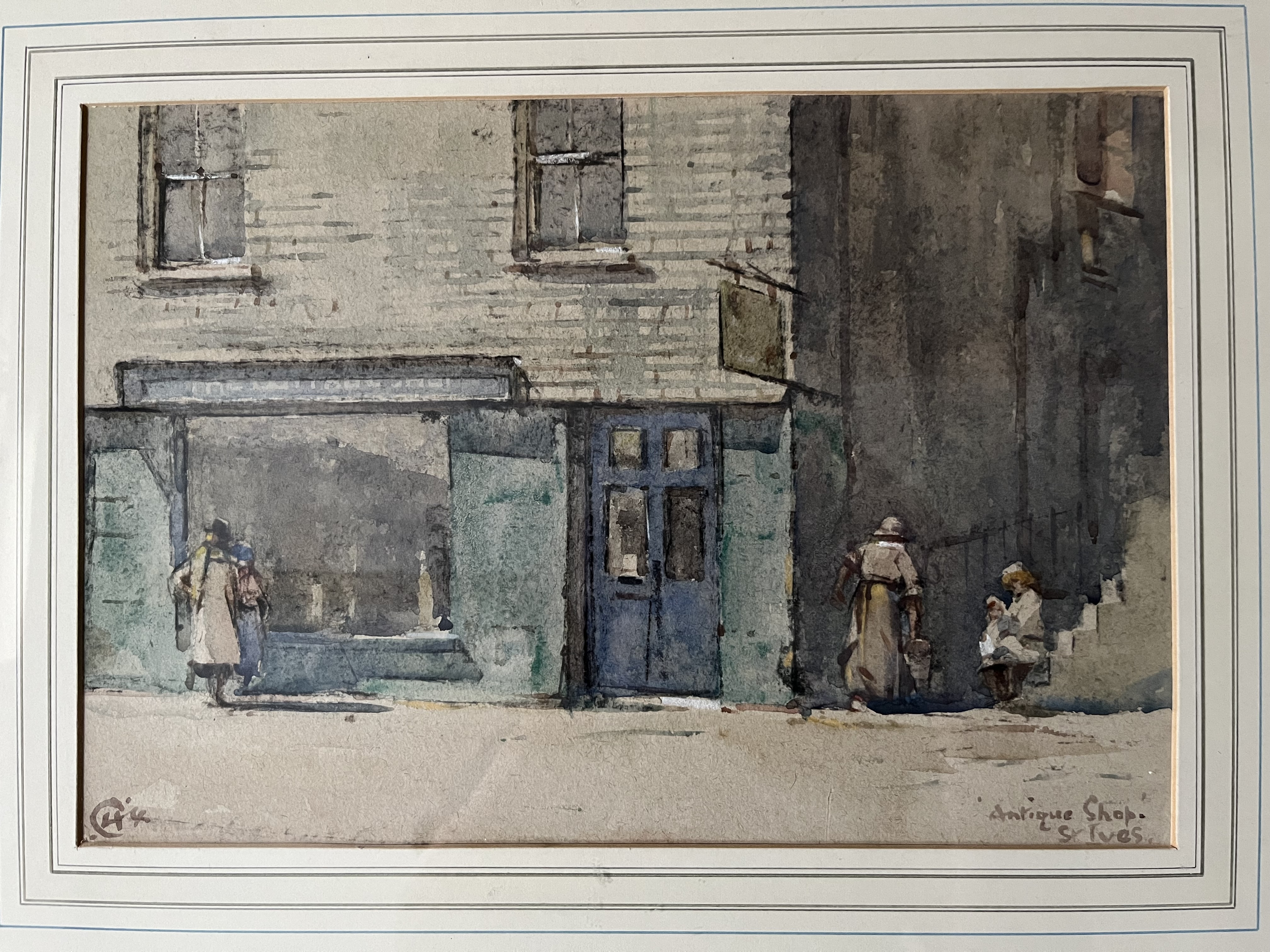
The most recent addition to the archive of paintings of antique shops is this beautifully rendered painting of an antique shop in St. Ives, Cornwall by the artist Cuthbert Crossley (1883-1960) (see below).
Cuthbert Crossley (1883-1960), ‘Antique Shop, St. Ives’ (1944). Private Collection. Photograph, Antique Dealers Research Project, University of Leeds.
I’ve unfortunately not yet been able to identify the actual antique shop, but it’s dated 1944 and at that time there were 12 dealers in St. Ives. The signboard over the shop in the painting just reads ‘The Antique Shop’, but the location looks like it may be near the harbour, perhaps The Wharf, which at the time had the shops of Andrew Glover and The Misses Hugo Habbijam and Marshall; Fore Street (F. Netteinghame; Andrew Armour; Basil Foulds Ltd; Kenneth Foulds); High Street (Charles Jackson), or Tregenna Place (John Vaughan) – you can of course take a look at the antique dealers interactive Map website if you are interested too – see www.antiquetrade.leeds.ac.uk – but if anyone does recognise the building in St. Ives I would be very interested to know.
Crossley was trained at the Halifax School of Art in Yorkshire before the First World War and became a professional painter in the 1920s. He exhibited the painting at the Royal Institute of Painters in Water Colours in Pall Mall, London (I’m guessing in c.1944 – it was priced at £8. 8 shillings at the time). Crossley moved to St. Ives in the 1940s, so I guess he painted the antique shop whilst he was living in St. Ives. The painting certainly has a ‘St. Ives School’ impressionism look about it.
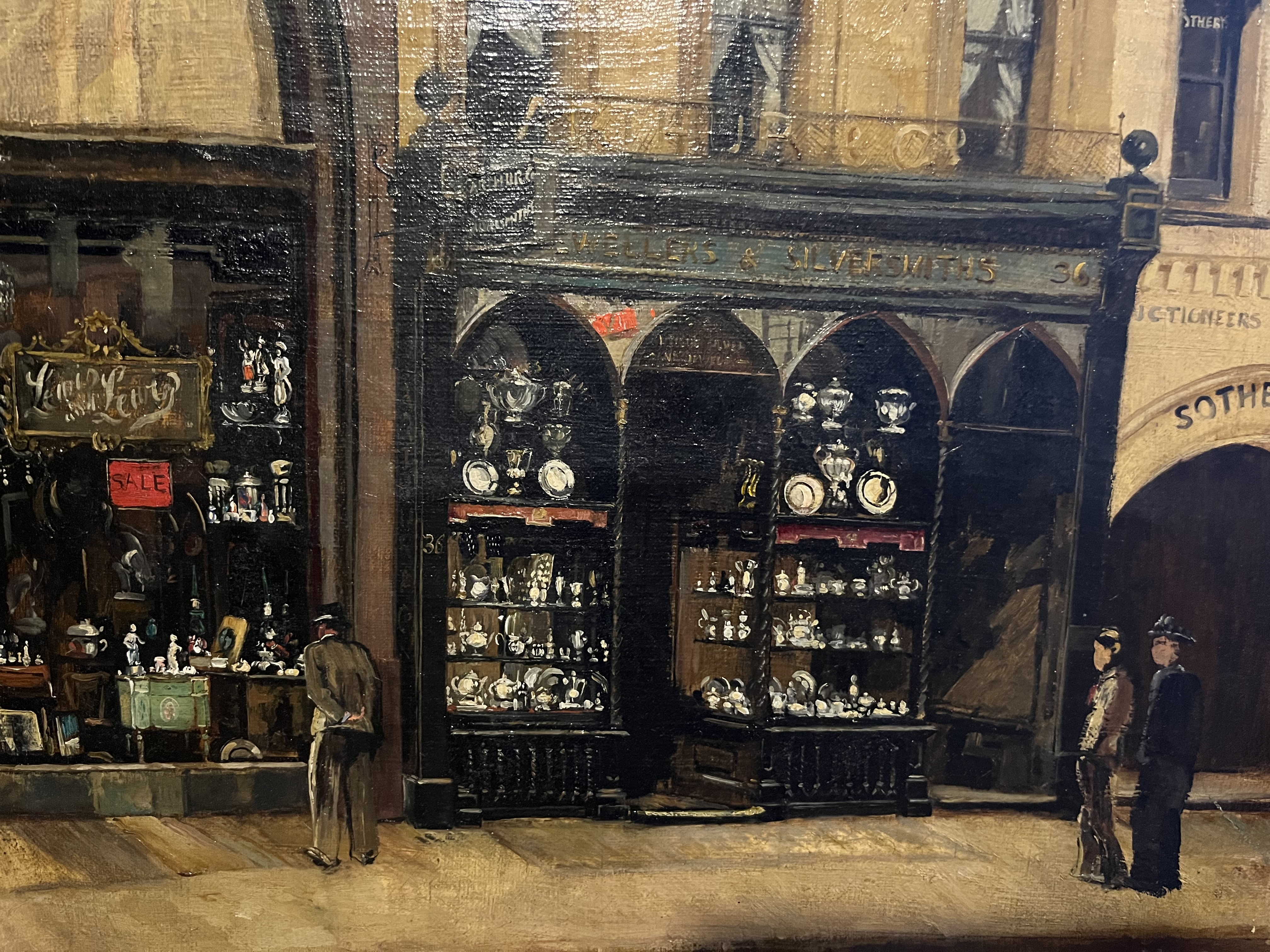
The 1940s and 1950s seem to have been a fruitful period for artists’ paintings of antique shops and one of the most well-known artists for painting antique shops is John Cole (1903-1975). Cole’s painting of the antique shops of Arthur & Co, and Lewis and Lewis in New Bond Street, London (see below) was the subject of the blog post Antique Shops in Visual Culture II (30th September 2023).
John Cole (1903-1975), antique shops in New Bond Street, London, c.1940. Private Collection. Photograph, Antique Dealers Research Project, University of Leeds.
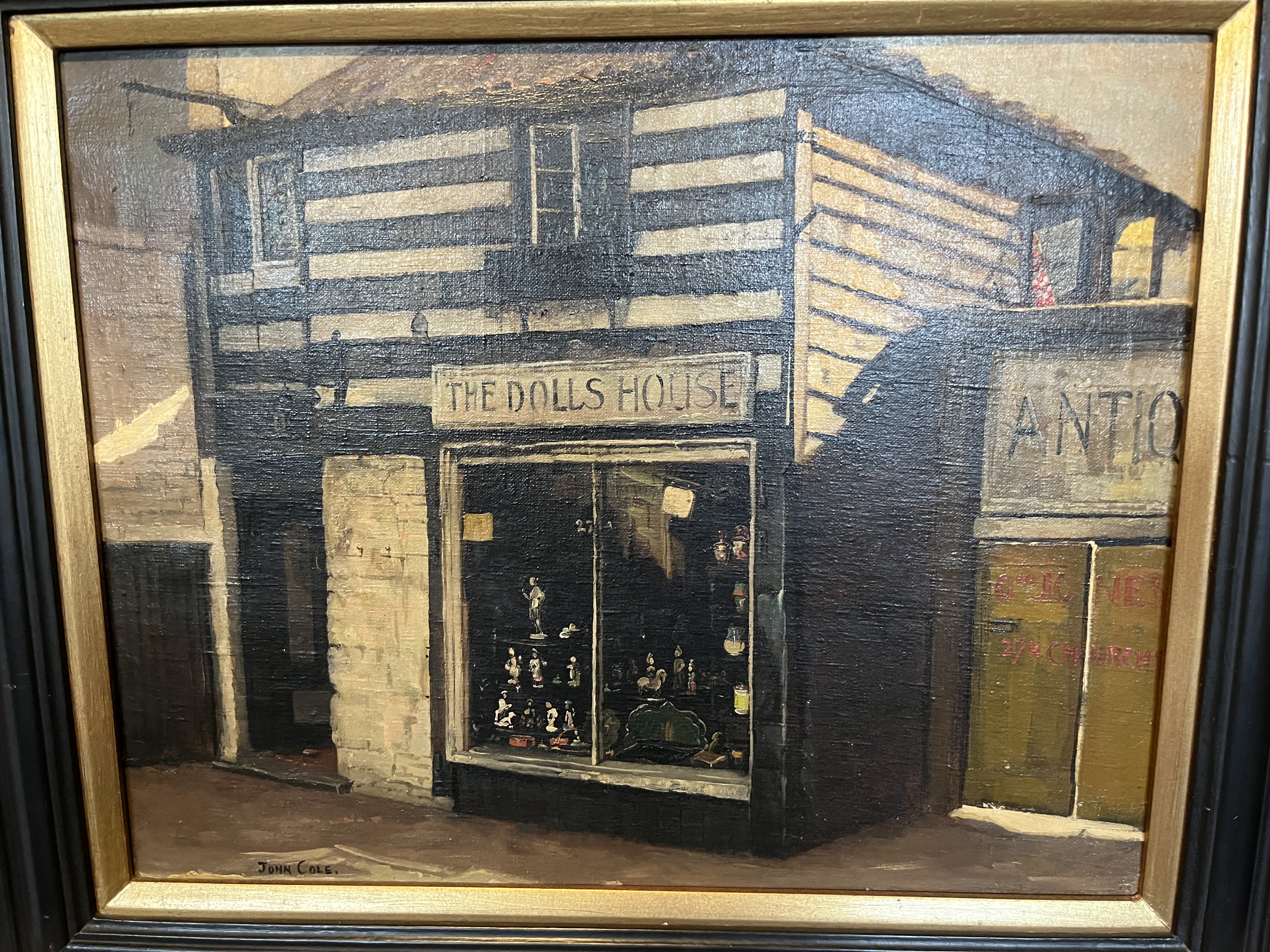
We are fortunate to have recently acquired (thanks to Sarah Colegrave Fine Art) another of Cole’s paintings of antique shops (he painted dozens of antique shops in the 1940s to 1970s). His painting of ‘The Dolls House’ (see below) is a much more well-known image. It was part of the exhibition The Cole Family: painters of the English Landscape 1838-1975, curated by Tim Barringer for Portsmouth City Museums in 1988, when it was then owned by the banking firm Morgan Grenfell. The Dolls House was at 27a Kensington Church Street, London, a very important street for antique shops from the 1920s right up to today (notwithstanding the decline in the number of antique shops in Kensington Church Street from the late 1990s). The Dolls House was owned by the antique dealer William Williams, beginning in the 1920s. Cole’s painting is typical of his style and his practice of recording old shops fronts; as Tim Barringer writes, ‘Through these shop front pictures, Cole achieved for the first time wide publicity and began to gain a public following’ (Tim Barringer, The Cole Family: painters of the English Landscape 1838-1975, (1988), p.175).
John Cole (1903-1975), ‘The Dolls House’, 1940. Private Collection. Photograph Antique Dealers Research Project, University of Leeds.
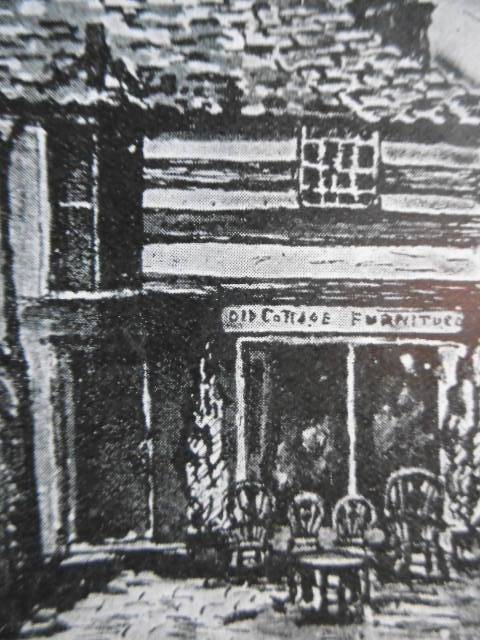
We have another image of The Dolls House, a pencil drawing from 1927. The drawing depicts the same black & white painted shingles to the front of the shop, but the signboard over the front states ‘Old Cottage Furniture’, which was a very popular description in the period for what we now describe as Regional Furniture. There are a few antique ‘Windsor Chairs’ outside the shop, for sale on the pavement.
The Dolls House, Kensington Church Street, London, 1927, pencil drawing. Photograph Antique Dealers Research Project, University of Leeds.
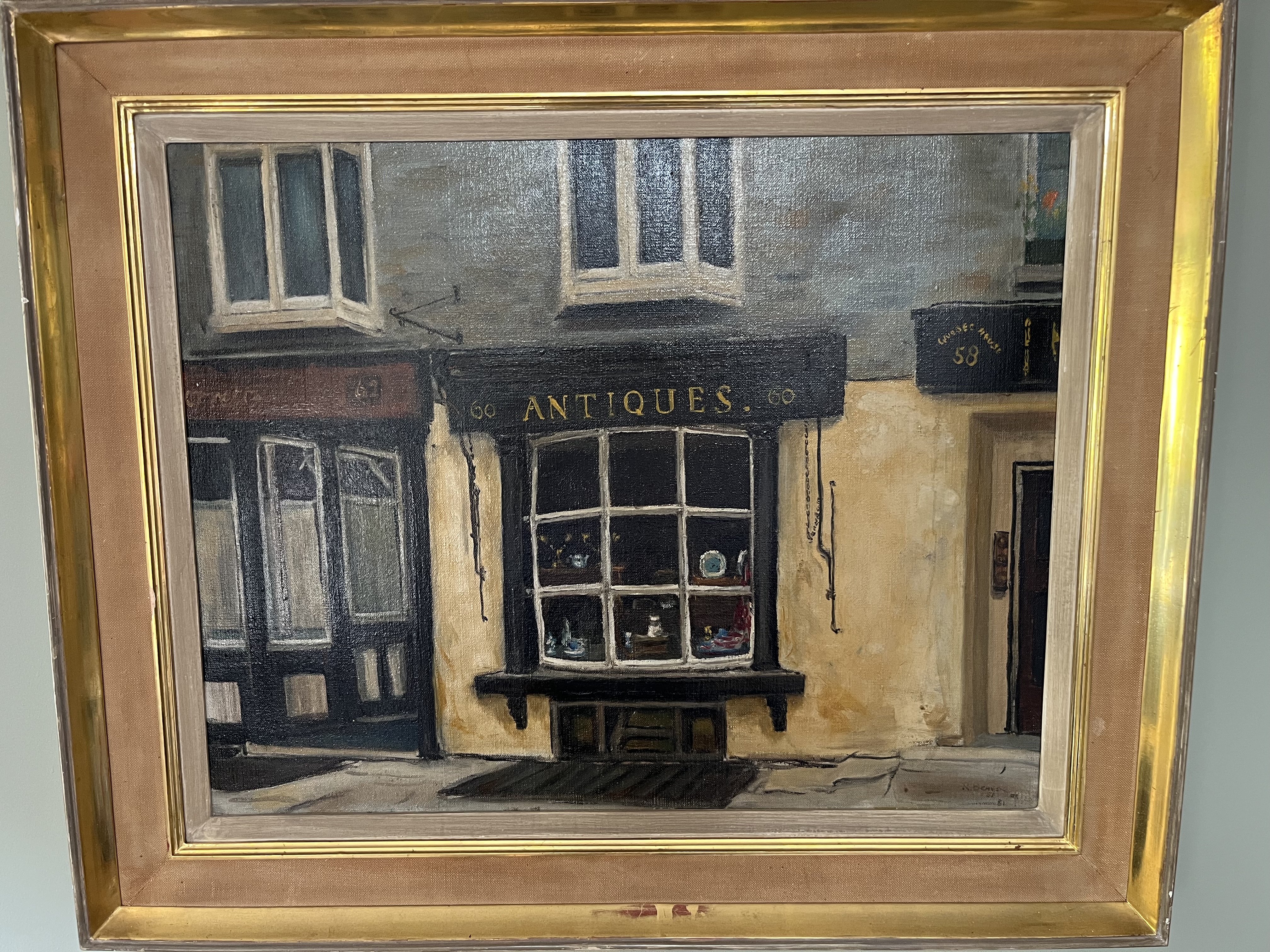
Another painting of an antique shop recently added to the archive of paintings is also from the same period as the paintings produced by John Cole. A painting titled ‘The Antique Shop’ by Robert Atwood Beaver (1906-1975), whose dates align almost precisely with those of John Cole (1903-1975); indeed his painting seems to owe a lot to Cole’s aesthetic as well. Beaver was an anaesthetist (he invented the famous ‘Beaver Respirator’) and a talented amateur painter. The painting is undated but seems to date to the 1950s; it’s not known which antique shop is depicted in Beaver’s painting, but it is known that he painted in and around London, although the particular shop depicted seems to be a country antique shop; perhaps a shop on the Isle of Wight, to which Beaver retired.
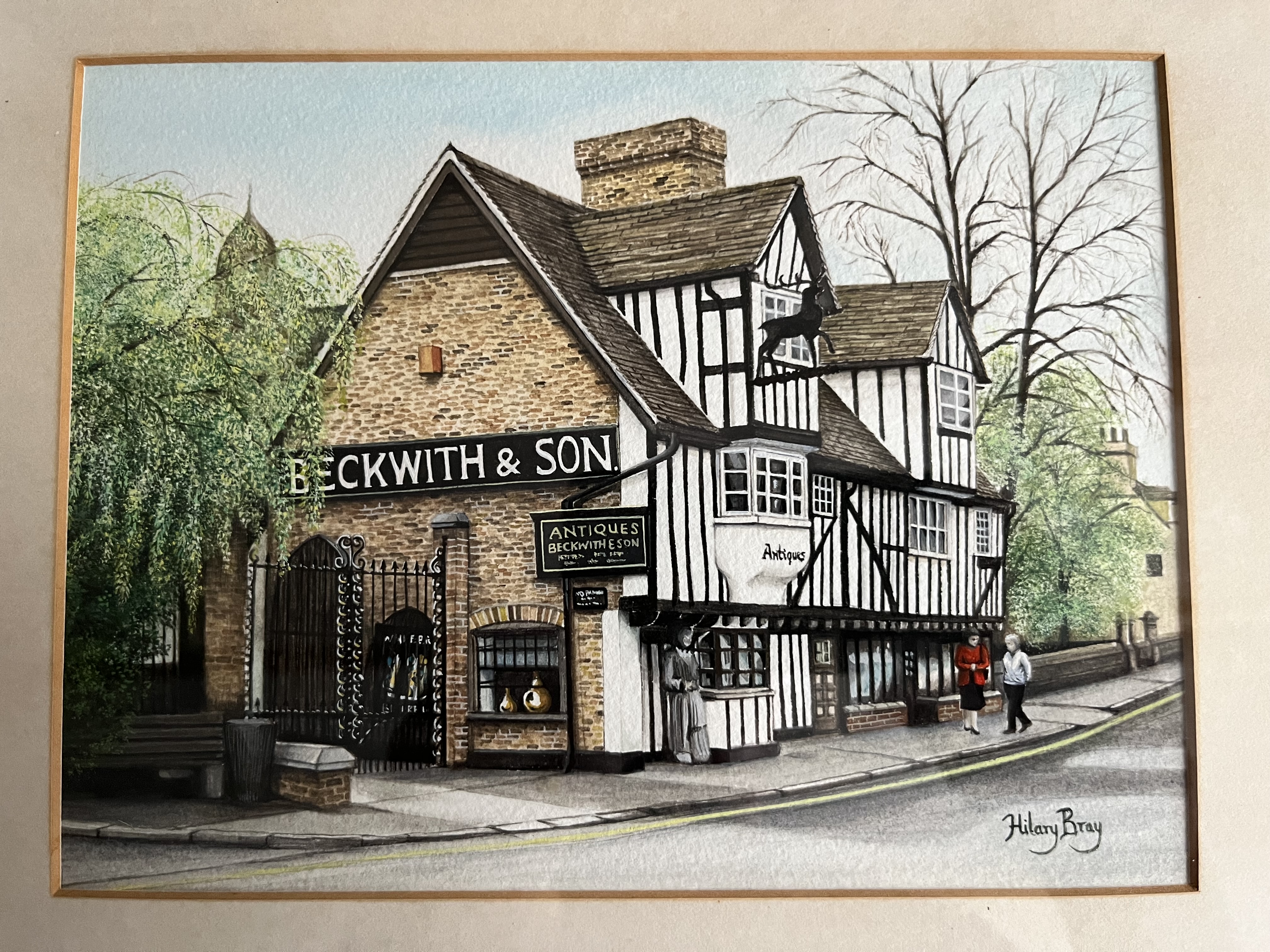
One of the key objectives of gathering an archive of paintings of antique shops is to consider the significance of the presence of the antique shop in British cultural life. Some of the paintings are fascinating, evocative artist’s impressions (like the Crossley and the Cole paintings), but some are more of what one might call ‘documents’. Our last painting of an antique shop in this Blog Post fits to that category I think. It is a work by the artist Hilary Bray, undated but probably 1980s (see below). It’s a competent work, but perhaps lacks the feeling present in the other paintings of antique shops? Nonetheless, the painting depicts a very famous antique dealing business, and perhaps amongst the longest -lived businesses in Britain.
Hilary Bray, ‘Beckwith & Son antique shop, Hertford, 1980s. Photograph Antique Dealer Research Project, University of Leeds.
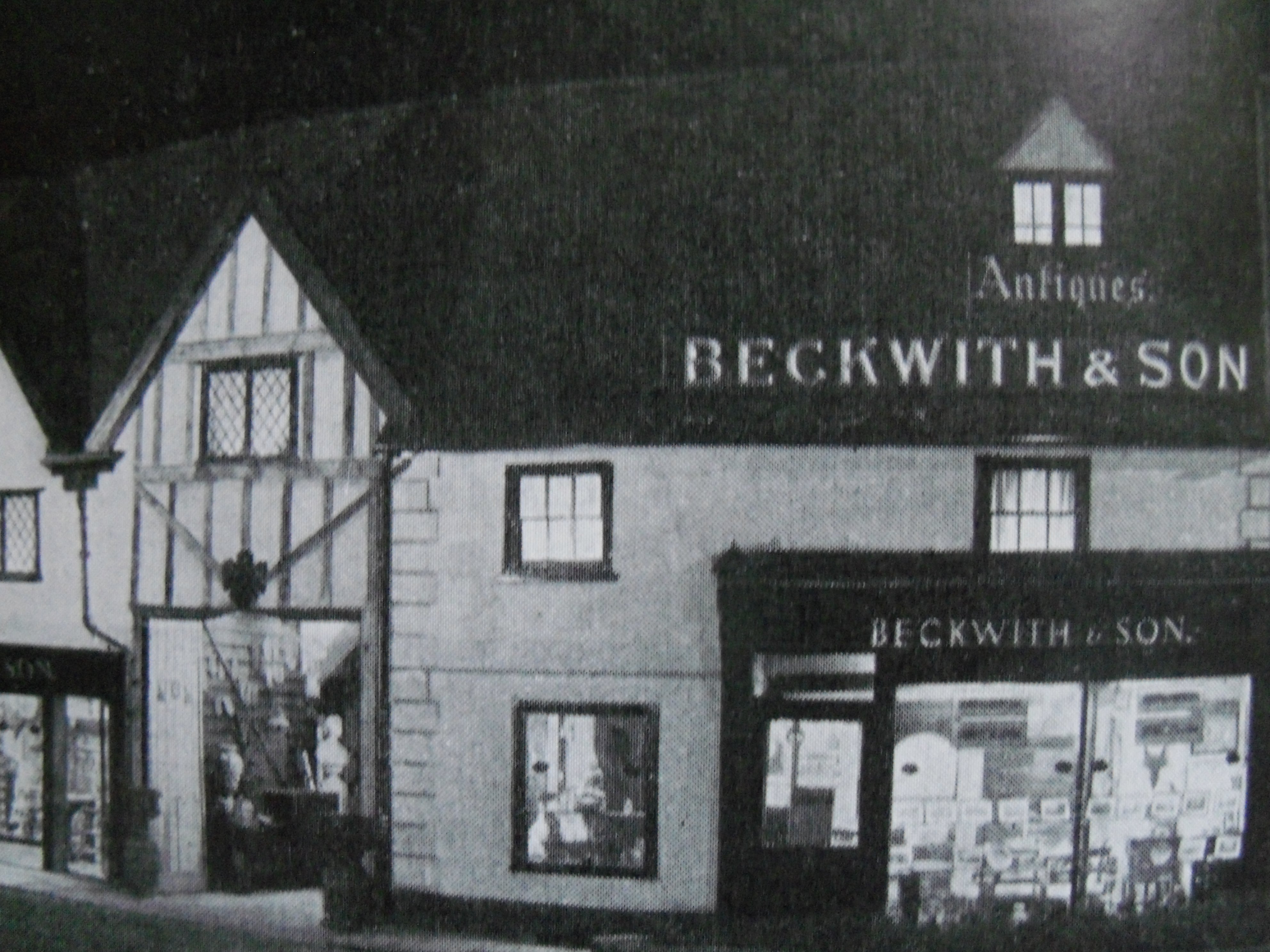
The shop is that of Beckwith & Sons, Old Cross in Hertford, who, according to their own publicity, trace their business back into the 18th century, to the Royal Cabinetmaker Samuel Beckwith (1740-1804). When the business became antique dealers is not known, but it’s likely to have been sometime towards the end of the 19th century. By the 1940s Beckwith & Son was owned by the antique dealer A. Knight Loveday. We have several photographs of the shop of Beckwith & Son at Old Cross in Hertford; this photograph (below), from 1963, seems to depict the shop from a different angle, or perhaps another premises they had in Old Cross, Hertford?
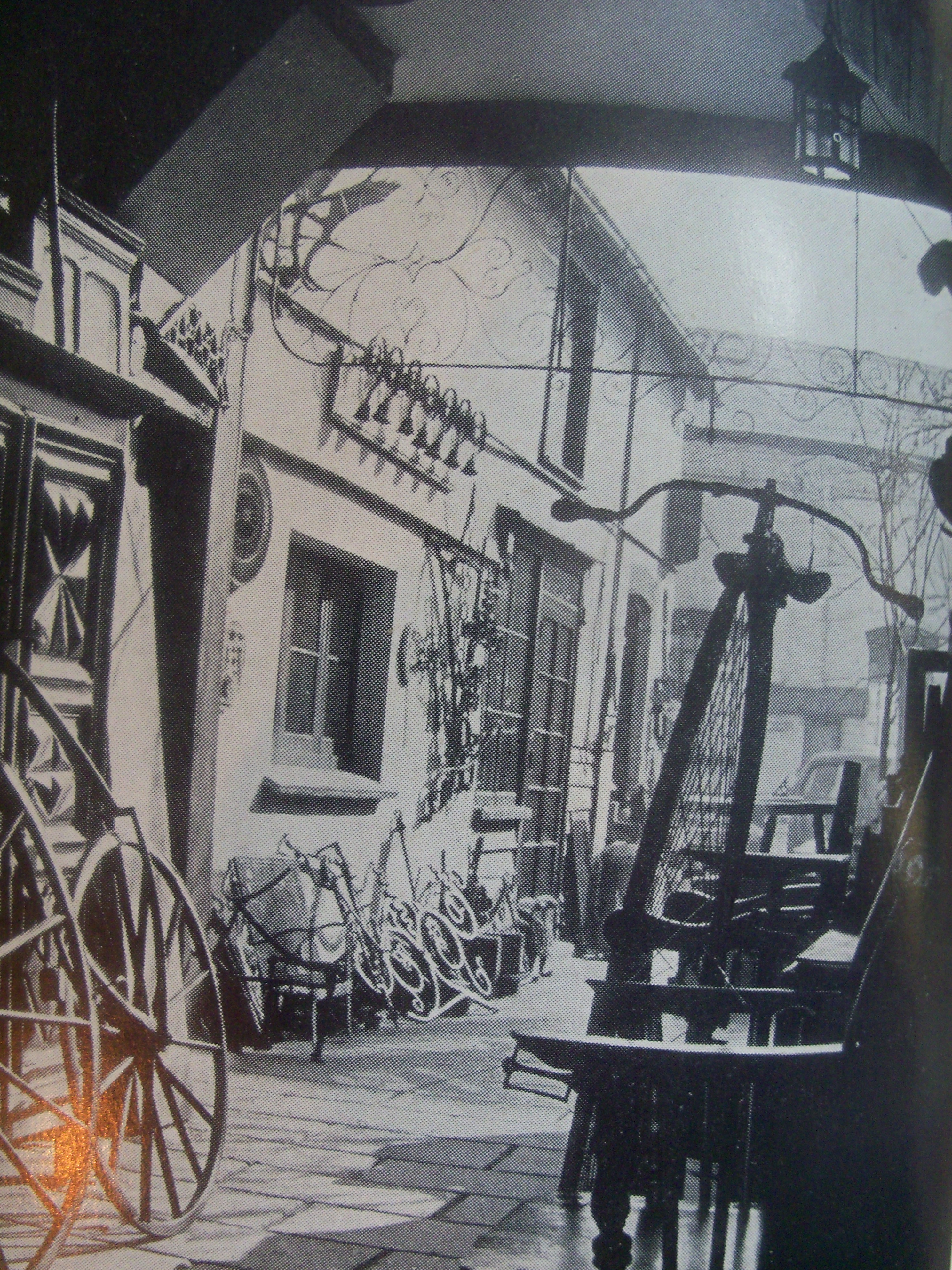
And below, this very evocative photograph (from 1957) of the passage leading to one of the entrances to the Beckwith & Son’s antique shop exemplifies the visual trope of the antique shop as a place for treasure hunters.
We have few more paintings of antique shops, and no doubt will acquire more still, so keep your eye of the antique dealers blog for ‘Antique Shops in Visual Culture V’ at some stage this year.
A fairly recent addition to the antique dealer archives is some material associated with the Loughborough based antique dealer C.W. Briggs (1906-1981), acquired in January 2023 at the Nottingham auctioneers Mellors & Kirk.
The material is an eclectic mix of stock books, personal letters and ephemera, together with a selection of material associated with an exhibition of ‘Old Masters’, held at the showroom of Smart & Brown Ltd, Nottingham in February 1928 – at which the paintings had been ‘hung’ by Mr C.W. Briggs. Smart & Brown Ltd were ‘Upholsterers, Cabinet Makers and Decorators’, so it’s an intriguing story, but I’ll save the ‘Old Masters’ exhibition for another blog post on C. W. Briggs. However, some of the other material offers an interesting insight into the life and history of a mid-20th century antique dealer.
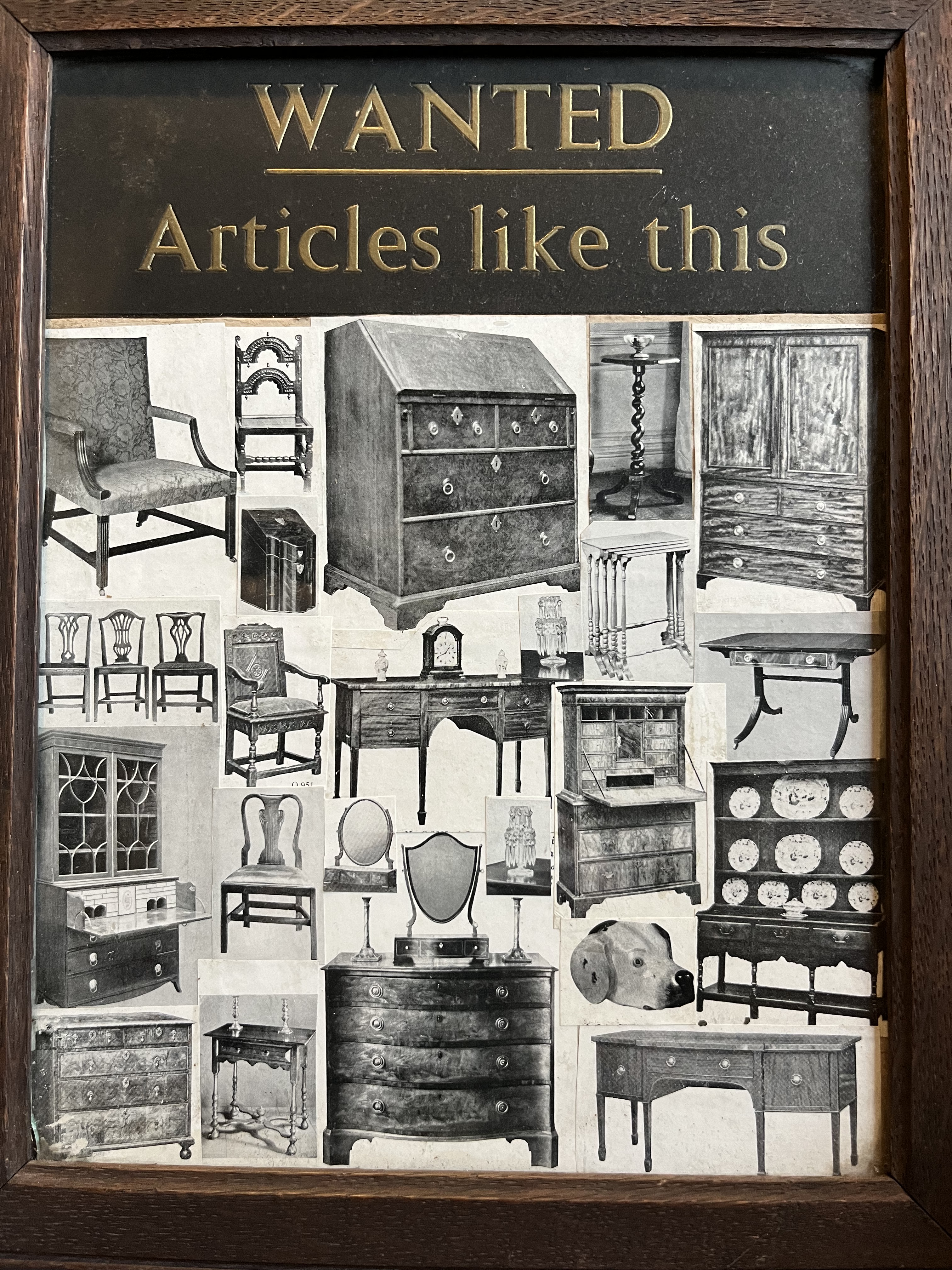
Firstly, I just love this oak-framed collage of black & white photographs of popular antiques of the period. The oak frame appears to date to the 1920s, but the collage of photographs of antique furniture are all culled from antique collecting magazines of the 1940s and 1950s, so I’d guess the composition dates from the 1950s. It was obviously something that Briggs would have placed in his antique shop to encourage people to sell antiques to him.
C. W Briggs, framed photos of antiques, c.1950, (13in x 10.5 in). Photograph, Antique Dealers Research Project, University of Leeds.
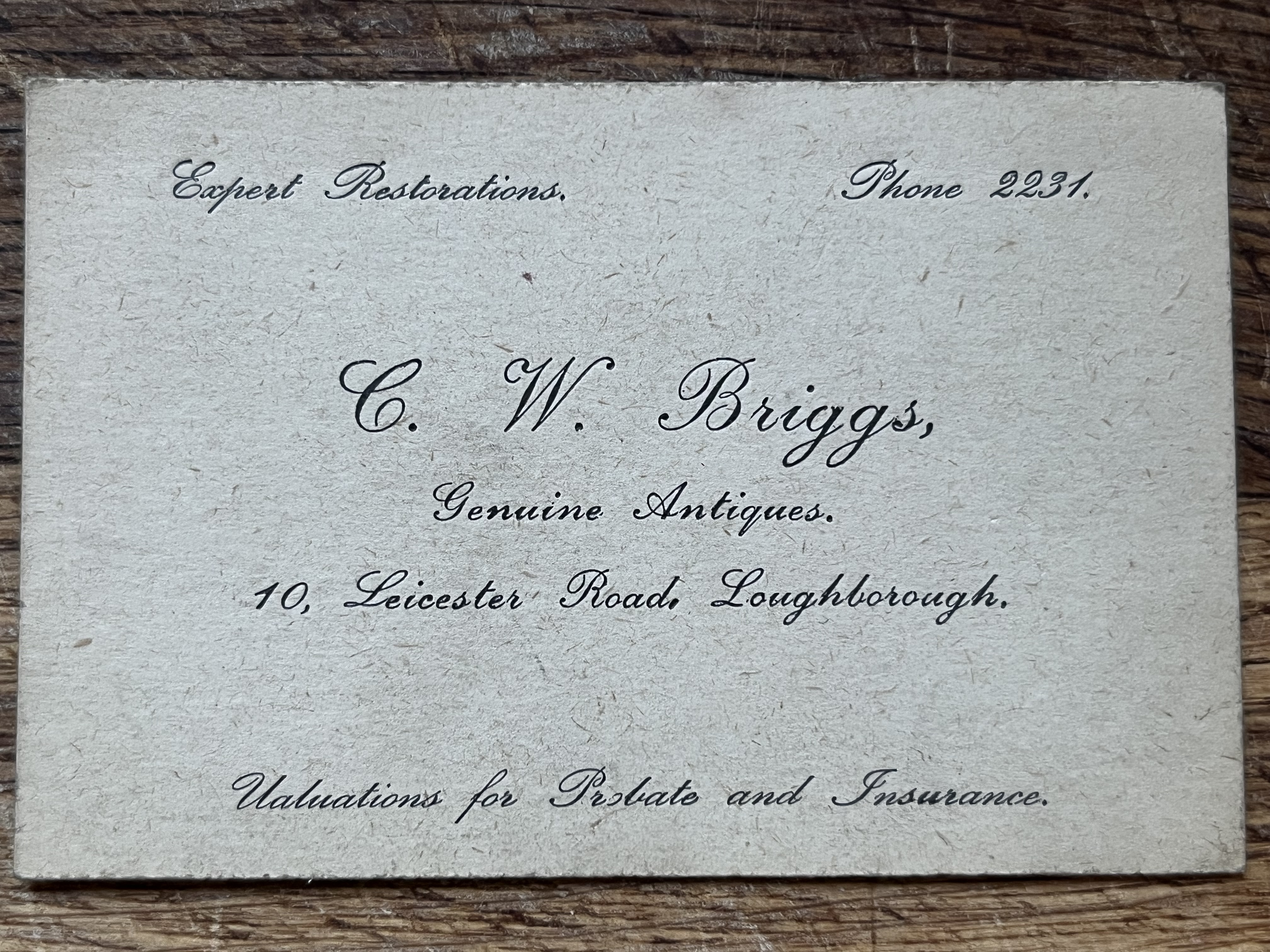
Cyril William Briggs operated as an antiques dealer from the 1920s until the mid 1970s. According to letters in the archive he passed away in August 1981. He was born in 1906 and was the son of William Henry Briggs (born c.1853), a shopkeeper and licensed victualler in Nottingham. The archive material also indicates that C.W. Briggs was in partnership with an individual called Alexander Marks in the 1920s, trading as Marks & Briggs ‘Art Connoisseurs’ at Moot Hall Chambers, Market Place, Nottingham – this is part of the business history related to the ‘Old Masters’ exhibition held at Smart & Brown Ltd in Nottingham in 1928. Here (below) is Briggs’ trade card for his shop at 10 Leicester Road, Loughborough – ‘Genuine Antiques’ is a term often associated with the antique trade of the early 20th century (when ‘fakes’ were a common concern amongst collectors and those furnishing their homes with antique furniture), so it’s interesting to see this on Briggs’ trade card.
C.W. Briggs trade card, c.1930s? Photograph, Antique Dealers Research Project, University of Leeds.
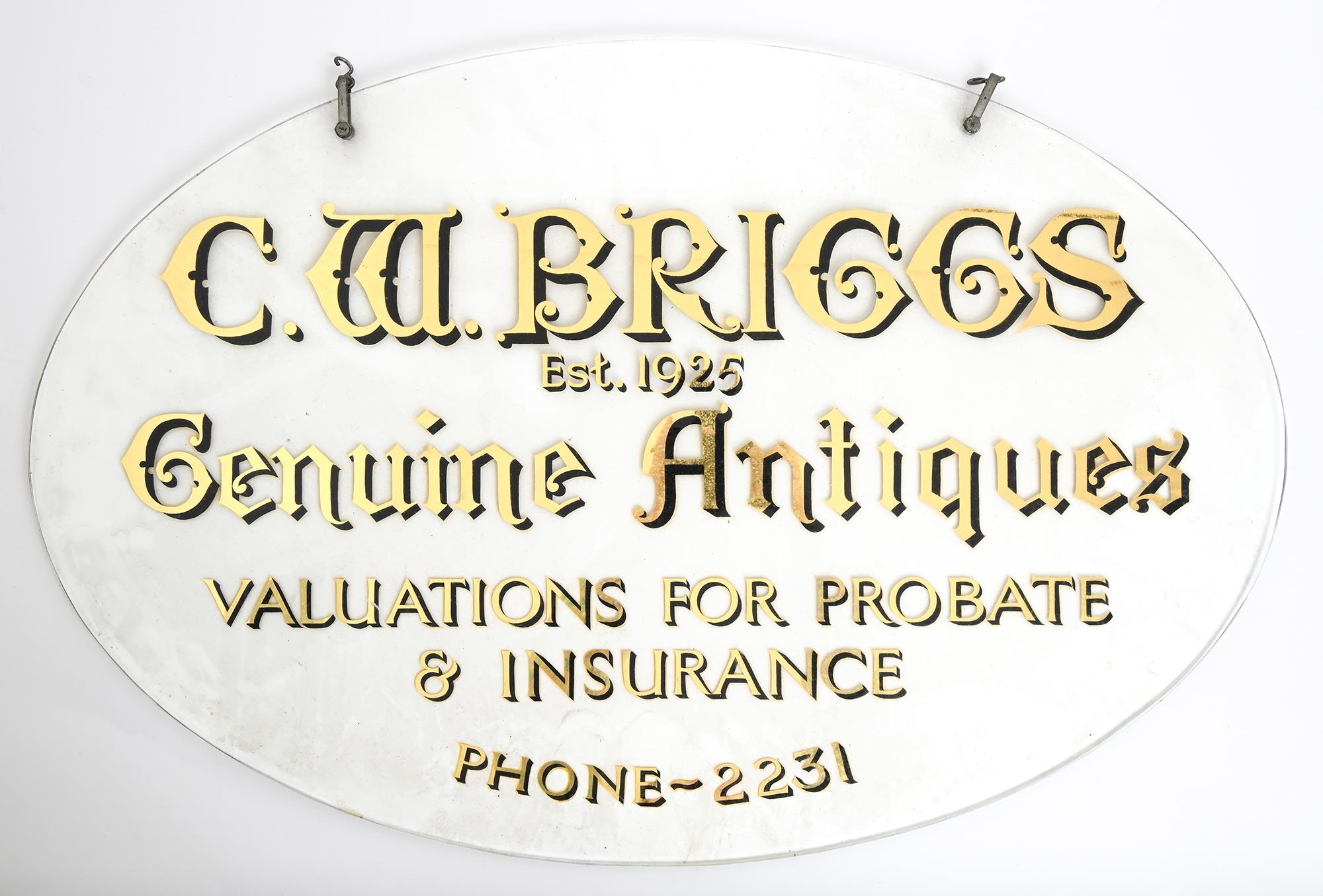
The use of the phrase ‘Genuine Antiques’ was also used by Briggs in his shop sign (see below, made of glass), where he gives a date of 1925 as the establishment of the business (this may relate to the business that he started with Alexander Marks at Moot Hall Chambers in Nottingham) – Briggs would have been just 19 years of age when he started in ‘the business’. Sadly, the hanging sign is not part of the archive (it went for a bit too much at the Mellors & Kirk auction!)
C. W. Briggs Antiques hanging sign, 1950s? Photograph, Mellors & Kirk Auctioneers, Nottingham.
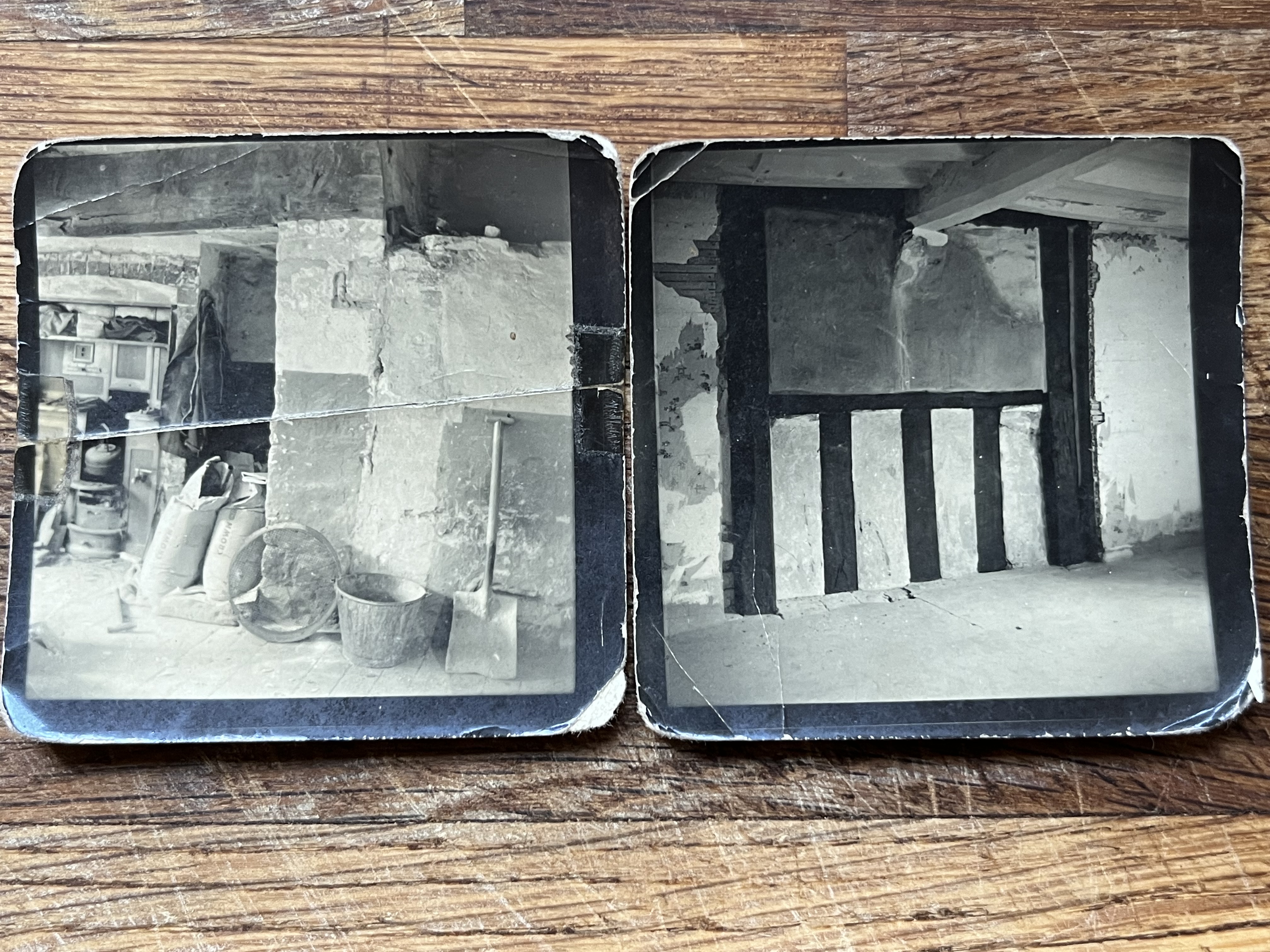
In the mid 1940s Briggs acquired ‘Kingscote’ 10 Loughborough Road, Walton-le-Wolds (he still retained his antique shop at 10 Leicester Road, Loughborough). ‘Kingscote’ is a mid-16th century timber-framed house (it was Grade II listed in 1966), and, according to a selection of photographs in the archive material, Briggs seems to have been very proud of his ‘ancient house’. Here are some photographs from the archive, showing the house and its interiors (the photos are probably from 1940s) – it looks like there was some restoration taking place.
C.W. Briggs, ‘Kingscote’ 10 Loughborough Road, Walton-le-Wolds, 1940s. Photograph, Antique Dealers Research Project, University of Leeds.C.W. Briggs, ‘Kingscote’ 10 Loughborough Road, Walton-le-Wolds, 1940s. Photograph, Antique Dealers Research Project, University of Leeds.C.W. Briggs, ‘Kingscote’ 10 Loughborough Road, Walton-le-Wolds, 1940s. Photograph, Antique Dealers Research Project, University of Leeds.
As readers of the Antique Dealers Research blog will know, antique dealers trading from and living in historic houses has been a consistent theme in the history of the antique trade (see blog posts March 23rd 2014; October 26th 2014; February 6th 2017; May 25th 2019; July 31st 2022) Such practices can be traced back to at least the 1920s, so C.W. Briggs was rehearsing an established tradition when he acquired ‘Kingscote’ in the 1940s.
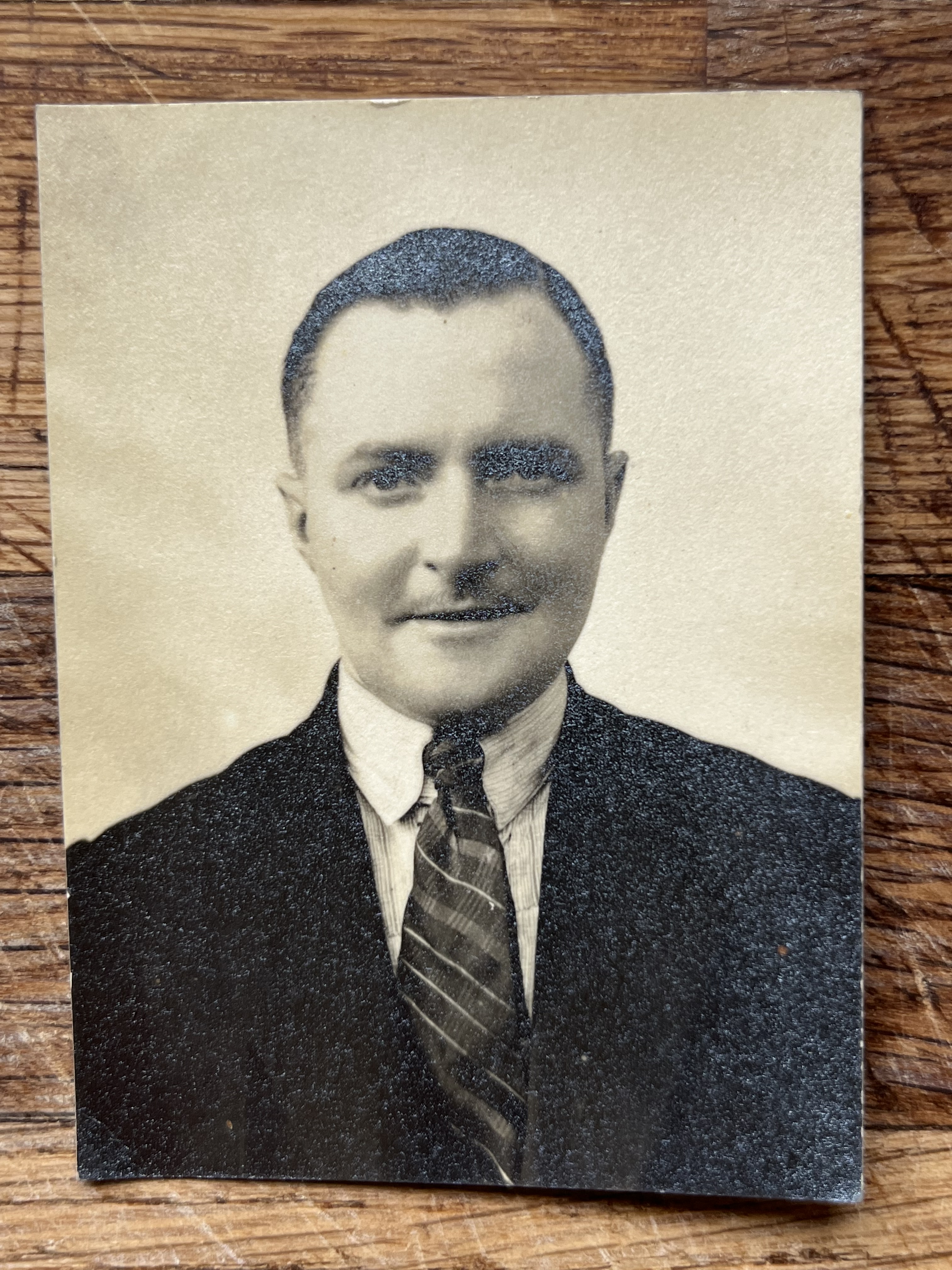
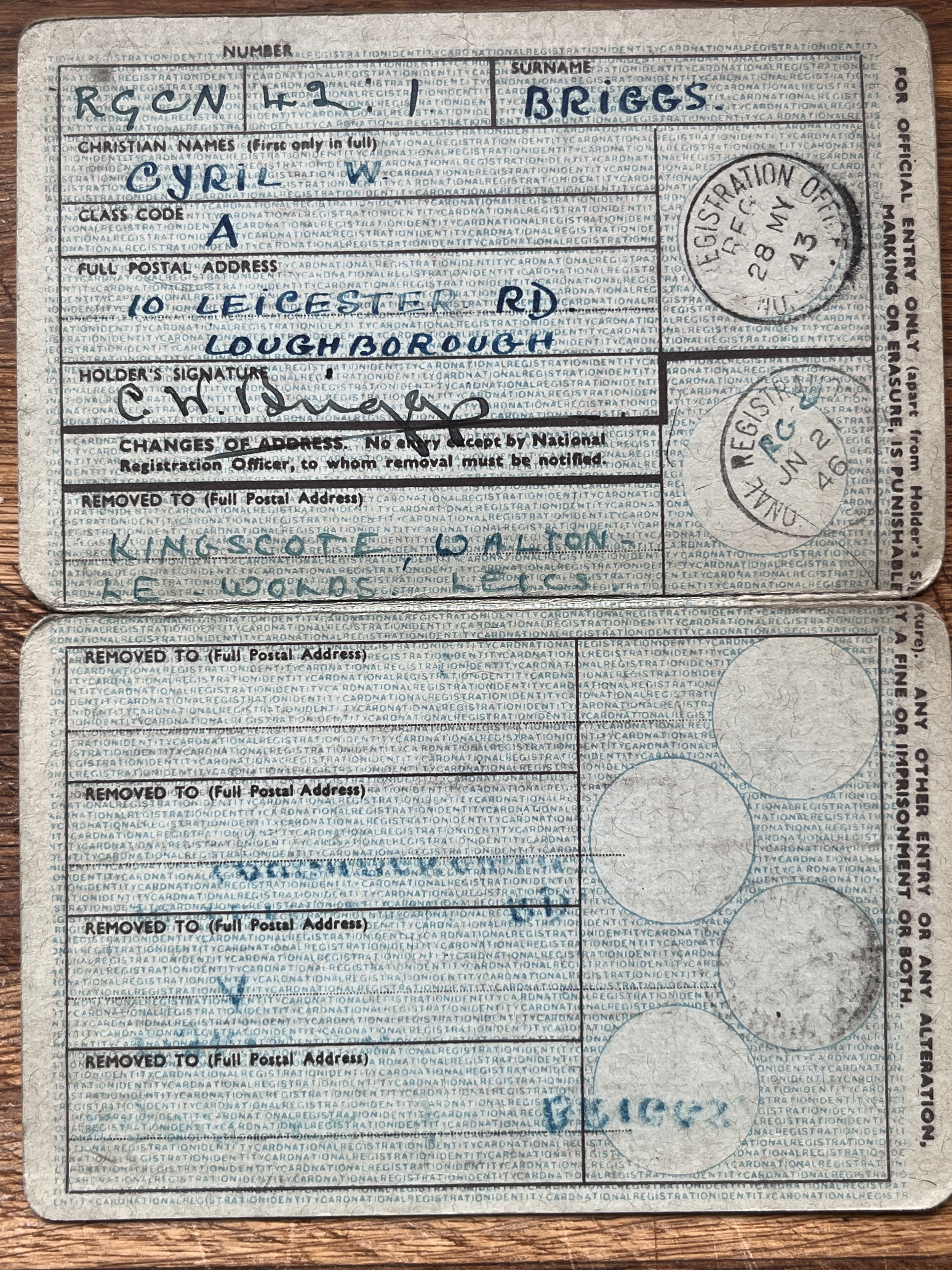
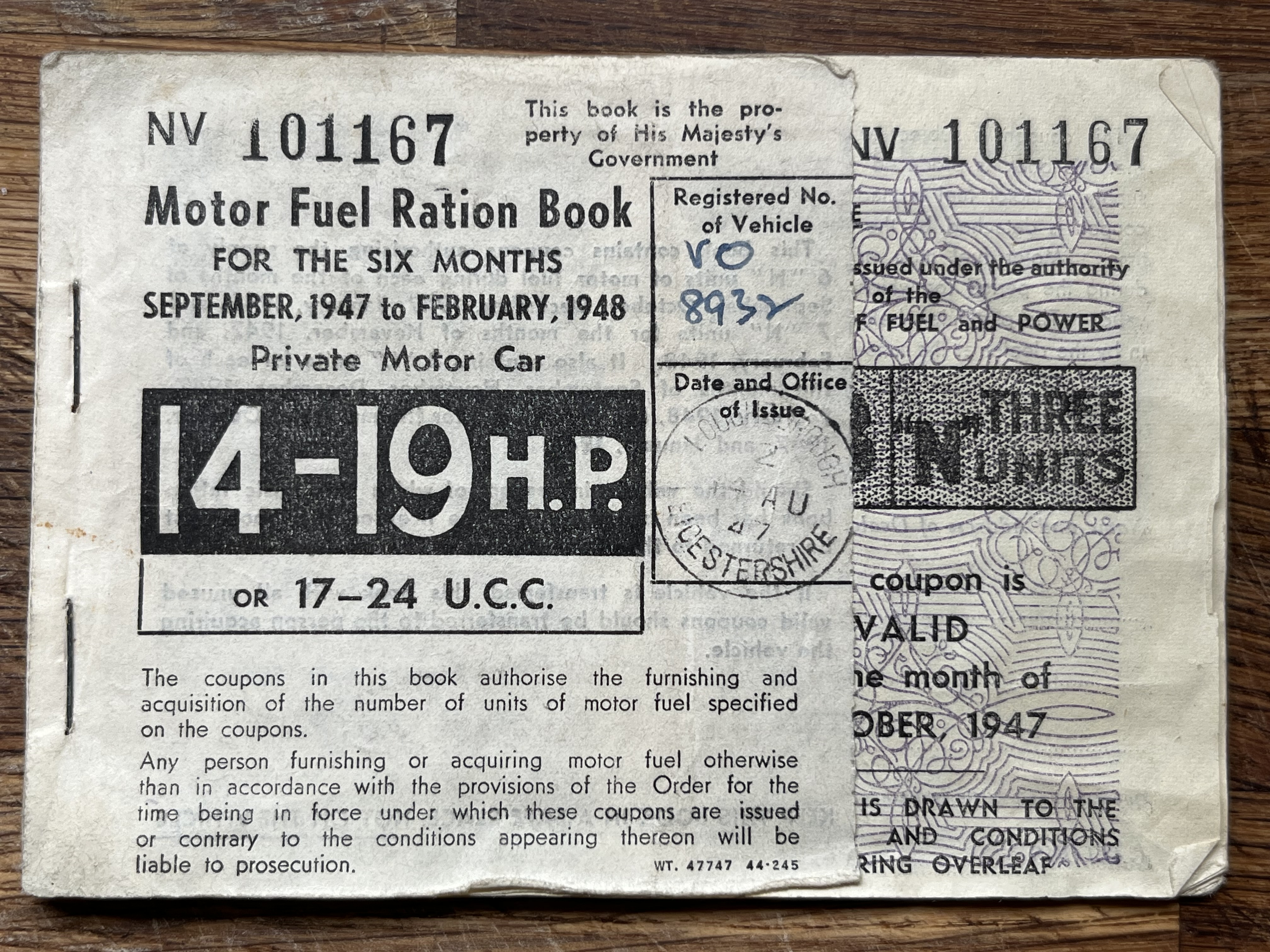
There are quite a few family photographs in the archive, and some interesting family correspondence, all of which presents a very human picture of Cyril. Here he is (see below), I guess from the 1940s, together with a photograph of his National Registration Identity Card from the Second World War, and a small cache of un-used fuel rationing coupons from the period 1947-1948, issued for his motor car, registration VO8932.
Cyril W. Briggs, 1940s. Photograph, Antique Dealer Research Project, University of Leeds.National Registration Identity Card, C.W. Briggs, 1940s. Photograph, Antique Dealers Research Project, University of Leeds.Motor Fuel Ration Book, 1947-1948, belonging to C.W. Briggs. Photograph, Antique Dealers Research Project, University of Leeds.
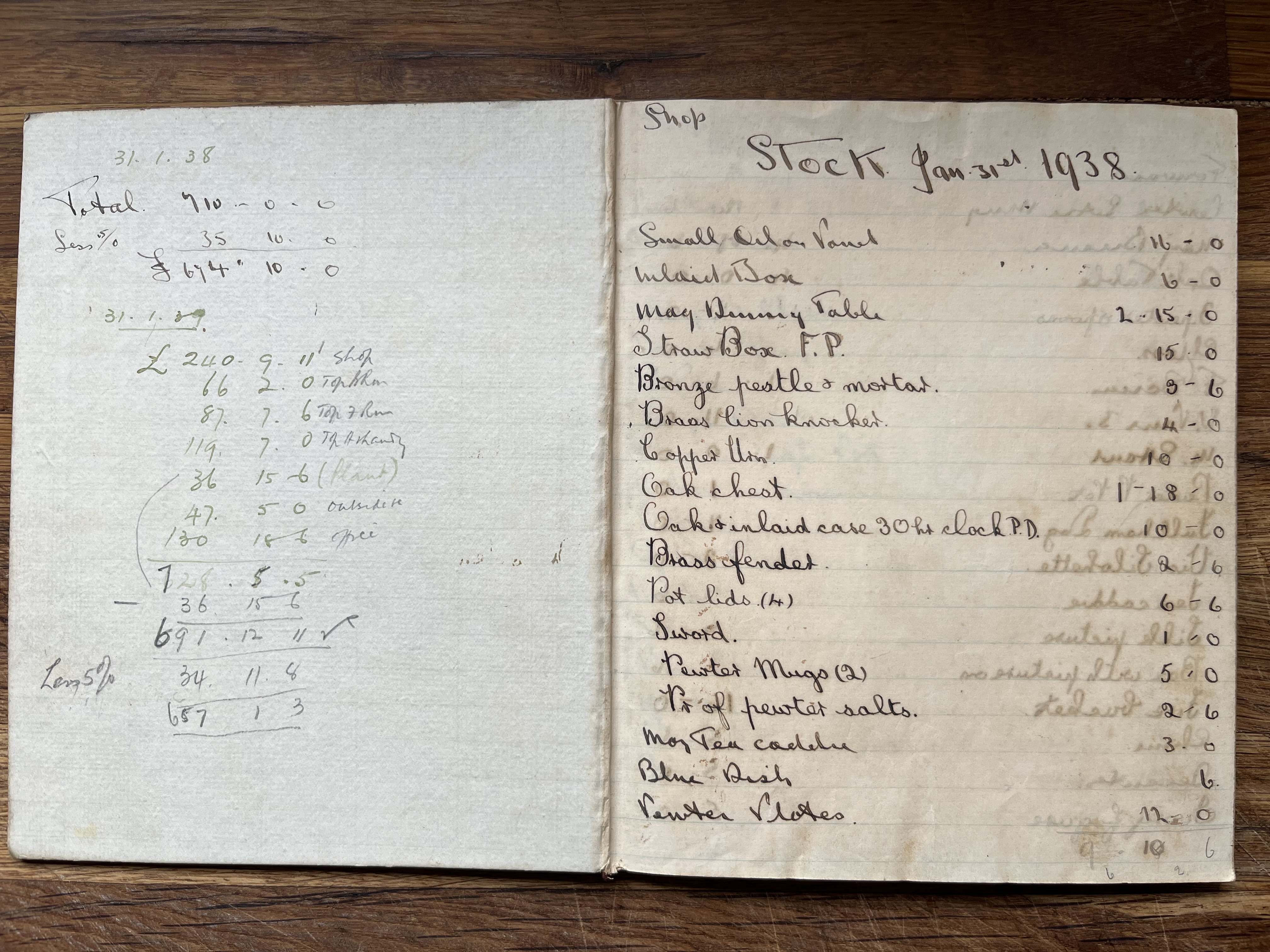
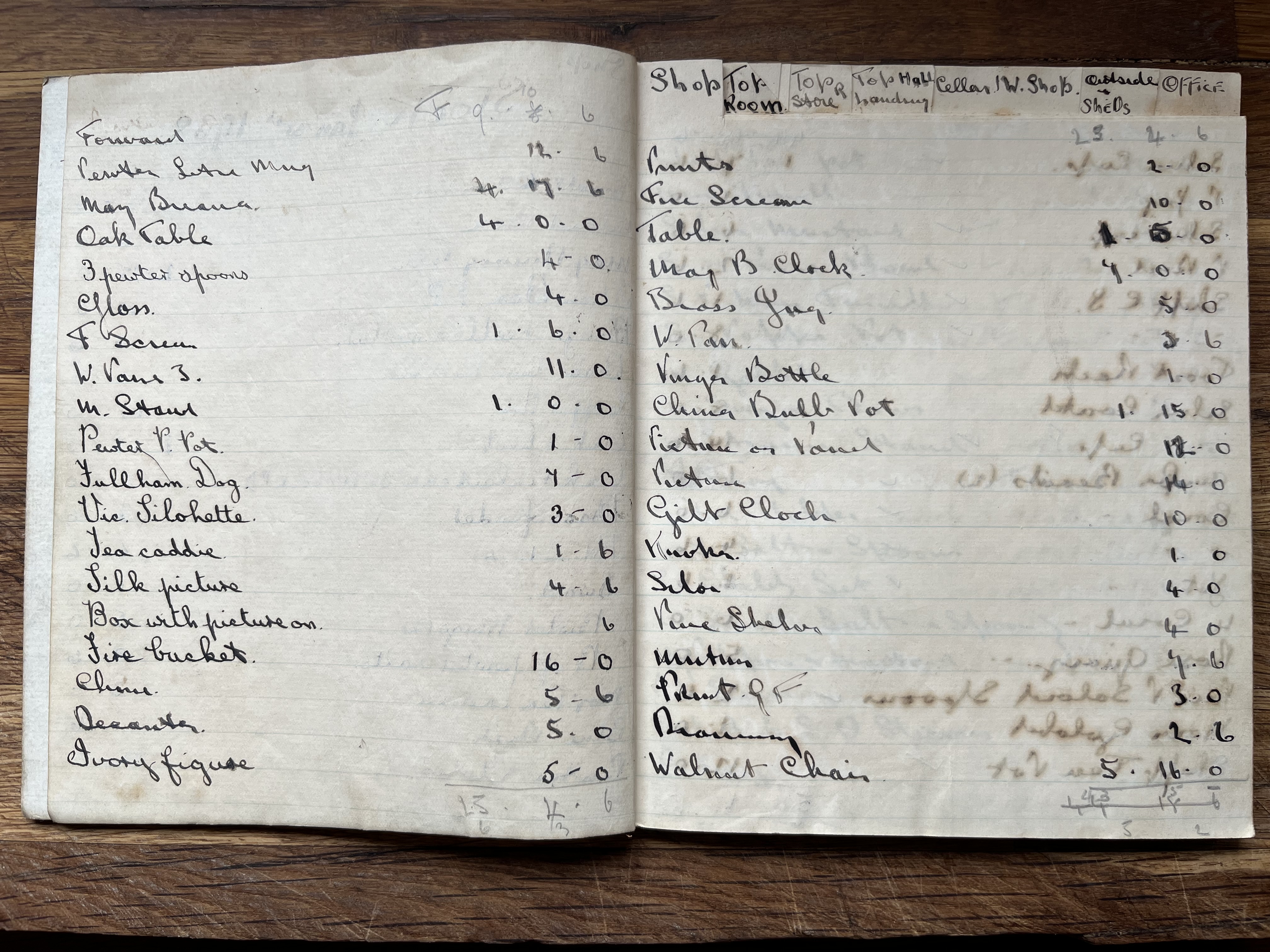
The stock books in the archive date from 1936 to 1940, (see below) and give a sense of the wide range of antiques that Briggs was selling in that period. There are some typically vague descriptions of objects, such as ‘Small Oil on Panel‘; ‘Oak chest‘ and a ‘China Bulb Pot‘, with very little detail in the descriptions. But Briggs seems to have been selling a very typical range of general antiques in the period, with lots of silver, pewter, ceramics and glass, together with the usual types of antique furniture.
C.W. Briggs stock book, 1938. Photograph, Antique Dealers Research project, University of Leeds.C.W. Briggs stock book, 1938. Photograph, Antique Dealers Research project, University of Leeds.
The other antique dealer business related archive material includes a sales book (undated) but from the mid 1930s, a ‘Creditors and Debtors’ book from the 1950s to 1970s, and a ‘Cash Book’ (1973-1975) – all very useful for the study of a mid-range, mid-20th century antique business.
Perhaps the most intriguing material in the archive are a few letters sent to Briggs in 1956 and 1958, relating to a ships’ figurehead. The initial letter (see below), from the well-known American antique dealers ‘Sacks Antiques Inc’ of Massachusetts USA, sent to Briggs on 12th September 1956, mentions a ‘figurehead’ that Briggs appeared to be negotiating to buy.
C.W. Briggs archive – Sacks Antiques letter, 12th September 1956. Photograph, Antique Dealers Research project, University of Leeds.
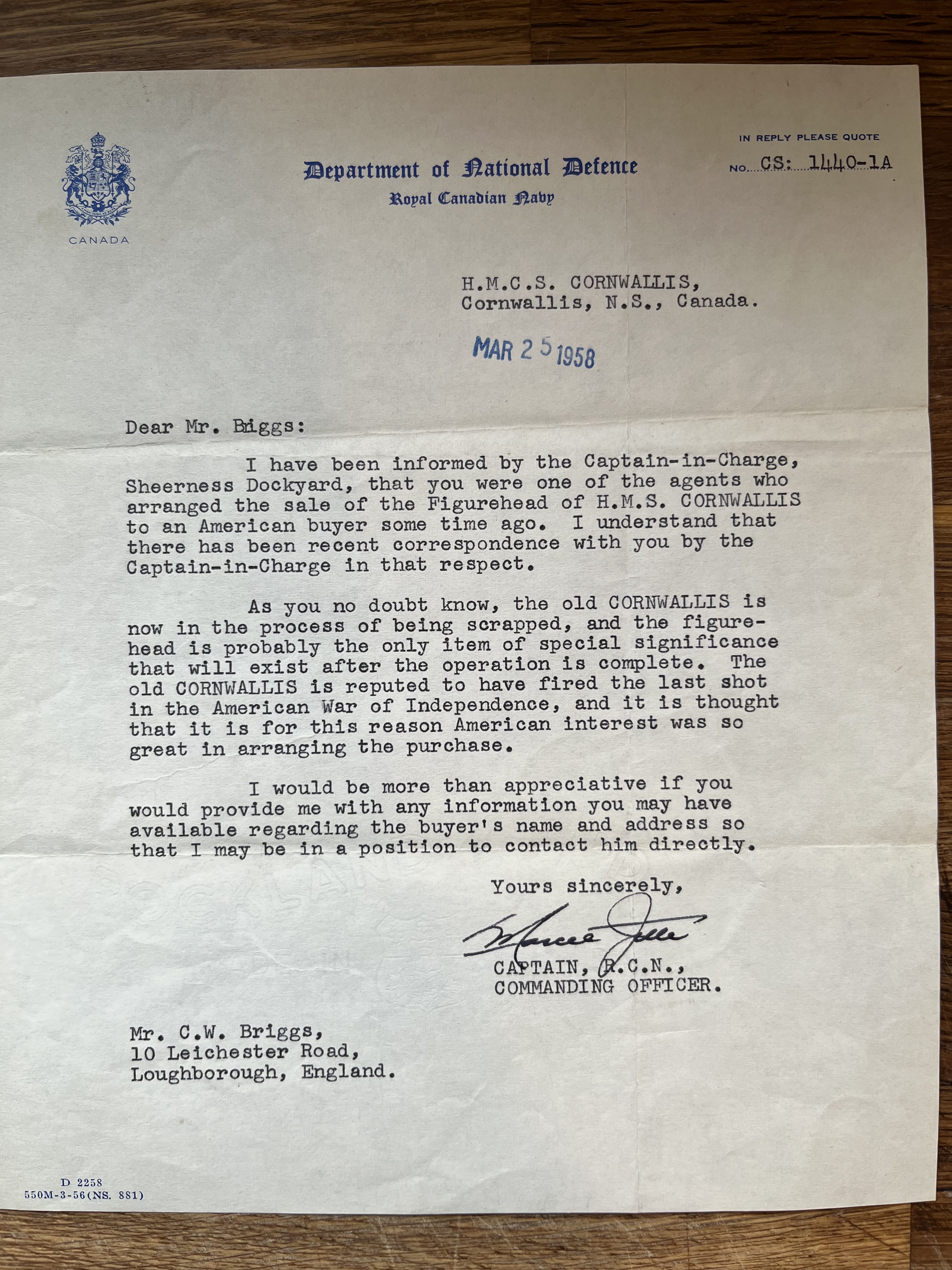
I guess this is all fairly standard in terms of antique dealer practices, and I’m aware of several antique dealers buying and selling antique ships figures heads in the period. According to a few other letters in the archive Briggs did indeed acquire the figurehead and sold it to an American dealer (probably Sacks?). It seems however, that the figurehead was quite an important thing; it was from HMS Cornwallis, which, according to the letter from the ‘Commanding Officer’ at H.M.C.S. Cornwallis, Department of National Defence, Canada, ‘is reputed to have fired the last shot in the American War of Independence’ (see below).
C.W. Briggs archive, H.M.C.S. Cornwallis letter, March 25th 1958. Photograph, Antique Dealers Research project, University of Leeds.
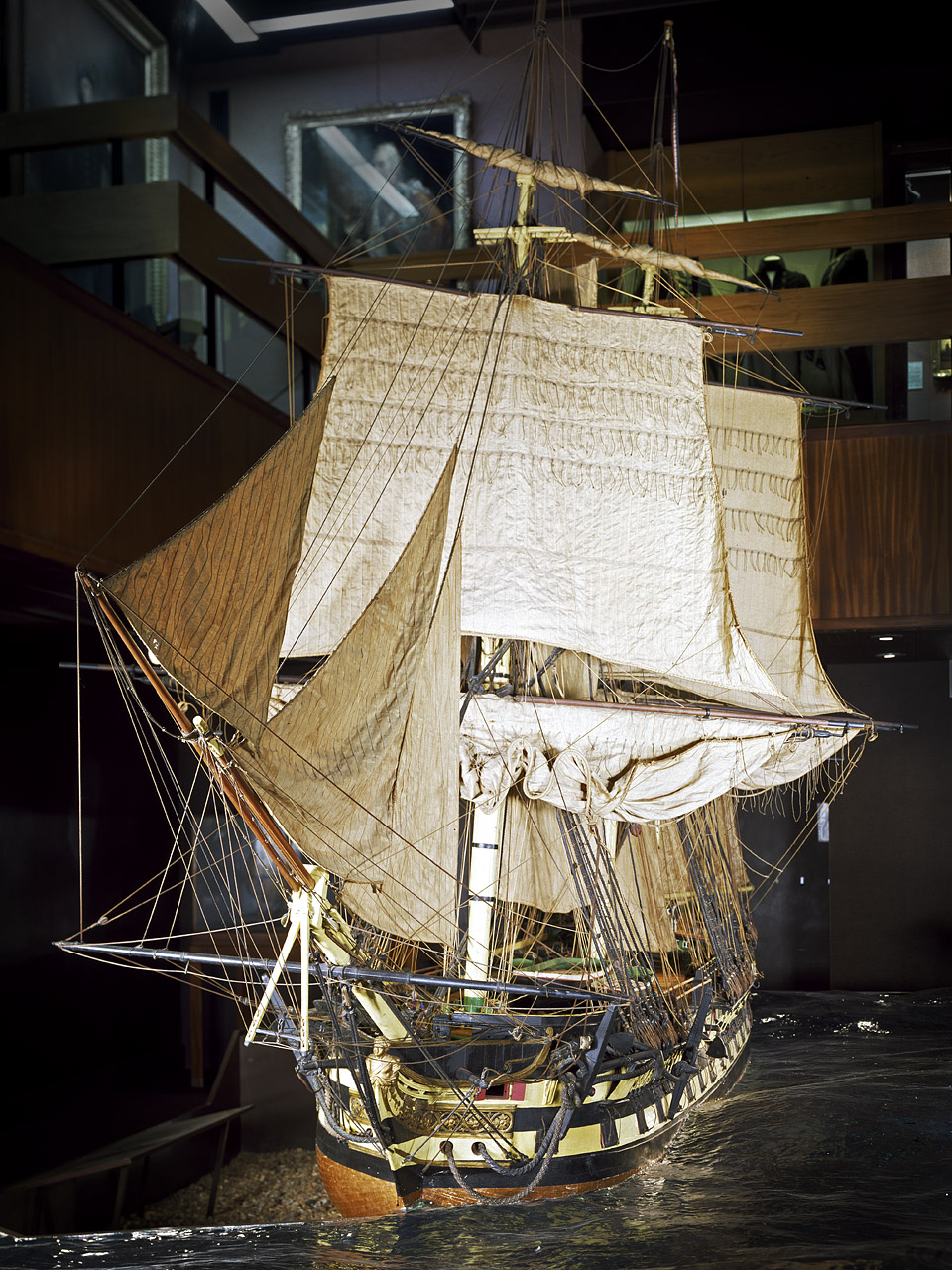
HMS Cornwallis was launched in 1813, a 74 Gun ship, she was involved in the American War of Independence, and later in the Crimean War (1853-56). She was converted into a jetty in 1865 and broken up in 1957. I’ve not been able to trace what happened to the figurehead from HMS Cornwallis, but the National Maritime Museum, Greenwich has a ship model of the HMS Cornwallis, built at the same time that the full-size ship was commissioned in 1813. Here’s a photograph (see below) of the ship model – you can just about make out what the figurehead looked like, so if anyone knows the whereabouts of the figurehead, I’d be very interested to hear.
Model of ‘Cornwallis’ (1813). Photograph, National Maritime Museum, Greenwich, Royal United Services Institution Collection.
The C.W. Briggs archive material offers a fascinating view of the business of a mid-20th century antique dealer. It is more than the usual antique dealer archive material that we have at the University of Leeds (which are mainly stock books and business letter archives) in that it also gives us a very human insight into the life of Cyril William Briggs, antique dealer. The archive will of course be making it’s way to the Brotherton Library Special Collections at the University of Leeds in due course. And of course, I’ll post a little more on the intriguing 1928 ‘Old Masters’ exhibition and Briggs involvement in that exhibition in another blog post – do keep your eye on the Blog!
A very recent acquisition to the growing archive of antique dealer ephemera, gathered as part of the wider antique dealer research project, is a fascinating cache of invoices from the dealer William Boore, dating from the late 1880s to mid 1890s.
Invoice, W. Boore to J.E. Taylor, 1888. Private collection.
They relate to sales of antiques and jewellery by the dealer William Boore to John Edward Taylor (1830-1905), the prominent newspaper proprietor and owner of the Manchester Guardian, which had been founded by his father John Edward Taylor (1791-1844). John Edward Taylor the younger was a major art collector; he donated many watercolour paintings to The Whitworth Art Gallery in Manchester and to the Victoria & Albert Museum in London in the 1890s. His extensive collection of paintings, sculptures a very wide range of antiques was sold at auction by Christie’s in 1912, following the death of his widow, Martha Elizabeth Taylor (1828-1912). Here (below) is a cover of the auction catalogue of Taylor’s collection.
Christie’s auction catalogue of the John Edward Taylor collection; July 1912. Private collection.
But of course, whilst this research blog is interested in collectors such as Taylor, it’s much more interested in the antique dealers that helped to assemble such collections. In fact, as well as the contents of the invoices of course and what they tell us about Taylor’s buying activities, what prompted me to acquire the cache of letters was the printed invoice headings themselves – ‘W. Boore, Late Forrest’ as they state – which connects William Boore with one of the most famous antique dealers of the 19th century, William Forrest (1798-1854).
Indeed, the writer George Retford, publisher of the famous Art Sales: a history of sales of pictures and other works of art (2 vols. 1888), described William Forrest as ‘the best informed dealer of his day’. He began trading in Edinburgh in the 1820s, but by the late 1830s he was in London at 54 Strand trading as ‘jeweller and dealer in silver plate and curiosities’. He died in Paris on 14th October 1854. Forrest sold antiques and curiosities to all the major collectors of the first half of the 19th century, including Ralph Bernal (1783-1854) and A.W. Franks (1826-1897); he was also a regular buyer at key auction sales such as those at Strawberry Hill, the collection assembled by Horace Walpole (1717-1797) and sold by the auctioneer George Robins (1777-1847) in 1842, and at the auction of the contents of Stowe in 1848.
It seems that William Boore not only took over Forrest’s shop in Strand, but also seems to have continued the business? He certainly seems to have deliberately drawn from the high profile and reputation that Forrest had amongst collectors of antiques by highlighting Forrest’s name in his invoices. What is also interesting (to me at least!) is how Boore highlights in his invoice headings of a range of antiques and curiosities that hark back to the practices of early 19th century dealers such as Forrest. The printed invoice heading, dating from late 1880s, lists a range of objects that would have been very familiar to Forrest in the 1840s – ‘Paintings, Curiosities, Sevres and Dresden [porcelains], Limoges Enamel, Statuary, Bijoutrie [jewellery, trinkets], Clocks & Watches, Precious Stones, Buhl Furniture [Boulle], Bronzes, Ancient Carvings, Arms & Armour, Gems and Cameos, Antique Plate [silver], Ivories, Majolica [ceramics]…all under the main heading of ‘Dealer in Works of Art’ – (see below).
Invoice, W. Boore to J.E. Taylor, 1888. Private collection.Invoice, W. Boore to J.E. Taylor, 1888. Private collection.
Boore continued the tradition of Forrest, selling antiques to major collectors of course; as well as selling to John Edward Taylor, William Boore also counted George Salting (1835-1909), who left his collections of paintings to the National Gallery, his prints and drawing to the British Museum, and his antiques to the Victoria & Albert Museum, as a customer.
And if you are interested in finding out more about dealers such as William Forrest, you can always consult my Biographical Dictionary of 19th century antique & curiosity dealers (2009 & 2011) – it’s FREE and online at the White Rose Research Online
And for those provenance researchers out there – the invoices from William Boore don’t seem to point to any of the objects that were sold at Christie’s in 1912? But I’ll keep looking!
Exciting news for the forthcoming start of 2024 – I’ve curated a new exhibition (with Rachel Eckersley, rare book specialist at the Brotherton Library Special Collections and Rhiannon Lawrence-Francis, Special Collections Curator), which opens on 9th January 2024 at the Treasures of the Brotherton Gallery at the University of Leeds.
The exhibition, ‘Part of the Furniture: The Library of John Bedford‘, which runs until 2nd December 2024 (so plenty of time to see it) is focused on the library of furniture history, assembled by former antique dealer, John Bedford (1941-2019). John owned William Bedford Antiques in North London, and which became a Public Limited Company (PLC) in the 1980s. John spent 45 years creating a remarkable library of books and manuscripts, dating from the 17th century to the twentieth century, and the exhibition celebrates John’s extraordinary gift to the University of Leeds.
Thomas Chippendale, The Cabinet-maker and Gentleman’s Director (1754)
The exhibition explores the history of furniture as a subject, highlighting the role that books and publications have played in the evolving discourse, and directing attention to the influential role that antique dealers and collectors have played in the formation of furniture history. It is full of rare and wonderful books and manuscripts, from a early 18th century Apprenticeship Indenture, and a unique copy of Jacques Androuet Du Cerceau’s Furniture Designs (c.1545-1565), to key texts such as Chippendale’s Director (1754) and Sheraton and Hepplewhite pattern books.
One of the most interesting items (as far as the antique dealer’s blog is concerned at least), is a unique sketch book of designs for drapery and furniture produced by Daniel Thorn (c.1788-1853) in the early 19th century. Thorn began trading as ‘Upholsterer’ in the 1810s, but by the 1830s he was trading as a ‘curiosity dealer’ and ‘dealer in ancient furniture’. Such a transition, as readers of the antique dealers blog will know, was quite common in the early 19th century.
Sketch book of Daniel Thorn, c.1814-1820s. Photograph Brotherton Library Special Collections University of Leeds.
Thorn’s sketch book contains dozens of designs for upholstery schemes, as well as sketches for furniture designs, all in the fashionable taste of the 1810s and 1820s. But his sketch book also contains some fascinating drawings of antiques and curios, demonstrating his evolving interests as a dealer in ancient furniture and curiosities. This drawing (below) is typical of the detailed sketches in Thorn’s album – a loose page inserted into the bound volume – it shows 16th and 17th century ‘Bellarmine’ jugs, a ‘Curious Bason [sic] plate (old Earthen Ware painted Yellow & B [brown/black?] ornam[ent]’, together with 17th century glass vessels, a knife ‘very rude’ and a ‘Yellow Earth[enware] pot’
Sketch book of Daniel Thorn, c.1814-1820s. Photograph Brotherton Library Special Collections University of Leeds.
The exhibition also includes a fabulously vibrant trade catalogue produced by Henry Lawford in 1855 – The Cabinet of Practical, Useful and Decorative Furniture Designs. It folds out, rather like an old Ordnance Survey Map, and contains brightly coloured lithographed designs, mounted on a linen background, for deep-buttoned sofas in typical Victorian styles of the period. It reminds us that the Victorian interior was a riot of colour, rather than being dour, dark and drab!
Henry Lawford, The Cabinet of Practical, Useful and Decorative Furniture Designs (1855). Photograph Brotherton Library Special Collections University of Leeds.
The exhibition is FREE to visit – the Treasures Gallery is open Tuesday to Friday 10am-5pm – and runs from 9th January until 21st December 2024. Do also keep your eyes open for events associated with the exhibition ‘Part of the Furniture: the John Bedford Library’ throughout 2024. I hope you get a chance to come and see the exhibition – do say hello!
Our thread on ‘Antique Shops in Visual Culture’ seems to be very popular with readers of the Antique Dealers Research blog, so here’s the third instalment (the last for a little while at least). If you have missed Parts I, & II of this thread, you can catch up in Blog posts July 30th 2023 and September 30th 2023.
Our first image in this third instalment of the ‘antique shop’ in visual culture is by the artist John Watkins Chapman (1832-1903) and dates from about 1880.
John Watkins Chapman (1832-1903), ‘The Antique Dealers’, c.1880. Oil on canvas. Private collection. Photograph Antique Dealers Research Project, University of Leeds.
Chapman’s painting, which is quite large, about 2 feet by 3 feet, is typical of his work. In the painting Chapman seems to be rehearsing common visual and literary tropes of the antique and curiosity shop – the shop piled high, cluttered with curious things. Chapman also presents the viewer with a quintessential Victorian sentimental narrative; the woman to the left, dressed in black is evidently a widow and in need of funds. She appears to be trying to sell some small paintings to the antique dealer, who is examining them carefully with his magnifying glass in an act of obvious connoisseurship. I’m not sure what the character reading a book in the centre is supposed to represent; he appears to be dressed, deliberately, in antiquarian style as an 18th century gentleman – perhaps he is a poetic memory of the life of the array of objects surrounding him? The painting was previously sold at auction at Christie’s in London in 1948 but we are pleased to say that it is now part of the collections of the antique dealer research project.
John Watkins Chapman is well-known for his representations of ‘The Old Curiosity Shop’, made famous through Charles Dickens’ story in 1840-41. Chapman painted dozens of examples in the second half of the 19th century. Perhaps Chapman’s most well-known and accomplished painting of this subject is his superbly detailed ‘The Old Curiosity Shop’ (also dating from c.1880), which was sold at Christie’s in 1991 – I think it remains in a private collection in Italy? But one of our readers may know otherwise?
This painting also formed the visual basis for our own contribution to the theme of the antique shop in visual culture, with our recreation of ‘The Old Curiosity Shop’ at the exhibition ‘SOLD! The Great British Antiques Story’ at The Bowes Museum (January to May 2019) – see various blog posts on the Antique Dealers Research blog from December 2018. You can still download a PDF copy of the SOLD! exhibition catalogue (for free!) here https://antiquedealers.leeds.ac.uk/research/sold-the-great-british-antiques-story/
SOLD! The Great British Antiques Story, exhibition install of ‘The Old Curiosity Shop’. The Bowes Museum, Jan-May 2019. Photograph, Antique Dealers Research Project, University of Leeds.
However, whilst both of Chapman’s paintings have a common theme, that of the antique and curiosity shop, Chapman’s representation of ‘The Old Curiosity Shop’ is much more anchored in the narrative of Dickens’ story. ‘Little Nell’ sits front and centre, and one can also see her Grandfather, the curiosity dealer, tucked away at the back of the shop, worrying over his mounting debts, and which will eventually lead to their escape from the shop and ultimately to the death of Little Nell.
What is also interesting about Chapman’s paintings is the representation of curious and antique objects. All of them will, I guess, be representations of real antique objects; some are iconic – the suits of armour in both paintings are emblematic objects of both the (generally) earlier ‘curiosity shop’ and the (generally) later ‘antique shop’. Although it’s clear that the suits of armour are not exactly the same example in each painting. However, the 18th century giltwood mirror (in the centre of ‘The Antique Dealers’, facing outwards; and just to the right, side-on, in ‘The Old Curiosity Shop’) is clearly the same ‘antique’ mirror. Perhaps this was an antique object from Chapman’s own collection?
As I say, Chapman’s visual representation of ‘The Old Curiosity Shop’ draws heavily from the literary description of Charles Dickens. In Dickens’ by now iconic description of ‘The Old Curiosity Shop’, he writes, it was:
”one of those receptacles for old and curious things which seem to crouch in every corner of this town, and hide away their musty treasures from the public eye in jealousy and mistrust. There were suits of mail standing like ghosts in armour, here and there, fantastic carvings brought from monkish cloisters; rusty weapons of various kinds; distorted figures in china, and wood, and iron, and ivory; tapestry. and strange furniture that might have been designed in dreams.” (Dickens, The Old Curiosity Shop (1841) p.3)
As I have written elsewhere, ”Dickens’ interior descriptions of the shop are well known and rehearse the trope of the shop as problematic space, one that is retentive with its knowledge and in which the dis-ordered objects in its interior provided the antithesis to the ordered collections assembled by the collector.” (Westgarth, The Emergence of the Antique & Curiosity Dealer 1815-1850: the commodification of historical objects (2020, p.28).
Two further visual representations of the history of the antique trade in Britain offer both a continued visual tradition (one is an image of a cluttered interior of an antique shop) and a contrast (one is not an image of an interior of an antique shop but of an open air second-hand market stall). This pair of watercolour paintings, (also now part of the collections of the antique dealers research project) date from c.1940s; they are about 12 inches by 8 inches. They are obviously by an amateur hand, but are charmingly naïve in the representations.
Anon. ‘An interior of an antique shop’, c.1940s. Watercolour. Photograph Antique Dealer Research Project, University of Leeds.Anon. ‘A view of Portobello Road market’, c.1940s. Watercolour. Photograph Antique Dealers Research Project, University of Leeds.
The painting of the antique shop interior (you can just see the remaining letters forming the words ‘Antique Dealer’ in the window), illustrates the wide range of antique objects that one might expect to see in an antique shop in the period. There’s also a clear sense of British nationalism in the choice of items represented – a portrait of Sir Walter Raleigh; a portrait of Horatio Nelson; the various British paintings displayed along the front of the display table. As well as objects from across the world – an Egyptian mummy, Chinese porcelains.
By way of contrast, the street market scene in the other painting illustrates a typical range of objects from second-hand cultures. Old but still usable pots and pans, bags, shoes, alongside the odd piece of broken pottery. As in the other painting, there’s a strong sense of British nationalism; the Second World War was probably taking place, or was a very recent memory, when these paintings were produced. As if to emphasise this, the small painting/photograph? to the right in the street market scene, depicts Charlie Chaplin in the famous American anti-war film ‘The Great Dictator’, which came out in 1940.
The shop behind the central figure is named ‘J. Bodger’ (certainly a fictional name – a ‘bodger’ is a wood-turner, someone who makes chair legs and turned parts of chairs and furniture). ‘J. Bodger’ is named as a ‘furniture dealer’, but seems to be buying and selling all sorts of second-hand material. The relationships between second-hand dealers and antique dealers has always been very close, but here, by the 1940s, there’s a very clear distinction between the two practices, as articulated in the pair of paintings. Indeed, Portobello Market (located in Portobello Road, as the street sign in the painting illustrates), which had developed as an open air market in the late 19th century, became associated with the second-hand trade by the 1920s, and became famously associated with the antiques trade in the 1940s, when these paintings were created.
The 19th century paintings by John Watkins Chapman and the anonymous pair of 20th century paintings of Portobello Road antique and second-hand markets, offer fascinating insights into the visual culture of the antique trade, and it’s rich potential as a research resource for the history of antique dealing.
This month, October 2023, is a significant moment for the Antique Dealers Research Blog – it’s our ANNIVERSARY!….we are 10 years old this month! Our first post was back on 25th October 2013 – a small, two sentence post briefly announcing the start of the new Blog with a small image of an antique dealer invoice dated October (the symmetry was deliberate) 1907, from ‘Adams’, ‘antique dealer’, who was trading in Edinburgh and New York. (see below) –
Adams Antique Dealer invoice, 1907. Photograph, Antique Dealers Research project, University of Leeds.
Since then, we have posted 231 individual Blog posts, including 2 or 3 guest blog posts from our friends and colleagues, Chris Coles (May 2014) Dr (now Professor!) Clare Taylor (February 2012 – May 2021) Anne Atton (a relative of F.G. & C. Collins Antiques) (April 2023), and from our former Laidlaw Scholar at the University of Leeds, Olivia Powell, (April 2017). Over the past 10 years we’ve composed over 120,000 words on the Blog, on a huge range of subjects related to the history of the antique trade in the 19th, 20th and 21st centuries, in Britain, Europe and the USA. I won’t rehearse all the themes here of course (there are far too many!), but you can search for all sorts of themes, name of dealers and a range of other antique dealer-related topics using the ‘TAGS’ and ‘SEARCH’ functions in the Blog.
The Blog has build up a hundreds of dedicated ‘Followers’ over the years. Our first Blog post in October 2013 has just 20 views, but the last few years we consistently get between 800 and 1,000 views per month. Since October 2013 we’ve had more than 77,000 views and more than 50,000 visitors, from all over the world – at the last count we’ve had visitors from 142 countries, from every Continent – not bad for such an arcane subject as the history of antique dealing!
Thank you to everyone that follows the Antique Dealers Research Blog – and to all our visitors, from where ever you are, Thank You!
We look forward to the next 10 years; do keep your eyes on the Blog, we have some exciting news to announce in the next few months!