The antique dealer research blog has regularly focused on the upper echelons of the British antique trade – dealers such as Frank Partridge & Sons, Phillips of Hitchin, M. Harris & Sons., and etc. This is understandable given the importance of such antique dealers in the history of the antique trade – it’s also an inevitable consequence of the amount of archive material and ephemera that was generated by such firms, and the survival of such evidence. The antique dealer archives held at The Brotherton Library Special Collections are a testament to that – see, for example, the Phillips of Hitchin archives at BLSC
But of course the trade includes a much wider range of participants than those represented by leading London dealers and there has always been an enormous number of smaller scale, local and regional antique dealers that have made up the ecology of the British antiques trade. Ephemera associated with such lower level antique dealing practices are rare (even rarer are the business archives), but some recent additions to the growing archives of ephemera associated with antique dealing gives an insight into these, largely, marginalised histories of the antique trade. Below, for example, is one of 3 cardboard advertising boards recently acquired for the antique dealer research project at the University of Leeds. The adverts were produced by antique dealers operating well below the expensive, museum quality antiques traded by the dealers in New Bond Street in London.
All 3 cardboard advertisements are the same size (20 inches x 30 inches), hand-painted (by a professional sign-writer I would have thought) and date from the early/mid 1970s. They would have been placed in the window of the antique shop, or perhaps in advertising display cases that were quite common in urban and rural areas alike.
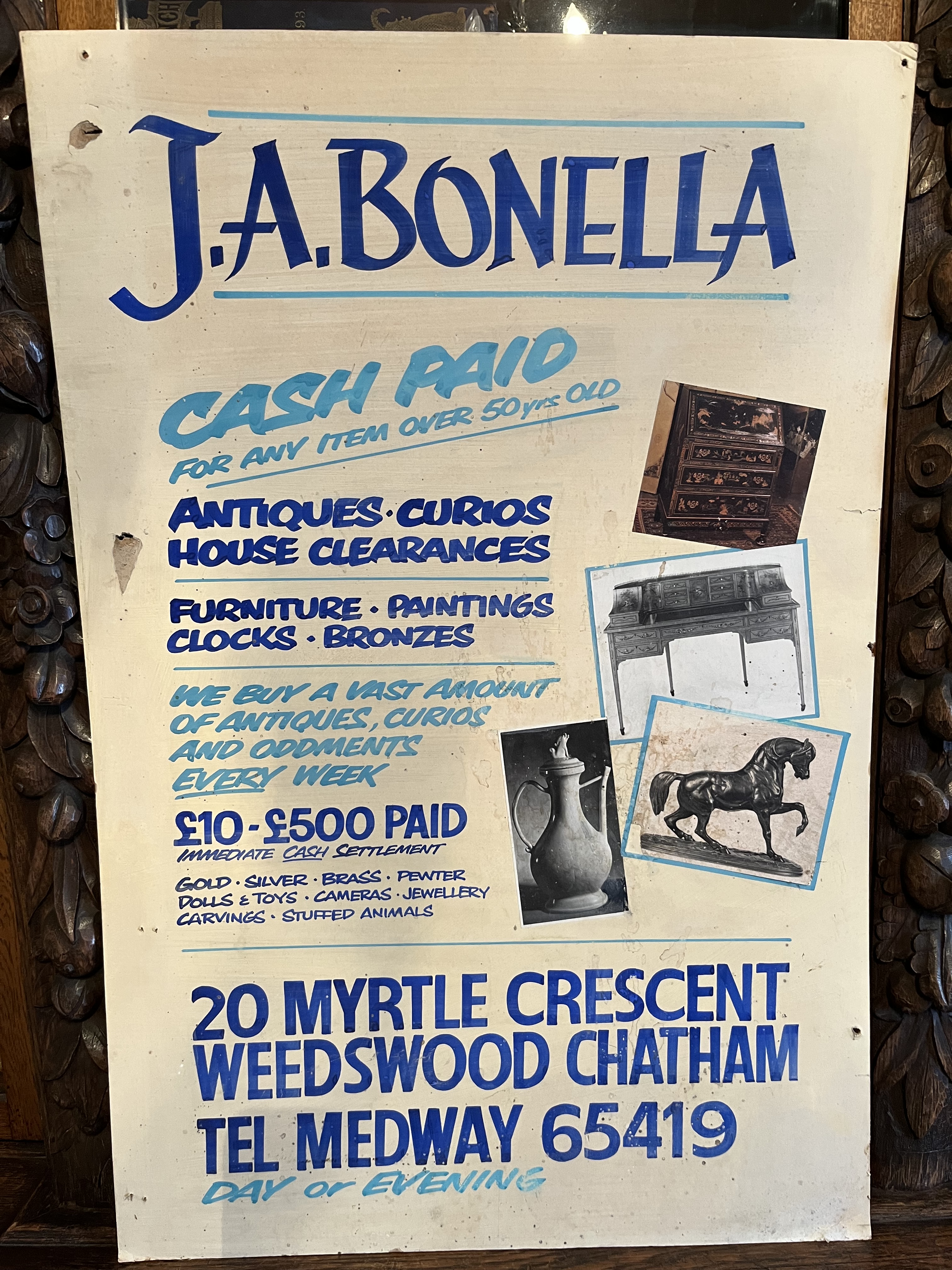
The advertising board (above), produced by J.A. Bonella, tells us a lot about these lower level, but no less culturally significant, antique dealing practices. Jack Alexander Bonella (1938-1987) traded as an antique dealer in the 1970s and 1980s from 20 Myrtle Crescent, Weedswood, Chatham. Myrtle Crescent was not a conventional antique shop, it was a standard domestic house, so Bonella must have had a warehouse or store somewhere. Many antique dealers in the post-WWII era traded from home, (especially country antique dealers), selling to other dealers higher up the ‘food chain’ so it would not have been that unusual. Bonella’s advert also indicates that he will buy ‘any item over 50 years old’ – so not the usual 100 year rule for ‘antiques’. Such practices are aligned much more closely with the second-hand trade, at the margins of the antiques trade proper, and Bonella’s advert usefully reminds us of these structures and practices.
But of course, buying and selling at the margins also offers great opportunities for bargains, particularly in ‘house clearances’, (which Bonella also highlights) where objects can be misunderstood, mis-described or unrecognised. What is also interesting about Bonella’s advertisement are the photographs of antiques pasted onto the advertising board. The photographs appear to have been cut from antique collecting magazines – a colour photograph of an 18th century black lacquer bureau (a very fashionable, and very expensive antique, in the 1970s), a black and white photograph of a late 19th century satinwood and painted ‘Carlton House’ desk; a photograph of a 19th century French bronze horse and an early Chinese porcelain ewer. All objects that antique dealers higher up the ‘food chain’ would buy and sell. The photographs illustrate the kinds of antiques that Bonella hopes he might find, rather than antiques that he would regularly keep in stock.
Another of the cardboard adverts has very similar paint colours and may have been produced by the same hand (the antique shops are both in Kent and only 11 miles apart). The advert relates to the antique dealing business of Colin Noel Bates (1932-1985), called ‘Blackamoor Antiques’ – (see below).
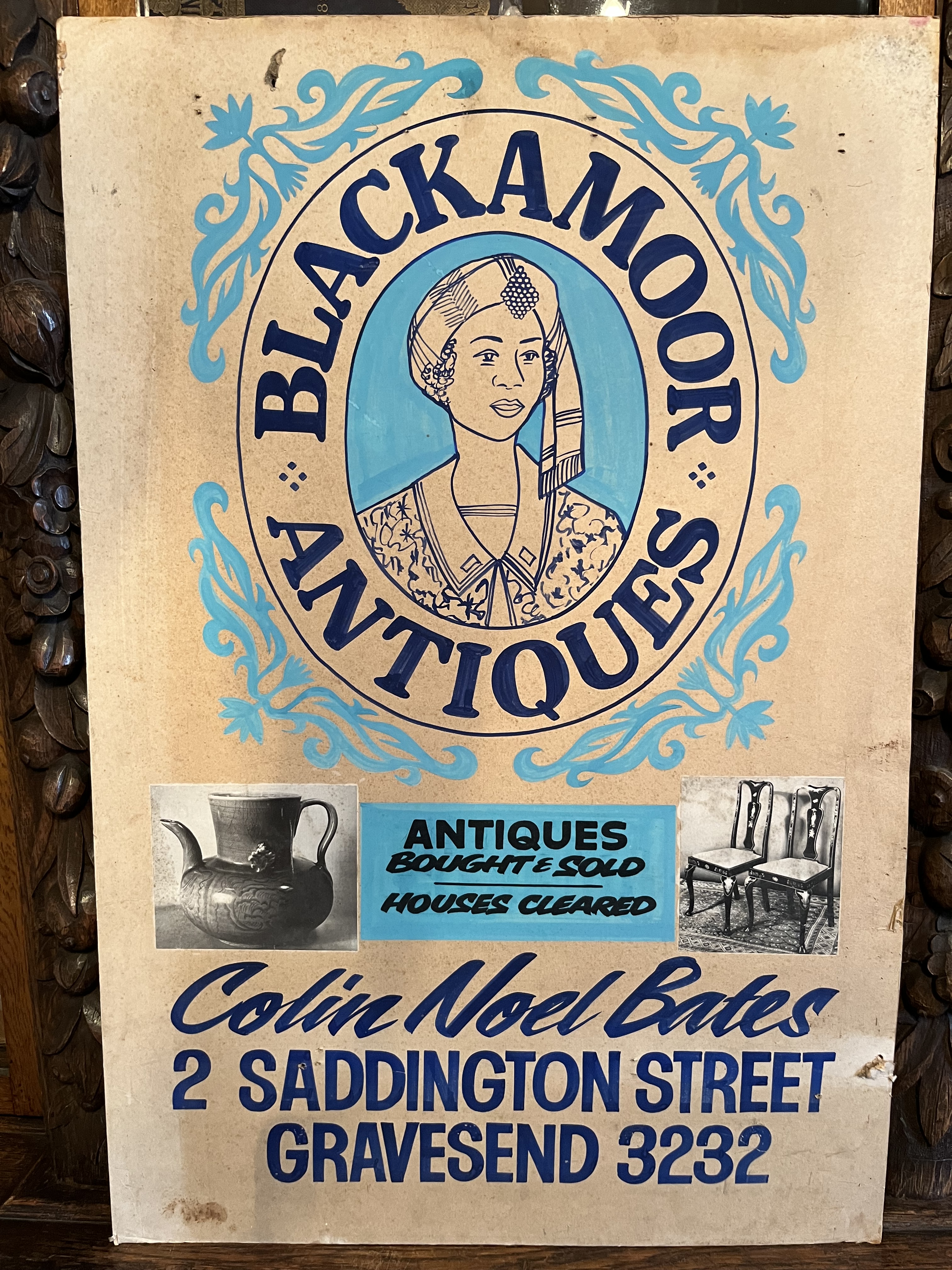
Bates’ advert is a very similar format to Bonella’s; it has photographs cut from contemporary antique collecting magazines and mentions ‘houses cleared’. It also dates from the 1970s. The final cardboard advertisement (see below) is that of Kirk Antiques, who traded in Parkgate, near Rotherham in South Yorkshire.
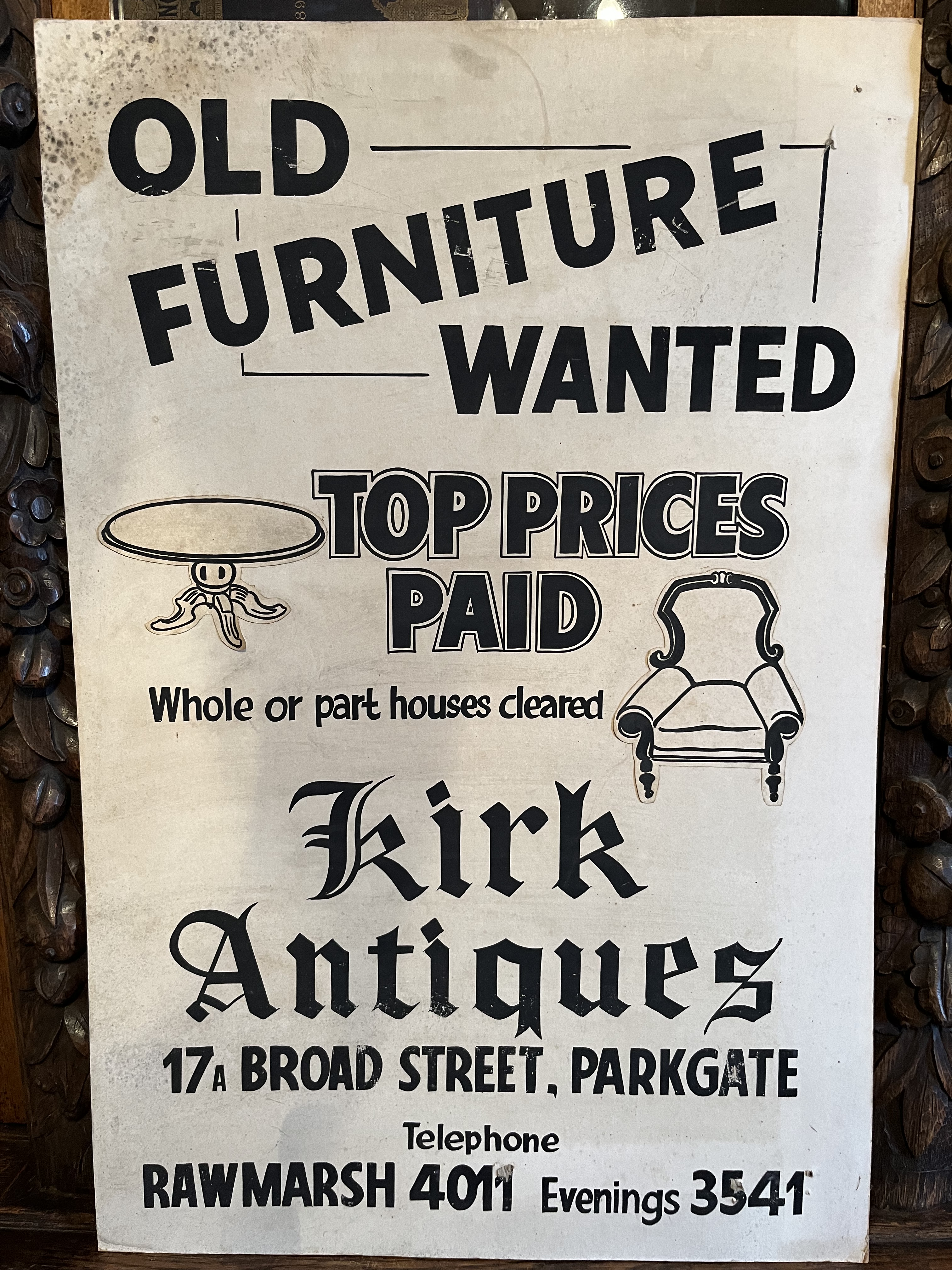
Kirk Antiques’ advert includes the ambiguous term ‘Old Furniture’, which by the 1970s had lost its cache and the middle-class associations it had in antique collecting and furnishing cultures of the 1920s and 1930s. The illustrations in Kirk’s advert are also in a different format – no longer photographs cut from magazines but hand-drawn illustrations of examples of typical Victorian furniture – furniture that, by the 1970s, may have been more likely to be offered to an antique dealer operating at the margins of the trade.
All 3 cardboard adverts hint towards the inter-dealer trading structure of the antique trade in the 20th century, the so-called pyramid structure, with thousands of dealers at the bottom of the pyramid, buying antiques in local house clearances, filtering their way up through the pyramid structure until they reach their level and are eventually sold to collectors and furnishers. This ‘system’ collapsed in the late 1990s as the internet and the world-wide-web fractured the established ecology of the antique trade, but these 3 cardboard adverts remind us how complex and fragile that ecology was.
Mark
 antiquedealersblog