As readers of the antique dealers Blog will know, we’ve been acquiring antique dealer ephemera for many years now – dealer catalogues, photographs and archives, as part of the on-going research project into the history of the antique trade in Britain. Much of this material, including the extraordinary collection of antique dealer archives, is housed at the Brotherton Library Special Collections at the University of Leeds.
More recently, we’ve been seeking out paintings depicting antique shops – we recently acquired, for example, a naïve painting (oil on canvas, c.1880, signed ‘M. Davis’) of the shop of Mr Deadman at an auction in The Netherlands of all places – ‘Ye Old Beckenham Curio Shoppe’ (see below). The shop depicted in the painting was in High Street, Beckenham in Kent (the building, which appears to be 16th century, was demolished by the 1930s). Frederick William Deadman (either the same dealer or perhaps a relative) was still trading as an antique dealer in the late 1930s – from a shop in Station Road, Freshwater on the Isle of Wight.

This painting has been added to our growing collection of paintings of antique shops, all of which demonstrate how important the idea of the antique shop has been in British cultural life. An earlier acquisition, of an equally naïve painting, illustrates this point. The painting, a watercolour, (10.5 in x 15 in, by H. Middleton-Holding, c.1910) of an antique shop in York Street, London, was acquired at auction in Shaftesbury, Dorset in 2019. It’s also a rather naïve work, but is charmingly rendered (see below):

The artist has copied an engraving of the same scene, much more competently rendered and published in The Daily Chronicle on Tuesday September 27th in either 1904 or 1911, a copy of which is pasted to the backboard of the painting (see below) – (unfortunately, the actual year of the publication is obscured by some brown paper tape). The newspaper article outlines the history of the buildings in York Street, London and their occupiers, including the political philosopher Jeremy Bentham (1748-1832) and the highwayman Dick Turpin (1705-1739).

The main shop in the scene, No. 32 York Street, was the location of a well-known female antique dealer, Mrs Amelia Jane Hardingham, who owned several antique shops in York Street (nos. 28-32), and began trading as an antique dealer in about 1900, in Waterloo Road, London. According to the article in The Daily Chronicle no.32 York Street was famous as the home of the artist George Morland (1763-1804) – perhaps that is why H. Middleton-Holding painted the scene again?
Amelia Hardingham’s shop was also captured in a photograph in c.1910 (see below).

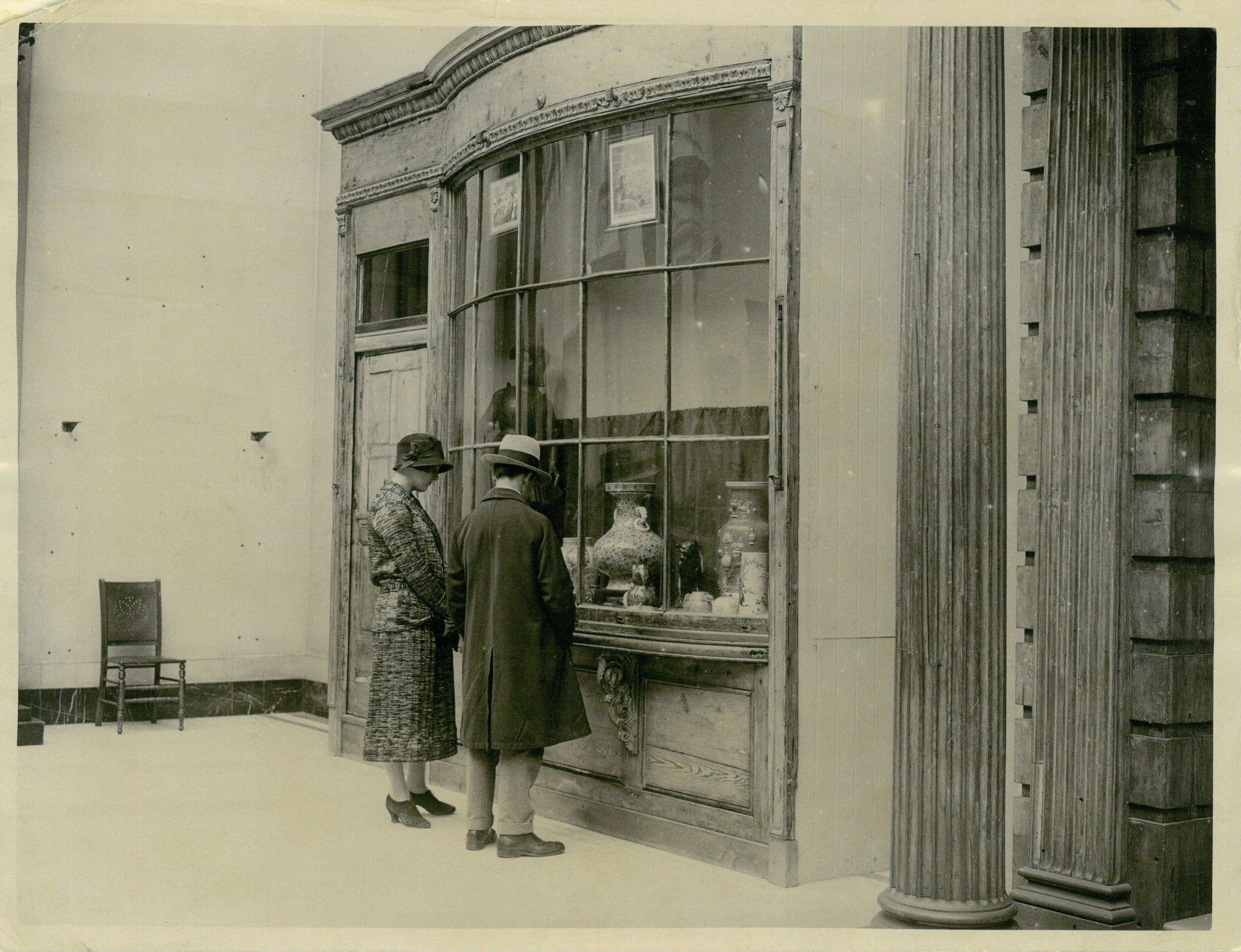
Amelia Hardingham’s antique shop was swept away when the buildings on York Street were demolished in 1923 to create ‘Petty France’, but the shop front of her shop was saved. It was gifted to the Victoria & Albert Museum by the Army Council (which owned the buildings) as a fine example of a late 18th century shop front. In fact, as those who visited the exhibition, ‘SOLD! The Great British Antiques Story‘ at The Bowes Museum in 2019, may remember we used an image of Amelia Hardingham’s shop front as part of the introductory interpretation at the exhibition. Indeed, when the 18th century shop front was put on display at the V&A in 1924, it was set up as a display reproducing Amelia Hardingham’s antique shop (see below).
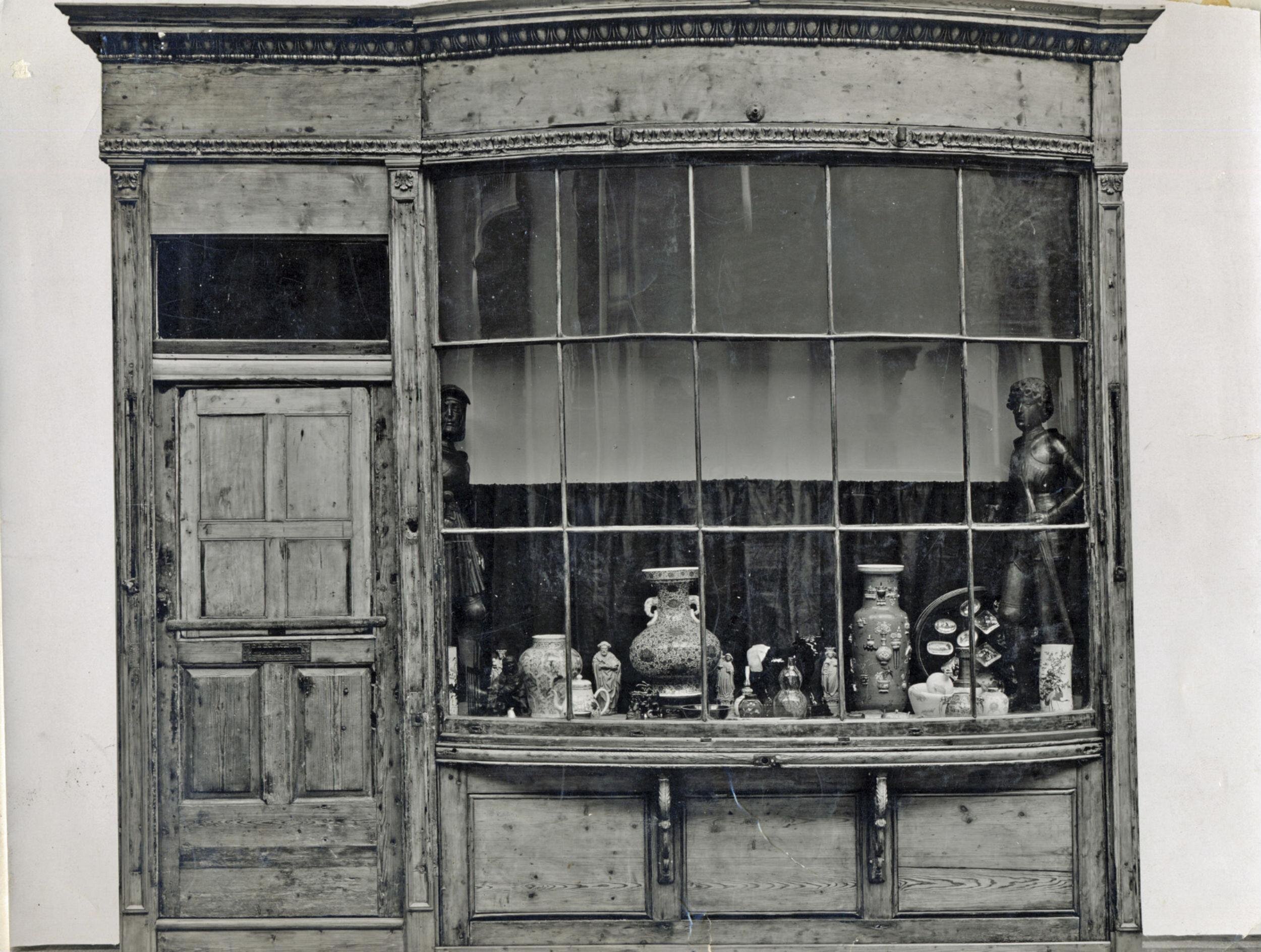
The antique shop display at the V&A Museum caused some consternation in the Press at the time, with some commentators questioning if it was appropriate that an antique shop display should be in a museum!
Readers of the Blog may also be interested to hear that women antique dealers (including Amelia Hardingham) are also the focus of some of our ‘Year of the Dealer‘ digital trails – we have ‘women antique dealer’ themes in our Trails at The Victoria & Albert Museum, The Bowes Museum and at Preston Park Museum as part of this project – so do keep your eyes open for our Year of the Dealer Trails public launch in September. As for paintings of representations of antique shops, we have acquired several other paintings over the last few years and will create another Blog post illustrating those in the next few months, so keep you eye on the Blog!
Mark
 antiquedealersblog